
Life Insurance for Depression
As an Independent Life Insurance Broker, we compare rates across 100+ carriers and prescreen every application before submission.
Life Insurance for Depression

Jason Stolz CLTC, CRPC, DIA, CAA
Life insurance for depression is one of the most misunderstood underwriting categories in the entire insurance market — not because coverage is genuinely difficult to obtain for most applicants, but because a single diagnosis label encompasses an enormous spectrum of real-world situations that carriers evaluate in dramatically different ways. The person who had a single episode of mild depression ten years ago, has been stable without medication for five years, and works full-time in a demanding profession sits at one end of that spectrum. The person with recurrent severe depression, multiple medication adjustments in the past year, recent hospitalization, and ongoing significant functional impairment sits at the other end. Both might describe their situation as “I have depression” on an initial inquiry — but the underwriting outcome for the two is entirely different, and treating them identically is how avoidable declines happen.
The most important thing anyone with a depression history can understand about life insurance is that the diagnosis name is not the underwriting decision — the clinical story behind that name is the underwriting decision. Stability over time, treatment compliance, functional capacity, medication history, and the presence or absence of acute care episodes are the variables that actually determine whether an application produces a competitive offer, a rated offer, a postponement, or a decline. At Diversified Insurance Brokers, Jason Stolz, CLTC, CRPC, DIA, CAA approaches life insurance for depression cases through the lens of how an underwriter will actually read the file — building the cleanest possible clinical narrative before any formal application is submitted and routing the case toward carriers whose guidelines are most consistent with the specific history presented. Our resource on high-risk life insurance covers the full spectrum of complex underwriting cases, and our resource on life insurance with pre-existing conditions covers the framework for evaluating where depression sits within the broader landscape of medically complex underwriting.
See Real-Term Rates Side by Side
Life Insurance Quoter
Life Insurance With Depression — Get the Right Outcome
Managing depression does not mean you are uninsurable. We prescreen your history with carriers that treat well-managed mental health most reasonably — confidentially, and without the wrong first submission.
Life Insurance for Depression — Underwriting Spectrum by Profile
Understanding where a specific depression history falls in the underwriting spectrum is the first step toward identifying which coverage options are realistically available and at what pricing. The table below maps six common profile types against their typical underwriting outcomes, key factors, and likely product pathways.
| Depression Profile | Typical Classification Outcome | Key Underwriting Factors | Likely Product Pathway |
|---|---|---|---|
| Mild depression, single episode 5+ years ago, no current treatment, fully functional | Often Standard or better — many carriers treat resolved mild depression as a manageable underwriting factor with sufficient time elapsed | Time since episode, confirmation of current stability, no ongoing treatment or medication | Traditional term or permanent; no surcharge expected at many pilot-friendly carriers |
| Mild to moderate depression, stable 12–24 months, consistent medication and therapy | Standard or mildly rated at most carriers — stable treatment plan and functional capacity are viewed favorably; active management is a positive underwriting signal | Medication stability (no recent changes), therapy consistency, work and daily functioning, no hospitalization history | Traditional term or permanent; carrier selection determines whether Standard or mild table rating |
| Moderate depression, medication change in past 6–12 months, otherwise stable | Carrier-specific — some apply mild rating; others may request additional information to confirm the medication change reflects optimization rather than escalation | Reason for medication change, current stability since change, functional impact, provider’s assessment of trend direction | Traditional coverage likely; prescreening recommended to identify best carrier for the medication change context |
| Moderate to severe depression, prior hospitalization 3+ years ago, consistently stable since | More carrier-specific — many carriers view 3+ years of post-hospitalization stability favorably; carrier guidelines vary significantly on required stability period | Time since hospitalization, follow-up care consistency, any recurrence or escalation, current functional status | Traditional coverage possible; likely rated; prescreening critical to identify which carriers accept the post-hospitalization profile |
| Active instability — recent hospitalization, escalating medication, missed work | Postponement likely — most carriers require a defined stability period following acute instability before traditional coverage is pursued; some simplified or guaranteed issue may remain available | Recency and severity of acute episode, current care plan, timeline for stability, any safety-related history | Simplified issue or guaranteed issue during instability period; re-evaluate traditional coverage after documented stability is established |
| Depression + comorbid anxiety or PTSD, stable treatment for both | Evaluated as a combined profile — many carriers treat co-occurring conditions as one underwriting evaluation when both are stable; overall functional impact is the central consideration | Stability of both conditions, whether treatment plan addresses both, functional capacity, any compound acute events | Traditional coverage often possible when both are stable; carrier selection determines outcome more than the combination itself |
The table’s most important insight is that the underwriting spectrum for life insurance with depression is genuinely wide — and where a specific applicant lands on that spectrum depends on the clinical story, not the diagnosis label. Two applicants with “depression” on their file can receive completely different outcomes based on the factors the table identifies. Our resource on life insurance table ratings explained covers how rated offers work and what each rating level means for the actual premium — important context for evaluating whether a rated offer is the best available option or whether a different carrier would produce a better result for the same history.
How Depression Affects Life Insurance Underwriting
Life insurance companies do not decline depression as a blanket rule. They underwrite based on risk indicators — the underwriter’s job is to evaluate whether an applicant’s history suggests a higher probability of early claim compared to an average applicant of the same age. Depression underwriting is less about the diagnosis name and more about what the complete clinical story looks like over time. That is why two applicants with identical diagnostic labels can receive completely different underwriting outcomes, and why the most important work in depression life insurance placement happens before any formal application is submitted.
Most carriers evaluate depression through the lens of stability-driven underwriting — a framework where the goal is to see a consistent pattern of health management and functional capacity rather than a specific treatment modality or medication class. An applicant who has been on the same antidepressant for three years, sees their prescribing physician every six months, maintains consistent employment, and has no history of acute psychiatric intervention represents a very different risk profile than an applicant with the same diagnosis who has had three different medications in the past year, missed multiple provider appointments, and had one emergency department visit for a psychiatric concern. The first profile has a clear, predictable pattern that many carriers are comfortable pricing. The second raises questions about whether the condition is controlled and what the ongoing risk trajectory looks like.
Where many depression applications go sideways is incomplete documentation that forces underwriters to fill gaps with conservative assumptions, or the wrong carrier receiving a profile that another carrier would have evaluated more favorably. Our resource on why is it so hard to get life insurance covers the systemic reasons why complex cases often produce suboptimal outcomes without professional case management, and our resource on what will disqualify me from life insurance covers the spectrum from absolute underwriting bars to carrier-specific limitations — helping applicants with depression understand which aspects of their history might be genuinely limiting versus which aspects are simply being misrepresented to the wrong carrier.
The Seven Underwriting Variables That Determine Depression Outcomes
Underwriters reviewing a life insurance application with depression in the file typically focus on a consistent set of variables. The better an applicant’s history aligns with favorable signals across these variables, the more likely a competitive outcome becomes — and the more important it is to present those favorable signals clearly rather than leaving the underwriter to search for them in an incomplete file.
Severity and symptom control is the foundation of the evaluation. Underwriters want to understand whether the depression is mild, moderate, or severe — and how it affects the applicant’s daily functioning. Applicants who are working consistently, maintaining normal routines, and experiencing no significant daily functional impairment from their depression present as lower risk than applicants whose symptoms regularly disrupt work, relationships, or daily activities. The functional impact of the condition matters as much as the diagnostic severity level.
Stability over time is the single most important variable in depression underwriting. Stability means a predictable pattern over the past 12–24 months: no major acute episodes, no repeated urgent interventions, no escalating care intensity, and no pattern suggesting the condition is worsening rather than maintaining. Even applicants who continue on ongoing medication can present strong stability stories when the treatment plan is consistent and the clinical trend is favorable. Carriers become progressively more comfortable as the stability track record extends — which is why a 12-month stability window often produces meaningfully better outcomes than a 6-month window, and a 24-month window often produces better outcomes than 12 months.
Treatment compliance is evaluated because it signals whether the applicant is actively managing the condition. Consistent medication use as prescribed, routine follow-up appointments with the prescribing provider, and ongoing therapy participation when applicable are all viewed as evidence of active management — which most carriers treat more favorably than untreated or inconsistently treated depression. The carrier’s concern is not that medication is being used but whether the overall treatment approach is managed and stable. Our resource on what is a life insurance exam covers how the medical underwriting process captures prescription history and treatment compliance from the medical record review and database inquiries that accompany most fully underwritten applications.
Medication history and changes are scrutinized because frequent medication switches or escalating dosages can signal ongoing symptom management challenges. Many applicants are surprised to learn that being on the same antidepressant for several years with no major changes can be viewed more favorably than having no medication but inconsistent symptoms — because the stable medication history demonstrates consistent management even if the treatment continues. Conversely, an applicant who has changed medications three times in the past year or whose dose has been progressively increased raises questions about whether the current plan is achieving stable control.
Hospitalizations, emergency visits, or significant time off work are reviewed carefully, particularly when they are recent. Any inpatient psychiatric treatment or emergency department visit for a psychiatric concern receives significant underwriting attention. This does not automatically produce a decline, but it does affect which carriers are most likely to evaluate the file favorably and whether the application should be prescreened before formal submission. The timing of such events relative to the application date is one of the most important variables — events that occurred five years ago with documented stability since are evaluated very differently from events that occurred in the past 12–18 months.
Suicide attempts or significant self-harm history are handled with particular care because of the direct relationship to mortality risk. The timeline of any such events is critical — most carriers require substantial time since the last event plus documented stability before traditional coverage becomes realistic. Our resource on life insurance with a prior decline covers strategies for navigating coverage when prior applications have been declined, including cases where the decline was related to mental health history, and our resource on how to prescreen a life insurance application covers the informal carrier evaluation that protects an applicant’s record while identifying which carrier in the current market is most likely to provide favorable evaluation of a complex file.
Comorbid conditions — particularly anxiety, PTSD, insomnia, and substance history — influence depression underwriting because they appear in the medical record alongside the depression and affect how carriers evaluate the overall treatment picture. Depression with stable, well-managed anxiety often produces similar outcomes to depression alone when the combined stability is clear. Depression with additional complicating factors that suggest the mental health picture is more complex or harder to stabilize requires more careful carrier selection. Our resources on life insurance for substance abuse and life insurance for alcohol use cover the specific underwriting frameworks for these comorbid conditions when they appear alongside depression.
What Most People Get Wrong About Depression and Life Insurance
The most persistent misconception about life insurance with depression is that medication must be stopped before an application will produce a favorable result. This belief has caused countless applicants to either avoid applying while appropriately medicated or to discontinue medication specifically for insurance purposes — neither of which serves the applicant’s interest and both of which may actually worsen their underwriting position. Carriers evaluating depression are not looking for absence of treatment; they are looking for evidence of controlled, stable management. A stable medication regimen maintained for years, with consistent provider follow-up, is often a more favorable underwriting signal than untreated depression with inconsistent symptoms.
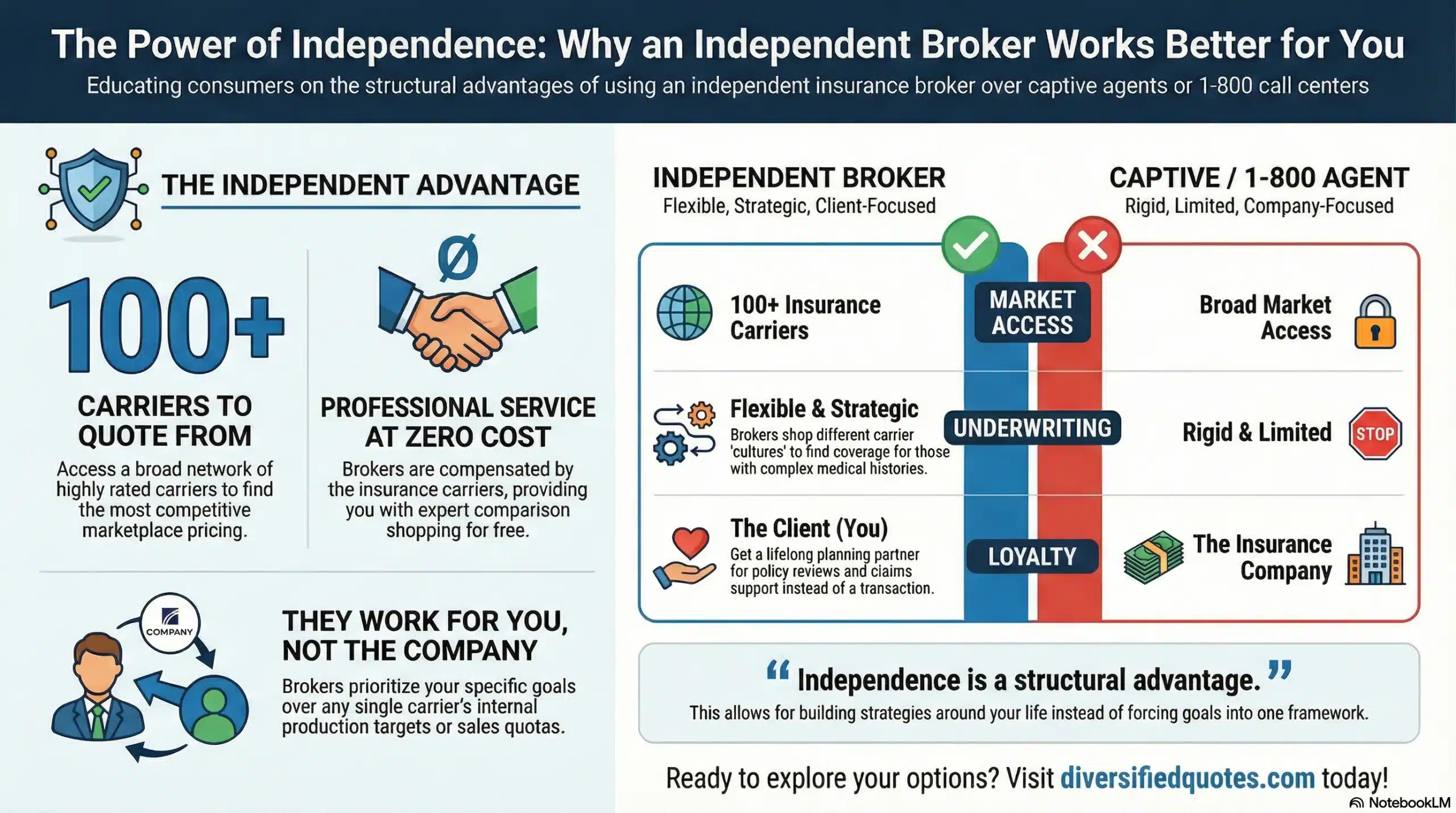
The second major misconception is that one carrier’s response reflects the market’s response — that a decline, a postponement, or a heavily rated offer from one company represents what every company will do with the same history. Depression underwriting guidelines vary significantly across carriers. Some insurers apply conservative mental health underwriting that treats virtually any psychiatric history as a significant risk factor. Others have specifically developed more nuanced guidelines that distinguish between severity levels, recognize the favorable signal of stable long-term treatment, and produce much more competitive outcomes for applicants whose depression profiles are well-managed. Shopping the market with a carrier who has poor mental health guidelines versus an independent broker who can identify which specific carriers in the current market are most favorable for a given depression profile can mean the difference between paying standard rates and paying 50–100% more than necessary. Our resource on best high-risk life insurance companies covers the carrier landscape for complex underwriting cases.
Life Insurance Options for People With Depression
Applicants with depression can access the same primary life insurance product categories as any other applicant — the underwriting evaluates the depression history, but it does not restrict the available product menu for most profiles. The right product choice depends on the coverage objective, the applicant’s budget, and what the underwriting reality for the specific profile produces in terms of offer quality across product types.
Term life insurance provides maximum death benefit for a defined period — typically 10, 20, or 30 years — and is the most common choice for income replacement, mortgage protection, and family security during peak responsibility years. Depression does not automatically prevent term coverage, and many applicants with well-managed depression histories qualify for traditional term policies at competitive rates. Using our term life insurance calculator provides baseline premium comparisons before the depression-specific underwriting variables are applied. For applicants concerned about future insurability, understanding the conversion provision in any term policy matters — the ability to convert term to permanent life insurance without new underwriting at a future date is particularly valuable when there is any uncertainty about long-term health trajectory. Our resource on at what age should you stop buying term life insurance covers the long-term term coverage decision framework.
Simplified issue policies — which skip the full medical exam and evaluate health through questionnaires and database reviews — can be appropriate when the depression history is stable and straightforward, or when the applicant’s profile makes the fully underwritten path uncertain. Simplified underwriting still includes mental health screening questions, and the best simplified issue product is not automatically better than a rated fully underwritten product — the comparison requires evaluating both paths. Guaranteed issue policies provide coverage without any health evaluation but carry lower face amounts and graded benefit structures; they represent a last resort option for situations where traditional underwriting is not currently available but coverage is genuinely needed. Our resource on final expense life insurance covers the full range of smaller permanent coverage options including both simplified and guaranteed issue designs.
Comorbid Conditions — When Depression Isn’t the Only Factor
Many applicants who search for life insurance with depression have medical histories that include additional conditions alongside their depression — whether mental health comorbidities like anxiety, PTSD, or insomnia, or physical health conditions that co-occur at higher rates in people who experience depression. Each additional condition in the file potentially affects the underwriting evaluation, both by its own characteristics and by what it suggests about the overall health picture when combined with depression.
For applicants with depression and a history of substance abuse or alcohol use, the combined underwriting evaluation is more complex than either condition alone. Carriers evaluate the recency of substance-related history, the evidence of recovery and stability, and whether the depression and substance history appear linked in ways that suggest ongoing vulnerability to either. Clean documentation of separation between the two histories — including evidence that depression management has not been complicated by substance-related interruptions — is particularly important in these combined files.
For applicants with depression and physical health conditions — autoimmune conditions, cardiovascular history, diabetes, or other chronic conditions — the combined underwriting evaluation aggregates both risk factors. Some carriers have aggregate risk tolerances that produce declined outcomes when two significant conditions are both present, while others evaluate each condition independently and produce offers when each factor is within their individual tolerance range. Our resource on life insurance with pre-existing conditions covers the framework for understanding how multiple health factors interact in underwriting, and our resource on best independent life insurance broker covers why independent carrier access is particularly critical when the underwriting evaluation must account for multiple conditions simultaneously.
How to Prepare for Your Depression Life Insurance Application
The documentation and information that produce the cleanest, most efficient underwriting review for a depression case are not complicated to assemble, but having them organized before any application is submitted materially reduces delays and the risk of the underwriter filling in gaps with conservative assumptions. The key information elements are: the approximate diagnosis date and the context in which depression was first diagnosed; the complete treatment timeline including therapy, medication start dates, and any major changes to the treatment plan; a clear summary of the past 12–24 months that demonstrates the current stability pattern; the applicant’s work situation and daily functioning during the current period; any history of inpatient psychiatric treatment or emergency department visits with specific dates and outcomes; and any comorbid conditions that appear in the medical record alongside the depression.
Understanding your coverage need before applying also produces better outcomes — not because it changes the underwriting, but because knowing how much life insurance you need allows the right face amount to be requested rather than an amount that triggers additional financial underwriting scrutiny on top of the medical evaluation. Our resource on how much life insurance do I need covers the income replacement, mortgage protection, and family financial security calculation that determines the right face amount. Our resource on how to protect your mortgage with life insurance covers the specific coverage goal that drives the most common face amount decision for families managing mental health alongside major financial obligations.
Get the Right Depression Underwriting Strategy
We help you avoid the wrong carriers, prevent unnecessary declines, and find the best rate class you can qualify for — confidentially and with a clear plan before any formal submission.
Related Pages
Additional resources for comparing mental health underwriting, understanding the high-risk life insurance market, and navigating complex applications.
Financial Protection Essentials
Complex underwriting guides, condition-specific coverage resources, and fallback coverage options for applicants with mental health history.
Compare Term Life Insurance Lengths
Explore different term periods to find coverage that best matches your timeline and budget.
Talk With an Advisor Today
Choose how you’d like to connect—call or message us, then book a time that works for you.
Schedule here:
calendly.com/jason-dibcompanies/diversified-quotes
Licensed in all 50 states • Fiduciary, family-owned since 1980
FAQs: Life Insurance With Depression
Can I get life insurance if I’ve been diagnosed with depression?
Yes — a depression diagnosis does not automatically disqualify a life insurance applicant. Most approvals come down to the severity of the condition, stability over the past 12–24 months, consistency of treatment, the presence or absence of acute care events like hospitalizations, and whether there are complicating factors like substance history or recent safety concerns. The vast majority of people with managed depression — particularly mild to moderate cases with stable treatment — are insurable through the fully underwritten market at carriers whose guidelines are appropriate for mental health histories. The difference between a favorable outcome and a poor one is usually carrier selection and how the clinical story is presented, not the diagnosis itself. Our resource on life insurance with pre-existing conditions covers the framework for understanding how mental health conditions are positioned within the full range of medically complex underwriting situations.
What depression details do life insurance companies look at most?
Carriers focus on a consistent set of factors when evaluating a depression history in a life insurance application. Current symptom control and how the depression affects daily functioning is the starting point — applicants who work consistently, maintain normal routines, and experience no significant daily impairment present a lower-risk profile than applicants whose symptoms regularly disrupt work or relationships. Time since last significant episode is critical, because stability over 12–24 months is the primary signal that carries the most weight with most carriers. Medication history — specifically whether the regimen has been stable or shows frequent changes and escalations — matters because it signals whether symptoms are well-controlled. Provider follow-up and therapy participation signal active management engagement. Any history of inpatient psychiatric treatment or emergency department visits is reviewed carefully, with particular attention to recency and the stability pattern since. And the presence of other conditions in the medical record — anxiety, PTSD, substance history, physical health conditions — affects how the overall file is evaluated. Our resource on life insurance table ratings explained covers how these factors combine to produce specific rate class outcomes.
Do antidepressants automatically mean higher rates?
No — and this is one of the most important misconceptions to correct for depression applicants. Taking a stable antidepressant as prescribed does not automatically produce higher rates, and in many cases it is associated with more favorable outcomes than untreated depression with inconsistent symptoms. What carriers are evaluating is not whether medication is being used but whether the medication use represents a stable, managed plan. An applicant who has been on the same antidepressant for three years with no dose changes, sees their prescribing physician twice a year, and experiences no significant symptoms or functional impairment is demonstrating exactly the kind of active, consistent management that many carriers view favorably. Conversely, an applicant who has changed medications four times in the past 18 months raises questions about whether the current plan is achieving stable control — not because the medication itself is concerning, but because the pattern suggests ongoing challenges with symptom management. The key variable is medication stability, not medication existence.
How far back do insurers ask about suicide attempts or suicidal ideation?
Most life insurance applications ask about suicide attempts in a lifetime or extended look-back period, and most carriers pay particular attention to the recency of any events in this category. Recent events — typically within the past two to five years depending on the carrier — often produce postponements until sufficient stability is documented. Older events may still be insurable depending on the carrier’s specific guidelines, the total time elapsed since the event, the documentation of stability and ongoing treatment in the intervening years, and whether there have been any recurrences or escalating concerns since. Carrier guidelines on this specific factor vary more than on almost any other depression underwriting variable — which is why prescreening with multiple carriers informally, before any formal application creates a record, is particularly important when this history is present. Our resource on how to prescreen a life insurance application covers the informal carrier evaluation process that identifies which carriers will evaluate this history most favorably before any formal application is submitted.
What if I had a hospitalization related to depression?
A prior psychiatric hospitalization does not automatically produce a permanent decline, but it is one of the factors that most significantly affects which carriers are appropriate and what timeline of stability is required before traditional coverage becomes realistic. Most carriers require a meaningful stability period following any inpatient psychiatric episode — the required timeframe varies by carrier and by the circumstances of the hospitalization, but 12–36 months of documented stability following the discharge is a common framework. The factors that matter most in evaluating a hospitalization history are: how long ago it occurred, what the clinical circumstances were that led to the hospitalization, what the follow-up care plan has been since discharge, whether there has been any recurrence or escalation of care since, and the applicant’s current functional status. A hospitalization that occurred five years ago with consistent stable outpatient treatment since presents a very different underwriting picture than one that occurred 18 months ago with incomplete follow-up care. During a period when traditional coverage is not yet accessible, simplified issue or guaranteed issue options may be appropriate to maintain some coverage. Our resource on final expense life insurance covers these fallback coverage options for situations where traditional underwriting is temporarily unavailable.
How does stability improve approval odds and pricing?
Stability is the single most important variable in depression underwriting because it directly addresses the carrier’s core concern: whether the applicant’s condition is controlled and predictable. Stability typically means a documented period — usually the past 12–24 months — during which there have been no major acute episodes, no repeated urgent interventions, no escalating care intensity, no significant medication changes, and a pattern of daily functioning that looks consistent and manageable. The longer and cleaner the stability record, the more confidence an underwriter can have that the current treatment plan is working and the risk profile is predictable. The relationship between stability and pricing is not just binary (approved vs. declined) — it also affects which rate class an approval produces. An applicant with 12 months of good stability may receive a table-rated offer, while the same applicant with 24 months of equally clear stability at the same carrier may receive standard rates. Extending the stability period before applying — when possible without sacrificing urgency of coverage need — is often the most effective strategy for improving pricing outcomes.
Can I qualify for standard or preferred rates with depression?
Standard rates are achievable for many depression applicants, and preferred rates are possible in a subset of mild, well-managed cases with no significant history. The cases most likely to qualify for standard or near-standard rates share several characteristics: mild to moderate severity, a multi-year stability track record, a consistent and unchanged treatment plan, no history of hospitalizations or emergency interventions, no significant functional impairment, and a clear overall clinical story that the underwriter can review without unanswered questions. The carrier matters enormously — the same profile that receives a table 2 rating at a conservative carrier may receive standard rates at a carrier with more experience and favorable guidelines for mental health histories. This carrier variation is the primary reason that working with an independent broker who knows the current mental health underwriting landscape produces better outcomes than applying directly to a single carrier or using a comparison platform that doesn’t account for the mental health factor specifically.
Does a history of anxiety or PTSD change how depression is underwritten?
Yes — comorbid mental health diagnoses affect the underwriting evaluation because carriers are assessing the overall mental health picture rather than evaluating each diagnosis in isolation. When depression and anxiety coexist and both are stable and well-managed with consistent treatment, many carriers evaluate the combined picture similarly to depression alone, because the functional impact is manageable and the treatment approach is comprehensive. When depression and anxiety are both present but the combined picture suggests more intensive management, more frequent care needs, or ongoing significant functional impact, the underwriting is typically more conservative. For applicants with depression and PTSD — a combination that appears frequently among military veterans and trauma survivors — the key factors are the same stability and functional capacity variables that apply to depression alone, with particular attention to whether the treatment plan addresses both conditions and whether the combined clinical picture is stabilizing over time. Our resource on life insurance for veterans with PTSD covers the specific framework for this combination, which includes additional considerations related to VA care coordination and service-connected disability documentation.
What if I was previously declined for life insurance due to depression?
A prior decline does not permanently close the life insurance market for applicants with depression — and many prior declines happen for avoidable reasons: the wrong carrier was chosen, the application presented the clinical history incompletely, or the file was submitted before an adequate stability period had been established. After a decline, the most important first step is understanding what specifically triggered it. Was the decline based on the depression alone, or were there additional factors in the file? Was the carrier’s decline a reflection of conservative mental health guidelines that other carriers don’t share? Was the stability period at the time of the prior application shorter than what is now available? Each of these scenarios suggests a different next step. Our resource on life insurance with a prior decline covers the complete strategy for navigating coverage after a prior underwriting decision, including the prescreening approach that prevents compounding the problem with additional unnecessary declines from carriers that are equally poorly matched to the file.
Why work with Diversified Insurance Brokers for depression cases?
Depression underwriting varies widely by carrier — the same clinical history can produce standard rates at one company and a table rating or decline at another. Our role in depression cases is to evaluate the clinical story from the underwriter’s perspective, identify the carriers whose guidelines are most consistent with the specific history presented, prescreen informally before any formal application is submitted, and then manage the documentation presentation to produce the cleanest possible initial review. This approach prevents the most common problems in depression life insurance applications: the wrong carrier receiving the file and producing an unnecessary decline that complicates future applications, incomplete documentation causing conservative default assumptions, and applicants overpaying for coverage because they assumed the first offer they received was representative of the market. Mental health is personal, and our process is confidential — we focus on the underwriting facts that matter and work to translate those facts into the most favorable available outcome without unnecessary interrogation of the applicant’s personal history. Our resource on best high-risk life insurance companies covers the carrier landscape for complex underwriting cases, and our resource on high-risk life insurance services covers the full scope of impaired risk placement that we provide across all health categories.
Browse all of our Mental Health and Substance Abuse Life Insurance Guides
About the Author:
Jason Stolz, CLTC, CRPC, DIA, CAA and Chief Underwriter at Diversified Insurance Brokers (NPN 20471358), is a senior insurance and retirement professional with more than 25 years of real-world experience helping individuals, families, and business owners protect their income, assets, and long-term financial stability. As a long-time partner of the nationally licensed independent agency Diversified Insurance Brokers, Jason provides trusted guidance across multiple specialties—including fixed and indexed annuities, long-term care planning, personal and business disability insurance, life insurance solutions, Group Health, Travel Medical and Evacuation Insurance, and short-term health coverage. Diversified Insurance Brokers maintains active contracts with over 100 highly rated insurance carriers, ensuring clients have access to a broad and competitive marketplace.
His practical, education-first approach has earned recognition in publications such as VoyageATL, and contributions from his agency featured in Kiplinger and GoBankingRates— highlighting his commitment to financial clarity and client-focused planning. Drawing on deep product knowledge and years of hands-on field experience, Jason helps clients evaluate carriers, compare strategies, and build retirement and protection plans that are both secure and cost-efficient. Visitors who want to explore current annuity rates and compare options across multiple insurers can also use this annuity quote and comparison tool.
Explore More Life Insurance Options: Browse our complete guide to High Risk Life Insurance — covering health conditions, guaranteed issue, special needs & underwriting challenges from 100+ carriers.
Last Reviewed: August 22, 2026 |
Reviewed by: Jason Stolz, CLTC, CRPC, DIA, CAA
Chief Underwriter, Diversified Insurance Brokers, Inc. | NPN: 20471358 | Diversified Insurance Brokers, Inc. — Licensed in all 50 states
Fact Checked by: Tonia Pettitt, CMIP©
Medicare Specialist, Diversified Insurance Brokers, Inc. | NPN: 14374308 | Diversified Insurance Brokers, Inc. — Licensed in all 50 states
Did you find this content helpful? Leave us a Google review — it helps others find trustworthy guidance too.
Editorial Standards: Diversified Insurance Brokers maintains rigorous editorial standards to ensure accuracy, clarity, and independence in all content. Learn more about our editorial standards and commitment to transparency.
