
At What Age Should You Stop Buying Term Life Insurance
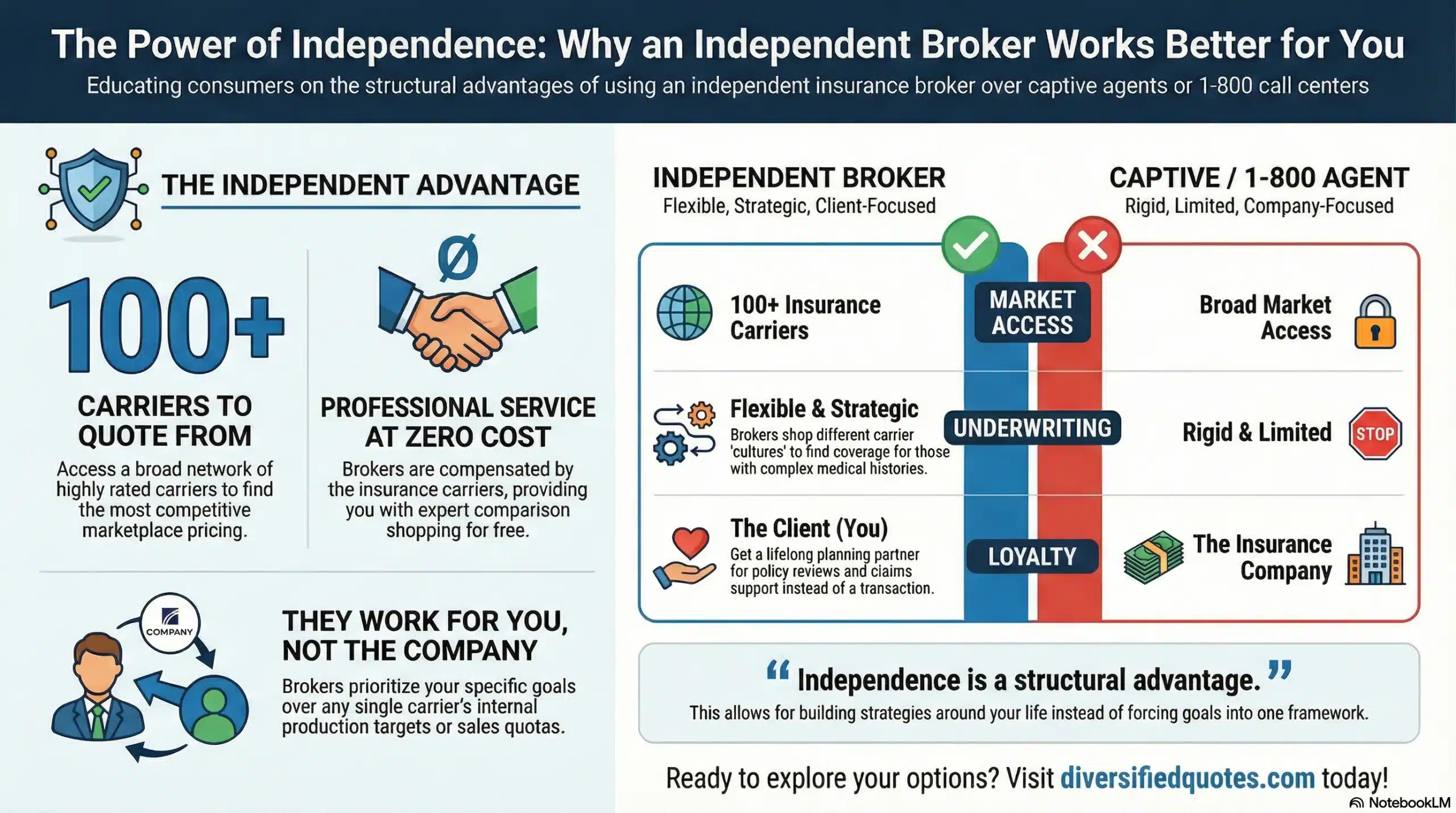
As an Independent Life Insurance Broker, we compare rates across 100+ carriers and prescreen every application before submission.
At What Age Should You Stop Buying Term Life Insurance

Jason Stolz CLTC, CRPC, DIA, CAA
At what age should you stop buying term life insurance? The most accurate answer — and the one that actually serves your planning — is that there is no universal stop age. There is, however, a point where term life insurance stops being the best tool for your specific goals. For some families, that point arrives in their 40s. For others it comes in their late 50s or early 60s. And for some households, term remains useful well into retirement because it efficiently solves a very specific, defined-duration problem that no other product addresses as cost-effectively. Age is a factor in pricing and in the mechanics of underwriting — but it is not the decision criterion. The decision criterion is whether a time-limited financial risk exists that would harm someone who depends on you.
At Diversified Insurance Brokers, Jason Stolz, CLTC, CRPC, DIA, CAA helps clients nationwide make this decision based on actual risk analysis rather than guesswork or age-based rules of thumb. Two mistakes appear consistently across the population: the first is stopping coverage too early — driven by the assumption that age alone disqualifies an applicant from meaningful term options, or that advancing age makes coverage automatically pointless. The second is continuing to buy or renew term without ever updating the strategy to reflect how life has changed — resulting in overpaying, under-insuring, or holding a policy that will expire precisely when ongoing coverage matters most. Our resource on what will disqualify me from life insurance covers the actual underwriting concerns that arise with age and health — the real factors rather than the mythologized ones — and our resource on best life insurance rates covers how term pricing actually changes across age and health class, giving concrete context for the strategic questions this page addresses.
See Real-Term Rates Side by Side
Life Insurance Quoter
Get a Term Strategy Mapped to Your Actual Timeline
Tell us your age, income, debts, and who depends on you. We’ll map the most cost-efficient coverage plan for your specific risk window — not a generic age-based formula.
Request a Term Strategy Review Call 800-533-5969Should You Keep, Replace, or Stop Term Life Insurance — Decision Framework by Life Situation
Rather than using age as the primary decision variable, the table below maps common life situations to the coverage question that actually matters: is there still a time-limited financial risk that would harm someone who depends on you? When that question is answered with situational specifics rather than general age assumptions, the right action becomes much clearer.
| Life Situation | Term Still Makes Sense? | Key Risk Drivers | Recommended Action |
|---|---|---|---|
| 30s–40s: young children at home, mortgage meaningful, spouse income-dependent | Yes — term is the foundational tool; the time-limited risk is clearly defined and the premium is at its most efficient | Income replacement for dependent children, mortgage paydown timeline, spouse’s financial security until retirement-ready age | Buy layered term matching obligation timelines; consider a laddering strategy to reduce total premium while covering the full risk window |
| Mid-40s to early 50s: children approaching independence, mortgage winding down, retirement savings growing | Likely yes but reassess — the risk is diminishing and the coverage structure should reflect that | Remaining mortgage, spouse’s income bridge to retirement, whether assets yet self-sustaining if death occurred today | Right-size coverage — don’t renew the same face amount reflexively; run the “if I die today” test and align coverage to what the answer actually requires |
| 50s: peak earning years, spouse still income-dependent, retirement 10–15 years out | Often yes — this is when a premature death most disrupts the retirement plan both spouses have been building | Spouse’s retirement readiness without this income stream, remaining mortgage or business obligation, time until retirement savings can fully sustain survivor | Tie the term period to the retirement protection window (e.g., cover the bridge to age 65 or Social Security); explore conversion provisions for longer-term coverage needs |
| Early 60s: one or both spouses approaching or entering retirement, assets growing, mortgage near payoff | Situation-dependent — the “if I die today” test often produces smaller needs, but specific obligations may still justify term | Surviving spouse income security, any remaining mortgage or debt, pension election stabilization, business transition obligations | Run the purpose test specifically — if no clear time-limited risk survives the test, term may be appropriate to wind down; if a specific bridge risk exists, a targeted shorter term can still be efficient |
| In retirement: no dependents, assets self-sustaining, no significant outstanding debts | Usually no — when no one is financially harmed by death and assets are sufficient, the fundamental purpose of term has been served | Legacy goals, charitable objectives, or estate planning — these are better served by different insurance structures than level term | Intentionally allow term to expire; redirect premium to other planning priorities; evaluate whether any ongoing coverage need exists for a specific legacy or estate purpose |
| Any age: new obligation created (second marriage, new business, late mortgage, new dependent) | Yes — new time-limited risks restart the term analysis regardless of age; the obligation, not the birthday, drives the coverage decision | Duration and size of the new obligation, who is harmed if death occurs before the obligation resolves, whether other assets could absorb the obligation | Match new term to the specific obligation’s timeline; prescreen health profile before applying to identify the best carrier for current age and health |
| Any age: existing term policy approaching the end of the level period | Evaluate — renewal into annually renewable term is often inefficient; compare renewal premium against new term or alternative structures | Current health (can you requalify?), remaining risk duration, whether renewal premium is competitive vs. new policy, whether conversion provision offers a better path | Start evaluating 3–5 years before the level period ends; compare new term pricing, conversion pricing, and renewal pricing to choose deliberately rather than by default |
The table reveals the most important insight about the “stop age” question: the right column to read is “Key Risk Drivers” — because that column shows what actually changes as life evolves. The mortgage shrinks, children leave, retirement assets grow, the spouse becomes retirement-ready. As those conditions are met, the compelling reasons for term coverage diminish. But each condition’s timeline is personal, and two people of the same age can have completely different risk profiles depending on when they started families, when they took on debt, and how their retirement savings have developed. Our resource on term life insurance calculator provides the baseline premium comparison tool for different term lengths and ages, and our resource on how to get the best life insurance rates covers the optimization strategy for getting the most competitive pricing at whatever age and health class applies to the current situation.
The Real Question Behind the Age Question
Term life insurance is a tool, and like any tool, it doesn’t become wrong based on age — it becomes less appropriate when the problem it was designed to solve no longer exists. The problem term is designed to solve is this: a time-limited financial obligation that would harm specific people if the primary earner or contributor died before the obligation was resolved. When that problem is clearly present, term is often the most cost-efficient solution available. When the problem has been resolved — debts paid, children independent, retirement assets sufficient, spouse financially secure — the case for continuing to pay term premiums weakens significantly.
The practical test is not “how old am I” but “what happens financially if I die this year?” If the honest answer is “my spouse would struggle to cover the mortgage and daily expenses,” there is still a meaningful term insurance need regardless of age. If the honest answer is “my spouse would be fine, and the only concern is a specific 8-year business loan that remains unpaid,” then a purpose-specific short-term policy aligned to that obligation is a clean, efficient solution. If the honest answer is “no one would be financially harmed, and my assets are sufficient,” then the primary case for term has been resolved, and the conversation appropriately shifts to whether any legacy, charitable, or estate-planning objective would benefit from a different insurance structure. Our resource on do you still need life insurance after retirement covers this transition in detail — including the situations where some form of coverage still makes sense in retirement and the ones where it genuinely does not.
Why the Stop Age Varies So Widely Across Families
The variation in when term stops making sense is almost entirely driven by life timeline differences rather than anything about insurance products. A person who had children in their mid-20s, paid off a 30-year mortgage on schedule, and maintained disciplined retirement savings may find that the term-eligible risk substantially resolves by their mid-50s — children are independent, mortgage is gone, retirement assets are meaningful. The same age person who had children in their late 30s, refinanced the mortgage into a longer term for cash flow reasons, and started retirement savings later may still be squarely in the “income replacement is essential” phase at 55 or even 60.
Business ownership adds another variable. Business owners often carry ongoing financial obligations — business loan guarantees, partnership buy-sell obligations, key person exposure — that create compelling term coverage needs well past the age when a salaried employee’s family protection need has substantially resolved. A 62-year-old business owner with a 5-year transition plan and $2 million in personal guarantees has a dramatically different term insurance need than a 62-year-old retired schoolteacher with no dependents and a pension. The “stop age” for one is not relevant for the other. Our resource on how to protect your mortgage with life insurance covers mortgage-specific term strategy, and our resource on life insurance laddering guide covers the layered term approach that allows different obligations to be covered with policies calibrated to their individual timelines — often producing significantly lower total premium than a single large-face-amount policy.
When Term Stops Being the Right Primary Tool
Several signals consistently appear when term is no longer the optimal primary coverage vehicle — and none of them is a specific birthday. The first signal is when the need is no longer time-limited: if coverage is wanted for whenever death occurs rather than during a specific window, term becomes a poor structural fit, particularly when it leads to repeatedly buying short terms or paying high renewal premiums to maintain coverage that has no defined end date. Term is specifically engineered for defined risk windows; for indefinite coverage needs, other structures serve better.
The second signal is buying term as a substitute for a long-term plan. When someone keeps renewing or buying new term policies because “they don’t want to decide” about long-term coverage, they often end up forcing a decision at the worst possible time — older, with more medical history, and with fewer choices available. The cost of deferring the decision accumulates, and the options that would have been available at 50 may not be available at 65. Planning the transition intentionally — when health is still strong and options are broad — almost always produces better outcomes than reactive decision-making after a health event or when renewal premiums become untenable.
The third signal is when premium-to-benefit efficiency has degraded. This often appears when renewing into annually renewable term after the level period expires — the premium can increase sharply, sometimes dramatically, because the policy is now being priced year-by-year rather than as a long-term block. When that happens, comparing the renewal cost against either a new term policy (which requires requalifying but may offer better pricing) or an alternative structure is the productive next step rather than passively accepting the renewal terms. Our resource on limited pay life insurance explained covers one alternative structure that appeals to some people in this transition — paying for coverage over a compressed premium period rather than buying term that may expire at an inconvenient time.
Term Strategies That Often Beat Binary “Stop vs. Keep” Thinking
The most effective coverage decisions rarely result from a binary “keep all of it” or “stop all of it” choice. The strategies that produce the best combination of cost efficiency and appropriate protection are typically more nuanced — calibrated to how obligations actually decline over time rather than applying a uniform approach to a changing life.
Laddering smaller term policies instead of one large term provides a practical mechanism: a 10-year layer covering the highest-obligation decade and a 20-year layer covering the longer runway allows the coverage to reduce naturally as obligations resolve, without paying for maximum coverage throughout the entire period. The laddering guide covers this in detail — it’s often one of the most impactful single changes available to families who have been carrying more coverage than their current risk profile requires. Keeping term for a specific near-term risk while evaluating a different structure for longer-term protection goals is another common hybrid approach — protecting a defined bridge need (the mortgage, the business obligation, the spouse’s retirement runway) with term while planning separately for any coverage that should extend beyond that window. The 50-year term, the 30-year term, and the 15-year term all serve different obligation durations — and matching the term length precisely to the actual risk window produces much better outcomes than defaulting to a standard length without analyzing the specific timeline. The term life insurance with return of premium structure is worth understanding for buyers who find the “pay and get nothing back” aspect of term psychologically difficult — it is not universally better, but for certain profiles it can improve coverage commitment and persistence, which has real long-term value.
Underwriting Reality at Different Ages — Why It Matters for Timing
Beyond the strategic question of whether term is the right tool, there is a practical timing dimension: underwriting outcomes become more variable as age and health history accumulate, and the spread between best-case and worst-case pricing grows wider. This means that for applicants who are approaching an age where health changes become more probable, the decision of when to act can have meaningful premium consequences.
A specific health event — a new diagnosis, a medication addition, a procedure — can shift the available underwriting class in ways that significantly affect long-term premium costs. For people who know they still want coverage for a defined window but are deliberating about timing, acting while health is favorable is usually more cost-efficient than waiting. The opportunity to requalify and lock in a favorable health class at current age may not be available at the same terms two or three years later if health changes in that interval. Our resource on what does an insurance company’s AM Best rating mean covers carrier financial strength evaluation — relevant for longer-term policies where the carrier’s ability to maintain its commitments over the life of the contract matters. Carrier selection becomes more consequential at older ages because the variation in underwriting interpretation across carriers can produce meaningfully different premium outcomes for the same profile — which is why independent broker access to 100+ carriers provides the comparison breadth that a single-carrier approach cannot replicate. Our resource on how insurance brokers are compensated covers the transparency question about why independent comparison often serves consumers better, and our resource on life insurance for H1B visa holders covers the carrier selection and documentation considerations for non-citizen applicants for whom term timing and carrier matching carry additional complexity. Our resource on how Social Security disability impacts retirement benefits covers the Social Security planning context that is relevant for the “bridge to Social Security” term strategy discussion — a common use case for term in the 55–65 age window. And our retirement income calculator provides the tool for modeling the retirement income picture that term coverage is meant to protect during the pre-retirement bridge years.
Renew, Replace, or Stop — Get the Answer for Your Situation
We map your obligations, timeline, and health profile to the most cost-efficient coverage strategy — including when to keep term, when to restructure it, and when it has genuinely served its purpose.
Build My Coverage TimelineRelated Pages
Carrier comparisons, disability protection resources, specialty condition guides, and professional coverage planning.
Financial Protection Essentials
Carrier reviews, cancer survivor coverage guides, and rate optimization resources for comprehensive protection planning.
Compare Term Life Insurance Lengths
Explore different term periods to find coverage that best matches your timeline and budget.
Talk With an Advisor Today
Choose how you’d like to connect—call or message us, then book a time that works for you.
Schedule here:
calendly.com/jason-dibcompanies/diversified-quotes
Licensed in all 50 states • Fiduciary, family-owned since 1980
FAQs: At What Age Should You Stop Buying Term Life Insurance?
Is there a specific age where term life insurance stops making sense?
No — there is no universal stop age. Term life insurance stops being the best primary tool when you no longer have a time-limited financial risk that would harm someone who depends on you if you died. For many families, that moment arrives somewhere between the late 50s and mid-60s as mortgages approach payoff, children become financially independent, and retirement assets reach a level where a surviving spouse could sustain themselves without the deceased’s income. For other families — those with late-career business obligations, second marriages, late-in-life mortgages, or dependents with ongoing support needs — the compelling case for term extends much further. The framework that matters is not “how old am I” but “what financial problem does someone face if I die this year, and how long does that problem last?” When the answer is “no significant problem,” the fundamental case for term has resolved. When the answer identifies a specific time-limited risk, term remains a candidate regardless of age. Our resource on do you still need life insurance after retirement covers the retirement-phase coverage evaluation in detail.
Can you buy term life insurance in your 60s?
Often yes — most carriers continue to offer term life insurance to applicants in their 60s, though the available term lengths and pricing change compared to earlier decades. A 62-year-old applicant in good health can typically qualify for 10-, 15-, or 20-year term from a range of carriers, with pricing reflecting their age and health class. A 68-year-old may find fewer term-length options and higher premiums, but meaningful coverage can still be available when the underwriting supports it. The key factors at this age band are: the clarity of the coverage purpose (what specific risk exists and for how long), the applicant’s current health and available underwriting class, and which carriers have the most favorable guidelines for the specific health profile. Blanket assumptions that term is unavailable in the 60s are simply inaccurate — coverage decisions should be based on actual carrier quotes for the specific situation rather than assumptions about age-based availability. Our resource on best life insurance rates covers the premium landscape across ages and health classes, and our resource on what will disqualify me from life insurance covers the actual underwriting factors that affect availability — none of which is “being in your 60s” on its own.
Why do term premiums jump so much later in life?
Term premiums increase with age because life insurance is priced on actuarial mortality probability — the probability of a claim during the policy period increases as age increases, so the premium reflects that higher expected cost. Two distinct mechanisms produce premium increases at different life stages. The first is the natural increase in pricing when a new policy is purchased at an older age — a 60-year-old applying for a new 10-year policy pays more than a 50-year-old applying for the same policy because the probability of dying in the next 10 years is actuarially higher at 60 than at 50. The second — often more surprising — is the jump that occurs when an existing term policy’s level premium period ends and the policy converts to annually renewable term. The level-premium period (typically 10, 20, or 30 years) reflects pricing locked in at the original application age. When that period ends, the carrier reprices the policy annually at the insured’s current age — which can produce dramatic premium increases because the insured is now 10, 20, or 30 years older than when the original level premium was established. This renewal trap is the most common reason people feel that term “stops working” — they weren’t aware the level premium had a defined end date and that post-level premiums would be substantially higher.
Should I renew an old term policy or buy a new one?
The comparison depends on three variables: your current health, the remaining duration of your coverage need, and the cost difference between renewal and a new policy. If your health has remained good since the original policy was issued, buying a new term policy and requalifying at your current age and health class often produces significantly lower premiums than renewing the existing policy into annually renewable term — because new term policies are priced as a level-premium block rather than the steep annual increases that characterize post-level renewal pricing. If your health has changed significantly since the original policy was issued, the requalification process for a new policy may produce a less favorable outcome or may not be available, making the existing policy’s renewal — despite the higher premium — the better option to preserve coverage. This evaluation should happen 3–5 years before the level premium period ends, not after — because at that point you still have time to compare options, maintain the existing policy in force during the new application process, and make a deliberate choice rather than a forced one. Our resource on convert term to permanent life insurance covers the conversion option that many policies include — allowing conversion to permanent coverage without new medical underwriting, which can be particularly valuable when health has changed since the original application.
What if I still need coverage but I’m worried I’ll outlive my term?
Outliving term — being alive when the policy expires — is the intended outcome, not a problem. Term is designed to provide cost-efficient coverage during a defined risk window; when the window closes and everyone is financially secure, the expiration is the policy working as designed. The concern about outliving term becomes a planning issue only when the coverage need extends indefinitely — meaning the financial risk is not time-limited — or when the term was too short to cover the actual risk duration. The appropriate response is not reflexively buying longer term but rather clarifying whether the ongoing need is truly indefinite (in which case a different coverage structure is more appropriate) or whether a longer-defined window would serve the purpose (in which case better-aligned term or a ladder approach is the answer). For applicants who want coverage that is less likely to expire before death regardless of timing, limited pay permanent life insurance is one alternative worth understanding — paying for coverage over a compressed premium period while maintaining permanent protection. Our resource on term with return of premium covers another alternative that reduces the psychological cost of outliving term by returning premiums if the insured is alive at the end of the level period.
Do I need term insurance after the kids are grown?
Maybe — and the answer depends on factors beyond children’s ages. Children growing up resolves the child-dependency portion of the income replacement need, but several other potential coverage drivers remain relevant. The most common is a spouse who still relies on the higher earner’s income — even without children at home, a surviving spouse who cannot sustain their retirement lifestyle on their own income or savings alone represents a meaningful ongoing insurance need. The mortgage is another: if the home is not yet paid off, term covering the remaining paydown period protects the surviving spouse from forced sale or financial hardship. Retirement timing is a third: if a premature death would disrupt a retirement plan that both spouses have been building — particularly in the decade before retirement when the savings are meaningful but not yet fully positioned — term can provide an important bridge. Run the practical test: “If I die this year, what happens to my spouse’s financial life?” When the honest answer shows significant disruption, the need for term persists regardless of whether children are in the picture. Our resource on how to protect your mortgage with life insurance covers the mortgage-specific coverage framework, and our retirement income calculator provides the tool for modeling what the retirement income picture looks like with and without the higher earner’s income.
Is term life insurance still useful in retirement?
It can be — and the key is identifying whether a specific, time-limited risk exists in retirement that term can cover efficiently. The most common retirement-phase term applications include: covering a surviving spouse’s income until pension elections stabilize or Social Security optimization is complete; protecting an outstanding mortgage that was intentionally maintained for cash flow or rate reasons; covering a business transition obligation that has a defined multi-year timeline; and providing a bridge for a specific debt that would burden heirs or force asset liquidation if death occurred prematurely. In these cases, term is often the most cost-efficient solution because the need is genuinely time-limited and the face amount can be matched precisely to the obligation without overpaying for coverage that extends indefinitely. The cases where term does not serve retirement well are when coverage is wanted indefinitely with no defined end point — in those situations, the term will eventually expire or become very expensive to renew, making a longer-duration structure more appropriate. Our resource on do you still need life insurance after retirement covers the full retirement-phase insurance evaluation, including both the cases where term still serves and the ones where it does not.
What is the biggest mistake people make with term insurance as they age?
The most consequential mistake is failing to plan for the end of the level premium period until the premium has already jumped. When an applicant purchases a 20-year term policy at 45 and does nothing to evaluate their next move until the policy is 19 years old, they find themselves at 64 facing a sharply higher annually renewable term premium — at an age and health status that may make requalifying for a new policy more expensive or more uncertain than it would have been at 59 or 60. The coverage gap risk also appears: if someone postpones their evaluation and then encounters a health change before acting, their options narrow significantly. Starting the evaluation 3–5 years before the level period ends — when the policy is still in full force, health is presumably still close to the original underwriting class, and time remains to compare options deliberately — produces consistently better outcomes. The second most consequential mistake is the opposite: allowing term to lapse or continuing to renew at increasing premiums without evaluating whether the original coverage objective still exists. Life changes in both directions — sometimes creating the need to maintain or expand coverage, sometimes resolving the need significantly faster than the original policy’s term anticipated. The coverage strategy should be re-evaluated as life milestones are reached, not set once and forgotten.
How do I know how long my term policy should be?
Match the term length to the duration of the specific risk the coverage is designed to address — not to a standard option or a general rule of thumb. The most reliable method is to identify the longest-running time-limited obligation that a death today would leave unresolved: how long until the mortgage is paid off, how many years until the youngest child is financially independent, how many years until retirement savings would be sufficient to sustain a surviving spouse, or how long a business obligation remains. The term length should cover the longest of those specific timelines, not an arbitrary round number. The laddering strategy can often match multiple obligations simultaneously — a shorter-term layer covers the highest-obligation decade, while a longer-term layer covers the full risk window at lower cost than one maximum-coverage policy for the entire duration. The 10-year, 15-year, and 30-year term structures serve very different obligation timelines — the selection should follow the obligation, not the other way around.
About the Author:
Jason Stolz, CLTC, CRPC, DIA, CAA and Chief Underwriter at Diversified Insurance Brokers (NPN 20471358), is a senior insurance and retirement professional with more than 25 years of real-world experience helping individuals, families, and business owners protect their income, assets, and long-term financial stability. As a long-time partner of the nationally licensed independent agency Diversified Insurance Brokers, Jason provides trusted guidance across multiple specialties—including fixed and indexed annuities, long-term care planning, personal and business disability insurance, life insurance solutions, Group Health, Travel Medical and Evacuation Insurance, and short-term health coverage. Diversified Insurance Brokers maintains active contracts with over 100 highly rated insurance carriers, ensuring clients have access to a broad and competitive marketplace.
His practical, education-first approach has earned recognition in publications such as VoyageATL, and contributions from his agency featured in Kiplinger and GoBankingRates— highlighting his commitment to financial clarity and client-focused planning. Drawing on deep product knowledge and years of hands-on field experience, Jason helps clients evaluate carriers, compare strategies, and build retirement and protection plans that are both secure and cost-efficient. Visitors who want to explore current annuity rates and compare options across multiple insurers can also use this annuity quote and comparison tool.
Explore More Life Insurance Options: Browse our complete guide to Life Insurance Ownership & Policy Management — covering reviewing, selling & understanding your existing policy, riders, taxes & claims from 100+ carriers.
Last Reviewed: May 27, 2026 |
Reviewed by: Jason Stolz, CLTC, CRPC, DIA, CAA
Chief Underwriter, Diversified Insurance Brokers, Inc. | NPN: 20471358 | Diversified Insurance Brokers, Inc. — Licensed in all 50 states
Fact Checked by: Tonia Pettitt, CMIP©
Medicare Specialist, Diversified Insurance Brokers, Inc. | NPN: 14374308 | Diversified Insurance Brokers, Inc. — Licensed in all 50 states
Did you find this content helpful? Leave us a Google review — it helps others find trustworthy guidance too.
Editorial Standards: Diversified Insurance Brokers maintains rigorous editorial standards to ensure accuracy, clarity, and independence in all content. Learn more about our editorial standards and commitment to transparency.
