
How Social Security Disability Impacts Retirement Benefits
As an Independent Disability Insurance Broker, we have access to exclusive discounts and negotiated pricing most captive agents can’t offer — see the full breakdown near the end of this page.
How Social Security Disability Impacts Retirement Benefits

How Social Security Disability impacts retirement benefits is a planning topic that matters far more than most people realize — and one where the blind spots tend to be expensive. If you receive Social Security Disability Insurance (SSDI) after an injury, illness, or long-term medical condition, it is natural to assume you will “deal with retirement later.” But SSDI and retirement benefits are connected in ways that shape household cash flow, Medicare eligibility, tax exposure, spousal protection, and the timing decisions you will face as you approach Full Retirement Age. Most of those connections happen automatically in the background — which is exactly why understanding them in advance produces better outcomes than discovering them at the moment of transition.
At Diversified Insurance Brokers, we help clients nationwide coordinate disability and retirement-income strategies so they do not run into avoidable coverage gaps, surprise Medicare costs, or income disruptions at the exact moments when financial stability matters most. This page explains what SSDI does — and does not do — for retirement planning, how the conversion at Full Retirement Age actually works, and what planning decisions should happen before that date. For the complete range of Social Security planning tools and guidance we offer, start with our Social Security Planning Services page.
Talk With a Social Security Expert
We’ll review your SSDI timeline, explain how it converts to retirement benefits, and map Medicare and income planning so you don’t lose value at the transition.
Explore Social Security ServicesSSDI vs. Retirement Benefits: The Core Relationship
SSDI — Social Security Disability Insurance — is a benefit paid when a person cannot work due to a qualifying medical condition expected to last at least one year or result in death. What distinguishes SSDI from other assistance programs is that it is tied to your work record: your earnings history and the Social Security taxes you have paid over your career. This is why SSDI is fundamentally different from SSI (Supplemental Security Income), which is a needs-based program not tied to work history. SSDI functions more like insurance — you paid into the system through FICA taxes on earned income, and the benefit is yours when a qualifying disability prevents work.
From a retirement planning standpoint, the most important concept to internalize is that SSDI is generally calculated to pay the equivalent of your Full Retirement Age retirement benefit. The program is designed to function as “retirement benefits paid early due to disability” — which is why SSDI and retirement benefits connect so tightly and why the transition at Full Retirement Age is typically automatic rather than requiring a new application. That connection is genuinely helpful, but it creates planning blind spots for people who assume SSDI behavior and retirement benefit behavior are identical. They are not identical in how they interact with Medicare, taxes, spousal benefits, and survivor planning — and those differences are where the real planning work happens. Our resource on how retirement accounts are taxed provides essential context on how different income sources interact in retirement, which becomes directly relevant when SSDI converts and other income streams are added to the household picture.
When SSDI Converts to Retirement Benefits — and What Actually Changes
One of the most common questions we receive is: “Do I need to apply for Social Security retirement if I am already on SSDI?” In most cases the answer is no. When you reach your Full Retirement Age — currently between 66 and 67 depending on birth year — your SSDI benefit typically converts automatically to a retirement benefit. You are not expected to re-qualify medically. You do not need to submit a new application solely for the conversion. Social Security handles the change administratively because disability benefits exist as a separate classification only up to Full Retirement Age — at FRA, retirement benefits become available without an early-claim reduction, so the disability classification is no longer needed to protect the full benefit amount.
What changes most at conversion is not the monthly check amount — it is the planning context surrounding it. Medicare premium withholding arrangements can shift. Spousal and dependent benefits may change. Other income sources you add around the same time — IRA withdrawals, a small pension, part-time income — can interact with the converted benefit in ways that affect your net household income even when the gross Social Security amount is unchanged. The FRA conversion date is best understood not as a “nothing changes” moment but as a planning milestone that deserves a deliberate review. Our resource on Social Security annual recomputation explains how prior-year earnings records can update the benefit calculation over time — relevant context for anyone whose work history includes both disability periods and earlier higher-income years.
Will Your Monthly Payment Change at Full Retirement Age?
In most cases, the gross monthly amount stays the same when SSDI converts to retirement at Full Retirement Age. SSDI is generally calculated to match the FRA-level retirement benefit — the program is specifically designed to replace income during disability and then transition seamlessly when retirement benefits become available at the full rate. This means the “early claiming reduction” that applies when someone voluntarily files for retirement at 62 or 63 does not apply to disability recipients, because SSDI is not treated as an early claim. The benefit amount was calculated at the full rate from the beginning.
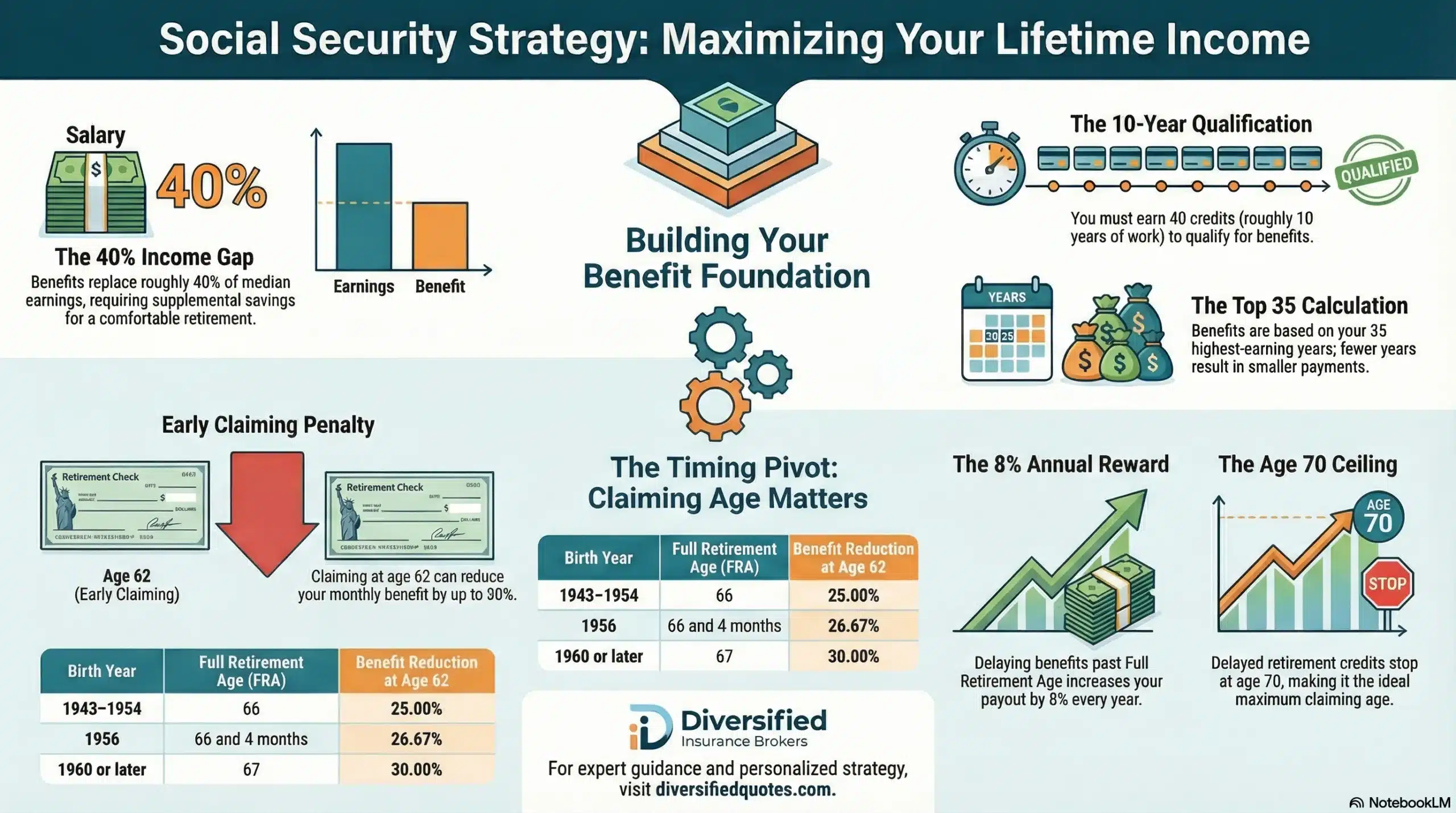
There is one important nuance: SSDI recipients generally do not earn delayed retirement credits for the period they are receiving disability benefits. The opportunity to increase a benefit by 8 percent per year by delaying past FRA — which is available to people who delay voluntarily — does not apply to SSDI recipients in the same way. This is worth understanding clearly, because some people assume they can “stack up” delayed credits while receiving SSDI. Understanding how delayed retirement credits work helps clarify what is and is not available in the SSDI context. Even when the gross benefit stays stable at conversion, household net income can still shift — a spouse may start or change benefit type, dependent benefits may end, Medicare premium withholding may adjust, and additional income sources may change tax exposure. These changes are worth planning for specifically rather than discovering reactively.
Medicare Eligibility While on SSDI — Often Before Age 65
Medicare eligibility is one of the most impactful and frequently misunderstood benefits connected to SSDI. Most SSDI recipients become eligible for Medicare before age 65 after meeting the SSDI-related Medicare qualification timeline — generally after a waiting period of 24 months following the month SSDI benefits began. For many families this changes the entire healthcare equation: it can reduce or eliminate reliance on employer coverage or individual-market plans, make specialist care more accessible, and create predictable coverage years before the peer group is thinking about Medicare enrollment at 65.
Early Medicare eligibility also creates decision points and enrollment deadlines earlier than most people expect. Parts A and B enrollment, prescription drug coverage under Part D, the choice between Medicare Advantage and traditional Medicare with a Medigap supplement, and IRMAA income-related premium surcharges all become relevant earlier for SSDI recipients than for standard retirees. Missing enrollment windows or making coverage choices without comparing options can produce higher premiums and coverage gaps that are difficult to correct afterward. Our resource on what IRMAA is covers the income-related Medicare premium surcharges that SSDI recipients with other household income sources need to understand and plan around. For modeling Medicare costs and comparing coverage options, our Medicare calculator provides a practical starting point. For the full picture of how Medicare and Social Security coordinate through premium withholding and administrative interaction, our companion guide on how Medicare and Social Security work together covers the mechanics in detail.
Taxes: When SSDI Becomes Taxable and Why It Surprises People
SSDI benefits can be taxable depending on the household’s total income picture — but the tax is not determined by SSDI alone. It is determined by how SSDI interacts with other income sources: wages from work activity, spousal income, pension income, IRA or 401(k) withdrawals, investment income, and rental income. The IRS uses a “combined income” formula — adjusted gross income plus nontaxable interest plus half of Social Security benefits — to determine what percentage of Social Security benefits, including SSDI, becomes subject to federal income tax. When combined income exceeds certain thresholds, up to 85 percent of Social Security benefits can become taxable.
This is where disability-to-retirement transitions create tax surprises that planning could have avoided. A person who begins taking IRA withdrawals to supplement income, receives a pension, sells appreciated assets, or adds portfolio income around the same time SSDI converts at FRA can find their net cash flow significantly different from what the gross benefit amount suggested. Our resources on when Social Security is taxable and how to minimize Social Security taxes provide actionable frameworks for managing this exposure. One planning approach many families use is building predictable income in tax-advantaged structures that complement Social Security rather than creating unnecessary bracket pressure — our lifetime income planning page covers how structured income can be coordinated to reduce avoidable tax drag.
Spousal and Dependent Benefits While on SSDI
If you receive SSDI, certain family members may qualify for benefits on your earnings record depending on household structure and eligibility rules. A spouse may be eligible for a spousal benefit, and dependent children may qualify for benefits as well — creating a situation where SSDI becomes a household income strategy rather than solely an individual benefit. When disability reduces earned income, these family benefits can provide meaningful financial support during years when household expenses often rise and financial flexibility is already constrained by the disability itself.
The planning challenge is that family benefits operate under different start and stop rules than the primary benefit, and the household total is subject to a family maximum benefit limit based on the worker’s record. Children aging out of eligibility, changes in household status, and the start of other income sources can create “silent income cliffs” that reduce household cash flow in ways the primary benefit holder may not anticipate. Our resource on Social Security survivor benefits for children provides important context on dependent benefit eligibility and timing. For coordinating spousal benefit decisions efficiently alongside SSDI and retirement planning, our guide on how to maximize Social Security benefits is the strongest starting point for household planning that treats both spouses’ benefit records as a coordinated strategy.
Survivor Benefits When Disability Is Part of the Story
Survivor planning takes on heightened importance when one spouse has a disability history, because that household often relies more heavily on Social Security income and earlier Medicare coverage than a household where both spouses maintained uninterrupted full-time employment through their peak earning years. When Social Security represents a larger share of the income floor, protecting the survivor scenario becomes the most financially consequential long-term decision — often more valuable than optimizing a single benefit amount in isolation.
Practical survivor planning starts with two questions: what would the surviving spouse receive if the disabled worker passed away, and are there claiming or sequencing decisions that strengthen long-term survivor protection without unnecessarily sacrificing current household income? For widows and widowers navigating these decisions, our resource on Social Security claiming strategies for widows covers how survivor benefits interact with retirement benefits and what sequencing decisions produce the most stable long-term outcome. Our resource on survivor benefits for disabled adults addresses the specific scenarios where disability history intersects with survivor benefit planning in ways standard retirement guides do not cover.
Working While on SSDI: Where People Unintentionally Create Risk
Many SSDI recipients want to test work capacity or re-enter the workforce in some capacity. Social Security does allow certain work-testing pathways — Trial Work Period provisions and Substantial Gainful Activity thresholds govern how work income is treated during and after SSDI receipt. But this is also an area where people create unintentional risk by assuming the rules are simple or that the system will catch issues automatically. When disability is involved, how work activity is reported and how it affects benefit status requires explicit understanding, not passive assumption.
From a retirement planning perspective, the biggest issue is often not the headline benefit amount — it is the ripple effects. Work income can shift the taxability of SSDI benefits, interact with household income thresholds for Medicare surcharges, and change net cash flow in ways that are not obvious until year-end totals surface. The Social Security earnings test is also worth understanding specifically — our resource on the earnings test after Full Retirement Age explains how the rules change at FRA and what that means for people transitioning from SSDI to retirement who also have work income in the picture. For self-employed individuals whose SSDI situation involves business income and self-employment tax considerations, our resource on Social Security benefits for the self-employed covers how those interactions are handled.
Planning Strategies for SSDI Recipients Approaching Retirement
The strongest SSDI-to-retirement plans follow the same four-step structure regardless of household specifics: confirm the conversion timeline, coordinate Medicare decisions, coordinate taxes and other income sources, and protect the household survivor scenario. These four steps address the areas where avoidable surprises most commonly occur.
Verifying your Full Retirement Age and SSDI conversion date is the foundation. FRA is generally between 66 and 67 depending on birth year, and knowing the exact date helps you plan what stays stable and what changes — particularly around Medicare premium withholding adjustments, any household benefit changes, and the timing of additional income sources. Coordinating Medicare decisions earlier than age 65 is the second step — the early Medicare eligibility that often accompanies SSDI creates Part B enrollment deadlines, prescription coverage decisions, and Medigap or Medicare Advantage comparisons that require proactive attention well before the standard age-65 planning window. Our resource on how to avoid Medicare late enrollment penalties is particularly relevant for SSDI recipients who may not realize their Medicare decisions have different timelines than standard retirees face.
Coordinating taxes with the full income picture is the third step — the income sources that get added around the FRA conversion date are often what tips the taxable portion of Social Security from a manageable number to an unexpected one. Our resource on how modified adjusted gross income affects Social Security and Medicare covers the specific income calculation that determines both Social Security tax exposure and Medicare premium surcharges simultaneously — two planning variables that are often handled separately but should be modeled together. Building a retirement income floor that provides stability without depending on market timing is the fourth step — when disability is part of the story, predictable income planning becomes more valuable because health uncertainty already introduces enough variability. Our lifetime income planning services page explains how structured guaranteed income coordinates with Social Security to build a stable household income foundation.
Real-World Planning Scenarios
The planning dynamics above play out differently in every household, but a few common scenarios illustrate how the pieces interact in practice. In the first scenario, a 60-year-old receives SSDI after a medical event prevents full-time work. The household gains a stable income stream and Medicare eligibility arrives years before the standard age-65 window. The planning questions that immediately become relevant are how to coordinate Part B enrollment and premium withholding, how to evaluate Part D prescription coverage against a growing medication list, and how to budget for IRMAA if spousal income or investment income pushes combined household income above the surcharge thresholds. When this individual reaches FRA, SSDI converts to retirement automatically and the monthly amount stays largely the same — but the household that planned proactively avoided coverage gaps and premium surprises that the household that waited would have discovered reactively.
In the second scenario, one spouse is on SSDI and the other is approaching their own claiming age. Rather than treating each spouse’s decision independently, the household plan focuses on long-term protection: which claiming sequence keeps household income most stable, and what happens to the surviving spouse’s budget if the higher-earning spouse passes away first. In many situations involving one disabled spouse, the most valuable claiming strategy is the one that maximizes the survivor benefit rather than the one that maximizes the current combined household check. In the third scenario, a person reaches retirement with reduced savings because disability interrupted peak earning years — reducing both the SSDI benefit calculation and the opportunity to accumulate retirement assets during high-income years. Planning in this situation focuses on predictability: coordinating Social Security and Medicare tightly, managing taxes on every dollar of the limited portfolio, and building a monthly income structure that covers essential expenses without depending on market performance in years when health uncertainty already adds enough variability. Our complete guide to Social Security advice and planning strategies covers the full range of filing and sequencing tools available across different household scenarios.
Why Work With Diversified Insurance Brokers
Navigating the intersection of SSDI, Medicare, retirement income, and long-term protection planning requires a coordinated view of all the pieces — not separate consultations with specialists who each see only one part of the picture. At Diversified Insurance Brokers, we help clients across every stage of this transition: from initial SSDI receipt and early Medicare enrollment decisions, through the FRA conversion milestone and the income and tax coordination that surrounds it, to the long-term household income planning that keeps a retirement plan stable when health uncertainty is part of the ongoing reality. We are licensed nationwide and have been serving clients since 1980 across disability insurance, Social Security planning, Medicare, and retirement income strategy.
📞 Call 800-533-5969 | Contact Us
Related Social Security and Retirement Pages
Schedule an Appointment with a Social Security Expert
We’ll help you understand how SSDI converts to retirement benefits, coordinate Medicare timing, and build a plan around your income goals.
How Social Security Disability Impacts Retirement Benefits — FAQs
SSDI converts to a retirement benefit automatically when you reach your Full Retirement Age — currently between 66 and 67 depending on your birth year. You do not need to submit a new application or re-qualify medically. Social Security handles the conversion administratively because disability benefits exist as a separate classification only up to Full Retirement Age. Once retirement benefits become available at the full rate, the disability classification is no longer needed to protect the benefit amount. What changes most at conversion is not the monthly check — it is the planning context surrounding it, including how Medicare premium withholding is structured, whether spousal or dependent benefits shift, and how other income sources interact with the converted benefit for tax purposes.
In most cases the gross monthly amount stays the same. SSDI is generally calculated to match the Full Retirement Age retirement benefit from the beginning — the program is specifically designed to replace income during disability at the full rate, not at an early-claim-reduced rate. This means the voluntary early-filing reduction that applies when someone elects retirement benefits at 62 or 63 does not apply to SSDI recipients. However, even when the gross benefit is unchanged, household net income can shift at FRA. Medicare premium withholding may adjust, dependent or spousal benefits may change, and any income sources added around the same time — IRA withdrawals, a pension, part-time work — can change how much of the Social Security benefit is taxable and how much you actually keep after federal income taxes. Planning around those changes before the FRA date prevents the most common financial surprises associated with the SSDI-to-retirement conversion.
Generally no — and this is one of the most important distinctions between SSDI and voluntary retirement benefit decisions. The delayed retirement credit system, which increases a benefit by approximately 8 percent per year for each year of delay past Full Retirement Age up to age 70, is available to people who voluntarily choose to defer filing for retirement. SSDI recipients, by contrast, are already receiving their equivalent of the FRA-level benefit during the disability period. There is no additional accumulation of delayed credits for the time spent receiving SSDI. This is worth understanding clearly because some people assume they can “bank” additional credits while receiving disability benefits and collect a higher amount after FRA — that is not how the system works. The benefit that SSDI calculates at the time of disability determination is generally the benefit that converts to retirement at FRA.
Most SSDI recipients become eligible for Medicare before age 65 — generally after a 24-month waiting period that begins the month SSDI benefits are payable. This is one of the most consequential SSDI-connected benefits and one of the most frequently misunderstood. Early Medicare eligibility can eliminate the need for employer coverage or expensive individual-market plans, provide access to specialist care at more predictable costs, and create a healthcare foundation years before the peer group reaches the standard Medicare enrollment age. It also creates decision points and enrollment deadlines earlier than most people expect. Part B enrollment timing, the choice between Medicare Advantage and traditional Medicare with a Medigap supplement, and income-related premium surcharges through IRMAA all require proactive decisions for SSDI recipients — often years before age 65. Missing enrollment windows or making coverage choices without comparing options can produce premium penalties and coverage gaps that are difficult to correct after the fact.
SSDI benefits can be taxable, but the taxability is not determined by SSDI alone — it is determined by how SSDI interacts with total household income. The IRS uses a “combined income” formula: adjusted gross income, plus nontaxable interest, plus half of Social Security benefits. When that combined income exceeds certain thresholds — currently $25,000 for individuals and $32,000 for married filing jointly — up to 50 percent of Social Security benefits becomes taxable. Above higher thresholds, up to 85 percent can be subject to federal income tax. Many SSDI recipients are surprised by increased tax exposure around their FRA conversion date because that is often when they begin adding income sources — IRA withdrawals, a pension, or part-time income — that push combined income above thresholds that SSDI alone did not reach. Coordinating those additional income sources deliberately, rather than adding them without modeling the tax interaction, is one of the highest-value planning steps available around the SSDI-to-retirement transition.
In many cases yes — certain family members may qualify for benefits on the disabled worker’s earnings record. A spouse may be eligible for a spousal benefit, and dependent children may qualify for benefits as well, subject to eligibility rules and a family maximum benefit limit based on the worker’s record. These family benefits can provide meaningful financial support during disability years when household income is reduced and expenses may be higher due to medical needs. The planning challenge is that family benefits operate under different eligibility rules and stop dates than the primary benefit. Children age out of eligibility, household status changes can affect spousal benefit eligibility, and the family maximum can create situations where adding one beneficiary reduces the amount available to others. Reviewing the household benefit picture periodically — rather than assuming it runs automatically without changes — helps prevent the “silent income cliffs” that can reduce household cash flow unexpectedly when a family member’s eligibility changes.
When one spouse has a disability history, survivor planning becomes a more central element of the overall household strategy because Social Security often represents a larger share of household income than it does in households where both spouses maintained uninterrupted full-time employment through peak earning years. When Social Security is the primary income floor, protecting what the surviving spouse will receive carries more financial weight than optimizing the current combined household benefit amount. Practical survivor planning in this context involves modeling what the surviving spouse receives under different scenarios, understanding how the disability history interacts with survivor benefit calculations, and evaluating whether claiming or sequencing decisions for the non-disabled spouse can strengthen the long-term survivor scenario without creating unacceptable tradeoffs in current income. In many households with one disabled spouse, the optimal strategy is the one that maximizes the survivor benefit rather than the one that maximizes the current monthly total.
Social Security provides structured pathways for SSDI recipients to test work capacity without immediately losing benefits — the Trial Work Period allows recipients to work for a defined number of months while still receiving full SSDI benefits, and Substantial Gainful Activity thresholds determine when earnings are considered sufficient to affect benefit status. However, this is an area where people create unintentional risk by assuming the rules are simpler than they are, or by assuming the system will automatically catch and handle issues without proactive reporting. Work activity needs to be reported to Social Security, and the interaction between work income and SSDI status needs to be monitored — particularly as income grows. From a broader financial planning standpoint, work income while on SSDI can also shift the taxability of SSDI benefits, create IRMAA surcharge exposure on Medicare premiums, and interact with other household income in ways that reduce net cash flow even when the SSDI benefit itself is unchanged. Understanding the complete picture before re-entering the workforce produces better outcomes than discovering the interactions after the fact.
The conversion itself is largely automatic — Social Security handles the administrative transition at FRA without requiring a new application in most cases. But the planning work that should happen before the conversion date is substantial and worth doing deliberately rather than reactively. Confirming your exact FRA date and understanding what changes at conversion is the starting point. From there, a productive pre-conversion review covers Medicare — specifically whether your premium withholding, prescription coverage, and supplement or Advantage plan choice are optimized for your expected income picture going forward. It then covers taxes — modeling what happens to the taxable portion of Social Security when any new income sources are added around the same time. And it covers household and survivor scenarios — whether any spousal benefit decisions should be made around FRA to strengthen long-term household stability. Most people who do this review proactively before their FRA date avoid the most common financial surprises. Most people who skip it discover them after the conversion has already happened.
Disability frequently interrupts peak earning years — the years when income is typically highest and retirement savings contributions are largest. This means many SSDI recipients arrive at retirement with lower account balances, smaller investment portfolios, and fewer years of compound growth than their peers who maintained uninterrupted employment. The practical implication is that Social Security — including the converted retirement benefit — often needs to carry more of the income load in retirement than it does for people who have substantial savings to draw from. In this context, optimizing Social Security is especially high-value because the benefit is the most reliable, longevity-protected income source in the plan. Building a predictable income floor that covers essential monthly expenses without depending on portfolio withdrawals becomes more important when the portfolio is smaller. Coordinating Medicare costs carefully, minimizing avoidable tax drag on every dollar of income, and structuring any additional guaranteed income to complement Social Security efficiently are the highest-impact planning moves available when disability has reduced the savings cushion that a healthy retirement plan would otherwise include.
About the Author:
Jason Stolz, CLTC, CRPC, DIA, CAA and Chief Underwriter at Diversified Insurance Brokers (NPN 20471358), is a senior insurance and retirement professional with more than 25 years of real-world experience helping individuals, families, and business owners protect their income, assets, and long-term financial stability. As a long-time partner of the nationally licensed independent agency Diversified Insurance Brokers, Jason provides trusted guidance across multiple specialties—including fixed and indexed annuities, long-term care planning, personal and business disability insurance, life insurance solutions, Group Health, Travel Medical and Evacuation Insurance, and short-term health coverage. Diversified Insurance Brokers maintains active contracts with over 100 highly rated insurance carriers, ensuring clients have access to a broad and competitive marketplace.
His practical, education-first approach has earned recognition in publications such as VoyageATL, and contributions from his agency featured in Kiplinger and GoBankingRates— highlighting his commitment to financial clarity and client-focused planning. Drawing on deep product knowledge and years of hands-on field experience, Jason helps clients evaluate carriers, compare strategies, and build retirement and protection plans that are both secure and cost-efficient. Visitors who want to explore current annuity rates and compare options across multiple insurers can also use this annuity quote and comparison tool.
Explore All Social Security Planning Guides: Browse our complete Social Security Planning guide — covering filing strategies, spousal benefits, survivor benefits, taxes, WEP, GPO & more.
Explore More Disability Insurance Options: Browse our complete guide to Disability Insurance Planning & Education — covering how it works, riders, elimination periods, own occupation, costs & buying guides from 100+ carriers.
Last Reviewed: May 9, 2026 |
Reviewed by: Jason Stolz, CLTC, CRPC, DIA, CAA
Chief Underwriter, Diversified Insurance Brokers, Inc. | NPN: 20471358 | Diversified Insurance Brokers, Inc. — Licensed in all 50 states
Fact Checked by: Tonia Pettitt, CMIP©
Medicare Specialist, Diversified Insurance Brokers, Inc. | NPN: 14374308 | Diversified Insurance Brokers, Inc. — Licensed in all 50 states
Did you find this content helpful? Leave us a Google review — it helps others find trustworthy guidance too.
Editorial Standards: Diversified Insurance Brokers maintains rigorous editorial standards to ensure accuracy, clarity, and independence in all content. Learn more about our editorial standards and commitment to transparency.
