
Social Security Annual Recomputation
Social Security Annual Recomputation

Social Security annual recomputation is one of the most overlooked ways retirees can permanently increase their monthly benefit after they have already started collecting. It is not a bonus, a loophole, or a special program that requires a separate application. It is a built-in recalculation process the Social Security Administration runs automatically to determine whether new earnings, withheld months, or benefit timing adjustments entitle you to a higher payment. For people who continue working in retirement, return to work after claiming benefits, or had benefits withheld before reaching Full Retirement Age (FRA), annual recomputation can quietly add real money to lifetime income. In some situations, it can also trigger retroactive back pay — sometimes thousands of dollars — without most beneficiaries realizing why their payment increased.
At Diversified Insurance Brokers, we regularly see clients who assume their benefit is “locked in” once they start collecting. That assumption costs people money. Annual recomputation exists to make sure your benefit reflects up-to-date earnings and entitlement rules — and understanding how it works, what triggers it, what timelines are normal, and what to do if something looks off is the knowledge that puts you in control of the outcome. Our Social Security services include reviewing earnings history, withheld months, and claiming timelines to confirm whether SSA has applied every increase you are entitled to. Our resource on how to maximize Social Security benefits provides the broader strategic context for recomputation within a complete claiming strategy, and our resource on whether you are leaving Social Security benefits on the table covers the full range of situations — recomputation among them — where benefits are missed simply because retirees did not know to look.
Social Security Annual Recomputation Review
We review your earnings history, withheld months, and claiming age to confirm whether SSA has applied every increase you’re entitled to — and when back pay should arrive.
Social Security ServicesCall 800-533-5969
What Annual Recomputation Actually Means
Most people learn one simplified idea about Social Security: you pick an age, you start the benefit, and the check arrives each month. That framing is useful but incomplete. The Social Security system is built around ongoing recordkeeping, and your benefit amount is tied to a living earnings record that can change — especially if you keep working, return to work, or had months withheld under the earnings test before Full Retirement Age.
Annual recomputation is the process of re-running parts of your benefit calculation to determine whether a change in your record should increase your benefit. The most common form is earnings-based: a new year of covered earnings can replace a low year — or a zero year — in your best-35 years, which can increase your Primary Insurance Amount (PIA). Because your monthly benefit is derived from your PIA, your payment can increase as well, and that increase is permanent. Future cost-of-living adjustments (COLAs) then compound on top of the newly higher base — which is why even a modest recomputation increase can be more valuable than its immediate monthly dollar amount suggests.
The word “annual” matters because recomputation typically occurs after SSA has final wage information for a completed year. That is why many increases show up later than people expect. When recomputation is processed after the effective date, SSA may also pay for the months you were owed the higher amount — which is why beneficiaries sometimes see a one-time deposit alongside a new monthly amount without understanding why. Our resource on how COLA is calculated explains how the annual cost-of-living adjustment differs from the individualized recomputation process — and why receiving both in the same year compounds in your favor.
How SSA Calculates Your Benefit — and Why Recomputation Can Move the Number
Your retirement benefit begins with your covered earnings history — income that had Social Security payroll taxes paid on it. SSA adjusts those earnings for wage inflation and builds the calculation around your highest 35 years of indexed earnings. If you have fewer than 35 years, the missing years are treated as zeroes, pulling the average down. Once SSA has your indexed top-35, it calculates an average and converts that into your Primary Insurance Amount — your benefit at Full Retirement Age before any early-filing reductions or delayed retirement credits.
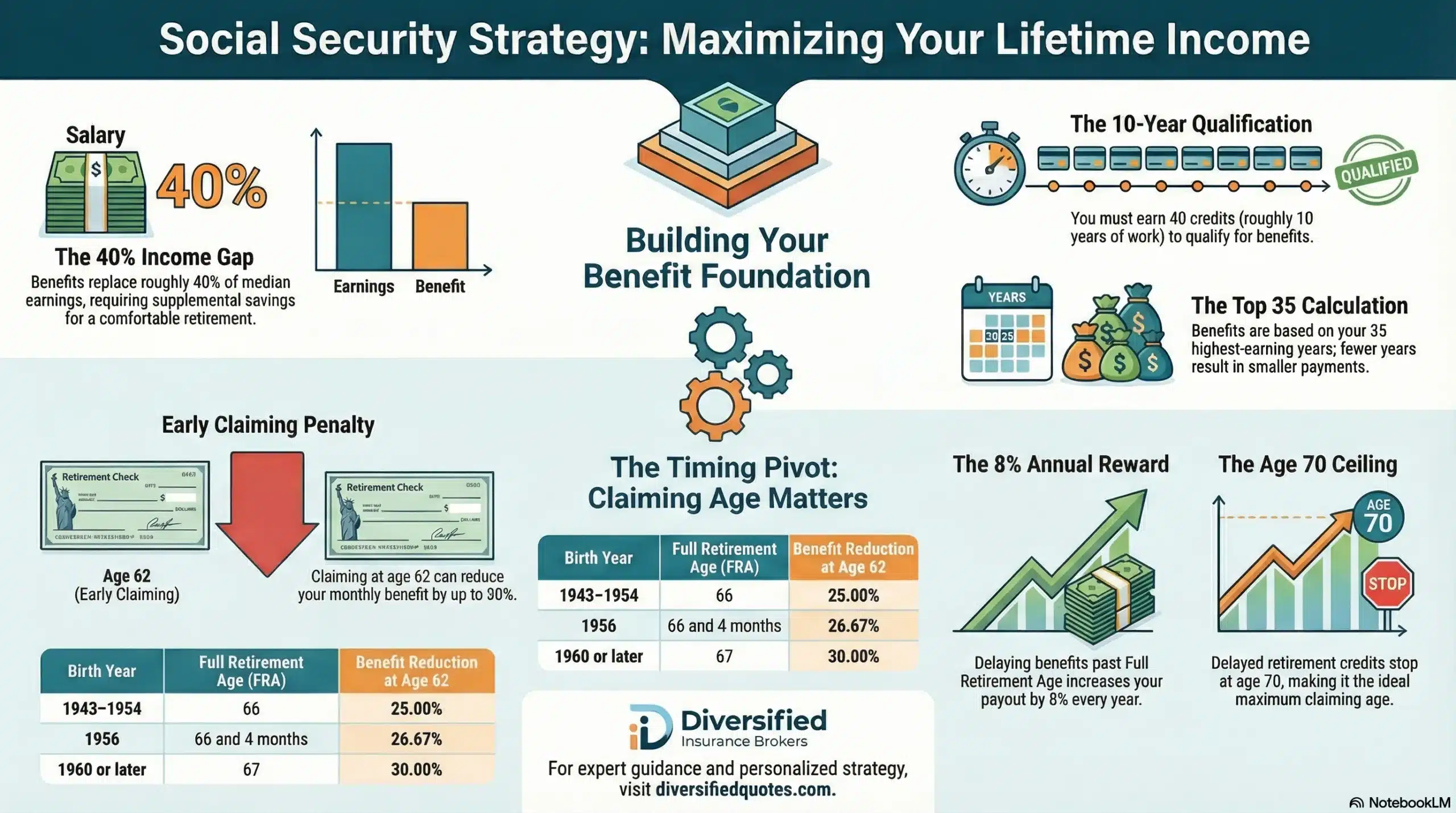
Annual recomputation matters because if a new year of earnings is higher than one of the years currently in your top-35, the system can swap the low year out and the new year in. That increases the average used in your PIA, which increases your monthly benefit. Even a small increase matters because future COLAs build on the higher base. For retirees who had gaps in employment, spent years in lower-paying roles earlier in their career, or experienced their highest-earning years near retirement, this swap mechanism can produce meaningful improvements over time — often without the retiree knowing it is happening, which is precisely why periodic verification matters. Our resource on delayed retirement credits and Social Security payout increases covers the related timing-based mechanisms that also permanently increase the base benefit.
The Three Primary Triggers for Annual Recomputation
| Trigger | What Happens | Timeline | Planning Implication |
|---|---|---|---|
| New covered earnings replace a low or zero year in the top-35 | New year is compared to lowest year in top-35; if higher, it replaces that year and increases PIA | Effective January after earnings year; processing may occur later in the calendar year | Even part-time earnings can trigger if the new year beats a low-earning year in the record |
| Earnings test withholding before Full Retirement Age | Withheld months are credited at FRA; benefit is recalculated as if claimed later, removing some early-filing reduction | Adjustment processed when beneficiary reaches FRA; may include back pay if processing is delayed | Withheld benefits before FRA are not “lost” — the recalculation at FRA partially restores them |
| Post-FRA timing adjustments and delayed retirement credits | Credits for delaying beyond FRA (up to age 70) must be reflected correctly; post-FRA changes are processed on the record | Should be reflected at benefit election; verify record if complexity exists (suspension, return to work, multiple benefit types) | Record verification is inexpensive compared to lifetime impact of an error; double-check if any complexity in the claiming history |
New Covered Earnings Replacing a Low or Zero Year
This is the classic recomputation scenario. If you earn wages (W-2 income) or self-employment income (reported on Schedule SE) after you start benefits, SSA compares each newly completed year of earnings to the lowest year in your current top-35. If the new year is higher — even modestly — it can replace that older low year and increase your PIA. This can happen whether you work full-time or part-time. The key is that the earnings must be covered by Social Security taxes and must be high enough to improve the calculation.
This is where people misunderstand “working while on Social Security.” The earnings test — which withholds benefits before FRA when income exceeds annual limits — is a separate mechanism from recomputation. Recomputation is a long-term calculation improvement; the earnings test is a short-term withholding rule with its own later credit mechanism. For retirees with a history of uneven earnings or gaps in covered employment, recomputation can be a quiet tailwind that gradually increases the base benefit over several years. Our resources on Social Security income limits, whether working past 65 affects Social Security benefits, and our guide on Social Security benefits for the self-employed cover the working-after-claiming framework in full, including how self-employment earnings are posted and how delays in tax filing affect recomputation timing.
Earnings Test Withholding Before Full Retirement Age
If you claim Social Security before Full Retirement Age and earn above the annual earnings limit, SSA withholds benefits — approximately $1 for every $2 earned above the threshold below FRA, and $1 for every $3 above the threshold in the year you reach FRA. The common misconception is that withheld benefits are permanently lost. In most cases, they are not. When you reach Full Retirement Age, SSA recalculates your benefit as though you had claimed later — removing some of the early-filing reduction tied to the withheld months — and that recalculation permanently increases the monthly benefit going forward.
This is one of the most emotionally fraught areas for retirees who experienced withholding and did not know about the later credit. They made decisions about part-time work, lifestyle, and retirement timing based on an incomplete understanding of how the system reconciles the withholding. Our resource on the earnings test after Full Retirement Age covers what changes once FRA is reached — specifically that the earnings test no longer applies, and that the withheld-month credit becomes effective. For retirees currently experiencing withholding, our resource on Social Security advice provides the planning context for making informed decisions about working while collecting before FRA.
When Annual Recomputation Happens and How Back Pay Works
A key reason annual recomputation feels mysterious is the timeline gap between the effective date of an increase and the date SSA actually processes and pays it. In most cases, an earnings-based recomputation increase is effective as of January following the year you earned the wages — but SSA needs finalized earnings data before running the recalculation. For W-2 employees, employers report wages and the system updates once records are finalized, typically later in the year. For self-employed individuals, SSA relies heavily on filed tax returns — meaning extensions, amended returns, or late filing can delay the recomputation by a year or more.
When SSA eventually processes the increase, it issues a notice and pays retroactive benefits covering the months you were owed the higher amount. If your monthly check changes and there is a one-time deposit accompanying it, annual recomputation is one of the first explanations to consider — especially if you continued working, returned to work after claiming, or had an earnings-test withholding history before Full Retirement Age. This is also why maintaining accurate earnings records and periodically verifying your Social Security earnings history is worth the small effort: an unposted year of earnings means recomputation cannot run on correct inputs, and the increase will not occur until the record is corrected. Our resource on the Social Security filing checklist provides the document framework for verifying and correcting your earnings record.
Annual Recomputation vs. COLA: Two Different Things
Annual recomputation and cost-of-living adjustments (COLAs) are frequently confused, but they serve completely different purposes. COLAs apply universally to all Social Security beneficiaries and are tied to inflation — specifically to changes in the Consumer Price Index for Urban Wage Earners and Clerical Workers (CPI-W). Annual recomputation is individualized and depends entirely on your specific earnings record and claiming history. You can receive both in the same year. When that happens, recomputation raises your base benefit and the COLA applies on top of that higher base — a compounding effect that makes a modest recomputation increase more valuable than its immediate dollar amount suggests.
The practical takeaway: a higher base benefit from recomputation is permanently valuable because every subsequent COLA multiplies from a larger starting point. Over a long retirement — particularly one that extends into the late 80s or 90s — even small base increases can compound into meaningful lifetime income improvements. Our resource on how COLA is calculated covers the inflation adjustment mechanism in full, and our broader resource on how to maximize Social Security benefits covers how recomputation fits alongside COLA, delayed credits, and claiming strategy within a complete optimization approach.
How Annual Recomputation Fits Into Retirement Planning
Annual recomputation should not be viewed in isolation. It interacts with claiming age decisions, tax planning, Medicare premium exposure, and the sequence of retirement income withdrawals. Additional post-claiming earnings may increase your Social Security benefit over time through recomputation, but those earnings can also raise combined income, increase the taxation of benefits, and in some households contribute to higher Medicare premiums through IRMAA surcharges. The right strategy is rarely simply “work or don’t work” — it is “work with a plan” so you understand what the work improves and what tradeoffs accompany it.
For the income tax dimension, our resources on whether Social Security is taxable, how to reduce taxes on Social Security, and how to minimize Social Security taxes cover the interaction between additional work income, combined income thresholds, and the portion of Social Security benefits that becomes taxable. For the Medicare premium dimension, our resources on IRMAA planning strategies, what IRMAA is, and our comprehensive guide on how MAGI affects Social Security and Medicare cover the two-year lookback mechanism that can turn a beneficial recomputation year into an unexpected Medicare premium increase two years later. And our guide on how Medicare and Social Security work together provides the integrated coordination framework.
A very common real-world pattern: a retiree claims early for cash flow, keeps working part-time for several years, then stops working around Full Retirement Age. That household might experience earnings-test withholding, a post-FRA recalculation related to withheld months, and annual recomputation as new earnings replace older low years. Without anticipating this sequence, the shifting payments feel inconsistent. When you understand the three triggers and their expected timelines, the changes become predictable — and budgeting becomes significantly more manageable. Our resources on when to start taking Social Security benefits and our guide on delayed retirement credits that boost Social Security provide the claiming timing context within which recomputation decisions operate.
Related Social Security Pages
Earnings rules, COLA mechanics, Medicare timing, tax planning, and Social Security strategy resources from Diversified Insurance Brokers.
Financial Protection Essentials
Medicare coordination, IRMAA planning, tax strategy, and Social Security optimization resources from Diversified Insurance Brokers.
FAQs: Social Security Annual Recomputation
Do I need to apply for annual recomputation?
No — Social Security annual recomputation is an automatic process run by the Social Security Administration. Once your earnings for a completed year are finalized and posted to your earnings record, SSA runs the recalculation without any application or request from you. If the new year of earnings is higher than one of the years currently in your top-35 calculation, SSA will adjust your Primary Insurance Amount and update your monthly benefit accordingly. The increase becomes effective in January following the earnings year, and if processing is delayed, back pay for the months owed at the higher amount is typically included when the update is posted.
Your role is not to trigger the recomputation — it is to verify that your earnings record is accurate and complete so the recomputation has correct inputs to work with. Common issues that prevent recomputation from running correctly include missing earnings years (especially for self-employed individuals whose income depends on filed tax returns), employer reporting delays, and earnings from jobs with multiple employers where one did not properly report. Periodically checking your earnings record through your SSA account allows you to catch and correct these issues before they become multi-year gaps. Our resource on the Social Security filing checklist covers the documentation and verification framework.
When will I see a recomputation increase?
The earnings-based recomputation increase is typically effective in January following the year you earned the wages — but the processing and payment of that increase can occur significantly later in the calendar year. SSA needs finalized wage data before running the recalculation. For W-2 employees, this depends on employer reporting timelines and SSA processing schedules. For self-employed individuals, SSA relies on filed tax returns, which means filing extensions, amended returns, or delayed filing can push the recomputation into the following calendar year.
When SSA processes the increase, it may issue a notice explaining the new monthly amount and pay retroactive benefits covering the months you were owed the higher amount. If you receive a one-time deposit alongside a new monthly payment amount and are wondering why, annual recomputation from post-claiming earnings is one of the most common explanations. For the withheld-months credit that occurs at Full Retirement Age, the timing depends on when you reach FRA and how quickly SSA processes the recalculation — some beneficiaries see the increase the month of their FRA birthday, while others experience a delay with back pay. Our resource on the earnings test after Full Retirement Age covers the FRA transition and the timing of the withheld-month credit in more detail.
Does part-time work really increase my benefit?
Yes — if your part-time earnings in a given year are higher than one of the years currently in your top-35 calculation, that new year can replace the older lower year and increase your Primary Insurance Amount. Even modest part-time income can trigger this improvement if your top-35 includes zero years or very low earning years from gaps in employment, early career, or periods outside covered employment. The threshold is not a fixed dollar amount — it depends entirely on whether the new year beats whatever is currently in the bottom of your top-35.
This is particularly relevant for retirees who had interrupted careers, spent years in lower-paying roles, or whose peak earnings came later in their career after decades of modest income. Each year of part-time work after claiming is compared to the lowest year in the current top-35, and if the new year is higher, the swap occurs and the benefit increases. The increase is small in any given year but permanent — and future COLAs apply to the new, higher base. Over a long retirement, this gradual base improvement from continued part-time work can accumulate into meaningful lifetime income. Our resource on whether working past 65 affects Social Security benefits covers this interaction in the full context of the working-while-collecting decision.
What happens if benefits were withheld before Full Retirement Age?
If you claimed Social Security before Full Retirement Age and earned above the annual earnings limit, SSA may have withheld some or all of your monthly benefits under the earnings test. The important point that most beneficiaries do not know: withheld benefits are typically not permanently lost. At Full Retirement Age, SSA recalculates your benefit as though you had claimed those withheld months later — effectively removing some of the early-filing reduction that was applied for the months where benefits were withheld. That recalculation permanently increases your monthly benefit going forward.
The increase may not be dramatic — each withheld month restores a fraction of the early-filing reduction — but it is real and ongoing for the rest of your life. For beneficiaries who had substantial withholding over multiple years before FRA, the post-FRA recalculation can produce a meaningful permanent increase. The timing of this adjustment depends on when you reach FRA and SSA’s processing schedule; back pay is often included if there is a delay between the FRA date and when SSA processes the recalculation. Understanding this mechanism can also inform decisions about working before FRA — if you expect significant withholding, knowing that the credit occurs at FRA can change how you view the short-term cash flow trade-off. Our resource on Social Security income limits covers the earnings test thresholds and how withholding is calculated for different income levels before FRA.
Is recomputation the same as a COLA?
No — they are entirely different processes that happen to both affect your monthly benefit amount. COLA (Cost-of-Living Adjustment) is inflation-driven and applied universally to all Social Security beneficiaries each year. The adjustment percentage is determined by changes in the CPI-W and applied to every beneficiary’s current payment regardless of their individual earnings history or work status. Annual recomputation is individualized and depends entirely on your specific earnings record, claiming history, and whether new earnings or withheld-month credits produce an increase in your particular case. You can receive both in the same year — and when that happens, recomputation increases your base benefit first, and the COLA then applies to the new higher base.
This compounding interaction is one of the reasons a modest recomputation increase is more valuable than its immediate dollar amount suggests. If recomputation raises your base monthly benefit by $15 and a 2.5% COLA is then applied to the new higher base, your future COLA dollar amounts are also slightly larger than they would have been without the recomputation. Over a 20-to-30-year retirement, that compounding effect on the higher base produces meaningful additional lifetime income. Our resource on how COLA is calculated explains the inflation adjustment mechanism and how it interacts with your base benefit over time.
What are the most common mistakes that delay or reduce recomputation increases?
The most common issue is an inaccurate or incomplete earnings record. Missing wages, incorrect employer reporting, and self-employment income that has not been fully processed can prevent annual recomputation from being applied correctly — or at all. When the record is wrong, recomputation may not occur, or the increase may be smaller than it should be. The practical habit is to periodically verify your earnings history through your SSA account, especially if you changed jobs, had multiple employers in a year, returned to work after claiming, or are self-employed with income that depends on tax filing timelines.
Another frequent issue is timing confusion. Many beneficiaries expect the recomputation increase to appear in January and assume something is wrong when it does not. In reality, recomputation is often processed later in the year and back pay for the owed months is paid at that time. Delays do not always indicate a problem — but a long delay combined with a missing earnings year in the record can be a sign that the earnings were not posted and the recomputation cannot run. For self-employed individuals, this specifically means ensuring that Schedule SE income from your most recently filed return has been posted to your Social Security record, which can lag behind the tax filing date. Our resource on Social Security benefits for the self-employed covers this posting and timing dimension in detail. The third common mistake is misunderstanding earnings-test withholding — assuming those withheld amounts are permanently gone and making overly conservative work and retirement decisions based on that incorrect assumption, when in fact the post-FRA credit restores much of the value.
How does recomputation interact with Social Security tax planning and Medicare premiums?
Annual recomputation improves your Social Security benefit — but the additional earnings that trigger it can also affect your income picture in ways that require coordination. The additional employment income that replaces a low year in your top-35 calculation is reportable income in the year earned, which can increase your combined income for Social Security taxation purposes. If that income pushes your provisional income above the relevant thresholds, more of your Social Security benefit becomes taxable — creating the “tax torpedo” effect where each additional dollar of income causes more than one dollar of additional taxable income through the Social Security inclusion mechanism. Our resources on whether Social Security is taxable and how to reduce taxes on Social Security cover this interaction.
For Medicare, the income from post-claiming work can raise MAGI for the IRMAA two-year lookback, potentially producing Medicare Part B and Part D premium surcharges in the two years following an income-heavy work year. This does not automatically make the work a bad decision — the recomputation benefit to the Social Security base is permanent and lifelong, while the IRMAA surcharge applies only for the specific surcharge years — but it should be factored into the planning analysis. Our resources on IRMAA planning strategies and our comprehensive guide on how MAGI affects Social Security and Medicare cover both dimensions of this income interaction so you can evaluate the net long-term benefit of post-claiming work with accurate cost-benefit clarity.
About the Author:
Jason Stolz, CLTC, CRPC, DIA, CAA and Chief Underwriter at Diversified Insurance Brokers (NPN 20471358), is a senior insurance and retirement professional with more than 25 years of real-world experience helping individuals, families, and business owners protect their income, assets, and long-term financial stability. As a long-time partner of the nationally licensed independent agency Diversified Insurance Brokers, Jason provides trusted guidance across multiple specialties—including fixed and indexed annuities, long-term care planning, personal and business disability insurance, life insurance solutions, Group Health, Travel Medical and Evacuation Insurance, and short-term health coverage. Diversified Insurance Brokers maintains active contracts with over 100 highly rated insurance carriers, ensuring clients have access to a broad and competitive marketplace.
His practical, education-first approach has earned recognition in publications such as VoyageATL, and contributions from his agency featured in Kiplinger and GoBankingRates— highlighting his commitment to financial clarity and client-focused planning. Drawing on deep product knowledge and years of hands-on field experience, Jason helps clients evaluate carriers, compare strategies, and build retirement and protection plans that are both secure and cost-efficient. Visitors who want to explore current annuity rates and compare options across multiple insurers can also use this annuity quote and comparison tool.
Explore All Social Security Planning Guides: Browse our complete Social Security Planning guide — covering filing strategies, spousal benefits, survivor benefits, taxes, WEP, GPO & more.
Last Reviewed: May 20, 2026 |
Reviewed by: Jason Stolz, CLTC, CRPC, DIA, CAA
Chief Underwriter, Diversified Insurance Brokers, Inc. | NPN: 20471358 | Diversified Insurance Brokers, Inc. — Licensed in all 50 states
Fact Checked by: Tonia Pettitt, CMIP©
Medicare Specialist, Diversified Insurance Brokers, Inc. | NPN: 14374308 | Diversified Insurance Brokers, Inc. — Licensed in all 50 states
Did you find this content helpful? Leave us a Google review — it helps others find trustworthy guidance too.
Editorial Standards: Diversified Insurance Brokers maintains rigorous editorial standards to ensure accuracy, clarity, and independence in all content. Learn more about our editorial standards and commitment to transparency.
