
How Social Security COLA is Calculated
How Social Security COLA is Calculated

Every October, tens of millions of Americans wait for a single announcement from the Social Security Administration: the cost-of-living adjustment, or COLA, that will change their monthly benefit checks beginning in January. Understanding how Social Security COLA is calculated matters for two distinct reasons. The first is simply knowing what to expect — how the number is determined, when it is announced, and when the change appears in actual deposits. The second, more consequential reason is understanding why the headline COLA figure rarely translates into the same percentage increase in net income. The interaction between COLA and Medicare Part B premiums, IRMAA surcharges, provisional income thresholds for Social Security taxation, and earnings-limit rules means that the announced adjustment and the actual deposit change are frequently different numbers. Planning around the gross COLA figure without accounting for these offsets produces retirement budgets that disappoint in January. At Diversified Insurance Brokers, Jason Stolz, CLTC, CRPC, DIA, CAA, works with retirees across all fifty states to build income strategies that account for these interactions — including how guaranteed income sources beyond Social Security can reduce dependence on COLA adjustments that never quite keep pace with actual senior spending patterns.
The 2026 Social Security COLA is 2.8 percent, announced by the Social Security Administration on October 24, 2025, following the Bureau of Labor Statistics release of September 2025 Consumer Price Index data. For the average retired worker, this translates to approximately $56 more per month — raising the estimated average benefit from $2,015 to $2,071 before Medicare premium deductions. The formula that produced this result has operated continuously and automatically since 1975, requiring no congressional vote or presidential action, and has a consistent mathematical structure that is worth understanding fully rather than just accepting the announced result at face value. Our resource on Social Security planning services covers the full landscape of decisions that interact with COLA, including claiming age, spousal coordination, and income strategy.
Get a Social Security and Retirement Income Review
See how COLA interacts with Medicare premiums, taxes, and your total retirement income picture — and what you can do to protect your net monthly deposit.
Request a Social Security Income ReviewThe CPI-W Formula: How the COLA Number Is Actually Produced
Social Security COLA is calculated using the Consumer Price Index for Urban Wage Earners and Clerical Workers, known as the CPI-W — a price index published monthly by the Bureau of Labor Statistics that tracks changes in the cost of a basket of goods and services purchased by households where at least half of income comes from wage or clerical employment. The basket includes food and beverages, housing, clothing, transportation, medical care, recreation, education, communication, and other categories. The CPI-W is one of several inflation measures BLS publishes, and its selection as the Social Security COLA benchmark has itself become a subject of ongoing policy debate, because the spending patterns of working-age households captured by the CPI-W differ in meaningful ways from the spending patterns of retirees — particularly in the healthcare and housing categories that consume a disproportionate share of senior budgets.
The calculation uses only a specific three-month window of CPI-W data: July, August, and September — the third quarter of the calendar year. The Social Security Administration averages the CPI-W values for those three months in the current year and compares that average to the highest third-quarter average ever previously recorded. Under the formula specified in Section 215(i) of the Social Security Act, if the current year’s third-quarter average is higher than the prior benchmark, the percentage difference — rounded to the nearest tenth of one percent — becomes the COLA for benefits payable beginning the following January. If the current third-quarter average is not higher than the benchmark, no COLA is applied and benefits remain flat. Benefits cannot be reduced by a negative COLA; the formula produces only increases or zeros, never decreases. Price data for the other nine months of the year — October through June — do not directly enter the COLA calculation, though they influence the trend that ultimately determines the third-quarter reading.
The timeline runs as follows: The Bureau of Labor Statistics releases September CPI-W data each October, typically in the third week. The Social Security Administration announces the COLA on the same day or shortly after. The adjustment takes effect for the December benefit, which is paid in January of the following year. Beneficiaries receive official notification by mail in December, and the new benefit amount is reflected in January deposits. This is why retirees monitoring COLA should be aware that the announced percentage applies to the benefit check received in January, not the one received in December of the announcement year. Understanding the full calendar of Social Security filing and timing decisions helps ensure retirees account for this January-effective structure in their income planning.
The COLA Calculation Step by Step
| Step | What Happens | Example (2026 COLA) |
|---|---|---|
| 1. BLS measures CPI-W monthly | Bureau of Labor Statistics publishes CPI-W each month, tracking price changes in the wage-earner household basket | Monthly CPI-W data published throughout the year |
| 2. Average Q3 of current year | SSA averages CPI-W for July, August, and September of the current year | Average CPI-W for Q3 2025 |
| 3. Compare to prior benchmark | Current Q3 average is compared to the highest Q3 average previously recorded (last year a COLA took effect) | Compared to Q3 2024 average |
| 4. Calculate percentage change | Percent increase is calculated; rounded to nearest tenth of one percent; zero if no increase | Result: 2.8% |
| 5. Announce in October | SSA announces COLA publicly, same day BLS releases September data | Announced October 24, 2025 |
| 6. Applied to December benefit | COLA takes effect for the December benefit, paid in January | January 2026 deposits reflect 2.8% increase |
Why the Headline COLA Is Not What You Actually Receive
The gap between the announced COLA percentage and the actual change in a beneficiary’s net monthly deposit is one of the most practically important and least discussed aspects of Social Security planning. For most retirees enrolled in Medicare Part B, the premium is deducted directly from the Social Security benefit before the check or direct deposit is issued. This means that when Medicare Part B premiums rise — as they do in most years — the premium increase offsets a portion of the COLA before the money ever reaches the beneficiary’s bank account. For the 2026 benefit year, the Medicare Part B standard premium rose by approximately $17.90 per month, from $185.00 to $202.90. The announced COLA increased the average benefit by approximately $56. The net gain for an average-benefit retiree is therefore roughly $38 per month — not the $56 the headline figure suggested. Understanding how Medicare and Social Security work together is essential for accurately projecting what the next year’s deposit will actually be.
The hold-harmless provision in federal law provides a structural protection for most standard-premium Medicare enrollees: the dollar increase in the Medicare Part B premium cannot exceed the dollar increase in the Social Security COLA for beneficiaries who receive Social Security retirement or disability benefits and pay the standard premium through automatic withholding. In years when Medicare premium increases would otherwise fully consume or exceed the COLA dollar amount, hold-harmless prevents the beneficiary’s net deposit from declining below the prior year’s level. For the 2026 benefit year, the average COLA dollar amount exceeded the standard premium increase, so hold-harmless protection was not widely needed — but its existence provides an important floor in years when the arithmetic is less favorable.
IRMAA: The Hold-Harmless Exclusion That Surprises Retirees
Hold-harmless protection does not apply universally. Three specific groups are excluded from its protection. New Medicare enrollees who were not paying premiums through Social Security withholding in the prior year have no baseline deposit to protect against. Beneficiaries who have not yet claimed Social Security but are enrolled in Medicare receive direct billing for premiums rather than withholding, so there is no benefit check to shield. And — most significantly for many financially successful retirees — beneficiaries subject to IRMAA surcharges are entirely excluded from hold-harmless protection.
IRMAA, the Income-Related Monthly Adjustment Amount, is a premium surcharge added to Medicare Part B and Part D costs for beneficiaries whose modified adjusted gross income exceeds certain thresholds. For 2026, the first IRMAA tier begins at $109,000 for single filers and $218,000 for married couples filing jointly, based on MAGI from the 2024 tax return — the two-year lookback that catches many retirees off guard. A retiree who had a high-income year two years prior due to a Roth conversion, a business sale, or required minimum distributions may be paying IRMAA surcharges today without any current income justifying that level of premium. Because IRMAA payers are excluded from hold-harmless, a year in which IRMAA surcharges rise faster than the COLA can produce a situation where the net Social Security deposit actually decreases despite an announced benefit increase. Our resource on IRMAA planning strategies covers how to manage and potentially appeal income-based Medicare surcharges, and our page on how MAGI affects both Social Security and Medicare explains the two-year lookback and its practical implications.
How COLA Interacts With Social Security Taxation
COLA also intersects with the federal income tax treatment of Social Security benefits in a way that erodes its purchasing power further for many retirees. Social Security benefits are subject to federal income tax based on a provisional income formula: adjusted gross income plus tax-exempt interest plus fifty percent of Social Security benefits. The thresholds above which benefits become partially taxable — $25,000 for single filers and $32,000 for married couples at the fifty-percent tier; $34,000 and $44,000 at the eighty-five percent tier — have never been indexed for inflation since they were set in the 1980s and 1990s. Because these thresholds are permanently frozen, a COLA increase that raises the Social Security benefit amount mechanically increases provisional income, which can push a retiree from a lower taxability tier into a higher one or increase the taxable fraction within an existing tier. The practical result is that a portion of every COLA increase is recaptured through higher taxes on Social Security income — an effect that compounds over years of accumulated adjustments applied to frozen thresholds.
This erosion of COLA value through taxation is one of the reasons long-term retirement planning cannot simply rely on Social Security benefits keeping pace with inflation. Our resource on how to minimize Social Security taxes covers the income structuring strategies — including Roth conversions, qualified charitable distributions, and annuity design — that reduce provisional income and limit the tax erosion effect on COLA increases. The companion resource on whether Social Security is taxable explains the full provisional income framework for readers who want to understand the calculation before implementing strategies to manage it.
The CPI-W Criticism: Why COLA Often Falls Short of Actual Senior Costs
The CPI-W measures price changes for urban wage earners and clerical workers — a demographic that is systematically different from the population of Social Security beneficiaries. Retirees spend a larger share of their budget on healthcare and housing relative to working-age households, and a smaller share on transportation and discretionary consumption. Healthcare costs, in particular, have historically risen faster than the broader CPI-W, which means that in most years the CPI-W understates the rate of actual cost increases that retirees experience in their daily lives. The Senior Citizens League, which tracks this dynamic annually, reported that the average Social Security benefit had lost approximately 13.7 percent of its purchasing power since 2010 as measured against actual senior spending patterns — despite receiving a positive COLA in most of those years.
An alternative index, the CPI-E (Consumer Price Index for Americans Aged 62 and Older), has been proposed as a more appropriate benchmark for Social Security COLA calculation. Research comparing historical COLA adjustments under CPI-W versus CPI-E shows that the CPI-E would have produced higher adjustments in most years because of its heavier weighting toward healthcare costs. Whether the CPI-W formula should be replaced with a more senior-appropriate index remains a policy question without legislative resolution, but the practical implication for retirees is clear: assuming COLA will fully protect purchasing power over a multi-decade retirement is an optimistic assumption. Building guaranteed income sources that do not depend on COLA adequacy — and that keep pace with care cost inflation regardless of what the CPI-W produces in any given year — is a more durable retirement income foundation. Our resource on annuities with inflation protection covers how certain annuity structures can provide purchasing-power preservation that tracks actual care and living cost inflation rather than a wage-earner price index. Specifically, the annuity with inflation protection option and the related annuity with inflation protection for seniors are directly relevant for retirees concerned about the long-term adequacy of COLA adjustments.
COLA, Delayed Retirement Credits, and Claiming Strategy
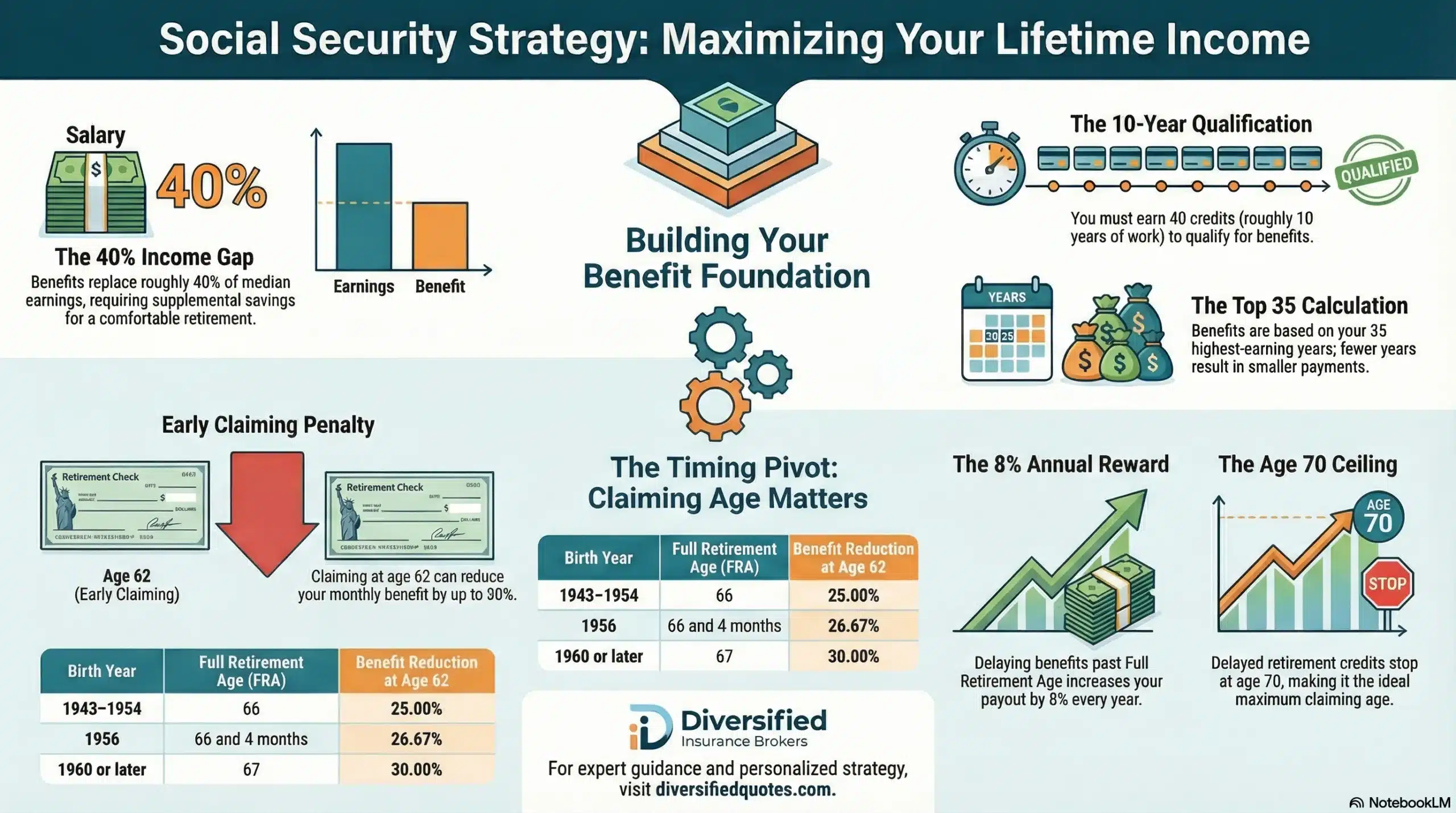
COLA interacts with claiming age in a way that makes the timing of Social Security benefits a compounding financial decision. Delayed retirement credits increase the benefit amount by approximately eight percent for each year a recipient delays claiming beyond full retirement age, up to age seventy. This eight-percent annual credit is permanently embedded in the base benefit — and once embedded, it is also the base on which every future COLA percentage is applied. A retiree who delays from age sixty-seven to seventy and locks in a benefit thirty-two percent higher than their full-retirement-age amount receives that thirty-two percent premium on every future COLA adjustment for the rest of their life.
This compounding dynamic means that delaying Social Security is not merely a decision about the initial monthly amount — it is a decision about the base on which all future inflation protection is calculated. A two-point-eight-percent COLA on a $2,800 monthly benefit produces $78 more per month. The same COLA applied to a $2,000 benefit produces $56. Over twenty years of retirement, that $22 monthly gap between two otherwise identical retirees compounds to a meaningful difference in lifetime income. Our resources on delayed retirement credits and payout increases and when to start taking Social Security benefits cover the claiming age decision in full, including how delayed credits interact with COLA over extended retirement horizons. The related resource on the Social Security annual recomputation explains how earnings continue to be factored into benefit calculations even after benefits begin.
COLA in Context: What It Does and Does Not Solve
COLA is designed to preserve the purchasing power of Social Security benefits relative to the CPI-W. It is not designed to grow benefits in real terms, to compensate for healthcare inflation above the CPI-W rate, to offset Medicare premium increases, to address the tax erosion of rising provisional income, or to provide the kind of guaranteed income floor that a lifetime annuity provides. Each of these gaps represents a real financial risk that COLA alone cannot address.
For retirees whose spending is predominantly covered by Social Security plus a guaranteed annuity income stream, the adequacy of COLA matters less than for retirees who are entirely dependent on Social Security for essential expense coverage. When an annuity covers housing, utilities, food, and healthcare costs through a guaranteed monthly payment that does not depend on CPI-W movements or Medicare premium arithmetic, the Social Security COLA becomes supplemental income rather than a survival necessity. Our resources on annuity options for retirees without pensions, how Social Security and annuities work together, and guaranteed income from annuities address the structural complementarity between Social Security COLA income and contractually guaranteed annuity income. The insight resource on the retirement income gap frames this problem directly: COLA-adjusted Social Security, even at its best, typically leaves a meaningful shortfall between what guaranteed government income provides and what actual retirement expenses require. Bridging that gap is where retirement income planning begins. For further context on managing the full scope of retirement income risk, our resource on protecting your nest egg and the comprehensive key retirement considerations checklist provide practical frameworks for building around Social Security rather than relying on it as a sole foundation.
Frequently Asked Questions: How Social Security COLA Is Calculated
What index is used to calculate Social Security COLA?
Social Security COLA is calculated using the Consumer Price Index for Urban Wage Earners and Clerical Workers, known as the CPI-W. This index is published monthly by the Bureau of Labor Statistics and tracks price changes in a basket of goods and services purchased by households where at least half of income comes from wage or clerical employment. The basket includes food, housing, energy, transportation, medical care, clothing, and other categories. The CPI-W has been used for Social Security COLA calculations since the automatic adjustment mechanism was established in 1975. One important criticism of using CPI-W for Social Security COLA is that it measures spending patterns of working-age households, which differ from the spending patterns of retirees — particularly in the healthcare and housing categories that consume a larger share of senior budgets. A separate index, the CPI-E, tracks prices specifically for Americans aged 62 and older and generally shows higher inflation for that demographic, though it has not been adopted as the official COLA benchmark. For more detail on how claiming decisions interact with COLA over time, see our page on when to start taking Social Security benefits.
When is Social Security COLA announced and when does it take effect?
The Social Security Administration announces the COLA each year in mid-to-late October, on the same day the Bureau of Labor Statistics releases September Consumer Price Index data — the final month needed to complete the third-quarter average that drives the formula. For the 2026 benefit year, the announcement occurred on October 24, 2025, immediately following the BLS release of September 2025 CPI-W data. The announced COLA takes effect for the December benefit, which is paid in January of the following year. Beneficiaries receive official notification letters in December, and the increased benefit amount first appears in January deposits. The calendar has a practical implication: a COLA announced in October 2025 does not reach a beneficiary’s bank account until January 2026. Retirees who are planning their household budget for the coming year should factor in this timing when projecting income for the first quarter.
Can Social Security benefits ever go down because of a negative COLA?
No. The Social Security COLA formula produces only increases or zeros — never a reduction in benefits due to deflation. If the CPI-W third-quarter average for the current year is not higher than the highest prior third-quarter benchmark, the result is a zero-percent COLA and benefits remain at their current level. The adjustment floor is always zero. However, the net deposit a beneficiary receives in their bank account can still decline even in a year with a positive COLA, if Medicare Part B premium increases exceed the dollar amount of the COLA adjustment. The hold-harmless provision prevents this for most standard-premium enrollees — it prohibits the dollar increase in Part B premiums from exceeding the dollar increase in the COLA. But beneficiaries subject to IRMAA surcharges are excluded from hold-harmless protection, meaning their net deposit can decrease when surcharges rise faster than the COLA. Our page on whether Medicare premiums increase covers the Part B premium trend and how it interacts with annual COLA adjustments.
Why does my net Social Security deposit increase by less than the announced COLA percentage?
Several factors reduce the net deposit increase below the headline COLA percentage. The most common is the simultaneous increase in Medicare Part B premiums, which are deducted directly from Social Security benefits before payment is issued. When Part B premiums rise in the same year as a COLA increase, the premium hike offsets a portion of the gross benefit increase. For the 2026 benefit year, the average COLA raised monthly benefits by approximately $56, while the standard Part B premium rose by approximately $17.90 — leaving a net increase of roughly $38 for an average-benefit retiree paying the standard premium. Additional reductions can come from Part D premium increases, IRMAA surcharges for higher-income retirees, and the indirect effect of rising provisional income pushing more Social Security benefits into taxable territory. The announced percentage applies to the gross benefit — what you see in Social Security’s records — while your bank deposit reflects the gross benefit minus all Medicare deductions. For help navigating these interactions, see our resource on how Medicare and Social Security work together.
What is the hold-harmless rule and who does it protect?
The hold-harmless provision is a statutory protection in the Social Security Act that prevents the dollar increase in Medicare Part B premiums from exceeding the dollar increase in a beneficiary’s Social Security COLA. In practical terms, it ensures that the net Social Security deposit cannot fall below the prior year’s deposit for protected beneficiaries, even when Medicare Part B premiums rise faster than the COLA. The protection applies to most beneficiaries who receive Social Security retirement or disability benefits and have Part B premiums automatically deducted from their Social Security checks. Three groups are excluded from hold-harmless protection: new Medicare enrollees who have no prior-year benefit baseline to protect; beneficiaries not yet collecting Social Security who receive direct billing for Medicare rather than withholding; and beneficiaries subject to IRMAA surcharges. The IRMAA exclusion is particularly important — higher-income retirees whose income-based surcharges rise in a year of modest COLA can see their net deposit decrease despite the announced benefit increase. Our IRMAA planning strategies page covers how to manage and potentially appeal income-based premium surcharges.
Does COLA apply to survivor and disability benefits, not just retirement benefits?
Yes. COLA adjustments apply to all Social Security benefit types, including retirement benefits, survivor benefits, Social Security Disability Insurance (SSDI), and Supplemental Security Income (SSI). The same CPI-W formula determines the COLA percentage that applies across all benefit categories, and the adjustment is applied automatically without any action required by the beneficiary. The mechanics of how COLA interacts with specific benefit types can vary — for example, how COLA affects the special minimum benefit or how disability benefit amounts are recalculated can involve additional provisions — but the core adjustment mechanism is universal across the program. Our page on how Social Security disability impacts retirement benefits covers the transition from disability benefits to retirement benefits and how COLA factors into that calculation. Resources on strategies for claiming Social Security for widows and survivor benefits for children address how COLA applies in survivor contexts.
How does delaying Social Security affect the long-term value of COLA?
Delaying Social Security benefits amplifies the long-term value of every future COLA adjustment because delayed retirement credits permanently increase the base benefit on which COLA percentages are applied. Each year of delay beyond full retirement age adds approximately eight percent to the monthly benefit, and once embedded, that increase becomes the permanent base for all future cost-of-living adjustments. A retiree who delays from age sixty-seven to seventy and reaches a benefit of $2,800 per month will receive $78 more per month from a 2.8-percent COLA, compared to $56 more for a retiree with a $2,000 benefit. Over twenty or more years of retirement, this difference in COLA base compounds significantly — making the claiming age decision not just a matter of initial benefit level but a determinant of lifetime inflation protection. The interaction between delay credits and COLA makes the decision to claim early primarily beneficial for those with shorter-than-average life expectancy; for most healthy retirees, delay builds a meaningfully larger COLA-adjusted income stream over the full retirement horizon. See our detailed resource on delayed retirement credits and their impact on your benefit.
Does COLA affect how Social Security is taxed?
Yes, indirectly. COLA increases the monthly Social Security benefit amount, which increases the Social Security component of the provisional income formula used to determine how much of the benefit is subject to federal income tax. Provisional income equals adjusted gross income plus tax-exempt interest plus fifty percent of Social Security benefits. The thresholds above which benefits become taxable — $25,000 for single filers and $32,000 for married couples at the fifty-percent tier; $34,000 and $44,000 at the eighty-five-percent tier — have never been adjusted for inflation. As COLA raises the benefit each year, provisional income rises mechanically, potentially pushing a retiree from a lower taxability tier into a higher one without any change in their other income sources. The result is that a portion of every COLA increase is effectively recaptured through higher taxes on benefits. For retirees near the provisional income thresholds, even a modest COLA can cross a taxation boundary and reduce the after-tax value of the increase. Strategies including Roth conversions before benefit commencement, qualified charitable distributions in lieu of IRA distributions, and non-qualified annuity income that applies the exclusion ratio rather than full taxation can reduce this effect. Our resource on reducing taxes on Social Security covers these strategies in practical detail.
About the Author:
Jason Stolz, CLTC, CRPC, DIA, CAA and Chief Underwriter at Diversified Insurance Brokers (NPN 20471358), is a senior insurance and retirement professional with more than 25 years of real-world experience helping individuals, families, and business owners protect their income, assets, and long-term financial stability. As a long-time partner of the nationally licensed independent agency Diversified Insurance Brokers, Jason provides trusted guidance across multiple specialties—including fixed and indexed annuities, long-term care planning, personal and business disability insurance, life insurance solutions, Group Health, Travel Medical and Evacuation Insurance, and short-term health coverage. Diversified Insurance Brokers maintains active contracts with over 100 highly rated insurance carriers, ensuring clients have access to a broad and competitive marketplace.
His practical, education-first approach has earned recognition in publications such as VoyageATL, and contributions from his agency featured in Kiplinger and GoBankingRates— highlighting his commitment to financial clarity and client-focused planning. Drawing on deep product knowledge and years of hands-on field experience, Jason helps clients evaluate carriers, compare strategies, and build retirement and protection plans that are both secure and cost-efficient. Visitors who want to explore current annuity rates and compare options across multiple insurers can also use this annuity quote and comparison tool.
Explore All Social Security Planning Guides: Browse our complete Social Security Planning guide — covering filing strategies, spousal benefits, survivor benefits, taxes, WEP, GPO & more.
Last Reviewed: June 11, 2026 |
Reviewed by: Jason Stolz, CLTC, CRPC, DIA, CAA
Chief Underwriter, Diversified Insurance Brokers, Inc. | NPN: 20471358 | Diversified Insurance Brokers, Inc. — Licensed in all 50 states
Fact Checked by: Tonia Pettitt, CMIP©
Medicare Specialist, Diversified Insurance Brokers, Inc. | NPN: 14374308 | Diversified Insurance Brokers, Inc. — Licensed in all 50 states
Did you find this content helpful? Leave us a Google review — it helps others find trustworthy guidance too.
Editorial Standards: Diversified Insurance Brokers maintains rigorous editorial standards to ensure accuracy, clarity, and independence in all content. Learn more about our editorial standards and commitment to transparency.
