
Earnings Test after FRA
Earnings Test after FRA
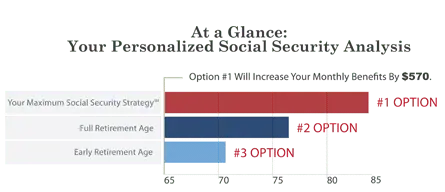
Earnings test after FRA is one of the simplest Social Security rules once you understand the timing: the earnings test ends in the month you reach Full Retirement Age. Once you hit FRA, you can work and earn any amount without Social Security reducing your retirement benefit because of wages. If you claimed earlier and had benefits withheld under the earnings test, Social Security adjusts your benefit at FRA to recognize those withheld months. The rule often feels like a penalty, but it is better understood as a scheduling mechanism that changes when you receive benefits — not whether you are entitled to them.
The confusion around earnings test after FRA usually comes from mixing three separate ideas: the earnings test itself (withholding before FRA), benefit growth from delaying beyond FRA (Delayed Retirement Credits, which apply if you delay filing past FRA up to age 70), and recomputation (how Social Security can adjust your payment if you keep working or had benefits withheld). These three mechanics interact in real life, especially for people who claimed early, kept working, or shifted into “semi-retirement.” This page puts those pieces in plain language so you can see what changes at FRA, what does not change, and how to coordinate the rule with taxes, Medicare, and your retirement income plan.
For one-on-one guidance on how these rules apply to your specific situation, start with our Social Security services page. If you are also coordinating healthcare decisions around age 65, review how Medicare and Social Security work together so you do not confuse “delaying your check” with “delaying Medicare enrollment” — a distinction that has significant financial consequences and that trips up many retirees who assume the two decisions are automatically linked.
Get a Social Security Timing Review
Coordinate your claiming age with work income, Medicare, and taxes for the highest lifetime value.
Social Security Services Medicare & Social Security
What the Earnings Test Is — and What It Is Not
The earnings test is a Social Security rule that can withhold retirement benefits when you claim before Full Retirement Age and continue working above an annual earnings limit. The most important detail is that it targets wages and self-employment income specifically. That means your paycheck can trigger the earnings test, but your investment income does not. Pension payments, IRA withdrawals, annuity income, interest, dividends, rental income, and capital gains can change the taxation of your Social Security benefits, but they do not trigger the earnings test the way wages do. This distinction is among the most commonly misunderstood aspects of the rule, and getting it wrong causes unnecessary anxiety about investment and retirement account withdrawals that are actually irrelevant to the earnings test calculation. For a thorough overview of how the earnings limit applies and the specific current-year thresholds, our resource on Social Security income limits covers the mechanics in full.
People often describe the earnings test as “losing benefits,” which is precisely why the phrase earnings test after FRA matters so much. At FRA, the withholding rule ends entirely. Before FRA, the earnings test may reduce monthly checks in certain months or even result in checks being withheld for an extended period when earnings are significantly above the annual limit. But the intent of the earnings test is to adjust timing — not to permanently eliminate entitlement. If months are withheld, Social Security later adjusts your benefit at FRA to reflect that you effectively received fewer months of early benefits than originally assumed when you filed. The withheld months are credited back in the form of a higher ongoing monthly payment.
Another critical misconception is that the earnings test is the same thing as the income-based taxation of Social Security benefits. It is not. Tax withholding is about the taxes you owe based on combined income from all sources, while the earnings test is a separate benefit-payment rule that can withhold benefits due to wages when you are below FRA. You can have no earnings test at all — if you are past FRA — and still owe income taxes on a significant portion of your Social Security benefit. Conversely, you can have benefits withheld under the earnings test even if your overall tax bill is modest. The two rules operate on entirely separate tracks and should be analyzed separately in any retirement planning conversation. For the taxation side of this picture, our resources on whether Social Security is taxable, reducing taxes on Social Security, and how to minimize Social Security taxes cover the distinct mechanics involved.
What Counts as Earnings Under the Test — and What Does Not
Understanding exactly what Social Security counts as “earnings” for purposes of the earnings test is essential, because the definition is narrower than many people assume. The earnings test applies to wages from employment — including tips and bonuses — and to net earnings from self-employment. These are the income types that Social Security treats as directly tied to your current work activity, and they are the ones that can trigger benefit withholding when you are below FRA.
The following types of income are generally not counted for earnings test purposes: pension payments (whether from a private employer, public employer, or government plan), IRA distributions, 401(k) withdrawals, annuity payments, dividend income, interest income, capital gains, rental income, and investment returns of all kinds. The logic here is that these income sources reflect previously accumulated assets rather than current work effort, and Social Security’s earnings test is specifically designed to interact with current wage activity — not with the broader portfolio of retirement resources a person has built.
For self-employed individuals, the calculation is somewhat more nuanced. The earnings test applies to net earnings from self-employment — meaning gross self-employment income minus allowable business deductions — not to gross revenue. This distinction can be meaningful for business owners who have significant deductible business expenses, because deducting those expenses against gross revenue can reduce net earnings significantly and potentially bring them below the annual earnings limit. The timing of when income is recognized also matters for self-employed individuals, particularly in the year they reach FRA, where the calendar-year structure of the higher earnings limit creates planning opportunities around income timing that salaried employees do not have. Our resource on Social Security benefits for the self-employed addresses these nuances in more detail.
How the Two Withholding Rates Work Before FRA
Before Full Retirement Age, the earnings test applies in two different ways depending on where you are in the timeline relative to FRA. Understanding this two-tier structure helps explain why the same wage level can create very different withholding outcomes depending on which year you are in and how far you are from FRA.
In years that are fully before the calendar year you reach FRA, Social Security applies the standard earnings limit and withholds benefits at a rate of one dollar for every two dollars you earn above the annual limit. This means that for each $2 of wages above the threshold, you lose $1 of benefits. If your wages are sufficiently above the limit, entire months of benefits may be withheld. The earnings limit itself adjusts annually and is tied to wage growth, so the specific threshold changes each year.
In the calendar year you actually reach FRA, Social Security uses a significantly higher earnings limit — approximately three times the standard limit in most recent years — and withholds at a rate of only one dollar for every three dollars earned above that higher threshold. This more generous treatment applies only to the portion of the year before your FRA month. Starting with the month you reach FRA, the earnings test stops completely, regardless of what happens in the rest of that calendar year. This transition creates an important planning opportunity for people who are approaching FRA in a year when they are still working, because the withholding exposure for the months before their FRA month is substantially lower than it was in prior years.
The practical implication of this two-tier structure is that the timing of when you claim relative to your FRA month can matter a great deal. Claiming in January of your FRA year and working through your FRA month exposes you to potential withholding under the higher FRA-year limit. Waiting to claim until your actual FRA month avoids the earnings test entirely from day one. For those who are close to FRA and still working, this timing calculation deserves explicit analysis as part of the claiming decision rather than being treated as an administrative detail.
What Changes at Full Retirement Age
The main point of earnings test after FRA is straightforward: the earnings test ends in the month you reach Full Retirement Age. Once you hit FRA, there is no longer any benefit reduction based on wages, no matter how much you earn. You can work full time, run a business, accept consulting income, take on new employment, or shift into a new career without Social Security reducing your retirement benefit because of your earnings. This is a complete and immediate elimination of the withholding rule — not a phase-out, not a gradual reduction, but a clean stop.
This represents a significant psychological and financial shift for many households, because it changes how risky it feels to claim while working. If you are below FRA and earning strong income, claiming early can create unwelcome surprises when the earnings test withholds checks you were counting on. But once you reach FRA, the withholding rule ends and the planning question changes entirely: should you claim now at FRA and receive the standard benefit, or delay past FRA and earn Delayed Retirement Credits through age 70? That is a completely different calculation from the earnings test question, and it depends on longevity expectations, household income needs, spousal benefit strategy, and tax considerations. For a full explanation of the DRC benefit-growth rule, see Delayed Retirement Credits: Boost Your Social Security and our companion resource on how delayed retirement credits increase Social Security payouts.
Earnings test after FRA also does not mean your payment is permanently fixed at the amount you receive on the day you reach FRA. Your benefit can still change for several distinct reasons: annual cost-of-living adjustments (COLA), recomputation if you keep working and your new earnings replace a lower year in your 35-year record, and — if you had benefits withheld before FRA — the adjustment that credits back those withheld months. These are separate mechanics from the earnings test itself, but they matter for people who keep working into their late 60s, because those additional years of earnings can improve the benefit calculation in meaningful ways. Our resource on Social Security annual recomputation explains exactly how the SSA updates your benefit when additional earnings improve your record.
Earnings Test Before FRA: What It Looks Like in Practice
To fully appreciate earnings test after FRA, it helps to have a concrete understanding of how the pre-FRA version of the rule actually behaves. The earnings test applies when you have claimed retirement benefits and you are under Full Retirement Age. Social Security measures your wages and self-employment income against an annual limit and, when your earnings exceed that limit, withholds benefits according to the applicable withholding rate.
This often shows up in unexpected ways for people who claim at 62 or 63 and continue working. A person who files early for Social Security while still earning a substantial salary may find that Social Security withholds their monthly checks entirely for a portion of the year, then resumes payments later once the withheld amount has been satisfied. This can feel chaotic if the benefit was expected to arrive consistently as a supplemental monthly income. The mechanics are not random, but without understanding the earnings test in advance, the experience can be disorienting.
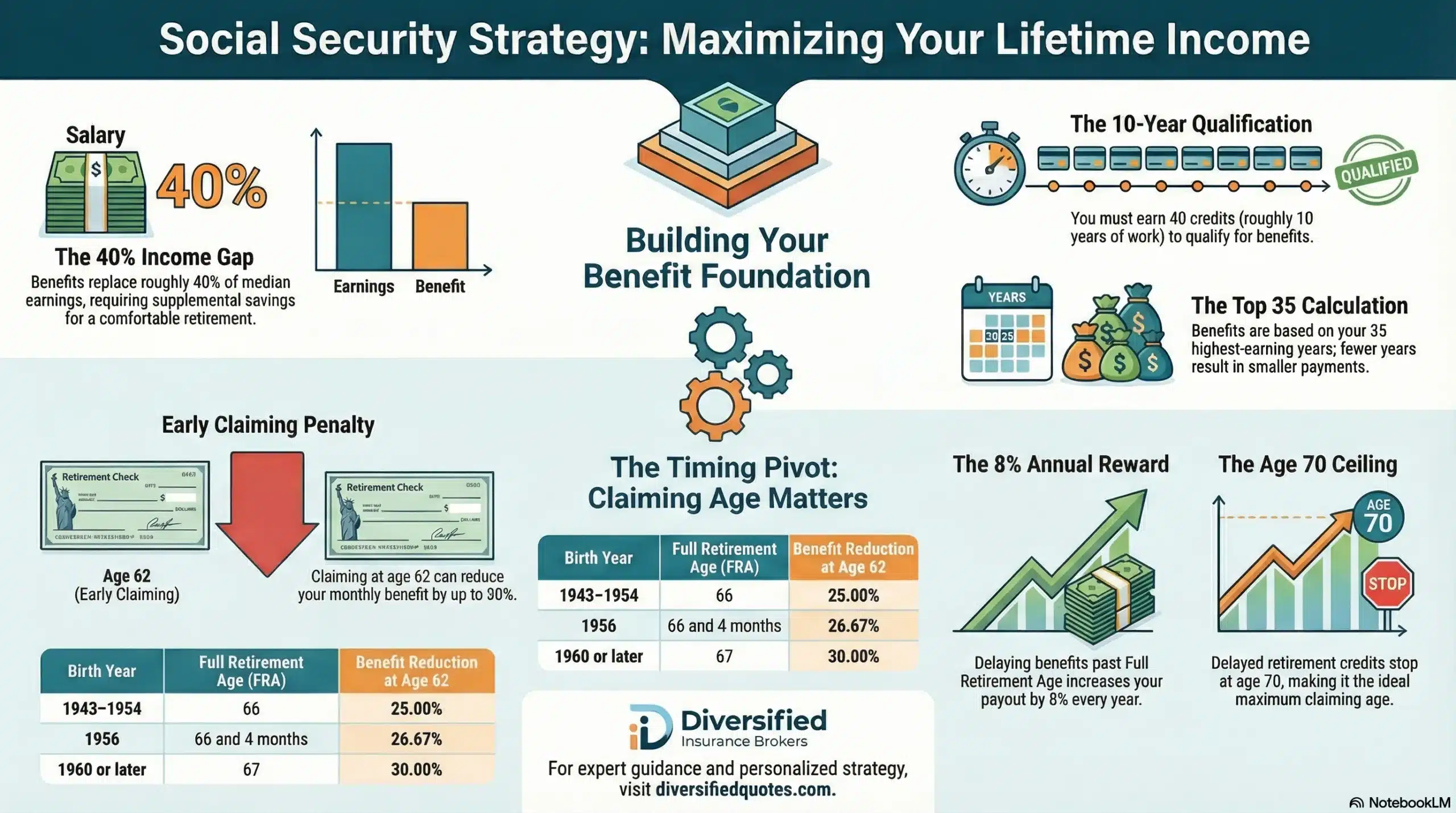
A particularly common confusion arises from the assumption that age 65 is the threshold for ending the earnings test. For Social Security purposes, 65 is not the relevant age — FRA is. For people born in 1955 or later, FRA ranges from 66 and 2 months to 67, depending on birth year. Someone born in 1960 or later has an FRA of 67. If that person claims at 65 and continues working with strong earnings, the earnings test applies for the full two years until they reach 67 — because the test ends at FRA, not at 65. This misunderstanding is one of the most common and most expensive mistakes in Social Security claiming, and it is entirely preventable with a clear understanding of when FRA actually falls. Our resource on when you should start taking Social Security benefits helps frame this timing decision in the context of the full claiming picture.
The Year You Reach FRA: A Transition Window
The calendar year you reach Full Retirement Age is a transition period where the earnings test behaves differently than in prior years. Social Security uses a higher annual earnings limit and a lower withholding rate in this year, and the test applies only up to the month you reach FRA. Starting with your FRA month, earnings test after FRA takes over and the withholding rule stops entirely.
This means that the specific month in which you claim — and the specific month in which your FRA falls — can matter as much as the year in which you make the decision. Someone who turns 67 in November and claims at the beginning of the year has ten months during which the FRA-year earnings test applies (at the higher limit and lower withholding rate). Someone who turns 67 in February and claims in January has only one month of exposure. These are not dramatic differences in most cases, but they are real, and for someone earning significantly above the FRA-year limit, the difference in withheld benefits can be meaningful.
Many retirees reduce their hours, retire mid-year, or accept a severance package around the time they approach FRA. Those income timing details can significantly change whether the earnings test triggers any withholding in the months before FRA. If you are close to FRA and planning a work transition, choosing the right claiming month — with awareness of when wages will be reduced or eliminated — can help you avoid unnecessary withholding and align benefit payments with your actual cash flow needs. This is the kind of analysis that benefits from coordination with an advisor who understands the interaction between employment income and Social Security timing, rather than a generalized rule of thumb about when to file. Our Social Security filing checklist provides a structured framework for working through these timing considerations before you submit your claim.
Are Withheld Benefits Lost? How Social Security Credits Them Back
One of the most important concepts in earnings test after FRA planning is what happens to benefits that were withheld before FRA. The answer, which surprises many people, is that withheld benefits are not simply lost — they are credited back in the form of a higher ongoing monthly benefit once you reach FRA. Social Security recalculates your benefit at FRA to account for the months that were withheld by adjusting the reduction factor that was applied when you claimed early. In practical terms, the system treats you as if you claimed early for fewer months than originally assumed, because some of the early months resulted in no check being paid.
The mechanism works like this: when you file for benefits before FRA, your monthly benefit is permanently reduced from the FRA benefit amount by a specific fraction for each month you claimed early. That reduction factor is calculated based on how many months early you filed. If the earnings test later withholds some of those early monthly checks, Social Security at FRA adjusts the reduction factor to reflect the withheld months — increasing your ongoing monthly payment to partially offset the early filing reduction for the months that were skipped. This adjustment is automatic and does not require you to take any action, but it is worth verifying that your benefit record reflects the correct adjustment if you had a complicated pre-FRA earnings history.
The practical reality is that the credit-back mechanism does not make the “claim early while working” strategy perfectly equivalent to having waited. The mathematics of timing mean that the adjusted benefit will be somewhat higher than what you were receiving before FRA, but whether it fully compensates for the withheld months depends on longevity — how long you live to collect the higher payment. In many cases, households decide to delay claiming until FRA or later simply because the predictability and simplicity of consistent monthly deposits are worth more than the flexibility of claiming early. For households that want to reduce reliance on portfolio withdrawals while they delay Social Security, coordinating with reliable income tools can be valuable. Our Lifetime Income planning page explains how many households build an income floor that works effectively alongside Social Security, particularly during the period between early retirement and the start of benefits.
Model Work + Claiming Month with Confidence
We will compare claiming at FRA versus delaying, and show how the earnings test behaves before FRA.
Start a Social Security Review
Delayed Retirement Credits: The FRA-to-70 Window
Once earnings test after FRA applies and wages no longer reduce your Social Security benefit, the planning conversation shifts to a different and often more valuable question: should you claim your benefit at FRA, or delay further to earn Delayed Retirement Credits? DRCs increase your monthly benefit by a defined percentage for each month you delay past FRA up to age 70. The monthly increase accumulates into a meaningfully higher permanent benefit for retirees who delay, and that higher benefit also serves as the baseline for calculating survivor benefits for a surviving spouse.
For most people, DRCs amount to an 8 percent increase per year of delay beyond FRA, compounding the monthly benefit for each year of deferral between FRA and age 70. A person whose FRA benefit would be $2,500 per month at age 67 could receive approximately $3,100 per month by waiting until age 70 — a 24 percent increase for three years of delay. That is a meaningful difference in lifetime income for anyone who lives into their late 70s or beyond, and for couples where the higher earner’s delay can establish a larger survivor benefit, the long-term household impact can be even more significant. Our dedicated resources on Delayed Retirement Credits: Boost Your Social Security and how delayed retirement credits increase Social Security payout cover the calculations in detail.
The DRC opportunity is one reason that understanding earnings test after FRA matters so much in practical planning: once you reach FRA and the earnings test ends, you enter a window where delaying your claim can meaningfully improve your permanent benefit without any concurrent risk of withholding under the earnings test. Working past FRA while deferring your Social Security claim is a strategy that many households can use effectively, particularly when they have other income sources to cover living expenses during the deferral period. Whether that strategy is right for a specific household depends on health, household longevity expectations, current income needs, tax considerations, and the interplay with spousal benefits — a calculation best done with a comprehensive analysis rather than a general rule of thumb. Our resource on whether you are leaving Social Security benefits on the table provides a useful self-assessment framework.
Can Working After FRA Increase Your Benefit?
Yes — and this is a genuinely important point that many retirees overlook because they assume that once benefits begin, the monthly amount is fixed. In reality, Social Security calculates your retirement benefit using your highest 35 years of indexed earnings. If you keep working after FRA and your new wages represent a year of higher earnings than one of your 35 lowest years on record, Social Security recomputes your benefit and increases your payment to reflect the improved earnings history. This recomputation is performed automatically by Social Security each year based on your updated earnings record, and any resulting increase is applied retroactively to January of the year following the year in which the new earnings were credited.
The magnitude of the increase depends on how much the new earnings year improves relative to the year it is replacing in the 35-year record. For workers with a complete 35-year earnings history of high wages, additional years of work may add little or nothing to the benefit calculation because there are no low-earning years left to replace. For workers with gaps in their work history, years with very low earnings, or career-changers who moved into higher-paying fields later in life, additional years of work after FRA can produce meaningful improvements in the monthly benefit. The Social Security annual recomputation process is the mechanism that captures these improvements, and it operates automatically without requiring any action from the beneficiary.
The practical planning question is not simply “Will my benefit increase?” but “How much will it increase, and does the improvement justify continuing to work for that reason specifically?” For most retirees, the decision to continue working after FRA will be driven by factors other than the incremental benefit improvement — income needs, personal fulfillment, health insurance considerations, or professional engagement. But knowing that the benefit can increase from continued work removes one potential deterrent to part-time or consulting work after FRA, and it reinforces the value of our Social Security advice resources for households making this decision.
Real-World Scenarios: How Earnings Test After FRA Shows Up in Practice
Earnings test after FRA is easy to summarize in the abstract, but real households encounter the rule under diverse circumstances that require nuanced analysis. The following scenario patterns illustrate how the rule behaves across common situations, not to suggest any single strategy is always superior, but to make the mechanics concrete and navigable.
In the most common scenario, someone files for benefits at age 62 or 63 because they want or need the income, then continues working at least part-time. The earnings test withholds checks in months or years when wages exceed the applicable annual limit. When the person reaches FRA, the earnings test ends completely, Social Security adjusts the ongoing benefit to reflect the withheld months, and wages no longer affect benefit payments under this rule. From that point forward, the person can work as much or as little as they choose without any earnings-based benefit reduction, and the only remaining considerations are tax treatment and the DRC decision if they want to consider delaying further.
A second common scenario involves claiming at age 65 under the incorrect assumption that 65 represents full retirement age. For people born in 1960 or later — for whom FRA is 67 — claiming at 65 and working with substantial wages creates two full years of earnings test exposure. Checks may be withheld, the household may receive less income than anticipated, and the experience can create confusion about why Social Security is not delivering what was expected. This scenario is entirely preventable by confirming the specific FRA before filing, something our Social Security filing checklist specifically addresses.
A third scenario involves someone who is working past FRA and deciding whether to claim now or delay to age 70. Once earnings test after FRA applies, wages do not reduce benefits, so the decision becomes a pure comparison between taking the FRA benefit amount now and receiving a higher DRC-enhanced amount later. For couples, the higher earner’s benefit often deserves the longest deferral because the FRA benefit amount determines the survivor benefit floor — the amount a surviving spouse would continue to receive if the higher earner dies first. A lower survivor benefit for decades can represent a far larger financial loss than the DRC income gained during the deferral years, making the claiming decision a household-level analysis rather than an individual one. Strategies for claiming Social Security for widows and our resource on understanding Social Security survivor benefits provide useful context for the survivor dimension of this decision.
A fourth scenario involves self-employed individuals or business owners who have more control over the timing and characterization of their income. For someone approaching FRA who is self-employed, it may be possible to time the recognition of self-employment income to fall after the FRA month, avoiding the earnings test entirely in the final year before FRA. The specific mechanics depend on the nature of the business and the accounting method used, and this type of timing strategy requires coordination with a tax advisor. But the principle is clear: for self-employed individuals, the flexibility to control when income is recognized creates options that wage earners do not have, and those options deserve deliberate analysis rather than passive acceptance of whatever the accounting default produces.
Spousal and Survivor Benefit Interactions
The earnings test applies not only to your own retirement benefit but can also affect spousal benefits that are paid to a spouse based on your earnings record. If a spouse is receiving benefits on your record and you are below FRA when those spousal benefits begin, the earnings test can apply to the spousal benefits being paid — though the mechanics are somewhat complex and depend on whose record the benefit is based on and whether you or your spouse is the one with wages above the earnings limit.
For couples coordinating Social Security strategy, the interaction between the earnings test and spousal benefits is one more reason why claiming timing needs to be analyzed at the household level rather than individually. The goal is to maximize the combined household lifetime income — accounting for the first spouse’s benefit, the second spouse’s spousal benefit, the survivor benefit, and the timing of all those payments relative to both spouses’ ages and health. Our resources on Social Security spousal benefits after divorce, how remarriage affects Social Security spousal benefits, and divorced spousal benefits timing address the spousal benefit mechanics for households with more complex marital histories.
The deemed filing rules for Social Security are also relevant here, because these rules govern whether filing for one type of benefit automatically triggers entitlement to another type. Deemed filing was expanded by the Bipartisan Budget Act of 2015, and it affects when claiming one benefit requires simultaneous claiming of another — a rule that can interact with the earnings test in ways that affect total household benefit receipt. Understanding the deemed filing framework is part of any complete Social Security planning conversation, particularly for households with both individual benefits and spousal benefit eligibility.
Taxes: The Hidden Lever When You Work and Claim
Earnings test after FRA removes one major concern — benefit withholding due to wages — but it does not eliminate the tax conversation. Working while collecting Social Security can raise your combined income, which may increase the portion of benefits that is taxable. Up to 85 percent of Social Security benefits can be taxable as ordinary income when combined income (adjusted gross income plus tax-exempt interest plus half of Social Security benefits) exceeds applicable thresholds. In other words, you can be past FRA with no earnings test at all and still see your after-tax Social Security outcome change significantly if wages and benefits overlap in the same year. Understanding whether Social Security is taxable in your specific situation is fundamental to evaluating the real net value of your claiming strategy.
The goal in Social Security planning is not just the biggest monthly gross check — it is the best net result for your household over time. Some people prefer to delay Social Security while they are working, using the delay years for Roth conversions or planned IRA withdrawals in lower tax brackets before benefits begin. Others start Social Security earlier because it reduces portfolio withdrawals, even if taxes rise slightly on the benefit. There is no universally correct approach, but any solid plan should compare after-tax cash flows across multiple claiming scenarios, not just the gross benefit amounts. Our resources on reducing taxes on Social Security and how to minimize Social Security taxes cover the specific strategies available for managing this tax exposure.
For higher earners, Medicare’s Income-Related Monthly Adjustment Amount (IRMAA) adds another income-sensitive cost that can be affected by the timing of Social Security claiming and earnings. If wages plus Social Security benefits push modified adjusted gross income above the IRMAA threshold, Medicare Part B and Part D premiums increase — sometimes substantially. This income-based premium surcharge is calculated on income from two years prior, so a high-income year this year can create higher Medicare premiums two years from now. For a detailed look at how MAGI interacts with both Social Security and Medicare simultaneously, our resource on how modified adjusted gross income affects Social Security and Medicare provides the integrated analysis. If guaranteed income tools are part of your broader plan, how annuities are taxed and how they interact with Social Security timing is also worth understanding as part of the complete picture.
Medicare and HSA Timing: The Most Common Mistake
Medicare is the area where many people misunderstand earnings test after FRA because they assume that “delaying Social Security” automatically means “delaying Medicare.” They are not the same rule and they are not linked in the way that many retirees assume. You can delay Social Security and still enroll in Medicare on time — and in many cases you must enroll in Medicare at the appropriate time to avoid permanent late-enrollment penalties, regardless of whether you have started collecting Social Security benefits.
The critical distinction is that Medicare Part B enrollment has its own timing rules — primarily based on age 65 and on whether you have qualifying employer coverage — that are entirely separate from your Social Security claiming date. If you are approaching 65 and not covered by qualifying employer-sponsored insurance, enrolling in Part B on time is typically the right choice regardless of your Social Security filing status. Our resources on how to avoid Medicare penalties for late enrollment and on Medicare enrollment for people still working clarify exactly when employer coverage qualifies as a basis for deferring Part B without penalty, and when it does not.
HSA contributions add another layer of complexity for people who are working past 65 and want to keep contributing to a Health Savings Account. Once Medicare enrollment begins, HSA contributions must generally stop — because being enrolled in Medicare disqualifies you from contributing to an HSA regardless of what health plan you are otherwise enrolled in. Additionally, certain Social Security filing decisions can create retroactive Medicare Part A enrollment going back up to six months, which can inadvertently create a period during which HSA contributions made before filing become technically ineligible in retrospect. If you are working and using an HSA, this is an area where slowing down to map the exact timeline before filing for Social Security or Medicare is worth the time. Our comprehensive resource on how Medicare and Social Security interact — how Medicare and Social Security work together — is the starting point for understanding this coordination.
For reviewing Medicare plan options and comparing costs, the Medicare calculator on our site can help you evaluate available plans in the context of your overall retirement income picture. Medicare planning is almost always simpler when treated as a separate decision that must be coordinated with Social Security — not as an automatic consequence of it.
Coordinate Work, Taxes, and Social Security
We will show how claiming month choices affect lifetime income and household stability.
Start Your Social Security Review
WEP, GPO, and the Earnings Test: Three Separate Reductions
For people who worked in jobs not covered by Social Security — primarily certain government positions and some nonprofit roles — two additional benefit-reduction rules can interact with the earnings test in ways that compound the complexity of claiming decisions. The Windfall Elimination Provision and the Government Pension Offset are separate from the earnings test, but all three can apply simultaneously to the same person, creating a layered set of reductions that requires careful analysis.
The Windfall Elimination Provision can reduce the Social Security retirement benefit for workers who receive a pension from employment that was not covered by Social Security, such as certain state and local government jobs or some foreign employment. The reduction is calculated based on the years of substantial Social Security-covered earnings the worker has, with fewer covered years generally producing a larger WEP reduction. This reduction applies before any earnings test calculation, which means that workers subject to WEP need to model their base benefit carefully before layering in the earnings test for the pre-FRA period. Our comprehensive resource on the Windfall Elimination Provision guide covers the calculation mechanics and the circumstances under which WEP applies and does not apply.
The Government Pension Offset is a separate rule that can reduce spousal and survivor benefits when the recipient also receives a government pension from non-covered employment. The GPO reduces the spousal or survivor benefit by two-thirds of the government pension amount, which can in some cases reduce the Social Security benefit to zero. For households with one spouse who worked in covered employment and one who worked in non-covered government employment, the GPO interacts with spousal benefit strategy in ways that must be explicitly modeled. Our resource on the government pension offset explained provides the foundational understanding needed to navigate this interaction.
Strategy Checklist: How to Make the Rule Work for You
Most people do not need a complicated Social Security “hack.” They need a clear framework that keeps the major moving parts in view and prevents the timing mistakes that are both common and costly. Earnings test after FRA is one of those major moving parts — once you hit FRA, wages no longer reduce benefits under the earnings test, and the claiming and deferral decisions that follow become much simpler. The following steps outline the planning framework that turns this knowledge into action.
The first step is confirming your Full Retirement Age with precision. FRA is the anchor for earnings test after FRA, and the rule is tied to the specific month you reach FRA — not to the year, not to age 65, and not to any other general milestone. If you do not know your FRA month, you risk assuming the earnings test has ended when it has not, or missing the window to coordinate your claiming date with your work transition for maximum effect. Knowing the specific month you reach FRA is more useful than knowing the year.
The second step is mapping your wages by year and by month through the period when you will be below FRA. If you are working and considering claiming before FRA, you want to estimate whether and to what extent the earnings test is likely to withhold benefits in the years before FRA, and particularly in the months before your FRA month in the year you turn FRA. This mapping exercise does not need to be perfectly precise, but it should be close enough to avoid claiming under the earnings test when the withholding exposure would eliminate most of the benefit you expected to receive.
The third step is verifying the benefit adjustment at FRA if you had benefits withheld before FRA. People sometimes miss the fact that Social Security adjusts the ongoing benefit at FRA to credit back withheld months, and the adjustment is not always communicated proactively. Verifying that your benefit record reflects the correct adjustment — by reviewing your Social Security statement or contacting the SSA directly — ensures you are receiving the correct amount going forward. Our how to apply for Social Security resource and our Social Security filing checklist both cover documentation and record verification as part of the claiming process.
The fourth step is deciding whether delaying beyond FRA fits your plan. Once earnings test after FRA applies, the decision becomes whether to claim now at the FRA benefit amount or delay for a higher permanent check through Delayed Retirement Credits. This is especially important for couples where the higher earner’s delay can enhance the survivor benefit for the lower-earning spouse. See how to maximize Social Security benefits for a comprehensive overview of the strategies available for optimizing the claiming decision across a full household.
The fifth and final step is coordinating taxes and Medicare as a distinct exercise from the earnings test itself. Even without the earnings test, wages plus Social Security benefits can materially change your tax picture. Medicare timing can create permanent penalties if mishandled, and HSA contributions can be affected by Medicare enrollment in ways that are not obvious. Use the Medicare and Social Security coordination resource as your baseline, compare Medicare plan options with the Medicare calculator, and run the numbers through our Social Security services page for a coordinated household-level analysis.
Schedule a Free Social Security Consultation
We will review your work income, claiming month options, Medicare timing, and tax impact — so you can file with confidence.
Related Social Security Pages
Use these guides to coordinate working, claiming, and household Social Security strategy.
Financial Protection Essentials
Planning around work and taxes is easier when your income sources are coordinated.
Schedule a Free Social Security Consultation
We’ll review your work income, claiming month options, Medicare timing, and tax impact—so you can file with confidence.
FAQs: Earnings Test After FRA
Does the earnings test apply after FRA?
No. Starting with the month you reach Full Retirement Age, the earnings test ends entirely and your Social Security retirement benefit is not reduced because of wages or self-employment income — regardless of how much you earn. You can work full time, run a business, or accept any amount of employment income without it triggering benefit withholding under the earnings test. This is a complete elimination of the rule, not a phase-out or gradual reduction.
The earnings test after FRA distinction matters because many people confuse FRA with age 65. The earnings test is tied specifically to Full Retirement Age — which ranges from 66 to 67 depending on birth year — not to age 65. Claiming at 65 and continuing to work with substantial earnings can still trigger benefit withholding for anyone whose FRA has not yet been reached. Confirming your exact FRA month before filing is the single most important step in avoiding this common mistake. Our resource on when to start taking Social Security benefits provides a framework for making this decision with full awareness of the earnings test timeline.
What happens to benefits withheld before FRA?
Benefits withheld under the earnings test before FRA are not permanently lost. At Full Retirement Age, Social Security recalculates your benefit to credit back the months that were withheld by adjusting the early filing reduction factor. In practical terms, the system treats you as if you claimed early for fewer months than you actually did, because some of those early months resulted in withheld rather than paid checks. This adjustment is applied automatically by Social Security — you do not need to request it — and typically results in a higher ongoing monthly payment compared to what you were receiving before FRA.
The credit-back mechanism does not always fully replicate the benefit you would have received by waiting to claim at FRA in the first place. Whether the adjusted benefit fully compensates for the withheld period depends on how many months were withheld, the size of the adjustment, and longevity — how long you live to collect the higher payment. Many households decide to simply delay claiming until FRA to avoid the uncertainty, particularly when they have other income sources and do not need Social Security to cover essential expenses in the pre-FRA period. Our Lifetime Income planning page covers how to build an income floor that supports this kind of delay strategy.
Can working after FRA still increase my Social Security check?
Yes. Even after you begin receiving Social Security benefits, continuing to work can increase your monthly payment through a process called recomputation. Social Security calculates your retirement benefit using the highest 35 years of your indexed earnings history. If you keep working after FRA and your new earnings represent a year that is higher than one of your existing 35 recorded years, Social Security automatically recomputes your benefit and increases your payment to reflect the improved history. This recomputation is performed annually and any increase is applied retroactively to January of the year following the year in which the new earnings were recorded.
For workers with complete high-earning histories, additional years of work may add little to the calculation because there are no low-earning years to replace. For workers with gaps, low-earning years, or career changes that led to higher pay later in life, continued work after FRA can produce meaningful improvements in the monthly benefit. Our resource on Social Security annual recomputation explains how this process works in detail and what documentation to review to verify that recomputation adjustments are being applied correctly to your benefit.
Should I delay filing if I am still working?
If you do not need the income, delaying beyond FRA allows you to earn Delayed Retirement Credits of approximately 8 percent per year through age 70, producing a permanently higher monthly benefit. For couples, the higher earner’s delay is especially important because the FRA benefit amount establishes the survivor benefit floor — the amount a surviving spouse would continue to receive if the higher earner dies first. A higher claiming benefit means a larger survivor benefit, which can have major implications for household financial security across potentially decades of widowhood.
If you are still working past FRA and do not need Social Security to cover current expenses, delaying allows you to earn DRCs while your wages cover day-to-day costs — effectively earning a guaranteed 8 percent annual increase on the deferred benefit. This is particularly attractive in environments where other guaranteed returns are lower. However, the decision also involves tax considerations, because Social Security income stacked on top of wages can push more of the benefit into taxable status. Running the after-tax numbers across multiple claiming scenarios — rather than just the gross benefit amounts — is the right way to make this decision. See reduce taxes on Social Security for strategies that can improve the after-tax outcome regardless of when you claim.
Does investment income trigger the earnings test?
No. The earnings test is tied specifically to wages and net self-employment income — income directly tied to current work activity. Investment income of all types — including dividends, interest, capital gains, rental income, pension payments, IRA distributions, 401(k) withdrawals, and annuity payments — does not trigger the earnings test and cannot cause benefit withholding under this rule, regardless of amount. This means that a retiree with substantial investment income and no wage income has no earnings test exposure at all, even if they claimed before FRA.
Where investment income does matter is in the taxation of Social Security benefits and in Medicare premium calculations. Combined income — defined as adjusted gross income plus tax-exempt interest plus half of Social Security benefits — determines what percentage of your benefit is taxable, and substantial investment income can push combined income above the thresholds where 50 or 85 percent of benefits become taxable. This is a distinct calculation from the earnings test and operates under entirely different rules. Our resources on whether Social Security is taxable and how MAGI affects Social Security and Medicare cover this taxation question in detail.
Can I enroll in Medicare without starting Social Security?
Yes. Medicare enrollment and Social Security claiming are separate decisions governed by separate rules, and enrolling in one does not require enrolling in the other. You can delay Social Security to earn Delayed Retirement Credits and still enroll in Medicare at the appropriate time — which for most people is at or near age 65, depending on employer coverage status. If you are approaching 65 and not covered by qualifying employer-sponsored insurance, enrolling in Medicare Part B on time is typically the right choice regardless of your Social Security filing intentions, because late enrollment carries permanent penalty premium increases.
The misconception that Social Security and Medicare must start simultaneously is one of the most common and potentially costly errors in retirement timing decisions. Our resource on how Medicare and Social Security work together and our guide on how to avoid Medicare penalties for late enrollment provide the coordination framework needed to handle both decisions correctly. The Medicare calculator on our site can help you evaluate plan options and costs in the context of your broader retirement income picture.
How does the earnings test interact with spousal benefits?
The earnings test can affect spousal benefits in addition to the claiming spouse’s own benefit, though the mechanics are complex and depend on whose earnings are above the limit and whether both spouses have filed. In general, if the worker whose earnings record the spousal benefit is based on is below FRA and has wages above the earnings limit, the earnings test can affect both the worker’s own benefit and the spousal benefit payments — though the specific rules about which benefits are withheld first and in what sequence depend on SSA’s calculation methodology.
For couples coordinating Social Security strategy, the interaction between the earnings test, spousal benefits, and survivor benefits needs to be analyzed at the household level. The higher earner’s claiming decision affects not only their own benefit but also the spousal benefit available to the lower earner and the survivor benefit the lower earner would receive if the higher earner dies first. Resources like how to maximize Social Security benefits and the deemed filing rules for Social Security cover the spousal and household claiming strategy in the detail needed to make well-informed decisions.
How does the earnings test affect self-employed individuals differently?
For self-employed individuals, the earnings test applies to net earnings from self-employment rather than gross revenue. This means that business expenses deducted against gross revenue can reduce net earnings below the annual earnings limit, even when gross revenue is above it. For business owners with significant deductible expenses, this distinction can meaningfully reduce or eliminate earnings test exposure in some years — a planning opportunity that wage earners do not have.
Self-employed individuals also have more flexibility over the timing of when income is recognized, particularly in the year they approach FRA. By timing the receipt or recognition of self-employment income to fall after the FRA month, it may be possible to avoid earnings test withholding entirely in the final year before FRA even while continuing to operate the business. The mechanics of income timing for self-employment purposes require coordination with a tax advisor, because the rules about when self-employment income is considered earned differ by business structure and accounting method. Our resource on Social Security benefits for the self-employed addresses the specific earnings test mechanics for self-employed individuals in more detail.
About the Author:
Jason Stolz, CLTC, CRPC, DIA, CAA and Chief Underwriter at Diversified Insurance Brokers (NPN 20471358), is a senior insurance and retirement professional with more than 25 years of real-world experience helping individuals, families, and business owners protect their income, assets, and long-term financial stability. As a long-time partner of the nationally licensed independent agency Diversified Insurance Brokers, Jason provides trusted guidance across multiple specialties—including fixed and indexed annuities, long-term care planning, personal and business disability insurance, life insurance solutions, Group Health, Travel Medical and Evacuation Insurance, and short-term health coverage. Diversified Insurance Brokers maintains active contracts with over 100 highly rated insurance carriers, ensuring clients have access to a broad and competitive marketplace.
His practical, education-first approach has earned recognition in publications such as VoyageATL, and contributions from his agency featured in Kiplinger and GoBankingRates— highlighting his commitment to financial clarity and client-focused planning. Drawing on deep product knowledge and years of hands-on field experience, Jason helps clients evaluate carriers, compare strategies, and build retirement and protection plans that are both secure and cost-efficient. Visitors who want to explore current annuity rates and compare options across multiple insurers can also use this annuity quote and comparison tool.
Explore All Social Security Planning Guides: Browse our complete Social Security Planning guide — covering filing strategies, spousal benefits, survivor benefits, taxes, WEP, GPO & more.
Explore More: Browse our complete Social Security Planning guide — covering filing strategies, FRA, earnings test & retirement income coordination from 100+ carriers.
Last Reviewed: May 20, 2026 |
Reviewed by: Jason Stolz, CLTC, CRPC, DIA, CAA
Chief Underwriter, Diversified Insurance Brokers, Inc. | NPN: 20471358 | Diversified Insurance Brokers, Inc. — Licensed in all 50 states
Fact Checked by: Tonia Pettitt, CMIP©
Medicare Specialist, Diversified Insurance Brokers, Inc. | NPN: 14374308 | Diversified Insurance Brokers, Inc. — Licensed in all 50 states
Did you find this content helpful? Leave us a Google review — it helps others find trustworthy guidance too.
Editorial Standards: Diversified Insurance Brokers maintains rigorous editorial standards to ensure accuracy, clarity, and independence in all content. Learn more about our editorial standards and commitment to transparency.
