
Strategies for Claiming Social Security for Widows
Strategies for Claiming Social Security for Widows

Strategies for claiming Social Security for widows represent one of the most financially consequential — and least well-understood — areas of retirement planning. Unlike the standard Social Security claiming decision, which involves a single benefit and a single timing question, the widow or widower’s claiming decision involves two distinct benefit types — a survivor benefit based on the deceased spouse’s earnings record and your own retirement benefit based on your own work history — that can be claimed at different times and in different sequences to produce very different lifetime income outcomes. The flexibility to claim one benefit first and switch to the other later when it is larger is a unique feature of survivor benefits that does not exist for most other Social Security beneficiaries — and it is the feature that creates the planning opportunity most widows and widowers never fully exploit. At Diversified Insurance Brokers, we help surviving spouses model the complete picture: which benefit to claim first, at what age, and when to switch — all anchored to the household’s actual income needs, work plans, retirement savings, and long-term health outlook. Getting the strategies for claiming Social Security for widows right can mean the difference of hundreds of dollars per month — permanently — for decades of retirement.
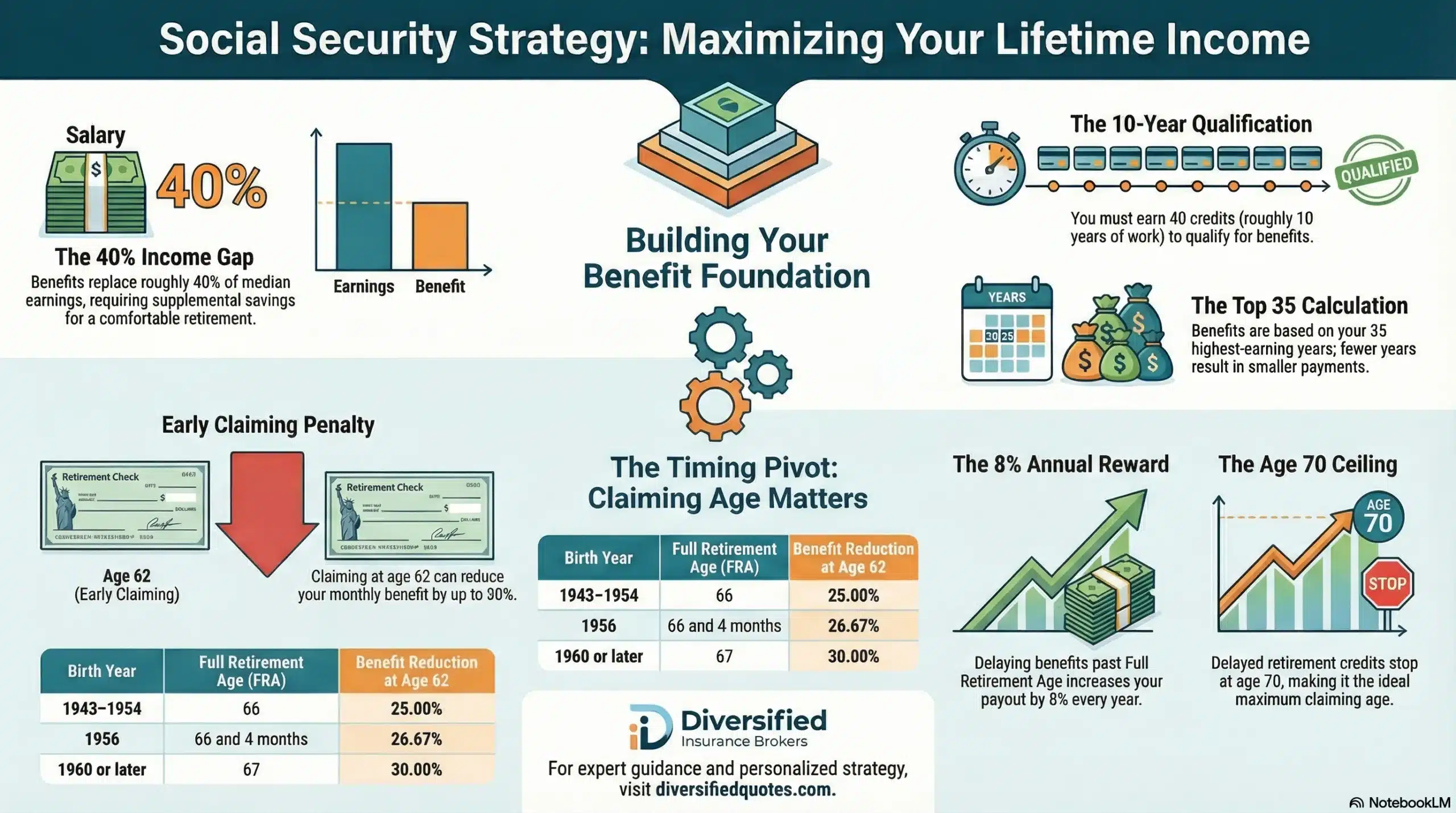
The foundational context for strategies for claiming Social Security for widows begins with a simple fact: survivor benefits and your own retirement benefit grow at different rates and follow different rules. Your own retirement benefit can grow by approximately 8% per year for every year you delay past Full Retirement Age, up to age 70. Survivor benefits do not grow past survivor Full Retirement Age in the same way — the maximum survivor benefit is available at survivor FRA regardless of further delay. This asymmetry is what creates the most powerful widow claiming strategies: use the survivor benefit to create income during the years before your own retirement benefit reaches its maximum, then switch. Our resource on delayed retirement credits covers how your own benefit grows with delay, and our resource on maximize Social Security benefits covers the broader lifetime optimization framework.
Get a Personalized Survivor Benefit Claiming Plan
We’ll confirm your survivor benefit eligibility, model claiming ages from 60 through FRA, and identify the switching strategy that protects the most lifetime income for your specific situation.
Explore Our Social Security ServicesHow Social Security Survivor Benefits Work — The Foundational Facts
Strategies for claiming Social Security for widows begin with understanding how the survivor benefit itself is structured. Social Security survivor benefits are paid to eligible widows and widowers based on the deceased spouse’s lifetime earnings record. If your spouse worked long enough to be insured under Social Security — which most workers who maintained consistent employment are — a monthly survivor benefit is available to you as the surviving spouse. The key foundational facts that determine how strategies for claiming Social Security for widows are applied are: the earliest eligible claiming age, the impact of claiming before or after survivor Full Retirement Age, and the interaction with your own retirement benefit.
The earliest age for survivor benefits — age 60 — is two full years earlier than the earliest claiming age for any other Social Security benefit type. If you are disabled and your disability began within seven years of your spouse’s death, you may be eligible to claim survivor benefits as early as age 50. If you are any age and are caring for your deceased spouse’s child who is under 16 or disabled, you may receive 75% of the deceased’s benefit regardless of your own age. These are the exception categories that can make income available much earlier than the standard age 60 window.
The survivor Full Retirement Age (FRA) determines when the survivor benefit becomes payable at its maximum amount — up to 100% of the deceased spouse’s benefit. The survivor FRA differs slightly from the standard retirement FRA: for those born between 1945 and 1956, the survivor FRA is generally 66; for those born in 1962 or later, it is 67; and for those born between 1957 and 1961, it rises gradually. This distinction matters for strategies for claiming Social Security for widows because the survivor FRA is the age at which you can receive the full survivor amount, and any claiming before survivor FRA produces a permanent proportional reduction.
Survivor Benefit Amounts at Different Claiming Ages — The Reduction Schedule
| Claiming Age | Survivor Benefit Percentage | Example: $2,500 Deceased FRA Benefit | Strategic Consideration |
|---|---|---|---|
| Age 60 (earliest) | ~71.5% of deceased’s FRA benefit — permanent reduction | ~$1,788/month | Use this if: immediate income needed AND you plan to switch to larger own benefit at 70 |
| Age 62 | ~80% range — varies by exact birth year and survivor FRA | ~$2,000/month | Slightly better than age 60; still significantly reduced from FRA amount |
| Age 65 | ~90% range — continues rising toward FRA | ~$2,250/month | Medicare eligibility starts at 65 regardless of Social Security timing |
| Survivor FRA (66 or 67 depending on birth year) | 100% of deceased’s benefit amount — no further increase available | $2,500/month | If survivor benefit is your primary lifelong income, this is often the optimal claiming age |
| After Survivor FRA (e.g., 68, 69, 70) | Still 100% — survivor benefits do NOT increase past survivor FRA | $2,500/month — same as at FRA | No benefit to delaying survivor benefits past FRA — claim at FRA if this is the long-term choice |
The table reveals the most important structural insight in strategies for claiming Social Security for widows: unlike your own retirement benefit which continues to grow at approximately 8% per year through age 70, survivor benefits reach their maximum at survivor FRA and stop growing. This means that delaying a survivor benefit past survivor FRA produces no additional income — making the survivor FRA the natural “maximum” claiming age if the survivor benefit is the primary income source. For strategies that involve eventually switching to your own retirement benefit, this distinction is critical: you want to delay your own benefit (which keeps growing) rather than the survivor benefit (which has already maxed).
Why Widow Claiming Strategy Is Uniquely Powerful — The Switching Option
The most distinctive and most valuable feature of strategies for claiming Social Security for widows — one that does not exist for standard retirement or spousal benefit situations — is the ability to claim one benefit type now and switch to the other later when it becomes more advantageous. This switching flexibility means that widows effectively have two independent benefit streams that can be sequenced strategically rather than being forced to choose one permanently at the outset.
For most Social Security beneficiaries, a filing decision is largely permanent — once you file for your own retirement benefit, delayed retirement credits stop accumulating and the monthly amount is set. Widows are different. A widow who files for survivor benefits at age 62 is not simultaneously filing for her own retirement benefit. Her own retirement benefit continues to grow with delayed retirement credits for every year she does not claim it, up to age 70. She can claim the survivor benefit to create income during her 60s, and then at 70 switch to her own retirement benefit if it has grown to be larger than the survivor benefit. Alternatively, she can claim her own benefit first and later switch to the survivor benefit at survivor FRA if the survivor benefit is ultimately larger. The sequencing decision — which benefit first, when to switch — is the heart of strategies for claiming Social Security for widows that produce the strongest lifetime income outcomes. Our resource on delayed retirement credits and payout increases covers exactly how your own benefit grows each year you delay beyond FRA.
The Social Security Fairness Act 2025 — Critical Change for Government Employees
One of the most important developments for strategies for claiming Social Security for widows in recent years occurred with the passage of the Social Security Fairness Act, which took effect in January 2025. This legislation repealed two provisions — the Government Pension Offset (GPO) and the Windfall Elimination Provision (WEP) — that had previously reduced or eliminated Social Security survivor benefits for certain government employees.
Before this change, public school teachers, firefighters, police officers, state and local government workers, and others who received government pensions from jobs not covered by Social Security had their Social Security survivor benefits reduced or eliminated by the Government Pension Offset. A widow who received a $2,000 government pension monthly could see her Social Security survivor benefit reduced by approximately two-thirds of that pension amount — potentially reducing a $1,500 survivor benefit to zero. The Social Security Fairness Act repealed this offset entirely. Government workers who were previously receiving reduced or eliminated survivor benefits due to the GPO are now entitled to their full survivor benefits without reduction. For widows who are government employees or who are married to government employees, this represents a potentially dramatic increase in monthly Social Security survivor income that should be confirmed directly with the SSA and factored into current and future income planning.
How the Deceased’s Own Claiming Decision Affects the Survivor Benefit
A critical but frequently overlooked element of strategies for claiming Social Security for widows is understanding how the deceased spouse’s own Social Security claiming decision directly determines the base amount the survivor benefit is calculated from. The timing choice the deceased made — or did not make — before death creates a floor and ceiling for the surviving spouse’s benefit that cannot be retroactively changed.
If the deceased claimed their own retirement benefit before their FRA — at 62, 63, 64, or 65 — their monthly benefit was permanently reduced by early claiming. However, the survivor benefit is not simply what the deceased was receiving at death in all circumstances. Social Security protects the survivor to some degree through what is often called the “limited benefit” rule: the survivor can receive the greater of (a) what the deceased was actually receiving at death, or (b) 82.5% of the deceased’s FRA benefit amount. This floor prevents the worst early claiming decisions from producing an extremely low survivor benefit, but it still means that a deceased spouse who claimed early produced a lower maximum survivor benefit than one who waited.
If the deceased reached their FRA before death without claiming, the survivor benefit is based on 100% of the FRA amount. If the deceased delayed to 70 and collected the expanded benefit for years before death, the survivor benefit equals what the deceased was receiving — a substantially larger amount than the FRA benefit. This means that a spouse who maximizes their own benefit by delaying to 70 also maximizes the survivor benefit their widowed partner will receive for the rest of their life. This powerful interlocking of the deceased’s claiming decision and the survivor’s lifetime income is one of the strongest arguments for a couple to deliberately sequence claiming — with the higher earner delaying as long as possible — as part of joint strategies for claiming Social Security that protect the surviving spouse. Our resource on what a joint lifetime income annuity is covers the parallel concept in annuity planning where similar joint protection mechanics apply.
Strategy 1 — Claim Survivor Benefits First, Switch to Your Own Benefit at 70
The most frequently optimal strategy among strategies for claiming Social Security for widows — particularly when the widow has a substantial own work history — is to claim survivor benefits first to create income during the 60s, while allowing the own retirement benefit to continue accumulating delayed retirement credits toward the age-70 maximum. Then, at 70, switch from the survivor benefit to the own benefit if the own benefit has grown larger.
This strategy works most powerfully when the widow’s own retirement benefit at 70 is expected to exceed the survivor benefit at survivor FRA. For a widow whose own FRA benefit is $1,800 and who delays to 70, the own benefit grows to approximately $2,232 (assuming the standard 8% annual delayed credit). If the survivor benefit at FRA would be $1,900, the widow’s own benefit at 70 ($2,232) becomes the better long-term income stream. By claiming the survivor benefit first — even at a slightly reduced amount if claiming before survivor FRA — the widow creates meaningful income during her 60s while leaving her own benefit untouched to compound toward its maximum. The net result over a long retirement is often substantially higher lifetime income than any alternative sequence.
The specific amount the survivor benefit pays during the claim-first period depends on when between age 60 and survivor FRA the widow claims. A widow who can wait until survivor FRA to claim the survivor benefit receives the full 100% amount while simultaneously leaving her own benefit accumulating. A widow who needs income sooner can claim the survivor benefit at 62 or 64 at a partial amount while still protecting the own benefit’s growth toward 70. The key strategic insight is that the specific age of the survivor benefit claim is less important than the commitment to not touching the own retirement benefit until it has reached a materially larger amount. Our resource on when should you start taking Social Security benefits covers the decision framework for timing choices in the broader claiming context.
Strategy 2 — Claim Your Own Benefit First, Switch to the Survivor Benefit at FRA
The reverse strategy — claiming your own retirement benefit first, then switching to the survivor benefit at survivor FRA — is the strongest approach when the survivor benefit is ultimately expected to be larger than the own retirement benefit and when the widow needs some income during the years before survivor FRA while preferring not to permanently reduce the survivor benefit through early claiming.
This strategy is most common among widows with relatively modest own earnings records — perhaps someone who spent significant years out of the workforce raising children or who worked in part-time or lower-wage positions — whose own FRA benefit might be $900 while the deceased spouse’s benefit (and thus the maximum survivor benefit at FRA) is $2,100. By claiming the own benefit first — even at a reduced amount due to early claiming — the widow creates a bridge of income while the survivor benefit remains unclaimed and available at its full amount when survivor FRA is reached. The bridge income from the own benefit is modest, but the full survivor benefit beginning at survivor FRA can be substantially larger and provides a permanent step-up in monthly income.
The trade-off to understand in this strategy is that claiming the own retirement benefit early permanently reduces it. A widow who claims her own benefit at 62 locks in a permanently reduced own benefit for the rest of her life — which matters if she later needs to switch back to her own benefit or if circumstances change. In most cases where the survivor benefit is clearly larger than the own benefit, this trade-off is acceptable because the own benefit was never going to be the primary long-term income source. But if there is genuine uncertainty about which benefit will ultimately be larger — particularly for widows with moderate own earnings records — modeling both strategies with actual numbers before filing is essential to making the right sequence decision. Our resource on Social Security filing checklist covers the preparation steps for any filing decision, and our resource on how to apply for Social Security covers the mechanics of the application process when the strategy is clear.
Strategy 3 — Wait Until Survivor FRA for the Maximum Survivor Benefit
For widows whose survivor benefit will be their primary — or only — meaningful Social Security income stream, and for whom near-term income from Social Security is not essential, waiting until survivor FRA to claim the survivor benefit at its maximum amount is often the cleanest strategy. This approach eliminates the permanently reduced monthly amount that results from claiming between 60 and FRA, provides the highest possible survivor benefit for the full duration of retirement, and avoids the complexity of multiple switching decisions.
The practical prerequisite for this strategy is having another income source available from the time of the spouse’s death until survivor FRA — typically 66 or 67. That bridge income might come from continued employment, retirement savings withdrawals, an inherited account, or other household income sources. Planning the bridge explicitly — identifying the income source, the withdrawal amount, and the tax implications of the bridge — is as important as the Social Security decision itself. A widow who waits until 67 to claim a $2,500 survivor benefit rather than claiming at 62 for a $2,000 survivor benefit receives $500 more per month permanently from that point forward — but must fund a 5-year income gap during the waiting period. Our resource on how Social Security and annuities work together covers how an annuity strategy can serve as the bridge income during a Social Security delay window — a particularly relevant approach for widows who want to maximize the survivor benefit while maintaining income stability during the wait. Our resource on best annuity for guaranteed income in retirement covers the annuity structures most commonly used alongside Social Security planning.
The Remarriage Rules — Where the Age 60 Line Falls
Remarriage rules represent one of the most consequential and least widely known elements of strategies for claiming Social Security for widows. Remarrying before age 60 generally terminates eligibility for survivor benefits based on the deceased spouse’s record — a permanent loss of what is often the largest monthly income available to a surviving spouse. Remarrying at age 60 or later typically does not affect survivor benefit eligibility — the remarriage after 60 leaves the survivor benefit intact and available regardless of the new marriage.
The practical planning implication is straightforward but emotionally sensitive: widows who are considering remarriage before their 60th birthday should understand that the Social Security survivor benefit from the deceased spouse will generally be permanently lost. The monthly value of that lost benefit, compounded over a 20 to 30-year retirement, can reach hundreds of thousands of dollars in lifetime income. This does not mean the remarriage decision should be made based on Social Security rules — personal and relationship considerations are paramount — but the financial impact should be explicitly understood before the decision is finalized rather than discovered afterward.
There is an additional provision that provides some flexibility: if a remarriage that occurred before age 60 later ends in divorce or death of the new spouse, the widow may regain eligibility for the original survivor benefit from the first spouse. This restoration of eligibility is not automatic and requires filing a new claim with SSA confirmation of the original eligibility. For widows whose situation includes prior divorce history — for example, a widow who was divorced from the deceased spouse and later widowed — additional eligibility rules apply that are covered in our resource on divorced spousal benefits timing.
Children, Dependents, and Multiple Survivor Benefit Streams
Strategies for claiming Social Security for widows with dependent children involve additional benefit streams that can meaningfully support household income during the years between a spouse’s death and the widow’s own retirement. Children under 18 (or up to 19 if still in high school, or any age if disabled before 22) of the deceased worker may be eligible for their own survivor benefits equal to 75% of the deceased’s FRA benefit per child, subject to a family maximum benefit that limits total household Social Security income based on the deceased’s earnings record.
The family maximum benefit is the most important planning consideration when dependent children are involved: the combined total of all family members’ benefits from one worker’s record is capped at approximately 150% to 180% of the deceased worker’s FRA benefit. When multiple family members — a surviving spouse and one or more children — all qualify for survivor benefits from the same deceased worker, the individual amounts may be proportionally reduced to stay within the family maximum. Understanding how the family maximum affects each individual’s benefit amount, and how it changes as children age out of eligibility, helps inform how the surviving widow times her own benefit claims as the household income picture evolves over time.
The 2025 Earnings Test for Widows Still Working
Many widows claim survivor benefits while still working — particularly those widowed in their early 60s who are not yet retirement-age. For widows who are working and collecting Social Security survivor benefits before their Full Retirement Age, the Social Security earnings test applies: in 2025, Social Security withholds $1 in benefits for every $2 in work earnings above $22,320 for the year. In the year the widow reaches FRA, a higher threshold applies with a less aggressive reduction formula. After FRA, the earnings test disappears entirely — the widow can earn any amount from work without affecting survivor benefits.
The withholding mechanism is frequently misunderstood as a permanent loss. It is not. Benefits withheld under the earnings test result in a recalculation at FRA that increases the monthly benefit going forward to partially compensate for the withheld amounts. The practical planning issue is cash flow management: if the widow expects work income to exceed the threshold significantly, claiming survivor benefits before FRA may produce very little net monthly income due to withholding, and delaying the survivor benefit claim until FRA (or until work income falls below the threshold) may be the cleaner practical approach. Our resource on Social Security income limits covers the earnings test mechanics in detail, and our resource on earnings test after FRA covers how the rules change when FRA is reached.
Taxes, the Widow’s Penalty, and IRMAA
A frequently overlooked dimension of strategies for claiming Social Security for widows is the tax environment that surrounds benefit timing. The death of a spouse creates a significant change in tax filing status — from Married Filing Jointly (with its lower marginal rates and higher standard deduction) to Single or Qualifying Widow (with higher effective tax rates on the same income). This shift — sometimes called the “widow’s penalty” — means that a surviving spouse may face higher taxes on Social Security benefits, retirement account withdrawals, and investment income than the couple faced together even when the total household income has decreased.
For strategies for claiming Social Security for widows, this tax context affects how survivor benefit income interacts with other income sources. Social Security benefits become taxable at the federal level when combined income (AGI plus half of Social Security benefits) exceeds $25,000 for single filers — up to 50% of benefits may be taxable above this threshold, and up to 85% above $34,000 (these thresholds are not indexed to inflation and have remained unchanged since the 1980s). Managing the provisional income calculation — sequencing withdrawals from taxable and tax-deferred accounts, considering Roth conversions during low-income years, and evaluating qualified charitable distributions — can meaningfully reduce the effective tax on survivor benefits. Our resource on how to reduce taxes on Social Security covers the provisional income framework and planning strategies, our resource on qualified charitable distributions guide covers the QCD strategy for IRA owners over 70½, and our resource on IRMAA planning strategies covers how income management affects Medicare premium surcharges that often increase in the widow years.
Build Your Personalized Survivor Benefit Strategy
We confirm eligibility, model all three claiming strategies with your actual numbers, identify the optimal switching month, and coordinate the Social Security decision with taxes, Medicare, and annuity income planning.
Explore Social Security Planning ServicesRelated Social Security Planning Resources
Explore the complete Social Security landscape — claiming age, delayed credits, income limits, taxes, Medicare, and advanced strategies.
Financial Protection Essentials for Widows
Connect Social Security widow strategies with annuity income planning, tax management, and retirement income security.
Schedule a Social Security Consultation
We’ll confirm the best survivor strategy, model switching options, and help you choose the cleanest filing month.
Frequently Asked Questions: Strategies for Claiming Social Security for Widows
When can I start Social Security survivor benefits as a widow?
Survivor benefits can begin as early as age 60 — two full years earlier than any other Social Security benefit type. If you are disabled and the disability began within seven years of your spouse’s death, benefits can start as early as age 50. If you are any age and caring for the deceased spouse’s child who is under 16 or disabled, you may receive 75% of the deceased’s benefit regardless of your own age. Claiming before your survivor Full Retirement Age (typically 66 or 67 depending on your birth year) permanently reduces the monthly amount — from approximately 71.5% at age 60 rising to 100% at survivor FRA. After survivor FRA, the survivor benefit does not continue to increase, making survivor FRA the natural maximum claiming age for this benefit type.
Can I take survivor benefits first and switch to my own benefit later?
Yes — and this is one of the most valuable features of strategies for claiming Social Security for widows. Unlike most Social Security beneficiaries, widows and widowers can claim one benefit type now and switch to the other later when it has grown or become more advantageous. Claiming survivor benefits first while letting your own retirement benefit accumulate delayed retirement credits through age 70 is the most common and often most financially powerful approach for widows with a meaningful own work history. Your own retirement benefit grows approximately 8% per year for every year past FRA you delay, while the survivor benefit has already reached its maximum at survivor FRA and gains nothing from further delay. Sequencing the survivor benefit first while the own benefit grows typically produces the highest total lifetime income.
What changed for government employees with the 2025 Social Security Fairness Act?
The Social Security Fairness Act, effective January 2025, repealed both the Government Pension Offset (GPO) and the Windfall Elimination Provision (WEP). Before this change, public school teachers, firefighters, police officers, and other government workers who received pensions from jobs not covered by Social Security had their survivor benefits reduced by approximately two-thirds of their government pension amount — often dramatically reducing or completely eliminating their Social Security survivor benefit. The repeal means that government employees who were previously receiving reduced or eliminated survivor benefits are now entitled to their full survivor benefits. Widows who are government employees or who were married to government employees should confirm their updated benefit amount directly with the SSA.
Does the deceased spouse’s claiming decision affect my survivor benefit?
Yes, significantly. If the deceased claimed their own retirement benefit before their FRA, the survivor benefit is limited to the greater of (a) what the deceased was receiving at death, or (b) 82.5% of the deceased’s FRA benefit. If the deceased claimed at FRA, the survivor benefit at survivor FRA is 100% of the FRA amount. If the deceased delayed to 70 and was receiving a larger benefit at death, the survivor benefit equals that larger amount — meaning the deceased’s delay directly and permanently increases what the survivor receives. This is why planning while both spouses are alive should include the higher earner deliberately delaying Social Security as long as possible — it protects the survivor’s lifetime income, not just the claiming spouse’s benefit.
Do I lose survivor benefits if I remarry?
Remarrying before age 60 generally terminates eligibility for survivor benefits based on the deceased spouse’s record — a permanent loss of often substantial lifetime income. Remarrying at age 60 or later typically does not affect survivor benefit eligibility at all — the remarriage after 60 leaves the survivor benefit intact and available for the rest of your life. If a pre-age-60 remarriage later ends in death or divorce, original survivor benefit eligibility may potentially be restored. For widows who are divorced from the deceased spouse (rather than married at time of death), the same remarriage rules generally apply, provided the marriage lasted at least 10 years.
What is the 2025 earnings limit if I work while collecting survivor benefits?
In 2025, if you collect Social Security survivor benefits before your Full Retirement Age and your work earnings exceed $22,320 for the year, Social Security withholds $1 in benefits for every $2 earned above that limit. In the year you reach FRA, a higher threshold applies with a less aggressive reduction formula. After reaching FRA, the earnings test no longer applies and you can earn any amount from work without affecting benefits. Withheld amounts are not permanently lost — they trigger a recalculation at FRA that increases your monthly benefit going forward to partially compensate. For widows whose work income significantly exceeds the threshold, delaying the survivor benefit claim until FRA or until work income falls below the threshold is often the cleanest practical approach.
Are Social Security survivor benefits taxable?
They can be, depending on your total income. Social Security benefits become taxable when combined income (AGI plus half of Social Security benefits) exceeds $25,000 for single filers. Up to 50% of benefits may be taxable above this threshold, and up to 85% may be taxable above $34,000 for single filers. Widows face a particular challenge because the transition from Married Filing Jointly to Single status increases the effective tax rate on the same income — the “widow’s penalty.” Coordinating survivor benefit timing with retirement account withdrawals, Roth conversions in lower-income years, and qualified charitable distributions can meaningfully reduce the effective taxation of survivor benefits and should be part of the complete claiming strategy.
About the Author:
Jason Stolz, CLTC, CRPC, DIA, CAA and Chief Underwriter at Diversified Insurance Brokers (NPN 20471358), is a senior insurance and retirement professional with more than 25 years of real-world experience helping individuals, families, and business owners protect their income, assets, and long-term financial stability. As a long-time partner of the nationally licensed independent agency Diversified Insurance Brokers, Jason provides trusted guidance across multiple specialties—including fixed and indexed annuities, long-term care planning, personal and business disability insurance, life insurance solutions, Group Health, Travel Medical and Evacuation Insurance, and short-term health coverage. Diversified Insurance Brokers maintains active contracts with over 100 highly rated insurance carriers, ensuring clients have access to a broad and competitive marketplace.
His practical, education-first approach has earned recognition in publications such as VoyageATL, and contributions from his agency featured in Kiplinger and GoBankingRates— highlighting his commitment to financial clarity and client-focused planning. Drawing on deep product knowledge and years of hands-on field experience, Jason helps clients evaluate carriers, compare strategies, and build retirement and protection plans that are both secure and cost-efficient. Visitors who want to explore current annuity rates and compare options across multiple insurers can also use this annuity quote and comparison tool.
Explore All Social Security Planning Guides: Browse our complete Social Security Planning guide — covering filing strategies, spousal benefits, survivor benefits, taxes, WEP, GPO & more.
Last Reviewed: May 25, 2026 |
Reviewed by: Jason Stolz, CLTC, CRPC, DIA, CAA
Chief Underwriter, Diversified Insurance Brokers, Inc. | NPN: 20471358 | Diversified Insurance Brokers, Inc. — Licensed in all 50 states
Fact Checked by: Tonia Pettitt, CMIP©
Medicare Specialist, Diversified Insurance Brokers, Inc. | NPN: 14374308 | Diversified Insurance Brokers, Inc. — Licensed in all 50 states
Did you find this content helpful? Leave us a Google review — it helps others find trustworthy guidance too.
Editorial Standards: Diversified Insurance Brokers maintains rigorous editorial standards to ensure accuracy, clarity, and independence in all content. Learn more about our editorial standards and commitment to transparency.
