
Deemed Filing Rules for Social Security
Deemed Filing Rules for Social Security

Deemed filing rules for Social Security determine what happens when you apply for retirement benefits and you also qualify for a spousal benefit. For most people today, filing for one benefit is treated as filing for both. That means Social Security evaluates your eligibility for your own retirement benefit and any spousal benefit you qualify for in the same month, then pays the combined result you are entitled to under the rules — starting with your own retirement benefit first and adding any eligible spousal “excess” amount on top of it. This is one of the most misunderstood Social Security rules because it directly affects strategies many couples still assume are available. A common belief is that someone can “take a spousal benefit now” and “switch to their own later.” In most modern cases, that spousal-only move is not available. If you are entitled to both benefits in the same month, your filing is deemed to include both, and Social Security will pay your own benefit plus any spousal excess you qualify for based on age and entitlement rules.
Understanding when deemed filing applies — and when it does not — helps you avoid timing mistakes that can permanently reduce household income, weaken survivor protection, and lock you into a claiming path you did not intend. The goal is simple: you should file intentionally, not accidentally. On this page, we walk through how deemed filing works in real life, who it affects, the major exceptions, and how to time retirement, spousal, and survivor benefits so your filing strategy supports the bigger picture — monthly cash flow, Medicare timing, and household protection. Our broader resource on how to maximize Social Security benefits covers the full strategic framework within which deemed filing decisions sit, and our Social Security filing checklist provides a practical pre-filing reference for confirming the key decisions before you apply.
Deemed Filing Confusing? Get a Timing Review
We model retirement, spousal, and survivor options month-by-month so you understand exactly what deemed filing will do before you apply.
Schedule a Social Security ReviewDeemed Filing: Does It Apply to Your Benefits?
Before examining the mechanics in detail, it helps to have a consolidated view of which benefit types are subject to deemed filing and which are not — because the scope of the rule determines the scope of your strategy. Many people assume deemed filing applies to all Social Security situations when they hear about it, but the reality is more targeted. The table below maps the primary benefit combinations to their deemed filing status.
Deemed Filing Rules for Social Security: Applicability by Benefit Type
| Benefit Combination | Deemed Filing Applies? | Birth Date Context | Key Notes |
|---|---|---|---|
| Own retirement + Spousal (married) | Yes | Born on or after Jan 2, 1954 | SS pays own benefit first; spousal excess added if spouse’s record supports higher combined amount |
| Own retirement + Divorced spousal | Yes (generally) | Born on or after Jan 2, 1954 | Must meet divorced spouse eligibility rules; own benefit pays first; divorced spousal excess added if applicable |
| Restricted application (spousal only) | Limited / Phased out | Born before Jan 2, 1954 only | Only in specific circumstances; must be verified before relying on it; not available for those born after Jan 1, 1954 |
| Own retirement + Survivor (widow/widower) | No | Any birth date | Deemed filing does NOT apply to survivor benefits; flexible claiming sequences available for widows and widowers |
| Child-in-care spousal benefits | Varies | Any age | Different rules from standard spousal retirement framework; specialized review required |
The table above establishes the scope: deemed filing applies to the retirement-plus-spousal combination for most modern filers, but not to survivor benefits — which is where significant planning flexibility still exists for widows and widowers. Everything that follows builds from this foundation. Our resource on Social Security advice covers the broader claiming framework, and our resource on divorced spousal benefits timing covers the specific timing considerations for the divorced spouse scenario.
Deemed Filing Rules: The Basics in Plain English
“Deemed filing” means that if Social Security considers you eligible for both your own retirement benefit and a spousal benefit in the same month, your application is treated as an application for both — even if you believed you were applying for only one. This is not a choice Social Security offers you at the window. It is a rule about how your application is processed when eligibility overlaps in the same month.
In real life, you do not receive two separate checks. You receive one combined payment. Social Security pays your own retirement benefit first. Then, if your spouse’s record supports additional spousal benefits above your own benefit, Social Security adds the difference as a spousal excess amount. This is why the idea of “taking spousal benefits” can be misleading. For most modern filers, you are not choosing one benefit or the other. You are filing, and Social Security calculates the best combined result you qualify for under the deemed filing rules.
The plain-English takeaway is this: for most people, there is no longer a “spousal-only” application. When you file and you are eligible for both benefits in the same month, Social Security will evaluate both and pay the combined outcome allowed under the rules. It is also important to understand that deemed filing is not just an abstract technical rule. It can change real monthly income, it changes the household’s long-term survivor picture, and it reduces flexibility once you are locked into a claiming path. That is why couples should treat filing as a household decision rather than two independent decisions that happen to occur around the same time.
Who Deemed Filing Applies To
Deemed filing applies to most people who are entitled to both their own retirement benefit and a spousal benefit around the same time. The most important dividing line is whether a person can still use the older “restricted application” strategy. That strategy allowed certain people to file for spousal benefits only at full retirement age and delay their own retirement benefit to earn delayed retirement credits. Most people can no longer do that because of rule changes tied to date of birth.
In general, people born on or after January 2, 1954 are subject to deemed filing for retirement and spousal benefits. That means if you are eligible for both benefits in the same month and you apply, Social Security treats your application as applying for both. People born before that date may have limited situations where a restricted application remains possible, but eligibility depends on timing and entitlement rules and is not something to assume. Our resource on delayed retirement credits covers how the delayed credit system interacts with benefit start dates, which is directly relevant to understanding why restricting a claim to spousal-only was valuable before deemed filing made it unavailable for most filers.
Deemed filing also applies to many divorced spouse scenarios. If you meet the divorced spousal eligibility rules — such as qualifying marriage duration and current unmarried status — and you are also eligible for your own retirement benefit in the same month, deemed filing typically means Social Security will pay your own retirement benefit first and then add any eligible divorced spousal excess on top of it. People often ask whether deemed filing applies if the spouse has not yet filed. The answer depends on whether you are actually entitled to both benefits in the same month. If you are not entitled to spousal benefits yet because the worker’s benefit status or entitlement conditions are not met, deemed filing may not be triggered until you are actually entitled. That month-by-month entitlement detail is where many surprises happen, which is why we emphasize “entitlement month” rather than just “age.”
How Social Security Actually Pays Under Deemed Filing
Many people picture spousal benefits as a separate benefit that replaces their own retirement benefit. In practice, Social Security treats your retirement benefit as the base layer of your payment. If you qualify for spousal benefits, Social Security evaluates whether your spouse’s record supports a higher total amount than your own retirement benefit alone. If it does, Social Security adds the difference as the spousal excess. That combined amount is your monthly payment.
This matters because your claiming age affects both parts of the equation. Your own retirement benefit is reduced if you claim before full retirement age and increased if you delay past full retirement age, up to age 70. Spousal benefits also have their own reduction rules if claimed before full retirement age. In many households, the decision of “who should claim when” becomes a balancing act between short-term cash flow and long-term protection — especially survivor protection.
Another point that creates confusion is the belief that spousal benefits equal exactly half of the spouse’s benefit. In many conversations, people say “I can get 50 percent of my spouse’s Social Security.” The reality is more nuanced. Spousal benefit calculations reference the worker’s primary insurance amount at full retirement age. Reductions may apply depending on when the spouse claims. And if the spouse has their own retirement benefit, Social Security pays that first and then adds only an excess amount (if any). That is why many people who expect a large spousal check are surprised when their combined payment is not dramatically higher than their own retirement benefit — they were eligible for spousal benefits, but the spousal benefit was mostly offset by their own retirement benefit.
Deemed filing does not create a penalty by itself. It simply removes the ability to choose a “spousal-only” filing strategy in most cases. The flexibility people lose is the ability to separate the two benefits and grow one while collecting the other. Once you accept that the filing is combined when you are eligible for both benefits, the strategy becomes about choosing the best timing for the household rather than trying to separate the benefits. The interaction of Social Security and annuities adds another dimension to this timing decision for households building a guaranteed income foundation from both sources.
When Deemed Filing Does Not Apply
Deemed filing is broad, but it is not universal. The major exception — and the one that creates the most planning opportunity for the people who need it — is survivor benefits.
Deemed filing does not apply to survivor (widow/widower) benefits. That creates a powerful flexibility: a surviving spouse can often choose a sequence of benefits that produces a better lifetime outcome. In many cases, the surviving spouse can claim one type of benefit first and later switch to the other. That can be valuable when one benefit grows larger over time. A widow might choose to claim a reduced survivor benefit at 60 and let her own retirement benefit grow to age 70, producing maximum income later. Or she might claim her own retirement benefit first at a moderate level and later switch to a larger survivor benefit if the deceased spouse had a significantly higher earnings record. Neither sequence is available in the standard married-and-living spousal benefit framework under deemed filing. Our resource on strategies for claiming Social Security for widows covers these survivor benefit sequences in detail, and our resource on Social Security survivor benefits for children covers the related rules for households with qualifying dependent children.
Child-in-care situations can also be different. If you are receiving benefits because you are caring for the worker’s child who is under 16 or disabled, the rules and mechanics can differ from standard spousal retirement benefits. These cases are more specialized and should be reviewed carefully because the filing and entitlement triggers can create outcomes that do not follow the typical spouse-at-retirement-age pattern.
Entitlement timing also matters as a potential exception. Deemed filing is typically triggered when you are entitled to both benefits in the same month. If you are not entitled to both benefits at the same time, deemed filing may not apply until entitlement overlaps. That is why we focus on entitlement months and household timelines rather than relying on general rules of thumb. If you are unsure whether an exception applies, the best time to find out is before you file. Some changes after filing are time-limited or difficult to reverse. The safest mindset is to treat your filing month as a one-way door decision unless a specific rule allows reversal within a set period.
Restricted Applications: Who Still Has Access
Restricted applications are the reason deemed filing receives so much attention in Social Security planning conversations. Under older rules, some people could file a restricted application for spousal benefits only at full retirement age and delay their own retirement benefit to earn delayed retirement credits. That strategy was phased out for most people when Congress changed the rules. Today, it survives only in limited scenarios tied to date of birth and entitlement conditions.
If you were born before January 2, 1954, you may still have a limited ability in certain situations to file a restricted application at full retirement age. This is not automatic. It depends on entitlement timing and how the household’s records align. If you were born on or after January 2, 1954, you are generally subject to deemed filing and a restricted application is typically not available.
The practical advice is straightforward: do not assume you can file spousal-only. If you believe you might be in the limited restricted application group, confirm the rule and confirm the timing before filing. The household’s strategy can look very different if that option genuinely exists, and it can be easy to miss if you do not evaluate it carefully before applying. Even when a restricted application is possible, the question is still whether it improves the household outcome compared to alternatives. Some households benefit significantly. Others discover that delaying one spouse’s own retirement benefit produces a better long-term result even without a restricted application. Strategy should always be driven by the numbers specific to the household, not by the existence of a particular tactic.
Entitlement Months and the “Same Month” Timing Problem
One reason deemed filing creates confusion is that most people plan by age, but Social Security often operates by entitlement month. Deemed filing typically triggers when you are entitled to both benefits in the same month — and that can be different from the month you think of as your birthday month or the month you assumed benefits would begin. Small timing differences can matter, especially when one spouse is filing and the other spouse is trying to coordinate spousal eligibility around that filing date.
In real planning situations, we regularly find that a couple is making a decision based on the assumption that spousal benefits will be available when the lower-earning spouse files, when in fact the spousal entitlement may not begin until a different month due to record conditions, filing timing, or other rules. When that happens, the person can end up filing earlier than intended for their own retirement benefit — expecting a spousal amount that does not materialize right away — and locks in a permanently lower retirement benefit with less flexibility to adjust later.
The safest approach is to model the plan month-by-month for each spouse and confirm what benefit types are actually available in each month. That is also how you avoid the most common deemed filing surprise: someone believes they are choosing a spousal strategy, but in reality they are filing for their own reduced retirement benefit first — which permanently lowers their base benefit — and the spousal excess they expected is smaller or absent than anticipated.
If you are trying to coordinate Social Security with Medicare enrollment timing, these month-by-month details matter even more. Many households are managing multiple timelines simultaneously, and the simplest way to reduce mistakes is to map out the entitlement months and decision points in a single coordinated plan. Our resource on how Medicare and Social Security work together covers the specific coordination points that affect both enrollment timing and benefit amounts.
What Happens When You File Early
When you claim Social Security before full retirement age, your retirement benefit is permanently reduced — and under deemed filing, that reduced benefit becomes the first layer Social Security pays. If you also qualify for a spousal benefit, Social Security may add a spousal excess on top of your reduced retirement benefit, but the combined amount may still be permanently lower than it would have been with different timing. There is no mechanism under current rules to undo the early-filing reduction after the fact for most situations.
Early filing can also create a household domino effect that couples do not always see coming. Many couples plan to have one spouse file early and the other spouse delay, or they assume the lower-earning spouse can effectively take spousal benefits while the higher-earning spouse delays. Deemed filing often disrupts the assumptions behind those strategies. When one spouse files early without a full household model, it can reduce flexibility and reduce future survivor protection in ways that are not visible until after filing, when the numbers are already locked in.
That does not mean early filing is always the wrong choice. Some households genuinely need income before full retirement age. Some have health considerations that change the value of delaying. Some prefer to preserve investment accounts and are comfortable claiming earlier as part of a deliberate strategy. The issue is not that early filing is “bad” — the issue is that early filing under deemed filing should be an intentional decision made with full awareness of what you are accepting and what you are forgoing. If you are still working and considering claiming, the earnings test adds another dimension. Our resource on the earnings test after full retirement age covers how ongoing earnings interact with benefits at different ages.
Planning From Full Retirement Age to Age 70
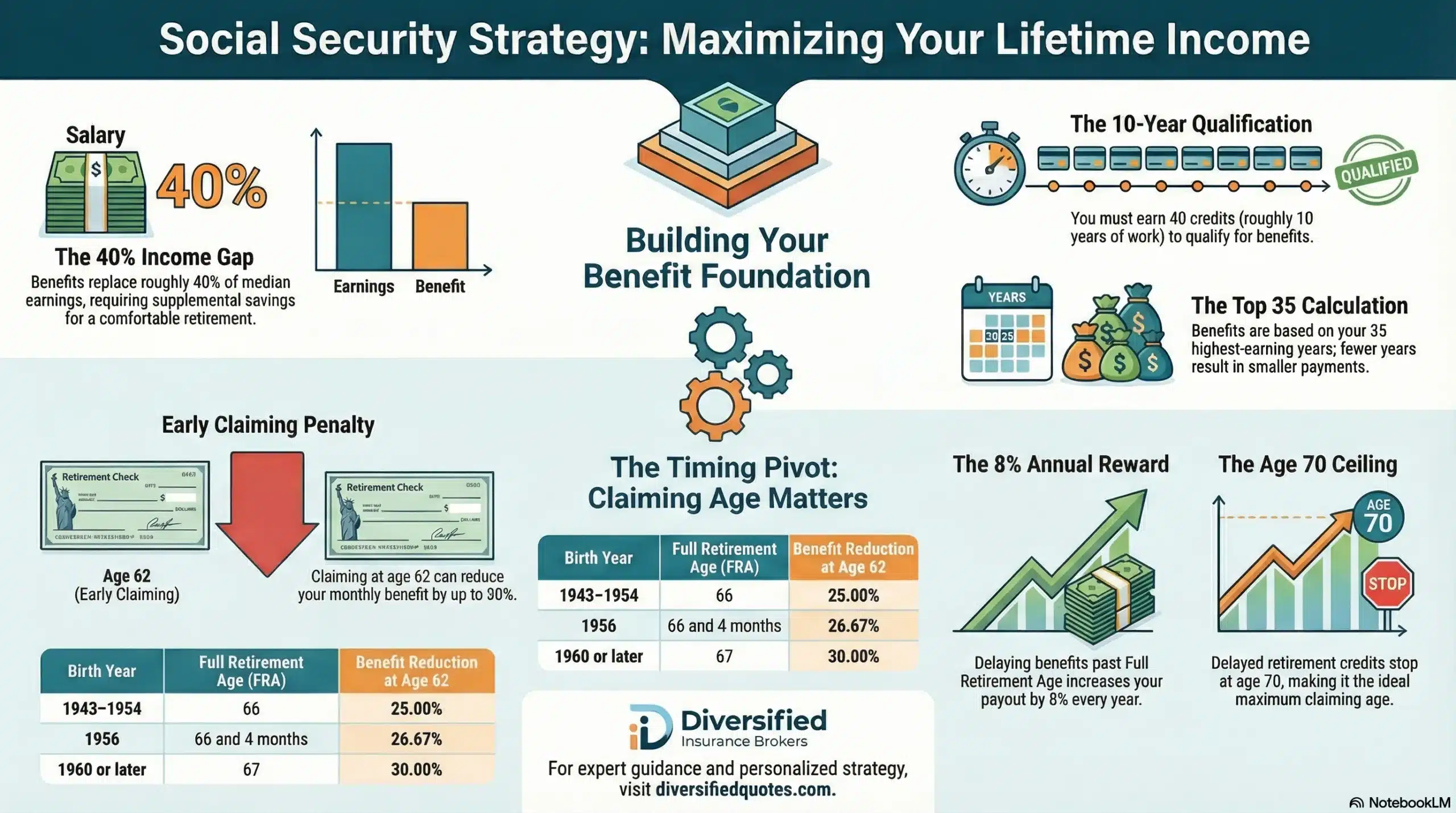
For many households, the most impactful Social Security planning happens between full retirement age and age 70. Waiting past full retirement age increases your benefit through delayed retirement credits — eight percent per year for most people born in 1943 or later. That larger benefit can meaningfully increase lifetime income for the worker and can strengthen the amount a surviving spouse may receive later. This is why many household strategies focus on having the higher earner delay longer when possible, especially when survivor protection is a primary priority.
Deemed filing pushes couples toward coordinated planning because it eliminates much of the “spousal-only” flexibility many people assumed existed. Instead of trying to separate benefits, the strategy often becomes: decide which spouse should prioritize delaying, decide how to manage cash flow during the waiting period, and decide how to protect the survivor scenario given any age gap or health difference between the spouses. Even small adjustments in timing can change the long-term outcome substantially, particularly for a couple where one spouse’s benefit will eventually become the survivor benefit.
The interaction between Social Security income and income taxes is another dimension that matters in this planning window. Both the timing of claiming and the total amount of Social Security income affect how benefits are taxed, which in turn affects net retirement income. Our resource on whether Social Security is taxable covers the federal taxation thresholds, and our resource on how to reduce taxes on Social Security covers the specific income management strategies that affect the taxation picture during both the pre-claiming and post-claiming phases. Our resource on Social Security income limits covers the earnings test thresholds that apply before full retirement age.
Deemed Filing for Divorced Spouses
Divorced spouse benefits can be extremely valuable and are often misunderstood. Eligibility typically depends on marriage duration (generally at least 10 years), current unmarried status, age requirements, and the ex-spouse’s work record meeting minimum thresholds. Those eligibility rules are separate from deemed filing. Deemed filing influences what happens when you are entitled to your own retirement benefit and a divorced spousal benefit in the same month.
In many divorced spouse situations, the person becomes entitled to their own retirement benefit and the divorced spousal benefit at the same time. Deemed filing typically means Social Security pays the person’s own retirement benefit first and then adds any divorced spousal excess amount if the ex-spouse’s record supports it. This is why many divorced spouses should not assume they can “take the divorced spousal benefit only” while letting their own benefit grow — unless they fall into the limited restricted application category based on date of birth and timing. Our resource on divorced spousal benefits timing covers the specific entitlement and timing mechanics for divorced spouse claiming.
Divorced spouse planning becomes especially nuanced when a person has remarried, divorced again, or is uncertain how a past marriage interacts with a current household plan. Remarriage can change eligibility for certain benefits depending on the specific situation and timing. Our resource on how remarriage affects spousal benefits covers how marital status changes interact with Social Security eligibility. The most important practical advice for divorced spouses is to verify both eligibility and timing before filing — many people file for their own retirement benefit earlier than was necessary because they assumed the divorced spousal benefit would serve as a substitute, when in reality the own-retirement benefit is the base layer and the divorced spousal benefit is an excess amount that may be smaller than expected or absent entirely.
WEP, GPO, and How They Interact With Deemed Filing
Two additional rules affect some households alongside deemed filing and deserve explicit attention because their effects on the combined benefit picture can be significant and are frequently overlooked until after filing: the Windfall Elimination Provision (WEP) and the Government Pension Offset (GPO). Both affect people who receive pensions from employment not covered by Social Security — public sector jobs in many states, certain school districts, and some federal positions.
WEP reduces the Social Security retirement benefit for workers who also receive a pension from non-covered employment. The reduction is applied to the worker’s own retirement benefit before that benefit is used as the base in a deemed filing calculation. That means a spouse or divorced spouse whose own benefit is WEP-reduced has a different starting point in the deemed filing calculation than someone whose own benefit is calculated at full formula. Our resource on the Windfall Elimination Provision covers how WEP is calculated and which workers are affected.
GPO affects people who receive a pension from non-covered employment and who would otherwise be entitled to Social Security spousal or survivor benefits. The GPO reduces the spousal or survivor benefit by two-thirds of the government pension amount — which in many cases eliminates the spousal benefit entirely. For households where one spouse has a government pension subject to GPO, the deemed filing calculation may show a spousal excess that evaporates once GPO is applied, changing the household’s Social Security income picture substantially. Our resource on the Government Pension Offset explained covers how GPO applies and which situations it affects most significantly.
Common Deemed Filing Mistakes and How to Avoid Them
Most deemed filing mistakes happen because people treat Social Security as a simple “start date” decision. In reality, it is an entitlement and household coordination decision. The mistakes that create the most lasting regret are predictable — and avoidable when the planning is done before filing rather than after.
Assuming a Spousal-Only Claim Is Still Available
For most filers today, it is not. If you are eligible for both benefits in the same month and you were born on or after January 2, 1954, Social Security will evaluate both and pay the combined result under deemed filing. That is why “I will just take the spousal benefit now” often turns into “I filed and locked in my own reduced retirement benefit” — which is often not what the person intended. The confusion arises because the strategy was genuinely available under older rules, and many people heard about it from friends or advisors who described it in historical terms. Verifying the current rule for your specific date of birth and entitlement situation before filing is the only way to avoid this mistake.
Filing Early Without Modeling the Full Household Outcome
Early filing can reduce benefits permanently and can reduce survivor protection for the remaining spouse later. The impact on the survivor benefit is one of the most commonly overlooked dimensions of early claiming decisions because it feels remote and abstract at the time of filing. A practical way to address this is to model the survivor scenario explicitly — what happens to the household income if the higher earner dies five years after filing, or ten years, or twenty? That question often reframes the filing timing decision and reveals tradeoffs that a pure monthly-income comparison would miss. Even when early filing is the right choice for a specific household, it should be chosen with full awareness of the long-term tradeoffs rather than defaulting to it because it feels simpler.
Not Coordinating Medicare Timing With Social Security Filing
Social Security filing and Medicare enrollment can overlap in ways that surprise households in both directions. Enrolling in Medicare Part B at the wrong time can create premium surcharges. Delaying Medicare enrollment while delaying Social Security can create gaps in coverage. And IRMAA surcharges — Medicare premium increases based on income from two years prior — can be affected by the timing of other income events around the Social Security claiming year. Our resource on how Medicare and Social Security work together covers the specific coordination points that most often create unexpected outcomes when households do not align these timelines deliberately.
Missing Remarriage Implications
Remarriage timing can change eligibility for certain benefits depending on the situation. This is one of the most overlooked Social Security planning risks, especially for divorced spouses or widows and widowers who have remarried or are considering remarriage. The timing of a remarriage relative to age 60 (for survivor benefits) and the current marital status for divorced spouse eligibility can both materially affect which benefits are available and when. Our resource on how remarriage affects spousal benefits covers these rules in detail.
Not Verifying the Month of Entitlement Before Filing
Deemed filing triggers when entitlement overlaps in the same month — not when you think entitlement should start based on an approximate age estimate. Many misunderstandings happen when someone assumes entitlement begins in a specific month that it actually does not, leading to filing earlier than intended for the own retirement benefit while expecting a spousal amount that does not materialize on that timeline. Confirming the exact entitlement months for both spouses before filing is one of the simplest and most impactful steps in pre-filing review.
Treating Social Security as Easy to Undo Later
Some changes are time-limited. There is a 12-month window after first claiming during which benefits can be withdrawn — but this requires repaying all benefits received, including Medicare premiums withheld, and it is a one-time option. After that window, benefit levels are generally set for life. A safer mindset is to treat filing as a major retirement decision that should be confirmed carefully before applying rather than approached with the assumption that it can be easily adjusted afterward.
Ready to Confirm Your Filing Plan?
We confirm eligibility, run spouse and divorce scenarios, and map out a filing sequence that fits your household — before you apply.
Schedule an AppointmentRelated Social Security Planning Pages
Deepen your plan — especially if you are coordinating a spouse, still working, or trying to maximize lifetime benefits.
Financial Protection Essentials
Social Security tax strategies, WEP and GPO resources, annuity income coordination, and household planning tools.
Schedule an Appointment with a Social Security Expert
Choose a time that works for you. We’ll review your claiming options and help you avoid timing mistakes.
FAQs: Deemed Filing Rules for Social Security
What does “deemed filing” mean in Social Security?
Deemed filing means that if Social Security considers you eligible for both your own retirement benefit and a spousal benefit in the same month, your application is automatically treated as an application for both — even if you believed you were applying for only one. Social Security does not ask you to choose between the two; it evaluates both and pays the combined result you are entitled to under current rules. Your own retirement benefit is paid first, and any eligible spousal excess is added on top of it.
The rule was introduced to end a strategy where couples could separate spousal claiming from their own retirement claiming — using the spousal benefit first while their own retirement benefit continued to grow through delayed retirement credits. Deemed filing closes that gap for most modern filers by treating both entitlements as a single combined filing when they overlap in the same month. Understanding this is the foundation for any meaningful Social Security planning because it redefines what “claiming options” are actually available.
Do I get two checks if I qualify for both retirement and spousal benefits?
No. Social Security issues one combined monthly payment. Your own retirement benefit forms the base of that payment. Social Security then evaluates whether your spouse’s record supports a higher combined amount than your own retirement benefit alone. If it does, the difference — called the spousal excess — is added to your retirement benefit to produce the combined total. You do not receive separate retirement and spousal checks, and the spousal benefit does not replace your retirement benefit; it supplements it when the supplemental amount is positive.
This structure has a practical implication: many people who expect a substantial “spousal check” are surprised when the combined payment is not dramatically higher than their own retirement benefit. If your own retirement benefit is already close to the 50 percent spousal benefit threshold based on your spouse’s primary insurance amount, the spousal excess can be small or zero. The combined payment is still the correct and correct outcome under the rules — it simply may not match an informal expectation that “I’ll get 50 percent of my spouse’s benefit” formed before understanding how the own-benefit-first structure works.
Who is most affected by deemed filing?
Deemed filing most directly affects people who were planning to use a “spousal-only” claiming strategy — filing for spousal benefits at full retirement age while delaying their own retirement benefit to earn delayed retirement credits. For most people born on or after January 2, 1954, that strategy is no longer available. Those born before that date may have limited remaining ability to file a restricted application in certain circumstances, but this must be verified rather than assumed.
Beyond that specific strategy, deemed filing affects any household where the spouses have overlapping eligibility for retirement and spousal benefits. That is a broad category that includes most two-income couples and some one-income couples, depending on the relative benefit amounts. The households most affected are those where one spouse had a lower earnings record and expected to benefit significantly from a spousal claiming sequence that relied on separating the two benefits — a sequence that deemed filing makes unavailable for most modern filers.
Does deemed filing apply to divorced spouse benefits?
Generally yes, for people born on or after January 2, 1954. If you are entitled to your own retirement benefit and a divorced spousal benefit in the same month, Social Security typically pays your own retirement benefit first and adds any divorced spousal excess if the ex-spouse’s record supports a higher combined amount. The divorced spousal eligibility rules — marriage duration, current marital status, age requirements — govern whether you qualify for the divorced spousal benefit at all, but deemed filing governs how the payment is calculated and structured once you are entitled to both.
One point many divorced spouses miss: if you file for your own retirement benefit early (before full retirement age) expecting to “add” a divorced spousal benefit later, the early filing may permanently reduce your own retirement benefit, and the divorced spousal benefit may not provide the compensation you expected because it is calculated as an excess over your own benefit rather than as an independent replacement. Modeling the divorced spousal scenario month-by-month before filing is the safest way to confirm what the combined payment will actually be in your specific situation. Our resource on divorced spousal benefits timing covers the entitlement mechanics in more detail.
Does deemed filing apply to survivor benefits?
No — and this exception is one of the most significant planning opportunities in Social Security for widows and widowers. Deemed filing does not apply to survivor benefits. That means a surviving spouse can choose to claim either their own retirement benefit or the survivor benefit first, and switch to the other later if that produces a better lifetime outcome. This flexibility allows benefit sequencing strategies that are not available in the standard spousal benefit framework under deemed filing.
The most common examples are a surviving spouse claiming a reduced survivor benefit at 60 while letting their own retirement benefit grow to age 70 (when it reaches its maximum), or a surviving spouse claiming their own retirement benefit first at a moderate level and later switching to a larger survivor benefit if the deceased spouse had significantly higher lifetime earnings. The right sequence depends on the relative size of the two benefits and the household’s cash flow and longevity outlook. Our resource on strategies for claiming Social Security for widows covers these sequences in detail.
Can I still file for spousal benefits only and delay my own retirement benefit?
For most people today, no. The ability to file a restricted application — claiming spousal benefits only at full retirement age while allowing your own retirement benefit to continue earning delayed retirement credits — was phased out for people born on or after January 2, 1954. If you were born on or after that date, deemed filing applies and a spousal-only application is generally not available. Both benefits are evaluated when you are entitled to them in the same month.
If you were born before January 2, 1954, a limited restricted application option may remain in specific circumstances — but this must be verified for your specific situation and entitlement timeline, not assumed. The details of who qualifies, under what timing conditions, and what the household benefit modeling looks like with and without the restricted application strategy are all questions that should be confirmed before filing, not after. Once you file under deemed filing, the ability to change the strategy is severely limited.
Why does deemed filing matter so much for couples?
Because it changes the strategy framework that most couples expected to use. Many couples formed their Social Security plans based on the assumption that one spouse could “claim spousal benefits now and switch later” — a sequence that is no longer available under deemed filing for most modern filers. When that assumption is built into a household plan and then turns out to be unavailable, the resulting filing is often suboptimal — locking in reduced retirement benefits, reducing survivor protection, or missing timing windows that would have produced better outcomes.
The deeper reason deemed filing matters for couples is the survivor benefit connection. The higher earner’s benefit, if delayed, becomes a larger survivor benefit for the remaining spouse. Deemed filing does not change that dynamic, but it changes the set of strategies available for managing the years between full retirement age and age 70 for households that previously planned to use spousal benefit claiming as a bridge. Planning within the modern framework — choosing who delays, how to manage cash flow during the delay, and how to protect the survivor outcome — is the work that produces the best household result. Social Security is a household financial asset, and filing decisions should be made as a household, not as two independent individuals who happen to be married.
What should I do before I file to avoid deemed filing mistakes?
Four steps consistently prevent the most common deemed filing mistakes. The first is confirming entitlement timing rather than relying on approximate age estimates. Entitlement is month-specific, and small differences in entitlement timing can change which benefits are available and when. Confirming the exact months when you and your spouse become entitled to each benefit type prevents the surprise of filing based on an assumption that turns out to be incorrect.
The second is confirming whether any restricted application rules apply based on your date of birth and specific situation. If you were born before January 2, 1954 and believe you might have access to the restricted application strategy, verify it before filing — not after. The third is modeling the spousal and survivor outcomes explicitly, not just the monthly benefit for the first year. A plan that looks optimal for the first five years can look significantly different when the survivor scenario is modeled over a 25-year horizon. The fourth is reviewing how Medicare enrollment timing coordinates with your planned Social Security filing date, since the two timelines interact in ways that can create premium and coverage gaps when not coordinated deliberately.
About the Author:
Jason Stolz, CLTC, CRPC, DIA, CAA and Chief Underwriter at Diversified Insurance Brokers (NPN 20471358), is a senior insurance and retirement professional with more than 25 years of real-world experience helping individuals, families, and business owners protect their income, assets, and long-term financial stability. As a long-time partner of the nationally licensed independent agency Diversified Insurance Brokers, Jason provides trusted guidance across multiple specialties—including fixed and indexed annuities, long-term care planning, personal and business disability insurance, life insurance solutions, Group Health, Travel Medical and Evacuation Insurance, and short-term health coverage. Diversified Insurance Brokers maintains active contracts with over 100 highly rated insurance carriers, ensuring clients have access to a broad and competitive marketplace.
His practical, education-first approach has earned recognition in publications such as VoyageATL, and contributions from his agency featured in Kiplinger and GoBankingRates— highlighting his commitment to financial clarity and client-focused planning. Drawing on deep product knowledge and years of hands-on field experience, Jason helps clients evaluate carriers, compare strategies, and build retirement and protection plans that are both secure and cost-efficient. Visitors who want to explore current annuity rates and compare options across multiple insurers can also use this annuity quote and comparison tool.
Explore All Social Security Planning Guides: Browse our complete Social Security Planning guide — covering filing strategies, spousal benefits, survivor benefits, taxes, WEP, GPO & more.
Last Reviewed: May 22, 2026 |
Reviewed by: Jason Stolz, CLTC, CRPC, DIA, CAA
Chief Underwriter, Diversified Insurance Brokers, Inc. | NPN: 20471358 | Diversified Insurance Brokers, Inc. — Licensed in all 50 states
Fact Checked by: Tonia Pettitt, CMIP©
Medicare Specialist, Diversified Insurance Brokers, Inc. | NPN: 14374308 | Diversified Insurance Brokers, Inc. — Licensed in all 50 states
Did you find this content helpful? Leave us a Google review — it helps others find trustworthy guidance too.
Editorial Standards: Diversified Insurance Brokers maintains rigorous editorial standards to ensure accuracy, clarity, and independence in all content. Learn more about our editorial standards and commitment to transparency.
