
ACA Subsidies Expired: What Alternatives are Available
As an Independent Group Health Insurance Broker, we compare fully insured, level-funded, and self-funded options across carriers to find the lowest cost coverage for your business.
ACA Subsidies Expired: What Alternatives are Available

Jason Stolz CLTC, CRPC, DIA, CAA
ACA subsidies expired — what alternatives are available is a question that reaches two very different audiences simultaneously. The first is the individual or family who purchased marketplace health insurance with the expectation that premium tax credits would make the plan affordable, and who now faces the full unsubsidized premium after subsidies ended or their income changed. The second is the small business owner or employer whose team members have been relying on individual marketplace coverage and who now needs to evaluate whether employer-sponsored group health is the more sustainable path forward. Both audiences are asking the same underlying question — what legitimate, comprehensive coverage options exist when the subsidy cushion disappears — but the answer looks meaningfully different depending on which side of the equation the person is on.
For individuals facing expired ACA subsidies, the alternatives landscape includes short-term medical coverage as a bridge option, COBRA continuation if they recently had employer-sponsored coverage, Medicaid if income qualifies, off-marketplace individual plans, and — if self-employed or part of a small business — the possibility of establishing employer-sponsored group coverage. For employers whose teams relied on individual marketplace plans and who are reconsidering that approach, the alternatives landscape is broader and more strategically interesting: traditional fully insured group health, level-funded group plans, self-funded structures, ICHRA reimbursement arrangements, and QSEHRA designs for businesses under 50 employees. At Diversified Insurance Brokers, Jason Stolz, CLTC, CRPC, DIA, CAA helps both individuals and employers navigate the full alternatives landscape after ACA subsidies expired, identifying the structure that delivers the best combination of coverage quality, cost predictability, and long-term stability for each specific situation. Our resource on ACA alternatives for company healthcare covers the employer-side alternatives in depth, and our resource on top questions employers ask about group health insurance covers the most common planning questions when businesses transition from individual-market reliance to employer-sponsored benefits.
Explore Your Alternatives After ACA Subsidies Expired
Whether you are an individual facing full unsubsidized premiums or an employer building a sustainable group health strategy, we compare every viable alternative across our network — identifying the structure that delivers the best coverage value for your specific situation.
Review Coverage OptionsWhy ACA Subsidies Expire — The Scenarios That Trigger This Search
ACA subsidies expired situations arise from several distinct triggers, and the right alternative depends significantly on which trigger applies. Understanding the source of the subsidy loss is the first step toward identifying the most practical coverage path forward.
The first scenario is income change. ACA premium tax credits are calculated based on household income as a percentage of the federal poverty level. When household income rises — from a new job, a business revenue increase, a side income stream, or a change in household composition — the subsidy entitlement can decline or disappear entirely. Households that experienced income growth and did not update their marketplace enrollment mid-year may owe subsidy repayment at tax time, on top of facing higher premiums going forward. Our resource on short-term medical coverage covers bridge options for households in transition, and our resource on Medicare covers the pathway for individuals approaching age 65 whose subsidy situation is changing as they near Medicare eligibility.
The second scenario is the expiration of enhanced subsidy provisions enacted by federal legislation. Enhanced subsidies that temporarily eliminated the “subsidy cliff” at 400% of the federal poverty level and made subsidies available to higher-income households were subject to legislative renewal — when those provisions expire or are not renewed, households above the standard income thresholds lose subsidy eligibility and face full unsubsidized marketplace premiums. This legislative risk is structural and recurs whenever enhanced provisions come up for reauthorization.
The third scenario is an employer offering affordable coverage. When an employer offers employer-sponsored health insurance that meets ACA affordability standards (the employee’s share of the self-only premium does not exceed 9.02% of their W-2 wages as of 2025), the employee loses eligibility for marketplace subsidies — even if the employer’s plan has a high deductible or limited benefits. Many employees in this situation discover they cannot receive marketplace subsidies but find the employer plan genuinely difficult to afford, creating a planning challenge for both the employee and the employer.
The Complete Alternatives Landscape When ACA Subsidies Expire
| Alternative | Best For | Coverage Comprehensiveness | Pre-Existing Conditions Covered? | Typical Duration | Key Limitation |
|---|---|---|---|---|---|
| Employer-Sponsored Group Health (fully insured) | Employees and small business owners with 2+ FT employees | High — comprehensive benefits | Yes — group plans cannot deny coverage | Annual, renewable | Requires minimum 2 qualifying employees |
| Level-Funded Group Health | Employers seeking group health with cost control | High — comprehensive with claims transparency | Yes — group plan rules apply | Annual plan year | Requires group eligibility; more admin than fully insured |
| ICHRA / QSEHRA | Small employers replacing group plan with reimbursement | Moderate — depends on individual plan selected | Yes — employees must purchase ACA-compliant individual plans | Annual plan year | Employees must purchase their own individual plans |
| Short-Term Medical Coverage | Individuals needing a bridge (healthy, limited conditions) | Moderate — limited benefits, exclusions apply | Typically no — medical history used in underwriting | 1–12 months (varies by state) | Not ACA-compliant; exclusions for pre-existing conditions |
| COBRA Continuation | Individuals who recently left employer-sponsored coverage | High — same employer plan, full benefits | Yes — continuation of existing group coverage | Up to 18–36 months | Full premium cost (employer no longer contributes) — often expensive |
| Medicaid | Individuals with income below state Medicaid thresholds | High — comprehensive state-administered coverage | Yes — Medicaid covers all qualifying enrollees | Ongoing while eligible | Income limits; not available in all states at same thresholds |
The table makes clear that the best alternative when ACA subsidies expire depends primarily on two factors: whether the person is an individual shopping for their own coverage or an employer building a benefits strategy, and whether comprehensive coverage including pre-existing condition protection is required. For most working-age individuals and employers, employer-sponsored group health — in one of its several funding structures — remains the most comprehensive and financially sustainable alternative to ACA marketplace coverage when subsidies are no longer available.
Individual Alternative: Short-Term Medical Coverage
Short-term medical coverage is the most commonly considered alternative when ACA subsidies expire for individuals who need an immediate bridge while transitioning to a different coverage structure. Short-term plans offer lower monthly premiums than fully-priced ACA marketplace plans, with faster enrollment and simpler application processes — making them appealing for healthy individuals facing a short-term coverage gap of a few months to a year.
The critical limitations of short-term medical coverage as an ACA subsidy alternative must be clearly understood before enrollment. Short-term plans are not ACA-compliant — they are not required to cover the ten essential health benefits, they typically use medical history in underwriting and can exclude pre-existing conditions entirely, and they may impose annual or lifetime benefit limits that ACA plans cannot. For a healthy individual who needs bridge coverage while transitioning to employer-sponsored group health or while evaluating other options, short-term medical can serve the bridge function. For anyone with ongoing health conditions, medications, or anticipated medical needs, the exclusions in short-term medical plans make them a poor substitute for comprehensive coverage. Our resource on short-term medical coverage covers the product landscape, availability by state, and the planning scenarios where short-term medical functions as a legitimate transitional tool.
Individual Alternative: COBRA Continuation
COBRA continuation coverage applies to individuals who recently held employer-sponsored group health coverage and lost it due to a qualifying event — job loss, reduction in hours below full-time eligibility, or a change in eligibility status. COBRA allows the former plan participant to continue the exact same employer group health coverage for up to 18 months (or up to 36 months in some qualifying circumstances), with full pre-existing condition protection and comprehensive benefits unchanged. The practical limitation is that COBRA requires the former plan member to pay the full premium — both the employee’s share and the employer’s contribution — plus an administrative fee, making COBRA often the most expensive coverage option available.
COBRA becomes relevant in the ACA subsidy expired conversation when a self-employed individual or small business owner decides to leave a corporate employer’s group health plan to establish their own business — and then discovers that marketplace subsidies are not available at their income level. In this transition scenario, COBRA may bridge the gap while the new employer entity establishes its own group health plan. The timing typically allows several months of COBRA continuation while the new business assembles the payroll documentation and employee count required for group health eligibility.
Individual Pathway: Medicaid and Medicare
For individuals whose income declined — whether due to a business downturn, a career change, or a planned pre-retirement income reduction — Medicaid eligibility may have expanded to cover the subsidy gap. Medicaid expansion under the ACA extended eligibility to households with income up to 138% of the federal poverty level in participating states. For individuals who experienced significant income reduction at the same time their enhanced subsidies expired, verifying current Medicaid eligibility is an important first step before assuming that individual market coverage is the only option. Our resource on Medicare services covers the pathway for individuals approaching age 65, for whom the ACA subsidy question becomes time-limited as Medicare eligibility provides the most comprehensive low-cost coverage transition available.
Employer Alternative: Group Health as the Primary Solution
For self-employed individuals, small business owners, and employers who have been relying on individual marketplace coverage for themselves or their employees, establishing a legitimate employer-sponsored group health plan is the most comprehensive alternative when ACA subsidies expire. Group health insurance is priced and structured fundamentally differently from individual marketplace coverage — it allows employer premium contributions that reduce employee net cost, operates under group rating rules that are separate from individual market pricing dynamics, and can be designed with plan features and network configurations that the marketplace’s standardized tier structure often cannot match.
The minimum threshold for employer-sponsored group health is two qualifying employees in most states — making it accessible to very small professional practices, family businesses, and partnerships where both principals draw W-2 payroll. Our resource on minimum employees for group health insurance covers the eligibility thresholds and participation requirements that govern when group health becomes accessible. Our resource on group health insurance cost for small business covers how employer group plan costs compare to individual market pricing at different employer sizes.
The employer’s premium contribution in a group plan changes the affordability equation dramatically. When an employer contributes 50-75% of the employee-only premium — a common contribution structure — the employee’s net monthly cost can be far lower than a full unsubsidized ACA marketplace premium for equivalent coverage. This is the fundamental financial mechanism that makes employer-sponsored group health the most practical primary alternative when ACA subsidies expire for business owners and their employees. Our resource on how to set up group health insurance for employees covers the implementation process for employers establishing their first group plan, and our resource on group medical insurance covers the full employer group coverage framework.
Employer Alternative: ICHRA and QSEHRA Reimbursement Models
For small employers who need to provide healthcare support to employees but cannot or do not want to establish a traditional group health plan, the Individual Coverage HRA (ICHRA) and Qualified Small Employer HRA (QSEHRA) provide reimbursement-based alternatives that partially address the coverage cost when ACA subsidies expire. Under these models, the employer sets a defined monthly reimbursement allowance — with no participation requirements and no minimum employee count for ICHRA — and employees purchase their own individual health insurance plans using that allowance. Reimbursements are tax-free to the employee when used for qualifying premiums and medical expenses.
The ICHRA and QSEHRA models are most useful when the workforce has diverse coverage situations — some employees on spouse’s employer plans, some using marketplace plans, some with other coverage sources — and the employer wants to provide a defined benefit contribution without the participation complexity of a traditional group plan. For employees who would otherwise face full unsubsidized ACA marketplace premiums, an ICHRA or QSEHRA employer contribution can partially restore the cost support that marketplace subsidies previously provided. Our resource on can 1099s get group level funding covers related eligibility questions for businesses with mixed workforce classifications, and our resource on ACA alternatives for company healthcare covers the full employer alternatives comparison.
Level-Funded Group Health — The Employer Alternative With Cost Control
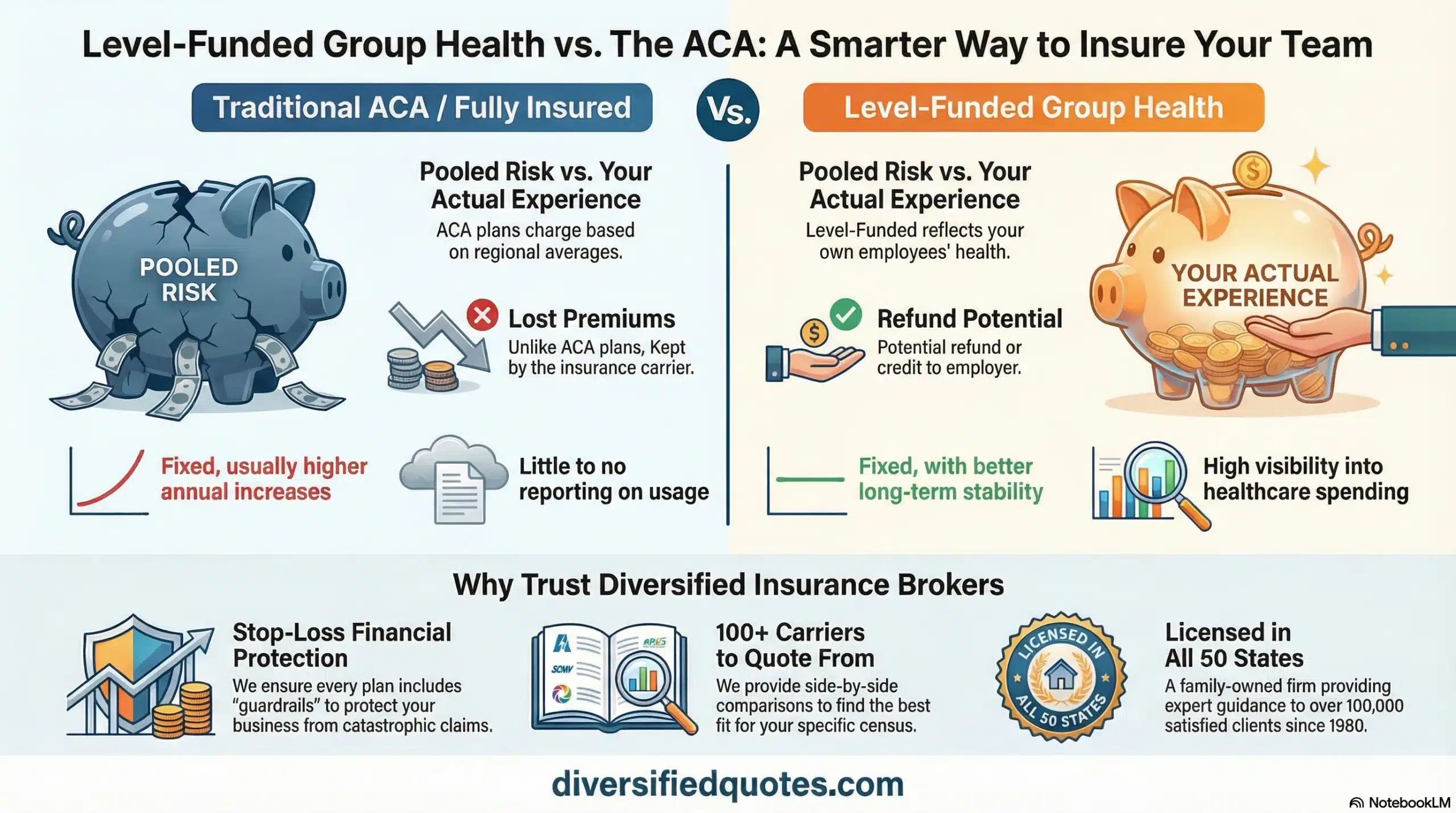
For employers transitioning from a situation where employees used subsidized individual marketplace plans to an employer-sponsored structure, level-funded group health often provides the right combination of coverage quality and premium predictability. Level-funded plans maintain a fixed monthly payment — providing the budget predictability that fully insured plans offer — while separating that payment into transparent components: administrative fees, stop-loss insurance, and a claims fund. If claims run below the fund at year end, the employer may receive a surplus credit or refund. If claims run above individual stop-loss attachment points, the stop-loss carrier absorbs the excess.
This structure makes level funding particularly valuable when the employer is moving away from individual market reliance for the first time and wants to build a sustainable group benefits framework without assuming unlimited claims risk. The defined monthly payment creates predictable budgeting; the transparency into claims components creates the foundation for intelligent cost management over time. Our resource on level funded health insurance tax benefits covers the tax efficiency advantages that add financial incentive to the level-funded structure, and our resource on why group level funding covers the strategic framework for employers evaluating this approach.
Self-Funded Group Health — Maximum Transparency and Control
For employers with larger workforces or stronger appetite for claims transparency and long-term cost management, self-funded group health provides the most comprehensive ACA alternative by giving the employer direct insight into where healthcare dollars are spent and direct ability to influence utilization patterns over time. Self-funded plans allow the employer to retain claims surplus, access detailed claims data, and adjust plan design intentionally rather than reacting to carrier-driven renewals. Stop-loss insurance limits catastrophic exposure at both the individual claim level and the aggregate plan year level.
Self-funding works best when the employer is committed to treating healthcare as a strategic cost management function rather than an annual purchasing decision. The transparency that self-funding provides — claims trends by category, utilization patterns, network performance — is the intelligence layer that allows the employer to build a multi-year healthcare cost strategy rather than accepting whatever renewal number the carrier presents. Our resource on what is self-funded group health insurance covers the mechanics in full, and our resource on pros and cons of self-funded group health provides the complete trade-off framework. Our resource on understanding stop-loss insurance in level funded plans covers the risk protection layer that makes self-funding viable for most employer sizes.
How to Plan a Transition After ACA Subsidies Expire
Whether transitioning from individual marketplace coverage to group health or from fully insured group health to a level-funded or self-funded alternative, the transition process requires intentional planning to avoid coverage gaps, compliance issues, and employee confusion. For employers establishing a new group plan, the critical planning steps include verifying group eligibility with carriers, confirming payroll documentation meets carrier requirements, establishing a participation and contribution structure that meets minimums, and communicating the transition to employees with sufficient advance notice to allow enrollment decisions.
Timing matters significantly. Group plans typically begin coverage on the first of the month following application approval and can require 30-60 days of lead time for underwriting and setup. Employers who wait until the day their marketplace plan becomes unaffordably expensive to begin the group health application process often face a gap between individual coverage ending and group coverage beginning. The practical recommendation is to begin evaluating group health alternatives at least 60-90 days before the planned transition date — giving adequate time for carrier evaluation, application submission, and employee communication. Our resource on how to reduce company healthcare costs covers the ongoing cost management strategies that employers use to maintain benefit quality after the initial transition from ACA marketplace reliance.
Build a Long-Term Strategy After ACA Subsidies Expire
Whether you are an individual facing full marketplace premiums or an employer building a sustainable group health alternative, we map every practical option across our carrier network and identify the structure that delivers the best long-term coverage value for your specific situation.
Request a Coverage ReviewRelated Group Health Pages
Continue exploring employer coverage strategies and funding models that may improve stability after subsidy changes.
Financial Protection Essentials
Chronic condition underwriting guidance, dental and vision options, financial firm reviews, and state-level consumer protections.
Talk With an Advisor Today
Choose how you’d like to connect—call or message us, then book a time that works for you.
Schedule here:
calendly.com/jason-dibcompanies/diversified-quotes
Licensed in all 50 states • Fiduciary, family-owned since 1980
Frequently Asked Questions: ACA Subsidies Expired — What Alternatives Are Available
What does it mean that ACA subsidies expired?
ACA subsidies expired means premium tax credits that previously reduced marketplace insurance premiums are no longer available — either because household income changed and crossed an eligibility threshold, because enhanced subsidy provisions enacted by federal legislation expired without renewal, or because an employer offered coverage that meets ACA affordability standards, disqualifying the employee from marketplace subsidies. Without subsidy support, the household or individual faces the full unsubsidized marketplace premium, which can be significantly higher than the subsidized amount. Many consumers begin exploring employer-sponsored group health alternatives when facing full unsubsidized premiums. Our resource on small employer group health insurance covers the group health pathway that is most commonly relevant for self-employed individuals and small business owners.
Why are ACA premiums so much higher after subsidies expire?
ACA marketplace premiums reflect the full actuarial cost of the coverage being purchased — including claims costs, administrative expenses, carrier profit margin, and risk adjustment factors. Subsidies do not reduce the actual cost of the coverage; they reduce what the enrollee pays by having the federal government cover a portion of the premium. When subsidies expire, the enrollee absorbs the full premium cost that was always built into the plan pricing. In many markets, full unsubsidized ACA premiums are substantially higher than equivalent employer-sponsored group coverage — particularly when an employer contribution is factored in. Reviewing structural cost differences provides important context for individuals comparing individual market costs against group health alternatives. Our resource on is short-term health insurance expensive covers one alternative cost benchmark for individuals evaluating bridge coverage options.
Is employer-sponsored group health insurance an alternative to ACA plans after subsidies expire?
Yes — and for most employers and self-employed individuals, group health is the most comprehensive and financially sustainable alternative when ACA subsidies expire. Group health insurance offers employer premium contributions that reduce employee net cost, group rating structures separate from individual market pricing dynamics, and plan design flexibility that marketplace standardized tiers often cannot match. The minimum threshold for employer-sponsored group health is two qualifying employees in most states. Our resource on what is self-funded group health insurance covers the more advanced group funding models that provide additional cost control and transparency beyond traditional fully insured group plans.
Can small businesses with very few employees qualify for group health insurance?
Yes. Most states allow employer-sponsored group health plans with as few as two qualifying employees — making it accessible to very small professional practices, family businesses, and partnerships where both principals draw W-2 payroll. Participation and contribution requirements apply: typically around 70% of eligible employees must enroll (with exceptions for employees who have other credible coverage), and the employer must usually contribute at least 50% of the employee-only premium. Our resource on 2-person group health insurance covers the specific mechanics and eligibility requirements for the smallest qualifying employer groups.
Is group health insurance less expensive than unsubsidized ACA plans?
In many cases, yes — particularly when the employer contributes a meaningful portion of the premium. The comparison is most straightforward at the employee-net-cost level: an employee whose employer covers 50-75% of the monthly premium may pay significantly less than a household facing a full unsubsidized ACA marketplace premium for comparable coverage. The employer’s contribution fundamentally changes the affordability equation in a way that the individual market cannot replicate without subsidies. Additionally, group plans that use level-funded or self-funded structures can produce long-term cost advantages over fully insured plans for employers with favorable claims experience. Our resource on what is self-funded group health insurance covers the funding structures that offer the greatest employer-side cost management potential.
What short-term alternatives exist for individuals who need immediate coverage while transitioning?
Short-term medical coverage provides a bridge option for healthy individuals who need immediate coverage during a transition period — for example, while establishing a new employer group plan or waiting for a qualifying life event that opens marketplace special enrollment. Short-term plans typically have lower premiums than full ACA marketplace plans but are not ACA-compliant, may exclude pre-existing conditions, and may impose benefit limits that ACA plans cannot. COBRA continuation is another bridge option for individuals who recently held employer-sponsored group health coverage — it preserves the existing plan with all pre-existing condition protections at the cost of paying both the employee and employer portions of the premium. For individuals approaching 65, Medicare eligibility may resolve the coverage gap without requiring any market alternative.
About the Author:
Jason Stolz, CLTC, CRPC, DIA, CAA and Chief Underwriter at Diversified Insurance Brokers (NPN 20471358), is a senior insurance and retirement professional with more than 25 years of real-world experience helping individuals, families, and business owners protect their income, assets, and long-term financial stability. As a long-time partner of the nationally licensed independent agency Diversified Insurance Brokers, Jason provides trusted guidance across multiple specialties—including fixed and indexed annuities, long-term care planning, personal and business disability insurance, life insurance solutions, Group Health, Travel Medical and Evacuation Insurance, and short-term health coverage. Diversified Insurance Brokers maintains active contracts with over 100 highly rated insurance carriers, ensuring clients have access to a broad and competitive marketplace.
His practical, education-first approach has earned recognition in publications such as VoyageATL, and contributions from his agency featured in Kiplinger and GoBankingRates— highlighting his commitment to financial clarity and client-focused planning. Drawing on deep product knowledge and years of hands-on field experience, Jason helps clients evaluate carriers, compare strategies, and build retirement and protection plans that are both secure and cost-efficient. Visitors who want to explore current annuity rates and compare options across multiple insurers can also use this annuity quote and comparison tool.
Explore More Group Health Insurance Options: Browse our complete guide to Level Funding, Self-Funded & ACA Alternatives — covering stop-loss coverage, tax benefits, 1099 options & ACA alternatives from 100+ carriers.
Last Reviewed: May 25, 2026 |
Reviewed by: Jason Stolz, CLTC, CRPC, DIA, CAA
Chief Underwriter, Diversified Insurance Brokers, Inc. | NPN: 20471358 | Diversified Insurance Brokers, Inc. — Licensed in all 50 states
Fact Checked by: Tonia Pettitt, CMIP©
Medicare Specialist, Diversified Insurance Brokers, Inc. | NPN: 14374308 | Diversified Insurance Brokers, Inc. — Licensed in all 50 states
Did you find this content helpful? Leave us a Google review — it helps others find trustworthy guidance too.
Editorial Standards: Diversified Insurance Brokers maintains rigorous editorial standards to ensure accuracy, clarity, and independence in all content. Learn more about our editorial standards and commitment to transparency.
