
Group Medical Insurance
Group Medical Insurance

Jason Stolz CLTC, CRPC, DIA, CAA
Group medical insurance is one of the most important employee benefits decisions a business can make — because it touches recruiting, retention, payroll strategy, and long-term cost control all at once. Whether you run a two-person company, a small employer with ten to fifty employees, or a growing organization with multiple locations, the right group medical plan can deliver broad access to care while helping you stabilize healthcare spending over time. A plan that is structured correctly for your group’s size, risk profile, and cash flow behaves very differently from one that was selected primarily on price — and that difference shows up most clearly at renewal time, when the decisions made during initial plan selection either pay off or create the next year’s problem.
At Diversified Insurance Brokers, we help employers compare plan types, funding structures, networks, and contribution approaches so the outcome is practical rather than theoretical. The goal is a plan your employees will actually use, a renewal process that is not a surprise every year, and a cost structure that fits the way your business actually operates. If you want more detail on adjacent topics, our guides on small employer group health insurance and what is self-funded group health insurance are useful companion resources.
Compare Group Medical Insurance Options
Tell us your employee count, state, and goals. We will outline practical plan options and the tradeoffs that matter for your specific situation.
Request a Group QuoteHow Group Medical Insurance Works
Group medical insurance allows an employer to offer health coverage to eligible employees under a coordinated plan structure. Instead of each person shopping independently for their own individual policy, the employer establishes a group plan with defined eligibility rules, a contribution strategy, and enrollment windows. Premiums are typically shared between employer and employee, and in many cases the group structure produces better pricing and broader access to care than individual shopping — especially when the employer contributes meaningfully and participation across the eligible population is strong.
Operationally, group medical coverage functions as a coordinated system. Employees enroll during open enrollment or when they first become eligible, premiums are collected through payroll deductions, and the plan is renewed on an annual cycle. The shape of the plan — meaning the network, deductibles, copays, and out-of-pocket maximums — determines how employees actually experience the coverage from day to day. There are three major ways the financial side of a group plan can be structured. A traditional fully insured plan uses a set premium where the carrier assumes the claims risk for the plan year. A level-funded plan blends predictable monthly payments with a claims-based accounting structure and stop-loss protection. A self-funded plan means the employer pays claims as they occur while using stop-loss insurance to cap catastrophic exposure from any single large claim or from aggregate claims above a threshold. Each structure can work well in the right scenario, and each carries tradeoffs that should be evaluated in the context of your specific group before a decision is made.
Why Employers Use Group Medical Insurance
For most employers, group medical insurance is simultaneously a benefits decision and a business decision. It helps you compete for talent, reduce unwanted turnover, and create stability in compensation planning. Health benefits are among the first items candidates evaluate — especially experienced hires and employees with families — and the presence or absence of a credible medical plan can meaningfully influence who is willing to join your organization and who stays long-term once they are there.
Group medical insurance also supports workforce productivity. When employees have reliable access to routine and preventive care, they are more likely to address health issues early rather than waiting until a condition becomes an emergency that requires time away from work. Over time, a plan that employees understand and use appropriately tends to reduce avoidable waste — unnecessary emergency room utilization, high-cost out-of-network patterns, and the downstream costs of untreated chronic conditions that get worse because access barriers kept employees from seeking timely care.
Finally, group medical insurance is a financial predictability tool for the employer. Even in an environment where healthcare costs rise nationally, employers that structure their plans intentionally — matching funding model, plan design, and contribution strategy to their actual group profile — typically experience fewer renewal surprises than employers who simply renew a generic plan each year without meaningful review or comparison.
Who Qualifies for Group Medical Coverage
Most states and carriers require a legitimate business entity and a minimum number of eligible participants to establish a group medical plan. In many cases, group eligibility begins with two enrolled employees or owners, though the exact requirements vary by state, carrier, and plan type. If you are uncertain what applies to your specific business structure, our guide on minimum employee counts for group health insurance is the best starting baseline. For businesses at the smallest end of the spectrum, our resource on 2-person group health insurance covers what options are specifically available for very small employer groups.
Eligibility is not only about raw headcount. Carriers typically look for an active business operation and define eligible employees based on consistent weekly hours — commonly a 20- to 30-hour threshold for full-time eligibility, though definitions vary. Employers also generally need to meet minimum contribution requirements, often tied to a percentage of employee-only premiums, and minimum participation requirements, often tied to the percentage of eligible employees who enroll after accounting for valid waivers from employees who have other coverage. For very small businesses, it is important to understand which individuals count for eligibility — owner-only setups, spouse employees, and related individuals can be treated differently depending on state rules and carrier underwriting guidelines. Building eligibility rules that are clear, defensible, and easy to administer consistently over time is the cleanest approach for employers at any size.
Plan Types — PPO, HMO, HDHP/HSA, and More
Once eligibility is established, the next decision is plan type — meaning how the network operates and how employees pay for care when they access services. Most employers choose from PPO, HMO, and high-deductible plan designs, with the HDHP often paired with a health savings account. Each can serve a group well, but each creates a meaningfully different employee experience that should be understood before a selection is made.
PPO plans are popular among employers because they typically provide broader provider access and allow employees to see specialists without strict referral requirements. In most markets, PPO designs are easier for employees to understand because the network is wider and provider choice is more flexible. The tradeoff is typically premium cost — PPO plans often carry higher premiums, particularly when the network is robust and the plan design is rich. HMO plans can be more cost-effective in the right region and when employees are concentrated in a defined service area. Most HMOs emphasize coordinated care through a primary care physician and require referrals for specialist access. When the provider ecosystem within the HMO network is strong, employees can have a good experience; when access is limited, HMO restrictions can become a source of employee frustration that undermines satisfaction with the benefits package overall.
HDHP plans paired with an HSA are often used when employers want to reduce premium costs without eliminating meaningful coverage. An HDHP is not cheap insurance — it is a different funding structure where employees pay more out of pocket upfront, but the plan is compatible with a health savings account that can be funded by employee and employer contributions on a pre-tax basis. When implemented with clear employee education and a genuine HSA contribution strategy, this approach can improve cost predictability for the employer while creating a valuable tax-advantaged savings tool for employees that has utility well beyond a single plan year. Many employers find that a two-option approach — pairing a value-focused HDHP/HSA plan with a buy-up PPO option — reduces employer costs without eliminating choice, especially when the contribution strategy is built to make the value plan financially attractive without making the buy-up plan prohibitively expensive.
Funding Models — Fully Insured vs Level-Funded vs Self-Funded
Plan type determines the employee experience. Funding model determines how costs behave over time and what levers the employer has to manage renewals and control long-term spending. Many employers begin with fully insured coverage because it is the most familiar structure, then evaluate level-funded or self-funded models as the organization grows and develops the appetite for more transparency and more control over healthcare spending decisions.
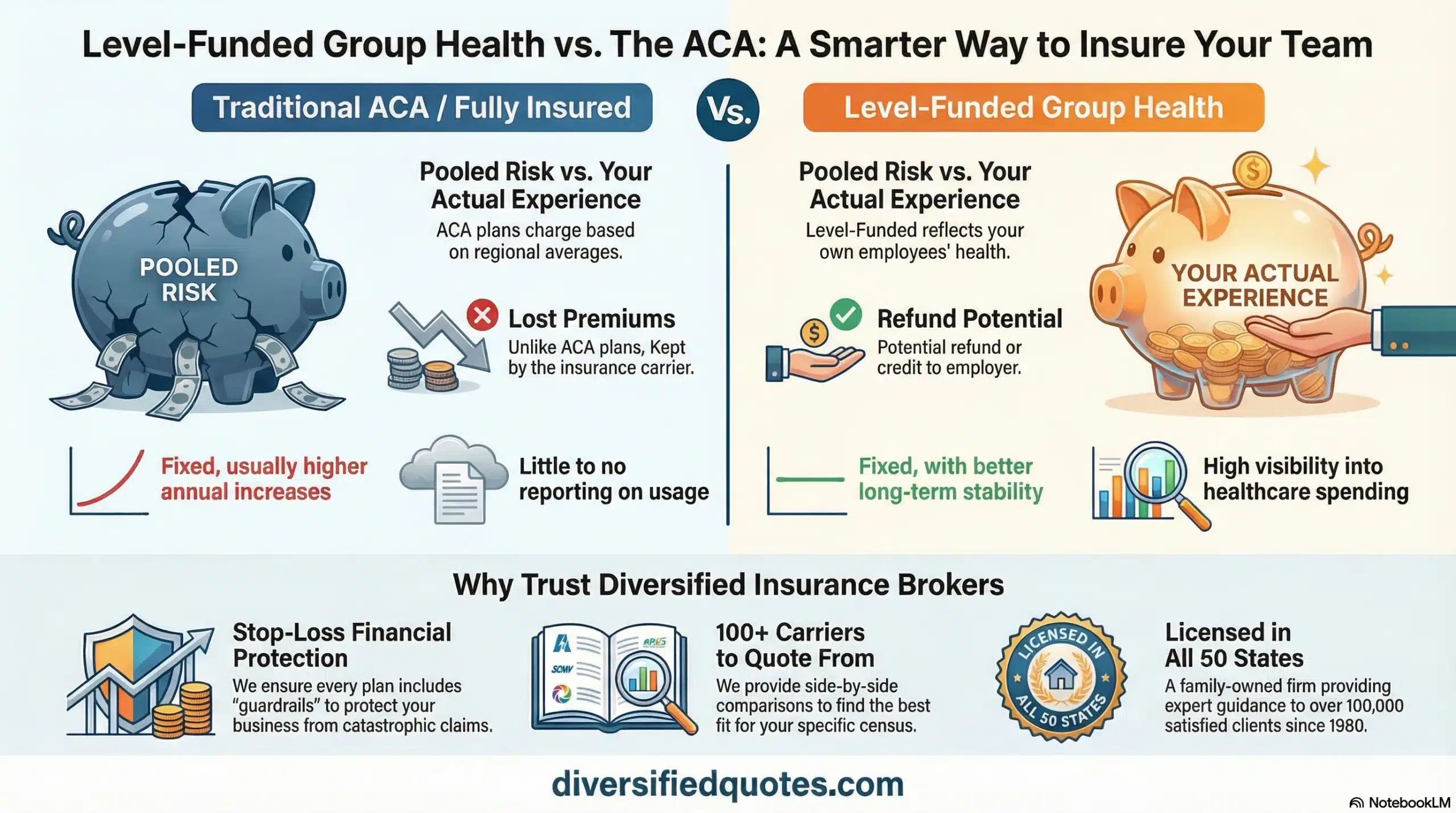
Fully insured coverage means the employer pays a set premium and the carrier assumes claims risk for the plan year. The advantages are operational simplicity and predictable monthly costs. The limitation is that transparency into what is actually driving cost is often limited, and renewals may include carrier margins, trend assumptions, and risk buffers that do not precisely reflect how your specific group performed during the year. Level-funded plans are designed to feel like fully insured from a cash-flow perspective — with a predictable monthly payment — but are typically built on a claims-based accounting structure with stop-loss protection. When claims for the group are favorable, some level-funded arrangements return unused claim funds or provide renewal credits. This can be a strong intermediate structure for employers who want cost predictability but also want a pathway to improved pricing mechanics as the group matures. Self-funded plans mean the employer pays claims as they occur while stop-loss insurance caps catastrophic exposure from large individual claims or from aggregate claims that exceed a budgeted threshold. The primary advantages are visibility and control: employers can see exactly what is driving claims costs, analyze pharmacy and disease-state trends, and make plan design adjustments based on real data rather than carrier-reported summaries. The requirement is appropriate discipline — a well-structured stop-loss arrangement, credible third-party administration, and a clear approach to budget planning and governance throughout the plan year.
The right funding model is the one that matches your organization’s risk tolerance, cash flow reality, and administrative capacity. The goal is not to pursue complexity for its own sake — it is to choose a structure that makes renewals more manageable, costs more explainable, and plan performance more responsive to the decisions your organization makes.
| Feature | Fully Insured | Level-Funded | Self-Funded |
|---|---|---|---|
| Monthly cost behavior | Fixed premium | Fixed payment with claims accounting | Variable based on claims timing |
| Risk positioning | Carrier holds claims risk | Shared risk with stop-loss | Employer pays claims with stop-loss protection |
| Transparency | Limited (varies by carrier) | Improved visibility vs fully insured | Highest visibility into claims drivers |
| Best fit | Employers prioritizing simplicity | Employers wanting predictability + upside | Employers wanting control + data-driven management |
Want a Side-by-Side Comparison Built for Your Business?
We will compare networks, plan designs, and funding models with clear best-case, expected, and stress-case cost outcomes for your specific group.
Request a ComparisonCost Control Strategies That Do Not Break Recruiting
Most employers make the same mistake when trying to reduce group medical costs: they squeeze benefits. This approach tends to backfire because it increases employee dissatisfaction, reduces plan participation, and can produce a higher-risk enrolling population — which makes the plan more expensive over time rather than less. Sustainable cost control is almost always structural rather than punitive, and the most effective levers are design decisions made during plan selection rather than during open enrollment or renewal scrambles.
The network is the starting point. A plan that appears cheaper on paper but forces employees into out-of-network situations can produce higher claims costs and more employee frustration than a slightly higher-premium plan with a genuinely functional network. A high-quality network reduces waste and improves employee satisfaction, and that combination tends to produce better long-term cost performance even when the initial premium comparison favors a different option. Offering a tiered plan structure — a value-focused option alongside a buy-up plan — allows employees to self-select based on their own needs and preferences. The value plan reduces employer costs for employees who prefer lower premiums and are comfortable with a higher-deductible design, while the buy-up plan retains appeal for employees with greater healthcare needs or stronger preferences for richer coverage.
Aligning deductibles, copays, and network design with real employee utilization patterns is another lever that many employers underuse. When the plan design matches how employees actually access care — primary care, urgent care, and prescription usage being the most common patterns — waste drops and satisfaction tends to improve. Brief, consistent employee education on how to navigate the plan — specifically on urgent care versus emergency room, how to verify network status, and how prescriptions work — can meaningfully reduce claims waste, particularly in smaller groups where a few avoidable high-cost events can have disproportionate influence on renewal pricing. Perhaps most importantly, starting the renewal review process early — rather than treating renewal as a deadline event — creates the time to compare options thoughtfully and avoid the rushed decisions that often lead to suboptimal multi-year outcomes.
Tax Advantages and Payroll Strategy
Group medical insurance is not only a benefits tool — it can also function as an effective payroll strategy when structured correctly. In many cases, employer premium contributions are treated as a deductible business expense, and employee premium contributions can be made on a pre-tax basis through a Section 125 cafeteria plan structure. This reduces the taxable compensation for employees who participate without requiring the employer to increase the dollar value of the benefit — effectively improving take-home value without a direct pay increase.
HDHP and HSA strategies introduce additional tax advantages for employees who want a dedicated vehicle for healthcare savings. When an employer contributes to employee HSAs as part of the overall benefits strategy, the contribution functions like a targeted, tax-advantaged compensation tool that supports retention and employee financial wellness simultaneously. The funds are owned by the employee, roll over year after year without expiration, and can be used for qualified medical expenses tax-free — creating long-term value that employees recognize and appreciate. For many employers, the key to maximizing these tax advantages is coordinating the plan design with payroll operations so contributions, deductions, and eligibility determinations are administered consistently and accurately throughout the plan year.
Renewals — Why Rates Change and How to Reduce Surprises
Renewals are where group medical insurance either becomes stable and manageable or becomes a recurring annual emergency. Rates move for a consistent set of reasons: overall healthcare cost inflation, changes in the group’s actual claims experience, shifts in plan participation, network performance, and carrier underwriting adjustments. Employers who do not understand why rates changed often feel they have no control over the outcome — when in reality, plan structure and renewal strategy can make a substantial difference in how rates move from year to year.
One of the most effective approaches is building a repeatable renewal calendar that starts well before the renewal date. Gathering clean enrollment and eligibility data early, reviewing plan performance against prior-year expectations, and comparing alternatives from multiple carriers gives you the information and the time to make a genuinely considered decision rather than a reactive one. Even when you ultimately stay with the same carrier, the act of benchmarking helps keep pricing competitive and prevents complacency from driving multi-year cost drift. If your organization is growing, it is also worth revisiting periodically whether the original funding model still fits your current size and risk profile — many employers outgrow their initial plan structure without realizing it, and a structured annual review is typically sufficient to identify whether a transition to level-funded or self-funded coverage would improve long-term cost management.
Implementation — What a Clean Group Medical Rollout Requires
A successful group medical rollout does not require a large HR infrastructure, but it does require a clear and well-sequenced process. The foundation is confirming eligibility rules precisely — defining full-time status, determining waiting periods for new employees, and clarifying how owner eligibility works for the specific entity structure. Once eligibility is clear, selecting plan options and establishing the contribution strategy for both employee-only and dependent tiers gives the plan its financial shape. Preparing simple, direct employee communication covering what the plan covers, what it costs employees, how to enroll, and how the network functions is often underinvested and disproportionately important — employees who do not understand the plan are more likely to misuse it in ways that increase costs.
Running enrollment on a clean timeline with a clear administrative point of contact reduces errors and ensures employees have the access they expect from day one. Following enrollment with a short check-in at 30 to 60 days — confirming ID cards were received, payroll deductions are processing correctly, and any network access issues have been identified and resolved — addresses the administrative problems that most commonly damage employee confidence in a new benefits plan, regardless of how strong the coverage itself may be. The employer that invests appropriately in implementation typically has a much smoother first renewal cycle than one that treats the plan as complete once enrollment closes.
Related Group Health Resources
Talk With an Advisor Today
Choose how you’d like to connect—call or message us, then book a time that works for you.
Schedule here:
calendly.com/jason-dibcompanies/diversified-quotes
Licensed in all 50 states • Fiduciary, family-owned since 1980
Group Medical Insurance FAQs
Group medical insurance is an employer-sponsored health plan that covers multiple employees under a single coordinated policy structure. Instead of each person purchasing their own individual coverage in the open market, the employer establishes a group plan with defined eligibility rules, a contribution strategy, and an annual enrollment process. Premiums are typically shared between employer and employee, with the employer’s share treated as a deductible business expense. Because coverage is purchased for a group rather than an individual, group medical insurance often produces better pricing, broader network access, and more predictable underwriting than equivalent individual coverage — particularly when employer contribution is meaningful and participation across the eligible employee population is strong. The result is a benefits structure that serves employees better than most individual alternatives while giving the employer a defined, manageable healthcare spending framework.
Most states and carriers require a legitimate business entity and a minimum number of eligible participants to establish a group medical plan. In many cases, eligibility starts at two enrolled employees or owners — though the exact requirements vary by state, carrier, and plan type. Carriers typically look for proof of an active business operation and define eligible employees based on consistent weekly hours, commonly using a 20- to 30-hour threshold for full-time eligibility. Employers also generally need to meet minimum contribution requirements, typically tied to a percentage of employee-only premiums, and minimum participation requirements, typically based on the percentage of eligible employees who enroll after accounting for valid waivers from those with other coverage. For very small or owner-structured businesses, the rules around who counts for eligibility — including spouse employees and related individuals — can vary significantly by state and carrier, making it important to confirm the specific eligibility framework that applies to your situation before beginning the plan selection process.
Yes — two-person businesses can often qualify for group health coverage, though the specific rules depend on the state, the carrier, and how the two participants relate to each other. Most carriers and states allow a two-person group when both individuals are active employees or owners who are not married to each other, since a married couple is typically treated as a single entity for group eligibility purposes. The two participants generally need to both enroll in the plan and meet whatever contribution and participation thresholds the carrier requires. In practice, two-person groups can access genuine group medical plans — with employer contribution, a coordinated network, and annual renewals — through carriers that specifically work with very small employers. The plan options and carrier availability for this group size can be more limited than for larger employers, making it particularly valuable to work with an independent broker who knows which carriers actively and competitively write this market segment in your state.
A PPO (Preferred Provider Organization) plan gives employees broad access to a provider network and typically allows them to see specialists without requiring a referral from a primary care physician. PPOs are generally easier for employees to understand and use because provider choice is wider and the rules around accessing care are more flexible. The tradeoff is that PPO premiums tend to be higher, particularly for rich-network plans in competitive markets. An HMO (Health Maintenance Organization) plan emphasizes coordinated care through a primary care physician and typically requires referrals for specialist access. HMOs can be more cost-effective — especially in regions where the HMO network is strong — but the managed access structure can be a source of friction for employees who want flexibility in how they access care. The right choice depends on where your employees are located, what the network looks like in your market, how your employee population tends to use healthcare services, and what premium level fits your contribution strategy. Many employers offer both and let employees choose based on their individual preferences.
A High Deductible Health Plan (HDHP) is a plan design with a higher annual deductible than traditional coverage — meaning employees pay more out of pocket before plan benefits kick in for most services. The HDHP is paired with a Health Savings Account (HSA), which is a tax-advantaged account that both the employer and employee can contribute to for the purpose of covering qualified medical expenses. HSA contributions are made on a pre-tax basis, the funds grow tax-free, and withdrawals for qualified medical expenses are also tax-free — creating a triple tax advantage that no other savings vehicle provides. Funds in an HSA roll over from year to year without expiring and are owned by the employee even if they change jobs or carriers. When implemented with a meaningful employer HSA contribution and clear employee education, an HDHP/HSA strategy can reduce employer premium costs, improve employee awareness of healthcare spending, and create a long-term savings resource for employees that many appreciate as a distinct financial benefit beyond just health coverage for the current year.
Level-funded group health insurance is a plan structure designed to provide the cash-flow predictability of a fully insured plan while incorporating claims-based pricing mechanics and stop-loss protection that give employers more transparency and potential cost savings than a traditional fully insured arrangement. The employer pays a fixed monthly amount — covering expected claims, stop-loss premium, and administrative fees — but the underlying economics are based on actual claims rather than a fixed premium rate negotiated with the carrier. When the group has favorable claims performance during the plan year, many level-funded arrangements return unused claim funds to the employer or apply them as a credit toward the next renewal. Stop-loss insurance caps the employer’s exposure if claims exceed the expected amount. Level-funded plans tend to be best for employers who want to move beyond the opacity of fully insured pricing but are not yet ready — or large enough — to take on the full administrative and financial responsibility of self-funding. They work particularly well for employers in the 10 to 200 employee range who have stable enrollment and are prepared to engage with claims data at renewal.
Yes — employer contributions to group medical insurance premiums are generally treated as a deductible business expense, reducing the employer’s taxable income by the amount contributed. Employee contributions can also be structured as pre-tax deductions through a Section 125 cafeteria plan, which reduces the employee’s taxable wages and the employer’s payroll tax obligations on those amounts simultaneously. This pre-tax treatment improves the effective value of the benefits package for employees without requiring the employer to increase the nominal dollar value of the contribution. HDHP plans paired with employer HSA contributions create an additional layer of tax efficiency — employer HSA contributions are deductible for the employer and tax-free for the employee, and the funds grow and are used tax-free when applied to qualified medical expenses. Coordinating the plan design with payroll and tax strategy allows many employers to extract meaningful financial efficiency from their group health investment beyond the direct recruiting and retention value of the coverage itself.
Group medical insurance renewal rates move for a consistent set of reasons that affect most employers to varying degrees. Overall healthcare cost inflation — driven by rising provider costs, pharmaceutical prices, and utilization trends — creates a baseline upward pressure that affects virtually all group plans in most markets. Beyond that baseline, your group’s own claims experience during the prior plan year is often the most significant single factor in your renewal rate, particularly for smaller groups and for level-funded or self-funded employers where claims are more directly reflected in pricing. Shifts in plan participation, changes in the demographics of enrolled employees, and network performance can also influence renewal pricing. For fully insured employers, carrier margin and risk buffer assumptions are built into the renewal and may not perfectly reflect your group’s actual performance. The most effective approach to managing renewals over time is starting the review process early, examining what actually drove your plan’s cost during the prior year, and comparing your current carrier’s renewal against alternative options — both within the same funding structure and across funding structures — before the renewal deadline creates time pressure.
In most cases, group medical insurance plans run on an annual contract cycle and are renewed or changed at the plan anniversary date rather than mid-year. Most carriers do not allow mid-year cancellation without a qualifying reason, and most plan structures are designed around a 12-month contract. That said, certain qualifying events — such as a significant carrier-initiated rate change, a carrier exiting a market, or a fundamental change in the group’s eligibility structure — may create a legitimate basis for mid-year transition depending on the specific carrier and state regulations that apply. For employers experiencing significant cost pressure or coverage quality issues, the most practical path is usually to document the current plan’s performance issues throughout the year and use that documentation to drive a comprehensive renewal comparison that gives full consideration to alternative carriers and funding structures. Working with an independent broker who can manage the carrier comparison process and negotiate on your behalf typically produces the best outcome whether you ultimately stay with the current carrier, transition to a new one, or change funding structures entirely.
An independent broker accesses the full competitive marketplace — comparing multiple carriers, funding structures, network options, and plan designs — rather than representing a single carrier’s product line. For group medical insurance, this market access is particularly valuable because the right plan for a specific employer depends on a combination of factors that no single carrier can optimize: the geographic distribution of your employees, your claims history, your risk tolerance, your administrative capacity, and your contribution budget. A captive agent or direct carrier representative can only present one company’s options. An independent broker can present the full landscape and make a recommendation based on which combination of carrier, plan design, and funding structure produces the best outcome for your specific group — not the best outcome for a carrier relationship or a sales quota. At Diversified Insurance Brokers, we have worked with employers across all size segments since 1980, and our approach to group medical insurance begins with understanding how the business actually operates and what problem the benefits plan needs to solve — before any carrier or product discussion begins.
About the Author:
Jason Stolz, CLTC, CRPC, DIA, CAA and Chief Underwriter at Diversified Insurance Brokers (NPN 20471358), is a senior insurance and retirement professional with more than 25 years of real-world experience helping individuals, families, and business owners protect their income, assets, and long-term financial stability. As a long-time partner of the nationally licensed independent agency Diversified Insurance Brokers, Jason provides trusted guidance across multiple specialties—including fixed and indexed annuities, long-term care planning, personal and business disability insurance, life insurance solutions, Group Health, Travel Medical and Evacuation Insurance, and short-term health coverage. Diversified Insurance Brokers maintains active contracts with over 100 highly rated insurance carriers, ensuring clients have access to a broad and competitive marketplace.
His practical, education-first approach has earned recognition in publications such as VoyageATL, and contributions from his agency featured in Kiplinger and GoBankingRates— highlighting his commitment to financial clarity and client-focused planning. Drawing on deep product knowledge and years of hands-on field experience, Jason helps clients evaluate carriers, compare strategies, and build retirement and protection plans that are both secure and cost-efficient. Visitors who want to explore current annuity rates and compare options across multiple insurers can also use this annuity quote and comparison tool.
Browse More Resources: Return to our complete Health Insurance, Dental, Vision & Disability guide — covering short term health, dental, vision, group health & disability.
Last Reviewed: June 9, 2026 |
Reviewed by: Jason Stolz, CLTC, CRPC, DIA, CAA
Chief Underwriter, Diversified Insurance Brokers, Inc. | NPN: 20471358 | Diversified Insurance Brokers, Inc. — Licensed in all 50 states
Fact Checked by: Tonia Pettitt, CMIP©
Medicare Specialist, Diversified Insurance Brokers, Inc. | NPN: 14374308 | Diversified Insurance Brokers, Inc. — Licensed in all 50 states
Did you find this content helpful? Leave us a Google review — it helps others find trustworthy guidance too.
Editorial Standards: Diversified Insurance Brokers maintains rigorous editorial standards to ensure accuracy, clarity, and independence in all content. Learn more about our editorial standards and commitment to transparency.
