
Travel Medical Insurance for Expats
Travel Medical Insurance for Expats

Jason Stolz CLTC, CRPC, DIA, CAA
Living abroad as an expatriate — whether for work, retirement, study, volunteer service, or long-term travel — can be rewarding, but it also means facing medical risk outside your home country’s healthcare system. Standard domestic health plans often provide little or no protection overseas, and that gap can turn a manageable medical issue into a major financial hit if you’re paying out of pocket for emergency care, hospital stays, or evacuation. Travel medical insurance for expats is built to bridge that gap by providing temporary medical coverage while you’re living or traveling abroad. The purpose is straightforward: help you access care, handle emergency costs, and avoid draining savings when unexpected medical bills show up in a foreign system. At Diversified Insurance Brokers, Jason Stolz, CLTC, CRPC, DIA, CAA helps individuals and families compare expat travel medical options based on destination, expected time abroad, activity level, and how much protection you want around evacuation and emergency coordination.
For expats who also need to address life insurance alongside medical coverage — particularly those with U.S. financial ties — our resource on life insurance for foreign nationals covers how U.S. life insurance works for non-citizens and citizens living abroad. Our companion resource on life insurance for foreign travel and residency covers the four distinct applicant profiles — U.S. citizens abroad, frequent business travelers, foreign nationals with travel, and foreign nationals outside the U.S. with U.S. ties — and how underwriting evaluates each one. If you’re a High Net Worth person living outside the United States, we have dedicated resources for you as well. This page focuses specifically on the medical coverage side of the expat protection picture: what travel medical insurance covers, how it compares to international health insurance, and how to choose coverage that actually fits the way you’re living abroad.
Get Expat Travel Medical Coverage Options
Share your destination, expected length of stay, traveler ages, and whether you need stronger evacuation protection. We’ll help you compare expat travel medical options that match your timeline.
Request Coverage Options Compare Plan DesignsWhy Expat Travel Medical Insurance Matters
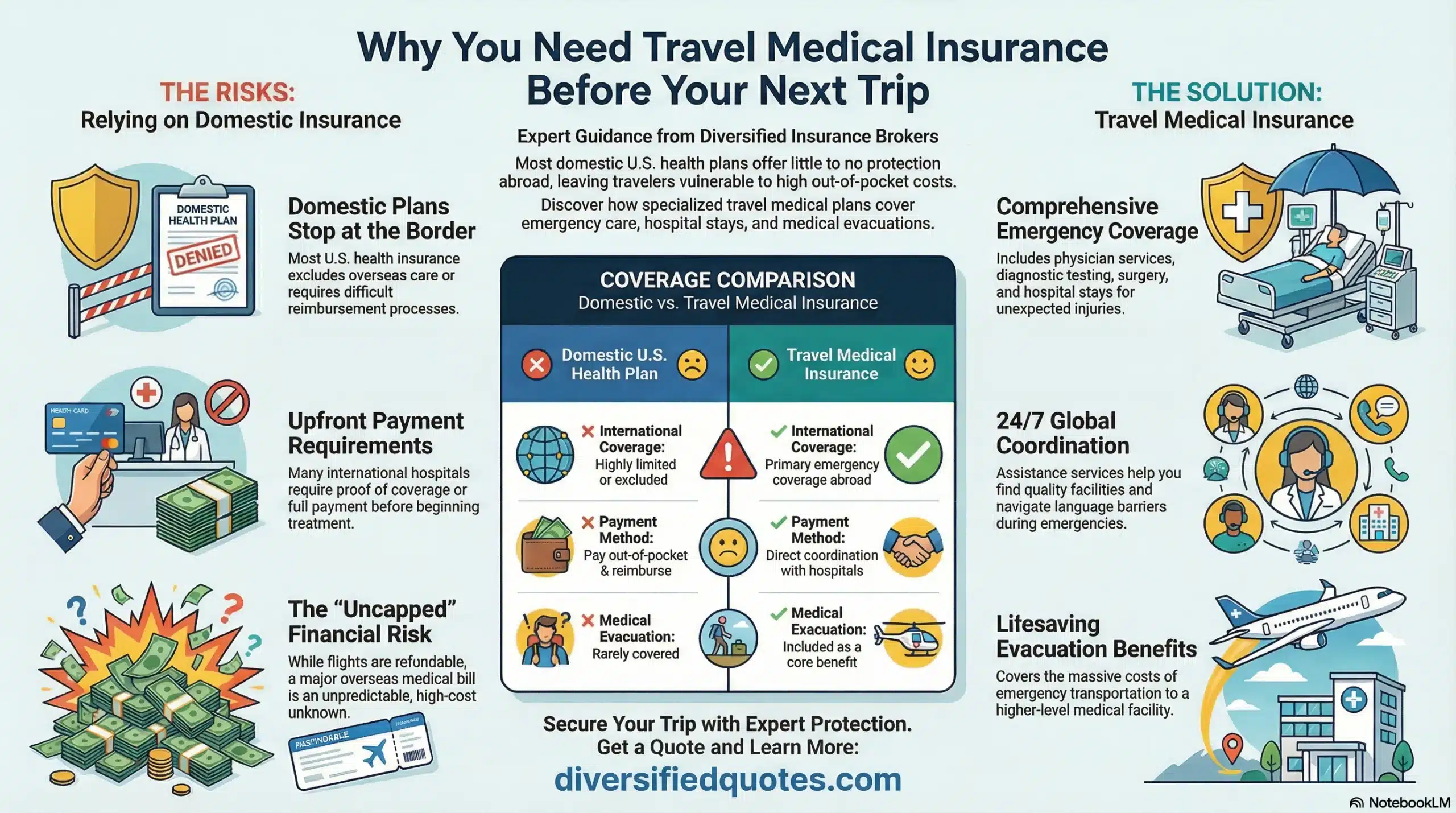
Moving overseas can place you outside the network — and outside the rules — of your domestic coverage. Many U.S. health plans either exclude international benefits or limit them in ways that don’t work in real life, especially when you need care quickly. That can leave expats paying out of pocket for emergency treatment, urgent physician visits, or hospitalization, even when the medical situation is not severe. Expats also face risks that are not always obvious at home: unfamiliar pathogens, different food and water standards, climate and altitude changes, variable hospital quality, and inconsistent access to English-speaking providers. Even when care is affordable in some countries, the issue becomes coordination — where to go, how to pay, and how to avoid treatment delays when you’re far from home. Travel medical insurance for expats is designed to remove those barriers by creating a clear, temporary coverage structure that supports access to care and provides meaningful protection for emergencies and evacuation. Our resource on why people buy travel medical insurance covers the most common motivations — from emergency care gaps to evacuation concerns — that drive the decision to add coverage before an international departure.
Travel Medical Insurance vs. International Health Insurance — Key Comparison
“Travel medical insurance” and “international health insurance” are often used interchangeably, but for expats they represent different levels of coverage and different planning assumptions. The table below maps the most consequential differences so you can identify which type fits your situation before comparing individual plans.
| Feature | Travel Medical Insurance | International Health Insurance |
|---|---|---|
| Primary purpose | Emergency and acute care during defined international stay — designed to protect against unexpected illness, injury, and evacuation costs | Comprehensive health coverage abroad — designed to function more like a domestic plan, including routine and preventive care |
| Coverage duration | Temporary — typically days to months; some plans allow multi-year coverage or renewals for extended stays | Long-term — annual policies designed for ongoing international living; renewable for continued expat residency |
| Routine and preventive care | Limited or excluded — focus is on acute illness, injury, and emergencies; routine checkups often not covered | Often included — annual physicals, wellness visits, vaccinations, and screening may be covered depending on plan tier |
| Pre-existing conditions | Often limited or excluded — some plans cover pre-existing conditions after a stability period or under specific plan designs; varies significantly | Coverage varies — some international plans include pre-existing conditions; medical underwriting may apply; coverage terms differ by carrier |
| Relative cost | Lower — designed for temporary protection; premiums are typically much more affordable than comprehensive international plans | Higher — broader coverage scope reflects higher premium cost; may include global coverage including return visits to the U.S. |
| Emergency medical evacuation | Commonly included — most expat travel medical plans include defined evacuation benefits for transport to appropriate care when local facilities are inadequate | Usually included — most international health plans include evacuation coverage, often with higher benefit limits for premium plans |
| Renewability and continuity | Varies — some plans allow renewals for extended stays; continuity depends on plan design and carrier; not designed for indefinite ongoing coverage | Designed for continuity — annual renewable coverage with continued eligibility for long-term expat residency |
| Return to home country coverage | Limited — most plans exclude coverage once you return home; designed for international use only | Often includes home country visits — many international health plans allow limited coverage during return visits to the U.S. |
| Best fit | Expats with a defined overseas period who primarily need strong emergency protection — short-term assignments, defined contract periods, gap coverage while transitioning to permanent local enrollment | Expats relocating long-term or permanently without a clear return date who want comprehensive ongoing coverage comparable to domestic plans |
The practical way to decide is to start with your timeline and your care expectations. If you primarily want emergency protection and flexibility during a defined stay abroad, travel medical insurance for expats often fits. If you want a more comprehensive health structure for ongoing care and long-term living, our resource on international health insurance covers the broader, longer-term coverage category. For major medical coverage specifically designed for foreign nationals — which overlaps significantly with the expat audience — our resource on major medical for foreign nationals covers the coverage design built for non-citizens and permanent residents living in or traveling through the United States.
Common Expat Profiles and How Coverage Fits Each
Expat travel medical insurance serves a wide range of situations, and the right coverage approach differs meaningfully by expat profile. A corporate employee on a defined overseas assignment typically has a specific departure and return date, a structured work schedule, and often some employer-provided coverage that may have gaps in international benefit depth — particularly around evacuation. Travel medical insurance bridges those gaps cleanly and does not require the long-term commitment of a full international health plan. An independent contractor or remote worker living abroad may have no employer coverage at all, making personal travel medical insurance essential rather than supplemental. The coverage period needs to align with their project timeline, and renewal flexibility matters if the engagement extends.
A retiree living abroad on a fixed income has different priorities: cost efficiency, predictable premium structure, and strong emergency and evacuation protection are typically more important than comprehensive routine care coverage — especially if the retiree is also managing Medicare or other domestic benefits that may cover them on return visits to the U.S. A volunteer or humanitarian worker operating in lower-income or conflict-adjacent regions faces the most acute evacuation and emergency care needs, because local medical infrastructure may be limited and the circumstances of potential injury or illness are more unpredictable. For this profile, evacuation benefit strength is usually the primary selection criterion. Our resource on travel medical and evacuation from Liberia covers a representative example of the coverage considerations that apply to West African humanitarian and NGO deployments — one of the most common contexts for volunteer expat medical planning. For the student or study-abroad profile — a different but adjacent expat audience — our resource on travel medical for international students covers the specific enrollment considerations and benefit structures most relevant to that population.
What Travel Medical Insurance for Expats Typically Covers
Strong travel medical plans for expats are usually built around emergency medical needs while you are overseas. Coverage commonly includes doctor visits for acute illness, urgent care, diagnostic testing, hospital stays, medically necessary prescriptions, and other covered treatment tied to illness or injury during the covered period. The details vary by plan, but the intent is consistent: access to care without the “pay everything first and figure it out later” problem. Emergency medical evacuation is a major value driver for expats. When serious care is not available locally, evacuation can be necessary for appropriate treatment, and the costs can become extreme without coverage. Our resource on emergency medical evacuation insurance covers how evacuation benefits are structured, what triggers an evacuation, and the planning considerations most relevant to expats in regions where local care is limited or unavailable.
Many expats also choose an emergency-focused travel health structure when they want to prioritize urgent protection over broader routine care. Our resource on emergency travel health insurance covers how emergency-centric plan designs work and when they represent a better fit than comprehensive international health coverage. For expats whose lifestyle includes higher-risk activities, physical work, or remote regional travel, our resource on high-risk travel insurance covers the coverage considerations that apply when standard plan exclusions may limit protection for the activities actually being undertaken.
Prescription and Medication Coverage Abroad
Prescription medication is a frequently overlooked component of expat travel medical planning. Many expats take regular prescriptions, and the intersection of plan coverage, foreign pharmacy availability, and import regulations creates practical planning challenges that surface quickly after departure. Most travel medical insurance plans cover prescriptions that are medically necessary and directly related to a covered acute illness or injury — meaning the plan covers treatment-related medications, not ongoing maintenance prescriptions for pre-existing conditions. If you take regular prescriptions, understanding this limitation before departure is important for planning how much medication to bring and whether supplemental coverage for ongoing prescriptions is needed separately.
Some international destinations have strong pharmacy networks and readily available generics for common medications, while others have significant supply limitations. Certain medications legal in the U.S. may require special import documentation in some countries. Traveling with a sufficient supply of essential medications, obtaining written prescription documentation from your U.S. physician, and confirming the plan’s pharmacy benefit for your specific destination reduces the likelihood of disruption during an extended stay. For expats considering a long-term international health plan that covers ongoing prescriptions more broadly, our resource on international major medical insurance covers the more comprehensive coverage structures that include better prescription benefits alongside emergency protection.
How to Choose the Right Expat Travel Medical Plan
Choosing expat travel medical coverage starts with a few decision points that drive plan fit. Duration is first. If you’re abroad for months or a couple of years, you need to match the plan’s maximum term and renewal rules to your expected timeline. Destination is second. Medical cost structures vary widely, and the quality and accessibility of care can change dramatically by country and region. A plan that feels sufficient in one region may feel inadequate in another if local care is limited or expensive. Regional context matters in specific ways — for Western European expat destinations with strong medical infrastructure, the coverage calculus is different than for regions with significant variability in hospital quality. Our resources on travel medical and evacuation from Austria and travel medical and evacuation from Germany cover what coverage looks like in high-quality European medical environments, where the planning emphasis is usually on coordination and cost protection rather than care quality concerns. By contrast, our resource on travel medical and evacuation from Congo covers the very different considerations that apply in regions where local medical infrastructure is limited and evacuation planning becomes the primary coverage consideration.
Your medical profile, including pre-existing conditions and prescription needs, is the third decision driver. Some plans have tighter limitations for pre-existing conditions, while others offer more flexibility depending on underwriting and plan design. Your activity level is fourth. If your expat lifestyle includes adventure activities, physical work, or volunteer service, coverage should align with those exposures to avoid unpleasant surprises at claim time. Evacuation and repatriation benefits round out the evaluation — many expats decide that evacuation protection is the non-negotiable component because it addresses the worst-case scenario where local care isn’t sufficient. For business travelers and employees who need an additional layer of accident-specific protection alongside their medical coverage, our resource on business travel accident insurance covers how accident-focused policies complement travel medical coverage for corporate expat and frequent traveler profiles.
What to Do When You Need Care Abroad
Knowing your coverage before you need it is the difference between a manageable situation and a chaotic one. Most travel medical plans provide a 24/7 emergency assistance number that serves as the first call when care is needed — this line connects you to multilingual coordinators who can identify appropriate local providers, facilitate direct billing arrangements, initiate evacuation logistics when necessary, and translate between you and local medical staff when language is a barrier. Making this call before seeking care (rather than after) typically produces significantly better financial and logistical outcomes, because the plan’s coordinator can often arrange direct payment to the facility rather than requiring full out-of-pocket payment and later reimbursement.
For non-emergency situations, most plans allow you to seek care from any licensed local provider and submit claims for reimbursement. Understanding the plan’s deductible, coinsurance, and maximum out-of-pocket before departure removes uncertainty when you’re deciding whether a situation warrants care. Keeping documentation — receipts, physician notes, diagnosis codes if available, and any prescription records — simplifies the claims process. For serious emergencies where local facilities are not adequate, the evacuation benefit initiates a more structured process: the plan’s assistance team coordinates transport, selects the receiving facility, and manages the logistics so the patient and family can focus on the medical situation rather than the coordination problem.
Common Expat Scenarios Where Travel Medical Insurance Fits Well
Travel medical insurance for expats often fits when you have a defined overseas period and you primarily want strong emergency protection. Short-term work assignments, study abroad programs, volunteer service placements, and retirement abroad with limited routine care needs are common examples. It can also be a practical option when you are transitioning to permanent relocation but haven’t committed to a long-term international health plan yet. It can also work well when you need coverage while waiting for local national health enrollment eligibility or employer plan activation overseas. In those cases, an expat travel medical plan can function as the “bridge” that protects you during the gap period, especially for unexpected illness and injury. If your expat situation involves higher-risk regions, remote travel within your host country, or more unpredictable medical infrastructure, reviewing how evacuation-forward plan designs handle extreme scenarios adds important context. Our resource on travel medical and evacuation from Lebanon covers one example of a high-complexity regional scenario where coverage planning requires specific attention to both medical quality variation and the logistics of emergency transport.
Administrative Basics for Expat Travel Medical Plans
Many expat travel medical plans are designed for straightforward enrollment. Eligibility is often driven by age, destination, coverage duration, and planned activities rather than extensive medical exams. That simplicity can be helpful when you are planning on short notice or coordinating coverage for a partner or family members. The key is to understand renewals, extensions, and how coverage behaves if your plans change. If you extend your stay, you want to avoid coverage gaps. If you return home earlier than expected, you want to understand plan end dates and how claims are handled. Clarifying these details in advance prevents last-minute problems. If your expat timeline is open-ended, or you want a plan that behaves more like a comprehensive domestic plan abroad, it may be time to compare long-term international solutions. Our resource on international health insurance covers the broader category, and our resource on international major medical insurance covers the major-medical tier specifically — the plan structures that include stronger routine care benefits alongside emergency protection for long-term expat living.
Common Mistakes Expats Make With Medical Coverage
One of the most common mistakes is assuming domestic coverage will follow you overseas in a meaningful way. In many cases it doesn’t, or it only applies in limited situations that don’t match real expat living. Another mistake is waiting until after departure to secure coverage, which can create avoidable limitations or exclusions depending on plan rules. Expats also sometimes choose a plan without verifying that it aligns with their lifestyle — volunteer service, physical work, extended travel within the host region, or higher-risk destinations can all change the fit. The right plan is the one that matches what you are actually doing abroad, not what the plan description seems to imply. Finally, many expats underestimate evacuation. Even when routine care is affordable locally, evacuation decisions often define the financial risk of the worst-case scenario — and without a defined benefit amount and coordinated logistics, the cost and complexity can become overwhelming at the worst possible moment.
How Diversified Insurance Brokers Helps Expats
We help expats evaluate travel medical insurance options that fit both short-term and extended stays abroad. The starting point is your destination, expected length of stay, traveler ages, activity level, and how important evacuation protection is for your plan. From there, we compare available plan designs and help clarify benefit differences, exclusions, renewal terms, and how the plan is intended to be used. The goal is for you to know what you’re buying before departure — especially how emergencies are handled, where evacuation fits, and what steps to take if you need care. If your situation calls for a more comprehensive long-term approach, we can also help you compare international health structures designed for ongoing expat living. If you want help narrowing your options quickly, start with the quoting tool to view plan structures and then send us your expat details so we can confirm fit.
Ready to Compare Expat Coverage Options?
Use the quoting tool to compare travel medical coverage for expats living abroad, then we’ll confirm the best match for your destination, timeline, and activity level.
Compare Plan Designs Request a ReviewRelated Travel Medical Pages
International medical options for expats, emergency travel health structures, and evacuation planning resources.
Financial Protection Essentials
Adjacent coverage resources for expats — visa holders, life insurance, disability, and Medicare planning alongside international medical coverage.
Talk With an Advisor Today
Choose how you’d like to connect—call or message us, then book a time that works for you.
Schedule here:
calendly.com/jason-dibcompanies/diversified-quotes
Licensed in all 50 states • Fiduciary, family-owned since 1980
FAQs: Travel Medical Insurance for Expats
What is travel medical insurance for expats?
Travel medical insurance for expats is temporary medical coverage designed to protect individuals living or traveling abroad from unexpected illness or injury costs outside their home country’s healthcare system. It is built around emergency and acute care needs — doctor visits, hospitalization, diagnostic tests, medically necessary prescriptions, and emergency evacuation when local care is insufficient. It is not a full replacement for a domestic health plan, and it typically does not cover pre-existing conditions, elective procedures, or routine preventive care. The primary value is clear, practical protection for the scenarios that create the most financial exposure during an international stay: serious illness, unexpected injury, and the cost and logistics of evacuation when local medical infrastructure cannot handle the condition.
Is international health insurance different from travel medical insurance?
Yes — they represent meaningfully different coverage levels and planning assumptions, despite being used interchangeably in casual conversation. Travel medical insurance is temporary, focused on emergency and acute care, and typically lower cost. It is designed for expats with a defined international period who primarily want strong emergency protection. International health insurance is a broader, more comprehensive structure that can include routine care, preventive services, chronic condition management, and stronger pre-existing condition coverage. It is designed for expats relocating long-term or permanently who want ongoing coverage that functions more like a domestic plan. The comparison table on this page maps the key differences across eight dimensions — purpose, duration, routine care, pre-existing conditions, cost, renewal, evacuation coverage, and best fit — to help identify which type fits a specific expat situation before comparing individual plans.
Does travel medical insurance cover emergency evacuation?
Yes — most comprehensive expat travel medical plans include emergency medical evacuation benefits. Evacuation coverage addresses one of the most financially severe scenarios for expats: a serious illness or injury that cannot be treated adequately at local facilities, requiring organized transport to a higher-level care center. The evacuation benefit typically covers the cost of medically supervised transport — by air ambulance, charter flight, or other appropriate means — to the nearest facility capable of providing the required care, or in some cases to the home country for further treatment. The plan’s assistance team coordinates the logistics, which matters as much as the financial benefit. Without this coordination, families must navigate foreign systems, carrier approvals, and facility selection simultaneously under emergency conditions. For expats in regions with variable medical infrastructure, evacuation is often the most important single benefit in the entire plan.
Can travel medical insurance be renewed or extended?
Some plans allow renewal or extension, depending on age, the duration of stay, carrier guidelines, and how the original plan was structured. Not all plans allow indefinite renewal — some have maximum duration limits that cap the total coverage period regardless of extensions. If your expat assignment extends beyond the original plan period, confirming renewal availability before that deadline is important to avoid a gap in coverage. When plans allow renewal, the process typically requires notifying the carrier before the current period expires and paying the applicable premium for the extended period. If renewal is not available or the stay becomes open-ended, transitioning to an international health insurance plan designed for ongoing long-term living is usually the better structural fit for continuity of coverage.
Do my domestic health benefits still apply when I’m living abroad?
Typically no — or only in very limited circumstances. Most U.S. domestic health plans either exclude international benefits entirely or apply them only in ways that don’t work in practical expat living. Some plans offer emergency-only coverage for international travel but require the situation to meet a high threshold, involve substantial co-pays, require pre-authorization that is impossible to obtain in real emergencies, or restrict coverage to specific countries or regions. For expats who are living abroad for months or years rather than visiting briefly, domestic coverage limitations are even more significant because routine care, non-emergency hospitalization, and ongoing treatment are far more likely to be needed. Verifying the specific international benefit language in your domestic plan before departure — and understanding what it actually covers in practice versus what it seems to cover — is an important step in identifying the gap that travel medical insurance needs to fill.
Does travel medical insurance cover pre-existing conditions?
Coverage for pre-existing conditions varies significantly by plan. Many travel medical insurance plans exclude pre-existing conditions entirely, or they cover only acute, unexpected complications directly related to a pre-existing condition while excluding ongoing management or elective treatment of that condition. Some plans offer pre-existing condition coverage after a stability period — typically defined as a set number of months during which no treatment, medication changes, or symptoms related to the condition occurred before the plan effective date. For expats with significant pre-existing conditions who need more comprehensive ongoing coverage, international health insurance plans that include pre-existing condition coverage with appropriate underwriting may be a better structural fit than travel medical insurance. The specific pre-existing condition language in any plan under consideration should be reviewed carefully before purchase, because the definitions, exclusion periods, and acute complication coverage provisions vary meaningfully between carriers and plan designs.
Is coverage worldwide, or are certain countries excluded?
Benefit areas vary significantly by plan. Some plans cover worldwide care including the home country on return visits, while others exclude specific regions — commonly countries under U.S. government travel bans, active conflict zones, or areas subject to existing State Department advisories at or above a certain level. The United States and Canada are sometimes excluded from international plans designed for non-residents, or U.S./Canada coverage may be available only as an add-on or separate benefit tier. Before purchasing any plan, verifying that your specific destination is within the plan’s covered benefit area is essential — particularly for expats in regions that could be reclassified during their stay. Plans also vary in how they handle coverage when the expat travels outside their primary host country during the coverage period, which is common for expats who make regional trips for leisure or business.
What should I do if I need medical care while abroad?
The most important first step for a serious situation is to call your plan’s 24/7 emergency assistance line before seeking care when possible. This line connects you to coordinators who can identify appropriate local providers, arrange direct billing so you don’t have to pay out of pocket and wait for reimbursement, coordinate translation services, and initiate evacuation logistics if the situation requires it. For non-emergency situations, you can typically seek care from any licensed local provider and submit claims for reimbursement. Keeping all documentation — receipts, diagnosis notes, prescription records, and any physician correspondence — makes the reimbursement process significantly faster. If the situation is life-threatening, getting to the nearest appropriate facility takes priority over plan coordination — document everything afterward and contact the plan’s assistance team as soon as the immediate situation is stable.
How does travel medical insurance interact with Medicare for retired expats?
Medicare generally does not provide coverage outside the United States, with very limited exceptions in specific border-region emergency scenarios. For U.S. retirees living abroad, Medicare coverage is effectively unavailable for the duration of the international stay, which means those retirees must rely entirely on travel medical insurance or international health insurance for their overseas coverage. This is an important planning consideration because Medicare enrollment rules continue regardless of international residence — premium obligations and enrollment period rules may still apply even when coverage is not usable. Some retirees choose to maintain Medicare Parts A and B during their expat period to protect future eligibility, while others suspend or drop certain parts depending on their expected return timeline and financial calculation. Coordinating the overseas coverage gap with Medicare enrollment strategy is a decision that benefits from review before departure rather than after.
What is the difference between travel medical insurance and travel insurance?
“Travel insurance” is a broad term that can refer to a wide range of products — trip cancellation, travel delay, lost baggage, and travel medical coverage may all be marketed under the general “travel insurance” label. Travel medical insurance is the specific component that covers medical expenses abroad. Many comprehensive travel insurance packages include a travel medical component, but the benefit limits for medical coverage within a bundled travel insurance policy are often significantly lower than what a dedicated travel medical plan provides. For short leisure trips, bundled travel insurance with modest medical limits may be sufficient. For expats living abroad for months or years, a dedicated travel medical insurance plan — or international health insurance — provides substantially more appropriate protection. Understanding what coverage is being purchased and what its limits are in the medical emergency scenario is more important than the product label on the policy.
About the Author:
Jason Stolz, CLTC, CRPC, DIA, CAA and Chief Underwriter at Diversified Insurance Brokers (NPN 20471358), is a senior insurance and retirement professional with more than 25 years of real-world experience helping individuals, families, and business owners protect their income, assets, and long-term financial stability. As a long-time partner of the nationally licensed independent agency Diversified Insurance Brokers, Jason provides trusted guidance across multiple specialties—including fixed and indexed annuities, long-term care planning, personal and business disability insurance, life insurance solutions, Group Health, Travel Medical and Evacuation Insurance, and short-term health coverage. Diversified Insurance Brokers maintains active contracts with over 100 highly rated insurance carriers, ensuring clients have access to a broad and competitive marketplace.
His practical, education-first approach has earned recognition in publications such as VoyageATL, and contributions from his agency featured in Kiplinger and GoBankingRates— highlighting his commitment to financial clarity and client-focused planning. Drawing on deep product knowledge and years of hands-on field experience, Jason helps clients evaluate carriers, compare strategies, and build retirement and protection plans that are both secure and cost-efficient. Visitors who want to explore current annuity rates and compare options across multiple insurers can also use this annuity quote and comparison tool.
Explore More Travel Medical Insurance Options: Browse our complete guide to Groups & Specialty Travel Insurance — covering church groups, missionaries, volunteers, students, expats, digital nomads & more.
Last Reviewed: June 17, 2026 |
Reviewed by: Jason Stolz, CLTC, CRPC, DIA, CAA
Chief Underwriter, Diversified Insurance Brokers, Inc. | NPN: 20471358 | Diversified Insurance Brokers, Inc. — Licensed in all 50 states
Fact Checked by: Tonia Pettitt, CMIP©
Medicare Specialist, Diversified Insurance Brokers, Inc. | NPN: 14374308 | Diversified Insurance Brokers, Inc. — Licensed in all 50 states
Did you find this content helpful? Leave us a Google review — it helps others find trustworthy guidance too.
Editorial Standards: Diversified Insurance Brokers maintains rigorous editorial standards to ensure accuracy, clarity, and independence in all content. Learn more about our editorial standards and commitment to transparency.
