
Travel Insurance for Missionary Groups
Travel Insurance for Missionary Groups

Jason Stolz CLTC, CRPC, DIA, CAA
Mission travel is powerful and purposeful — but the risk profile of missionary group travel looks significantly different from a standard vacation, and the gap between adequate coverage and inadequate coverage becomes most visible during a medical emergency far from home. Overseas travel to developing-world destinations, exposure to unfamiliar food and water systems, long physically demanding service days, rural travel in areas with limited medical infrastructure, and the extended durations that characterize missionary deployments all create a cumulative risk exposure that standard travel plans designed for vacationing tourists are not built to address. Travel insurance for missionary groups is designed to provide the medical coverage, evacuation coordination, and emergency support infrastructure that faith-based organizations need to send their teams with confidence and to respond effectively if something goes wrong.
At Diversified Insurance Brokers, we work with churches, nonprofits, denominations, and missions organizations across the country to help leadership teams choose coverage that actually fits the specific trip — the destination conditions and their medical access realities, the type of service activities involved (construction, community outreach, medical missions, agricultural support, educational programs, church planting), the duration of the deployment, the age and health profile of the roster, and the organizational structure through which the coverage needs to be administered. Whether your organization is coordinating a small team serving in Central America for two weeks or managing a large-scale deployment across multiple regions over several months, the right coverage structure allows leaders to stay focused on the mission rather than improvising through an unfamiliar healthcare system during an emergency. If you are also coordinating youth-specific mission travel, that page is available at travel insurance for youth mission trips. If your programs extend beyond traditional mission structures into broader church travel, comparing how coverage approaches differ across programs is covered at travel insurance for church groups.
Get Travel Medical Coverage for Your Mission Team
Apply online in minutes for international medical coverage and support services designed for short-term mission travel.
Want us to match coverage to your actual mission itinerary?
Share destination(s), dates, approximate ages, and the type of service work (construction, outreach, medical support, rural travel). We’ll help confirm the coverage structure fits missionary travel.
Why Missionary Groups Need Specialized Travel Insurance
The risk profile of missionary group travel differs from vacation travel in ways that standard travel insurance designs do not adequately address. Vacation travel typically involves defined destinations with accessible medical infrastructure, predictable itineraries with limited physical exertion, and trips measured in one to two weeks that limit cumulative health exposure. Missionary travel commonly involves destinations selected for their service need rather than their tourist infrastructure — which frequently means limited hospital resources, rural or peri-urban service sites far from advanced care, physical service work that increases injury probability, extended durations that increase cumulative health exposure, and travel conditions (long bus journeys, variable lodging, unfamiliar food and water) that elevate the likelihood of illness even for otherwise healthy team members.
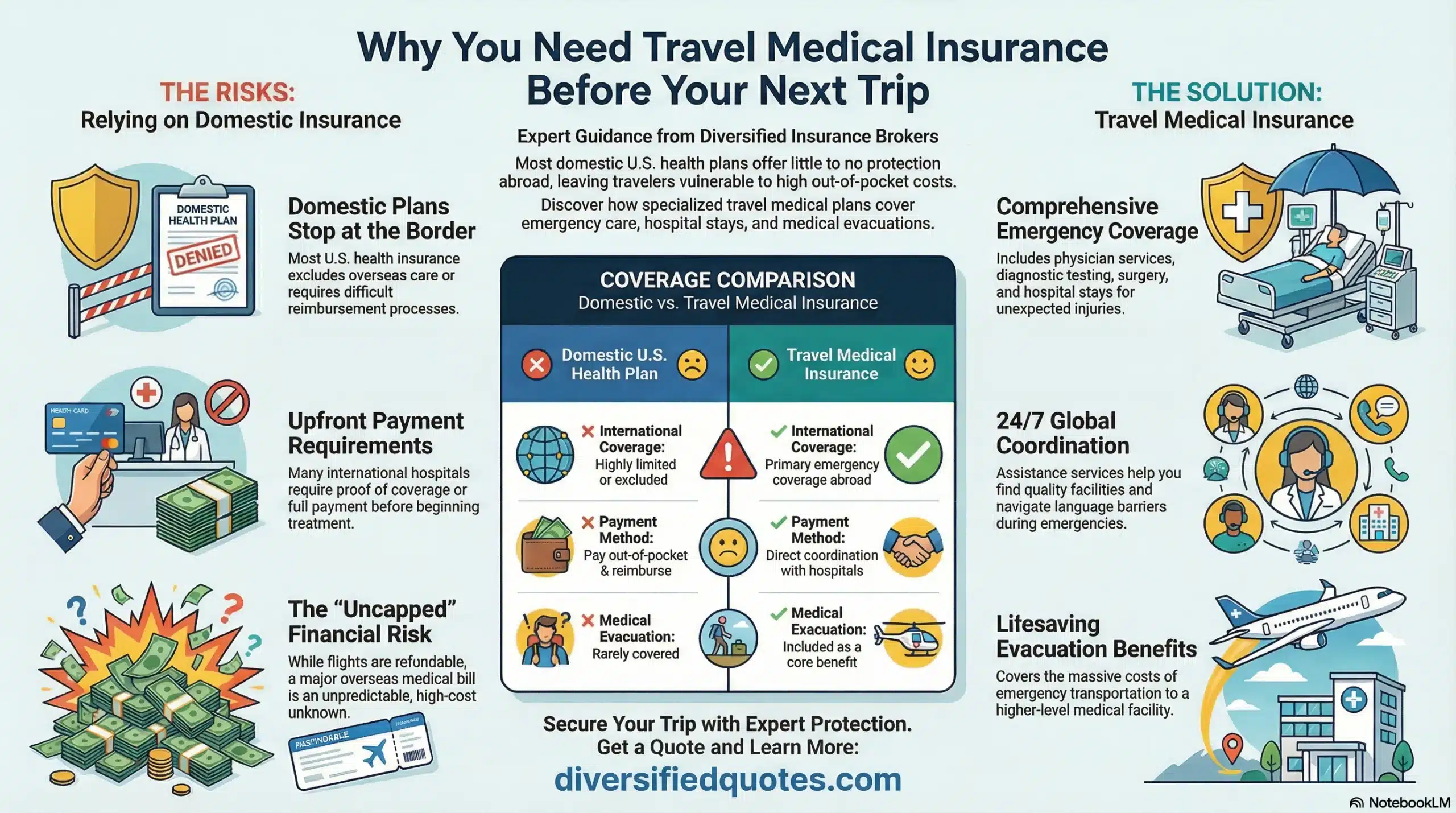
Most missionary organizations prioritize medical and evacuation protection as the foundational layer of their travel coverage because the most consequential risks in mission travel are medical — not lost luggage or a delayed flight. Emergency medical treatment abroad can be expensive in ways that surprise teams unfamiliar with international healthcare payment norms: providers often expect payment at the point of service before treatment proceeds, domestic US health insurance provides little to no international coverage, and the cost of inpatient treatment or surgery at an international facility can generate bills that overwhelm both individuals and organizational budgets. If local care is inadequate for the severity of the medical event, the evacuation dimension becomes the determining factor in whether the team member receives appropriate care — and evacuation costs can independently reach or exceed the entire budget of the trip if they occur without coverage in place. Emergency medical evacuation insurance covers evacuation coverage mechanics, what triggers evacuation authorization, and what adequate evacuation limits look like relative to actual transport costs from different world regions. Travel medical insurance covers the full range of emergency-focused medical coverage options for international travelers and groups as the foundational product layer for missionary travel planning.
Missionary Travel Coverage: Key Benefit Priorities by Deployment Type
| Deployment Type | Primary Risk Profile | Evacuation Priority | Activity Coverage Concern | Key Planning Note |
|---|---|---|---|---|
| Short-term construction / building missions | Physical labor injuries, heat illness, dehydration, wound infection in limited-care environments | High — remote construction sites often require significant transport to reach any advanced care | Manual labor and construction work may be excluded under standard travel plans — confirm explicitly | Activity alignment is critical — wound care and infection management in limited-facility environments are practical priorities |
| Medical missions and healthcare outreach | Occupational exposure to communicable illness, bloodborne pathogen risk for medical volunteers, travel health risks for all team members | High — medical outreach often occurs in underserved areas with limited backup care capacity | Medical volunteer work may require specific occupational hazard coverage — confirm whether clinical activities are addressed by the plan | Medical credential status of team members affects some plan terms — verify how licensed vs. unlicensed volunteer work is characterized |
| Long-term missionary deployment (months to years) | Full spectrum of health risk over extended periods — routine and emergency care both relevant; chronic condition management may arise | High — long-term missionaries are often based in locations with limited ongoing medical infrastructure | Standard travel medical plans may have duration limits — long-term deployment may require international health insurance rather than travel medical coverage | Long-term missionaries should evaluate whether travel medical or international health insurance is the appropriate product for their deployment duration |
| Church planting and pastoral support | Travel-related illness and injury across extended itineraries; rural travel risk; limited emergency response infrastructure in some regions | Moderate to high — depends heavily on region and whether work is urban or rural | Generally lower physical activity risk than construction — location risk and regional medical access are the primary coverage considerations | Multi-country itineraries common in church planting support — confirm all countries on the itinerary are covered under one policy |
| Disaster relief and humanitarian response | Physical labor in hazardous environments, exposure to waterborne illness, environmental health hazards from post-disaster conditions | Very high — post-disaster medical infrastructure is often severely compromised; evacuation to neighboring country may be the only path to adequate care | Heavy debris clearing and hazardous material exposure may require specific coverage confirmation — standard plans may restrict these activities | Some carriers restrict coverage in active disaster zones or regions under specific advisory levels — geographic coverage confirmation is essential before deployment |
What Mission-Focused Travel Medical Coverage Is Designed to Provide
Mission-specific travel medical insurance is built to address unexpected illness or injury during the travel period — the acute events that occur after the policy effective date that could not have been anticipated or planned for before departure. Depending on plan design and the specific coverage selected, emergency medical benefits can include physician evaluation and urgent care treatment, inpatient hospitalization including room and board and nursing care, surgical procedures, diagnostic imaging and laboratory testing tied to a covered medical event, prescription medications related to a covered condition, and specialist referral and treatment as medically necessary. These benefits activate for new conditions that arise during the trip rather than for pre-existing conditions managed before departure — which makes the pre-existing condition exclusion language one of the most important policy terms for any team member with a medical history.
For missionary groups, evacuation and repatriation benefits are typically the planning centerpiece because they address the scenario that most directly determines whether an adequate medical outcome is achievable: the situation where local care is insufficient for the condition the team member is facing. A team member who can be stabilized locally but needs surgery or specialist treatment that the local facility cannot provide depends on evacuation coverage to reach appropriate care without the financial and logistical barriers that would otherwise delay or prevent that transport. Plans that include real-time coordination assistance — where the insurer’s operations center actively locates appropriate providers, arranges transport, communicates with receiving facilities, and manages the logistics of the response — provide substantially more practical value than plans that only promise to reimburse costs the leader arranges independently during an active emergency. The coordination infrastructure is often more valuable than the financial benefit, particularly for teams serving in regions where local healthcare navigation is genuinely complex. Emergency travel health insurance covers the emergency-first coverage design in detail. Emergency travel health insurance for foreign nationals covers coverage options for multi-national mission teams that include non-US citizens. Travel medical insurance for religious groups covers the specific coverage considerations and plan designs for faith-based group travel.
Short-Term Mission Travel vs. Long-Term Missionary Deployment
One of the most important coverage planning distinctions for missions organizations is the difference between short-term mission travel and long-term missionary deployment — because these two contexts have meaningfully different coverage needs and are often served by different product types. Short-term mission travel — typically defined as trips of days to several months in duration — is generally well-served by travel medical insurance, which provides emergency medical and evacuation coverage during the defined trip period and is designed specifically for temporary international travel. These plans are priced for the trip period, can be purchased close to departure, and are structured around the emergency-first coverage priorities that characterize most short-term mission deployments.
Long-term missionary deployment — defined as missionaries living and working abroad for extended periods of six months or more, often without a fixed return date — typically requires international health insurance rather than travel medical coverage. International health insurance behaves more like a comprehensive health plan that happens to apply internationally, providing not just emergency coverage but routine medical care, chronic condition management, preventive services, and higher annual benefit limits designed for individuals or families whose primary healthcare context is abroad rather than at home. Organizations that manage both short-term teams and long-term field missionaries need to use different coverage products for each context rather than applying one product to both situations. International health insurance covers the longer-term international medical coverage option for organizations evaluating benefits for long-term missionaries. International travel health coverage covers the range of international medical protection options across different duration and benefit structures. Travel medical insurance for large groups covers structural and underwriting considerations for organizations coordinating coverage for larger rosters under group plan designs.
Apply online for missionary travel medical coverage
Skip paper forms — quote and apply online, then distribute proof of coverage and emergency instructions to leaders before departure.
Group vs. Individual Policies for Mission Teams
Missionary organizations typically choose between group travel medical plan structures and individual policy enrollments for each team member, and the right structure depends on the organization’s administrative capacity, the consistency of trip itineraries across team members, and whether all travelers share the same departure and return dates. Group plan structures cover the entire roster under a single master policy, simplify administration when all team members share the same travel dates and itinerary, and may provide pricing advantages for larger rosters. They also make it easier to distribute consistent documentation to all team members and to create standardized emergency contact protocols for leaders. The primary practical advantage is administrative simplicity — one policy to manage, one set of benefit terms to communicate to all team members, and one relationship to maintain with the insurer’s assistance team.
Individual policy enrollments provide more flexibility when team members are traveling from different home states, departing on different dates, have meaningfully different age or health profiles that affect appropriate coverage levels, or when some team members have specific coverage needs that the group structure cannot accommodate. Individual policies also ensure that each team member has their own policy documentation — which can matter for destination countries that require individual proof of coverage at the border, for team members whose personal health situations require specific benefit confirmation, or for organizations that want each traveler to have their own direct relationship with the insurer’s assistance services rather than routing everything through a group policy administrator. Either structure can provide adequate coverage for mission travel when the benefit limits, evacuation provisions, and activity coverage are confirmed as appropriate for the specific trip. How to get the best travel medical insurance rates covers the comparison methodology that produces the most appropriate and competitive coverage. How to get travel medical insurance last minute covers options when coverage needs arise close to departure. What is the primary reason people buy travel medical insurance covers the core risk calculation driving the purchase decision for international group travel.
Common Mistakes in Mission Trip Insurance Planning
The most consequential mistake missionary organizations make in coverage planning is purchasing a plan based primarily on price without confirming that the specific activities, destination regions, and group composition of the actual mission are compatible with the plan’s coverage terms. Activity exclusions are a frequent source of claim denials: many travel plans designed for tourist travel contain exclusions for manual labor, physical construction work, organized service activities, and local transportation methods (motorbikes, non-commercial vehicles) that are directly relevant to what missionary teams do. Discovering an exclusion after an injury occurred during a construction project or while traveling on a local vehicle is among the most avoidable and most frustrating outcomes in mission insurance planning, because confirming activity coverage takes minutes before purchase but cannot be corrected after a claim is denied.
Under-sizing evacuation limits relative to actual evacuation costs from the destination region is the second most common planning error. Many organizations focus primarily on medical benefit limits and treat evacuation as a secondary consideration — but in regions where advanced care requires evacuation, the evacuation cost can exceed the medical benefit limit as the primary cost driver of the event. Air ambulance from Central America, Sub-Saharan Africa, or Southeast Asia can reach tens of thousands of dollars before medical treatment costs are even calculated, and a plan with strong medical limits but inadequate evacuation limits leaves the organization financially exposed at the most critical moment. Waiting until the last minute to purchase coverage is the third common error — late purchasing creates administrative pressure, limits the organization’s ability to review terms carefully, and prevents leaders from having adequate time to understand benefit terms and emergency contact procedures before departure. High-risk travel insurance covers specialized coverage for teams serving in elevated-risk environments. Travel and medical insurance for high-risk travel covers the coverage design considerations for deployments in the most challenging destination environments. Is travel medical insurance expensive covers pricing expectations to help organizations budget appropriately without sacrificing essential coverage quality.
Send trip details and we’ll confirm the best fit
Destination conditions, travel dates, age ranges, and the type of service work matter. A quick review helps avoid mismatched coverage.
How Diversified Insurance Brokers Supports Your Mission
Our role in missionary group insurance is to keep coverage selection practical and accurate — match the plan to the specific trip, confirm that the benefits leaders actually need are in the policy they are purchasing, and identify the blind spots before departure rather than after a claim is filed. That is especially valuable when missionary groups include mixed age rosters, multiple destination countries, rural outreach travel into areas with limited medical infrastructure, physically demanding service activities that require activity coverage confirmation, or team compositions that include both US citizens and international partners who may need different coverage structures.
For organizations that run multiple mission programs annually — short-term construction teams, adult outreach groups, long-term field missionaries, and humanitarian response deployments — we can also help standardize the coverage planning framework across programs so that leaders across all programs know exactly what coverage is in place, what the emergency contact procedures are, and what the response process looks like if a medical event occurs. Consistent coverage planning across an organization’s programs reduces the probability of a coverage gap in any individual program and reduces the administrative burden of making independent coverage decisions for each trip from scratch. Travel insurance for humanitarian aid workers covers coverage considerations for organizations whose mission programs extend into humanitarian response contexts. Mission trip travel insurance covers the full range of mission travel coverage structures across different trip types and organizational contexts. Emergency travel medical insurance for US citizens covers the specific coverage considerations for American missionaries whose domestic plans provide no meaningful international coverage. Life insurance for foreign travel and residency covers the life insurance considerations for long-term missionaries whose extended international residence affects policy portability and beneficiary planning. Business travel accident insurance covers accident coverage for organizational staff making regular international mission-related trips.
Protect your mission team before you depart
Apply online for travel medical coverage designed for international trips, with support resources leaders can rely on during emergencies.
Need help choosing limits and evacuation options?
We’ll help you avoid overbuying while still protecting against the high-severity outcomes that can derail a mission trip.
Related Travel Medical Pages
Build your mission travel plan around medical access, emergency support, and evacuation readiness.
Related Mission & Group Travel Pages
Compare coverage setups for mission teams, church groups, volunteer programs, and youth deployments.
Talk With an Advisor Today
Choose how you’d like to connect—call or message us, then book a time that works for you.
Schedule here:
calendly.com/jason-dibcompanies/diversified-quotes
Licensed in all 50 states • Fiduciary, family-owned since 1980
Frequently Asked Questions: Travel Insurance for Missionary Groups
What is the most important coverage feature for most missionary groups?
For most missionary groups, emergency medical coverage combined with robust evacuation benefits represents the highest-priority coverage foundation. Emergency medical coverage addresses the cost of unexpected illness or injury treatment abroad — which can be expensive and often requires upfront payment at the point of service at international facilities. Evacuation coverage addresses the scenario that creates the most acute medical and financial risk: a situation where local care is insufficient for the condition a team member is facing, and transport to a more appropriate facility is the only path to an adequate medical outcome. For teams serving in areas with limited medical infrastructure, evacuation limits and the quality of real-time coordination assistance can matter as much as the medical benefit limits themselves.
What is the difference between travel medical insurance and international health insurance for missionaries?
Travel medical insurance is designed for temporary international travel — typically covering emergency medical and evacuation benefits during a defined trip period measured in days to several months. It is most appropriate for short-term mission teams and is priced for the specific trip duration. International health insurance is designed for individuals whose primary healthcare context is abroad for an extended period — behaving like a comprehensive health plan that provides routine care, chronic condition management, preventive services, and higher annual limits in addition to emergency coverage. Long-term missionaries living and working abroad for six months or more typically need international health insurance rather than a travel medical plan, because travel medical plans may have duration limits and are not designed for the full spectrum of healthcare needs that arise during an extended residence abroad.
Are construction and service work activities covered under missionary travel plans?
Not automatically — and this is one of the most important coverage questions to confirm before purchasing any plan for a missionary group that includes physical service work. Many travel plans contain exclusions for manual labor, physical construction activities, and organized service work that apply directly to what mission construction teams do. Plans designed for tourism rather than service travel may treat a house-building activity as an excluded occupational hazard rather than a covered recreational travel activity. Confirming explicitly that planned service activities — construction, demolition, clean-up work, agricultural support, heavy lifting, local vehicle transportation — are covered or specifically excluded under the plan terms before purchase is essential for avoiding claim denials that are entirely preventable with advance verification.
How does coverage work for international partners or non-US citizens on a mission team?
Non-US citizens traveling internationally on a joint mission team may need different coverage structures than US citizens on the same team, because eligibility rules, premium structures, and benefit designs for travel medical insurance often vary by the traveler’s home country and citizenship status. International partners traveling from their home country to serve in the United States have a different coverage need than those traveling to a third country. Organizations that include international partners should evaluate coverage options specifically for non-US travelers rather than assuming the same plan structure that works for US team members applies equally. Coverage options specifically for non-US citizens traveling internationally can be reviewed as part of the coverage selection process to ensure all team members are adequately covered regardless of their citizenship.
Should mission organizations use group plans or individual policies for team members?
Both structures can provide adequate coverage when properly selected, and the right choice depends primarily on administrative practicality and the consistency of the team’s travel structure. Group plans simplify administration when all team members share the same travel dates, itinerary, and departure and arrival points — providing one policy to manage, one set of terms to communicate, and one emergency contact infrastructure for all team members. Individual enrollments offer more flexibility when team members depart from different locations, have meaningfully different age or health profiles, or need specific coverage configurations that a group structure cannot accommodate uniformly. Organizations running frequent trips throughout the year often find group structures more administratively sustainable, while one-time trip leaders may find individual policy management more straightforward for a defined roster.
About the Author:
Jason Stolz, CLTC, CRPC, DIA, CAA and Chief Underwriter at Diversified Insurance Brokers (NPN 20471358), is a senior insurance and retirement professional with more than 25 years of real-world experience helping individuals, families, and business owners protect their income, assets, and long-term financial stability. As a long-time partner of the nationally licensed independent agency Diversified Insurance Brokers, Jason provides trusted guidance across multiple specialties—including fixed and indexed annuities, long-term care planning, personal and business disability insurance, life insurance solutions, Group Health, Travel Medical and Evacuation Insurance, and short-term health coverage. Diversified Insurance Brokers maintains active contracts with over 100 highly rated insurance carriers, ensuring clients have access to a broad and competitive marketplace.
His practical, education-first approach has earned recognition in publications such as VoyageATL, and contributions from his agency featured in Kiplinger and GoBankingRates— highlighting his commitment to financial clarity and client-focused planning. Drawing on deep product knowledge and years of hands-on field experience, Jason helps clients evaluate carriers, compare strategies, and build retirement and protection plans that are both secure and cost-efficient. Visitors who want to explore current annuity rates and compare options across multiple insurers can also use this annuity quote and comparison tool.
Explore More Travel Medical Insurance Options: Browse our complete guide to Groups & Specialty Travel Insurance — covering church groups, missionaries, volunteers, students, expats, digital nomads & more.
Last Reviewed: June 17, 2026 |
Reviewed by: Jason Stolz, CLTC, CRPC, DIA, CAA
Chief Underwriter, Diversified Insurance Brokers, Inc. | NPN: 20471358 | Diversified Insurance Brokers, Inc. — Licensed in all 50 states
Fact Checked by: Tonia Pettitt, CMIP©
Medicare Specialist, Diversified Insurance Brokers, Inc. | NPN: 14374308 | Diversified Insurance Brokers, Inc. — Licensed in all 50 states
Did you find this content helpful? Leave us a Google review — it helps others find trustworthy guidance too.
Editorial Standards: Diversified Insurance Brokers maintains rigorous editorial standards to ensure accuracy, clarity, and independence in all content. Learn more about our editorial standards and commitment to transparency.
