
Is Travel Medical Insurance Expensive?
Is Travel Medical Insurance Expensive?

Jason Stolz CLTC, CRPC, DIA, CAA
Is travel medical insurance expensive? In most cases, no — and for most travelers, the more useful question is whether the cost of a plan is large relative to the financial risk it protects against. A basic travel medical plan often costs only a few dollars per day for a healthy traveler on a standard international trip. That number can increase with age, trip length, destination risk, and benefit level — but even at higher premium points, the total cost of coverage frequently represents a small fraction of what a single overseas emergency room visit, hospitalization, or medical evacuation could cost. The reason travel medical insurance feels like a bargain to people who have actually used it is that the events it covers are not modestly expensive. They are potentially six-figure events that arrive without warning and have no connection to how healthy you felt when you boarded the plane.
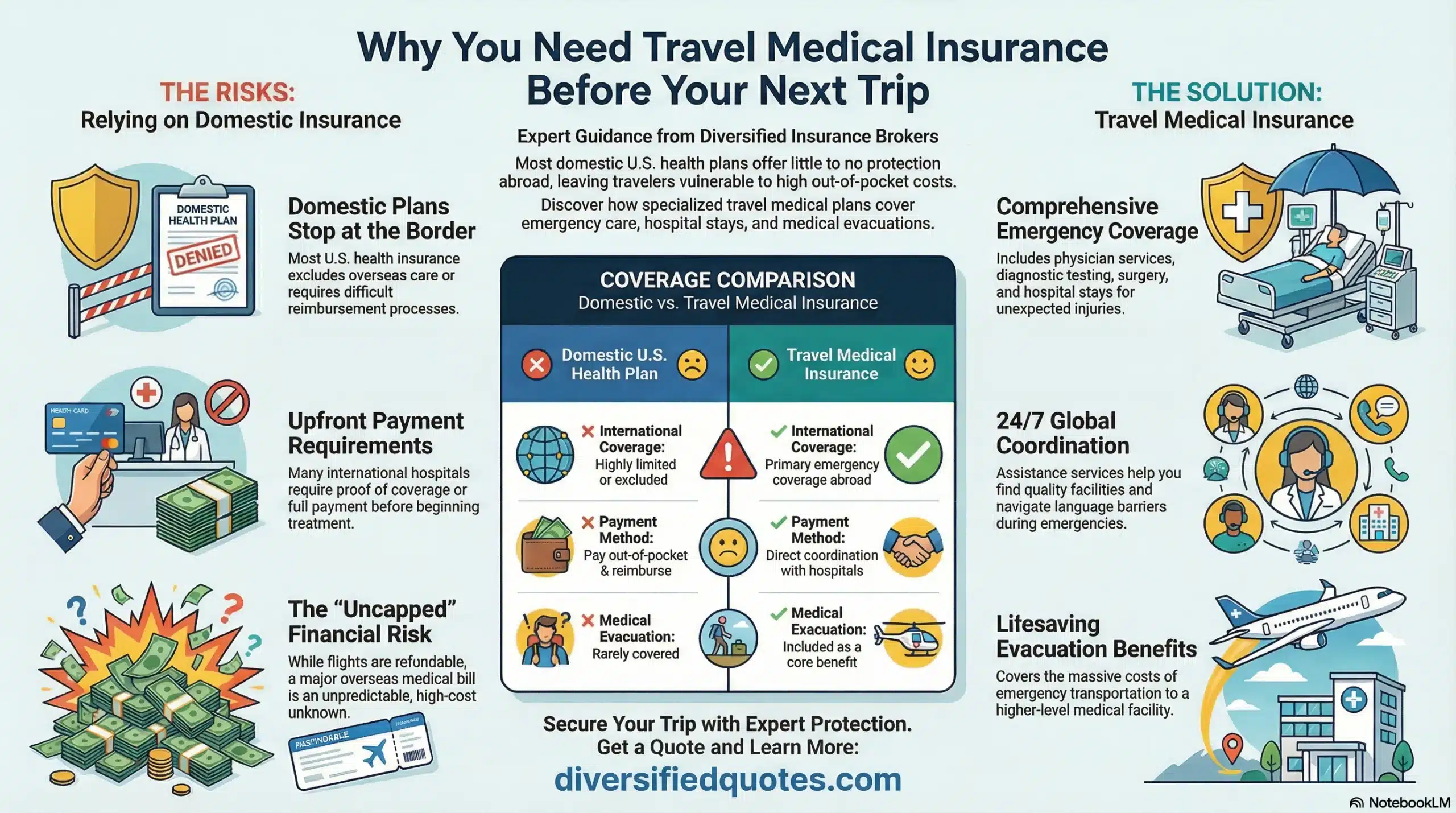
At Diversified Insurance Brokers, Jason Stolz, CLTC, CRPC, DIA, CAA, helps travelers compare travel medical plans from providers including International Medical Group (IMG) and Petersen International Underwriters (PIU) so that coverage fits the actual trip — the length, the destination, the activity level, and the realistic risk profile of the traveler. Many U.S. health insurance plans provide limited or no benefits outside the country, and Medicare generally does not function as primary coverage internationally. That gap is the fundamental reason travel medical insurance exists: to create a clear plan for emergency medical expenses when domestic coverage stops at the border and out-of-pocket exposure becomes genuinely open-ended. For a foundational explanation of how these plans are structured and what they cover, emergency travel health insurance and emergency travel medical insurance for U.S. citizens both cover what domestic coverage gaps look like and how travel medical fills them.
Compare Travel Medical Options in Minutes
Share your destination, dates, ages, and activity level. We’ll help you compare plans and avoid common gaps before you travel.
Questions? Call 800-533-5969
Why Travel Medical Insurance Is Worth the Cost
The value of travel medical insurance is not felt during the routine parts of a trip. It is felt when something escalates — a severe illness that requires imaging and specialist care, a fracture that needs surgical repair, a complicated infection that requires IV treatment and inpatient observation, or a situation where the best available care is not at the nearest local facility and evacuation becomes the right answer. In those moments, the coverage provides two things simultaneously: the financial protection that limits out-of-pocket exposure and the assistance infrastructure that solves the logistical problem of getting the right care in an unfamiliar system. Both matter. A plan that reimburses expenses but provides no coordination assistance leaves a traveler navigating a foreign healthcare system in a potentially high-stress situation without guidance. A plan that provides coordination but insufficient benefit limits transfers significant financial risk back to the traveler. The best plans provide both, and understanding how to evaluate them is more important than finding the lowest premium.
The medical downside scenario is also worth making concrete. An international air evacuation from many destinations costs $50,000 to $200,000 or more depending on distance, aircraft requirements, and medical staff involved. An inpatient hospitalization in many European or Asian destinations can run $5,000 to $30,000 per day in a private hospital. Emergency surgery can add tens of thousands more. These numbers are not exotic worst cases — they are the realistic cost of events that happen to ordinary travelers on ordinary trips every year. Against those numbers, the cost of a travel medical plan almost always represents a favorable risk transfer, and travelers who decline coverage are effectively self-insuring a risk whose maximum loss is far larger than most people would knowingly accept.
What Drives Travel Medical Insurance Pricing Up or Down
Travel medical insurance is priced primarily around trip duration, traveler age, destination, and benefit design — not around the long-term health underwriting that governs domestic major medical plans. For many healthy travelers on a standard two-week international trip, a plan with solid medical and evacuation coverage costs a modest amount that stays well below what any meaningful emergency would cost. Understanding the specific factors that move that number helps travelers make better decisions about where to invest their premium budget and where to accept more risk.
Trip length is one of the most straightforward pricing variables: coverage is tied to the travel period, and more days of coverage cost more overall, though the per-day cost often remains relatively predictable. Age has a more meaningful impact on premium because the likelihood of needing medical care increases substantially as travelers get older, and insurers price that utilization risk accordingly. A 30-year-old and a 65-year-old taking the same trip to the same destination can face meaningfully different premium levels for equivalent coverage. The medical benefit maximum chosen also affects premium: a plan with a $500,000 maximum costs more than one with a $100,000 maximum, though the per-dollar cost of additional coverage often decreases at higher levels because the incremental probability of reaching those amounts is lower.
Deductibles are one of the most powerful levers for travelers managing premium cost. Choosing a higher deductible — $250 or $500 instead of $0 — can meaningfully reduce the premium while preserving protection against the large events where the financial exposure is genuinely serious. This trade-off makes sense for travelers who are primarily concerned about catastrophic risk rather than reimbursement for routine care, and it is often the most efficient way to lower premium without reducing the core protection that makes the plan valuable. Destination influences pricing because healthcare costs and claim patterns vary significantly by region, and some destinations create higher expected evacuation costs — high-risk travel insurance and travel and medical insurance for high-risk travel both cover how plan structure and pricing shift when destinations involve more remote environments or less predictable medical infrastructure. For travelers who want guidance on finding the most competitive rates across plan options, how to get the best travel medical insurance rates covers the comparison framework. And for situations where travel is imminent and the purchase window is short, how to get travel medical insurance last minute covers what to expect when timeline is compressed.
Explore IMG Travel Medical Plans
Compare travel medical options built for international trips, with coverage designed for unexpected illness, injury, and emergency coordination.
What You Are Actually Buying — and Why the Non-Financial Benefits Matter
Travel medical insurance is frequently described as reimbursement coverage, but reimbursement is only part of what the plan provides. In many of the situations where a travel medical plan matters most, the most valuable component is the assistance and coordination infrastructure that comes with it. When a traveler becomes seriously ill in a foreign country — not knowing which facility is appropriate for the condition, not speaking the language, not understanding how the local healthcare system works, and potentially not able to communicate clearly with family — an experienced 24-hour assistance team with relationships in that market can direct the situation in ways that an individual cannot direct themselves. That coordination reduces the probability of receiving inadequate care, reduces the probability of making logistical decisions under extreme stress that turn out to be wrong, and creates a documented record of care that matters for claims and for follow-up treatment at home.
For evacuation specifically, the assistance infrastructure is the mechanism through which the benefit actually works. An evacuation benefit that says “we will pay for evacuation” is only as valuable as the operational capability behind it — the ability to arrange appropriate aircraft and medical staffing, to coordinate with receiving facilities, to manage the logistics of a cross-border medical transfer in a compressed timeframe. Evaluating that operational capability rather than just the dollar limit is one of the most important and most frequently overlooked dimensions of travel medical plan comparison. Emergency medical evacuation insurance covers what triggers an evacuation, how coordination requirements work in practice, and what to look for in both benefit limits and operational standards. For coverage specifically involving high-risk destinations where that coordination is most likely to matter, travel medical and evacuation insurance for high-risk areas covers how plan selection changes when the destination itself creates elevated evacuation probability.
When Longer-Term International Coverage Is a Better Fit
For travelers whose international presence extends beyond a defined trip into something closer to extended living abroad, the cost and structure comparison shifts. Digital nomads, expats on multi-month assignments, international students, long-term volunteers, and retirees who have relocated internationally typically find that short-trip travel medical plans do not fit their situation — either because duration limits create coverage gaps or because the emergency-oriented design does not address the routine care, prescription access, and specialist availability that becomes part of normal life when abroad for months at a time. For those situations, international health insurance covers the product category designed for ongoing global living rather than trip-based emergency protection. PIU options are particularly relevant for extended stays and longer-duration protection needs where the goal is coverage that functions more like a major medical plan than a travel supplement.
Longer-Term Global Health Coverage
A strong option for extended stays abroad and travelers who want more comprehensive, longer-duration protection.
Medical Risk vs. Trip Cost Risk — Separating the Two Decisions
A helpful framework for evaluating travel insurance purchases is to separate two distinct risks that travelers often blend together without realizing it. Medical risk is the cost of needing treatment abroad, the financial exposure from hospitalization, surgery, or evacuation, and the logistical challenge of navigating an unfamiliar healthcare system. Trip cost risk is the financial loss from non-refundable airfare, hotels, tours, and prepaid expenses if something forces cancellation or early return. These are different risks with different probability profiles and different financial magnitudes, and they are served by different products.
Travel medical insurance addresses medical risk. Trip cancellation coverage addresses trip cost risk. Many travelers purchase travel medical coverage even when trip cancellation is not relevant — because the trip is refundable, low-cost, or otherwise not worth insuring against cancellation — because the medical downside is unpredictable and can be very large regardless of how much the trip itself cost. The decision to purchase each type of coverage is independent and should be made based on the specific risk profile of the trip rather than on a general assumption that “travel insurance” is one product that either covers everything or is not worth purchasing at all. For travelers who are also evaluating gaps in domestic coverage — particularly those between jobs, in employer benefit transition periods, or in situations where domestic health coverage is limited — short-term health insurance and how short-term health insurance bridges coverage gaps cover how domestic and international protection can be coordinated so neither leaves a blind spot.
Get Your Travel Medical Pricing and Options
Tell us where you are going and for how long. We will show you affordable options that fit your trip and protect against the big-ticket risks.
Questions? Call 800-533-5969
Talk With an Advisor Today
Choose how you’d like to connect—call or message us, then book a time that works for you.
Schedule here:
calendly.com/jason-dibcompanies/diversified-quotes
Licensed in all 50 states • Fiduciary, family-owned since 1980
Frequently Asked Questions: Is Travel Medical Insurance Expensive?
How much does travel medical insurance typically cost for a two-week trip?
For a healthy traveler in their 30s or 40s on a standard two-week international trip, a travel medical plan with solid medical and evacuation coverage can cost anywhere from $50 to $150 total depending on destination, benefit level, and deductible choice. For older travelers — those in their 60s or 70s — the same trip with equivalent benefits typically costs more because the utilization probability is higher and carriers price that risk accordingly. The range widens with age, destination risk, and medical limit selection. A plan with a $500,000 medical maximum costs more than one with $100,000, though the incremental cost of higher limits is often modest relative to the additional protection provided. The most effective way to find the right number for a specific trip is to compare plans directly across the variables that matter — destination, age, trip length, deductible, and benefit maximum — rather than starting from an assumption about what travel medical “should” cost.
Can I reduce the cost of travel medical insurance without losing meaningful protection?
Yes — and deductible selection is the most effective lever for doing so. Choosing a higher deductible ($250 or $500 instead of $0) can reduce premium meaningfully while preserving the core protection against the large events — hospitalization, surgery, evacuation — where the financial exposure is genuinely serious. This trade-off makes the most sense for travelers who are primarily concerned about catastrophic risk rather than reimbursement for routine care or minor illness. Reducing the medical maximum is another option, though it requires more careful consideration: a plan with a $100,000 maximum may be insufficient for an evacuation from a distant destination, while a $500,000 maximum provides broader coverage for a modest additional premium in most cases. Optional riders — dental coverage, adventure sports coverage, pre-existing condition coverage — also add cost and can be evaluated individually based on whether the specific benefit is relevant to your trip. The goal is identifying which protections are genuinely necessary for your situation and which are optional additions that may not be worth the premium for your specific itinerary.
Does destination affect the cost of travel medical insurance?
Yes, though the effect varies by carrier and plan. Destinations are often grouped into geographic regions or risk tiers, with higher-risk or higher-cost destinations reflected in premium adjustments. The two most significant destination-related factors are the cost of medical care in the destination country and the probability and cost of evacuation if care there is insufficient. Destinations with high local healthcare costs but reliable medical infrastructure — much of Western Europe, for example — may create higher potential claim costs but lower evacuation risk. Destinations with lower local healthcare costs but limited medical infrastructure may create lower initial claim costs but higher evacuation probability and expense. Remote itineraries, developing-country destinations, and regions with active conflict or limited medical access typically warrant closer attention to evacuation benefits specifically, because the scenarios where those benefits become relevant are more probable and the logistical complexity of executing them is higher.
Is travel medical insurance worth it if I already have domestic health insurance?
For most international travel, yes — because domestic health insurance typically provides limited or no coverage outside the United States. Most U.S. employer health plans and individual marketplace plans either exclude international claims entirely or provide only very limited emergency coverage that requires out-of-pocket payment first and reimbursement later at domestic reimbursement rates, which may be significantly lower than actual international costs. Medicare provides no coverage outside the U.S. for the vast majority of situations. The gap between what domestic insurance covers abroad and what actual international medical costs can reach is the core reason travel medical insurance exists. Even travelers with comprehensive domestic coverage are typically unprotected internationally in any meaningful way — and the specific events that travel medical covers, particularly evacuation, are not covered by domestic health plans under any circumstances.
What is the difference between travel medical insurance and trip cancellation insurance?
Travel medical insurance covers the cost of medical care and evacuation if you become ill or injured while traveling internationally. Trip cancellation insurance covers the financial loss of non-refundable travel expenses — airfare, hotels, tours, cruise deposits — if something forces you to cancel or cut the trip short before or during travel. These are different products addressing different risks, and the decision to purchase each is independent. Many travelers purchase travel medical coverage even when trip cancellation is not relevant — because the trip is fully refundable or inexpensive enough that the financial loss of cancellation is acceptable — because the medical downside is unpredictable and can be very large regardless of how much the trip cost. Travel medical is generally the first coverage we recommend for any international trip, because the medical risk exists on every trip regardless of how much was spent on it, while trip cancellation risk depends on the specific financial exposure of non-refundable prepaid costs.
About the Author:
Jason Stolz, CLTC, CRPC, DIA, CAA and Chief Underwriter at Diversified Insurance Brokers (NPN 20471358), is a senior insurance and retirement professional with more than 25 years of real-world experience helping individuals, families, and business owners protect their income, assets, and long-term financial stability. As a long-time partner of the nationally licensed independent agency Diversified Insurance Brokers, Jason provides trusted guidance across multiple specialties—including fixed and indexed annuities, long-term care planning, personal and business disability insurance, life insurance solutions, Group Health, Travel Medical and Evacuation Insurance, and short-term health coverage. Diversified Insurance Brokers maintains active contracts with over 100 highly rated insurance carriers, ensuring clients have access to a broad and competitive marketplace.
His practical, education-first approach has earned recognition in publications such as VoyageATL, and contributions from his agency featured in Kiplinger and GoBankingRates— highlighting his commitment to financial clarity and client-focused planning. Drawing on deep product knowledge and years of hands-on field experience, Jason helps clients evaluate carriers, compare strategies, and build retirement and protection plans that are both secure and cost-efficient. Visitors who want to explore current annuity rates and compare options across multiple insurers can also use this annuity quote and comparison tool.
Explore More Travel Medical Insurance Options: Browse our complete guide to Travel Insurance Planning & Education — covering how it works, costs, last minute coverage, high risk travel & buying guides.
Last Reviewed: June 14, 2026 |
Reviewed by: Jason Stolz, CLTC, CRPC, DIA, CAA
Chief Underwriter, Diversified Insurance Brokers, Inc. | NPN: 20471358 | Diversified Insurance Brokers, Inc. — Licensed in all 50 states
Fact Checked by: Tonia Pettitt, CMIP©
Medicare Specialist, Diversified Insurance Brokers, Inc. | NPN: 14374308 | Diversified Insurance Brokers, Inc. — Licensed in all 50 states
Did you find this content helpful? Leave us a Google review — it helps others find trustworthy guidance too.
Editorial Standards: Diversified Insurance Brokers maintains rigorous editorial standards to ensure accuracy, clarity, and independence in all content. Learn more about our editorial standards and commitment to transparency.
