
Emergency Medical Evacuation Insurance
Emergency Medical Evacuation Insurance

Jason Stolz CLTC, CRPC, DIA, CAA
What Emergency Medical Evacuation Insurance Actually Does — and Why the Coordination Matters More Than the Limit
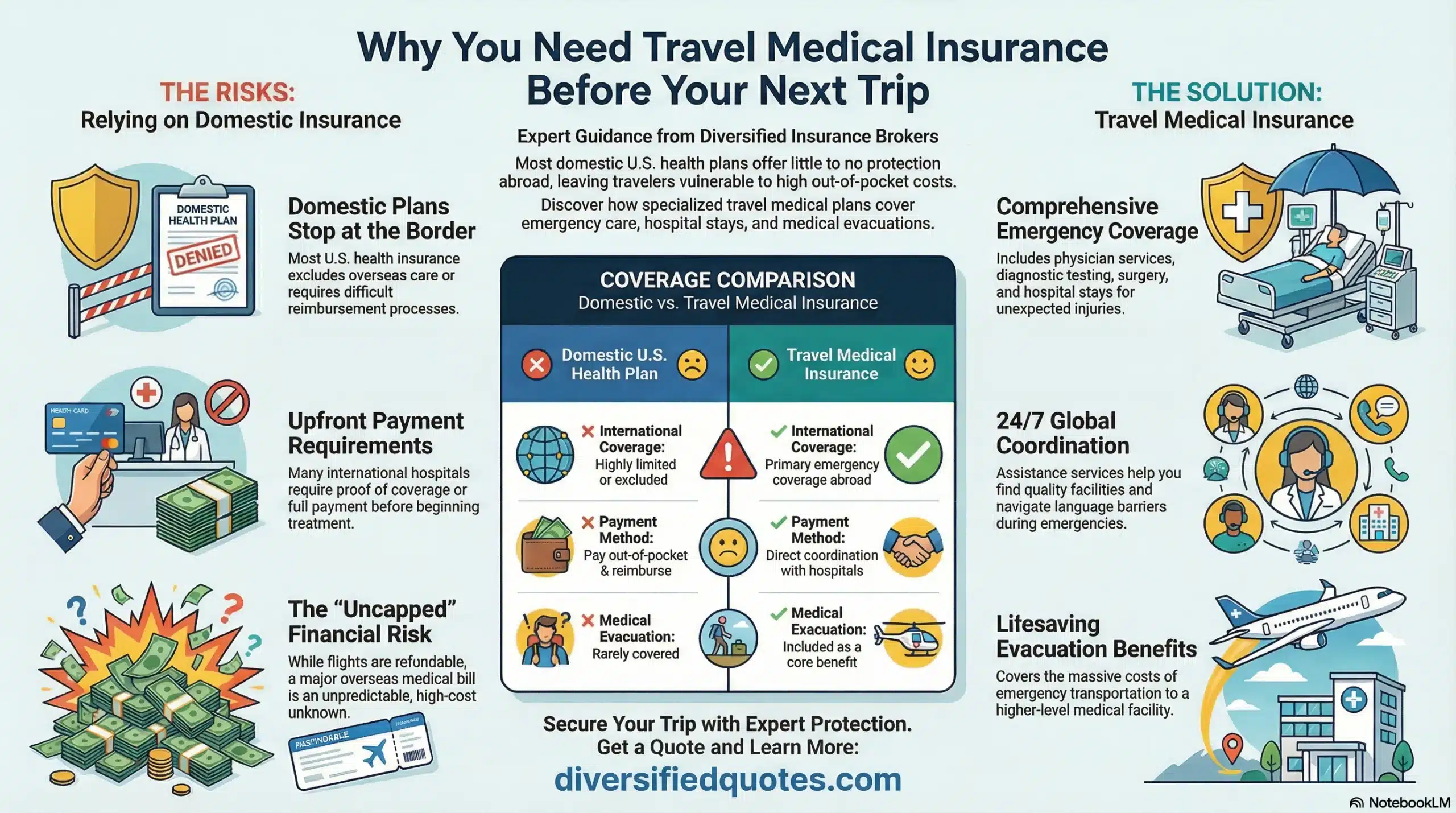
Emergency medical evacuation insurance pays for medically necessary transport when local facilities cannot treat your condition — covering the cost of ground ambulance, helicopter, or fixed-wing air ambulance with medical staff to move you from where you are to a facility capable of providing the care you need. For travelers in remote areas, developing countries with limited specialty care, or destinations where the distance from adequate healthcare is measured in hours, the cost of that transport without insurance can easily exceed $100,000 and in complex international repatriations can reach $250,000 or more. A helicopter rescue from alpine terrain runs $15,000 to $50,000. A fixed-wing air ambulance for international repatriation from a mid-distance destination runs $50,000 to $250,000. A ship-to-shore transfer from a cruise to a mainland hospital runs $10,000 to $40,000. These are not edge-case numbers — they reflect the actual cost of air medical transport in the markets where evacuations most commonly occur. At Diversified Insurance Brokers, Jason Stolz, CLTC, CRPC, DIA, CAA evaluates evacuation coverage against the realistic transport exposure for each client’s specific destination, duration, and health profile — confirming the benefit limit is adequate, the “nearest appropriate facility” definition is workable, and the authorization requirements are manageable under real emergency conditions. Travel medical insurance addresses the treatment cost layer that sits alongside or beneath the evacuation benefit — understanding how both fit together is the starting point for any complete travel health protection strategy.
The Coordination Problem Is the Real Risk — Not Just the Cost
The financial cost of evacuation is significant, but the more immediate problem in a real emergency is the coordination gap — the series of decisions, communications, and arrangements that must happen correctly and quickly while the patient or their companions are under extreme stress, often in an unfamiliar language and healthcare system. A physician must certify that local care is inadequate. The insurer’s assistance team must confirm medical necessity and pre-authorize the transport. A receiving facility must accept the patient. The appropriate aircraft type must be arranged based on the patient’s condition and distance. Medical equipment and possibly a flight nurse or physician must be on board. All of this happens in parallel while the patient needs care and family members need information.
The 24/7 assistance team that a quality evacuation plan provides is the mechanism that manages this coordination problem — not just a phone number to call, but an operational capability that handles facility communication, physician-to-physician coordination, transport logistics, and documentation requirements simultaneously. This is why the quality and capability of the assistance provider is as important as the dollar limit when evaluating plans. A plan with a $500,000 evacuation limit but a weak assistance infrastructure can produce worse real-world outcomes than a plan with a $250,000 limit backed by a capable assistance team with established carrier and facility relationships. High-risk travel insurance addresses the specific coordination complexity that arises when destinations involve elevated operational risk — where the assistance team’s capability matters even more than in standard international travel. International health insurance for longer-term stays and expatriate coverage provides the comprehensive medical coverage framework within which standalone evacuation plans fit for travelers whose stay extends beyond a typical short trip.
Compare Emergency Medical Evacuation Plans
View evacuation-focused plans and apply online. We’ll help confirm the right limit and coordination structure for your destination and trip profile.
Evacuation, Repatriation, and Medical Escort — Three Distinct Benefits Often Confused
| Benefit | What It Covers | When It Applies |
|---|---|---|
| Emergency medical evacuation | Transport from the location of illness or injury to the nearest appropriate facility capable of providing the required treatment — may be a regional hospital within the same country, or a facility across a border when the local healthcare system lacks the necessary capability; includes ground ambulance, helicopter, or fixed-wing air ambulance depending on the patient’s condition and transport distance | When a licensed physician certifies that the current facility cannot provide adequate care; the insurer’s assistance team pre-authorizes transport after confirming medical necessity; applies to serious illness, major trauma, surgical complications, or acute conditions requiring specialty care not available locally |
| Medical repatriation | Transport from a foreign medical facility back to the patient’s home country for continued treatment — a separate benefit from evacuation to the nearest appropriate facility; may cover the cost of returning to a hospital near home rather than the nearest adequate foreign facility; the “hospital of choice” benefit on premium plans allows return to a preferred home institution rather than the geographically nearest facility | When the patient has been stabilized at the evacuation destination but continued treatment is more appropriate at home; requires medical certification that repatriation is medically necessary; not all plans include repatriation, and the repatriation benefit limit may differ from the evacuation benefit limit — both must be confirmed before purchase |
| Medical escort | A qualified medical professional — flight nurse or physician — accompanies the patient during transport when commercial air travel is possible but monitoring or medical support is required en route; less expensive than a full air ambulance transport because a commercial flight is used rather than a chartered medical aircraft | When the patient is stable enough for commercial travel but requires medical oversight during the flight — for example, post-surgical recovery where the flight itself creates risk that requires monitoring; determined by the assistance team’s medical staff in coordination with the treating physician; applies when full air ambulance transport is not medically required but unsupported commercial travel is not appropriate |
The three benefits in the table serve distinct phases of a serious travel medical episode — evacuation gets the patient to appropriate care, repatriation gets them home, and medical escort manages the in-between step of a monitored commercial return. Most buyers focus on the evacuation benefit and overlook whether repatriation is included, at what limit, and under what conditions. For travelers who specifically want the ability to return to their home hospital rather than the nearest adequate foreign facility, the repatriation benefit and its “hospital of choice” variant are the most important design elements to confirm. Short-term health insurance and short-term medical coverage provide alternative frameworks for domestic coverage gaps — structurally different from travel evacuation but relevant for buyers managing coverage transitions around international travel periods.
How Much Evacuation Coverage Is Enough — and What Drives the Limit Decision
Most travelers on standard international trips need $100,000 to $250,000 in evacuation coverage as a baseline. Remote destinations, adventure activities, multi-country itineraries, or areas with limited healthcare infrastructure typically require $250,000 or more because the transport distance, logistical complexity, and aircraft requirements for those scenarios drive costs significantly higher than a standard urban international destination. The evacuation limit decision is primarily a function of worst-case transport cost from the planned destination — not average cost — because the purpose of the benefit is to eliminate the financial exposure from a serious low-probability high-cost event rather than to cover typical minor medical costs.
Destination matters more than trip length for limit sizing. A traveler spending two weeks in a major European city with well-developed healthcare infrastructure faces a very different evacuation cost scenario than a traveler spending a week in a remote part of Southeast Asia or sub-Saharan Africa where the nearest appropriate facility is hundreds of miles away and domestic air ambulance infrastructure is limited. For the European destination, a $100,000 limit may be adequate. For the remote destination, a $250,000 limit is a more defensible floor. For high-risk professional assignments — contractor work in conflict-adjacent areas, mission deployments in medically underserved regions, expedition or extreme sport activities — limits above $500,000 and specialized security evacuation provisions may be appropriate alongside the medical evacuation benefit. Life insurance planning for international travelers and foreign nationals addresses the mortality risk dimension that exists alongside the medical evacuation risk for buyers managing complex international exposure. Key person life insurance through Lloyd’s of London is available for high-value individuals whose international deployments involve elevated personal risk that standard carrier markets may not fully address. For workers or contractors whose international assignment involves ongoing occupational risk, disability insurance protects the income stream that an evacuation event could interrupt even after the medical emergency is resolved.
The Authorization Requirement — Why You Must Call Before You Arrange Transport
The most common evacuation insurance mistake is arranging transport independently and then seeking reimbursement — and having the claim denied because pre-authorization was not obtained. Most evacuation plans require contact with the insurer’s 24/7 assistance line before any evacuation is arranged. The assistance team confirms medical necessity, identifies the appropriate destination facility, arranges the transport, and coordinates with the treating and receiving physicians. Transport arranged independently — even if medically necessary and logistically reasonable — may not be covered because the authorization and coordination requirement was bypassed.
This requirement is not bureaucratic obstruction — it is the mechanism that ensures the plan pays for the most medically appropriate and cost-efficient transport option rather than whatever was available at the moment of the emergency. The assistance team has established relationships with air ambulance operators, receiving facilities, and local medical networks that a traveler or their companion cannot replicate independently under emergency conditions. The practical implication is that the assistance line number must be saved, accessible, and shared with any travel companions or group leaders before departure — not looked up in a moment of crisis after something has already gone wrong. For group travel — mission teams, church groups, corporate delegations — building a simple documented emergency protocol that includes who calls the assistance line first is a meaningful risk management step that the insurance policy alone does not provide. Group versus individual coverage structures and group level funding approaches provide context for organizations evaluating how to structure protection for groups of travelers under a coordinated policy framework.
Evacuation Coverage for Seniors — The Medicare Gap That Makes It Essential
For travelers on Medicare or Medicare Advantage, emergency medical evacuation insurance is not optional supplemental protection — it is the coverage that addresses a genuine and significant gap. Original Medicare and Medicare Advantage plans generally do not cover medical care or transport outside the United States. A Medicare beneficiary who experiences a serious medical event while traveling internationally faces the full cost of both treatment and evacuation out of pocket unless a separate travel medical and evacuation policy is in place. The same Medicare Advantage plan that covers an ER visit in Georgia with a defined copay provides no coverage whatsoever for an ER visit in Greece or an air ambulance from rural Mexico to a U.S. hospital. How Medicare works and Medicare enrollment planning establish the coverage structure whose international gap creates this specific evacuation insurance need for senior travelers. Medicare supplement plans address the domestic Medicare cost-sharing gaps, and some Medigap plans include limited foreign travel emergency benefits — but even the Medigap foreign travel benefit has lifetime limits ($50,000 in most plans after a $250 deductible) that may be inadequate for a major international evacuation event. Hospital indemnity for Medicare Advantage members addresses the domestic supplemental coverage dimension — a separate but complementary protection need for the same senior population that most needs evacuation coverage for international travel.
Senior Travel and the Long-Term Care Connection
Senior travelers managing chronic conditions face an additional complexity: an international medical event that requires evacuation may also require follow-up care after return home that goes beyond acute hospital treatment. Post-evacuation skilled nursing care, rehabilitation, or home health services are distinct from the evacuation itself and fall under the long-term care coverage landscape rather than the travel medical framework. Whether Medicare covers long-term care — it does not cover custodial care — establishes the care cost gap that can extend an evacuation episode’s financial impact well beyond the transport itself. Annuities with long-term care benefits and long-term care insurance with shared spousal benefits address that downstream care cost risk for senior travelers whose health profile creates realistic post-evacuation care needs. The IRMAA planning strategies that reduce Medicare premium surcharges help free retirement income for travel insurance premiums and other protection costs. Getting a second opinion on Medicare coverage confirms the specific international coverage terms of any Medigap or MA plan before travel — so the gap the evacuation policy needs to fill is precisely understood. Hospital indemnity for observation stays and ER and urgent care hospital indemnity benefits address the domestic cost-sharing needs that exist alongside the international evacuation exposure — together they provide a more complete protection picture for senior travelers who face both domestic medical cost-sharing and international evacuation risk.
Integrating Evacuation Coverage With the Broader Senior Financial Plan
For senior travelers, evacuation insurance is one component of a broader financial protection architecture that includes retirement income security, domestic healthcare cost management, and long-term care planning. Social Security planning guidance and maximizing Social Security benefits establish the retirement income foundation within which all protection premiums — including travel and evacuation coverage — must be sustainably budgeted. How Social Security and annuities coordinate in a retirement income plan provides the complete income architecture that makes discretionary travel and its associated protection costs affordable on a fixed budget. Annuities for conservative investors represent the guaranteed income base that makes predictable monthly expenses — including annual travel insurance premiums — manageable regardless of market conditions. For seniors who travel frequently and want annual multi-trip coverage rather than per-trip policies, the ability to budget a single annual premium that covers all trips during the year is an income planning consideration that the annuity income foundation directly supports. Annuity income as a monthly retirement cash flow source and the best annuity for guaranteed retirement income provide the income planning specifics that determine whether annual travel protection premiums fit comfortably within the household budget. What annuity guarantees mean and the fundamentals of how annuities work establish the product knowledge foundation for the income planning decisions that surround all senior protection costs. Non-qualified long-term care annuities address the care cost and income security dimensions simultaneously — the comprehensive planning instrument for seniors managing both retirement income adequacy and care cost exposure. Whether life insurance is still needed in retirement and burial insurance for seniors address the life insurance and final expense dimensions of the complete senior protection portfolio. Final expense whole life insurance specifically ensures funeral and end-of-life costs are covered — the permanent life insurance complement to the travel evacuation coverage. Life insurance with pre-existing conditions and life insurance alternatives provide the broader life insurance landscape context. Whole life insurance with cash value growth and permanent life insurance structures complete the life insurance options for senior buyers evaluating their complete protection needs. Life insurance options over 50 frames the full product landscape for the senior demographic that most frequently needs both evacuation coverage for travel and final expense coverage for the permanent life insurance purpose. The annuity rescue plan process at Diversified reviews all existing insurance and annuity positions together to confirm the complete financial protection architecture is optimized — including whether travel and evacuation coverage is appropriately in place for the household’s actual travel patterns.
Verify Your Evacuation Coverage for Your Next Trip
Share your destination, trip length, and traveler profile — we’ll confirm the right evacuation limit, repatriation terms, and coordination structure for your specific itinerary.
Talk With an Advisor Today
Choose how you’d like to connect—call or message us, then book a time that works for you.
Schedule here:
calendly.com/jason-dibcompanies/diversified-quotes
Licensed in all 50 states • Fiduciary, family-owned since 1980
FAQs: Emergency Medical Evacuation Insurance
Does my regular health insurance or Medicare cover emergency medical evacuation abroad?
For Medicare beneficiaries, the answer is effectively no — Original Medicare and Medicare Advantage plans do not cover medical care or transport outside the United States with very limited exceptions. A Medicare Advantage plan that covers an ER visit domestically provides no coverage for an international ER visit, and no evacuation benefit whatsoever for international transport. Some Medicare supplement (Medigap) plans include a foreign travel emergency benefit, but it is capped at a $50,000 lifetime maximum after a $250 deductible on most plans — which may be insufficient for a serious international evacuation that costs $100,000 to $250,000 or more.
For employer-sponsored health plans, international coverage varies significantly by plan. Some group health plans include limited international coverage or emergency-only provisions; others exclude international care entirely. Even plans with some international coverage rarely include the evacuation coordination capability — the 24/7 assistance team, the transport logistics network, and the physician-to-physician coordination — that makes an evacuation benefit functionally useful in a real emergency. A plan that will reimburse evacuation costs after the fact, with no coordination support at the time of the event, is not equivalent to a plan that actively coordinates and manages the evacuation in real time. Confirming specifically what your existing health insurance covers internationally — including both treatment costs and evacuation costs — before travel is the first step in determining what gap a standalone evacuation policy needs to fill.
What is the difference between “nearest appropriate facility” and “hospital of choice”?
These are two different evacuation destination definitions with significantly different practical implications. A “nearest appropriate facility” policy transports you to the closest facility capable of treating your condition — which may be in a neighboring country, a major city hundreds of miles away, or a regional hospital that can handle your condition but is not your preferred institution and is not near your home. The plan determines where you go based on the nearest facility meeting the medical adequacy standard, not based on your preference.
A “hospital of choice” or “home hospital” provision allows the evacuation destination to be a facility of your choosing — typically your home hospital or a preferred institution — when it is medically safe to travel that distance rather than to the nearest facility. This is particularly valuable for patients with complex medical histories who have established care relationships with specific physicians or hospitals, and for situations where the nearest adequate facility is in a country where you do not speak the language or where you have concerns about care quality. Hospital of choice provisions are typically found on premium or higher-limit plans and may come with conditions — such as requiring that the longer transport distance is medically appropriate and authorized by the assistance team’s medical staff. Confirming which definition applies and under what conditions is one of the most important pre-purchase clarifications for buyers who specifically want the ability to return to a particular home institution.
What happens if I arrange my own evacuation without calling the insurer first?
In most cases, arranging evacuation independently without pre-authorization from the insurer’s assistance team will result in a denied or significantly reduced claim. Most evacuation policies require that all transport be arranged through and pre-authorized by the insurer’s 24/7 assistance line — the coverage is contingent on the insurer coordinating the evacuation, not reimbursing one the policyholder arranged independently. This is a fundamental structural feature of the benefit, not a technicality that can be waived after the fact.
The only exception most plans allow is genuine impossibility — situations where the patient was unconscious, incapacitated, or completely without communication access and a companion made emergency arrangements without being able to contact the assistance team first. In those cases, most plans require that the assistance team be contacted as soon as possible after transport is arranged, and claims are evaluated on a case-by-case basis. The practical preparation for this scenario is ensuring that traveling companions, group leaders, or family members who might need to activate the benefit on your behalf also know the assistance line number and understand the authorization requirement — the policy’s value depends on the right calls being made at the right time, even if you are not the one making them.
Is there a difference between evacuation-only plans and travel medical plans that include evacuation?
Yes — meaningfully so for some buyer profiles. A standalone evacuation-only plan provides transport and coordination benefits but does not cover treatment costs — it gets you to care but does not pay for the care itself. A travel medical plan that includes evacuation as a built-in benefit covers both treatment costs and transport, which eliminates the gap between “arriving at the facility” and “paying for the care once you are there.” For most international travelers, a comprehensive travel medical plan that includes strong evacuation limits is the more complete solution than a standalone evacuation plan, because a serious medical event that requires evacuation will also generate substantial treatment costs at both the originating and receiving facilities.
Standalone evacuation-only plans have a specific use case: travelers who already have comprehensive international medical coverage through an employer plan, expatriate health plan, or international health insurance policy that covers treatment costs well but either lacks an evacuation benefit or provides an inadequate one. In that scenario, adding a standalone evacuation plan supplements the treatment coverage’s transport gap without duplicating the treatment benefit. Frequent travelers who want predictable annual coverage for transport coordination — independently of trip-by-trip treatment coverage decisions — also use standalone evacuation plans for this purpose. Comparing the evacuation limit, repatriation terms, and coordination quality between a standalone plan and the evacuation benefit included in a comprehensive travel medical plan is the most useful comparison for buyers deciding which structure serves their specific travel profile.
Does evacuation insurance cover pre-existing conditions?
Coverage for evacuation events arising from pre-existing conditions varies significantly by plan design and is one of the most important underwriting questions for older travelers and those with chronic health conditions. Some travel medical plans with evacuation benefits exclude pre-existing conditions entirely — meaning an evacuation triggered by a cardiac event, stroke, or exacerbation of a managed condition that existed before the policy was purchased would not be covered. Other plans include a pre-existing condition waiver when the policy is purchased within a defined window of the initial trip deposit, typically 10 to 21 days — buyers who purchase within that window are covered for pre-existing condition events, while those who purchase later are not.
For senior travelers managing chronic conditions — the demographic for whom international evacuation coverage is most critical given Medicare’s international coverage gap — the pre-existing condition terms are the most consequential underwriting feature to confirm before purchase. A plan that excludes the pre-existing conditions most likely to produce a serious international medical event provides significantly less protection than it appears to offer. Confirming specifically which conditions are excluded, whether a waiver is available and at what purchase timing, and how the plan defines “stable” pre-existing conditions (many plans cover conditions that have been stable for a defined period without treatment changes) is essential before finalizing coverage for any traveler with a meaningful medical history.
Should I buy per-trip coverage or an annual multi-trip evacuation plan?
The per-trip versus annual decision is primarily a frequency-of-travel question. For travelers who take one or two international trips per year, per-trip coverage priced at the time of each trip is typically cost-effective and allows the coverage to be tailored to each specific destination and trip profile. For travelers who take three or more international trips per year — frequent business travelers, retirees who travel extensively, families with multiple international trips annually — an annual multi-trip plan that covers all qualifying trips during the policy year at a single premium is often more economical and more convenient than purchasing per-trip coverage repeatedly.
Annual plans typically include per-trip duration limits — most cap each individual trip at 30, 45, or 60 days — so a single very long trip may not be fully covered under an annual plan designed for shorter frequent trips. Long-term stays, extended expatriate assignments, or trips significantly longer than the annual plan’s per-trip limit are better served by trip-specific coverage or a longer-duration international health plan rather than an annual multi-trip structure. The premium difference between per-trip and annual plans narrows quickly with trip frequency — buyers who cross three or four international trips per year in a typical year should compare both structures to identify which provides better value for their specific travel volume and duration patterns.
About the Author:
Jason Stolz, CLTC, CRPC, DIA, CAA and Chief Underwriter at Diversified Insurance Brokers (NPN 20471358), is a senior insurance and retirement professional with more than 25 years of real-world experience helping individuals, families, and business owners protect their income, assets, and long-term financial stability. As a long-time partner of the nationally licensed independent agency Diversified Insurance Brokers, Jason provides trusted guidance across multiple specialties—including fixed and indexed annuities, long-term care planning, personal and business disability insurance, life insurance solutions, Group Health, Travel Medical and Evacuation Insurance, and short-term health coverage. Diversified Insurance Brokers maintains active contracts with over 100 highly rated insurance carriers, ensuring clients have access to a broad and competitive marketplace.
His practical, education-first approach has earned recognition in publications such as VoyageATL, and contributions from his agency featured in Kiplinger and GoBankingRates— highlighting his commitment to financial clarity and client-focused planning. Drawing on deep product knowledge and years of hands-on field experience, Jason helps clients evaluate carriers, compare strategies, and build retirement and protection plans that are both secure and cost-efficient. Visitors who want to explore current annuity rates and compare options across multiple insurers can also use this annuity quote and comparison tool.
Explore More Travel Medical Insurance Options: Browse our complete guide to Travel Insurance Planning & Education — covering how it works, costs, last minute coverage, high risk travel & buying guides.
Last Reviewed: June 9, 2026 |
Reviewed by: Jason Stolz, CLTC, CRPC, DIA, CAA
Chief Underwriter, Diversified Insurance Brokers, Inc. | NPN: 20471358 | Diversified Insurance Brokers, Inc. — Licensed in all 50 states
Fact Checked by: Tonia Pettitt, CMIP©
Medicare Specialist, Diversified Insurance Brokers, Inc. | NPN: 14374308 | Diversified Insurance Brokers, Inc. — Licensed in all 50 states
Did you find this content helpful? Leave us a Google review — it helps others find trustworthy guidance too.
Editorial Standards: Diversified Insurance Brokers maintains rigorous editorial standards to ensure accuracy, clarity, and independence in all content. Learn more about our editorial standards and commitment to transparency.
