
ER & Urgent Care: When Hospital Indemnity Pays
ER & Urgent Care: When Hospital Indemnity Pays

Jason Stolz CLTC, CRPC, DIA, CAA
When Hospital Indemnity Pays for ER and Urgent Care — and When It Doesn’t
Hospital indemnity insurance pays a fixed cash benefit directly to you when a qualifying ER or urgent care visit occurs — regardless of what your primary insurance pays, how large the bill is, or how the claim is coded. The benefit amount is defined in the policy at purchase: $150 per ER visit, $250 per ER visit, $100 per urgent care visit — the specific trigger and amount vary by plan design, but the mechanism is the same. You visit the ER or urgent care, the visit meets the policy’s definition of a qualifying encounter, you file a claim with the required documentation, and the cash is paid to you. You decide how to use it — toward the ER copay, the coinsurance, the physician charge that arrives separately three weeks later, the prescription written at discharge, the transportation cost to get there, or the household bills that pile up while you recover.
The most important planning clarification is what hospital indemnity does not do. It does not replace major medical insurance, negotiate the bill, or pay providers directly. It is not a primary coverage mechanism — it is a defined cash supplement that activates when policy triggers are met. For seniors on Medicare Advantage with meaningful ER copays and separate observation cost-sharing, for working adults with high-deductible plans whose ER visit produces multiple layers of cost-sharing before the deductible is met, and for households that experience frequent short visits that create a pattern of repeated out-of-pocket costs, the indemnity benefit provides predictable monthly premium in exchange for predictable cash support when the visits occur. At Diversified Insurance Brokers, Jason Stolz, CLTC, CRPC, DIA, CAA designs hospital indemnity plans that align the specific benefit amounts and triggers to the client’s actual cost-sharing structure — matching the ER benefit to the actual ER copay, confirming whether observation coverage is needed alongside the ER benefit, and evaluating whether an ambulance rider addresses a realistic exposure for the client’s geography and health profile. Hospital indemnity for observation stays covers the specific scenario where an ER visit progresses into an observation hold — the situation where the indemnity benefit chain is most valuable and most often misunderstood. Observation versus inpatient classification and how cash benefits pay is the foundational reference for understanding why the observation benefit is a separate design consideration from the ER benefit rather than a redundant addition.
Why ER Visits Produce Multiple Layers of Cost-Sharing
The common assumption that an ER visit produces a single copay significantly underestimates the actual cost-sharing most patients experience. A typical emergency department visit generates multiple separate billing events: the facility charge from the hospital for the use of the emergency department, a separate professional charge from the emergency physician who treated the patient, imaging charges if X-rays or CT scans were ordered, lab charges if blood work was processed, a separate charge for any specialist consultation that occurred, and a pharmacy charge for any medications administered or prescribed at discharge. Depending on how the primary insurance processes these charges — and specifically how cost-sharing applies before or after the deductible — the patient’s out-of-pocket exposure from a single ER episode can range from a modest copay to several hundred or several thousand dollars if a deductible has not yet been met.
Urgent care cost-sharing is typically lower per visit than an emergency department but follows a similar multi-billing pattern — facility charge, physician charge, lab if ordered, imaging if needed, and a prescription. The additional scenario specific to urgent care is escalation: a visit that begins as urgent care can end with a referral to the emergency department, producing two sets of cost-sharing — the urgent care encounter and the ER encounter — for a single health episode. A hospital indemnity plan with both an ER benefit and an urgent care benefit provides a defined cash payment for each qualifying encounter, meaning both stops on that escalation pathway trigger their respective benefit amounts. Hospital indemnity for Medicare Advantage members specifically addresses how the MA plan’s defined cost-sharing structure — ER copays, observation cost-sharing, ambulance charges — interacts with indemnity benefit design and why MA members are among the most natural buyers of a well-designed hospital indemnity plan.
Design an ER and Urgent Care Benefit That Fits Your Real Costs
We compare hospital indemnity plans across carriers — aligning ER, urgent care, observation, and ambulance benefits to your actual cost-sharing and visit patterns.
Request My QuoteER, Urgent Care, Observation, and Ambulance — The Four-Trigger Design
| Benefit Type | How It Triggers | Why It Matters for Real Episodes |
|---|---|---|
| ER benefit | Pays a fixed cash amount per qualifying emergency department visit — typically regardless of whether the visit results in admission, observation, or discharge; most designs pay per visit up to a defined number of visits per year; some designs require a minimum level of treatment or specific services to qualify | The most commonly used benefit for the most common short-episode scenario — the ER visit that produces a copay or coinsurance but does not result in an inpatient admission; pays independent of admission status, which means the benefit fires whether the patient is discharged home, held for observation, or admitted as inpatient |
| Urgent care benefit | Pays a separate, typically smaller fixed cash amount per qualifying urgent care visit; most designs pay per visit at a rate lower than the ER benefit — reflecting the lower average cost-sharing of urgent care compared to emergency department visits; some plans include urgent care within the ER benefit at a reduced rate; others structure it as a separate rider | Addresses the high-frequency, lower-severity visit pattern — multiple urgent care visits per year for infections, minor injuries, or after-hours needs that individually seem manageable but collectively create meaningful annual out-of-pocket cost; particularly valuable for households with children or members managing chronic conditions that require periodic urgent evaluation |
| Observation / short duration stay benefit | Pays a cash benefit for stays in a hospital observation unit or short-duration hold — typically defined as 6 to 24 hours; critical design feature: the best plans pay the same per-day benefit for observation as for inpatient, because Medicare and Medicare Advantage classify observation as outpatient and impose different (often higher) cost-sharing than for inpatient admission | The gap that most hospital indemnity buyers do not anticipate — many base plans pay only for formal inpatient admission, leaving observation stays fully exposed; buyers who are frequently held under observation status (cardiac monitoring, fall evaluation, post-procedure monitoring) can face significant observation cost-sharing that a base inpatient benefit does not cover; the observation benefit fills that specific gap |
| Ambulance rider | Pays a fixed cash benefit per qualifying ground or air ambulance transport — typically structured as separate benefit amounts for ground versus air transport given the significant cost difference; triggers on transport to an emergency facility regardless of whether admission follows; does not require a hospital stay to pay the ambulance benefit | Ambulance transport is separately billed from all other emergency services and often produces significant cost-sharing exposure before the primary insurance processes its portion; ground ambulance bills of $800–$2,000 and air transport bills that can reach $30,000 or more are common; the rider provides a defined cash payment that offsets this exposure without requiring the member to predict the final bill amount |
The four benefits in the table form the complete short-visit safety net — the design that mirrors the actual sequence of a real emergency episode rather than covering only the largest single trigger. The chain transport → ER → observation is the common pathway for many hospital episodes that never result in formal inpatient admission, and each step in that chain produces its own cost-sharing. A plan that covers only inpatient admission leaves the first three steps of that chain fully exposed. Medicare supplement plans for seniors address the cost-sharing exposure from the Medicare side for Original Medicare beneficiaries — though Medicare supplement does not coordinate with Medicare Advantage, making the hospital indemnity approach more relevant for MA members whose cost-sharing is defined by the MA plan’s schedule rather than by Original Medicare’s structure. How Medicare works and Medicare enrollment planning establish the foundational coverage structure within which hospital indemnity supplements the cost-sharing gaps.
When the ER Benefit Does Not Pay — The Exclusions and Limits That Matter
Understanding when the benefit does not pay is as important as understanding when it does. Hospital indemnity plans are not unlimited coverage — they include benefit limits, waiting periods, and exclusions that determine whether a specific visit qualifies for the cash payment. The most common scenarios where the ER benefit does not pay are pre-existing condition waiting periods, benefit frequency limits, and visit definitions that require certain types of treatment.
Pre-Existing Condition Waiting Periods
Most hospital indemnity plans include a pre-existing condition clause that excludes coverage for conditions that existed before the policy’s effective date for a defined period — typically 6 to 12 months from the effective date. An ER visit that occurs during the waiting period for a condition that was diagnosed or treated before the policy was issued may not trigger the benefit or may pay only a reduced benefit. This is the most significant exclusion for seniors managing chronic conditions who are purchasing hospital indemnity specifically because those conditions produce ER visits — the plan may not pay for those specific ER visits until the waiting period expires. The pre-existing condition period varies by carrier and state, and some carriers offer more favorable terms than others for specific health profiles. Disability insurance underwriting approaches pre-existing conditions differently than hospital indemnity — understanding both frameworks helps buyers evaluate the full supplemental coverage landscape. Whether Medicare covers long-term care — and specifically what it does not cover in the post-ER, post-hospital trajectory — establishes the care cost exposure that extends beyond the ER visit itself. IRMAA planning strategies for Medicare cost management provide the broader Medicare cost context within which hospital indemnity benefit design decisions are made. Medicare cost projection helps establish the full out-of-pocket exposure baseline that hospital indemnity supplements.
Benefit Frequency Limits and Annual Maximums
ER and urgent care benefits are typically limited to a defined number of visits per policy year — commonly two to four ER visits per year and three to six urgent care visits per year, though specific limits vary significantly by plan design and carrier. A buyer who has five ER visits in a single year will exhaust a two-visit annual limit after the second qualifying visit — the remaining three visits do not trigger additional benefit payments regardless of cost. For buyers with health profiles that produce frequent ER or urgent care visits, the annual limit is one of the most critical design parameters to confirm before selecting a plan. Paying a slightly higher premium for a plan with a higher annual visit limit may produce significantly better outcomes for high-frequency users than choosing the lowest-premium option with tighter limits.
The 60-day reset provision on most hospital indemnity plans — which restores benefits after 60 continuous days without hospital confinement — applies primarily to the inpatient daily benefit rather than to the ER per-visit benefit. For ER and urgent care, the annual visit count is the operative limit, and it resets at the policy anniversary date. Confirming the specific annual limits for both the ER benefit and the urgent care benefit before purchase — and matching those limits to realistic expected visit frequency — is part of the design review that ensures the plan performs as expected when visits occur. Short-term health insurance provides a separate context for buyers managing coverage gaps — complementary to but structurally different from hospital indemnity’s supplemental cash benefit approach. Short-term medical coverage options at Diversified establish the full range of supplemental and gap coverage available for different buyer profiles and coverage situations.
Coordinating Hospital Indemnity With the Complete Senior Financial Plan
Hospital indemnity benefits for ER and urgent care exist within a broader financial protection architecture that determines how significant the out-of-pocket exposure actually is in practice. A senior with robust retirement income from Social Security and annuity sources, Medicare supplement covering the Original Medicare gaps, and manageable monthly expenses may experience an ER copay as a minor disruption. A senior managing tighter retirement income, a Medicare Advantage plan with meaningful cost-sharing, and a budget with limited discretionary margin may find the same ER copay genuinely disruptive. The value of the hospital indemnity benefit is proportional to how painful the cost-sharing is within the specific household’s financial context.
Retirement Income and Budget Context
Social Security planning guidance and maximizing Social Security benefits through optimal claiming establish the income floor that determines how much discretionary margin exists to absorb unexpected medical costs. How Social Security and annuities coordinate in a retirement income plan is the complete income architecture within which all protection premiums — including hospital indemnity — must be sustainably budgeted. Annuities for conservative investors represent the guaranteed income complement that makes fixed monthly insurance premiums reliably affordable regardless of market conditions. The best annuity for guaranteed retirement income and annuity income as a monthly cash flow source provide the income planning foundation that determines whether adding a hospital indemnity premium creates budget strain or fits comfortably alongside other fixed expenses.
Long-Term Care, Life Insurance, and Estate Planning Context
Annuities with long-term care benefits address the care cost exposure beyond the ER visit — the post-hospital skilled nursing, rehabilitation, or home care costs that can accumulate after the ER episode resolves. Long-term care insurance with shared spousal benefits provides the dedicated care cost coverage for couples managing the risk of extended care needs alongside routine medical cost-sharing. Non-qualified long-term care annuities address income security and care cost protection simultaneously — the comprehensive planning instrument for seniors managing both dimensions. Whether life insurance is still needed in retirement contextualizes the life insurance dimension of the senior protection portfolio alongside healthcare cost supplements. Life insurance with chronic illness riders provides living benefit access from a life policy for health events — complementary to hospital indemnity for buyers whose life insurance includes accelerated benefit provisions. Life insurance options over 50 and permanent life insurance structures frame the life insurance landscape that surrounds supplemental health coverage decisions for senior buyers. Burial insurance for seniors and final expense whole life insurance address the end-of-life cost protection dimension — the permanent coverage need that exists alongside the hospital indemnity’s healthcare cost-sharing supplement. Whether annuities have a death benefit, what annuity guarantees mean, and whether annuities can lose money are the foundational annuity knowledge questions that inform the income planning decisions surrounding all protection costs in retirement. Annuities 101 and how tax deferral creates compounding advantage establish the complete annuity education context. Whole life insurance with cash value growth, life insurance alternatives, and annuity strategies for early retirees complete the broader financial protection landscape for buyers who are evaluating hospital indemnity as one component of a comprehensive senior protection plan. Group versus individual coverage establishes the comparison between employer-sponsored supplemental benefits — including group hospital indemnity — and individually-owned plans that are portable and not subject to employer plan changes. Group level funding structures provide context for employers considering hospital indemnity as a voluntary benefit within a larger group benefits architecture. The annuity rescue plan process at Diversified reviews existing insurance and annuity positions together — confirming the complete financial protection architecture, including any supplemental health coverage, is optimized for the senior’s current needs.
Build Your ER and Short-Visit Safety Net
We compare ER, urgent care, observation, and ambulance benefit designs across carriers — matching the plan to your actual cost-sharing structure, visit patterns, and monthly budget.
Request My Quote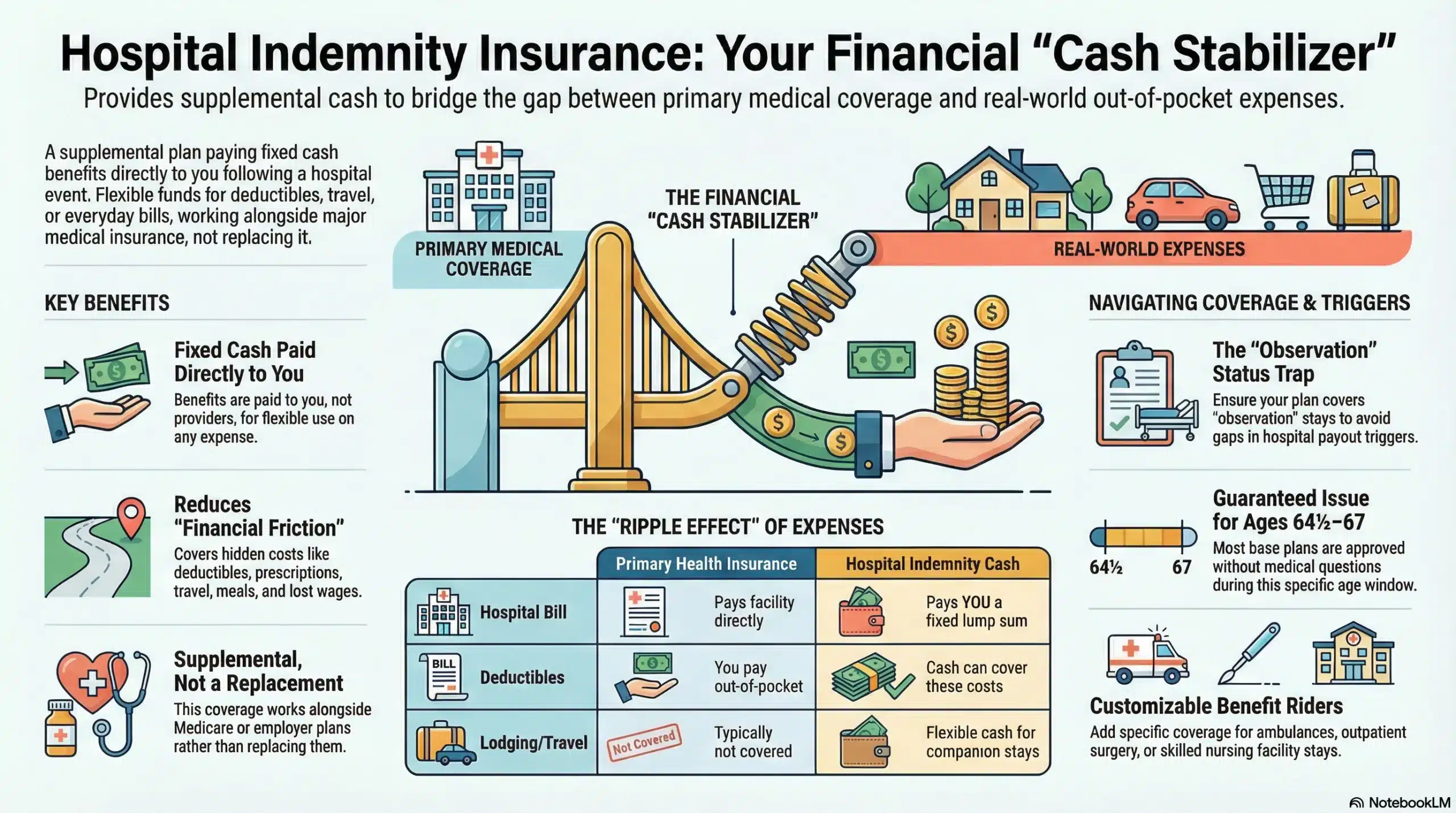
Talk With an Advisor Today
Choose how you’d like to connect—call or message us, then book a time that works for you.
Schedule here:
calendly.com/jason-dibcompanies/diversified-quotes
Licensed in all 50 states • Fiduciary, family-owned since 1980
FAQs: ER and Urgent Care — When Hospital Indemnity Pays
Does the ER benefit pay even if I am not admitted to the hospital?
Yes — most hospital indemnity ER benefits are designed to pay per qualifying ER visit regardless of whether the visit results in inpatient admission, observation hold, or discharge home. The trigger is the qualifying ER encounter, not the admission status. This is one of the most important design features to confirm when selecting a plan, because some designs — particularly basic or entry-level plans — condition the ER benefit on admission following the ER visit rather than paying on the visit itself. A plan that only pays when the ER visit results in admission leaves the majority of ER encounters — those that end in discharge without admission — without a benefit payment.
For seniors on Medicare Advantage, the ER copay is typically a fixed amount per visit regardless of whether admission follows, so an ER benefit that fires on the visit itself aligns directly with the actual cost-sharing exposure. Confirming that the specific plan pays per ER visit — not per ER visit that results in admission — is the most important policy terms question for any buyer whose primary concern is the ER copay rather than the inpatient daily benefit.
What if my urgent care visit turns into an ER referral — do both benefits pay?
On most plans with both an urgent care benefit and an ER benefit, each qualifying visit to each type of facility triggers its respective benefit independently — meaning both can pay for the same health episode if you visit urgent care and are then referred to and treated in the emergency department. The urgent care visit triggers the urgent care benefit, and the subsequent ER visit triggers the ER benefit, because each is a separate qualifying encounter at a different type of facility. This stacking is one of the most practically valuable aspects of having both benefits in a single plan, because the escalation from urgent care to ER is a common real-world pattern.
The specific terms of the plan should be confirmed before purchase — some plans include language about related conditions or same-day encounters that may affect whether both benefits pay in close succession. The typical design, however, does allow both to pay when both qualifying encounters occur, which is why having the urgent care benefit alongside the ER benefit rather than selecting one and omitting the other is the preferred approach for buyers whose visit patterns include both types of facilities.
How does the observation benefit work differently from the ER benefit?
The ER benefit pays for the qualifying emergency department encounter itself — the visit to and treatment in the emergency department. The observation benefit pays for the period during which you are held in the hospital under observation status rather than formally admitted as an inpatient. These are two separate events that often occur in sequence: an ER visit that leads to an observation hold. Both benefits can fire for a single episode — the ER benefit for the emergency department encounter and the observation benefit for the subsequent observation stay.
The observation benefit is critical because Medicare and Medicare Advantage classify observation as outpatient rather than inpatient, which can produce different and sometimes higher cost-sharing than a formal inpatient admission. A hospital indemnity plan that only pays an inpatient daily benefit misses the observation stay entirely for seniors who are held under observation and discharged without ever being formally admitted. The observation benefit — particularly plans that pay the same per-day amount for observation as for inpatient — fills that gap directly. For seniors with cardiac history, fall risk, or conditions that frequently produce monitoring holds without formal admission, the observation benefit is often more valuable in practice than the inpatient daily benefit because their hospital episodes more commonly end in observation discharge than in full inpatient admission.
What documentation do I need to file a claim for an ER or urgent care visit?
Most hospital indemnity claims for ER and urgent care visits require the facility’s bill or visit summary showing the date of service, the facility name and type (emergency department or urgent care), and the services provided or the reason for the visit. Some carriers also require the explanation of benefits from the primary insurance carrier showing how the claim was processed. The claim form from the hospital indemnity carrier itself — typically a one-page document available on the carrier’s website or from the agent — must be completed and submitted alongside the supporting documentation.
Benefits are typically paid within one to two weeks of a complete claim submission. Incomplete claims — missing the facility bill or the primary insurance EOB if required — cause processing delays. The most efficient approach is to retain the facility bill and the primary insurance EOB for every ER or urgent care visit and submit the hospital indemnity claim promptly after the primary insurance processes its portion. For buyers who are unsure which documents are required under their specific plan, Diversified Insurance Brokers outlines the exact claim documentation requirements at the time of policy issuance so the process is clear before the first claim occurs rather than uncertain when it is needed.
Is the ambulance rider worth adding if I rarely use ambulance transport?
The ambulance rider evaluation depends on the cost of the rider relative to the exposure it addresses and the buyer’s specific risk profile. Ambulance transport is not a high-frequency event for most people — but when it does occur, the bill is significant. Ground ambulance transport typically costs $800–$2,000 before insurance processes it, and the patient’s cost-sharing after insurance can still be several hundred dollars. Air ambulance transport costs that can reach $30,000 or more are not uncommon for rural-to-urban hospital transfers, and the patient’s share after insurance can be substantial. A single air transport event without a rider could produce a cost exposure far exceeding the years of premiums paid for the rider.
The rider’s premium is typically modest — often $5–$15 per month depending on the carrier and benefit amount — which makes the cost-benefit analysis favorable for most buyers when the potential exposure is considered. For buyers who live far from hospital facilities, who have fall risk or cardiac history that produces emergency transport scenarios, or who are on Medicare Advantage plans that have specific ambulance cost-sharing, the rider is generally worth adding. For buyers in urban areas with very short transport distances and relatively low ambulance cost exposure, the decision is less clear-cut — but the modest premium relative to the potential claim amount still makes it defensible for most budgets. The ambulance rider does not require a hospital admission to pay — transport to an ER that ends in discharge home still triggers the benefit on most plans.
Can I add hospital indemnity coverage if I already have Medicare or Medicare Advantage?
Yes — hospital indemnity insurance is specifically designed to supplement Medicare and Medicare Advantage coverage rather than replace it. It is one of the most common supplemental products purchased by Medicare Advantage members because MA plans have defined cost-sharing schedules — ER copays, observation charges, inpatient per-day charges — that create predictable out-of-pocket exposure that hospital indemnity is purpose-built to address. Hospital indemnity pays regardless of what Medicare or the MA plan pays — there is no coordination of benefits that reduces the indemnity payout because the MA plan already paid something. The cash payment is made directly to you based solely on whether the policy trigger was met.
For Original Medicare beneficiaries, hospital indemnity can complement a Medicare supplement plan or function as a standalone supplement when a full Medigap plan is not the preferred approach. Health questions typically apply to hospital indemnity applications — the policy is medically underwritten at the simplified issue level in most cases, with pre-existing condition waiting periods that vary by carrier and state. Guaranteed issue hospital indemnity options exist in some markets and circumstances, though they may carry higher premiums or more limited benefits. The application and enrollment timing relative to any pre-existing conditions is an important planning consideration for buyers whose primary concern is ensuring the benefit pays for their existing health conditions’ ER and urgent care visits as soon as possible after the policy is issued.
About the Author:
Jason Stolz, CLTC, CRPC, DIA, CAA and Chief Underwriter at Diversified Insurance Brokers (NPN 20471358), is a senior insurance and retirement professional with more than 25 years of real-world experience helping individuals, families, and business owners protect their income, assets, and long-term financial stability. As a long-time partner of the nationally licensed independent agency Diversified Insurance Brokers, Jason provides trusted guidance across multiple specialties—including fixed and indexed annuities, long-term care planning, personal and business disability insurance, life insurance solutions, Group Health, Travel Medical and Evacuation Insurance, and short-term health coverage. Diversified Insurance Brokers maintains active contracts with over 100 highly rated insurance carriers, ensuring clients have access to a broad and competitive marketplace.
His practical, education-first approach has earned recognition in publications such as VoyageATL, and contributions from his agency featured in Kiplinger and GoBankingRates— highlighting his commitment to financial clarity and client-focused planning. Drawing on deep product knowledge and years of hands-on field experience, Jason helps clients evaluate carriers, compare strategies, and build retirement and protection plans that are both secure and cost-efficient. Visitors who want to explore current annuity rates and compare options across multiple insurers can also use this annuity quote and comparison tool.
Browse More Resources: Return to our complete Supplemental, Hospital Indemnity & Critical Illness guide — covering hospital indemnity, accident insurance & critical illness coverage.
Last Reviewed: June 9, 2026 |
Reviewed by: Jason Stolz, CLTC, CRPC, DIA, CAA
Chief Underwriter, Diversified Insurance Brokers, Inc. | NPN: 20471358 | Diversified Insurance Brokers, Inc. — Licensed in all 50 states
Fact Checked by: Tonia Pettitt, CMIP©
Medicare Specialist, Diversified Insurance Brokers, Inc. | NPN: 14374308 | Diversified Insurance Brokers, Inc. — Licensed in all 50 states
Did you find this content helpful? Leave us a Google review — it helps others find trustworthy guidance too.
Editorial Standards: Diversified Insurance Brokers maintains rigorous editorial standards to ensure accuracy, clarity, and independence in all content. Learn more about our editorial standards and commitment to transparency.
