
Disability Insurance for High Earners and Business Owners
As an Independent Disability Insurance Broker, we have access to exclusive discounts and negotiated pricing most captive agents can’t offer — see the full breakdown near the end of this page.
Disability Insurance for High Earners and Business Owners

Jason Stolz CLTC, CRPC, DIA, CAA
High earners and business owners face a disability insurance challenge that lower-income employees do not: the income at stake is large enough that the standard group long-term disability plan — when one exists at all — fails to replace it adequately, fails to protect the right income sources, and in many cases fails to define disability in a way that actually pays when the high-earning professional cannot perform the specialized work that generates their income. A physician earning $400,000 annually, a business owner generating $300,000 from a practice they built over two decades, an attorney whose trial and client work represents years of relationship development, or an executive whose total compensation package includes bonuses and equity that group plans categorically exclude — all of these professionals face a common structural problem: the insurance architecture that the employment and group benefits system provides was designed for average employees, not for the people whose income and career investments stand to lose the most from a disability event. Disability insurance for high earners and business owners is the specialized planning discipline that addresses the gaps the standard system creates at exactly the income levels where those gaps are most financially consequential.
At Diversified Insurance Brokers, Jason Stolz, CLTC, CRPC, DIA, CAA works with physicians, dentists, attorneys, executives, financial professionals, practice owners, and high-earning business owners across all industries to build income protection architectures that actually reflect the financial reality of high-income professional careers — the total compensation picture that group plans underprotect, the business overhead obligations that personal disability income coverage cannot address, the key person dependencies that threaten entire enterprises when a single high-value individual becomes disabled, and the own-occupation policy structures that distinguish protection that genuinely pays from protection that merely appears to. The planning conversation for a high earner is fundamentally different from the conversation for an average employee — and it requires an advisor who understands both the problem and the multi-layer solution.
Build Your High-Earner and Business Owner Disability Insurance Architecture
We review coverage options across 100+ carriers and design the multi-layer protection structure that reflects your full income, your business obligations, and your occupational risk profile.
Request a High-Earner Protection ReviewWhy Standard Group Plans Fail High Earners — The Four Structural Gaps
| Group Plan Structural Failure | How It Works in the Plan | Impact on High Earners | Individual DI Solution |
|---|---|---|---|
| Benefit cap | Most group LTD plans cap monthly benefits at a fixed dollar amount — often $5,000, $10,000, or $15,000 per month — regardless of the insured’s actual income | A professional earning $300,000 annually theoretically should receive approximately $15,000 per month at 60% — but if the plan caps at $6,000, the actual coverage is only 24% of income. The cap turns a stated 60% plan into a fraction of that for high earners | Individual disability insurance is sized to actual documented income without a fixed-dollar ceiling, providing benefit amounts calibrated to the professional’s real income level |
| Base salary only — bonuses and commissions excluded | Group plans calculate the 60% replacement on W-2 base salary — they do not include bonus income, commission income, production bonuses, or equity compensation | For a physician whose total compensation includes production bonuses, an executive whose total pay includes performance bonuses and equity, or a salesperson whose income is largely commission, the group plan protects a small fraction of actual take-home compensation | Individual disability insurance underwriting uses documented total earned income — base plus bonus, production plus base, commission plus base — providing protection calibrated to what the professional actually earns |
| Taxable benefits | When an employer pays group LTD premiums, the resulting disability benefit is typically taxable as ordinary income — reducing real purchasing power by the applicable tax rate | A group plan paying 60% of salary at the cap produces a net benefit of closer to 40–45% of actual take-home pay after taxes at higher income levels — the stated coverage percentage is not the delivered replacement rate | Individual disability insurance purchased personally with after-tax dollars produces tax-free benefits — the full stated benefit amount reaches the household without income tax reduction |
| Any-occupation definition transition | Most group LTD plans define disability as own-occupation for only the first 24 months — then transition to any-occupation, requiring the insured to be unable to perform any work for which they are reasonably suited | A specialist physician, attorney, or executive who cannot perform their specific professional role but could theoretically perform some other work loses benefits at 24 months under the any-occupation standard — at exactly the point when long-term disability has proven itself | Individual own-occupation disability insurance maintains the own-occupation standard for the full benefit period to age 65 — paying benefits when the insured cannot perform their specific profession regardless of other theoretical work capacity |
The four structural failures in the table are not edge cases or unusual plan limitations — they are the standard design of most employer group LTD plans, and they affect high earners and business owners more severely than any other population because the financial gap between what the plan provides and what the household actually needs is largest at the highest income levels. Disability insurance by occupation acknowledges that the planning conversation for high earners and business owners requires not just a single policy but a coordinated architecture of individual and business coverage layers — each designed to address a different dimension of the financial exposure that disability creates.
The Own-Occupation Definition — Why It Is Non-Negotiable for High Earners
No disability insurance planning decision matters more for high earners and specialized professionals than the disability definition — specifically whether the policy uses true own-occupation language that pays when the insured cannot perform their specific profession, or a modified definition that allows the insurer to argue that the professional’s disability does not qualify because they could theoretically do some other work. The financial stakes of this distinction are dramatically higher for a professional earning $400,000 per year than for an average employee — and disability insurance litigation consistently documents that the any-occupation and modified-any-occupation definitions are the most common mechanisms through which high-value claims are denied at the 24-month transition point.
A true own-occupation disability insurance policy pays when the insured cannot perform the material and substantial duties of their specific occupation at the time of disability — even if they can work in some other capacity. A surgeon with a hand tremor receives benefits under an own-occupation policy even if they could theoretically teach or consult. A trial attorney who loses clear speech capacity after a neurological event receives benefits even if they could theoretically perform transactional legal work. A business owner whose cognitive impairment prevents the decision-making and executive function their company requires receives benefits even if they could theoretically perform some simpler employment. The own-occupation standard recognizes that the professional’s income derived from a specific, developed career capacity — and that the loss of that capacity is a genuine economic disability regardless of what else might theoretically be possible.
The cognitive impairment dimension is particularly important for high earners whose income depends on professional judgment, complex decision-making, and sustained cognitive performance. As documented in disability insurance litigation, insurers evaluating high-earner claims may minimize or ignore the cognitive requirements of an occupation — focusing on physical capacity while dismissing the intellectual and cognitive functions that actually generate the professional’s income. Own-occupation language that specifically encompasses the cognitive and professional judgment functions of the occupation provides the strongest protection against this pattern. Understanding how short-term and long-term disability definitions interact across the policy’s full timeline is essential — the 24-month transition that group plans impose is the moment when a long-term disability claim becomes most financially significant and when the definition weakness is most damaging.
Business Overhead Expense Coverage — The Layer Personal DI Cannot Cover
For business owners, the personal disability income question — how much monthly benefit replaces my personal income during disability — addresses only half of the financial exposure that disability creates. The other half is the business overhead layer: the fixed costs of operating the business that continue whether the owner is working or not. Rent, employee salaries, equipment financing, insurance premiums, licensing fees, professional association dues, supply costs, and debt service obligations do not pause because the owner-doctor, owner-attorney, or owner-executive is disabled. They accumulate month after month against the zero business revenue that many owner-operated businesses generate when the owner cannot work.
Business overhead expense disability insurance is the policy structure specifically designed to fund this second layer — paying a monthly benefit calibrated to the actual fixed operating costs of the business during the owner’s qualifying disability. The BOE structure pays the bills: it covers the staff who keep the business operational, the facilities that maintain its location, and the infrastructure that preserves the client relationships and business capacity built over years of professional practice. For a physician whose medical practice represents decades of patient relationship building and clinical reputation, for an attorney whose law firm represents years of client development and associate training, or for any professional service business owner whose disability would simultaneously eliminate production revenue and threaten the business infrastructure — BOE coverage is not optional supplemental planning. It is the mechanism that distinguishes a disability that temporarily pauses a business from one that permanently destroys it.
Key Person Disability Insurance — Protecting the Business When a Critical Individual Falls
Beyond the owner’s personal disability exposure and the business overhead layer, many high-income enterprises face a third disability risk dimension: the financial loss that a key employee’s disability creates for the business that depends on that employee’s skills, knowledge, or client relationships. The production physician who generates the majority of a medical group’s revenue, the managing partner whose client relationships sustain a law firm, the lead engineer whose technical expertise anchors a technology company’s product development — these are individuals whose disability creates a financial loss to the business entity that extends well beyond their personal salary loss.
Key person disability insurance pays a benefit to the business entity rather than to the individual — providing the business with capital to recruit, hire, and train replacement capacity during the key person’s disability period, compensating for the revenue disruption the disability creates, or funding the business continuity measures that prevent the key person’s absence from cascading into client loss and revenue collapse. The key person income insurance dimension specifically addresses high-value employees whose disability creates a business production loss that no simple hiring and salary replacement can fully offset. For business owners evaluating their complete disability protection architecture, key person coverage completes the picture that personal DI and BOE coverage begin.
The High-Earner Income Documentation Challenge
The income documentation process for high earners and business owners involves layers of complexity that average employee disability applications do not. For a business owner, the relevant income is not the W-2 salary paid by the business but the documented net earned income from Schedule C, partnership K-1 income, S-corporation distributions mixed with salary, or whatever income structure the business entity uses. For a physician with both institutional salary and private practice production, the total income picture requires comprehensive documentation of all sources. For an executive with base salary, annual bonus, and equity compensation, the relevant income for disability purposes requires specific analysis of which elements qualify as earned income under the carrier’s guidelines.
The maximum approvable monthly benefit is calculated as a percentage of documented earned income — typically 60 to 70 percent — making the income documentation process the direct determinant of how much coverage is actually available. A high earner who approaches the disability insurance market with incomplete income documentation may find the available benefit ceiling lower than their income justifies. How much disability insurance a high earner actually needs is a calculation that should account for total income including all variable compensation, the household’s actual financial obligations during a disability period, and — for business owners — the overhead obligations addressed separately through BOE coverage.
High-Limit Disability Insurance — When Standard Markets Are Not Enough
For very high-income professionals — those whose total compensation substantially exceeds the monthly benefit ceilings that standard disability insurance carriers allow — the standard market may not provide sufficient coverage even with optimal policy design. Standard individual disability insurance carriers generally cap available monthly benefits in the range of $20,000 to $30,000 per month at the highest level, depending on the carrier and occupational class. For a physician or business owner earning $500,000 or more annually, even the maximum standard market benefit replaces only a fraction of actual income.
High-limit disability insurance — policies available through specialty markets that issue coverage above the standard carrier maximums — addresses this gap by layering additional coverage on top of existing standard market individual and group coverage to bring total income replacement closer to the professional’s actual income level. The specialty market for high-limit disability coverage uses simplified underwriting relative to standard carriers, typically does not require detailed medical examination at issuance, and can provide additional monthly benefits in amounts ranging from several thousand to substantially more per month depending on the income level and the carrier’s guidelines. For very high-income professionals who have maximized the standard market’s available benefits and still face significant unprotected income, the high-limit specialty market provides the mechanism to bring the total coverage architecture into appropriate alignment with the actual financial exposure.
Policy Design Priorities for High Earners and Business Owners
The policy design considerations that are most consequential for high earners and business owners differ from those that matter most for average employees. Beyond the own-occupation definition — which is the paramount consideration — the following design elements deserve specific attention for this population.
The residual disability benefit provision is critical for high earners and business owners whose disability may produce partial rather than total income loss. A physician who can work reduced hours during recovery from illness, a business owner who can manage some functions but not others during disability, or a professional whose condition limits but does not eliminate their work capacity — all of these situations produce partial income loss that a residual benefit provision addresses proportionally. A policy without a residual benefit forces a binary determination: fully disabled or not disabled at all — a standard that does not reflect the realistic partial disability scenarios most high earners actually face.
The elimination period for high earners and business owners is generally longer than for employees with limited reserves — a 90-day or even 180-day elimination period is appropriate for a professional with sufficient liquid assets to sustain household expenses during the wait period, producing lower annual premiums for the same ultimate coverage. The benefit period should extend to age 65 without exception — partial recovery scenarios and long-term disability events are both addressed only by a to-age-65 benefit period. The rider options most valuable for high earners include the future increase option — allowing benefit increases as income grows without new medical underwriting — and the cost of living adjustment rider that protects the real purchasing power of benefits across a multi-year disability period.
For high earners with complex health histories, prior medical conditions, or occupational risk factors, disability insurance with pre-existing conditions is available through independent broker channels that compare carrier guidelines across the full market. No-exam disability insurance options serve high earners whose health history makes traditional fully underwritten applications uncertain. For any high earner who already has disability coverage and questions whether it is adequate for their actual income level and professional situation, a second opinion on existing disability insurance from an independent broker who understands high-earner planning regularly reveals coverage gaps — unprotected bonus income, benefit cap shortfalls, definition vulnerabilities — that existing policies leave open. Working with an independent disability insurance broker who accesses the full carrier market — including standard carriers, multi-life discount programs, and high-limit specialty markets — is the structure that identifies the most complete and most cost-effective coverage architecture available for any specific high earner’s situation.
Build Your Complete High-Earner and Business Owner Coverage Architecture
We evaluate your full income picture, business overhead obligations, and key person exposures across 100+ carriers to build the disability protection architecture that actually reflects what you stand to lose.
Request a High-Earner Protection Review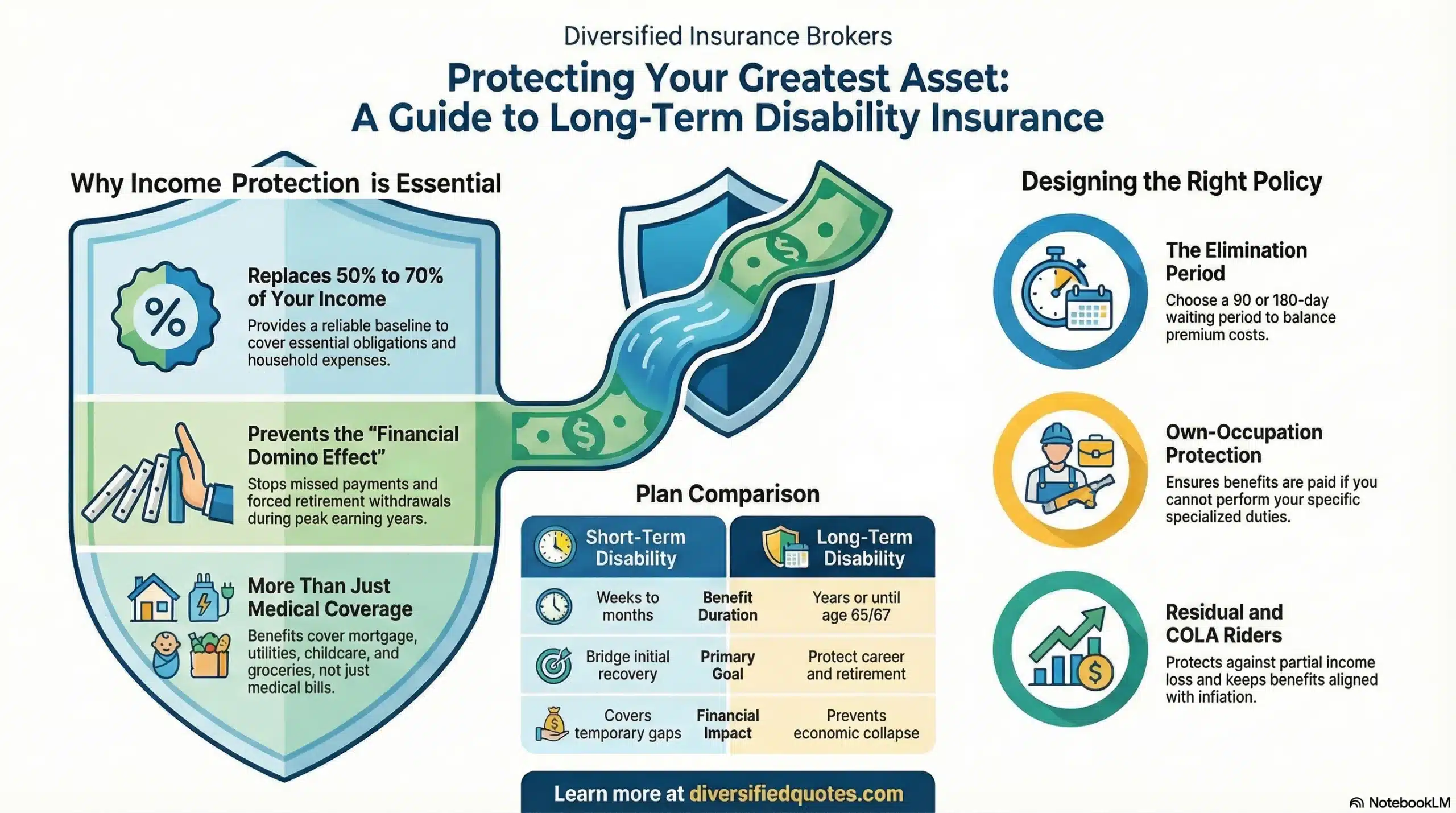
Talk With an Advisor Today
Choose how you’d like to connect—call or message us, then book a time that works for you.
Schedule here:
calendly.com/jason-dibcompanies/diversified-quotes
Licensed in all 50 states • Fiduciary, family-owned since 1980
FAQs: Disability Insurance for High Earners and Business Owners
Why isn’t my employer’s group disability plan sufficient for a high-income professional?
Group long-term disability plans are designed to serve the average employee population — and the average employee’s income is well within the range that group plans are built to protect. High earners face a specific and compounding set of limitations that make the stated coverage percentage largely fictional at their income levels. The most common limitation is the monthly benefit cap: most group plans cap total monthly disability benefits at $5,000, $10,000, or $15,000 regardless of the insured’s actual income. A professional earning $30,000 per month who expects 60% replacement — approximately $18,000 per month — may receive only $6,000 under a group plan with a $6,000 cap. The stated 60% plan delivers closer to 20% of actual income replacement.
The second critical limitation is the exclusion of variable compensation. Group plans calculate the benefit percentage on W-2 base salary — they categorically exclude bonus income, production bonuses, commission income, and equity compensation. For professionals and executives whose total compensation substantially exceeds their base salary, the group plan protects only the smallest component of their actual earnings. The third limitation is taxability: when employers pay group plan premiums, the benefits are typically taxable as ordinary income at claim time — reducing the already-capped benefit by another 30 to 40 percent at higher income tax rates. Understanding the after-tax value of disability insurance benefits reveals that group coverage for high earners frequently delivers less than 30 percent of actual take-home income in real purchasing power — making the gap between “having coverage” and “having adequate coverage” enormous at high income levels.
As a business owner, what disability coverage layers do I actually need?
A business owner’s complete disability protection architecture typically involves three coordinated layers, each addressing a different financial dimension of the disability exposure. The first layer is personal disability income insurance — an individual policy with a true own-occupation definition that replaces your personal earned income from the business when disability prevents you from working. This is the layer most people think of when they consider disability insurance, and it is the foundation the other layers build on.
The second layer is business overhead expense disability insurance — a policy that pays a monthly benefit calibrated to the actual fixed operating costs of your business during your disability period. Rent, employee wages, equipment financing, insurance premiums, and other fixed obligations do not stop because the owner is disabled — BOE coverage funds these obligations during the disability period, preserving the business infrastructure rather than allowing it to collapse against zero revenue. The third layer, relevant when you employ or depend on other high-value individuals, is key person disability insurance — coverage paid to the business entity when a critical employee whose disability would create business financial losses becomes disabled. Having all three layers evaluated together — with amounts calibrated to the actual financial structure of your specific business — produces genuinely adequate protection rather than the appearance of it.
What is the maximum monthly benefit I can get as a high earner?
Standard individual disability insurance carriers generally allow maximum monthly benefits in the range of $20,000 to $30,000 per month, depending on the specific carrier, the insured’s occupational class, and the insured’s documented income. The benefit ceiling is calculated as a percentage of documented earned income — typically between 60 and 70 percent — and is further subject to the carrier’s absolute monthly maximum for the occupational class. A physician with documented total compensation of $40,000 per month may qualify for approximately $25,000 to $28,000 per month from a single standard carrier at 60 to 70 percent — still leaving meaningful income unprotected.
For professionals whose income substantially exceeds the standard market’s coverage ceiling, high-limit disability insurance — specialty market policies that layer additional coverage on top of standard carrier maximums — provides the mechanism to bring total income replacement closer to actual income. High-limit specialty policies can add anywhere from a few thousand to substantially more per month in additional benefit above the standard carrier ceiling. The combination of standard market individual coverage, existing group coverage where applicable, and high-limit specialty coverage produces the most complete income protection architecture for very high-income professionals. High-risk and high-limit disability insurance options specifically address the coverage architecture for professionals whose income level, health history, or occupational profile creates complexity in the standard market.
I earn significant bonus and commission income — how does that affect my disability insurance?
Variable compensation — bonus income, commission income, production bonuses, profit distributions — is where the gap between group plan protection and individual disability insurance protection is most acute for high earners. Group plans universally calculate benefits on base W-2 salary, categorically excluding all variable compensation regardless of how large a component of total earnings it represents. For a financial advisor whose total earnings are primarily commission-based, an executive whose total compensation doubles with annual performance bonuses, or a physician whose production bonuses substantially exceed base salary, the group plan is protecting the smallest and least variable component of their income while leaving the largest and most variable component completely uninsured.
Individual disability insurance uses documented total earned income — including documented average bonus, commission, and production income over a two-year period — as the income basis for underwriting. This allows individual coverage to be calibrated to what the professional actually earns rather than just their salary component. The documentation process requires two or more years of tax returns and compensation records demonstrating the variable income pattern — not to exclude it but to establish it as part of the insurable income base. How much disability insurance is actually needed for a professional with significant variable compensation requires a genuine analysis of total compensation, after-tax income, and the household’s actual financial obligations — not a simple percentage of salary.
I already have disability insurance — how do I know if it is actually adequate for my income level?
The review of existing disability insurance for a high earner involves four specific questions that most professionals have never asked about their current coverage. First: what is the actual monthly benefit cap in the policy — not the stated percentage, but the fixed-dollar maximum at which the plan stops paying regardless of income? For many high earners, the answer reveals that the effective coverage percentage is dramatically below the stated plan design. Second: does the benefit calculation include bonus and commission income, or only base salary? If the policy defines covered income as W-2 salary, all variable compensation is uninsured. Third: is the disability definition own-occupation for the full benefit period to age 65, or does it transition to any-occupation at 24 months? The 24-month transition is the most common definition trap — it converts genuine own-occupation protection into a far weaker standard at exactly the point when long-term disability has become established. Fourth: are the benefits taxable at claim time, and if so, what is the effective after-tax replacement rate rather than the stated gross replacement rate?
For most high earners who run this analysis honestly, the result reveals meaningful gaps in one or more of these dimensions. A second opinion on your disability insurance from an independent broker who evaluates the complete picture — existing group coverage, existing individual coverage, income documentation, and business protection needs — identifies exactly where the gaps are and what additional coverage, if any, closes them. For high earners who discover they have been paying premiums for coverage that would provide a fraction of their actual income in the event of a claim, the second opinion conversation is the most financially productive planning discussion they can have.
When is the best time for a high earner to purchase individual disability insurance?
The most financially advantageous time is always earlier than most high earners act on it — and the compound cost of waiting at high income levels is substantial. Disability insurance premiums are age-rated: the premium locked in at the time of purchase applies for the policy’s duration, and purchasing at 35 rather than 45 locks in a meaningfully lower rate for a policy that may cover the next 30 years. The premium differential between a 35-year-old physician and a 45-year-old physician for identical coverage can represent many thousands of dollars in cumulative premium savings over the policy life.
The health history dimension of timing is equally important. Every year of professional practice and normal aging produces health events — a managed cardiac finding, a treated joint condition, a mental health treatment record — that narrow the available coverage terms or trigger exclusion riders at underwriting. Purchasing coverage while health is genuinely clean produces the most comprehensive available policy without the exclusions, table ratings, or limited definitions that health histories generate. For early-career professionals with student loan obligations and income expected to grow, the future insurability option on a policy purchased early allows benefit increases as income grows without new medical underwriting — locking in the favorable health-based terms of the early purchase through the full income trajectory. Why high earners need disability insurance earlier than they think is answered most directly by the math: the cost of acting now is always lower than the cost of acting later, and the coverage terms available now are almost always better than those available after years of professional career accumulate health history.
About the Author:
Jason Stolz, CLTC, CRPC, DIA, CAA and Chief Underwriter at Diversified Insurance Brokers (NPN 20471358), is a senior insurance and retirement professional with more than 25 years of real-world experience helping individuals, families, and business owners protect their income, assets, and long-term financial stability. As a long-time partner of the nationally licensed independent agency Diversified Insurance Brokers, Jason provides trusted guidance across multiple specialties—including fixed and indexed annuities, long-term care planning, personal and business disability insurance, life insurance solutions, Group Health, Travel Medical and Evacuation Insurance, and short-term health coverage. Diversified Insurance Brokers maintains active contracts with over 100 highly rated insurance carriers, ensuring clients have access to a broad and competitive marketplace.
His practical, education-first approach has earned recognition in publications such as VoyageATL, and contributions from his agency featured in Kiplinger and GoBankingRates— highlighting his commitment to financial clarity and client-focused planning. Drawing on deep product knowledge and years of hands-on field experience, Jason helps clients evaluate carriers, compare strategies, and build retirement and protection plans that are both secure and cost-efficient. Visitors who want to explore current annuity rates and compare options across multiple insurers can also use this annuity quote and comparison tool.
Explore More Disability Insurance Options: Browse our complete guide to Disability Insurance for Legal, Finance & White Collar Professionals — covering attorneys, accountants, bankers, executives, financial planners & business professionals from 100+ carriers.
Last Reviewed: August 18, 2026 |
Reviewed by: Jason Stolz, CLTC, CRPC, DIA, CAA
Chief Underwriter, Diversified Insurance Brokers, Inc. | NPN: 20471358 | Diversified Insurance Brokers, Inc. — Licensed in all 50 states
Fact Checked by: Tonia Pettitt, CMIP©
Medicare Specialist, Diversified Insurance Brokers, Inc. | NPN: 14374308 | Diversified Insurance Brokers, Inc. — Licensed in all 50 states
Did you find this content helpful? Leave us a Google review — it helps others find trustworthy guidance too.
Editorial Standards: Diversified Insurance Brokers maintains rigorous editorial standards to ensure accuracy, clarity, and independence in all content. Learn more about our editorial standards and commitment to transparency.
