
Short Term Disability
As an Independent Disability Insurance Broker, we have access to exclusive discounts and negotiated pricing most captive agents can’t offer — see the full breakdown near the end of this page.
Short Term Disability

Jason Stolz CLTC, CRPC, DIA, CAA
Short-term disability insurance helps replace part of your income when a covered illness or injury keeps you out of work for a short, defined period — often thirteen or twenty-six weeks, and sometimes up to fifty-two weeks depending on the plan design. The goal is straightforward: keep cash flow steady when paychecks pause so you can focus on recovery instead of scrambling to cover bills. Most people think a short income disruption is something they can power through with savings or credit — but even a few weeks without pay can create a chain reaction that is surprisingly difficult to manage. The mortgage does not pause while you recover. Utilities still draft automatically. Childcare and groceries still cost the same whether you are working or not. Minimum debt payments continue on schedule. Short-term disability coverage is designed to absorb that financial shock and give you time to recover without turning a medical event into a financial crisis that outlasts the medical event itself.
At Diversified Insurance Brokers, we help clients nationwide compare disability income options and structure a plan that matches real-world needs — your budget, your occupation, your existing paid time off policies, and the length of time you could realistically manage without earned income before your financial position begins deteriorating. Short-term disability works best when it is designed to fit your actual financial life: it should begin when paid leave ends and last long enough to bridge you into long-term disability protection when recovery extends beyond the short-term benefit period. A poorly designed plan that starts too late or ends too soon leaves the gap it was supposed to close. A well-designed plan eliminates that gap entirely. Short-term vs long-term disability insurance covers the full comparison framework for how these two types of coverage work together and how to coordinate them into a comprehensive income protection structure. Is disability insurance worth it covers the cost-benefit framework that helps individuals evaluate whether the premium investment makes sense relative to the income at risk and the alternatives available.
Get a Short-Term Disability Quote
Compare benefit amounts, waiting periods, and pricing across multiple carriers — fast, unbiased, nationwide.
Designed for real cash-flow gaps • Clear trade-offs • No pressure
Short-Term Disability Insurance Basics
Most short-term disability plans are built around three interconnected variables: how much the policy pays, how soon it starts paying, and how long it continues to pay. Many plans replace roughly fifty to seventy percent of gross income, subject to a weekly or monthly benefit cap that reflects the carrier’s underwriting limits for the coverage tier. The elimination period — the waiting time between the onset of disability and when benefits begin — is often seven to fourteen days for illness and sometimes shorter for accidents depending on the plan design, though some plans carry longer elimination periods in exchange for lower premiums. The benefit period — the maximum duration of benefits — is typically thirteen or twenty-six weeks, with some designs extending to fifty-two weeks for higher-cost plans or occupations with longer expected recovery windows.
Short-term disability is designed primarily for off-the-job illnesses and injuries — medical events, surgical procedures, or recovery periods that temporarily prevent the insured from performing the duties of their occupation. The coverage is explicitly not workers’ compensation, which covers only work-related injuries and illnesses. STD covers the far larger category of medical events that happen outside of work but nonetheless prevent income-producing activity — which, as documented by disability statistics consistently over many years, accounts for the substantial majority of disability claims filed. The most common STD claims involve musculoskeletal conditions, mental health and behavioral health events, digestive disorders, cardiovascular events, and post-surgical recovery — none of which are work-related and none of which workers’ compensation addresses.
Thinking about STD in terms of timing helps clarify where it fits in the overall income protection picture. Most employed individuals have some paid time off or sick leave accrued, but rarely enough to cover a meaningful recovery from a significant medical event. A surgery with a six-to-eight week recovery, a hospitalization followed by rehabilitation, or a mental health treatment program can easily exceed whatever paid leave is available. STD is most valuable when it begins exactly when paid leave runs out — providing immediate income replacement at the moment the financial gap opens rather than after a second waiting period the insured must fund from savings. When the timing is calibrated correctly, STD functions less like a traditional insurance product and more like a financial stabilization mechanism that prevents the income disruption from cascading into missed obligations, damaged credit, drawn-down retirement savings, or premature return to work before recovery is genuinely complete. Assurity Life short-term disability insurance covers one of the leading individual STD carrier options and how it is structured for individuals who need non-employer-sponsored coverage. Disability insurance riders explained covers the optional policy features that can enhance basic STD coverage — cost-of-living adjustments, partial disability provisions, and return-to-work incentives — and how they affect both the premium and the real-world benefit delivered during a claim.
One important note for this offering: maternity and childbirth are not covered under the short-term disability options available through this page’s request.
Short-Term vs. Long-Term Disability: Core Differences
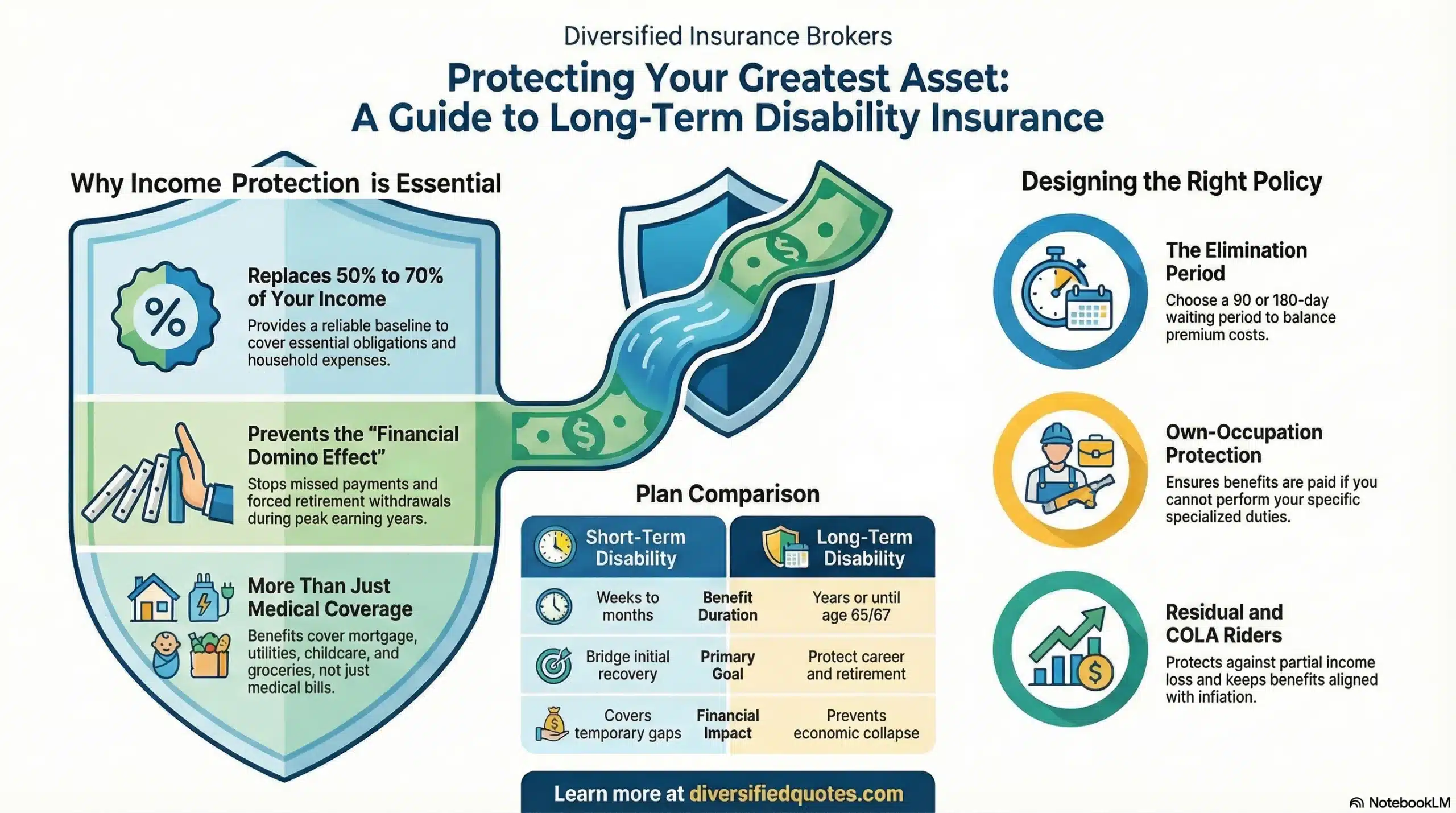
Short-term disability and long-term disability solve structurally different problems and are not substitutes for each other — they are sequential layers in a comprehensive income protection design that together cover the full duration of a potential disability event from the first day of benefits through potentially age sixty-five. STD handles short recoveries and near-term income disruptions where the primary question is whether the household can maintain financial stability through a defined recovery window. LTD handles severe or prolonged conditions where the primary question is whether the individual can sustain income for years or even decades if they cannot return to their occupation in its current form. Many individuals and advisors build both together — using STD as the bridge into LTD so that coverage does not fall off at a critical point mid-recovery when the short-term benefits have ended but the long-term benefits have not yet begun.
| Feature | Short-Term Disability (STD) | Long-Term Disability (LTD) |
|---|---|---|
| When it pays | Days to months — designed for short recovery periods and temporary income disruptions | Months to years — designed for extended or permanent disabilities, often to retirement age |
| Elimination period | 0 to 14 days is common; designed to begin when paid leave ends | 60 to 180 days is common; designed to begin when STD benefits end in a coordinated plan |
| Benefit period | 13 weeks, 26 weeks, or 52 weeks — defined at policy issuance | 2 years, 5 years, 10 years, or to age 65/67 — selected based on income protection objective |
| Income replacement | Often 50–70% of gross income, subject to weekly or monthly benefit caps | Often 50–60% of gross income, with higher amounts available through specialty markets for high earners |
| Coverage trigger | Off-the-job illness or injury that prevents current job duties; not workers’ compensation | Illness or injury preventing own-occupation or any-occupation work, depending on policy definition |
| Policy definition | Typically inability to perform current job duties — less nuanced than long-term definitions | Own-occupation or any-occupation — the definition critically determines benefit applicability for specialists |
| Best use case | Short recoveries, surgical procedures, medical events, bridging the LTD elimination period | Serious or extended disabilities, catastrophic illness, permanent inability to work in current occupation |
When building a full disability income protection structure, aligning the STD benefit duration with the LTD elimination period is the design principle that prevents a coverage gap mid-recovery. If STD pays for twenty-six weeks and the LTD elimination period is one hundred eighty days, the transition from STD to LTD is seamless — benefits continue uninterrupted while the medical situation is addressed. If STD pays for only thirteen weeks and the LTD elimination period is one hundred eighty days, there is a thirteen-week gap where neither coverage applies — a period the insured must fund from savings, credit, or other resources. Identifying and closing this gap is one of the most important coordination decisions in disability income planning. Disability insurance services covers the full range of disability coverage options and how they are coordinated across different income levels, occupations, and benefit timelines. How much disability insurance do I need covers the income replacement calculation framework that determines the appropriate benefit amount across both short-term and long-term coverage structures.
Tax Treatment of Short-Term Disability Benefits
Tax treatment is one of the most misunderstood and most consequential elements of disability coverage evaluation, because the stated benefit percentage is not the actual benefit the insured receives — what matters is the after-tax benefit, which is what hits the bank account when income has stopped and obligations continue. In most cases, the tax treatment of STD benefits depends on who paid the premium and how the premium was paid relative to the insured’s taxable income. If the employer pays the full premium, benefits received are typically taxable as ordinary income to the employee in the year received — because the employer-paid premium was a tax-free benefit at payment time, the government taxes the resulting benefit as income. If the employee pays the premium entirely with after-tax dollars, benefits received are typically tax-free — the insured has already paid tax on the premium dollars, so the benefit is not taxed again. If premiums are paid through pre-tax payroll deductions — which is how many employer-sponsored benefits are structured — some or all benefits may be taxable because the premium was paid with pre-tax dollars that avoided income recognition at the time of payment.
The practical implication is that two STD plans with identical stated benefit percentages can produce materially different after-tax income replacement depending on how their premiums are funded. A plan that pays sixty percent of gross income but makes benefits fully taxable may deliver an effective after-tax replacement rate closer to forty-two to forty-five percent for an employee in a meaningful tax bracket. A plan that pays sixty percent on an after-tax premium basis delivers the full sixty percent net. Evaluating STD options on an after-tax basis — not on a gross benefit basis — produces a more accurate comparison of real-world income protection during a claim.
Who Short-Term Disability Coverage Helps Most
Short-term disability is most valuable for individuals who have a meaningful income dependency and limited paid leave available to buffer a medical event. This category is broader than most people assume. Employees who do not have a robust employer-sponsored STD plan — which describes a significant portion of small and mid-sized employer workforces — have no automatic income protection during a medical absence and must either rely on whatever paid time off they have accrued or fund the gap from savings. Professionals who use paid time off throughout the year for vacation and personal time may find they have insufficient leave remaining when an unplanned medical event occurs. Anyone whose household budget is calibrated around consistent paychecks — with mortgage payments, childcare, car payments, and other fixed obligations leaving limited monthly slack — faces meaningful financial stress from even a temporary income disruption that STD directly addresses.
STD is also a strategically valuable layer for individuals who already have long-term disability protection but want to ensure the early months of a claim are covered rather than self-funded through the LTD elimination period. Many LTD plans require sixty to one hundred eighty days of continuous disability before benefits begin — a period that can represent thousands of dollars of income that must come from somewhere. STD covering that elimination period eliminates the need to self-fund the early disability months, prevents the draw-down of retirement savings or emergency reserves during a period of medical recovery, and removes the financial pressure that might otherwise push the insured to return to work before genuinely ready. Disability insurance for new professionals covers how early-career individuals should approach disability planning when income is lower but the long-term financial vulnerability to disability is at its highest relative level. Disability insurance for white-collar professionals covers the specific coverage design considerations for professionals in office-based occupations where own-occupation definitions and income replacement levels are the primary planning considerations. Disability insurance for high earners and business owners covers the specialized coverage design needed to protect both personal income and business continuity simultaneously for higher-income professionals.
Short-Term Disability for Self-Employed and 1099 Workers
For self-employed professionals and 1099 workers, short-term disability takes on different dimensions than it does for W-2 employees — because there is no employer-sponsored plan as a baseline, no paid sick leave provided by an employer, and often no structural separation between the individual’s personal income and the business’s revenue. When a self-employed professional is unable to work for several weeks or months, the financial impact is dual: personal income stops because work cannot be performed, and in some cases the business also loses revenue that may or may not be offset by a team, a partner, or a structure that continues generating income in the owner’s absence.
Many self-employed individuals rely on a combination of savings and the assumption that a short medical event is manageable without coverage — an assumption that is often accurate for a two-week absence but begins to break down at six, eight, or twelve weeks when the revenue gap has grown beyond what reasonable cash reserves can offset and the cascade of delayed invoices, disrupted client relationships, and missed obligations creates compounding financial pressure. A well-structured individual disability plan covering the short-term need can protect cash flow, reduce the pressure to return to work before medical clearance, and ensure that a medical event remains a medical event rather than also becoming a business continuity crisis. Because income documentation can vary significantly for self-employed individuals — with gross revenue, net income, business expenses, owner draws, and K-1 distributions all potentially relevant to underwriting — the benefit sizing process requires careful documentation coordination to ensure the coverage reflects actual income rather than a conservative or technically available but practically insufficient benefit amount. Disability insurance for self-employed covers the specific underwriting, documentation, and coverage design considerations for individuals without employer-sponsored benefits who need to build individual disability protection from the ground up. Business overhead disability insurance covers the complementary coverage that addresses the business’s fixed operating costs during a disability period — separate from personal income replacement and equally important for business owners who cannot simply close operations during an extended medical absence.
Common Exclusions and Limitations to Understand
Most short-term disability plans contain exclusions and limitations that can produce unexpected outcomes for claimants who have not reviewed the policy terms carefully before a disability event occurs. Work-related injuries and illnesses are the most common exclusion — these are handled under workers’ compensation rather than individual or group STD, which covers off-the-job medical events. Pre-existing condition limitations are common, particularly in group plans and in individual plans during an initial coverage period — a condition for which the insured received diagnosis, treatment, or medical advice within a defined lookback period before coverage began may not be covered for claims that begin within a specified period after the policy’s effective date. These limitations vary significantly by carrier and plan, and understanding their specific terms before coverage is bound is essential for setting accurate expectations about when the full benefit will be available.
The policy’s definition of disability determines when benefits are triggered and what documentation supports a claim — and this definition varies in important ways across different plans. Some plans define disability as inability to perform the duties of the insured’s current occupation; others require inability to perform any occupation the insured is reasonably suited for by education, training, or experience. For most STD contexts the current-occupation standard is the more favorable and more common definition, but confirming this in the specific policy language before purchase prevents surprises at claim time. Return-to-work and partial disability provisions also vary — some plans reduce benefits when the insured returns to part-time work during recovery, while others include partial disability benefits that support a graduated return-to-work by supplementing reduced income while full capacity is restored. As noted earlier, maternity and childbirth are not covered under the STD offerings available through this page’s request. Own occupation disability insurance covers the definition of disability that provides the strongest protection for specialists and professionals and how it compares to any-occupation and modified-own-occupation definitions in real claim scenarios. Disability insurance for physicians covers how definition considerations apply specifically in medical professional contexts where the own-occupation definition is most consequential.
How to Choose the Right Short-Term Disability Policy
Effective STD selection begins with understanding the specific financial gap the coverage needs to fill — not the maximum benefit available or the lowest premium achievable, but the actual monthly amount needed to maintain household financial stability if earned income stops. The practical calculation starts with identifying fixed monthly obligations — housing, utilities, minimum debt payments, insurance premiums, childcare, and grocery costs — and then determining the difference between those obligations and whatever income sources would continue during a disability period: a spouse’s income, investment distributions, rental income, or any employer-paid leave that would still apply. The gap between continuing obligations and continuing income is the minimum benefit the STD policy needs to deliver. Designing around that gap rather than around a generic benefit percentage produces coverage that is both financially adequate and premium-efficient.
Once the benefit amount is determined, aligning the elimination period with existing resources is the next design decision. If the insured has thirty days of paid sick leave available, an elimination period of thirty days matches perfectly — the leave covers the waiting period and STD begins exactly when leave ends. If the insured has two weeks of leave and significant emergency savings, an elimination period of seven days or fourteen days may make sense even without employer leave to cover the gap, while a longer elimination period reduces premiums but requires the insured to fund a longer self-insured period. The premium savings from a longer elimination period must be weighed against the actual self-insured cost in a realistic disability scenario.
The benefit duration decision — thirteen weeks, twenty-six weeks, or fifty-two weeks — should reflect the realistic recovery window for the types of medical events most likely to trigger a claim for the specific insured’s occupation, health history, and physical demands of their work. Office-based professionals may find twenty-six weeks sufficient for the vast majority of medical events they are likely to experience. Individuals in physically demanding occupations, those with health histories suggesting higher medical event probability, or those whose households have limited savings to extend coverage beyond the STD benefit period may benefit from the longer duration that fifty-two week plans provide. How to get the best disability insurance rates covers the underwriting and comparison approach that produces the most competitive premium across the carrier market for a given benefit design. Best disability insurance rates covers the current rate landscape across individual disability coverage. Best independent disability insurance broker covers why independent broker access to the full carrier market — rather than a single carrier’s product lineup — produces the most competitive and appropriately structured coverage for complex or non-standard disability planning situations.
Compare Short-Term Disability Options
We’ll help you select the right waiting period and benefit duration, then compare pricing across multiple carriers.
Related Disability Insurance Pages
Explore disability planning resources to coordinate short-term protection with long-term income strategy.
Related Planning Pages
Short-term income protection is strongest when it is part of a wider financial protection plan.
Talk With an Advisor Today
Choose how you’d like to connect—call or message us, then book a time that works for you.
Schedule here:
calendly.com/jason-dibcompanies/diversified-quotes
Licensed in all 50 states • Fiduciary, family-owned since 1980
Frequently Asked Questions: Short-Term Disability Insurance
What does short-term disability insurance actually cover?
Short-term disability insurance covers off-the-job illnesses and injuries that temporarily prevent the insured from performing the duties of their occupation. Common qualifying events include post-surgical recovery, serious illness requiring medical leave, musculoskeletal conditions, mental health treatment programs requiring time away from work, and other medical events that are neither work-related nor permanent. Coverage pays a defined percentage of gross income — typically fifty to seventy percent — for the duration of the benefit period, which is usually thirteen to fifty-two weeks depending on plan design. Work-related injuries are handled under workers’ compensation and are not covered by STD. Maternity and childbirth are not covered under the specific STD offerings available through this page’s request.
How does the elimination period work and how should I choose it?
The elimination period is the waiting time between the onset of a qualifying disability and when benefits begin to pay. Common elimination periods for STD range from zero to fourteen days for illness and may be shorter for accidents in some plan designs. The optimal elimination period depends on how much paid leave is available from the employer and how much savings the insured can comfortably draw on during a gap period. If thirty days of paid sick leave is available, matching the elimination period to thirty days means the leave covers the waiting period exactly and STD begins when the paycheck stops. A longer elimination period reduces premiums but requires the insured to self-fund the waiting period from savings — a reasonable trade-off when emergency reserves are sufficient to cover that window comfortably.
Are short-term disability benefits taxable?
The tax treatment of STD benefits depends primarily on who paid the premium and how it was paid. If the employer paid the premium, benefits are typically taxable as ordinary income to the employee because the employer-paid premium was a tax-free benefit at the time of payment. If the employee paid the premium with after-tax dollars, benefits are typically received tax-free. If premiums were paid through pre-tax payroll deductions, some or all benefits may be taxable. The practical implication is that evaluating STD options on an after-tax basis rather than a gross benefit basis produces a more accurate picture of real-world income replacement during a claim — two plans with identical stated benefit percentages can produce meaningfully different after-tax outcomes depending on how premiums are funded.
How should STD coordinate with long-term disability coverage?
The most important coordination principle is matching the STD benefit period to the LTD elimination period so benefits transition seamlessly without a gap. If STD pays for twenty-six weeks and the LTD elimination period is one hundred eighty days, the transition from STD to LTD is continuous — income replacement continues uninterrupted throughout the recovery period. If STD pays for only thirteen weeks and the LTD elimination period is one hundred eighty days, there is a thirteen-week gap the insured must fund independently. The goal is to eliminate that gap by design rather than leave it to chance. Many comprehensive disability income plans are built with this coordination as the explicit design objective — STD as the bridge into LTD so no period of disability is uncompensated above the elimination period threshold.
Can self-employed individuals get short-term disability insurance?
Yes — individual disability policies structured for short-term needs are available for self-employed professionals and 1099 workers who do not have access to employer-sponsored plans. Because self-employed income can be documented in various ways — gross revenue, net income after business expenses, owner draws, or K-1 distributions — the underwriting and benefit sizing process requires careful income documentation coordination to ensure the coverage reflects actual earnings rather than a conservative or technically available but practically insufficient benefit amount. The same core design principles apply — matching the elimination period to available reserves, sizing the benefit to cover genuine monthly obligations, and coordinating with longer-term disability protection — but the income verification process and carrier options may differ from standard employer-sponsored designs.
About the Author:
Jason Stolz, CLTC, CRPC, DIA, CAA and Chief Underwriter at Diversified Insurance Brokers (NPN 20471358), is a senior insurance and retirement professional with more than 25 years of real-world experience helping individuals, families, and business owners protect their income, assets, and long-term financial stability. As a long-time partner of the nationally licensed independent agency Diversified Insurance Brokers, Jason provides trusted guidance across multiple specialties—including fixed and indexed annuities, long-term care planning, personal and business disability insurance, life insurance solutions, Group Health, Travel Medical and Evacuation Insurance, and short-term health coverage. Diversified Insurance Brokers maintains active contracts with over 100 highly rated insurance carriers, ensuring clients have access to a broad and competitive marketplace.
His practical, education-first approach has earned recognition in publications such as VoyageATL, and contributions from his agency featured in Kiplinger and GoBankingRates— highlighting his commitment to financial clarity and client-focused planning. Drawing on deep product knowledge and years of hands-on field experience, Jason helps clients evaluate carriers, compare strategies, and build retirement and protection plans that are both secure and cost-efficient. Visitors who want to explore current annuity rates and compare options across multiple insurers can also use this annuity quote and comparison tool.
Explore More Disability Insurance Options: Browse our complete guide to Disability Insurance for the Self-Employed & Business Owners — covering independent contractors, business overhead, guaranteed issue group, 1099 workers & entrepreneurs from 100+ carriers.
Last Reviewed: June 16, 2026 |
Reviewed by: Jason Stolz, CLTC, CRPC, DIA, CAA
Chief Underwriter, Diversified Insurance Brokers, Inc. | NPN: 20471358 | Diversified Insurance Brokers, Inc. — Licensed in all 50 states
Fact Checked by: Tonia Pettitt, CMIP©
Medicare Specialist, Diversified Insurance Brokers, Inc. | NPN: 14374308 | Diversified Insurance Brokers, Inc. — Licensed in all 50 states
Did you find this content helpful? Leave us a Google review — it helps others find trustworthy guidance too.
Editorial Standards: Diversified Insurance Brokers maintains rigorous editorial standards to ensure accuracy, clarity, and independence in all content. Learn more about our editorial standards and commitment to transparency.
