
Assurity Life Short Term Disability Insurance
As an Independent Disability Insurance Broker, we have access to exclusive discounts and negotiated pricing most captive agents can’t offer — see the full breakdown near the end of this page.
Assurity Life Short Term Disability Insurance

Jason Stolz CLTC, CRPC, DIA, CAA
Assurity Life short-term disability insurance provides temporary income replacement when illness, injury, surgery, or pregnancy-related conditions prevent you from working. For households built around predictable income — which describes most working families, freelancers, and small business owners — missing even three or four weeks of pay creates immediate pressure that emergency savings alone may not fully absorb. Short-term disability is designed for exactly that gap: it keeps cash flow moving during the recovery period so the disruption stays manageable rather than compounding into a broader financial problem. At Diversified Insurance Brokers, Jason Stolz, CLTC, CRPC, DIA, CAA helps clients evaluate Assurity short-term disability alongside alternatives — identifying the right elimination period, benefit period, and benefit amount for the specific household’s income profile, savings buffer, and risk exposure. Assurity is frequently considered by self-employed workers, gig workers, freelancers, and W-2 employees with limited employer-provided sick leave because of its accessible online application process and straightforward plan design. Our resource on is Assurity a good insurance company covers the carrier’s financial strength and product philosophy — useful context before any purchase commitment.
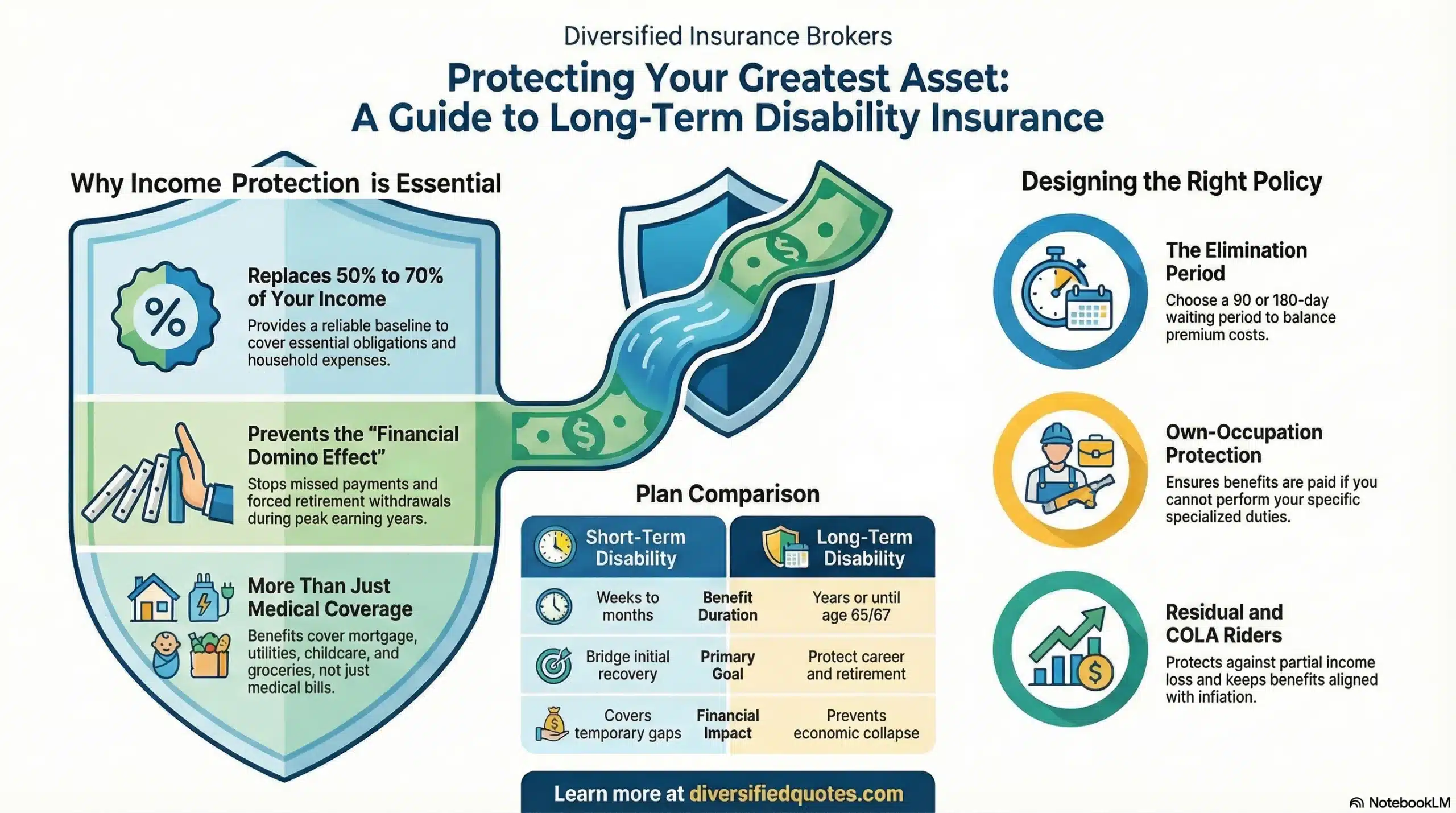
Short-term disability is distinct from long-term disability in purpose and design. It addresses the immediate months after a covered medical event — the period when income is interrupted but recovery and return to work are the expected outcome. Long-term disability addresses the scenario where disability extends significantly beyond the short-term window and income replacement for a longer period is necessary. Both serve different planning objectives, and many comprehensive income protection strategies include both. Our resource on Assurity Life disability insurance covers the longer-duration disability product for clients whose planning includes both short-term and long-term income protection. Our resource on disability insurance services covers the full disability insurance landscape including the comparison framework for evaluating different carrier options and policy designs alongside Assurity.
Quote & Apply for Assurity Short-Term Disability Online
Choose your waiting period and benefit length, then apply in minutes — no agent required. Or request advisor guidance if you want help selecting the right design before you commit.
Quote & Apply Online With Assurity Request Advisor GuidanceAssurity Short-Term Disability — Plan Design Configuration Guide
The two variables that most determine how Assurity short-term disability behaves during an actual claim are the elimination period (waiting period before benefits begin) and the benefit period (how long benefits can continue). Getting these two variables right for your specific savings level, monthly expenses, and job profile is the most important design decision in the purchase — more important than the benefit amount itself, which is constrained by income eligibility rules. The table below maps common configuration combinations to the buyer profiles and trade-offs they represent.
Sample rates for illustrative comparison. Actual premiums depend on carrier, health class, state, and plan options selected.
| Elimination Period | Benefit Period | Best For | Savings Buffer Needed | Premium Impact | Key Trade-off |
|---|---|---|---|---|---|
| 7–14 days | 3 months | Thin cash reserves; gig workers and freelancers with no employer sick leave; households where missing even 2 weeks of pay creates immediate pressure | Minimal — benefits start almost immediately after disability is confirmed | Highest — shortest elimination period = highest premium relative to coverage duration | Benefit period may end before recovery is complete for complex or surgical cases; good for typical short disruptions |
| 7–14 days | 6 months | Households with thin savings who also want coverage for longer recovery windows; maternity planning; jobs with physical demands where recovery may be unpredictable | Minimal to low | Higher than 30-day elimination options but broad coverage window justifies cost for most buyers | Premium is meaningfully higher than a 30-day elimination period option — evaluate whether the first 2–3 weeks of coverage (what the shorter elimination adds) is worth the additional cost versus keeping those weeks in savings |
| 30 days | 3 months | Moderate cash reserves (1–2 months of expenses); employees with some PTO who need coverage for extended recovery beyond what PTO covers | Low-moderate — must cover 30 days from savings before benefits begin | Lower — most common cost-effective starting point for buyers with moderate savings | Only 3 months of benefits after the 30-day wait — total protection window is 4 months; may be tight for surgery or complex medical events with longer recovery |
| 30 days | 6 months | Most versatile configuration for many buyers — moderate savings cushion meets practical recovery window for typical and extended short-term disability events | Low-moderate — 30 days from savings; then 6 months of benefit coverage | Moderate — balances cost against coverage duration effectively for most profiles | Total protection window of 7 months covers most short-term disability events; if longer recovery is a specific concern, the 12-month benefit period is the next step up |
| 60–90 days | 12–24 months | Strong cash reserves (2+ months of expenses); buyers who want maximum benefit duration for peace of mind; bridge between short-term disability and long-term disability waiting periods | High — must cover 60–90 days from savings or other sources before benefits begin | Lowest relative to total benefit period — longer elimination period reduces premium significantly | Requires meaningful cash reserves to bridge the elimination period; may overlap with long-term disability coverage start — coordinate with LTD policy waiting period to avoid gaps |
The table’s most actionable guidance for most buyers is the third row from the top — a 30-day elimination period with a 6-month benefit period is the configuration that balances premium cost against coverage duration most effectively for a buyer with moderate savings. The buyer who has one to two months of expenses in an accessible account can bridge the 30-day elimination from existing savings while the short-term disability benefit covers the subsequent six months — creating a combined protection window of seven months without the premium cost of a shorter elimination period. The decision to move to a 14-day elimination period should be specifically tied to the question of whether eliminating the first two weeks of personal savings drain is worth the additional monthly premium across the full policy term. Our resource on why you need disability insurance even if you’re young and healthy covers the income protection case that anchors these plan design decisions in the planning context that makes them most meaningful.
What Assurity Short-Term Disability Actually Covers
Assurity’s short-term disability insurance provides a replacement income benefit when a covered medical condition prevents the policyholder from performing their normal occupational duties. Covered conditions typically include illness, non-work-related injury, recovery from surgery, and pregnancy-related limitations — including maternity leave, depending on the specific policy terms and the timing requirements that govern pregnancy coverage. The benefit is not limited to emergency or catastrophic situations; it is specifically designed for the common, recoverable medical events that interrupt work schedules without permanently ending careers.
The distinction from workers’ compensation is important and frequently misunderstood: workers’ compensation covers only work-related injuries — those that happen on the job or as a direct consequence of employment. Assurity short-term disability covers conditions that arise off the job, during personal time, travel, or everyday life. A back injury from a weekend home improvement project, a fracture from a recreational activity, a surgical procedure with a medically recommended recovery period, or a pregnancy-related complication that prevents normal work duties — all of these are the types of events short-term disability is designed to cover.
Mental health conditions — including depression, anxiety, and other behavioral health diagnoses — may be covered under the policy’s terms depending on how the condition is documented and whether the attending physician certifies work restrictions. Mental health disability claims have specific documentation requirements, and the policy’s definition of disability and physician certification requirements govern whether a mental health-related inability to work qualifies for benefits under the specific plan. Reviewing the policy terms for mental health conditions specifically is worthwhile for buyers whose occupations or personal histories make this a relevant planning consideration. Our resource on are disability insurance payments taxable covers the tax treatment of disability benefits — a practical planning dimension that determines how much of the gross benefit amount actually reaches the household as spendable income.
Who Needs Assurity Short-Term Disability — and Why Employer Coverage Often Falls Short
The employer-provided disability insurance gap is the primary driver of demand for individual short-term disability policies. Many employers offer group disability benefits, but the coverage is frequently more limited than employees assume. Group short-term disability typically covers 60–70% of base salary with a waiting period that may not align with when actual financial pressure begins. Employees on commission, tips, bonuses, or variable compensation may find that the group disability base salary calculation leaves a significant income gap. And self-employed individuals, gig economy workers, independent contractors, and freelancers generally have no employer-provided disability coverage at all — their income stops completely when they cannot work, with no institutional backstop.
Self-employed workers represent the clearest and most urgent case for individual short-term disability. When a sole proprietor, freelancer, or independent contractor cannot work, revenue typically stops immediately — there is no payroll department continuing checks, no sick leave accrual, and no HR process to manage the income gap. Short-term disability converts the risk of income interruption from a financial emergency into a planned cost — the monthly premium — in exchange for a defined benefit that maintains cash flow during recovery. Our resource on disability insurance for the self-employed covers the specific planning considerations for self-employed applicants evaluating short-term and long-term disability coverage, and our resource on disability business overhead expense insurance covers the parallel coverage that protects the ongoing fixed costs of the business (rent, utilities, staff payroll, insurance premiums) during a disability period — the complementary business-level protection that personal short-term disability does not address.
W-2 employees with physically demanding jobs have a specific need that group disability often does not fully address: the risk that an injury or condition makes them unable to perform their specific job duties even if they could technically perform some form of light-duty work. The definition of disability in the policy — whether it covers inability to perform the “own occupation” or inability to perform “any occupation” — determines whether a benefit is paid when the worker can technically do something but not the job they actually hold. Short-term disability policies typically use a more generous definition that covers inability to perform normal occupational duties, which is the most relevant definition for workers whose jobs require physical capacity, mobility, or specific physical demands. Our resource on disability insurance for high-risk occupations covers the occupation-specific considerations that affect disability policy design and carrier selection for jobs with elevated physical demand.
Pregnancy, Maternity Leave, and Short-Term Disability Planning
Pregnancy-related disability coverage is one of the most common reasons people seek individual short-term disability, and it is also the context where timing and plan design details matter most. Most short-term disability policies — including Assurity’s — cover pregnancy-related conditions after the required elimination period has been satisfied and after the policy has been in force for the required pre-existing condition waiting period. The specific timing requirements vary by state and by policy terms, which is why purchasing short-term disability before pregnancy is the standard recommendation for buyers who want maternity-related coverage.
The practical planning framework is straightforward: purchasing short-term disability while currently healthy and not pregnant, allowing the policy’s any required waiting period to satisfy, and then having coverage in place when pregnancy-related limitations or post-delivery recovery limits normal work duties. The benefit during pregnancy-related disability typically covers the period when a physician certifies that the covered condition — whether pregnancy complications before delivery or recovery limitations after delivery — prevents the policyholder from performing normal occupational duties.
The plan design variables that matter most for maternity planning are the elimination period (which determines when benefits begin relative to when the disability starts) and the benefit period (which determines how long the benefit can continue). For a delivery with a typical recovery window, a 6-month benefit period generally provides adequate coverage including the standard post-delivery recovery period and any prenatal complications. For buyers whose recovery might extend longer, a 12-month benefit period provides additional security. Our resource on how to buy short-term disability insurance online covers the full purchase process and timing considerations that are particularly relevant for maternity planning scenarios.
How Claims Work — From Disability Event to Benefit Payment
Understanding how the claims process works before a disability occurs is the preparation that prevents claim processing delays and confusion during an already stressful period. The general claims workflow for Assurity short-term disability follows a standard structure: the policyholder reports the disability claim to Assurity, typically by completing a claimant statement that describes the medical condition, the date the disability began, and how the condition prevents normal work performance. The policyholder’s attending physician completes a separate physician statement certifying the diagnosis, the treatment plan, and the work restrictions that document the disability. Income verification documents — typically tax returns, pay stubs, or other income documentation — may be requested to confirm the benefit amount calculation.
Once the initial claim documentation is submitted and the elimination period has been satisfied, Assurity reviews the claim and, when approved, begins benefit payments according to the policy’s payment schedule. Benefits continue as long as the disability continues, the physician continues to certify the work restrictions, and the benefit period has not expired. If the disability resolves and the policyholder returns to work, benefits stop — and the policyholder resumes normal employment without penalty to future coverage. If the condition recurs after return to work, the policy terms govern whether the recurrence constitutes a new claim or a continuation of the original claim, which affects whether a new elimination period applies.
The practical value of a well-designed plan becomes most visible at claim time: a policy with an elimination period aligned to actual savings means the policyholder does not face unexpected financial pressure during the waiting period, and a benefit period that matches a realistic recovery window means benefits do not run out before the physician certifies return to work. The plan design decisions made at purchase directly determine the claim experience — which is why evaluating those design choices deliberately before purchase is worth the time investment. Our resource on hospital indemnity insurance covers the complementary supplemental product that provides a separate cash benefit specifically tied to hospital admission and confinement — relevant for buyers who want layered coverage for medical events that involve both hospitalization and an extended work absence. Our resource on Assurity Life accident insurance covers the accident-specific supplemental product that provides fixed cash benefits for covered accidental injuries — another complementary layer for buyers who want comprehensive supplemental protection alongside their disability income coverage.
Short-Term Disability, Long-Term Disability, and the Complete Income Protection Stack
Short-term disability solves a specific and time-limited problem: income interruption during recovery. For most people, it is not a standalone income protection solution — it is the front end of a complete income protection architecture that includes both short-term and long-term disability components, designed so that short-term disability handles the first weeks and months while long-term disability handles the extended or permanent disability scenario. The coordination between these two coverage types — specifically, ensuring that the short-term disability benefit period and the long-term disability elimination period are aligned so that one picks up where the other leaves off — is one of the most important planning details in income protection design.
A common coordination structure: short-term disability with a 30-day elimination period and a 6-month benefit period paired with long-term disability with a 90-day or 180-day elimination period (waiting period). When disability occurs, short-term disability benefits begin after 30 days and cover the first six months of the disability. If disability persists beyond six months, long-term disability begins (after its own waiting period satisfies) and provides extended income replacement. When the short-term and long-term policies are coordinated correctly, there is no gap between them — the transition from one to the other is seamless. When they are not coordinated, a gap period without income replacement can occur precisely when the disabled person needs financial support most.
For buyers who are currently employed with employer-provided group long-term disability, individual short-term disability fills the front-end gap that most group plans do not cover — the first weeks and months of a disability that precedes the long-term disability elimination period. For self-employed individuals with no employer benefits, both short-term and long-term disability are typically necessary components of a complete income protection strategy. Our resource on disability insurance for the self-employed covers the specific coordination and coverage considerations for this group. For buyers in physically demanding careers — law enforcement, firefighting, construction, or other high-exposure occupations — our resources on disability income insurance for law enforcement and disability income insurance for firefighters cover the occupation-specific design considerations that apply when the disability risk is elevated above the general population baseline. Our resource on disability insurance future insurability rider covers the provision that allows policyholders to increase disability coverage in the future without new medical underwriting — particularly relevant for younger buyers who expect their income to grow and want to lock in coverage expansion rights while they are healthy. And our resource on disability insurance for medical residency covers the specific planning framework for medical residents whose income protection needs during training are distinct from their long-term coverage needs as practicing physicians.
Tax Treatment of Short-Term Disability Benefits — Why It Matters
Whether Assurity short-term disability benefits are taxable to the recipient when paid depends on how the premiums were paid. When premiums are paid with after-tax dollars — the standard case for most individually purchased disability policies — the benefit payments received during a disability claim are generally not subject to federal income tax. This tax-free benefit treatment means the gross benefit amount stated in the policy is approximately equal to the net amount the policyholder actually receives, which is an important factor in evaluating whether the benefit level is sufficient to maintain household cash flow during recovery.
When premiums are paid with pre-tax dollars — as typically happens with employer-sponsored group disability plans where premiums are deducted from pre-tax payroll — the benefit payments are generally taxable as ordinary income. This distinction creates a meaningful practical difference in net benefit: a group short-term disability plan that pays 60% of salary with taxable benefits may deliver significantly less spendable income than an individually purchased plan with after-tax premiums at the same gross benefit level. For buyers who are comparing employer group coverage against individual coverage, evaluating the after-tax benefit rather than the gross benefit percentage produces a more accurate comparison. Our resource on are disability insurance payments taxable covers the complete tax treatment framework for disability benefits in both qualified and individual policy contexts — essential reading before any disability income comparison.
How to Buy Assurity Short-Term Disability Insurance Online
Assurity makes the quote-and-apply process available directly through their online portal, designed for efficient completion without an agent appointment. The process involves entering basic eligibility information — age, income, occupation, and state — followed by plan design selection (elimination period and benefit period), review of estimated premium, and completion of the application including health and eligibility questions. Many applicants receive decisions relatively quickly for cases that fall within simplified underwriting parameters. Cases requiring additional information or medical review may take longer.
Buyers who want to review the design choices with an advisor before submitting — to confirm that the elimination period, benefit period, and benefit amount are correctly calibrated for their specific income, savings, and planning situation — can request that guidance before or alongside the online application process. The plan design decision made at purchase is not easily changed after the policy is in force, which is why taking the time to structure it correctly before applying produces better long-term results than defaulting to whatever options appear first in the online flow. Our resource on how to buy term life insurance online covers the parallel online purchase process for term life — relevant for buyers who are simultaneously evaluating income replacement for disability and income replacement for death as part of a comprehensive protection review. And for buyers considering protective coverage beyond income replacement — including hospital-specific supplemental benefits — our resource on hospital indemnity insurance covers the additional supplemental layer that many buyers add alongside disability coverage when hospital admission is a specific concern.
Get Covered or Get Guidance — Both Options Available
Apply directly online with Assurity in minutes, or request advisor help to confirm your plan design and compare alternatives before you commit.
Quote & Apply Online With Assurity Request Advisor GuidanceRelated Pages
Short-term disability planning resources, Assurity carrier review, complementary income protection products, and broader disability coverage guides.
Financial Protection Essentials
Specialized coverage resources, estate and burial planning guides, and financial protection tools across life stages.
Talk With an Advisor Today
Choose how you’d like to connect—call or message us, then book a time that works for you.
Schedule here:
calendly.com/jason-dibcompanies/diversified-quotes
Licensed in all 50 states • Fiduciary, family-owned since 1980
FAQs: Assurity Life Short-Term Disability Insurance
How does Assurity short-term disability insurance work?
Assurity short-term disability insurance replaces a portion of your income when you cannot work due to a covered medical condition — typically illness, non-work-related injury, surgery recovery, or pregnancy-related limitations. You select a plan with an elimination period (the waiting period before benefits begin), a benefit period (how long benefits can last), and a benefit amount tied to your income. When a covered disability occurs and you satisfy the elimination period, Assurity pays benefits directly to you — typically weekly or monthly — until you return to work, recover, or reach the end of your selected benefit period. The benefit is designed to cover the essential expenses that continue during recovery: housing, utilities, food, insurance premiums, and debt payments. Unlike workers’ compensation, short-term disability is not limited to work-related injuries — it covers conditions that arise in everyday life, during travel, or at home. Our resource on are disability insurance payments taxable covers whether the benefits you receive are subject to federal income tax, which depends on how your premiums were paid.
How do I choose the right elimination period?
The elimination period — the waiting period before benefits begin — should be matched to how many days of income disruption your household can cover from existing savings or other available resources. If you have an emergency fund that covers one to two months of essential expenses, a 30-day elimination period is a common and cost-effective choice: you bridge the first 30 days from savings, and benefits begin on day 31. If your savings are thin or your monthly cash flow has very little flexibility, a 7-day or 14-day elimination period means benefits begin much sooner — reducing the personal savings drain from the earliest days of a disability — at the cost of a higher monthly premium. If your savings are strong and you want to minimize premium cost while still having coverage for longer recovery periods, a 60-day or 90-day elimination period dramatically reduces premium and still provides meaningful coverage for the extended recovery period that follows. The key question is: if a disability started tomorrow, how many days could you cover all your essential expenses from existing savings before financial stress would begin? That number anchors the right elimination period choice.
Do I need a medical exam to apply for Assurity short-term disability?
Many applicants qualify for Assurity short-term disability through simplified underwriting that does not require a full physical examination, blood work, or urine testing — making the approval process faster and more accessible than fully underwritten long-term disability policies. The application includes health questions that must be answered accurately, and certain health conditions or responses may trigger additional review or affect eligibility. Applicants who are in generally good health and whose medical history falls within Assurity’s simplified underwriting parameters can typically expect a faster decision process than applicants whose histories require more detailed review. The absence of a medical exam requirement is one of the features that makes Assurity’s short-term disability accessible for buyers who want to establish coverage quickly without a lengthy underwriting process — which is particularly relevant when coverage is being purchased ahead of a planned medical event or as a maternity planning step.
How long are typical benefit periods?
Assurity short-term disability benefit periods typically range from 3 months to 24 months depending on the plan design selected and state availability. The most commonly selected options are 3 months, 6 months, 12 months, and 24 months. The right benefit period depends on the type of disability scenario you are most concerned about protecting against, how your job duties affect recovery timelines, and how the short-term disability benefit period coordinates with any long-term disability coverage you hold or plan to hold. A 6-month benefit period is the most versatile option for most buyers — it covers the typical range of common short-term disability events (surgery recovery, illness, musculoskeletal injuries, maternity) without over-building the policy for an event most people expect to recover from within that window. A 12-month or 24-month benefit period makes sense when recovery for the type of disability you’re concerned about is more unpredictable or when the coordination with a long-term disability waiting period requires a longer short-term benefit period to bridge the gap cleanly.
Does Assurity short-term disability cover pregnancy and maternity leave?
Yes — pregnancy-related conditions and maternity recovery are typically covered under Assurity’s short-term disability after the policy’s required waiting period has been satisfied. This is one of the most common reasons people purchase individual short-term disability — particularly self-employed individuals and W-2 employees whose employers do not provide meaningful maternity disability benefits. The standard planning approach for maternity-related coverage is to purchase the policy while currently healthy and not pregnant, allow the policy’s pre-existing condition waiting period to pass, and then have the coverage in place when pregnancy begins. Attempting to purchase short-term disability after becoming pregnant will typically subject the pregnancy to pre-existing condition limitations that delay or limit coverage. The elimination period you choose also affects when maternity-related benefits begin — a shorter elimination period allows benefits to start sooner after a pregnancy-related disability is certified by your physician. If maternity planning is a primary motivation for purchasing short-term disability, reviewing the specific policy terms for pregnancy coverage timing and waiting period requirements before purchasing is strongly recommended.
Can self-employed individuals apply for Assurity short-term disability?
Yes — self-employed individuals, freelancers, independent contractors, gig workers, and sole proprietors are among the most common applicants for individual short-term disability because they typically have no employer-provided coverage and face the most immediate financial consequences when they cannot work. A freelancer who cannot work for 8 weeks due to surgery recovery faces 8 weeks of zero income against ongoing household expenses — there is no payroll department continuing checks, no sick leave bank, and no HR process managing the situation. Short-term disability converts that risk from a potential financial emergency into a planned monthly premium, in exchange for a defined benefit that maintains cash flow during recovery. For self-employed applicants, documenting income for the benefit amount eligibility calculation — typically through tax returns or other income verification — is an important part of the application process. Our resource on disability insurance for the self-employed covers both short-term and long-term income protection planning specifically for self-employed applicants, and our resource on disability business overhead expense insurance covers the parallel business-level protection for self-employed owners who also want to protect ongoing business fixed costs during a disability period.
What happens if my disability lasts longer than my benefit period?
If a disability extends beyond the selected benefit period, short-term disability benefits stop — and the policyholder is responsible for covering expenses from personal savings or other income sources. This is the scenario that makes coordination between short-term and long-term disability coverage so important in a complete income protection strategy. A well-designed income protection architecture uses short-term disability to cover the early months of disability and long-term disability to cover the extended scenario where disability persists beyond what short-term coverage provides. The key coordination detail is ensuring that the short-term disability benefit period and the long-term disability elimination period are aligned so there is no gap — the short-term disability benefits should still be payable when the long-term disability waiting period expires, creating a seamless transition from one product to the other. If the short-term benefit period ends before the long-term disability waiting period expires, there is a gap period without income replacement. Our resource on Assurity Life disability insurance covers the longer-duration disability product that serves as the long-term component of this coordinated strategy.
How do I file a claim with Assurity?
When a covered disability occurs, the claims process begins by contacting Assurity to initiate the claim — typically online through the policyholder portal or by phone. You will complete a claimant statement describing the medical condition, the date the disability began, and how the condition prevents you from performing normal work duties. Your attending physician will complete a separate Attending Physician’s Statement confirming the diagnosis, treatment plan, and work restrictions that document the basis for the disability claim. Income verification documentation — typically recent pay stubs, tax returns, or other income records — may be requested to confirm the appropriate benefit amount. Once the elimination period has been satisfied and the documentation has been reviewed, Assurity processes the claim and begins benefit payments according to the policy’s payment schedule. Benefits continue while disability continues and the physician certifies ongoing work restrictions, up to the selected benefit period. One practical note: organizing documentation proactively and submitting complete paperwork with the initial claim prevents the most common source of processing delays — incomplete or missing documentation that requires follow-up and extends the time to first payment.
About the Author:
Jason Stolz, CLTC, CRPC, DIA, CAA and Chief Underwriter at Diversified Insurance Brokers (NPN 20471358), is a senior insurance and retirement professional with more than 25 years of real-world experience helping individuals, families, and business owners protect their income, assets, and long-term financial stability. As a long-time partner of the nationally licensed independent agency Diversified Insurance Brokers, Jason provides trusted guidance across multiple specialties—including fixed and indexed annuities, long-term care planning, personal and business disability insurance, life insurance solutions, Group Health, Travel Medical and Evacuation Insurance, and short-term health coverage. Diversified Insurance Brokers maintains active contracts with over 100 highly rated insurance carriers, ensuring clients have access to a broad and competitive marketplace.
His practical, education-first approach has earned recognition in publications such as VoyageATL, and contributions from his agency featured in Kiplinger and GoBankingRates— highlighting his commitment to financial clarity and client-focused planning. Drawing on deep product knowledge and years of hands-on field experience, Jason helps clients evaluate carriers, compare strategies, and build retirement and protection plans that are both secure and cost-efficient. Visitors who want to explore current annuity rates and compare options across multiple insurers can also use this annuity quote and comparison tool.
Explore More Disability Insurance Options: Browse our complete guide to Disability Insurance Planning & Education — covering how it works, riders, elimination periods, own occupation, costs & buying guides from 100+ carriers.
Last Reviewed: May 28, 2026 |
Reviewed by: Jason Stolz, CLTC, CRPC, DIA, CAA
Chief Underwriter, Diversified Insurance Brokers, Inc. | NPN: 20471358 | Diversified Insurance Brokers, Inc. — Licensed in all 50 states
Fact Checked by: Tonia Pettitt, CMIP©
Medicare Specialist, Diversified Insurance Brokers, Inc. | NPN: 14374308 | Diversified Insurance Brokers, Inc. — Licensed in all 50 states
Did you find this content helpful? Leave us a Google review — it helps others find trustworthy guidance too.
Editorial Standards: Diversified Insurance Brokers maintains rigorous editorial standards to ensure accuracy, clarity, and independence in all content. Learn more about our editorial standards and commitment to transparency.
