
How to Buy Term Life Insurance Online
How to Buy Term Life Insurance Online

Jason Stolz CLTC, CRPC, DIA, CAA
Buying term life insurance online has changed more in the past five years than in the previous five decades. Accelerated underwriting programs now allow many healthy applicants to receive a binding coverage decision within minutes — no nurse visit, no blood draw, no weeks of waiting for medical records to arrive at an underwriting desk. The process runs entirely through a digital application, drawing on prescription databases, motor vehicle records, prior insurance application history, and algorithmic risk modeling to make a coverage determination that a generation ago would have required a full paramedical examination. For families with active lives and time constraints, the ability to apply for a twenty-year, million-dollar term policy on a Tuesday evening from a laptop and have coverage in force by Wednesday morning represents a genuine improvement in how financial protection is delivered. At Diversified Insurance Brokers, Jason Stolz, CLTC, CRPC, DIA, CAA, supports both self-directed online applications and full-service advisory guidance — so buyers can choose how much involvement they want from an independent expert who has access to more than one hundred carriers.
The core product is straightforward: level term life insurance provides a fixed death benefit for a defined coverage period — ten, fifteen, twenty, twenty-five, or thirty years are the most common term lengths — at a premium that is guaranteed level for the entire term. If the insured dies during the coverage period, the named beneficiaries receive the death benefit income-tax-free. If the insured survives the term, the coverage expires with no residual value unless a return-of-premium rider was purchased or the policy is converted to permanent coverage. This predictability — fixed premium, fixed death benefit, defined duration — makes term insurance the most cost-efficient tool for protecting against the financial consequences of premature death during the years when a family’s obligations are largest and most concentrated. A healthy thirty-five-year-old can currently secure a twenty-year, $500,000 term policy for approximately $25 to $40 per month, representing one of the best dollar-for-dollar protection values available in personal finance.
Quote and Apply for Term Life Insurance Online
Run your own quotes. Choose your coverage amount and term length. Apply in minutes — instant decisions for many applicants.
Powered by Assurity’s digital platform. No exam required for most qualifying applicants.
Start My Online Application Request Advisor GuidanceHow Accelerated Underwriting Works Online
Accelerated underwriting is the most consequential development in life insurance distribution in the past decade — and also the most commonly misunderstood. It is not a shortcut through rigorous risk assessment. It is a different method of conducting that assessment, one that replaces the traditional nurse exam and blood draw with a real-time data query process that is often faster, more accurate, and less invasive than the traditional exam. When an applicant submits an online term life application, the carrier’s automated underwriting system simultaneously queries multiple data sources: the MIB (Medical Information Bureau) for prior application history, the prescription drug monitoring database for current and past medication records, motor vehicle records for driving history, and other aggregated data feeds. If the algorithmic assessment finds no risk flags and the applicant’s profile falls within the carrier’s accelerated underwriting guidelines, a binding coverage decision — approval, pending, or decline — is issued within minutes.
Three important caveats apply. First, not all applicants qualify for accelerated underwriting. Applicants above certain age thresholds, those requesting face amounts above the carrier’s no-exam limit, or those whose data queries return potential health concerns will typically be redirected to the traditional fully underwritten pathway — which requires the paramedical exam and medical records review that the accelerated pathway was designed to replace. Second, accelerated underwriting typically produces the same rate classification as fully underwritten — the carrier is pricing the same risk with different information sources, not offering a discount for skipping the exam. Third, the maximum face amounts available without a medical exam vary by carrier and age, typically ranging from $500,000 to $3 million depending on the program. Our resource on how to buy instant decision life insurance covers the mechanics and eligibility criteria of accelerated underwriting in full detail, and the resource on whether instant decision term insurance costs more addresses the premium comparison directly.
Online Term Life: Step-by-Step Process
| Step | What Happens | What You Provide | Typical Timeline |
|---|---|---|---|
| 1 | Coverage sizing | Calculate death benefit needed (DIME method or income multiple); select term length matching your obligations | Before application — 15–30 minutes |
| 2 | Quote comparison | Age, gender, tobacco status, state of residence, face amount, term length — instant rate display | Seconds to minutes |
| 3 | Health questionnaire | Medical history, current medications, height/weight, family history, lifestyle — answered online | 10–20 minutes |
| 4 | Automated data query | Carrier queries MIB, prescription database, MVR — no action required from applicant | Seconds (runs automatically) |
| 5 | Underwriting decision | Approved / Pending (exam required) / Declined — displayed instantly for qualifying applicants | Instant to several days |
| 6 | Policy delivery and e-sign | Review policy documents electronically, sign, and submit first premium payment to activate coverage | Same day to 24 hours after approval |
What You Need Before You Apply Online
The online application process moves quickly — which means arriving unprepared can cause it to stall or produce inaccurate answers that affect the underwriting result. Before beginning, have the following information available: your full legal name, date of birth, Social Security number, state of residence, and height and weight. Your complete medication list — including dosage and the condition each medication treats — is critical, because the prescription database check will surface every prescription filled in recent years and any discrepancy between your application answers and the database result can delay or complicate the underwriting decision. Your primary care physician’s name, address, and phone number may be requested for medical records follow-up if the accelerated pathway routes to traditional underwriting. Beneficiary information — full legal name, date of birth, relationship, and Social Security number — is needed to complete the application. For face amounts above certain thresholds, some carriers require documentation of financial need to ensure the death benefit is proportionate to documented financial obligations.
Two pieces of information that most applicants underestimate the importance of: the complete list of all health conditions ever diagnosed, regardless of whether treatment is ongoing, and the complete family history of cardiovascular disease, cancer, and other hereditary conditions. Omitting a prior diagnosis that appears in medical records or the MIB is the single most common cause of application complications — not because buyers are dishonest, but because they forget conditions treated years ago or do not realize insurers ask about resolved conditions. Accurate and complete answers on the application produce the fastest path through underwriting. Our resource on how to prescreen a life insurance application and the resource on what can disqualify you from life insurance help applicants identify potential issues before the formal application is submitted.
Term Length Selection: Matching Coverage to Obligations
Term length selection is the design decision that most directly determines whether the coverage is actually in force when the family needs it most. The foundational principle is to match the policy’s coverage period to the longest-lasting obligation it is designed to protect. A buyer with a twenty-three-year mortgage, two children aged four and seven, and a spouse who would need income replacement for the duration of the working years has obligations that extend at least twenty years. A ten-year term policy leaves that family uninsured for thirteen of the most financially vulnerable years. A thirty-year term provides ten years of unnecessary premium payments after the obligations have resolved. A twenty-year term aligns precisely with the risk horizon.
The practical complication is that obligations rarely terminate simultaneously. The mortgage may have twenty-two years remaining; the youngest child may not be financially independent for twenty-three years; the income replacement need may run to retirement in twenty-eight years. In these situations, the laddering strategy — purchasing multiple overlapping term policies of different lengths — provides the largest coverage during peak obligation years and gradually reduces to a smaller death benefit as obligations expire, rather than maintaining full coverage until the final obligation resolves. Our life insurance laddering guide covers this strategy in detail with specific examples. For buyers choosing a specific term length, our individual resources on 10-year term, 20-year term, and 30-year term cover the specific scenarios and buyer profiles best suited to each duration. The important question of what happens at term expiration — and what options exist — is addressed in our resource on what happens at the end of your term life insurance policy.
How Much Term Life Insurance Costs Online
Online term life insurance pricing is driven by the same actuarial factors as traditional underwriting — age, gender, health classification, tobacco status, face amount, and term length — but the digital platform’s ability to display real-time competitive quotes from multiple carriers in seconds makes comparison far more practical than the traditional appointment-and-quote process. A healthy, non-smoking thirty-five-year-old can currently secure a twenty-year, $500,000 term policy for approximately $25 to $40 per month. The same coverage at age forty-five typically costs $70 to $100 per month for a male in equivalent health. By age fifty-five, the same coverage exceeds $200 per month for most applicants. These rate differences underscore the compounding cost of delay: every year of postponement permanently locks in a higher premium for the full term period ahead.
Tobacco use is one of the largest single premium multipliers in term life insurance — typically two to three times the non-smoker rate for comparable age and coverage. A buyer who smokes and plans to quit within the next twelve months may find it financially advantageous to wait until they have been tobacco-free for twelve consecutive months before applying, as most carriers reclassify applicants to non-smoker rates at that milestone. The premium savings over a twenty-year term can be substantial enough to justify the delay, though each individual situation should be evaluated against the risk of health changes occurring during the waiting period. Our resource on how much life insurance costs provides a full rate comparison table by age, gender, health class, and face amount, and best life insurance rates provides current competitive market benchmarks. The term life insurance calculator provides instant estimates for specific combinations of age, face amount, and term length.
When the Online No-Exam Path and When Traditional Underwriting Is Better
The online accelerated underwriting pathway delivers its strongest results for applicants who are younger than fifty-five, in good to excellent health with no significant chronic conditions, requesting face amounts within the carrier’s no-exam limit, and who do not have complex health histories that would benefit from manual underwriter review. For applicants who meet these criteria, the accelerated pathway typically produces approval at equivalent rates to fully underwritten policies with a dramatically shorter timeline and no exam requirement. Our dedicated resource on no-exam life insurance covers the full landscape of accelerated and simplified issue options with current carrier-specific limits and eligibility guidelines.
Traditional fully underwritten applications remain preferable — and sometimes produce better outcomes — in specific situations. Applicants in excellent health seeking very large face amounts, where the exam’s favorable results can earn a Preferred Plus classification that online accelerated underwriting might conservatively classify at Preferred, will typically receive a lower premium per thousand of coverage through full underwriting. Applicants with health conditions that are well-controlled and well-documented, where a medical review by a human underwriter familiar with the specific condition might be more favorable than an algorithmic assessment based on prescription data, may also benefit from the traditional pathway. And applicants who have been declined through the automated pathway have not been declined for life insurance — they have been declined for accelerated underwriting, and most will qualify for coverage through traditional fully underwritten carriers once their health profile is properly placed with the right carrier. Our resources on what to do if you are denied life insurance and life insurance with pre-existing conditions address this scenario specifically.
The Conversion Privilege: Why It Matters Even on Online Term Policies
The conversion privilege — the contractual right to convert a term policy to a permanent policy without submitting new evidence of insurability — is as important in an online-purchased term policy as in a traditionally underwritten one, and it is one of the features most commonly overlooked in the speed and simplicity of the online application experience. A buyer who purchases a twenty-year term policy online at age thirty-five and develops a serious health condition at age forty-eight is otherwise uninsurable for new coverage — but if their policy includes a conversion privilege, they can convert to a permanent policy at forty-eight using their original health classification. The permanent policy premium is based on current age, not the original issue age, but the right to obtain permanent coverage exists regardless of current health status.
Not all online term policies include conversion privileges of equal quality. Some restrict conversion to a narrow window in the first five or ten years. Some limit the permanent products available upon conversion to a subset of the carrier’s portfolio. Some exclude certain riders from the converted policy. Evaluating the conversion privilege before finalizing an online term purchase is an important review step that the speed of the digital application can make easy to skip. Our resource on converting term to permanent life insurance covers the mechanics, timing, and strategic value of this right in detail. Buyers who want to understand the full spectrum of policy features before committing to an online purchase — or who want advisor guidance on carrier selection alongside self-service application capability — can work with our independent advisory team through the Monday form contact option alongside the self-directed Assurity QuickStart application.
Who Should Buy Term Life Insurance Online and Who Should Not
Online term life insurance is an excellent fit for buyers who are in good health, in their twenties through early fifties, clear about the face amount and term length they need, comfortable with a digital-first application process, and either confident in their health history’s accuracy or using the prescreening resources available to them before applying. It is particularly well-suited to first-time buyers who want to understand the market independently before engaging with an advisor, buyers who have done their coverage sizing research and simply need to execute the purchase, and buyers who want coverage in place quickly without scheduling appointments. Our resource on how to get life insurance and the comprehensive process guide at how to buy life insurance provide the foundational decision framework that most buyers should complete before choosing application pathway.
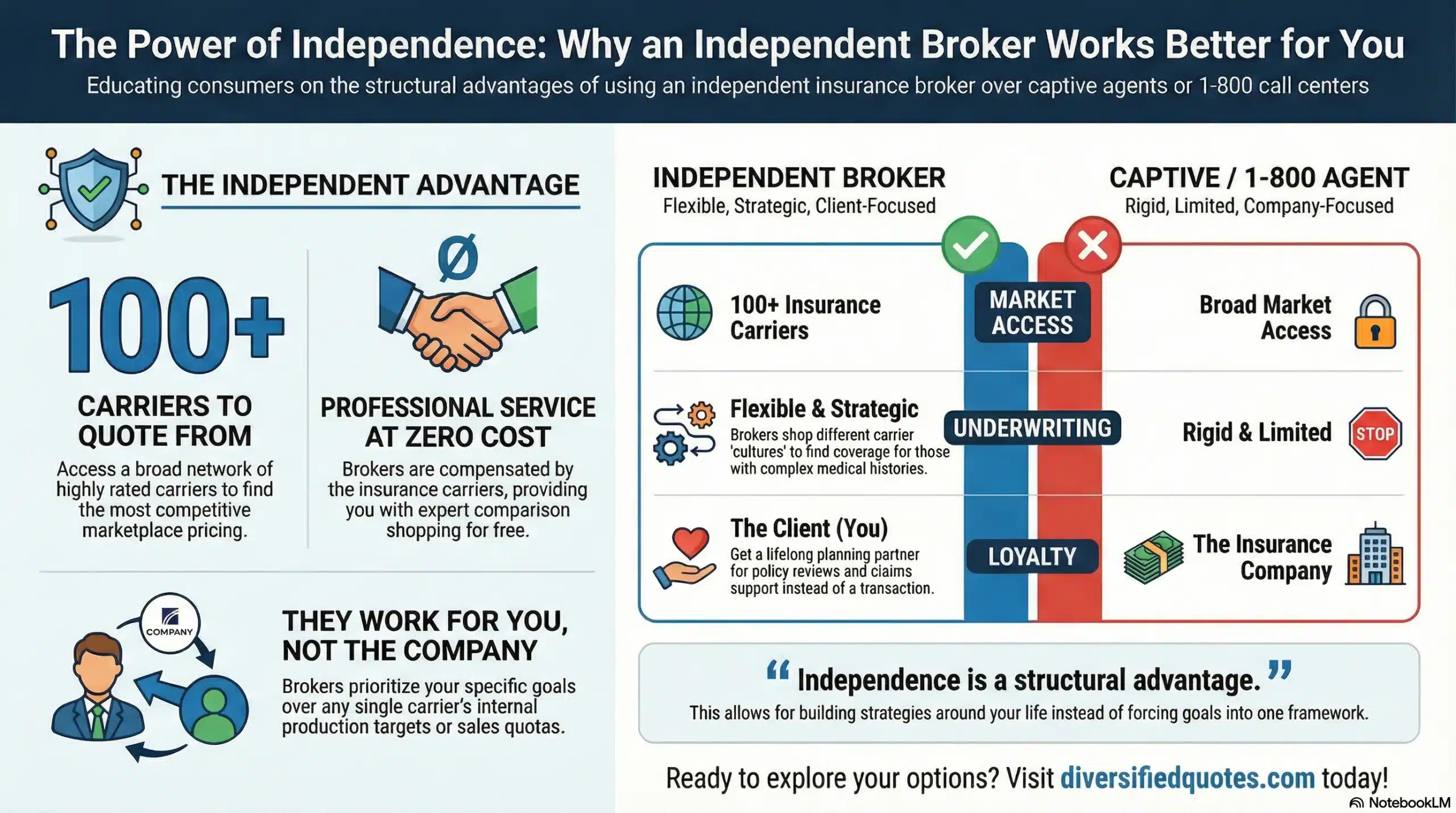
Online self-directed application is less suited to buyers with complex health histories where carrier selection significantly affects both eligibility and pricing, buyers seeking face amounts above $2 million where manual underwriting may produce better rate classifications, high-income earners or business owners whose coverage needs involve multi-policy structures, buy-sell agreements, or key person strategies that require professional design, and buyers who have previously been declined or rated and need independent broker expertise to identify the most favorable available carrier. For these profiles, the advisory pathway produces better outcomes than the fastest available self-service application. Our resource on why working with an independent life insurance broker matters explains how an independent brokerage’s carrier access and underwriting knowledge produces results that self-directed applications at a single carrier cannot replicate — and the second opinion on life insurance quotes service is available for buyers who have already received a quote and want to validate it against the competitive market before committing.
Talk With an Advisor Today
Choose how you’d like to connect—call or message us, then book a time that works for you.
Schedule here:
calendly.com/jason-dibcompanies/diversified-quotes
Licensed in all 50 states • Fiduciary, family-owned since 1980
Frequently Asked Questions: How to Buy Term Life Insurance Online
Can I really buy term life insurance online without a medical exam?
Yes, and for many applicants it is now the most common pathway. Accelerated underwriting programs allow carriers to make coverage decisions using real-time data queries — prescription history, motor vehicle records, prior insurance application data from the MIB, and algorithmic risk modeling — rather than a nurse-administered physical examination. For applicants who are younger than approximately fifty-five, in good to excellent health, and requesting face amounts within the carrier’s no-exam limit, accelerated underwriting typically produces an instant or same-day coverage decision without any exam requirement. The face amount limits vary by carrier — generally ranging from $500,000 to $3 million for qualifying applicants — and age eligibility windows differ by program. Not every applicant who begins an online application completes it through the accelerated pathway; those whose data queries surface health concerns or who exceed the no-exam face amount threshold are typically redirected to the traditional fully underwritten pathway, which does require an exam. But for the majority of healthy applicants in the prime working-age range, the no-exam online pathway is a genuinely viable and fast route to coverage in force. For specific carrier programs and limits, our no-exam life insurance resource covers current market options in detail.
How much does online term life insurance cost?
Online term life insurance pricing reflects the same actuarial factors as traditionally underwritten policies — age, gender, health classification, tobacco status, face amount, and term length — because the same carriers price both pathways. A healthy, non-smoking thirty-five-year-old can currently secure a twenty-year, $500,000 term policy for approximately $25 to $40 per month, representing one of the most cost-effective financial protection tools available. A million-dollar twenty-year term policy for the same profile runs approximately $50 to $65 per month. Premiums increase significantly with age: the same $500,000 policy that costs roughly $30 per month at age thirty-five can exceed $150 per month at age fifty. Tobacco use typically doubles or triples the non-smoker rate for comparable age and coverage. Health classifications — Preferred Plus, Preferred, Standard Plus, Standard, and Table Ratings — affect premiums by as much as thirty to fifty percent between the best and standard tiers, which is why pre-screening health profile against carrier underwriting guidelines before applying is one of the most valuable steps in the online purchase process. Use our term life insurance calculator for instant estimates based on your specific age, face amount, and term length.
How long does online term life insurance take to get?
For applicants who qualify for accelerated underwriting, the full process from beginning the application to policy delivery can be completed in a single day — sometimes in under an hour for straightforward applications at lower face amounts. The application itself typically takes fifteen to thirty minutes to complete online, the automated data queries run in seconds, and the binding coverage decision is displayed immediately for qualifying applicants. Policy documents are delivered electronically and coverage takes effect once the applicant signs and submits the first premium payment. For applicants whose applications are routed to traditional fully underwritten review — due to health concerns surfaced in the data queries, age, or face amounts exceeding the no-exam threshold — the timeline extends to four to eight weeks, matching the standard traditional underwriting process. The difference between these two pathways is determined entirely by the applicant’s profile and the carrier’s automated assessment — not by which platform or application tool is used. Our resource on what the life insurance exam involves covers the traditional underwriting timeline for reference.
What information do I need to apply for term life insurance online?
Having the following information ready before beginning the online application makes the process significantly faster and reduces the risk of errors that can delay or complicate the underwriting decision. Personal information: full legal name, date of birth, Social Security number, state of residence, driver’s license number. Coverage details: desired face amount, term length, beneficiary information (full legal name, date of birth, relationship, Social Security number for each beneficiary). Health information: complete medication list including dosage and the condition each medication treats, height and weight, primary care physician name and contact information, all medical diagnoses and conditions ever treated including resolved conditions, any hospitalizations or surgeries in the past ten years, family history of cardiovascular disease and cancer in immediate family members. Lifestyle information: tobacco use status and history, hazardous occupation or avocation (aviation, scuba diving, motor racing), foreign travel or residence plans. The medication list is the most critical element because the prescription database check cross-references every prescription filled in recent years — any discrepancy between application answers and database records will flag the application for additional review. See our application prescreening guide for a complete preparation checklist.
What term length should I choose when buying online?
Term length selection should be driven by the duration of the specific financial obligations the coverage is protecting against — not by premium optimization alone. The most common framework is to identify the longest-lasting financial obligation the death benefit needs to cover: typically the remaining mortgage balance, the number of years until the youngest child reaches financial independence, or the years remaining until the surviving spouse would have adequate retirement assets to self-sustain without the insured’s income. Buying a term shorter than the actual obligation horizon leaves the family unprotected during the most financially vulnerable years. Buying a term significantly longer than needed means paying premiums for coverage the family does not require. A twenty-year term is the most widely purchased option because it aligns well with the typical family’s peak financial dependency window — covering mortgage, child-rearing, and income-replacement obligations for buyers in their thirties and early forties. For buyers with obligations extending beyond twenty years, a thirty-year term or the laddering strategy — using multiple overlapping policies of different lengths — may provide better cost-per-obligation coverage. Our resources on 20-year term and 30-year term cover each length in detail, and the laddering guide explains the multi-policy strategy.
I was declined online — does that mean I can’t get life insurance?
A decline through an online accelerated underwriting platform is typically a decline for that specific carrier’s no-exam program — not a universal determination that you are uninsurable. Accelerated underwriting programs use algorithmic assessment with conservative thresholds that flag certain health or data profile characteristics for traditional underwriting rather than approving through the automated pathway. Many applicants declined through automated channels qualify for coverage at standard or better rates through fully underwritten applications at different carriers. Additionally, different carriers have different underwriting philosophies for specific conditions — an applicant declined at one carrier for controlled Type 2 diabetes may receive a standard offer at another carrier that is more favorable to managed diabetes cases. Working with an independent broker who can identify the most favorable carrier for your specific health profile, and who can pre-screen the application before formal submission, produces better outcomes than applying again through another online direct platform and accumulating MIB inquiry records. Our resource on what to do if you are denied life insurance covers the specific next steps, and our resource on life insurance with pre-existing conditions identifies carrier selection strategies for common health profiles that face declination risk.
Is a conversion privilege important in an online term policy?
Yes — and it is one of the most commonly overlooked features when buyers are focused on the speed and price of the online application process. A conversion privilege is the contractual right to convert some or all of a term policy to a permanent policy without providing new evidence of insurability, within a defined conversion window. The practical value is future insurability protection: a buyer who purchases a twenty-year term policy at thirty-five and develops a serious health condition at forty-nine can convert to a permanent policy at forty-nine using their original health classification, regardless of their current health status. Without a conversion privilege, that buyer may be unable to obtain any new life insurance coverage at an affordable rate — or at all. The quality of conversion privileges varies significantly among online term carriers. Some allow conversion only in the first five to ten years of the policy. Some restrict the permanent products available upon conversion to a narrow subset. Some exclude riders from the converted policy. Evaluating the conversion privilege as part of the carrier comparison — not just the premium — is an important step that the fast, self-directed nature of online applications makes easy to skip. Our resource on converting term to permanent life insurance covers the mechanics, timing, and value of this right.
Should I buy term life insurance online or work with an agent?
Online self-directed term life purchase is a strong fit for buyers who are healthy, clear on the face amount and term length they need, comfortable with a digital-first process, and either early in their career with straightforward financial profiles or experienced enough with life insurance to know what they are buying. For these buyers, the speed and simplicity of the online pathway, combined with the competitive pricing that digital comparison tools provide, makes self-service application practical and efficient. An independent agent or broker adds measurable value in specific scenarios: when the applicant has a health history where carrier selection significantly affects both eligibility and premium class, when the coverage need involves multiple policies, business insurance, or estate planning coordination, when the buyer is over fifty-five where underwriting nuance becomes more significant, or when a prior decline from an online platform has created an MIB record that requires careful placement. The important point is that working with an independent broker — as distinct from a captive agent representing one carrier — provides access to the same competitive pricing as the best online platforms, plus the carrier selection expertise that improves outcomes for complex profiles. For buyers who want both, the Assurity QuickStart online application and the advisory contact form on this page are both available. See our resource on why to work with an independent life insurance broker for the comparison in detail.
About the Author:
Jason Stolz, CLTC, CRPC, DIA, CAA and Chief Underwriter at Diversified Insurance Brokers (NPN 20471358), is a senior insurance and retirement professional with more than 25 years of real-world experience helping individuals, families, and business owners protect their income, assets, and long-term financial stability. As a long-time partner of the nationally licensed independent agency Diversified Insurance Brokers, Jason provides trusted guidance across multiple specialties—including fixed and indexed annuities, long-term care planning, personal and business disability insurance, life insurance solutions, Group Health, Travel Medical and Evacuation Insurance, and short-term health coverage. Diversified Insurance Brokers maintains active contracts with over 100 highly rated insurance carriers, ensuring clients have access to a broad and competitive marketplace.
His practical, education-first approach has earned recognition in publications such as VoyageATL, and contributions from his agency featured in Kiplinger and GoBankingRates— highlighting his commitment to financial clarity and client-focused planning. Drawing on deep product knowledge and years of hands-on field experience, Jason helps clients evaluate carriers, compare strategies, and build retirement and protection plans that are both secure and cost-efficient. Visitors who want to explore current annuity rates and compare options across multiple insurers can also use this annuity quote and comparison tool.
Explore More Life Insurance Options: Browse our complete guide to How Life Insurance Works — covering term life, whole life, final expense, annuity alternatives & more from 100+ carriers.
Last Reviewed: June 11, 2026 |
Reviewed by: Jason Stolz, CLTC, CRPC, DIA, CAA
Chief Underwriter, Diversified Insurance Brokers, Inc. | NPN: 20471358 | Diversified Insurance Brokers, Inc. — Licensed in all 50 states
Fact Checked by: Tonia Pettitt, CMIP©
Medicare Specialist, Diversified Insurance Brokers, Inc. | NPN: 14374308 | Diversified Insurance Brokers, Inc. — Licensed in all 50 states
Did you find this content helpful? Leave us a Google review — it helps others find trustworthy guidance too.
Editorial Standards: Diversified Insurance Brokers maintains rigorous editorial standards to ensure accuracy, clarity, and independence in all content. Learn more about our editorial standards and commitment to transparency.
