
Life Insurance for Smokers
As an Independent Life Insurance Broker, we compare rates across 100+ carriers and prescreen every application before submission.
Life Insurance for Smokers

Jason Stolz CLTC, CRPC, DIA, CAA
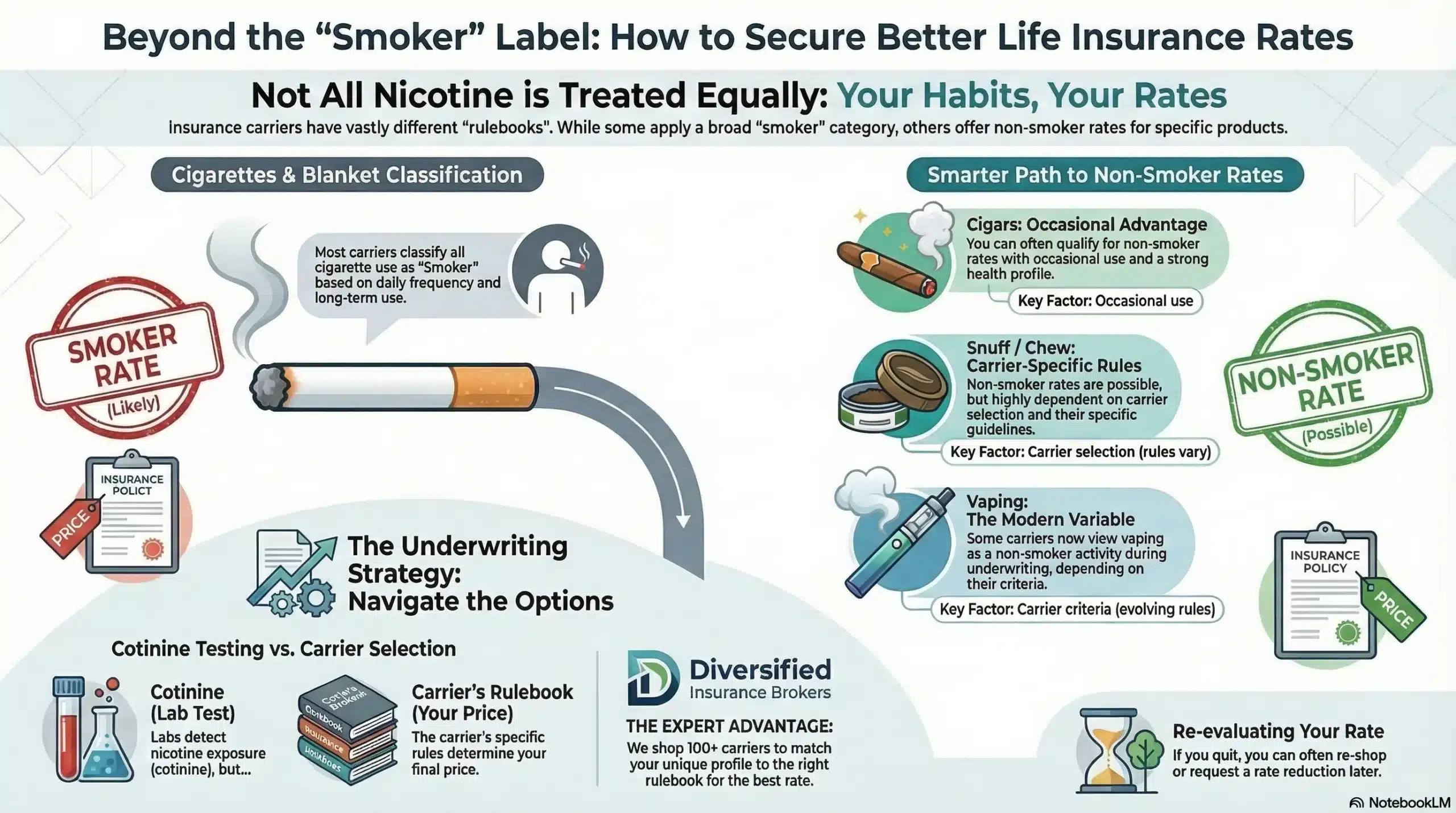
If you use tobacco — cigars, chew or dip, vaping, pipe, or even occasional cigarettes — the most important thing to know about life insurance underwriting is this: tobacco use does not automatically mean smoker rates. At Diversified Insurance Brokers, we regularly place tobacco users at non-smoker rates through carriers whose underwriting guidelines recognize the meaningful difference between tobacco types, frequency, and risk profile. Cigars smoked occasionally, smokeless tobacco, pipe tobacco, and vaping can all qualify for non-smoker classification at the right carrier — which translates directly into significantly lower premiums than the same applicant would receive if submitted to a carrier that treats any nicotine as equivalent to daily cigarette smoking.
This is the underwriting reality that most direct-to-consumer platforms and single-company agencies completely miss: tobacco classification is not binary, and carrier selection determines whether you pay smoker rates or non-smoker rates for the same habit. Two tobacco users with identical usage patterns can receive quotes that differ by 50–100% or more — not because one is healthier, but because one application was submitted to a carrier with nuanced tobacco classification guidelines and the other was not. At Diversified Insurance Brokers, Jason Stolz, CLTC, CRPC, DIA, CAA maps each tobacco-using applicant’s specific usage pattern against the carrier market’s current classification rules before any formal application is submitted — targeting the carriers whose guidelines produce the best legitimate class for the specific tobacco profile. Our resource on life insurance table ratings explained covers how rate classes translate into actual premium differences — context that makes the carrier selection decision concrete and quantifiable.
See Real-Term Rates Side by Side
Life Insurance Quoter
Find Out If You Qualify for Non-Smoker Rates
Tell us how you use tobacco — type, frequency, recency. We match you to carriers whose guidelines produce the best class you can legitimately earn.
Request a Free Quote Call 800-533-5969Tobacco Type Classification — Which Types Can Qualify for Non-Smoker Rates
The single most important table on this page maps each tobacco type against its realistic non-smoker rate opportunity. The “non-smoker rates possible” column is not generic optimism — it reflects how the carrier market actually works across our 100+ carrier network, where tobacco classification guidelines vary significantly and the right carrier match determines whether a tobacco user pays $80 per month or $160 per month for the same coverage.
| Tobacco / Nicotine Type | Non-Smoker Rates Possible? | Key Conditions for Non-Smoker Class | Carrier Landscape Notes |
|---|---|---|---|
| Cigars (occasional — 1–2 per month or less) | Yes — commonly achievable at the right carrier | Frequency documented accurately; no daily cigarette use; cotinine may test positive — carrier must recognize cigar non-smoker class | Multiple carriers offer cigar-specific non-smoker class for occasional use. See our life insurance for cigar smokers page for specifics. |
| Cigars (regular — several per week) | Possible at select carriers — frequency-dependent | Some carriers allow non-smoker class for regular cigar users who do not smoke cigarettes; highly carrier-specific | Carrier selection is decisive — some treat any regular cigar use as smoker; others have separate cigar class regardless of frequency |
| Chew / dip / smokeless tobacco | Yes — many carriers classify smokeless tobacco separately from cigarettes | Accurate disclosure of smokeless (not cigarette) use; no concurrent cigarette smoking; some carriers require specific non-cigarette class election | A meaningful segment of carriers offers non-smoker or preferred non-smoker classes for smokeless tobacco users |
| Pipe tobacco (occasional) | Yes — treated similarly to occasional cigar use at many carriers | Occasional use, accurate disclosure, no daily cigarette use; carrier must specifically allow pipe non-smoker class | Carriers that allow cigar non-smoker class generally extend the same benefit to occasional pipe tobacco users |
| Vaping / e-cigarettes (nicotine-containing) | Possible at select carriers — underwriting varies widely | Some carriers distinguish vaping from cigarettes; frequency and nicotine concentration matter; cotinine positive expected | Less standardized than cigar/smokeless tobacco; carrier selection is most critical; actively evolving market |
| Vaping / e-cigarettes (nicotine-free) | Yes — typically non-smoker class when cotinine is negative | Cotinine test negative; disclosure that vaping is nicotine-free; no concurrent cigarette or tobacco use | Nicotine-free vaping generally does not trigger tobacco class when labs confirm no nicotine exposure |
| Nicotine replacement therapy (patches, gum, lozenges) | Carrier-specific — some treat as quit attempt, some as nicotine exposure | Timing and context matter — carriers who treat NRT as a quit attempt may offer non-smoker class; others see positive cotinine and apply tobacco class | Disclosure of NRT use with no recent cigarette use can produce favorable outcomes at the right carrier |
| Cigarettes (very limited — occasional only, well documented) | Possible at a select number of carriers — rare but not zero | Extremely limited frequency (occasional social smoking), long history of minimal use, no daily use pattern, accurate disclosure critical | A small number of carriers have provisions for very infrequent cigarette use under non-smoker guidelines — carrier-specific and not universal |
| Cigarettes (regular / daily) | Typically smoker class — but carrier competition still matters for pricing within smoker classes | Regular daily cigarette use typically produces smoker classification; the goal is finding the most competitive smoker-class pricing and understanding the re-shopping timeline after cessation | Smoker pricing varies significantly across carriers even within smoker class; independent shopping still produces meaningfully different premiums |
The table makes the central point of this page concrete: tobacco use is not a binary “smoker penalty” situation. Cigars, chew, dip, pipe, and certain vaping patterns can all qualify for non-smoker rates when the application is submitted to a carrier whose classification guidelines recognize the distinction. This is Diversified’s primary competitive advantage in the tobacco underwriting market — knowing which carriers award non-smoker class for which tobacco types, and routing applications accordingly before any formal submission creates a record. Our resource on life insurance for cigar smokers covers the specific cigar underwriting landscape in depth — including which carriers are most cigar-friendly, what frequency thresholds matter, and how cotinine results interact with cigar non-smoker class elections.
Why Tobacco Life Insurance Pricing Varies So Much — and What That Means for You
Life insurance carriers do not price tobacco because they are trying to punish nicotine users. They are pricing what their actuarial data suggests correlates with higher mortality risk over the policy period. The problem for tobacco users is that insurers use different definitions, different class structures, different lookback periods, and different treatment for different tobacco types — which means the same applicant with the same usage pattern can receive dramatically different quotes depending entirely on which carrier receives the application.
This variation is the market opportunity that independent broker placement exploits. A cigar smoker who uses 1–2 cigars per month submitting to a carrier that treats all tobacco as smoker-equivalent will receive a smoker-class quote with premiums potentially 50–100% higher than a non-smoker of the same age and health profile. The same cigar smoker submitting to a carrier with a specific occasional-cigar non-smoker provision receives a non-smoker class quote. The habit is identical. The premium difference is entirely a product of which carrier’s rulebook applied to the application. Our resource on how to prescreen a life insurance application covers the informal carrier evaluation process that identifies the best carrier match before any formal application creates a permanent underwriting record — the most important single step in tobacco life insurance placement.
How Carriers Verify Tobacco Use — Cotinine and What It Means
For most fully underwritten policies — particularly at higher face amounts — carriers confirm nicotine exposure through a combination of the application questionnaire and lab testing. The primary lab marker is cotinine, a metabolite produced when the body processes nicotine. Cotinine can be detected in blood or urine and indicates recent nicotine exposure regardless of the source: cigarettes, cigars, chew, vaping, or nicotine replacement all produce detectable cotinine.
This is why the carrier selection conversation matters before the lab test happens, not after. A positive cotinine result means different things at different carriers: at a carrier that treats any nicotine as smoker equivalent, a positive cotinine locks in smoker class regardless of the tobacco type. At a carrier with a separate cigar or smokeless tobacco non-smoker class, a positive cotinine combined with accurate disclosure of the specific tobacco type produces the non-smoker class the applicant legitimately qualifies for. The lab result is the same in both cases. The underwriting outcome is completely different based on which carrier’s rulebook applies.
The correct strategy is not to try to manage lab results — it is accurate disclosure combined with deliberate carrier selection. When disclosure is precise and the carrier’s classification rules fit the actual tobacco pattern, lab results confirm the story rather than contradicting it. Where applicants get into trouble is when disclosures are vague or inconsistent and the carrier’s underwriter fills in the gaps with conservative assumptions. Our resource on common mistakes people make when buying life insurance covers the application and disclosure errors that most commonly produce inflated premiums — relevant reading before any life insurance application is submitted regardless of tobacco history.
Cigars — The Most Misunderstood Tobacco Category in Life Insurance
Cigar underwriting is where the non-smoker rate opportunity is most clearly established in the carrier market and where the most value is available to applicants who submit correctly. The misunderstanding is common: cigar users assume they will be classified as smokers because they use tobacco, and they submit applications that either don’t distinguish cigar use from cigarette use or that submit to carriers without specific cigar non-smoker provisions. The result is a smoker-class quote that was entirely avoidable.
The reality is that a meaningful number of major carriers have specific provisions that allow occasional cigar users to qualify for non-smoker rate classes — even when a cotinine test comes back positive, as it often does for cigar users. These provisions typically require accurate disclosure of the cigar-only nature of the tobacco use, consistent with what appears in the medical record, and the absence of concurrent cigarette use. Frequency matters at some carriers but not others — some carriers allow non-smoker class for any cigar frequency when cigarettes are absent, while others have specific monthly or annual limits. Identifying which carrier’s specific cigar guidelines are most favorable for the specific frequency pattern is the prescreening work that turns a smoker-class quote into a non-smoker-class placement. Our dedicated resource on life insurance for cigar smokers covers the carrier landscape for cigar underwriting in significant depth — including specific carrier approaches, frequency thresholds, and how to present a cigar-only tobacco profile to maximize the probability of non-smoker classification.
Chew, Dip, and Smokeless Tobacco — Non-Smoker Rate Opportunity
Smokeless tobacco users — chew, dip, and snuff — occupy one of the most favorable positions in the tobacco underwriting market, because the risk profile that actuarial data associates with smokeless tobacco is genuinely different from the risk profile of daily cigarette smoking. Many carriers recognize this distinction in their underwriting guidelines and maintain separate classification provisions for smokeless tobacco that can produce non-smoker class outcomes for applicants who accurately disclose their usage pattern as smokeless rather than cigarette.
The key requirements for non-smoker class for smokeless tobacco are consistent across most carriers that offer this provision: no concurrent cigarette use, accurate disclosure of the smokeless rather than cigarette nature of the tobacco use, and submission to a carrier whose guidelines specifically address the smokeless tobacco category rather than aggregating all tobacco into a single class. For smokeless tobacco users who have been quoted at smoker rates — particularly through online comparison tools that default all tobacco to smoker class — re-shopping through an independent broker with specific knowledge of which carriers offer smokeless tobacco non-smoker provisions is often the most impactful single action available.
Vaping and E-Cigarettes — The Evolving Classification Landscape
Vaping underwriting is the most actively evolving category in the tobacco classification market, and it is where the variation across carriers is currently greatest. Some carriers treat any vaping as equivalent to cigarette smoking for underwriting purposes and apply smoker class regardless of nicotine content or frequency. Others distinguish vaping from cigarettes and maintain separate classification criteria for nicotine-containing vape use. And for nicotine-free vaping — where cotinine tests come back negative — most carriers who test for cotinine will produce non-smoker classification based on the negative lab result rather than the vaping behavior itself.
For nicotine-containing vaping, the strategy is the same as for other tobacco types: accurate disclosure of the vaping-rather-than-cigarette nature of the nicotine use, submitted to a carrier whose classification guidelines treat vaping more favorably than cigarette-equivalent. Because carrier guidelines for vaping are less standardized than for cigars or smokeless tobacco, prescreening across multiple carriers before any formal submission is particularly valuable — both to identify which carriers offer the most favorable vaping classification and to avoid the mistake of submitting to a strict carrier that will produce an inflated offer or a decline that follows the applicant’s MIB record into subsequent applications.
When Tobacco Use Overlaps With Health Conditions
Tobacco use does not exist in isolation in many applicant files. Carriers also evaluate health factors that frequently co-occur with tobacco use: pulmonary symptoms, cardiovascular risk markers, elevated blood pressure, cholesterol abnormalities, and other conditions that may be related to or exacerbated by tobacco exposure. When tobacco class and health ratings stack in the same underwriting file, carrier selection becomes even more critical — because some carriers are more conservative in how they aggregate multiple risk factors while others evaluate each factor more independently and produce more competitive combined outcomes.
For tobacco users with pulmonary conditions including COPD or chronic bronchitis, our resource on life insurance for COPD covers what carriers look for in pulmonary stability documentation and how treatment compliance affects the combined tobacco-plus-pulmonary underwriting picture. For tobacco users with cardiovascular history or elevated cardiac risk factors, our resource on life insurance for heart disease covers the cardiac underwriting framework and how tobacco class interacts with cardiac ratings in combined files. In many cases, the most effective underwriting move for combined-risk files is identifying the carrier most favorable for the dominant risk factor — because that carrier’s framework for handling the secondary factors is often better calibrated for the specific combination.
Term vs. Permanent Life Insurance for Tobacco Users
For most tobacco users, term life insurance is the highest-priority coverage because it provides the most death benefit per dollar during the years when financial protection matters most — while income-earning years are ongoing, mortgage obligations are active, and children or dependents are financially reliant on the primary earner. Our resource on how to protect your mortgage with life insurance covers the specific coverage sizing for mortgage protection, which is one of the most common coverage objectives. Our term life insurance calculator provides preliminary premium comparisons across term lengths, and our resource on best term life insurance policy covers the evaluation framework for selecting among competing term options.
Permanent life insurance becomes relevant for tobacco users whose goals extend beyond a defined term window — legacy planning, final expense coverage that doesn’t expire, or coverage that addresses the risk of future health changes making future underwriting more difficult. For tobacco users who are also considering their re-shopping strategy — what happens when they quit and want to convert from smoker to non-smoker class — the policy’s conversion provision and carrier’s re-rating process matter as much as the initial classification. Our resource on life insurance calculator helps model the appropriate coverage amount regardless of whether term or permanent is the selected structure.
Re-Shopping After Quitting — Capturing the Non-Smoker Benefit
For cigarette smokers who receive smoker-class coverage and subsequently quit, the re-shopping pathway after a qualifying cessation period is one of the most valuable opportunities in the tobacco life insurance market. Most carriers have specific lookback windows — defined periods of confirmed nicotine abstinence — after which a former smoker can either request reconsideration of an existing policy’s rate class or apply for new coverage at non-smoker rates. The specific lookback period varies by carrier but commonly ranges from one to three years of documented abstinence.
Planning this re-shopping pathway from the point of initial policy purchase — not as an afterthought after cessation — allows tobacco users to select coverage that positions them for the most efficient future re-rating. Some policies and carriers facilitate reconsideration more easily than others; some require a new application while others allow a rate-class change on the existing policy. Understanding the re-shopping mechanics in advance means that the coverage structure purchased now supports the premium optimization that becomes available later rather than creating obstacles. Our resource on what is a flat extra in life insurance covers how surcharge structures work — context that is relevant for tobacco users who receive offers with flat extra loading rather than simple class changes, because the flat extra structure can interact differently with future re-rating requests than a table rating does.
Find Out Your Best Eligible Class Today
Tell us your tobacco type, frequency, and how recently you used it. We match your profile to the carriers most likely to award you the best legitimate class — including non-smoker rates for many tobacco users.
Request a Free Quote Call 800-533-5969Related Pages
Cigar-specific underwriting, health condition stacking, no-exam options, and coverage for specific life situations.
Financial Protection Essentials
High-risk lifestyle and avocation underwriting guides, prescreening tools, and fallback coverage options.
Compare Term Life Insurance Lengths
Explore different term periods to find coverage that best matches your timeline and budget.
Talk With an Advisor Today
Choose how you’d like to connect—call or message us, then book a time that works for you.
Schedule here:
calendly.com/jason-dibcompanies/diversified-quotes
Licensed in all 50 states • Fiduciary, family-owned since 1980
FAQs: Life Insurance for Smokers and Tobacco Users
Can I get life insurance if I smoke or use tobacco?
Yes — and for many tobacco users, the outcome is better than expected when the application is submitted to the right carrier. The tobacco type, frequency, recency, and overall health profile all affect the outcome, but the most important factor for non-cigarette tobacco users is carrier selection: many carriers offer non-smoker rate classes for cigar users, smokeless tobacco users, and pipe users who accurately disclose their usage pattern as distinct from cigarette smoking. For regular cigarette smokers, coverage is widely available at competitive smoker-class pricing when applications are shopped across carriers rather than submitted to a single insurer. The premium difference between an optimized tobacco placement and a poorly-matched carrier submission is significant — sometimes 50% or more — which makes strategic broker placement the single most impactful action for any tobacco user seeking life insurance. Our resource on life insurance table ratings explained covers how rate classes translate into actual premium numbers, providing context for evaluating whether any specific offer represents the best available outcome for the specific tobacco profile.
Can cigar users qualify for non-smoker rates?
Yes — and cigar non-smoker rates are one of the most commonly achieved non-smoker class outcomes for tobacco users across our carrier network. A meaningful number of major carriers have specific provisions that allow occasional cigar users to qualify for non-smoker rate classes, even when a cotinine test comes back positive confirming nicotine exposure. The specific conditions vary by carrier but typically involve accurate disclosure of the cigar-only nature of the tobacco use (no concurrent cigarette smoking), frequency within the carrier’s acceptable range, and submission to a carrier whose classification guidelines specifically include a cigar non-smoker provision rather than aggregating all tobacco into a single class. The key mistake cigar users make is submitting applications that don’t clearly distinguish cigar use from cigarette use, or submitting to carriers that don’t have cigar-specific classification provisions — both of which produce smoker-class outcomes that were entirely avoidable. Our dedicated resource on life insurance for cigar smokers covers the carrier landscape, frequency thresholds, and application strategy for maximizing the probability of cigar non-smoker classification.
Do chew or dip users always get smoker rates?
No — many carriers classify smokeless tobacco (chew, dip, snuff) separately from cigarettes and offer non-smoker or preferred non-smoker class to smokeless tobacco users who do not concurrently smoke cigarettes. This is one of the clearest non-smoker rate opportunities in the tobacco underwriting market, because the actuarial risk profile associated with smokeless tobacco is genuinely different from that of daily cigarette smoking, and a meaningful portion of the carrier market has updated its classification guidelines to reflect that distinction. The key requirements are consistent across most carriers that offer this provision: accurate disclosure of the smokeless rather than cigarette nature of the use, no concurrent cigarette smoking, and submission to a carrier whose underwriting guidelines specifically address the smokeless tobacco category. Smokeless tobacco users who have received smoker-rate quotes — particularly from online comparison tools that default all tobacco to smoker class — frequently find substantially lower premiums available when applications are submitted to the right carrier through an independent broker familiar with smokeless tobacco classification guidelines.
How do insurers treat vaping or e-cigarettes?
Vaping underwriting is the most actively evolving area of tobacco classification, and carrier variation is currently larger for vaping than for any other tobacco type. Some carriers treat any vaping — regardless of nicotine content or frequency — as equivalent to cigarette smoking for classification purposes. Others distinguish vaping from cigarettes and evaluate nicotine concentration, frequency, and usage pattern separately. For nicotine-free vaping specifically, most carriers that test for cotinine will produce a non-smoker classification when labs return negative — the absence of measurable nicotine metabolites in lab results generally leads to non-smoker class regardless of the vaping behavior itself. For nicotine-containing vaping, the strategy is accurate disclosure of the vaping-rather-than-cigarette nature of the nicotine use, submitted to a carrier whose current guidelines treat vaping more favorably than cigarette-equivalent. Because carrier guidelines for vaping classification are less standardized than for cigars or smokeless tobacco, informal prescreening across multiple carriers before any formal submission is particularly valuable for vaping cases. Our resource on how to prescreen a life insurance application covers the process that protects your record while identifying the most favorable carrier for vaping classification.
How do life insurance companies verify nicotine use?
Most carriers verify nicotine exposure through a combination of the application questionnaire and laboratory testing — specifically testing for cotinine, a metabolite produced when the body processes nicotine. Cotinine can be detected in blood or urine and indicates recent nicotine exposure regardless of the tobacco or nicotine source: cigarettes, cigars, chew, vaping, nicotine patches, and nicotine gum all produce detectable cotinine if used recently enough before the test. The key implication for tobacco users is that the cotinine test confirms nicotine exposure but does not distinguish which source produced the exposure — which is why what the carrier does with a positive cotinine result depends entirely on how that carrier’s classification rules are structured. A carrier with a cigar non-smoker provision interprets a positive cotinine alongside accurate cigar-use disclosure as confirmation of the cigar use pattern. A carrier without that provision interprets the same positive cotinine as smoker-class confirmation regardless of the disclosed tobacco type. This is why carrier selection happens before the lab test, not after — because the classification framework determines what the positive result means for the underwriting outcome. Our resource on common mistakes people make when buying life insurance covers how application and disclosure errors interact with lab results to produce inflated premiums.
If my labs show cotinine, does that automatically mean smoker rates?
No — a positive cotinine result does not automatically produce smoker rates. What the positive cotinine result means for your classification depends entirely on the carrier’s classification framework and the accuracy of your disclosure. At a carrier that treats any positive cotinine as smoker-equivalent, a positive result locks in smoker class. At a carrier with separate cigar, smokeless tobacco, or pipe provisions, a positive cotinine result combined with accurate disclosure of the specific non-cigarette tobacco type confirms the usage pattern and produces the appropriate non-smoker or preferred non-smoker class. The same lab result, the same tobacco use, the same health profile — different carriers, different outcomes. This is the fundamental reason why carrier selection before any formal application is the most important step in tobacco life insurance placement. For tobacco users who are not daily cigarette smokers, the goal is always to ensure the application reaches a carrier whose classification rules allow the non-smoker class the applicant legitimately qualifies for — not to manage or avoid lab results.
Should I quit before applying for life insurance?
For cigarette smokers, quitting before applying is the most direct path to non-smoker rates — but the timing depends on the carrier’s lookback window and whether the quitting is genuine and sustainable. Most carriers require a defined period of confirmed nicotine abstinence (commonly 12 months, though this varies) before reclassifying a former smoker to non-smoker class. Applying immediately after quitting typically still produces smoker-class quotes until the carrier’s lookback period is satisfied. For non-cigarette tobacco users — cigar users, smokeless tobacco users, pipe users — quitting is not necessarily required to qualify for non-smoker rates, because many carriers offer non-smoker class for these tobacco types based on usage type and pattern rather than abstinence. For these users, the better question is not “should I quit” but “which carrier treats my current usage pattern most favorably.” We help tobacco users think through both the current placement strategy and the re-shopping plan after any planned cessation — so the coverage structure purchased now positions the client for the best available re-rating when cessation milestones are reached.
How long do I need to be nicotine-free to qualify as a non-smoker?
The required abstinence period to qualify as a non-smoker varies by carrier, and there is no single industry standard. Many carriers use a 12-month lookback window — applicants who have been nicotine-free for 12 months or more at the time of application may qualify for non-smoker classification. Some carriers use shorter windows (6 months) and others use longer windows (2–3 years for preferred non-smoker class specifically). The verification method is typically a negative cotinine lab result at the time of the paramedical exam combined with application disclosure confirming no nicotine use in the lookback period. One practical consideration: nicotine replacement therapy (patches, gum, lozenges) can produce positive cotinine results even after cigarette cessation — meaning a former smoker using NRT to quit may still test positive for cotinine and be classified as a tobacco user at carriers that treat any positive cotinine as smoker-equivalent. This is why understanding which carrier’s specific lookback and cessation definition applies is part of the re-shopping strategy for former cigarette smokers. We help clients map the optimal timing for re-shopping based on their specific cessation date and the carrier options available at that point.
What if I smoke and also have health issues?
Coverage may still be available, and in many cases it is — but when tobacco use combines with other health factors, the underwriting picture requires more sophisticated carrier targeting. Carriers evaluate combined risk profiles rather than a single factor in isolation, and some carriers are more conservative in how they stack tobacco classification with additional health ratings than others. For tobacco users with pulmonary conditions, our resource on life insurance for COPD covers the pulmonary underwriting framework that applies when tobacco use and pulmonary health interact in the same file. For tobacco users with cardiovascular history or risk factors, our resource on life insurance for heart disease covers how cardiac ratings interact with tobacco classification. In combined-risk cases, the most effective strategy is identifying the carrier most favorable for the primary risk driver — often the health condition rather than the tobacco use — and confirming how that carrier treats the tobacco element in combination. Our resource on high-risk life insurance covers the full placement approach for complex combined-risk profiles.
Can I improve my rate later if I quit?
For cigarette smokers paying smoker-class rates, quitting and satisfying the carrier’s lookback period opens one of the most impactful rate improvement opportunities in personal life insurance. Depending on the carrier and the policy, the re-rating process may involve requesting a rate-class review on the existing policy or re-applying for new coverage at non-smoker rates — the specific mechanism depends on the carrier’s policies and whether the original application was structured to facilitate future re-rating. Planning the re-shopping strategy from the time of the initial purchase — not after quitting — ensures the coverage structure supports the future rate improvement rather than creating obstacles. The premium difference between smoker and non-smoker class for the same age and health profile is significant enough that the expected premium savings after a qualifying cessation period are often substantial. Our resource on life insurance with a prior decline covers the broader strategy for navigating coverage after challenging initial placements — relevant context for tobacco users who want to understand the full lifecycle of their coverage strategy including the cessation and re-rating pathway.
About the Author:
Jason Stolz, CLTC, CRPC, DIA, CAA and Chief Underwriter at Diversified Insurance Brokers (NPN 20471358), is a senior insurance and retirement professional with more than 25 years of real-world experience helping individuals, families, and business owners protect their income, assets, and long-term financial stability. As a long-time partner of the nationally licensed independent agency Diversified Insurance Brokers, Jason provides trusted guidance across multiple specialties—including fixed and indexed annuities, long-term care planning, personal and business disability insurance, life insurance solutions, Group Health, Travel Medical and Evacuation Insurance, and short-term health coverage. Diversified Insurance Brokers maintains active contracts with over 100 highly rated insurance carriers, ensuring clients have access to a broad and competitive marketplace.
His practical, education-first approach has earned recognition in publications such as VoyageATL, and contributions from his agency featured in Kiplinger and GoBankingRates— highlighting his commitment to financial clarity and client-focused planning. Drawing on deep product knowledge and years of hands-on field experience, Jason helps clients evaluate carriers, compare strategies, and build retirement and protection plans that are both secure and cost-efficient. Visitors who want to explore current annuity rates and compare options across multiple insurers can also use this annuity quote and comparison tool.
Explore More Life Insurance Options: Browse our complete guide to Life Insurance for Mental Health & Substance Use — covering depression, PTSD, ADHD, bi-polar disorder, and substance use from 100+ carriers.
Last Reviewed: June 15, 2026 |
Reviewed by: Jason Stolz, CLTC, CRPC, DIA, CAA
Chief Underwriter, Diversified Insurance Brokers, Inc. | NPN: 20471358 | Diversified Insurance Brokers, Inc. — Licensed in all 50 states
Fact Checked by: Tonia Pettitt, CMIP©
Medicare Specialist, Diversified Insurance Brokers, Inc. | NPN: 14374308 | Diversified Insurance Brokers, Inc. — Licensed in all 50 states
Did you find this content helpful? Leave us a Google review — it helps others find trustworthy guidance too.
Editorial Standards: Diversified Insurance Brokers maintains rigorous editorial standards to ensure accuracy, clarity, and independence in all content. Learn more about our editorial standards and commitment to transparency.
