
Life Insurance for Cigar Smokers
Life Insurance for Cigar Smokers

Jason Stolz CLTC, CRPC, DIA, CAA
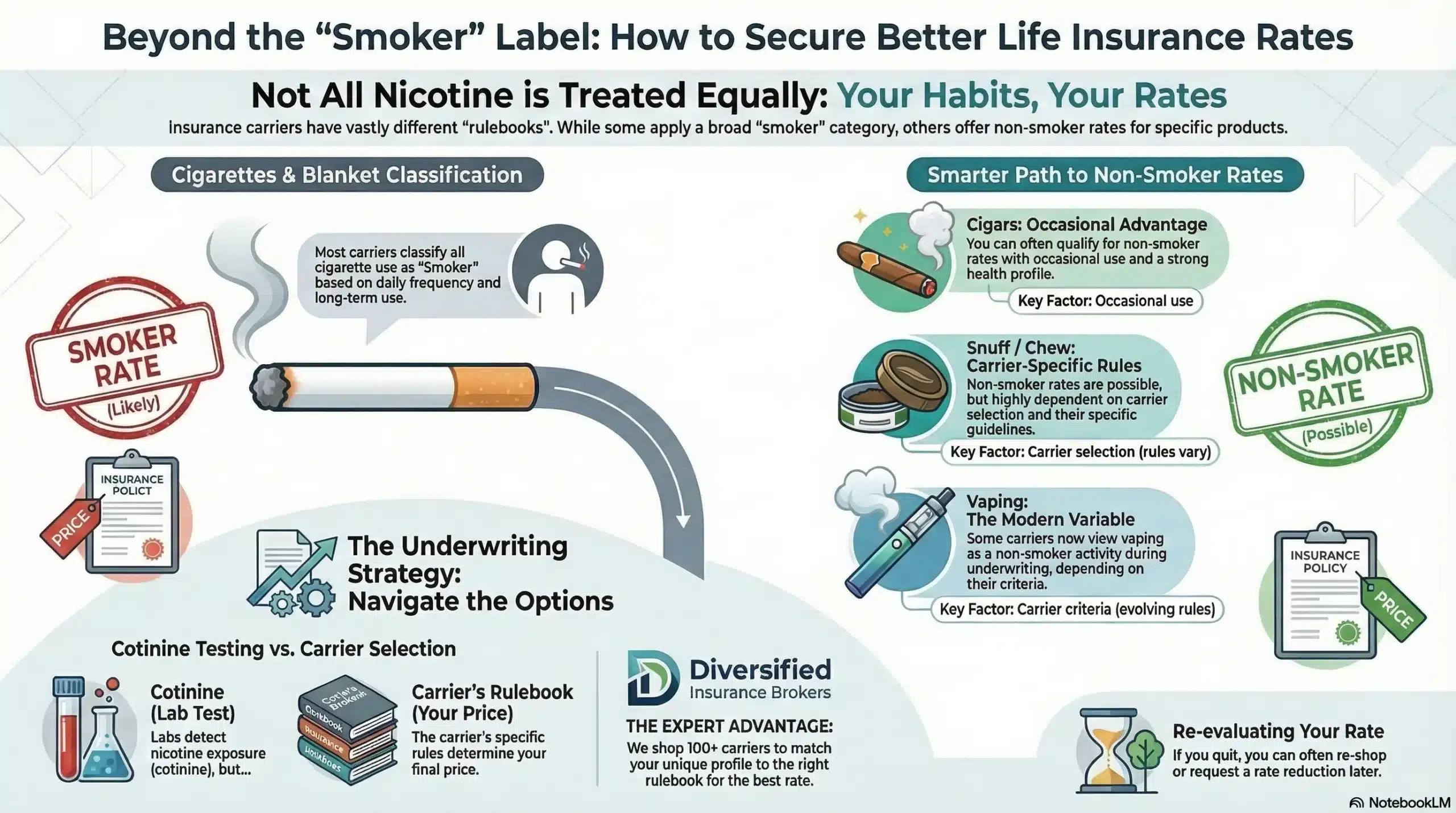
Life insurance for cigar smokers is one of the most misunderstood underwriting categories in the entire market — because the premise that most applicants operate from is simply wrong. Cigar smokers are not automatically classified as tobacco users by life insurance carriers. Many carriers make an explicit distinction between cigar use and cigarette use, and select carriers maintain guidelines specifically allowing occasional cigar users to qualify for non-smoker life insurance rates — the same pricing tier available to applicants who have never used any tobacco product. The difference between a cigar smoker paying standard non-smoker rates and the same individual paying tobacco rates — which can be two to four times higher for the same coverage — is not determined by whether they smoke cigars. It is determined by which carrier receives their application, how the cigar use is documented, whether any cigarette use appears in the disclosure or medical history, and how the nicotine test result is interpreted under that specific carrier’s guidelines. Getting this right the first time is the entire game in life insurance for cigar smokers — because getting it wrong means paying significantly more than the actuarial risk actually warrants for the life of the policy.
At Diversified Insurance Brokers, Jason Stolz, CLTC, CRPC, DIA, CAA specializes in matching cigar smoker applicants to the carriers whose underwriting guidelines treat cigar use as categorically distinct from cigarette use — and who allow non-smoker classification for applicants who meet their specific criteria. Our resource on life insurance for smokers covers the broader tobacco underwriting landscape, providing the contrast that makes the cigar-specific opportunity most visible, and our resource on life insurance table ratings explained covers the premium adjustment mechanism that applies when a cigar user is classified as a tobacco user at a carrier that doesn’t offer the non-smoker exception.
Compare Life Insurance Rates for Cigar Smokers
Life Insurance Quoter
Get Cigar-Friendly Non-Smoker Rate Quotes
We identify which carriers treat your specific cigar use profile as non-smoker — and show you real premium comparisons between non-smoker and tobacco-rated pricing so you can see exactly what accurate classification saves.
Request Information Call 800-533-5969How Carriers Classify Different Cigar Use Profiles — The Non-Smoker Decision Matrix
The most important insight in life insurance for cigar smokers is that the underwriting outcome is not determined by cigar use alone — it is determined by the interaction of cigar frequency, the absence or presence of cigarette use, nicotine test results, and the specific carrier’s guidelines. The table below maps the most common cigar use profiles to typical underwriting outcomes across the market, showing where non-smoker rates are accessible and where they are not.
| Cigar Use Profile | Cigarette / Other Tobacco Use? |
Likely Nicotine Test Result |
Non-Smoker Rate Available? |
Strategy |
|---|---|---|---|---|
| Celebratory / Rare (1–3 cigars per year) | None | Typically negative if not smoked recently | Yes — at most cigar-friendly carriers; even preferred non-smoker possible | Target carriers with explicit cigar exception language; time application away from recent use |
| Occasional (1–2 per month) | None | May be negative or low positive depending on timing | Yes — at select carriers that allow positive cotinine with cigar disclosure | Carrier selection critical — some require negative lab; others allow positive with proper cigar disclosure |
| Weekly / Weekend (1 or more per week) | None | Likely positive for cotinine | Possible at select carriers — frequency threshold is the key variable by carrier guideline | Pre-screen against carrier frequency thresholds before applying; some carriers cap at 12/year, others at 24/year |
| Daily cigar user | None | Positive | Possibly — most carriers will classify as tobacco. Careful pre-screen is a must for Non Tobacco rate outcomes | Working with an experienced life insurance broker to ensure the correct carrier is applied with. |
| Cigars + Occasional cigarettes | Yes — cigarette use present | Positive | No — cigarette use of any frequency eliminates non-smoker eligibility at virtually all carriers | Apply as tobacco user; shop best tobacco-rated pricing across carriers |
| Cigars + Vaping or nicotine pouches | Yes — other nicotine products present | Positive | No — combined tobacco/nicotine product use forces tobacco classification at most carriers | Tobacco-rated pricing applies; carrier selection for best tobacco premium |
The table reveals the two primary variables that determine whether life insurance for cigar smokers can access non-smoker pricing: the absence of cigarette or other tobacco product use, and the frequency of cigar use relative to the specific carrier’s threshold. Everything else — nicotine test results, health profile, policy type — flows from these two variables. An applicant who is in the top two or three rows of the table, working with an independent broker who knows which carriers have cigar exception language in their guidelines, has a genuinely viable path to non-smoker rates. An applicant in the bottom three rows does not — and the strategy shifts to identifying the carrier with the most competitive tobacco-rated pricing rather than pursuing non-smoker classification that is not available given the actual use pattern.
The Cigarette Rule — Why This One Variable Changes Everything
The most important single variable in determining whether life insurance for cigar smokers can access non-smoker rates is whether the applicant has used cigarettes. This is not a nuanced underwriting judgment call — it is a near-universal boundary condition across virtually all carriers that offer cigar exceptions. Cigarette use of any frequency, within the lookback period defined by the carrier’s guidelines, eliminates non-smoker eligibility and forces tobacco classification regardless of how occasionally the cigars are used, how clean the nicotine test is, or how favorably the rest of the health profile presents.
The actuarial basis for this distinction is meaningful. Cigarettes deliver nicotine through inhalation of combusted tobacco, typically many times per day for regular users — a fundamentally different exposure pattern than occasional cigar use where most smokers do not inhale. The mortality risk associated with regular cigarette use is substantially higher than the mortality risk associated with occasional cigar use, which is why carriers that distinguish between the two are making an actuarially supportable underwriting decision rather than simply being lenient. When cigarette use is present — even if described as “occasional,” “just social,” or “a few here and there” — most carriers cannot make this distinction cleanly and will apply the more conservative tobacco classification to protect against the higher-risk scenario.
For applicants who smoke both cigars and occasional cigarettes and are considering life insurance, the most productive approach is honest disclosure of the complete tobacco history alongside a commitment to full cessation of cigarettes — then applying after the carrier’s non-tobacco lookback period has elapsed. Attempting to minimize cigarette use in an application creates misrepresentation risk that can result in claim denial when the policy is most needed. The value of an accurately disclosed application that produces a tobacco rate is substantially higher than a misrepresented application that produces a non-smoker rate but may be contested at death.
Nicotine Testing — How It Works and What Determines the Outcome
The nicotine testing dimension of life insurance for cigar smokers is where the carrier-selection imperative becomes most concrete. Carriers that offer cigar exceptions handle positive nicotine or cotinine test results in two fundamentally different ways — and choosing the wrong carrier for an applicant who is likely to test positive eliminates the non-smoker rate option regardless of how favorable the cigar use profile otherwise appears.
The first approach — taken by carriers whose cigar exception requires a negative nicotine test — is straightforward: the applicant must test negative for cotinine (the primary metabolite of nicotine) at the time of the paramedical exam to qualify for non-smoker rates. For infrequent cigar users whose last cigar was weeks before the exam, this condition may be achievable because cotinine clears from blood and urine within a few days to weeks depending on frequency of use and individual metabolism. For more frequent cigar users, or applicants who cannot predict exam timing with enough precision to ensure clearance, this carrier approach creates a meaningful risk of a positive result that forces tobacco classification.
The second approach — taken by carriers whose cigar exception acknowledges positive cotinine in the context of disclosed cigar use — is more accommodating. These carriers accept that a disclosed cigar user may test positive for cotinine, and they evaluate the test result alongside the application disclosure rather than treating a positive as an automatic tobacco classification. The critical requirement is that the disclosure and the test result are consistent — a positive cotinine test alongside a disclosed cigar use history creates no inconsistency and supports the non-smoker classification under these carrier guidelines. A positive cotinine test alongside no tobacco disclosure — or only a vague disclosure — creates the inconsistency that triggers conservative underwriting interpretation. This is why the application language matters as much as the test result at these carriers: complete, specific, and accurate disclosure of cigar use is the condition that makes positive cotinine manageable rather than disqualifying.
Frequency Thresholds — How Often Is “Too Often” for Non-Smoker Classification?
Among carriers that offer cigar exceptions for non-smoker classification, the frequency threshold — the maximum number of cigars per year or month that still qualifies for the exception — is one of the most variable and least visible underwriting criteria in the market. Different carriers define this threshold completely differently, which makes it impossible to give a universal answer to the question “how often can I smoke cigars and still get non-smoker rates?” The honest and accurate answer is: it depends on which carrier is evaluating the application.
Some carriers define their cigar exception narrowly — limited to celebratory or truly rare use, sometimes capped at a specific number of cigars per year (commonly 12 or 24). These carriers are appropriate for applicants who genuinely use cigars only for specific occasions and whose actual frequency falls well within the threshold. Some carriers define their cigar exception more broadly — allowing regular but non-daily use within a defined frequency range — and may accommodate weekend cigar use as part of a lifestyle pattern without forcing tobacco classification. And some carriers simply do not offer a cigar exception at all, applying tobacco rates to any disclosed cigar use regardless of frequency or cigarette use status.
The practical implication for any cigar smoker seeking non-smoker life insurance rates is that accurately representing their actual frequency — not minimizing it, not estimating conservatively low — and then matching that honest frequency to the carrier whose threshold accommodates it is the only strategy that produces a sustainable outcome. Understating frequency creates a misrepresentation risk that comes due when a claim is filed and the carrier investigates. Accurately stating frequency and targeting the carrier whose guidelines fit it produces a non-smoker classification that holds throughout the life of the policy. Our resource on how much does life insurance cost covers the premium landscape across health classes, providing the dollar-level context for understanding how much the non-smoker vs. tobacco rate distinction is actually worth across different ages and face amounts. Our resource on life insurance rates covers the rate comparison framework that makes this premium differential concrete.
Other Tobacco and Nicotine Products — The Hidden Disqualifiers
Beyond the cigarette rule, a category of other tobacco and nicotine products creates disqualification risk for cigar smokers who may not realize their other habits affect the classification decision. Vaping and e-cigarettes — which deliver nicotine through an aerosol from heated liquid rather than combusted tobacco — are treated as tobacco or tobacco-like products by most carriers and typically eliminate non-smoker eligibility when used alongside cigars. Smokeless tobacco including chewing tobacco and dip — which delivers nicotine through oral mucosa absorption — produces cotinine profiles that carriers evaluate as tobacco use regardless of the concurrent cigar use. Nicotine pouches and nicotine gum or patches, if used regularly, produce cotinine levels that some carriers will classify as tobacco use depending on their specific guidelines.
The critical disclosure practice for any cigar smoker with additional nicotine habits is full transparency about every nicotine-containing product in use — not just cigars. An application that discloses cigar use but omits vaping creates a cotinine inconsistency that is more damaging to the underwriting outcome than simply disclosing both products would be. Carriers see the test result and compare it to the disclosure; unexplained nicotine is interpreted conservatively. Explained nicotine, even from multiple sources, allows the carrier to evaluate the actual use pattern rather than assuming worst-case behavior. Our resource on what will disqualify me from life insurance covers the broader range of disclosure and application accuracy issues that affect underwriting outcomes, and our resource on life insurance for alcohol use covers another lifestyle disclosure variable that cigar-smoking applicants — who often enjoy cigars in social or celebratory contexts — may encounter alongside the tobacco question.
The Premium Difference — What Non-Smoker Rates Are Actually Worth
The dollar value of correctly qualifying for non-smoker life insurance rates instead of tobacco rates is one of the most compelling arguments for investing the effort in proper carrier selection and application preparation for cigar smokers. Tobacco-rated life insurance premiums are substantially higher than non-smoker premiums for the same age, face amount, and term length — across all carriers and all product types. The premium multiplier for tobacco classification relative to non-smoker classification varies by age, health class, and carrier, but the difference is consistently significant and compounding over the life of a multi-decade term policy.
For a 40-year-old male seeking $500,000 of 20-year term coverage, the difference between preferred non-smoker and preferred tobacco pricing is typically substantial — often in the range of two to three times the non-smoker premium on an annualized basis. Over a 20-year term, the total premium difference on a single policy of this size can represent tens of thousands of dollars in additional cost. For a cigar smoker who genuinely qualifies for non-smoker classification at the right carrier, the effort invested in working with an independent broker who understands the cigar underwriting landscape pays for itself immediately and continues paying over the entire policy period. Our resource on how to get the best life insurance rates covers the strategies that maximize premium competitiveness for any applicant, with cigar use being one of the most impactful variables available to manage through proper carrier selection.
Policy Types That Work for Cigar Smokers
Life insurance for cigar smokers who qualify for non-smoker classification has access to the same policy types and face amounts as any non-tobacco applicant — because the classification determines the pricing, not the available products. Term life insurance is the most common choice for the same reasons it is the most common choice for any applicant: maximum death benefit per premium dollar for a defined period. Most cigar-smoking applicants pursuing non-smoker rates are using term life for income replacement, mortgage protection, or family financial security during peak obligation years.
Permanent life insurance — whole life, guaranteed universal life, indexed universal life — is equally available to cigar smokers at non-smoker rates when the qualification criteria are met. The cigar use has no effect on the product type available; it only affects the health class and associated premium. For applicants who want the flexibility to move from term to permanent coverage at a later date, convertible term policies offer a pathway that preserves permanent coverage access at the original term underwriting class — which is particularly valuable for applicants who qualify for non-smoker rates now and want to ensure that classification carries forward even if their cigar frequency changes. Our resource on convert term to permanent life insurance covers conversion mechanics and timing. Our resource on group vs. individual life insurance covers the structural comparison for applicants who have employer group coverage and are evaluating whether individual coverage addresses the portability and face amount limitations that group plans typically create.
Replacing an Existing Policy That Was Rated as Tobacco
Many cigar smokers who already have life insurance are paying tobacco rates — either because they applied through a carrier without a cigar exception, or because their initial application was not positioned correctly. If the current premium is above what non-smoker rates would provide and the applicant now qualifies for non-smoker classification at a cigar-friendly carrier, policy replacement is worth evaluating carefully. Our resource on how to buy instant decision life insurance covers the accelerated underwriting path that may allow a replacement policy to be issued quickly, which is relevant for applicants who want to confirm the new non-smoker offer before surrendering or reducing an existing policy.
The replacement analysis should compare: the total premium savings from the rate reclassification, any surrender charges or transition costs, the new policy’s terms relative to the existing one, and whether the current age produces a higher or lower premium than the original application age. In many cases, even with a slightly higher base rate from aging, the shift from tobacco to non-smoker classification produces a net premium reduction that makes replacement economically compelling. For business owners whose life insurance serves key person or buy-sell planning functions, the premium savings from reclassification can directly improve the economics of business coverage that must fit within compensation structures. Our resource on key man policy for business covers the business life insurance context where premium efficiency is particularly valuable.
Find Out If You Qualify for Non-Smoker Rates
We identify which carriers allow your specific cigar use profile to qualify for non-smoker classification — and show you the premium difference between correct classification and tobacco rating so you know exactly what’s at stake.
Request Information Call 800-533-5969Related Pages
Explore underwriting guides for lifestyle factors and learn how table ratings work.
Financial Protection Essentials
Lifestyle underwriting, avocation risk, and business owner life insurance planning resources.
Compare Term Life Insurance Lengths
Explore different term periods to find coverage that best matches your timeline and budget.
Talk With an Advisor Today
Choose how you’d like to connect—call or message us, then book a time that works for you.
Schedule here:
calendly.com/jason-dibcompanies/diversified-quotes
Licensed in all 50 states • Fiduciary, family-owned since 1980
FAQs: Life Insurance for Cigar Smokers
Can cigar smokers get non-smoker rates?
Yes — many cigar smokers qualify for non-smoker life insurance rates, and in some cases even preferred non-smoker rates, when their profile meets three conditions: no cigarette or other tobacco product use, cigar frequency within the threshold defined in the carrier’s guidelines, and application submission to a carrier that has an explicit cigar exception provision in their underwriting rules. The distinction is critically dependent on carrier selection — some carriers offer robust cigar exception language that allows applicants to qualify for non-smoker rates with disclosed cigar use, while other carriers apply tobacco classification to any cigar use regardless of frequency. Working with an independent broker who knows which specific carriers in the market have favorable cigar underwriting guidelines — and what the precise qualification criteria are at each — is the most reliable way to access non-smoker rates for cigar smokers who qualify. The premium savings over a 20-year term can be substantial, making this one of the highest-return underwriting decisions available to a cigar-smoking applicant.
How often can I smoke cigars and still qualify for non-smoker rates?
The frequency threshold varies significantly by carrier — there is no universal rule across the market. Some carriers define their cigar exception very narrowly, allowing non-smoker classification only for truly celebratory or rare use capped at a defined number per year (commonly 12 per year at some carriers). Others allow broader monthly frequency without forcing tobacco classification. Still others define the threshold by whether the applicant considers themselves a regular tobacco user rather than by a specific count. Accurately representing actual frequency — not estimating conservatively or rounding down — and matching that honest disclosure to a carrier whose threshold accommodates it is the correct approach. Understating frequency to fit under a threshold creates misrepresentation risk; accurately stating frequency and targeting the right carrier produces a sustainable non-smoker classification. The pre-screening process we use reviews the specific thresholds at cigar-friendly carriers against the applicant’s actual usage pattern before any formal application is submitted.
Do I have to disclose cigar use on the application?
Yes — always. Accurate and complete disclosure of cigar use is not optional, and it is not a choice between disclosure and non-disclosure. It is a choice between complete disclosure and incomplete disclosure — and incomplete disclosure creates far more risk than the classification consequence of honest disclosure. Life insurance carriers investigate claims, particularly within the contestability period, and any evidence that tobacco use was known and not disclosed can result in claim denial or policy rescission. The goal is not to avoid disclosing cigar use — it is to disclose it accurately and completely while applying to the carrier whose guidelines treat that disclosed use profile most favorably. An application that discloses cigar use at the right carrier produces a legitimate, sustainable non-smoker classification that holds for the life of the policy. Our resource on life insurance table ratings explained covers what happens to the classification and premium when tobacco use disclosure leads to a tobacco rating rather than a non-smoker exception.
Will a nicotine test affect my rate class?
It depends on which carrier the application is submitted to and how the test result aligns with the disclosure. Some carriers require a negative cotinine test as a condition of their cigar exception — meaning a positive test forces tobacco classification regardless of the cigar use disclosure. Other carriers accept a positive cotinine result in the context of disclosed cigar use, treating the consistency between the disclosure and the test as evidence of honest representation rather than as a disqualifying finding. This carrier-specific difference is one of the most important variables in the underwriting outcome for cigar smokers who may test positive. Applicants who know they are likely to test positive — because they smoke frequently enough that cotinine clears slowly — should be directed to carriers in the second category. Applicants who smoke rarely enough that the test is likely to be negative have a wider carrier selection available to them. Pre-screening the case before application takes both variables into account.
What if I smoke cigars and also use another nicotine product?
If you use cigarettes, vaping, dip, chewing tobacco, nicotine pouches, or any other nicotine-containing product in addition to cigars, the cigar exception pathway to non-smoker rates is effectively closed at virtually all carriers in the market. The non-smoker exception is specifically designed for applicants whose only tobacco or nicotine activity is occasional cigar use — when other tobacco or nicotine products are present, the combined use pattern moves the applicant into a clearly tobacco-user profile that carriers are underwriting as tobacco regardless of how the cigars are characterized. The honest and productive approach in this situation is to apply as a tobacco user and shop for the most competitive tobacco-rated pricing across carriers that price tobacco premiums differently. Not all tobacco-rated policies are priced the same — carrier selection within the tobacco classification can still produce meaningful premium differences. Our resource on life insurance for smokers covers the tobacco-rated pricing landscape for this scenario.
Which life insurance companies are best for cigar smokers?
The “best” carrier for life insurance for cigar smokers is the one whose specific underwriting guidelines fit the applicant’s actual cigar use profile — and this determination cannot be made from a general carrier reputation or brand familiarity. It requires knowing which carriers have cigar exception language, what the frequency thresholds are, whether positive cotinine is acceptable with disclosure, and how those criteria interact with the applicant’s specific disclosure. These guidelines change over time, are not publicly published in accessible form, and vary by product and state. This is precisely why working with an independent broker who actively tracks cigar underwriting guidelines across multiple carriers is the most reliable way to identify the best carrier for any specific cigar smoker’s profile — rather than submitting to a carrier based on name recognition or a general “low rate” comparison that doesn’t account for how the cigar disclosure will affect the classification.
Can I switch a current smoker-rated policy to a better class?
Often, yes — if you currently have a policy with tobacco ratings that was incorrectly classified or submitted to a carrier without a cigar exception, and you now qualify for non-smoker rates at a carrier with favorable cigar guidelines, policy replacement may produce meaningful long-term premium savings. The analysis should compare the total premium savings over the remaining policy period against any transition costs, the new policy’s terms, and the current age-based rate versus the original application age. In many cases, even with age-related premium increases, the shift from tobacco to non-smoker classification produces a net premium reduction that makes replacement worthwhile. For applicants who want to confirm a new non-smoker offer before making any changes to an existing policy, our resource on how to buy instant decision life insurance covers accelerated underwriting pathways that can produce a coverage decision quickly.
What type of policy is usually best for cigar users?
Term life insurance is typically the most cost-effective starting point for most cigar-smoking applicants because it provides maximum death benefit per premium dollar for a defined period — and when the cigar smoker qualifies for non-smoker rates, those term premiums are competitive with what any non-tobacco applicant would pay. Most cigar-smoking applicants use term for income replacement during peak obligation years, mortgage protection, or family financial security while children are dependent. For applicants who want long-term coverage flexibility or planning beyond a defined term period, a convertible term policy provides the ability to move into permanent coverage at the original underwriting class — preserving access to non-smoker permanent coverage at future option dates even if cigar frequency changes. Our resource on convert term to permanent life insurance covers how conversion provisions work and when they are most strategically valuable for term policyholders planning for permanent coverage.
About the Author:
Jason Stolz, CLTC, CRPC, DIA, CAA and Chief Underwriter at Diversified Insurance Brokers (NPN 20471358), is a senior insurance and retirement professional with more than 25 years of real-world experience helping individuals, families, and business owners protect their income, assets, and long-term financial stability. As a long-time partner of the nationally licensed independent agency Diversified Insurance Brokers, Jason provides trusted guidance across multiple specialties—including fixed and indexed annuities, long-term care planning, personal and business disability insurance, life insurance solutions, Group Health, Travel Medical and Evacuation Insurance, and short-term health coverage. Diversified Insurance Brokers maintains active contracts with over 100 highly rated insurance carriers, ensuring clients have access to a broad and competitive marketplace.
His practical, education-first approach has earned recognition in publications such as VoyageATL, and contributions from his agency featured in Kiplinger and GoBankingRates— highlighting his commitment to financial clarity and client-focused planning. Drawing on deep product knowledge and years of hands-on field experience, Jason helps clients evaluate carriers, compare strategies, and build retirement and protection plans that are both secure and cost-efficient. Visitors who want to explore current annuity rates and compare options across multiple insurers can also use this annuity quote and comparison tool.
Explore More Life Insurance Options: Browse our complete guide to Life Insurance for Mental Health & Substance Use — covering depression, PTSD, ADHD, bi-polar disorder, and substance use from 100+ carriers.
Last Reviewed: June 14, 2026 |
Reviewed by: Jason Stolz, CLTC, CRPC, DIA, CAA
Chief Underwriter, Diversified Insurance Brokers, Inc. | NPN: 20471358 | Diversified Insurance Brokers, Inc. — Licensed in all 50 states
Fact Checked by: Tonia Pettitt, CMIP©
Medicare Specialist, Diversified Insurance Brokers, Inc. | NPN: 14374308 | Diversified Insurance Brokers, Inc. — Licensed in all 50 states
Did you find this content helpful? Leave us a Google review — it helps others find trustworthy guidance too.
Editorial Standards: Diversified Insurance Brokers maintains rigorous editorial standards to ensure accuracy, clarity, and independence in all content. Learn more about our editorial standards and commitment to transparency.
