
Group vs Individual Life Insurance
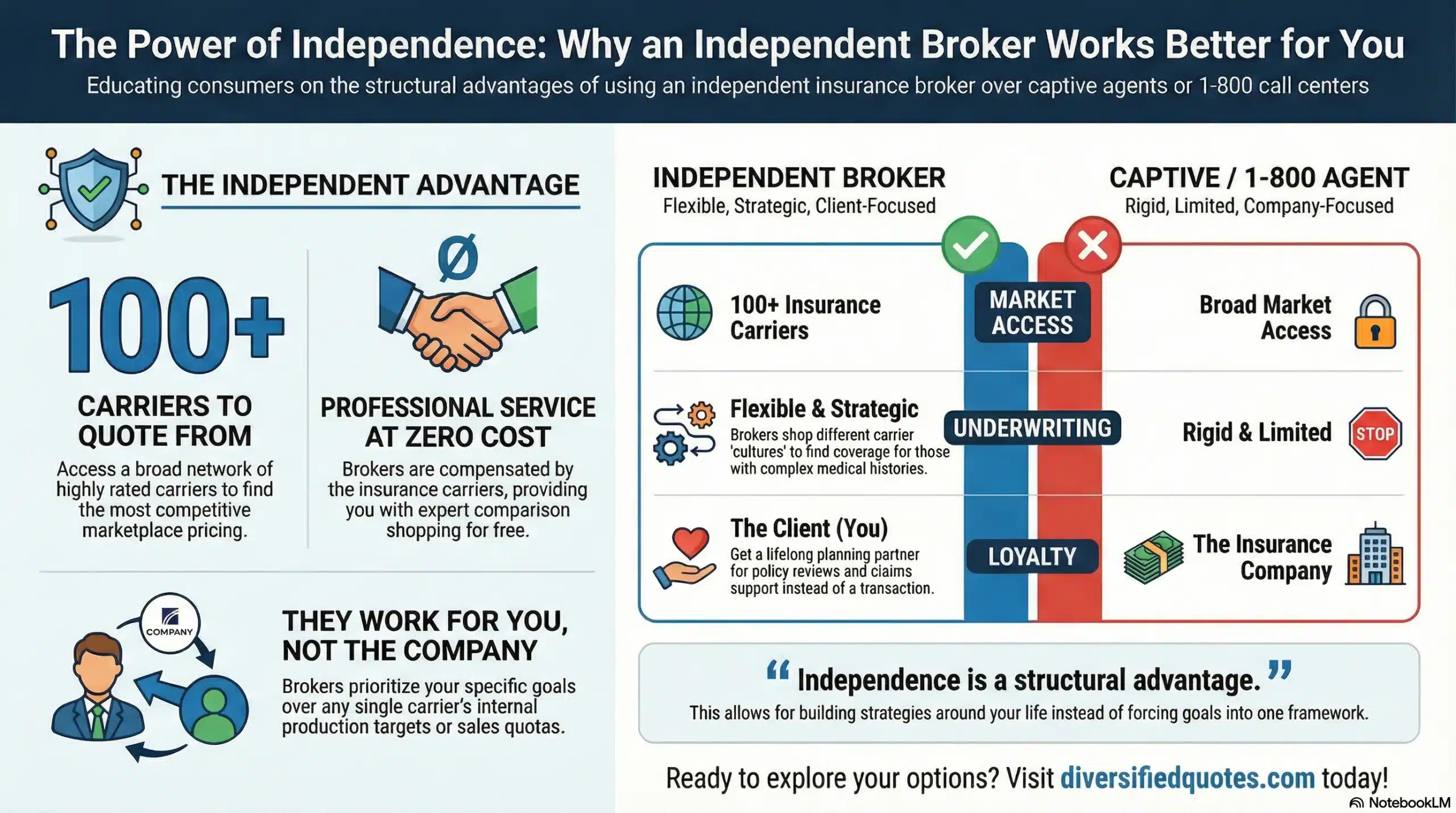
As an Independent Life Insurance Broker, we compare rates across 100+ carriers and prescreen every application before submission.
Group vs Individual Life Insurance

Jason Stolz CLTC, CRPC, DIA, CAA
Most Americans first encounter life insurance through work — a checkbox during open enrollment, one or two times salary, a named beneficiary, and coverage begins without any medical review. For many families, that employer-sponsored benefit is the first and sometimes only life insurance they ever own. The real question is not whether group coverage is useful — it clearly is — but whether it is enough, and whether it is the right foundation for a long-term protection strategy. Understanding group vs. individual life insurance means understanding portability, pricing stability, underwriting flexibility, long-term guarantees, and what actually happens to your family’s protection when careers change, employers change, and employment ends.
At Diversified Insurance Brokers, Jason Stolz, CLTC, CRPC, DIA, CAA helps families compare workplace benefits against individually owned policies from over 100 A-rated carriers — and in most cases, the answer is not choosing one over the other. The optimal strategy for most households is a layered design: keep the free or inexpensive employer base coverage, secure a long-term individual level-term policy sized to the actual financial obligations that need protection, and make the voluntary group buy-up decision based on comparison rather than assumption. Our resource on life insurance laddering guide covers how stacking policies can reduce total cost while covering different financial timelines, and our resource on life insurance services covers the complete individual life insurance landscape that contextualizes the group vs. individual decision.
See Real-Term Rates Side by Side
Life Insurance Quoter
Compare Individual Coverage Against Your Workplace Plan
We’ll compare your workplace coverage to top individual carriers and help you choose the smartest long-term combination — with real pricing before open enrollment closes.
Request a Coverage Review Call 800-533-5969Group Life Insurance vs. Individual Life Insurance — Complete Feature Comparison
The differences between group and individual life insurance are more consequential than most employees realize during open enrollment. The table below maps the most important structural differences side by side — making the tradeoffs concrete rather than abstract.
| Feature | Group Life Insurance (Employer-Sponsored) | Individual Life Insurance (Personally Owned) |
|---|---|---|
| Policy ownership | Employer-owned — the master policy belongs to the employer or plan sponsor; employees participate as certificate holders, not policyholders | You own the policy — the contract is between you and the carrier; coverage is yours regardless of any employment relationship |
| Portability | Coverage typically ends when employment ends — portability or conversion options exist at some employers but usually involve significantly higher cost at attained age | Fully portable — the policy follows you from employer to employer, through layoffs, career pivots, entrepreneurship, and retirement, with no coverage gap and no re-underwriting |
| Premium stability over time | Voluntary buy-up premiums are frequently age-banded — increases every 5 years as the employee ages; rates can rise substantially in the 50s and 60s | Level-term premiums are fixed for the full term period (10, 20, 30 years) — the rate established at purchase never increases regardless of age or health changes |
| Medical underwriting at enrollment | Minimal — base amounts usually guaranteed-issue; higher voluntary buy-up amounts may require health questionnaires; no paramedical exam for most group enrollment | Required for most policies — medical exam or health questionnaire determines rate class; healthy applicants earn the best pricing; accelerated underwriting is available at many carriers |
| Maximum coverage amounts | Typically capped at 3–5× salary or a stated dollar maximum (often $500,000–$1M); high earners and families with large obligations frequently find group coverage structurally insufficient | Limited only by underwriting capacity and insurable interest — $1M, $5M, or more is available depending on income and financial need; sized to actual obligations rather than salary multiples |
| Policy customization and riders | Standardized plan design — limited or no ability to add waiver of premium, accelerated death benefit, conversion, or other riders; plan terms are set by the employer’s contract, not the employee | Fully customizable — riders for waiver of premium, return of premium, accelerated death benefit, children’s term, and others can be added based on specific planning needs and budget |
| Beneficiary flexibility | Beneficiary designation made through HR enrollment process — updates require HR action; language may be simpler and less flexible for complex family situations like blended families or trusts | Full control over beneficiary designations — can name primary and contingent beneficiaries, use per stirpes language, designate trusts, and update at any time directly with the carrier |
| What happens at job separation | Coverage typically terminates at job end; portability election may be available for a limited window at a higher cost; conversion to permanent insurance at attained age — often expensive | No change — policy continues uninterrupted; no portability election required; no premium increase; no new underwriting; coverage simply continues as if nothing changed |
| Long-term cost for healthy, younger applicants | Base coverage may be free or low-cost; voluntary supplemental amounts become increasingly expensive relative to individual term as age-banding adjustments accumulate over a 20–30 year period | Level pricing locked at application age — a 35-year-old buying a 30-year individual term policy pays the same premium at 55 as at 35; cumulative cost advantage grows significantly over multi-decade horizons |
| Best suited for | Base employer coverage: accepting as a free or heavily subsidized benefit. Voluntary buy-up: employees who cannot medically qualify for individual coverage and need additional protection regardless of cost | Anyone who wants portable, price-stable, fully customizable protection that is not contingent on continued employment — which describes the financial protection needs of most working-age adults and families |
The table’s most consequential row for most families is portability — because it reveals that group coverage’s single most dangerous characteristic is its invisibility as a problem. When employment is stable and the coverage is free, nothing appears wrong. The vulnerability only becomes apparent when employment ends, health has changed, and the options available are expensive conversion or no coverage at all. Individual life insurance eliminates that vulnerability entirely: the policy follows the person regardless of where they work, and the underwriting class earned when healthy is preserved for the entire policy term. Our resource on at what age should you stop buying term life insurance covers the related strategic question of how long individual term coverage should be maintained — providing the decision framework that extends from initial purchase through retirement planning.
What Group Life Insurance Is — And What It Actually Provides
Group life insurance is coverage provided through an employer, association, or other organization. The employer negotiates a master policy with a carrier, and employees participate as certificate holders — they receive a certificate of coverage rather than owning the policy directly. The master policy is the contract; individual employees have rights under it, but those rights are defined by the employer’s terms, the plan design, and the applicable carrier’s certificate language.
Base group life coverage — the amount provided at no cost to the employee — is typically set at one times annual salary, though some employers provide more. This base coverage is usually guaranteed-issue, meaning no health information is required to enroll. For employees with health histories that would complicate individual underwriting, this guaranteed-issue access to basic coverage is a genuinely valuable benefit — providing protection that might otherwise be difficult to secure. Our resource on creditable coverage and employer size covers the regulatory framework that governs group insurance benefits — important context for understanding which employers are required to offer group coverage and what rules govern its design.
Voluntary buy-up options — allowing employees to purchase additional multiples of salary coverage — are available at many employers beyond the base benefit. These supplemental amounts are typically age-banded, meaning the premium rate increases at defined intervals (commonly every five years) as the employee moves through age brackets. This age-banding is the mechanism through which voluntary group coverage becomes progressively more expensive relative to individually owned level-term policies as the employee ages. A 35-year-old paying $15 per pay period for voluntary group coverage may find that the same coverage costs $35 per pay period at 50, and $75 or more at 60 — while a 35-year-old who locked in a 30-year individual term policy pays exactly the same premium at 55 and 65 as they did at 35.
What Individual Life Insurance Is — And Why Ownership Matters
Individual life insurance is a contract between the policyholder and the insurance carrier. The policyholder owns the policy, not an employer. That ownership distinction is the foundational advantage of individual coverage: it means the policy follows the person rather than the employment relationship, remains in force regardless of career changes or job separations, and gives the policyholder complete control over coverage amount, term length, riders, and beneficiary designations without routing any of those decisions through an employer’s HR system.
Level-term individual life insurance — the most common individual policy type for income replacement and family protection — locks the premium at the rate established when the policy was issued. A policy purchased at 35 carries the same monthly premium at 45, 55, and 65 as it did at 35. This premium certainty is valuable both as a budgeting tool and as a hedge against future health changes that might otherwise make coverage more expensive or unavailable. Our resource on best term life insurance policy covers the evaluation framework for selecting individual term coverage, and our resource on how much does life insurance cost covers the premium landscape by age and health class — providing the concrete comparison numbers that make the group vs. individual cost analysis real rather than abstract.
The medical underwriting process for individual coverage — which some applicants view as a disadvantage compared to guaranteed-issue group enrollment — is actually the mechanism that produces the level, locked premium that makes individual coverage so valuable over long time horizons. When a carrier evaluates health, age, and lifestyle and establishes a rate class, that rate class is fixed for the policy’s level term period. The healthy 30-year-old who earns a preferred plus rate class locks in the most competitive premium available. Our resource on what is a life insurance exam covers the paramedical examination process that is part of fully underwritten applications — including what is tested, how results affect underwriting, and how accelerated exam-free pathways work at many carriers for qualifying applicants.
Why Group Coverage Is Rarely Sufficient on Its Own
The most persistent misconception about employer life insurance is that “having coverage at work” means adequate life insurance protection. In reality, employer base coverage — typically 1–2× annual salary — is designed as a supplemental benefit, not a complete financial protection plan. A common benchmark for family income protection is 10–15× annual income depending on debts, dependent ages, and future income replacement needs. For a family with a $100,000 household income, a $150,000 employer benefit leaves a gap of $850,000 to $1,250,000 of unmet protection need — and that gap exists while the employee is still employed. At job separation, it disappears entirely.
The practical implication is that group base coverage serves as a useful supplement — a first dollar of protection that comes without premium cost — but it should rarely be the foundation of a family’s life insurance strategy. The foundation should be individually owned coverage sized to actual obligations: the mortgage balance, income replacement for the years until dependents are financially independent, outstanding debts, and future financial goals. Our resource on life insurance for parents with young children covers the coverage sizing framework for families with the highest protection needs — where group coverage’s limitations are most consequential. Our resource on how to protect your mortgage with life insurance covers the mortgage-specific coverage calculation that is one of the most common individual policy objectives.
Portability — The Problem Nobody Notices Until It’s Too Late
The portability problem with group coverage is invisible when employment is stable — and devastating when it isn’t. In a career with one employer from first job to retirement, group coverage can serve adequately alongside a retirement savings strategy that builds sufficient assets to make life insurance unnecessary in the later years. But most working Americans change employers multiple times over their careers, and many face unexpected layoffs, career pivots, or entrepreneurial transitions that end the employment relationship before coverage was ever planned to terminate.
When group coverage ends at job separation, the employee typically has a limited window to elect portability (continuing the group coverage at group rates, which may increase substantially) or conversion (converting to an individual permanent policy at attained age, without new underwriting). The conversion option sounds valuable until the premium quote arrives: a 52-year-old converting $300,000 of group term to individual permanent life insurance at attained age pays premiums reflecting their current age and a product type (permanent) that is inherently more expensive than the level-term alternative they could have locked at 35 when still healthy. The employee who owns an individual policy experiences none of this — their coverage continues at the original premium, unchanged by the job separation, with no election window, no conversion premium, and no new underwriting.
For professionals in career-intensive fields where employer transitions are common — technology, consulting, finance, healthcare — the portability advantage of individual coverage is particularly significant. For business owners and entrepreneurs who have no employer to provide group coverage at all, individual coverage is the only option from the start. Our resource on life insurance for business owners covers the coverage landscape for entrepreneurs, and our resource on key man policy for business covers the business-specific life insurance applications where individual ownership is essential by design.
Beneficiary Designations — The Detail Most Group Enrollees Get Wrong
Group life insurance beneficiary designations are completed during HR onboarding — often during the same week as direct deposit enrollment, health insurance selection, and 401(k) plan paperwork — at a moment when most employees are overwhelmed with administrative tasks and not focused on the nuances of estate planning. The result is beneficiary designations that are frequently incomplete, outdated, or structurally inappropriate for the employee’s actual family situation.
The most common problems are outdated designations following divorce or remarriage, failure to name contingent beneficiaries so that proceeds pass through probate when the primary beneficiary predeceases the insured, and inadequate language for complex family structures like blended families with children from multiple relationships. Individual life insurance policies offer greater flexibility in beneficiary structuring: the policyholder can add contingent beneficiaries, use per stirpes distribution language to ensure proceeds reach intended heirs even if a beneficiary predeceases, and name a trust as beneficiary for more sophisticated estate or special needs planning. Our resource on per stirpes vs. per capita covers the two most common beneficiary distribution structures — explaining in plain language how each affects benefit distribution across family members when death occurs.
Underwriting Access and Health Considerations
Group coverage’s guaranteed-issue access to base amounts is most valuable for employees who have health histories that would produce complicated results in individual underwriting. For a 55-year-old with controlled diabetes, a prior cardiac procedure, and blood pressure medication, guaranteed-issue group coverage provides baseline protection that might otherwise require high table ratings or more restrictive underwriting in the individual market. The convenience of group enrollment without health evaluation is genuinely valuable in these situations — and voluntary group buy-up may be the only cost-effective way to access meaningful additional coverage when health precludes competitive individual underwriting.
For healthy applicants — the majority of working-age adults — individual underwriting is not an obstacle: it is the mechanism that produces the favorable rate class and locked level premium that makes individual coverage so economically advantageous over long time horizons. A 32-year-old non-smoker in good health completing individual term underwriting earns a preferred or preferred plus rate class that locks in competitive pricing for 20 or 30 years. That same 32-year-old’s voluntary group buy-up will cost less today but will increase at every age-band anniversary. For most healthy working-age applicants, the economic argument for individual term over voluntary group buy-up is clear and compelling across multi-decade time horizons. Our resource on life insurance for diabetics with complications covers the individual underwriting framework for applicants whose health history requires strategic carrier selection — relevant context for employees evaluating whether individual underwriting is viable given their specific health profile. Our resource on high-risk life insurance services covers the broader impaired-risk landscape for applicants whose health histories make individual underwriting more complex.
When Group Coverage Genuinely Makes Sense as the Primary Option
Group coverage is the right primary option in specific situations where its structural advantages align with the employee’s needs. Employees who cannot medically qualify for individual coverage at reasonable rates — due to significant health histories that produce high table ratings or declinations in individual underwriting — may find that guaranteed-issue group coverage provides the most accessible baseline protection available to them. For this population, voluntary group buy-up at age-banded rates, despite the cost trajectory, may be preferable to the alternative of no coverage at all or expensive individual alternatives. Temporary workers, contractors, and employees in transitional employment who anticipate joining an employer with group benefits in the near future may find group coverage an appropriate short-term bridge. And employees who are very late in their working career — approaching retirement in the next few years — may find that the group coverage’s simplicity and the absence of new underwriting requirements makes it the most practical option for a short remaining coverage window. Our resource on life insurance alternative options covers structural alternatives that can serve these transitional situations, and our resource on term life insurance calculator provides the premium comparison tool that makes the group vs. individual cost analysis concrete for a specific age and coverage amount.
Designing the Optimal Combination
For most working-age adults, the most effective approach is not choosing between group and individual coverage — it is designing the right combination of both. The framework is simple: keep the free or heavily subsidized employer base coverage as a supplemental first dollar of protection; purchase an individually owned level-term policy sized to the actual financial obligations that need protecting (mortgage balance, income replacement years, dependent support, outstanding debts); and evaluate voluntary group buy-up based on price comparison against individual alternatives rather than defaulting to the employer plan.
This layered strategy produces several advantages simultaneously. The employer base coverage provides zero-cost protection as a supplemental layer without requiring any premium outlay. The individually owned policy provides the primary protection layer with the portability, premium stability, and coverage sizing that group coverage cannot deliver. The combined result is a protection architecture that is more resilient than either option alone — because the individual policy’s portability ensures that family protection survives employment changes, while the group base provides additional coverage at no marginal cost. Our resource on life insurance laddering guide covers how multiple policies can be structured across different time horizons to reduce total premium while covering the full range of financial obligations that require protection at different life stages. Our resource on convert term to permanent life insurance covers the long-term flexibility built into many term policies through conversion provisions — allowing the individual term policy to adapt to changing coverage needs over time without new underwriting. For employees with specialized occupational or industry circumstances — from marijuana industry professionals to those in high-risk occupations — carrier selection for individual coverage matters significantly. Our resource on life insurance for the marijuana industry illustrates how specialized circumstances require targeted carrier approaches that group enrollment cannot provide. For individuals with unique family situations — including special needs dependents — our resource on life insurance for autistic individuals covers coverage planning considerations where individual policy flexibility is particularly valuable. For those who want to explore life insurance for new family members, our resource on life insurance for new parents covers the family formation coverage framework where the group vs. individual decision is most consequential.
Review Your Group Plan Before Open Enrollment Ends
We’ll compare your workplace coverage to top individual carriers and help you choose the smartest long-term combination — with real pricing across 100+ carriers before the enrollment window closes.
Request a Coverage ReviewRelated Planning Resources
Employer coverage regulations, specialized industry and individual coverage guides, and business life insurance resources.
Financial Protection Essentials
Carrier reviews, retirement income planning tools, accidental death coverage, and specialized health and business protection resources.
Talk With an Advisor Today
Choose how you’d like to connect—call or message us, then book a time that works for you.
Schedule here:
calendly.com/jason-dibcompanies/diversified-quotes
Licensed in all 50 states • Fiduciary, family-owned since 1980
FAQs: Group vs. Individual Life Insurance
Is group life insurance enough coverage for most families?
For most families with mortgages, young children, and meaningful income obligations, group life insurance alone is not sufficient. Employer base coverage is typically set at 1–2× annual salary — a $75,000 earner receives $75,000–$150,000 in base coverage. A common benchmark for family income protection is 10–15× income, which for that same earner means $750,000–$1,125,000. The gap between what the employer provides and what the family actually needs is substantial — and that gap exists while the employee is still employed. At job separation, the gap becomes total when group coverage ends entirely. The most effective strategy for most families is treating employer base coverage as a supplemental first dollar of protection and building the primary protection foundation on an individually owned level-term policy sized to actual financial obligations. Our resource on life insurance laddering guide covers how stacking multiple policies across different time horizons can reduce total premium while ensuring the most important obligations are covered throughout the family’s financial lifecycle. For families with young children specifically, our resource on life insurance for parents with young children covers the coverage sizing framework that accounts for mortgage, income replacement years, childcare, and future education costs.
What happens to my group life insurance if I leave my job?
In most cases, group life insurance coverage terminates when employment ends — typically on the last day of the month the employment relationship concludes or on the termination date itself, depending on the plan. Most employers provide a limited portability election window (commonly 31 days) during which the departing employee can elect to continue the group coverage by paying the full premium themselves rather than having the employer subsidize it. Continued group coverage is priced at the applicable group rates — which may be higher than what the employee was paying when the employer was subsidizing — and still carries the age-banding premium increase schedule rather than locking a level rate. Conversion to an individual permanent policy (whole life) is another option at many plans and does not require new medical underwriting, but premiums are based on attained age for a permanent product — often substantially more expensive than the level-term individual policy that could have been locked at a younger age. An employee who owns an individual life insurance policy experiences none of this complexity: coverage continues exactly as before, at the same premium, with no action required and no change in coverage. Our resource on at what age should you stop buying term life insurance covers the long-term strategic framework for managing individual coverage across career and life transitions.
Is individual life insurance cheaper than group life insurance?
The cost comparison is nuanced and depends on age, health, and the time horizon being evaluated. Employer base coverage — the amount provided at no cost to the employee — is not a fair comparison because it involves no employee premium outlay. The meaningful comparison is between voluntary group buy-up coverage and individually owned level-term coverage for the same face amount. At younger ages (20s and 30s) in good health, individual level-term is frequently less expensive than voluntary group buy-up on a long-term basis — because individual term locks a level rate while voluntary group rates increase every 5 years through age-banding. By the time an employee is in their 50s, the age-banded voluntary group premium can be two to four times what the same person would have paid by locking individual term in their 30s. At older ages or with health complications, the calculation can shift: guaranteed-issue group enrollment may be more accessible than individual underwriting at competitive rates. The cost comparison is best done with actual current quotes rather than assumptions — our term life insurance calculator provides the individual term baseline, and the voluntary group premium can typically be found in the employer’s open enrollment materials for direct comparison.
Can I have both group and individual life insurance?
Yes — and for most working-age adults with families and financial obligations, having both is the optimal strategy rather than choosing one over the other. The combination approach works like this: the employer base coverage (free or heavily subsidized) serves as a supplemental first dollar of protection that adds to the total coverage picture at zero or minimal premium cost. An individually owned level-term policy serves as the primary protection foundation — sized to actual financial obligations, portable across employment changes, with locked premiums and full policy ownership. Voluntary group buy-up coverage is evaluated on a case-by-case basis depending on whether its pricing is competitive relative to individual alternatives, the employee’s health profile, and their specific coverage goals. This layered design produces better outcomes than either option alone: the group coverage contributes supplemental protection at low or no cost, while the individual policy provides the portability, pricing stability, and coverage sizing that the group plan cannot deliver. Our resource on life insurance laddering guide covers how multiple policies can be structured across different time horizons as part of a comprehensive layered protection design.
How should I structure my beneficiaries for a group policy?
Group life insurance beneficiary designations deserve more careful attention than they typically receive during HR onboarding. The most common mistakes are naming a spouse as sole beneficiary without naming a contingent beneficiary — so that proceeds pass through probate if both spouses die in the same event — and failing to update beneficiary designations after divorce, remarriage, or the birth of additional children. For employees with blended families or multiple children from different relationships, the specific beneficiary language matters significantly: naming “my children equally” without per stirpes language may produce unintended results if one of the named children predeceases the insured. Individual policies offer more flexibility in beneficiary structuring than most group enrollment forms — you can add contingent beneficiaries, specify per stirpes distribution, and name trusts as beneficiaries for more sophisticated planning situations. Our resource on per stirpes vs. per capita explains the two most common beneficiary distribution structures in plain language — covering how each affects the distribution of proceeds across family members and descendants when primary beneficiaries predecease the insured. Reviewing and updating beneficiary designations on both group and individual policies at each major life event (marriage, divorce, birth, adoption) is one of the most important and most commonly neglected elements of life insurance maintenance.
What are the main advantages of individual life insurance over group coverage?
The four most consequential advantages of individual life insurance over group coverage are portability, premium stability, coverage sizing, and policy control. Portability means the policy follows the person rather than the employment relationship — no coverage gap at job transitions, no portability election required, no conversion decision at an inconvenient time. Premium stability means the rate established at application remains fixed for the entire level-term period — a 30-year term policy purchased at 35 carries the same monthly premium at 55 as at 35, while voluntary group buy-up rates increase through age-banding at every 5-year anniversary. Coverage sizing means the face amount is based on actual financial obligations — mortgage, income replacement, dependents’ needs — rather than arbitrary salary multiples that may leave meaningful gaps in family protection. And policy control means the policyholder makes all decisions directly with the carrier: coverage amounts, term lengths, riders, and beneficiary designations without routing any of those decisions through an employer’s benefits administration system. For healthy applicants in their 30s and 40s who are considering individual coverage, our resource on best term life insurance policy covers the evaluation framework for selecting among individual term options, and our resource on how much does life insurance cost provides premium context across ages and health classes.
When does group life insurance make more sense than individual coverage?
Group life insurance provides the most relative advantage over individual coverage in specific circumstances. The guaranteed-issue access of group enrollment is most valuable for employees who have significant health histories that would produce table ratings, flat extras, or declinations in individual underwriting — providing baseline protection that is more accessible than what the individual market offers at competitive rates. Employees who are near retirement and need coverage for a short remaining window may find that group coverage’s simplicity and the absence of new underwriting requirements make it the most practical option for their specific timeline. Employees whose employer provides a substantial employer-paid base benefit — multiple times salary at no premium cost — should absolutely retain that benefit as a supplemental layer regardless of what individual coverage they also own. And in situations where an employee genuinely needs to bridge a temporary period between individual policies, group coverage may serve that transitional purpose. Our resource on life insurance for diabetics with complications illustrates a case where individual underwriting requires more careful management — where group guaranteed-issue access may provide coverage that individual underwriting cannot match at competitive rates for a specific profile. Our resource on high-risk life insurance covers the complete impaired-risk underwriting landscape for applicants evaluating individual options given complex health histories.
About the Author:
Jason Stolz, CLTC, CRPC, DIA, CAA and Chief Underwriter at Diversified Insurance Brokers (NPN 20471358), is a senior insurance and retirement professional with more than 25 years of real-world experience helping individuals, families, and business owners protect their income, assets, and long-term financial stability. As a long-time partner of the nationally licensed independent agency Diversified Insurance Brokers, Jason provides trusted guidance across multiple specialties—including fixed and indexed annuities, long-term care planning, personal and business disability insurance, life insurance solutions, Group Health, Travel Medical and Evacuation Insurance, and short-term health coverage. Diversified Insurance Brokers maintains active contracts with over 100 highly rated insurance carriers, ensuring clients have access to a broad and competitive marketplace.
His practical, education-first approach has earned recognition in publications such as VoyageATL, and contributions from his agency featured in Kiplinger and GoBankingRates— highlighting his commitment to financial clarity and client-focused planning. Drawing on deep product knowledge and years of hands-on field experience, Jason helps clients evaluate carriers, compare strategies, and build retirement and protection plans that are both secure and cost-efficient. Visitors who want to explore current annuity rates and compare options across multiple insurers can also use this annuity quote and comparison tool.
Explore More Life Insurance Options: Browse our complete guide to Business Life Insurance — covering buy-sell agreements, key person, contract indemnity & group life from 100+ carriers.
Last Reviewed: May 27, 2026 |
Reviewed by: Jason Stolz, CLTC, CRPC, DIA, CAA
Chief Underwriter, Diversified Insurance Brokers, Inc. | NPN: 20471358 | Diversified Insurance Brokers, Inc. — Licensed in all 50 states
Fact Checked by: Tonia Pettitt, CMIP©
Medicare Specialist, Diversified Insurance Brokers, Inc. | NPN: 14374308 | Diversified Insurance Brokers, Inc. — Licensed in all 50 states
Did you find this content helpful? Leave us a Google review — it helps others find trustworthy guidance too.
Editorial Standards: Diversified Insurance Brokers maintains rigorous editorial standards to ensure accuracy, clarity, and independence in all content. Learn more about our editorial standards and commitment to transparency.
