
Group Health Insurance for Physician Practices
As an Independent Group Health Insurance Broker, we compare fully insured, level-funded, and self-funded options across carriers to find the lowest cost coverage for your business.
Group Health Insurance for Physician Practices

Jason Stolz CLTC, CRPC, DIA, CAA
Group Health Insurance for Physician Practices — Why Level-Funded Plans Are the Right Starting Point for Most Medical Groups
Physician practices face a health insurance cost problem that is structurally different from most small businesses, and it requires a structurally different solution. The workforce is highly compensated, clinically sophisticated, and capable of evaluating benefit quality in detail — which means a weak plan is noticed immediately and discussed openly. The practice operates under reimbursement pressure that makes benefit cost inflation directly damaging to physician compensation and practice investment capacity. And the practice’s claims experience — driven by the health of physicians, advanced practice providers, clinical and administrative staff and their families — is specific, real, and knowable, yet traditional fully insured plans price physician groups based on broad community-rated or small-group market pools that may bear no resemblance to what the practice’s own workforce actually costs to insure. Level-funded health insurance is the structure that corrects this mismatch. A level-funded plan prices the physician practice on its own claims experience rather than on someone else’s pool, returns surplus when the group’s actual claims are lower than projected, and provides the transparency and data that allow the practice to manage health plan costs as a business function rather than absorb them as an uncontrollable overhead item. At Diversified Insurance Brokers, Jason Stolz, CLTC, CRPC, DIA, CAA works with physician practices, medical groups, and specialty clinics to evaluate group health plan structures across more than 100 carriers — with level-funded plans as the primary recommendation for most physician practices that have sufficient group size and stable enough workforce demographics to benefit from experience-rated pricing. Fully insured plans remain appropriate as a bridge for newer practices, practices with adverse recent claims experience, or practices whose group composition makes community-rated pricing favorable — but they are the fallback, not the primary strategy, for a medical group that intends to manage its benefit costs intelligently over the long term. Why group level funding works and how it differs structurally from both traditional fully insured and large-group self-funded arrangements is the foundational explanation for why this plan type consistently produces better outcomes for employer groups whose claims experience is better than the pool average.
What Level-Funded Plans Do That Fully Insured Plans Cannot
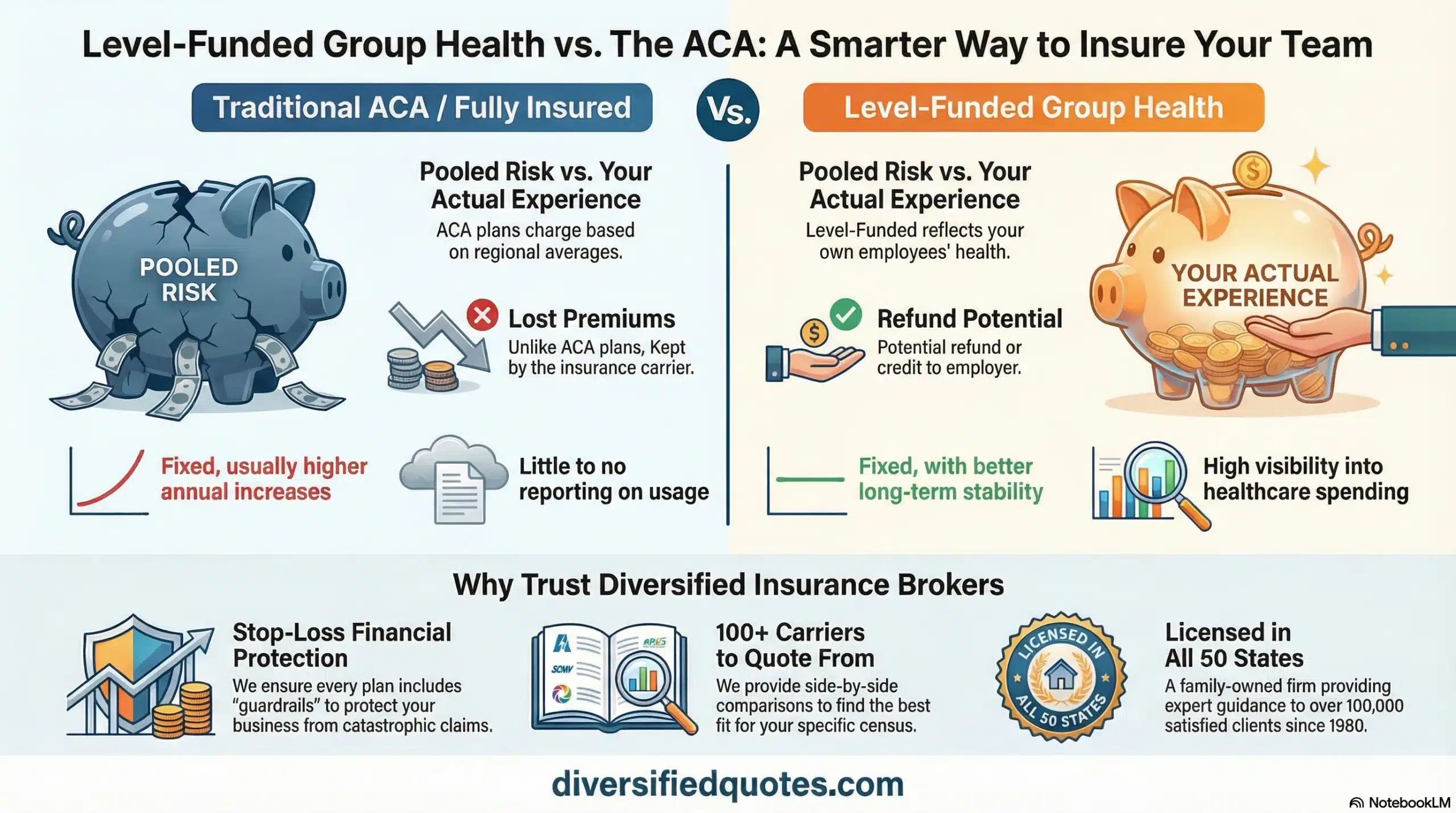
A level-funded health plan has three components that fully insured plans do not offer in combination: a fixed monthly payment from the employer, a claims fund that pays actual employee claims up to an individual and aggregate stop-loss limit, and a year-end refund mechanism that returns surplus to the employer when actual claims come in below the projected amount funded during the plan year. The monthly payment is predictable — giving the practice the same budget-ability as a traditional fully insured premium — but the underlying economics are fundamentally different. In a fully insured plan, every dollar of premium that is not spent on claims becomes the carrier’s profit. In a level-funded plan, every dollar of the claims fund that is not spent on claims returns to the employer at year end. For a physician practice with a reasonably healthy workforce, this refund mechanism alone can represent a material annual cost reduction that the fully insured model structurally prevents. Stop-loss insurance — both individual stop-loss, which caps the plan’s liability on any single member’s claims, and aggregate stop-loss, which caps the plan’s total claims exposure for the year — protects the practice from catastrophic single-claim events that would otherwise eliminate the cost advantage of experience-based pricing. How stop-loss insurance works within level-funded plans — the attachment points, the aggregate cap mechanics, and how carriers price both individual and aggregate coverage — is the risk management layer that makes level-funded economically viable for groups that would otherwise be exposed to open-ended claims liability. The tax benefits of level-funded health insurance — including the treatment of claims fund contributions, stop-loss premiums, and surplus refunds under applicable tax frameworks — add an additional financial advantage that reduces the effective cost of the plan beyond what the claims economics alone would produce.
Request a Level-Funded Plan Review for Your Physician Practice
We compare level-funded designs alongside fully insured options across 100+ carriers — showing the cost mechanics, stop-loss structure, surplus refund terms, and network access side by side so your practice can make an informed decision at renewal.
Plan Structure Comparison — Fully Insured vs. Level-Funded for Physician Practices
| Planning Dimension | Fully Insured | Level-Funded (Recommended) |
|---|---|---|
| Cost basis | Priced on community-rated or small-group pooled factors; the practice’s actual claims experience does not directly influence the premium in the first years; practices with healthy workforces subsidize higher-cost groups in the same pool | Priced on the practice’s own claims experience; a healthy workforce produces lower cost-per-employee and generates surplus refunds at year end; the practice pays for its own experience rather than the pool’s average |
| Renewal mechanics | Carrier proposes renewal rates based on broad market trend factors; the practice has limited negotiating leverage because the carrier does not share granular claims data; renewal increases of 8–15% in elevated cost environments are common with limited ability to challenge them | Renewal is driven by the practice’s own claims data, which the employer receives in detail throughout the year; the practice can identify the specific cost drivers — high-cost claimants, pharmacy trends, utilization patterns — and make plan design adjustments to address them before renewal; the employer has real data to negotiate with |
| Surplus and risk | All premium paid to the carrier regardless of actual claims; if the group’s claims are low, the surplus belongs to the carrier; if claims are high, the carrier absorbs the excess — but the employer pays market-rate premium regardless of experience | Surplus in the claims fund at year end returns to the employer; stop-loss insurance caps the practice’s claims exposure so that high-claims years do not produce open-ended liability; the employer captures the upside of good experience while the stop-loss protects against the downside |
| Reporting and transparency | Most small-group fully insured plans provide limited or no claims data reporting; the employer has no visibility into what specific conditions, services, or utilization patterns are driving cost; plan management is reactive rather than proactive | Regular claims reporting — typically monthly — shows the employer actual utilization data, cost drivers, and remaining claims fund balance; this transparency enables proactive cost management, targeted wellness initiatives, and data-informed plan design decisions at renewal |
| Best fit | Appropriate as a bridge for new practices without claims history, practices in a year of adverse claims that would price them out of level-funded underwriting favorably, or very small groups where community-rated pricing is competitive relative to the available level-funded options | The primary recommendation for most physician practices with a stable workforce and reasonably predictable utilization; produces better long-term cost outcomes for groups whose claims are at or below the average for their demographic profile, which describes the majority of organized medical practices |
The comparison makes the financial logic of level-funded plans clear for physician practices: fully insured is the right choice for groups that need protection from adverse experience pricing, and level-funded is the right choice for groups that can benefit from their own good experience. Most physician practices — with educated, health-conscious employees who have access to healthcare and tend to use it appropriately — have workforces that perform better than the broad market pool, which means they are structurally subsidizing other employers in a fully insured arrangement rather than benefiting from their own favorable experience. How to choose the right group health plan for a medical practice requires exactly this analysis — identifying whether the practice’s workforce demographics and utilization profile favor experience-based pricing or community-rated pooling, then selecting the structure accordingly. How to get the best group health insurance rates across plan types and carriers is the market-competitive analysis that confirms the chosen structure is priced as favorably as the available market allows.
Physician Practice Size and the Level-Funded Entry Point
One of the most common misconceptions physician practices carry into benefit planning discussions is that level-funded plans require a large group size to access. The level-funded market has expanded dramatically in recent years and now serves groups starting at two to three enrolled employees in some carrier designs, with the most competitive and flexible level-funded options generally becoming available at five to ten enrolled lives. For a solo physician practice with even a modest clinical and administrative staff, level-funded enrollment is almost certainly accessible — and the question is not whether the practice qualifies but which carrier’s level-funded product best matches the group’s demographics, network requirements, and benefit design priorities. Group health insurance for 20-employee practices — a common size for a small single-specialty or two-physician group — represents a group that is well within the level-funded market’s sweet spot: large enough to generate meaningful claims data, small enough that a good claims year produces a surplus refund that is materially beneficial relative to premium paid. Practices at 30 employees have additional carrier options and may access more favorable aggregate stop-loss attachment points that reduce the risk corridor and make level-funded pricing even more competitive. Larger physician groups at 100 employees or more are typically evaluating level-funded alongside partially self-funded options with custom plan design and direct primary care carve-outs that provide additional cost management tools beyond what the standard level-funded market offers. The minimum employee count for group health insurance — how carriers define eligibility for group coverage and the specific enrollment thresholds that affect plan type availability — establishes the baseline for any physician practice evaluating whether they can access the group health market at their current size.
The Physician Practice Benefit Ecosystem — Group Health Is One Component of a Complete Package
For most physician practices, group health insurance is the most visible and highest-cost employee benefit — but it is one component of a complete benefit and protection package that also includes disability income protection, life insurance, and in many cases business continuation planning for the physician-owners themselves. The most common planning gap in physician practice benefit structures is an inadequate disability income protection program. The physician’s clinical income is both the practice’s revenue driver and the household’s primary financial resource — and the group long-term disability benefit that most fully insured plans provide as a standard inclusion is typically a fraction of what a physician’s actual income replacement need requires. Disability income insurance for doctors and physicians — including own-occupation definitions, benefit period structures, and the specific policy features that matter for medical professionals — is the protection planning dimension that group health discussions frequently fail to address adequately, and that physician-owners specifically cannot afford to underplan. Disability insurance for high earners and business owners covers the complete protection landscape for physicians who are simultaneously the practice’s key employee and an equity owner whose disability would create both personal income loss and business continuity risk. Key person life insurance for physician-owners — where the practice owns the policy and receives the death benefit to fund business continuity, hire replacement coverage, or service debt — addresses the business risk dimension that physician death creates alongside the personal life insurance need. Buy-sell life insurance funds the ownership transition agreement between physician partners — ensuring that a partner’s death does not force the surviving partners into an ownership dispute with the deceased’s estate or into a distressed sale of the practice to fund a buyout. Section 162 executive bonus plans using employer-paid life insurance premiums provide a deductible compensation tool that physician practices can use to provide highly compensated physicians and advanced practice providers with individually owned, portable life insurance as a benefit enhancement that the standard group life plan cannot replicate. Group life insurance for physician practice employees — the basic employer-paid and voluntary supplemental life coverage that rounds out the core benefit package — should be evaluated for its portability provisions and coverage adequacy alongside the health and disability components rather than treated as a checkbox item.
1099 Contractors, Employed Physicians, and Benefit Eligibility
Physician practices frequently operate with a mix of W-2 employed staff and 1099 independent contractor arrangements — particularly for part-time or per-diem physicians, locum tenens coverage, and specialist arrangements. The eligibility rules for group health insurance under ACA and state regulations distinguish between employees and independent contractors in ways that affect who can be included in the group plan and how participation requirements are calculated. Whether 1099 contractors can access group level-funded coverage — and how practices structure the group to include or exclude contractor arrangements depending on the practice’s relationship with those workers — is a compliance and eligibility question that affects both the group’s composition and the carriers available for level-funded underwriting. How consulting firms structure group health for mixed employee and contractor workforces provides a relevant parallel for physician practices navigating similar eligibility questions. Accounting firm group health structures illustrate another professional services employer navigating comparable employee classification and benefit design challenges. Private school group health insurance is a useful comparison for practices evaluating level-funded options in markets where the eligible group includes a mix of highly compensated professionals and lower-wage support staff — a demographic distribution common in physician practices. How to set up group health insurance for employees — including the legal requirements, carrier application process, and implementation timeline for a new or renewing group plan — establishes the practical mechanics for practices implementing a level-funded plan for the first time. Working with an independent group health broker — rather than a captive agent representing a single carrier’s products — is the distribution approach that gives physician practices access to the full competitive market rather than the single-carrier menu that a direct enrollment relationship provides. Group health for volunteer-heavy organizations and construction crew group health illustrate how group health plan design adapts to non-standard workforce compositions — context relevant for practices with unusual staffing structures. Group health insurance cost for small businesses — how premiums are calculated, what factors affect the employer’s cost per covered life, and what the employer contribution requirements look like across plan types — establishes the cost comparison baseline for evaluating fully insured versus level-funded pricing in the physician practice context.
Compare Level-Funded and Fully Insured Plans for Your Practice
We build a side-by-side comparison of your current plan against level-funded alternatives — showing the cost mechanics, stop-loss protection, surplus refund potential, and claims transparency that most physician practices are not getting from their current carrier relationship.
Talk With an Advisor Today
Choose how you’d like to connect—call or message us, then book a time that works for you.
Schedule here:
calendly.com/jason-dibcompanies/diversified-quotes
Licensed in all 50 states • Fiduciary, family-owned since 1980
FAQs: Group Health Insurance for Physician Practices
Why do physician practices pay more for fully insured group health than they should?
Traditional fully insured small-group plans price physician practices based on community-rated or market-pool factors that average the claims experience of many different employer groups together. A physician practice with a relatively healthy, health-literate workforce that uses medical services appropriately is priced the same as an employer group with significantly higher utilization — the practice’s good experience provides no premium benefit because the premium is driven by the pool, not by the practice’s own claims. In a fully insured arrangement, the carrier captures all the premium surplus when the group has a good claims year, and the employer absorbs the market-trend renewal increase regardless of the practice’s actual claims performance. For most physician practices, this means they are paying for someone else’s higher utilization while receiving no credit for their own lower costs.
Level-funded plans correct this by pricing the group on its own experience, returning surplus claims fund balances at year end, and providing the claims data that allows the practice to understand and manage its own cost drivers. A physician practice with genuinely favorable claims history — physicians who get regular checkups, employees who navigate the healthcare system efficiently, and a workforce without disproportionate catastrophic claims — produces real savings under a level-funded structure that the fully insured model prevents them from accessing. The shift to level-funded is not about accepting more risk — it is about capturing the benefit of good risk that the fully insured model currently redirects to the carrier.
What size physician practice qualifies for a level-funded plan?
The level-funded market has expanded significantly in recent years and now serves groups starting at two to three enrolled employees with some carriers, though the most competitive and flexible level-funded options generally become available at five to ten enrolled lives. A solo physician with two to four employed staff members and full-time equivalent coverage can often access level-funded options. A practice with ten to twenty employees is firmly within the level-funded market’s core underwriting window, where multiple carriers compete and the employer has meaningful selection among plan designs, network options, and stop-loss structures. Practices at 30 to 50 employees typically have additional carrier options and may access aggregate stop-loss attachment points that reduce the risk corridor meaningfully relative to smaller groups.
The more important eligibility factors beyond headcount are enrollment participation — most level-funded carriers require a defined percentage of eligible employees to enroll in the plan — and the absence of extremely adverse recent claims history that would make the group uninsurable under experience-rated underwriting. For a physician practice that has been on a fully insured plan and is evaluating a transition to level-funded, the underwriting process involves reviewing the prior year’s claims experience under the current carrier. If that history is favorable, the level-funded quote will reflect it. If the group has had a challenging claims year, a one-year bridge on fully insured may be the right path to allow the claims history to normalize before transitioning to experience-based pricing. Jason Stolz evaluates both scenarios as part of the initial group health review, confirming which structure is financially advantageous for the practice at its current claims history point.
What is stop-loss insurance and does it adequately protect the practice?
Stop-loss insurance is the risk protection component of a level-funded plan that prevents the practice’s claims exposure from becoming open-ended. It operates in two forms. Individual stop-loss — also called specific stop-loss — caps the plan’s liability on any single member’s claims at a defined attachment point, typically set between $20,000 and $50,000 per individual per plan year depending on the group size and carrier design. Once a single member’s claims exceed that attachment point, the stop-loss carrier pays all additional claims for that member for the remainder of the plan year. Aggregate stop-loss caps the plan’s total claims liability for all members combined at a percentage of the projected annual claims, typically 125% of projected claims. If total claims for the year exceed the aggregate attachment point, the stop-loss carrier covers the excess.
Together, the individual and aggregate stop-loss protections define the worst-case financial exposure the practice faces in a bad claims year. For most physician practices on properly structured level-funded plans, the combination of the fixed monthly payment structure and stop-loss protection produces a maximum annual cost that is known at the time of plan selection — and that maximum is typically competitive with or below what the practice would pay on a fully insured plan at renewal. The stop-loss premium is a component of the monthly level-funded payment rather than a separate cost, so the practice sees a single predictable monthly number rather than an unbundled set of insurance components. The attachment points selected at plan inception are critical to this protection — too high an individual attachment point leaves meaningful claims exposure uncovered, while too low an attachment point increases stop-loss premium cost unnecessarily. Proper sizing requires reviewing the group’s claims history and demographic profile before selecting the attachment points rather than accepting a carrier’s default offering.
Will a level-funded plan affect our network or benefit quality?
Network and benefit quality in a level-funded plan are determined by the carrier’s provider network and plan design — not by the funding structure itself. Most level-funded plans use the same carrier networks as that carrier’s fully insured products, meaning the physician practice’s employees have access to the same hospitals, specialists, and primary care providers they would have on a comparable fully insured plan from the same carrier. The funding structure change — from fully insured to level-funded — does not require employees to change providers, change how they access care, or accept reduced benefit coverage in any area. From the employee’s perspective, the plan typically looks and functions identically to a fully insured plan in terms of deductibles, copays, out-of-pocket maximums, and network access.
For physician practices specifically, provider network quality matters enormously — both because physicians themselves have strong preferences about network access and because administrative staff in a medical setting understand plan quality in detail. Presenting a level-funded transition to employees and physician staff as a cost-management move that preserves or improves benefit quality requires confirming in advance that the level-funded carrier’s network includes the specific providers, hospitals, and specialist groups the workforce uses regularly. This verification is part of the plan comparison process at Diversified Insurance Brokers — confirming network equivalence alongside cost mechanics before recommending a transition ensures that the financial benefit does not come at the cost of the clinical access the practice’s employees and physician-owners need.
How does group health insurance for physician-owners differ from coverage for employed staff?
Physician-owners — whether structured as S-corporation shareholders, partnership members, or sole proprietors — face different tax treatment for health insurance premiums than W-2 employed staff. S-corporation shareholders who own more than 2% of the company cannot participate in a pre-tax Section 125 cafeteria plan for the owner’s health insurance premium; instead, premiums paid by the S-corp for the owner’s health insurance are included in the owner’s W-2 wages and then deducted above-the-line on the owner’s personal income tax return. This differs from the FICA-exempt treatment that W-2 employees receive for pre-tax premium contributions through a cafeteria plan. For partnership and sole proprietor structures, health insurance premiums are also deducted above-the-line rather than through the business as a pre-tax employee benefit.
These ownership structure nuances affect the total cost comparison between group coverage and individual market coverage for physician-owners specifically. A physician-owner who understands the tax treatment of their group plan premium can make a more accurate cost comparison than one who assumes the premium is a straightforward business expense. For practices evaluating plan design at renewal, confirming that the plan structure accommodates the different tax treatment for owners versus employed staff — and that the plan’s premium allocation is correctly structured for each participant class — is part of the compliance review that prevents downstream tax errors. These decisions require coordination with the practice’s tax advisor, and Diversified Insurance Brokers positions the group health analysis alongside that professional guidance rather than attempting to substitute for it.
When should a physician practice stay on a fully insured plan instead of moving to level-funded?
There are three primary scenarios where staying on a fully insured plan — or using it as a bridge — is the more defensible financial choice compared to transitioning to level-funded. The first is a group with adverse recent claims history: if the practice has experienced one or more high-cost catastrophic claims in the prior plan year — a major surgery, a cancer diagnosis, a NICU admission, or another event that drove claims significantly above the projected level — level-funded underwriting may reflect that history with unfavorable stop-loss pricing or exclusions that reduce the appeal of the experience-rated approach. In this case, a fully insured renewal that pools the practice with a broader community may produce lower cost despite the lack of transparency. A one-year fully insured bridge while claims history normalizes is often the right tactical choice before transitioning to level-funded.
The second scenario is a very small group — typically two to four eligible lives — where the statistical volatility of a single high-cost claim relative to the total group size makes the aggregate stop-loss attachment point unpredictable enough that the risk corridor is less comfortable than community-rated pricing. The third scenario is a practice whose community-rated or ACA small-group market premium is genuinely competitive due to favorable geographic rating area, age composition, or other local market factors that make level-funded pricing less distinctive. This is relatively rare but does occur in markets with unusual carrier competition or specific demographic profiles. In each of these scenarios, Diversified Insurance Brokers identifies the fully insured option as the right choice for the current plan year while designing the renewal strategy to position the practice for level-funded at the appropriate future point.
About the Author:
Jason Stolz, CLTC, CRPC, DIA, CAA and Chief Underwriter at Diversified Insurance Brokers (NPN 20471358), is a senior insurance and retirement professional with more than 25 years of real-world experience helping individuals, families, and business owners protect their income, assets, and long-term financial stability. As a long-time partner of the nationally licensed independent agency Diversified Insurance Brokers, Jason provides trusted guidance across multiple specialties—including fixed and indexed annuities, long-term care planning, personal and business disability insurance, life insurance solutions, Group Health, Travel Medical and Evacuation Insurance, and short-term health coverage. Diversified Insurance Brokers maintains active contracts with over 100 highly rated insurance carriers, ensuring clients have access to a broad and competitive marketplace.
His practical, education-first approach has earned recognition in publications such as VoyageATL, and contributions from his agency featured in Kiplinger and GoBankingRates— highlighting his commitment to financial clarity and client-focused planning. Drawing on deep product knowledge and years of hands-on field experience, Jason helps clients evaluate carriers, compare strategies, and build retirement and protection plans that are both secure and cost-efficient. Visitors who want to explore current annuity rates and compare options across multiple insurers can also use this annuity quote and comparison tool.
Explore More Group Health Insurance Options: Browse our complete guide to Group Health Insurance by Industry — covering law firms, consulting, construction, medical practices, schools & more from 100+ carriers.
Last Reviewed: June 9, 2026 |
Reviewed by: Jason Stolz, CLTC, CRPC, DIA, CAA
Chief Underwriter, Diversified Insurance Brokers, Inc. | NPN: 20471358 | Diversified Insurance Brokers, Inc. — Licensed in all 50 states
Fact Checked by: Tonia Pettitt, CMIP©
Medicare Specialist, Diversified Insurance Brokers, Inc. | NPN: 14374308 | Diversified Insurance Brokers, Inc. — Licensed in all 50 states
Did you find this content helpful? Leave us a Google review — it helps others find trustworthy guidance too.
Editorial Standards: Diversified Insurance Brokers maintains rigorous editorial standards to ensure accuracy, clarity, and independence in all content. Learn more about our editorial standards and commitment to transparency.
