
Group Health Insurance for 10 Employees
Group Health Insurance for 10 Employees

Jason Stolz CLTC, CRPC, DIA, CAA
Group health insurance for 10 employees is often the point where healthcare costs become a genuine financial planning decision rather than simply a benefit line item. At this size, the monthly premium commitment becomes large enough to influence hiring capacity, cash flow, and the business owner’s own compensation — but the group is still small enough that a single high-cost claim can materially affect renewal pricing in a fully insured environment. The decisions made at 10 employees about funding structure, plan design, and contribution strategy frequently determine whether healthcare costs remain manageable as the business grows or compound into a renewal problem that becomes harder to solve each year. At Diversified Insurance Brokers, we help 10-employee organizations evaluate both traditional and alternative funding options, compare carriers and plan designs side by side, and build group health strategies structured around long-term cost predictability rather than simply the lowest current premium. Our resource on the group health insurance cost for small business provides the broader cost framework that applies at this size.
Group Health Review for 10 Employees
We review your current plan and show cost-control strategies without sacrificing coverage quality. Compare fully insured and level-funded options side by side.
Request a Group Health ReviewWhy Group Health Costs Often Become a Problem at 10 Employees
Most businesses at exactly 10 employees are placed into traditional fully insured small-group health plans almost automatically — it is what brokers who work with a single carrier tend to default to, it is what SHOP marketplace options produce, and it is what most business owners assume is the only available structure. Fully insured plans are genuinely simple to administer: the employer pays a fixed monthly premium, the carrier assumes the claims risk, and the employer receives no claims data or financial visibility into what drives the cost. That simplicity is useful, but the pricing methodology behind it creates a structural problem that compounds over time.
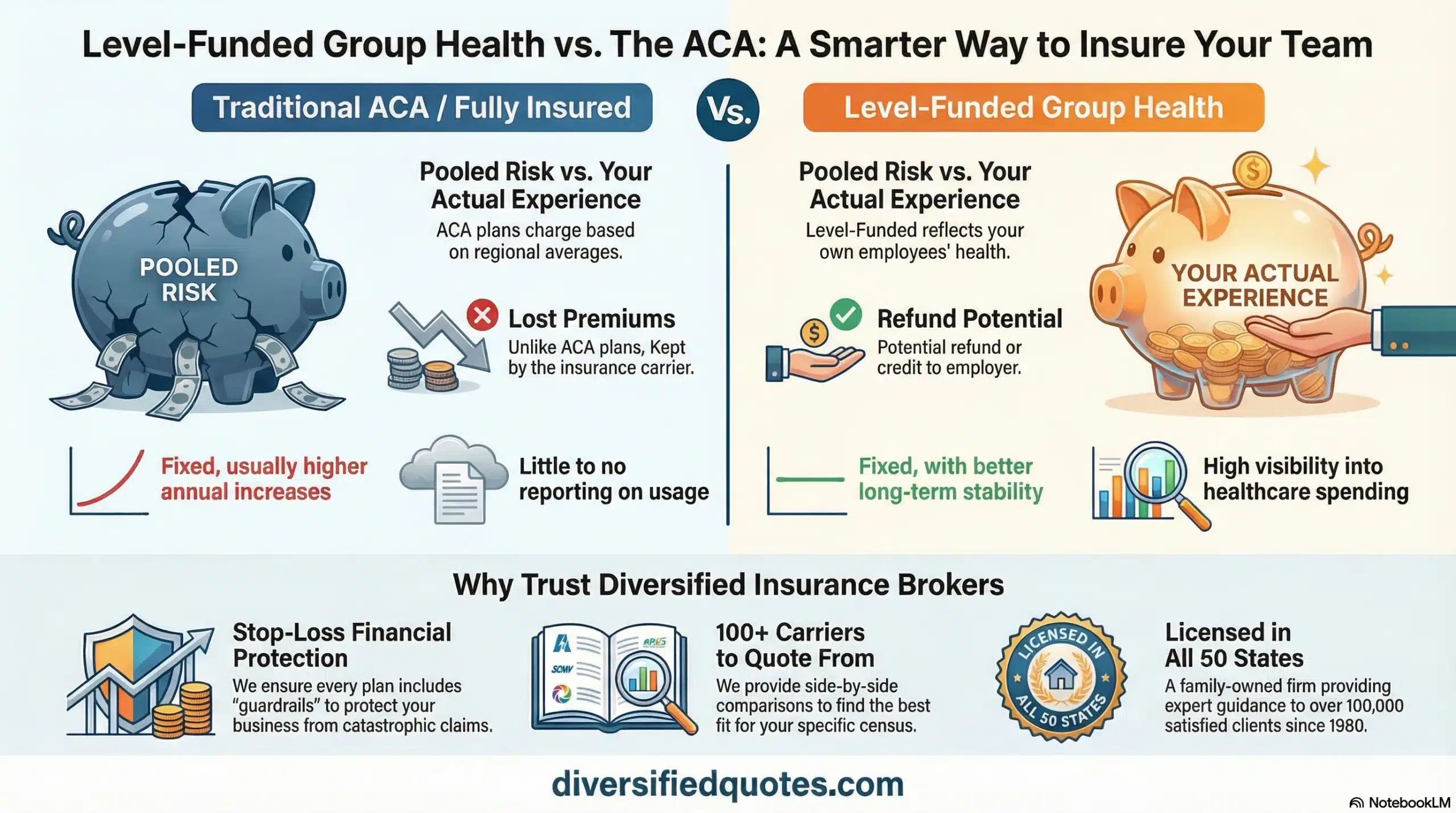
Fully insured premiums for small groups are built using conservative market-pooled pricing assumptions designed to protect the carrier against the unpredictable claims exposure across thousands of small groups. This means even if every employee in a 10-person business is healthy and collectively has a low-utilization year, the renewal pricing still largely reflects broad market trend assumptions rather than the specific group’s performance. A group that paid $500 per employee per month and generated $3,000 in total claims for the year may receive a 12 percent renewal increase despite that favorable experience — because the carrier’s pricing model is not designed to pass those savings back to individual small groups. Understanding this dynamic — why group medical insurance pricing models work the way they do for small employers — is the foundation for evaluating whether alternatives make sense for a specific 10-employee group.
Funding Options Available for 10-Employee Groups
The landscape for group health insurance at 10 employees has expanded significantly over the past decade. While fully insured coverage remains common and appropriate for some groups, level-funded arrangements are now available to many 10-employee groups that would previously have been locked into the fully insured small-group market. Understanding how each structure works — and which fits a specific group’s health profile and risk tolerance — is the core of a sound group health strategy at this size.
Group Health Funding Structures for 10-Employee Organizations
| Funding Structure | How Premium Is Set | Claims Risk | Refund If Claims Run Low | Best Fit at 10 Employees |
|---|---|---|---|---|
| Fully Insured | Fixed monthly premium; community rating + demographics; no group-specific claims experience used | Carrier assumes all claims risk | No refund; carrier retains surplus | Preferred simplicity; older/higher-risk workforce; first group plan; limited admin resources |
| Level Funded | Fixed monthly payment covering expected claims + admin + stop-loss insurance | Employer funds expected claims; stop-loss caps excess exposure | Yes — unused claims fund may be returned at year-end per contract terms | Healthy workforce; cost transparency desired; want refund potential; growth-oriented business |
| Partially Self-Funded | Variable; employer funds claims as they occur with individual and aggregate stop-loss protection | Employer retains meaningful claims risk within stop-loss boundaries | Savings through lower overall claims spending; no separate surplus return mechanism | More typically appropriate at 25+ employees; some 10-person groups with favorable stop-loss terms and appropriate cash reserves |
Fully Insured Coverage at 10 Employees: When It Makes Sense
Fully insured coverage at 10 employees is the right answer in several specific situations, and recognizing those situations honestly prevents the error of pursuing an alternative funding structure when it is not actually the best fit. The clearest case for fully insured coverage is a group with significant health complexity — employees or dependents with ongoing high-cost chronic conditions, recent large claims, or age distribution concentrated in the upper range of the rating band. For groups in this profile, the conservative pricing of fully insured coverage is actually the protection mechanism: the carrier assumes the risk, and the employer’s cost exposure is capped at the fixed monthly premium regardless of what the group’s actual claims produce.
Fully insured is also the right starting point for a business implementing group health coverage for the first time. The administrative simplicity — no claims accounting, no stop-loss coordination, no year-end surplus reconciliation — reduces the operational burden at a stage when the business may not have HR infrastructure to manage a more complex arrangement. For first-time coverage setup, our resource on how to set up group health insurance for employees covers the implementation process from eligibility determination through enrollment. As the business matures and develops an understanding of its utilization patterns, the decision to shift to level funding can be revisited at a future renewal.
Level-Funded Health Insurance at 10 Employees: How It Works
Level-funded group health insurance has become the most significant structural development in small group health coverage over the past decade, and it is now available to many 10-employee groups that would not have had access to it previously. The mechanics of level funding are straightforward: the employer pays a single, fixed monthly amount — just like a fully insured premium — but that fixed payment is structured differently under the hood. It consists of three components: a claims fund (the amount set aside to pay expected claims for the period), an administrative component (carrier administration, network access, and plan management), and stop-loss insurance premiums (coverage that protects the employer against claims above the individual or aggregate thresholds defined in the contract).
At the end of the plan year, the claims fund is reconciled against actual claims experience. If the group’s actual claims were lower than the amount set aside in the claims fund, the unused balance may be returned to the employer — either as a check or as a credit toward the next plan year — subject to the specific terms of the carrier’s level-funded contract. This refund potential is what distinguishes level funding from fully insured coverage most clearly: in a fully insured plan, the carrier retains all the surplus from a low-claims year; in a level-funded plan, the employer may recover a portion of that surplus. For a 10-employee group with favorable health experience, refunds of $5,000 to $20,000 or more are possible in strong years, making a meaningful contribution to the business’s overall benefit cost management.
The stop-loss component of level funding is the mechanism that protects the employer from catastrophic claim exposure. Individual stop-loss covers claims above a per-person threshold — often $15,000 to $30,000 per individual — meaning that if one employee has a $75,000 hospitalization, the employer’s claims fund is responsible only for the first $15,000 to $30,000, and the stop-loss carrier covers the remainder. Aggregate stop-loss caps the employer’s total claims liability for the group as a whole, preventing a bad-claims year from creating an open-ended financial exposure. Our resource on why group level funding matters covers the full stop-loss structure and how it works to protect employers at the 10-employee level.
Level Funding Eligibility: What Carriers Evaluate at 10 Employees
Not every 10-employee group will qualify for level funding, and understanding what carriers evaluate during the underwriting process helps employers determine whether to pursue it and how to position the application. The primary underwriting factors are workforce health profile, age distribution, and industry classification. Carriers offering level-funded products at the 10-employee level typically require employees to complete a health questionnaire as part of the underwriting process — unlike fully insured small-group plans in many states, which are guaranteed-issue and cannot consider individual health histories. This underwriting step allows level-funded carriers to assess the specific group’s risk profile before offering terms.
Groups with employees who have significant ongoing health conditions — particularly high-cost conditions like active cancer treatment, recent major cardiac events, or complex autoimmune diseases — may face higher stop-loss attachment points, lower refund potential, or outright declines for level-funded products. In those cases, the fully insured market remains the appropriate structure. For groups with generally healthy employees, level-funded underwriting typically produces favorable terms — lower effective net cost when stop-loss premiums are factored in against the refund potential, and more stable long-term renewal pricing because the carrier is pricing based on the group’s specific experience rather than broad community rating. Checking minimum employees required for group health insurance and the related eligibility standards helps clarify which structure requires what from a compliance and carrier standpoint.
Claims Transparency: Why It Matters at 10 Employees
One of the most frustrating aspects of fully insured coverage for small business owners is the near-total lack of visibility into what drives their costs. Most fully insured small-group plans provide minimal or no claims reporting to the employer — the carrier collects the premium, processes the claims, and sends a renewal notice. When the renewal comes in at 15 percent above the prior year, the employer typically receives no explanation beyond a general reference to medical cost trend. This opacity makes strategic cost management nearly impossible because the employer cannot see what is actually driving the spending.
Level-funded arrangements fundamentally change this dynamic. Because the employer is funding the claims pool directly, level-funded carriers typically provide detailed monthly or quarterly claims reporting that shows actual utilization — categories of care accessed, claim sizes, and spending patterns. This visibility allows employers to identify cost drivers early and make informed plan design adjustments that address the actual spending pattern rather than making generic changes that may not target the real issue. A group that discovers its pharmacy spending is unusually high can adjust its prescription benefit structure. A group that sees frequent specialist utilization without primary care coordination can redesign the referral pathway. This data-driven approach to plan management is what separates strategic group health management from passive renewal acceptance. Our resource on what self-funded group health insurance is covers the transparency framework that level funding builds from.
Plan Design for Cost Reduction Without Cutting Benefits
For 10-employee businesses, cost reduction rarely requires reducing the quality or scope of coverage — it typically comes from better plan architecture. Three dimensions of plan design have the most direct impact on cost at this size: network selection, deductible and cost-share structure, and pharmacy benefit design.
Network selection affects costs in two ways: directly, through the contracted discount rates that determine how much the plan pays for services, and indirectly, through the utilization patterns the network produces. A plan that incentivizes employees to use primary care as the coordinating gateway — rather than going directly to specialists for conditions that could be managed at the primary care level — reduces unnecessary specialist utilization without limiting access to appropriate specialty care when genuinely needed. Regional carrier networks in many markets offer comparable quality to national networks at meaningfully lower premium cost, and evaluating regional versus national carrier options is a standard part of a comprehensive plan comparison.
Deductible and cost-share structure determines how the financial responsibility for healthcare expenses is divided between the plan and the employee. Higher deductibles reduce premiums by shifting a portion of the cost-sharing responsibility to employees, but they also increase the employee’s out-of-pocket exposure when care is accessed. The right deductible level depends on the workforce’s financial profile — employees who cannot absorb a $3,000 deductible comfortably may avoid care to prevent out-of-pocket costs, which is counterproductive for chronic conditions that benefit from consistent management. Our resource on how to choose the right group health plan covers the plan design decision framework that balances cost management with appropriate coverage access.
Pharmacy benefit design is frequently the highest-leverage plan design variable for small groups because prescription costs represent a large and growing share of total healthcare spending. Tiered formulary structures — directing employees toward generic equivalents and preferred brand-name drugs before expensive specialty tiers — reduce pharmacy spending without restricting access to necessary medications. Specialty pharmacy management becomes particularly important for groups where one or more employees are on high-cost specialty drugs, which can individually exceed $50,000 to $100,000 annually and heavily influence a small group’s total claims picture.
Participation Strategy at 10 Employees
Participation requirements have a different character at 10 employees than they do at larger groups because the math is more sensitive. If a carrier requires 70 percent participation among eligible employees, a 10-person business needs 7 of the 10 eligible employees to enroll. If 3 employees waive coverage because they have spousal coverage, Medicare, or other qualifying alternatives, the employer still needs 7 of the remaining 7 to enroll — 100 percent of the non-waiving pool. A single additional decline from a healthy employee who does not want to pay the premium could push the group below the minimum, potentially jeopardizing eligibility for the preferred plan or carrier.
This sensitivity makes the employer contribution strategy at 10 employees more consequential than at larger groups where participation math is less tight. A higher employer contribution — covering 70 or 75 percent of employee premiums rather than the minimum 50 percent — meaningfully reduces the employee’s monthly cost share, making enrollment more financially attractive to employees who are on the fence. For a business where one or two employees enrolling or not enrolling can determine whether the plan is viable, the incremental employer contribution cost to increase participation is often a very good investment in plan stability.
Employees who decline coverage because they have coverage through a spouse’s employer or through Medicare typically do not count against the participation calculation — these are “qualified waivers” that most carriers exclude from the denominator when calculating the participation percentage. Documenting these waivers properly during enrollment is important for preserving participation eligibility and should be managed carefully with carrier support or broker guidance. For businesses that offer group coverage in specialized industries, our resource on group health insurance for consulting firms covers participation strategies and coverage structures in knowledge-worker environments where employee profile and expectations differ from traditional employee-heavy businesses.
Adding Dental and Vision to a 10-Person Group Plan
At 10 employees, bundling dental and vision with the medical plan creates a more complete benefits package that increases the plan’s attractiveness relative to competitors for talent, often for a modest incremental premium commitment. Dental coverage for a 10-person group typically adds $25 to $50 per employee per month for single coverage, and $60 to $120 for family dental depending on the benefit structure. Vision coverage is typically $8 to $15 per employee per month for single coverage. For a 10-employee group, the combined dental and vision addition to the employer’s monthly benefits cost ranges from approximately $330 to $650 — a relatively modest amount against the total health insurance premium but one that employees notice and value.
Many carriers offer bundled group health, dental, and vision products that can simplify administration by consolidating all three coverages under a single carrier relationship and single billing statement. This can be particularly valuable for a 10-employee business that does not have HR infrastructure for managing multiple carrier relationships. Our resources on national care dental and vision and Ameritas dental and vision insurance cover carrier-specific options for businesses that want to add dental and vision to an existing or new medical plan.
Planning Ahead: Using the 10-Employee Plan as a Foundation for Growth
The healthcare strategy decisions made at 10 employees often become the foundation — for better or worse — of a business’s benefits trajectory as it grows to 15, 20, 30, and beyond. Businesses that default to the simplest available fully insured option at 10 employees frequently find themselves working backward at 25 or 30 employees to address renewal volatility and cost transparency issues that were built into the structure from the beginning. Businesses that introduce level funding, claims visibility, and strategic plan design at 10 employees typically experience smoother cost trajectories as they grow, because they have already developed the data literacy and plan architecture to manage benefits proactively.
The transition from 10 to 20 employees is a natural point for revisiting the funding structure, contribution strategy, and carrier relationships established at 10. As the group grows, the claims pool becomes more statistically credible and level-funded pricing can improve. Networks that were appropriate for a 10-person team in one location may need to evolve as the business adds employees in different geographies. Our resource on group health insurance for 20 employees covers the specific strategic considerations at that next size milestone.
Why Work With an Independent Group Health Broker at 10 Employees
Many 10-employee businesses receive group health insurance advice from captive agents who represent a single carrier or from online platforms that offer a limited market view. An independent group health broker — one with contracts across multiple carriers and access to both fully insured and level-funded products — provides a materially different service: objective, multi-carrier comparison that identifies the best available option for the specific group profile rather than the best available option within a single carrier’s portfolio.
At 10 employees, the premium differential between the most competitive and least competitive carrier can be 15 to 25 percent for comparable coverage, and the difference between fully insured and level-funded can be even larger for groups with favorable health profiles. An independent broker surfaces those differences through actual market quotes, models the refund potential of level-funded options against the fully insured alternative, and provides honest guidance about which structure fits the group’s specific situation. Our resource on what the best independent group health broker provides covers what to look for in a broker relationship, and our resource on why to work with an independent group health insurance broker covers the structural advantages of independence over captive representation. For businesses that want to benchmark their current plan against market alternatives without committing to a change, our second opinion on group health insurance quotes service provides that comparison.
Compare Group Health Options for 10 Employees
We compare fully insured and level-funded strategies across multiple carriers to find the most efficient structure for your 10-person team.
Compare Group Health OptionsRelated Group Health Planning Pages
Explore small business health insurance strategies, funding options, and employer planning guides.
Financial Protection Essentials
Dental, vision, critical illness, broker resources, and supplemental coverage guides.
Not the Right Headcount?
Use the options below to jump to the group health page that matches your workforce size.
100 Employees
A major transition point: funding options expand and plan design matters more.
150 Employees
More claims credibility means more leverage—optimize funding and reduce overpaying.
500 Employees
Enterprise approach: analytics, vendor oversight, and smarter funding strategy.
750 Employees
Scaled cost-control with deeper data visibility and targeted interventions.
1,000+ Employees
Enterprise governance, advanced funding, and high-impact cost management.
Talk With an Advisor Today
Choose how you’d like to connect—call or message us, then book a time that works for you.
Schedule here:
calendly.com/jason-dibcompanies/diversified-quotes
Licensed in all 50 states • Fiduciary, family-owned since 1980
FAQs: Group Health Insurance for 10 Employees
Can a business with 10 employees qualify for group health insurance?
Yes. Most insurance carriers offer small-group health coverage to businesses with 10 employees, and the state-specific definition of a small group — which determines which market rules and rating regulations apply — typically covers employers with up to 50 or 100 full-time equivalent employees depending on the state. Qualifying for group health insurance requires meeting minimum participation requirements (usually 51 to 70 percent of eligible employees enrolling), satisfying the employer contribution minimum (typically 50 percent of employee-only premiums), and having at least one eligible employee beyond the owner in most carrier guidelines.
Beyond traditional fully insured coverage, many 10-employee groups also qualify for level-funded arrangements, which historically were available primarily to larger groups but are now offered by a growing number of carriers to small groups that meet underwriting standards. Level-funded eligibility depends on the workforce health profile, age distribution, and industry, and it requires individual health questionnaires from enrolling employees as part of the underwriting process. A 10-person business with a generally healthy workforce in a non-high-risk industry has a realistic path to level-funded coverage. Our resource on minimum employees for group health insurance covers the eligibility standards in detail.
Is group health insurance expensive with only 10 employees?
Group health insurance at 10 employees can carry a significant per-employee premium cost because small groups do not yet have the pricing leverage that comes with larger employee populations. In the fully insured small-group market, carriers use community rating — where pricing is based on the geographic market’s overall risk pool rather than the specific group’s claims experience — which means a healthy 10-person business pays rates based partly on the claims of thousands of other small groups in the same market. Monthly premiums in the range of $400 to $800 per employee for single coverage and $1,200 to $2,000+ for family coverage are common depending on location, plan type, and workforce demographics.
The cost picture for 10-employee groups is not fixed, however. Two strategies consistently reduce effective net costs for employers at this size. The first is comparing funding types — specifically evaluating level-funded options alongside fully insured quotes, because groups with healthy workforces often see a lower effective net cost when level funding’s refund potential is modeled against the fully insured premium. The second is carrier competition — premium differences of 15 to 25 percent between the highest and lowest carrier for comparable coverage are common in small-group markets, and shopping across multiple carriers through an independent broker consistently surfaces savings that a single-carrier or limited-market approach misses.
What is a level-funded plan and can it work for a 10-employee group?
A level-funded plan is a group health arrangement where the employer pays a fixed monthly amount — structured like a fully insured premium — but that payment is divided into three components: a claims fund (money set aside to pay expected claims), an administrative fee (carrier administration and network access), and stop-loss insurance premiums (coverage protecting against claims above defined individual and aggregate thresholds). At year-end, if the group’s actual claims are lower than the claims fund amount, the unused balance may be returned to the employer depending on the contract terms.
Level funding can work for 10-employee groups that meet the carrier’s underwriting standards — typically requiring employees to complete health questionnaires and demonstrating a generally healthy workforce profile. For groups that qualify, level funding typically provides two advantages over fully insured: lower effective net cost in good-claims years through refund potential, and more stable long-term renewal pricing because the carrier can use the group’s actual claims experience in future pricing rather than relying purely on market-pooled assumptions. For groups with health complexity or conditions that would create adverse underwriting results, fully insured coverage remains the appropriate structure. Our resource on why group level funding matters covers the structure in detail.
Can we get a refund if claims are low?
Refund potential is tied specifically to level-funded plan designs. In a level-funded arrangement, the claims fund component of the monthly payment is set aside to pay expected claims. If the group’s actual claims for the plan year come in below the funded amount, the unused portion of the claims fund may be returned to the employer — either as a direct payment or as a credit toward the next year’s premium — depending on the specific contract terms. The amount and timing of potential refunds vary by carrier, and not all level-funded contracts return the full unused claims fund balance; some carriers retain a portion as surplus.
Traditional fully insured plans do not return unused premium under any circumstance. The carrier retains the full premium regardless of claims experience, and the employer receives no financial benefit from a low-utilization year beyond the indirect effect of favorable experience potentially influencing future renewal pricing. This structural difference is one of the primary reasons that 10-employee groups with healthy workforces increasingly evaluate level funding — the refund potential in favorable years can meaningfully reduce the effective net cost of coverage over a multi-year horizon.
Do we need 100% employee participation?
Not necessarily, but participation requirements become more sensitive at exactly 10 employees because the math of meeting a percentage threshold involves a smaller absolute number of people. Most carriers require 51 to 75 percent of eligible employees to enroll, but employees who waive coverage because they have qualifying alternative coverage — through a spouse’s employer, Medicare, Medicaid, or a documented marketplace plan — typically do not count against the participation calculation. This means the practical participation requirement may be less demanding than the headline percentage suggests if several employees have qualified waivers.
For a 10-employee group where 3 employees have spousal coverage waivers, the remaining 7 employees are the eligible pool, and 4 or 5 of those 7 enrolling may be sufficient for most carrier thresholds. However, if a healthy employee declines without a qualified waiver — simply because they do not want to pay the premium — that declination does count against participation and can be a problem in a small group. Employer contribution level directly affects this: higher contributions reduce the employee’s cost share and make enrollment more attractive, reducing the risk of healthy employees opting out for financial reasons.
How can a 10-employee company reduce healthcare costs without cutting benefits?
The most effective cost-reduction levers for a 10-employee business generally do not involve reducing benefits — they involve improving plan architecture. Three dimensions produce the most consistent results: network selection, plan design restructuring, and funding type evaluation. Switching from a broad-network PPO to an HMO or EPO with a high-quality regional network typically reduces premium by 15 to 25 percent for comparable coverage quality. Adjusting the deductible and cost-share structure to more accurately reflect how employees actually use care eliminates unnecessary low-deductible premium cost without removing access to care.
Pharmacy benefit design is frequently the highest-leverage adjustment for small groups — directing employees toward generic equivalents and preferred formulary tiers can significantly reduce drug spending without restricting medically necessary prescriptions. At the funding level, evaluating whether the group qualifies for level funding can surface savings through refund potential and more experience-driven renewal pricing. Annual benchmarking against the full market — not just the incumbent carrier’s renewal — consistently identifies premium savings opportunities that passive renewal management misses. Working with an independent broker who shops the full market at each renewal is the simplest mechanism for capturing all of these levers systematically.
How long does it take to set up a group plan for 10 employees?
Implementation timeline depends on the effective date, the carrier selected, and how quickly the employer and employees can complete the enrollment documentation. For most fully insured small-group plans, the process from initial quote request to effective coverage typically takes three to five weeks. The key milestones are: carrier selection and application submission (one to two weeks from initial quotes), employee enrollment window during which employees complete enrollment forms and dependent documentation (one to two weeks), carrier underwriting and approval (two to five business days for fully insured; slightly longer for level-funded underwriting with health questionnaires), and ID card and benefit document issuance (one to two weeks after approval).
For businesses with an urgent coverage need, some carriers offer expedited enrollment processes that can compress the timeline to two to three weeks for straightforward fully insured applications. Level-funded underwriting typically adds a few business days for health questionnaire review but rarely extends the total timeline significantly for groups that present clean, consistent health information. Our resource on how to set up group health insurance for employees walks through the full implementation process step by step, including the documentation required from the employer and the enrollment forms needed from employees.
About the Author:
Jason Stolz, CLTC, CRPC, DIA, CAA and Chief Underwriter at Diversified Insurance Brokers (NPN 20471358), is a senior insurance and retirement professional with more than 25 years of real-world experience helping individuals, families, and business owners protect their income, assets, and long-term financial stability. As a long-time partner of the nationally licensed independent agency Diversified Insurance Brokers, Jason provides trusted guidance across multiple specialties—including fixed and indexed annuities, long-term care planning, personal and business disability insurance, life insurance solutions, Group Health, Travel Medical and Evacuation Insurance, and short-term health coverage. Diversified Insurance Brokers maintains active contracts with over 100 highly rated insurance carriers, ensuring clients have access to a broad and competitive marketplace.
His practical, education-first approach has earned recognition in publications such as VoyageATL, and contributions from his agency featured in Kiplinger and GoBankingRates— highlighting his commitment to financial clarity and client-focused planning. Drawing on deep product knowledge and years of hands-on field experience, Jason helps clients evaluate carriers, compare strategies, and build retirement and protection plans that are both secure and cost-efficient. Visitors who want to explore current annuity rates and compare options across multiple insurers can also use this annuity quote and comparison tool.
Explore More Group Health Insurance Options: Browse our complete guide to Group Health Insurance by Company Size — covering plans for 2, 10, 20, 50, 100, 250, 500, 750 & 1,000+ employees from 100+ carriers.
Last Reviewed: June 1, 2026 |
Reviewed by: Jason Stolz, CLTC, CRPC, DIA, CAA
Chief Underwriter, Diversified Insurance Brokers, Inc. | NPN: 20471358 | Diversified Insurance Brokers, Inc. — Licensed in all 50 states
Fact Checked by: Tonia Pettitt, CMIP©
Medicare Specialist, Diversified Insurance Brokers, Inc. | NPN: 14374308 | Diversified Insurance Brokers, Inc. — Licensed in all 50 states
Did you find this content helpful? Leave us a Google review — it helps others find trustworthy guidance too.
Editorial Standards: Diversified Insurance Brokers maintains rigorous editorial standards to ensure accuracy, clarity, and independence in all content. Learn more about our editorial standards and commitment to transparency.
