
Group Health Insurance
As an Independent Group Health Insurance Broker, we compare fully insured, level-funded, and self-funded options across carriers to find the lowest cost coverage for your business.
Group Health Insurance

Jason Stolz CLTC, CRPC, DIA, CAA
Group health insurance is the foundation of employer-sponsored benefits for millions of American workers — and one of the most significant financial and strategic decisions a business makes when building and retaining a productive workforce. For employers, the question is rarely whether to offer group health coverage but how to structure it to deliver maximum value for employees while maintaining cost sustainability over multi-year time horizons. The answer to that question has changed substantially over the past decade as alternative funding structures have become accessible to smaller and smaller employer groups, as pharmacy costs have become a larger share of total healthcare spend, and as carrier market dynamics have made renewal predictability increasingly difficult under traditional fully insured models.
At Diversified Insurance Brokers, we help employers across the country build group health strategies that balance employee experience, cost control, and long-term financial sustainability. We work across the full funding spectrum — from traditional fully insured plans for employers who prioritize maximum simplicity to level-funded designs that combine predictable monthly costs with claims transparency and potential surplus returns, to self-funded structures for larger employers seeking maximum control and customization. Our independence means we compare across carriers and funding models rather than defaulting to a single-carrier answer, and our process is built around understanding the employer’s specific workforce and goals before recommending a structure. The pages below and the sections that follow explain how group health insurance works across the funding spectrum, what level-funded plans specifically offer that traditional fully insured plans do not, and how to evaluate which structure produces the best outcome for a specific employer situation.
Compare Level-Funded Group Health Options
We build side-by-side funding comparisons based on your census, location, and participation structure — across fully insured, level-funded, and hybrid funding models.
Request Group Health OptionsQuestions? Call 800-533-5969
The Group Health Insurance Funding Spectrum: From Fully Insured to Self-Funded
Group health insurance is not a single product — it is a category that encompasses a range of financing structures, each representing a different allocation of financial risk and administrative responsibility between the employer and the insurance carrier. Understanding where on this spectrum a given plan structure falls, and what the practical implications of that position are for the employer’s cost, flexibility, and exposure, is the foundation for making intelligent group health decisions rather than simply accepting the first proposal presented.
At one end of the spectrum sits the fully insured plan — the most familiar and historically dominant structure for employer-sponsored group health. In a fully insured arrangement, the employer pays a fixed monthly premium to an insurance carrier, and the carrier assumes all financial risk for claims, manages network contracting, handles plan administration, and retains any favorable claims experience as profit. The employer’s primary advantage is simplicity and predictability: the monthly cost is fixed, there is no claims exposure above the premium, and the administrative burden is minimal. The employer’s primary disadvantage is that the premium includes the carrier’s risk margin, administrative overhead, state premium tax, and profit — components that the employer pays regardless of how their group actually performs. An employer with a healthy workforce that generates consistently favorable claims still pays premiums priced on pooled regional risk, contributing to the carrier’s profit rather than benefiting from their own group’s health outcomes.
At the other end sits fully self-funded group health insurance — where the employer pays actual claims directly from company funds, with stop-loss insurance providing protection against catastrophic individual and aggregate claims exposure. The employer retains any favorable claims experience as savings, gains complete transparency into their own claims data, and has maximum flexibility in plan design. The employer’s tradeoffs are cash flow volatility (claims are lumpy rather than smooth), reserve requirements (typically two to four months of projected claims must be held in reserve), and administrative complexity (the employer must manage TPA relationships, stop-loss contracting, network access, and PBM strategy as separate vendor relationships). Our resource on what is self-funded group health insurance explains the full mechanics of self-funded plan structure in detail.
Between these endpoints sits level-funded group health insurance — the fastest-growing segment of the employer group health market for small-to-mid-size employers over the past several years. Level-funded plans combine the predictable fixed monthly payment structure of fully insured plans with the self-funding mechanics, claims transparency, and potential surplus benefits of self-funded arrangements. The employer pays a defined monthly amount that bundles together expected claims funding, stop-loss insurance, and TPA administration — and at the end of the plan year, if actual claims are below the funded level, the employer may receive a surplus return on the unused claims funding. The level-funded structure removes the two most common barriers to self-funding for smaller employers — cash flow volatility and the reserve requirement — while preserving the transparency and potential cost advantages that make self-funding attractive. Our resource on why choose group level funding explains the specific value proposition of this structure.
Why Employers Are Moving Toward Level-Funded Group Health
The shift toward level-funded group health among small and mid-size employers is driven by a convergence of factors that have made traditional fully insured plans increasingly frustrating to manage over the past decade. Understanding these factors helps employers frame the level-funded decision as a response to real problems rather than a response to marketing.
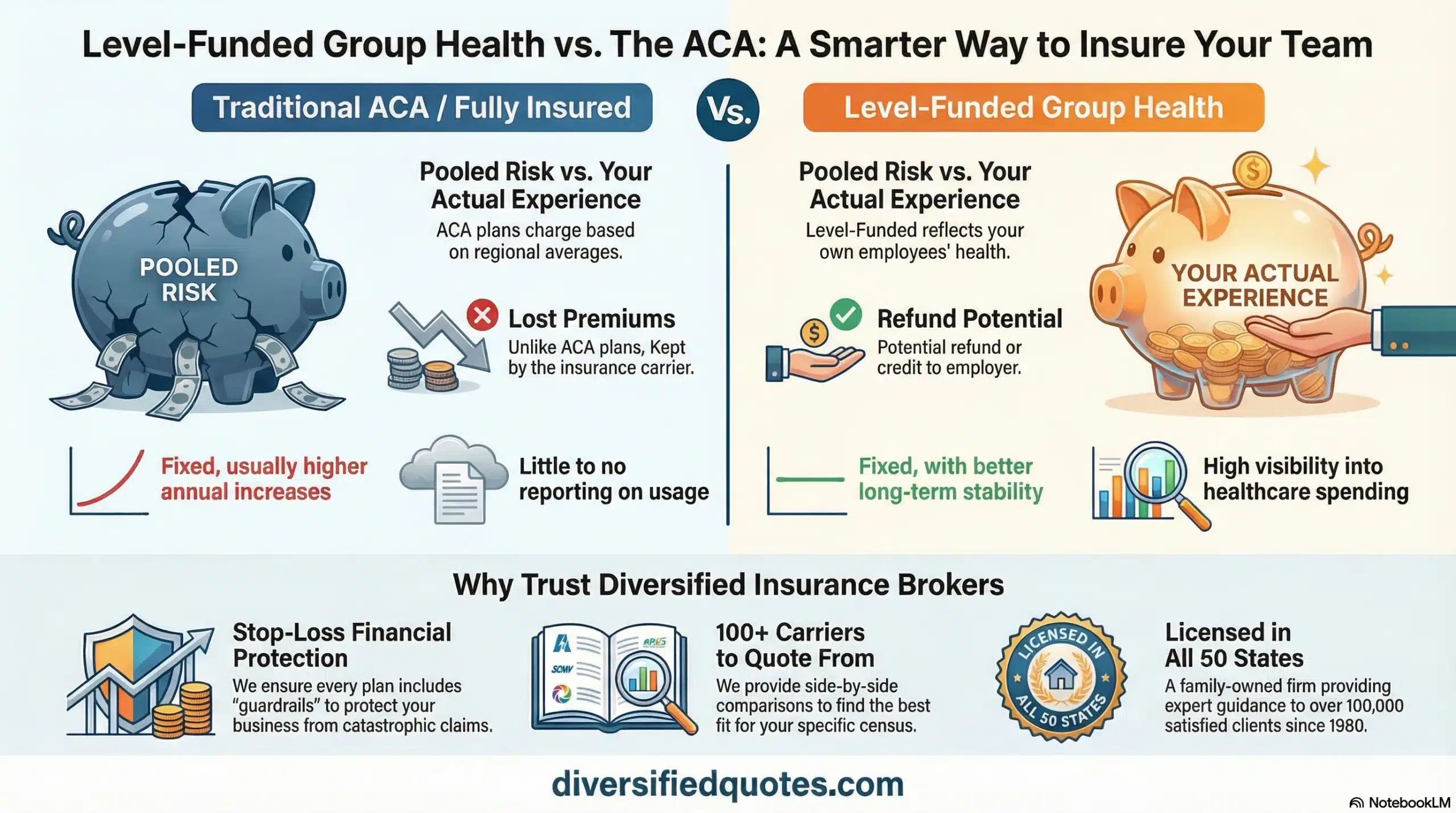
Renewal unpredictability and pooled risk distortion. Traditional fully insured group health premiums are driven partly by the employer’s own claims experience but also by the broader risk pool performance of the carrier’s book of business in the region. For smaller employers, the pooled risk component dominates — the group’s own favorable health performance has limited impact on their renewal rate because they are too small to be fully experience-rated. This means an employer with consistently healthy employees can receive large renewal increases driven by the poor performance of other groups in the carrier’s pool that have nothing to do with the employer’s own workforce. Level-funded plans tie the employer’s cost outcomes more directly to their own group’s experience — favorable health means favorable financial outcomes, and the employer benefits from their own workforce health rather than subsidizing others.
Claims transparency and the intelligence gap. Fully insured employers typically receive limited claims reporting — aggregated data that does not reveal the specific cost drivers affecting their premium. This opacity makes it impossible to make intelligent plan design decisions or evaluate the effectiveness of wellness programs because the employer cannot see what is actually driving their costs. Level-funded employers receive detailed claims reporting — showing utilization by service category, by provider type, by pharmacy, and in aggregate — that allows them to understand their own cost drivers and make informed decisions about plan design modifications, wellness investments, and employee communication strategies.
Surplus potential and performance alignment. When a fully insured employer’s claims run favorably, the savings accrue entirely to the carrier as additional profit — the premium is fixed regardless of claims performance. In a level-funded plan, when actual claims are below the funded level and contract terms allow surplus distribution, the employer receives a return on the unused claims funding. This surplus potential creates performance alignment: the employer and the plan structure share the same financial interest in workforce health and cost-effective utilization. Not every year produces a surplus, and surplus should not be treated as a guaranteed return, but the multi-year potential for surplus accumulation represents a meaningful structural financial advantage over fully insured plans that systematically transfer favorable performance to the carrier.
ERISA preemption and plan design flexibility. Level-funded plans, like self-funded plans, are structured under federal ERISA regulation rather than state insurance law — which means they are largely exempt from the state insurance mandates that drive up the cost of fully insured plans in high-mandate states. This regulatory advantage allows level-funded employers to design benefit structures that prioritize the care categories their specific workforce actually uses, rather than paying for mandated benefits that state regulators have required of insurance products regardless of whether those benefits are relevant to the specific employer population.
How Level-Funded Group Health Actually Works
Level-funded plans operate using a structured monthly payment that includes three primary cost components, each serving a distinct financial function within the plan’s architecture.
The claims funding component represents the actuarially projected cost of expected medical and pharmacy claims for the covered population during the plan year. This projection is based on the group’s census data — ages, genders, geographic location, and historical claims experience when available — and external benchmark data for similar populations in the same geographic market. The claims funding is deposited into a claims payment account (or held by the TPA) and drawn down as claims are adjudicated and paid throughout the year. If actual claims are below the projected level at year-end, the unused claims funding is the source of any surplus distribution. If actual claims exceed the projected level, stop-loss coverage engages to limit the employer’s net exposure.
The administrative cost component covers TPA services — claims adjudication, network access, compliance support, customer service, and reporting. This component is typically fixed and represents the ongoing cost of administering the plan. Unlike the claims funding and stop-loss components, the administrative cost does not vary based on claims performance — it represents the service infrastructure cost that makes the plan functional.
The stop-loss insurance component provides the financial protection that makes level-funded plans practical for employers who cannot absorb open-ended claims risk. Specific stop-loss protection limits the employer’s net claims cost for any single covered individual to the specific attachment point — the per-individual deductible. If one employee generates $250,000 in claims against a $50,000 specific attachment point, the stop-loss carrier reimburses the $200,000 excess. Aggregate stop-loss protection limits the employer’s total net claims cost for the year to a defined corridor above the expected level. Together, specific and aggregate stop-loss create the defined maximum net exposure framework that makes level-funded financial planning reliable. Our resource on understanding stop-loss insurance in level-funded plans explains these mechanics in detail.
Plan Design in Level-Funded and Group Health Programs
Level-funded group health plans support most of the same benefit design structures that employees expect from traditional group coverage — but with greater flexibility to customize the design around the employer’s specific workforce characteristics and cost management priorities.
Network structure is one of the most important plan design choices. Broad PPO networks provide employees with the widest provider access but typically carry higher network costs. Narrower EPO or HMO networks can reduce premium but limit provider choice and can create employee dissatisfaction when employees discover their preferred providers are out-of-network. In some markets, tiered network designs allow employees to access different providers at different cost-sharing levels — incentivizing use of higher-value, lower-cost providers without eliminating access to others. The right network structure depends on the employer’s geographic market, the competitive provider landscape in that market, and how much provider flexibility the workforce values.
Deductible and out-of-pocket structure determines how claim costs are shared between the plan and the covered employee. Higher deductible designs reduce premium for the employer but increase the financial burden on employees when they need care — which can affect care-seeking behavior, employee satisfaction, and the plan’s utilization pattern. High deductible health plans (HDHPs) paired with Health Savings Accounts (HSAs) allow employees to save pre-tax dollars for healthcare costs, creating a tax-advantaged offset to higher out-of-pocket exposure. The employer can contribute to employee HSA accounts as an additional benefit component. Health Reimbursement Arrangements (HRAs) provide another mechanism for the employer to fund employee healthcare costs in a structured, tax-advantaged way without taking on direct claims risk.
Pharmacy benefit design is increasingly one of the most consequential plan design decisions as specialty drug costs continue escalating. Formulary structure — which drugs are covered at which tier, which drugs require prior authorization, which drugs are subject to step therapy requirements — directly affects both total plan pharmacy cost and employee out-of-pocket exposure at the pharmacy. Employers with level-funded or self-funded plans can often negotiate pharmacy benefit terms more directly than fully insured employers, potentially including transparent rebate pass-through arrangements that reduce net pharmacy cost relative to bundled carrier pharmacy pricing.
Preventive care and wellness provisions are important both for employee engagement and for long-term claim cost management. Plans that provide $0 cost-sharing for preventive care services — annual physicals, cancer screenings, chronic condition monitoring — encourage early detection and ongoing management of conditions that generate significantly higher claims when unaddressed. Wellness program integration, employee health risk assessments, chronic disease management programs, and virtual care access all contribute to claim cost management by reducing avoidable high-cost utilization. For level-funded employers who benefit financially from favorable claims performance, investments in wellness infrastructure often produce multi-year returns that outweigh the program costs.
Small Group Eligibility, Participation, and the 1099 Question
Level-funded plans have expanded their accessibility significantly in recent years, with many carriers now offering level-funded products to employer groups as small as two enrolled employees in certain states. This expansion has opened the level-funded model to businesses that were previously limited to the small-group fully insured market — often a less competitive and less flexible segment of the carrier market.
The specific minimum group size requirements vary by carrier and by state, because state insurance regulations affect how group health products are structured and what eligibility rules apply to groups of different sizes. States with robust small group insurance markets may have more carrier options at small group sizes; states with thinner small group markets may have fewer options, particularly for the smallest employer groups. Understanding the state-specific eligibility landscape before beginning the quoting process prevents surprises when proposals come back with eligibility conditions the employer had not anticipated.
Participation requirements — minimum percentages of eligible employees who must enroll for the plan to be issued — are a standard feature of group health underwriting. Most carriers require at least 50% to 75% of eligible employees (excluding those with verifiable other coverage) to enroll, to prevent adverse selection dynamics where only the sickest employees choose to participate. Participation rates that fall below carrier minimums can prevent the plan from being issued or create conditions at renewal. Employer contribution strategy — how much of the premium the employer pays versus what employees pay — directly affects participation: higher employer contributions increase the affordability of coverage for employees and typically support stronger participation rates.
The 1099 contractor question is one of the most frequently asked eligibility questions in small group health, particularly for businesses with blended workforces. Some level-funded carriers allow 1099 contractors to participate in group health plans when they meet specific eligibility requirements — typically including regular work hours, integration into the employer’s business operations, and sometimes minimum tenure. The rules vary significantly by carrier and state, and the answer to “can my 1099 workers participate?” requires confirming the specific carrier’s underwriting guidelines for contractor eligibility rather than assuming a universal answer. Our resource on whether 1099s can get group level funding addresses this question in detail.
The Employer Compliance Responsibilities in Group Health
Group health insurance carries meaningful compliance obligations for employers that extend beyond simply paying premiums and enrolling employees. Understanding these obligations — and ensuring the broker and TPA relationships support them — is part of responsible group health plan management.
For employers with 50 or more full-time equivalent employees, the Affordable Care Act’s employer mandate requires offering minimum essential coverage that meets minimum value standards to full-time employees and their dependents, at a premium cost that meets ACA affordability thresholds. Employers who fail to satisfy these requirements and have at least one full-time employee who receives a premium tax credit in the marketplace may be subject to employer shared responsibility payments. The ACA also requires applicable large employers to file IRS Forms 1094-C and 1095-C annually, reporting coverage information for all full-time employees. Smaller employers below the ALE threshold have different compliance obligations, but group health plans of all sizes must comply with ERISA notification and disclosure requirements, COBRA continuation coverage rules when applicable, HIPAA privacy and portability rules, and in some cases state-specific requirements.
These compliance requirements are manageable with appropriate broker and TPA support, but employers who treat group health as “set it and forget it” create avoidable compliance risk. An experienced independent broker who helps the employer track compliance obligations, provides support for required annual notices, and ensures the plan documentation remains accurate and current is providing compliance value that significantly exceeds the visible cost of the broker relationship.
Long-Term Strategy: Why Level Funding Is a Platform, Not a Product
The most effective way to think about level-funded group health insurance is as a platform for multi-year employer healthcare strategy rather than as a static annual product purchase. The plan’s architecture — claims funding, stop-loss protection, TPA administration, and data analytics — creates a foundation that becomes more valuable over time as the employer accumulates claims history, develops deeper understanding of their cost drivers, and implements increasingly targeted interventions that improve population health and reduce avoidable claim costs.
Year one of a level-funded plan establishes the baseline: the employer experiences the plan’s mechanics, the TPA’s administrative quality, and the stop-loss structure’s protection during a real plan year with real claims. The claims data from year one provides the first meaningful view of what is actually driving healthcare costs in the workforce — typically revealing a concentration of claims in a small number of high-cost claimants, specific chronic conditions driving pharmacy spend, or utilization patterns suggesting care coordination opportunities.
Year two and beyond allow the employer to use this data for targeted strategy — implementing disease management programs for high-prevalence conditions, modifying the pharmacy formulary to reduce specialty drug costs, adjusting the plan design to incentivize preventive care utilization, and negotiating stop-loss renewal terms with the advantage of demonstrated claims experience. Over a three-to-five-year horizon, employers who engage actively with this data-driven improvement cycle typically produce claim cost trends that are meaningfully below the market average for similar populations — generating both employer cost savings and improved employee health outcomes.
See If Your Group Qualifies for Level Funding
Share a simple census and we’ll evaluate eligibility, funding scenarios, and potential surplus ranges for your specific group profile.
Check My Group EligibilityQuestions? Call 800-533-5969
Model Best Case and Worst Case Cost Scenarios
We show level-funded, fully insured, and hybrid funding comparisons — so you can make a decision with clarity about the range of possible outcomes, not just the average expectation.
Run My Funding ComparisonQuestions? Call 800-533-5969
Related Group Health Strategy Pages
Explore funding strategies, employer protection planning, and cost control resources.
Financial Protection Essentials
Carrier evaluations, international travel medical protection, and pre-settlement funding education resources.
Talk With an Advisor Today
Choose how you’d like to connect—call or message us, then book a time that works for you.
Schedule here:
calendly.com/jason-dibcompanies/diversified-quotes
Licensed in all 50 states • Fiduciary, family-owned since 1980
FAQs: Group Level-Funded Health Insurance
What is level-funded group health insurance?
Level-funded group health insurance combines features of fully insured and self-funded plans in a structure designed primarily for small-to-mid-size employers. Employers pay one fixed monthly amount that bundles together three components: a claims funding reserve (the projected cost of expected medical and pharmacy claims for the covered population), stop-loss insurance (which protects against catastrophic individual and aggregate claims), and TPA administrative costs (covering claims processing, network access, compliance, and reporting). The monthly payment is predictable — like fully insured — but the underlying mechanics are self-funded, meaning the employer’s financial outcome is tied to their own group’s actual claims performance rather than to pooled carrier risk.
At the end of the plan year, if actual claims are below the funded level and contract terms allow surplus distribution, the employer may receive a return on unused claims funding. If claims exceed the projected level, stop-loss insurance absorbs the excess above the attachment point, protecting the employer from open-ended financial exposure. This structure gives employers the budget predictability of fully insured plans, the claims transparency and performance alignment of self-funded plans, and the financial protection of stop-loss insurance — a combination that has made level-funded plans the fastest-growing segment of the group health market for smaller employers over the past several years.
How do premium refunds or surplus credits work?
Surplus returns in level-funded group health arise when actual plan claims for the year are meaningfully below the claims funding component of the monthly payment. The exact mechanics depend on the carrier’s contract terms — specifically how the surplus is calculated (typically actual claims paid versus funded claims reserve), what “run-out period” applies for claims incurred during the plan year but not yet processed, and whether the surplus is distributed as a direct refund, applied as a credit to future months, or retained in a claims reserve for subsequent plan years.
The surplus is never guaranteed — it depends on the group’s actual health outcomes, participation stability, and the specific contract terms. Most experienced employers and brokers evaluate level-funded plans across three scenarios: favorable claims year (potential for meaningful surplus return), average claims year (cost comparable to fully insured, with better transparency), and adverse claims year (stop-loss protection limits the downside, with no surplus but no catastrophic exposure either). In any of these scenarios, the level-funded structure provides more information about what is driving costs than a fully insured plan does — which is valuable independent of whether a surplus is returned.
Are refunds guaranteed with level-funded plans?
No — surplus returns depend on claims performance, participation stability, plan design, and contract-specific rules. Many employers choose level-funded plans for reasons beyond refund potential: the claims transparency provides cost management intelligence that fully insured plans cannot offer, the stop-loss protection creates a more predictable worst-case financial boundary than fully insured renewal volatility, and the ERISA preemption advantage provides plan design flexibility that allows benefits to be tailored to the actual workforce rather than to state insurance mandates.
The right way to think about level-funded refund potential is as a performance benefit that arises when the employer’s investment in workforce health and cost management produces genuinely favorable health outcomes — not as a cash rebate that should be expected every year regardless of how the group actually performs. Employers who approach level-funded plans as a long-term strategy and actively engage with the claims data to drive wellness programs, pharmacy optimization, and plan design improvements tend to generate better claims performance over time and therefore more consistent surplus potential than employers who treat the plan as a passive annual purchase.
How small can a group be for level-funded insurance?
Many level-funded carriers now support groups as small as two enrolled employees, depending on state regulations and carrier underwriting guidelines. This minimum has contracted significantly over the past decade — level-funded products were historically available only to groups of 25, 50, or 100 employees and above, but competitive carrier expansion and technological improvements in small group underwriting have pushed accessibility down to micro-employer sizes in many states. The specific minimum varies by carrier and state, and some states impose regulatory requirements on small group products that affect the minimum size at which level-funded designs are available.
Eligibility at small group sizes also depends on participation rates — the percentage of eligible employees who enroll. Most carriers require at least 50% to 75% of eligible employees (excluding those with documented other coverage) to enroll, which can be a practical challenge for very small groups where a single employee’s enrollment decision significantly affects the participation percentage. Employer contribution strategy — how much of the premium the employer covers — directly affects whether employees find coverage affordable enough to enroll, and therefore whether participation thresholds are met. Our resource on minimum employees for group health insurance addresses how these thresholds work across different group sizes.
Can 1099 contractors be included in level-funded group plans?
Some level-funded programs allow 1099 independent contractors to participate in group health plans when they meet specific carrier eligibility requirements. These requirements typically include working a minimum number of hours per week for the employer, having a direct employment or contractual relationship with the sponsoring employer, and sometimes meeting minimum tenure requirements. The inclusion of 1099 workers can be meaningful for employers with blended workforces — particularly in industries like construction, consulting, technology, and creative services where independent contractors work alongside W-2 employees on integrated projects.
The rules vary significantly by carrier and state — some carriers explicitly support 1099 participation with defined eligibility standards, others exclude 1099 workers entirely, and still others evaluate 1099 eligibility on a case-by-case basis during underwriting. State regulations also affect this question, because some states have specific rules about who can participate in employer group health plans that may limit or expand contractor eligibility. Confirming the specific carrier’s 1099 eligibility rules before structuring enrollment avoids surprises during the application process. Our resource on whether 1099s can get group level funding explains the eligibility framework in detail.
What happens if claims are higher than expected?
Stop-loss insurance is specifically designed to protect the employer when claims exceed expectations. Specific stop-loss limits the employer’s net financial exposure for any single covered individual — if one employee generates $200,000 in claims against a $50,000 specific attachment point, the stop-loss carrier reimburses the $150,000 excess. Aggregate stop-loss limits total plan claims exposure for the year — if total claims exceed the aggregate corridor (typically 120% to 125% of projected annual claims), the stop-loss carrier covers the excess. Together, these protections convert open-ended claims risk into defined maximum net exposure that the employer can plan for and absorb.
The practical result is that even in a bad claims year — where a catastrophic illness or injury generates a large individual claim, or where multiple above-average claims coincide — the employer’s financial outcome is bounded rather than catastrophic. This stop-loss protection structure is often what gives smaller employers the confidence to adopt level-funded plans despite initially unfamiliarity with self-funding mechanics: the worst-case financial outcome is defined and manageable, while the best-case outcome (surplus return in a good claims year) is genuinely possible. Our resource on understanding stop-loss insurance in level-funded plans explains these mechanics in full detail.
Are monthly costs predictable with level-funded plans?
Yes — employers pay a fixed monthly payment that bundles claims funding, administrative costs, and stop-loss premiums, providing the same monthly billing predictability as traditional fully insured plans. This predictability is one of the most important practical advantages of level-funded plans for small and mid-size employers who need to budget group health costs with confidence. Unlike traditional self-funded plans where monthly cash outflow varies with actual claims volume — creating cash flow volatility that requires maintaining reserves and managing funding cycles — level-funded plans have a smooth, predictable monthly obligation that integrates cleanly into standard payroll and operating expense budgeting.
The predictability at the monthly level does not eliminate year-over-year renewal variation — the monthly payment may change at each annual renewal based on updated actuarial projections, claims experience, and stop-loss renewal terms. However, level-funded renewals are typically more grounded in the employer’s own actual experience than fully insured renewals that reflect pooled regional risk pool performance — which means favorable employer claims history directly supports more competitive renewal terms rather than being diluted by others in the carrier’s book of business.
Why are more small employers switching to level-funded group health?
The shift toward level-funded group health among small and mid-size employers reflects several converging factors. The traditional fully insured model has become increasingly frustrating for employers with healthy workforces — renewal increases driven by pooled regional risk pool performance feel arbitrary when the employer’s own claims are favorable, and the opacity of fully insured pricing makes it impossible to understand what is driving cost changes or what would improve them. Level-funded plans restore the connection between an employer’s actual workforce health outcomes and their plan cost outcomes.
The expansion of level-funded plan accessibility down to very small group sizes has also been a significant driver — employers who were previously limited to the small-group fully insured market, often with limited carrier options and more restrictive plan designs, now have access to level-funded alternatives that provide more flexibility, more transparency, and better potential cost alignment. The growth of the broker community’s expertise in level-funded plans has also accelerated adoption — more employers hear about these options from advisors who can explain them clearly and model the multi-scenario financial outcomes that allow employers to make informed decisions rather than accepting default fully insured assumptions.
Browse Group Health Insurance by Company Size
About the Author:
Jason Stolz, CLTC, CRPC, DIA, CAA and Chief Underwriter at Diversified Insurance Brokers (NPN 20471358), is a senior insurance and retirement professional with more than 25 years of real-world experience helping individuals, families, and business owners protect their income, assets, and long-term financial stability. As a long-time partner of the nationally licensed independent agency Diversified Insurance Brokers, Jason provides trusted guidance across multiple specialties—including fixed and indexed annuities, long-term care planning, personal and business disability insurance, life insurance solutions, Group Health, Travel Medical and Evacuation Insurance, and short-term health coverage. Diversified Insurance Brokers maintains active contracts with over 100 highly rated insurance carriers, ensuring clients have access to a broad and competitive marketplace.
His practical, education-first approach has earned recognition in publications such as VoyageATL, and contributions from his agency featured in Kiplinger and GoBankingRates— highlighting his commitment to financial clarity and client-focused planning. Drawing on deep product knowledge and years of hands-on field experience, Jason helps clients evaluate carriers, compare strategies, and build retirement and protection plans that are both secure and cost-efficient. Visitors who want to explore current annuity rates and compare options across multiple insurers can also use this annuity quote and comparison tool.
Explore All Group Health Insurance Options: Browse our complete Group Health Insurance guide — covering small business, company size options, industry-specific plans, level funding & ACA alternatives.
Last Reviewed: June 9, 2026 |
Reviewed by: Jason Stolz, CLTC, CRPC, DIA, CAA
Chief Underwriter, Diversified Insurance Brokers, Inc. | NPN: 20471358 | Diversified Insurance Brokers, Inc. — Licensed in all 50 states
Fact Checked by: Tonia Pettitt, CMIP©
Medicare Specialist, Diversified Insurance Brokers, Inc. | NPN: 14374308 | Diversified Insurance Brokers, Inc. — Licensed in all 50 states
Did you find this content helpful? Leave us a Google review — it helps others find trustworthy guidance too.
Editorial Standards: Diversified Insurance Brokers maintains rigorous editorial standards to ensure accuracy, clarity, and independence in all content. Learn more about our editorial standards and commitment to transparency.
