
Understanding Stop-Loss Insurance in Level-Funded Plans
As an Independent Group Health Insurance Broker, we compare fully insured, level-funded, and self-funded options across carriers to find the lowest cost coverage for your business.
Understanding Stop-Loss Insurance in Level-Funded Plans

Jason Stolz CLTC, CRPC, DIA, CAA
Stop-loss insurance in level-funded plans is the financial backstop that keeps a predictable monthly employer payment from being crushed by unpredictable claims. A level-funded plan is designed to feel like traditional group health — steady billing, predictable budgeting — while using self-funded mechanics behind the scenes. That is why stop-loss matters so much. It is the mechanism that caps risk when a large claim hits, when a handful of members drive unusually high utilization, or when claims timing creates cash-flow stress early in the plan year. At Diversified Insurance Brokers, this page breaks down how stop-loss works inside a level-funded plan, what specific and aggregate protection actually mean, how attachment points and contract basis change real-world outcomes, and why underwriting inputs like eligibility, participation, and documentation can quietly make or break the total cost of coverage. If you are new to level funding, start with our guide on why group level funding can make sense and our full resource on what self-funded group health insurance is. For a direct comparison of the tradeoffs employers face when choosing between fully insured, level-funded, and self-funded arrangements, see our resource on the pros and cons of self-funded group health. Then come back here to understand the stop-loss layer in detail.
Model Stop-Loss Options for Your Level-Funded Plan
We’ll compare carriers and show how specific, aggregate, contract basis, and laser choices change premium and retained risk for your group.
Stop-Loss Comparison
Side-by-side modeling of attachment points, contract basis, and carrier options across your group size.
Request ComparisonLevel Funding Overview
Understand the full level-funded structure before diving into how stop-loss operates within it.
Learn MoreGet a 2nd Opinion
Already have a level-funded quote? We’ll evaluate whether the stop-loss structure is competitive.
Get 2nd OpinionWhy Stop-Loss Exists in Level-Funded Plans
Level-funded arrangements are often described as a hybrid between fully insured and self-funded group health. The monthly payment is designed to be stable, which helps employers budget and avoid the surprise swings that pure self-funding can create. Behind the scenes, level-funded plans typically include three cost buckets: expected claims funding, fixed administrative costs (TPA, network access, reporting), and stop-loss premium. When claims are favorable, many level-funded designs return a portion of unused claims funding at the end of the year, depending on plan terms. When claims run high, stop-loss is the protection layer that keeps the plan from turning into an unmanageable financial event. From a practical standpoint, stop-loss is what makes level funding “comfortable” for smaller and mid-market employers. It puts a ceiling on exposure while still allowing the employer to benefit from improved claims performance. That is why two quotes with the same monthly payment can behave very differently if the stop-loss layer is structured differently. For context on how group medical insurance is priced and where level-funded plans sit on the control vs. predictability spectrum, see our broader group health insurance overview. Understanding the full landscape matters before evaluating specific stop-loss design choices.
Stop-Loss Key Terms at a Glance
| Term | What It Protects | Lower Setting Means | Higher Setting Means | Primary Planning Consideration |
|---|---|---|---|---|
| Specific Stop-Loss | Per-individual shock claims (one high-cost member) | Less retained risk per person; higher premium | More retained risk per person; lower premium | Match to employer’s cash-flow capacity and claims volatility tolerance |
| Aggregate Stop-Loss | Total group claims running above projections | More protection against high-utilization years; higher premium | Less protection against broad overutilization; lower premium | Important for groups where utilization clustering (not single claims) is the main risk |
| Attachment Point | Threshold at which stop-loss begins reimbursing | Earlier reimbursement trigger; more predictable exposure | Later trigger; more retained volatility but lower premium | Model multiple options against “early shock claim” scenarios before deciding |
| Laser | Higher specific deductible applied to one identified high-risk individual | N/A — laser is either accepted or not | Higher laser = more concentrated risk on that individual | Evaluate whether premium savings justify maximum exposure for the lasered member |
| Contract Basis | Timing window for which claims count under the policy | 12/12: claims incurred and paid in same period; more timing risk | 12/15 or 12/18: run-out window for late-paid claims; smoother year-end | Longer run-out reduces late-claim surprises at renewal; important for smaller groups |
Specific vs. Aggregate Stop-Loss: What They Really Protect
Specific stop-loss caps exposure to any one individual who experiences an unusually large claim. Think of it as a per-person shock-claim limiter. Once the plan has paid eligible claims up to the specific attachment point for that member, the stop-loss policy reimburses additional eligible amounts according to the contract rules. Specific stop-loss is the protection layer that matters most when a single medical event — surgery, cancer treatment, specialty drug regimen, premature birth, or a complex inpatient stay — creates a six-figure claim for one person. At 50 employees or fewer, a single large claim from one member can represent a disproportionate share of annual claims funding. At 80 employees and above, the pool is large enough that specific stop-loss still matters, but aggregate protection becomes increasingly important as utilization patterns emerge across a larger population.
Aggregate stop-loss caps exposure to the group’s total claims for the year. Instead of focusing on one member, aggregate protection looks at all covered lives combined. When cumulative eligible claims exceed the aggregate attachment point, the policy reimburses the excess, subject to contract terms. Aggregate is most valuable when you do not have one monster claim but do have a high-utilization year where multiple members are using care more than expected. Both can exist together, and in level-funded designs they typically do. The tradeoff is consistent: lower attachment points reduce volatility and financial stress but increase stop-loss premium. Higher attachment points reduce premium but increase retained risk. The best fit depends on risk tolerance, cash-flow flexibility, and the employer’s ability to absorb a bad month without disrupting operations.
Attachment Points: The Dial That Changes Premium vs. Risk
An attachment point is the threshold where stop-loss begins reimbursing the plan. For specific stop-loss, it is the amount the plan pays for an individual’s eligible claims before reimbursement begins. For aggregate stop-loss, it is the cumulative amount the plan pays across the entire group before reimbursement begins. Attachment points are not just theoretical — they change how the plan feels when real claims occur. A lower specific attachment can be the difference between a large claim being an inconvenient budget item versus a business-disrupting event. A higher specific attachment can be perfectly acceptable for employers with strong cash reserves and favorable claims histories, but it can create serious cash-flow pressure for smaller groups if a large claim hits early in the year before claims funding has had time to build. For employers evaluating 100-employee plans and above, the claims base is large enough that attachment point selection becomes a genuine actuarial decision rather than a comfort preference. For smaller groups at 50 employees, the shock-claim risk is more concentrated and lower specific attachment points are generally more prudent. The correct approach in every case is to model multiple attachment options and show the expected-cost range under different claim scenarios — premium alone does not reveal the worst-case experience.
Lasers: The Underwriting Tool That Can Quietly Shift Risk
Lasers are one of the most misunderstood stop-loss concepts, and they appear most often when a plan member is identified as a known high-cost risk — someone currently in cancer treatment, managing a high-cost chronic condition, or expected to generate significant claims in the upcoming plan year. A laser applies a higher specific deductible to that specific individual. Instead of the standard attachment point protecting the employer from that person’s claims at, say, $40,000, a laser might set their individual threshold at $80,000 or $120,000. The stop-loss carrier reduces its exposure to that person’s claims, which typically results in a lower overall stop-loss premium. The employer retains more risk for that individual but pays less to protect the rest of the group. Lasers are not automatically bad. In some cases, accepting a laser is what makes a quote feasible for a group that would otherwise be declined or priced out of the market entirely. In other cases, a laser makes the premium look attractive while increasing the employer’s real exposure to a level they did not intend to carry. The critical step is clarity: model the maximum amount the employer would pay if the lasered person has a high-claim year, compare that against the premium savings, and make a deliberate decision rather than a surprised one at claim time. When we model level-funded options, presenting “laser vs. no laser” comparisons is standard because employers deserve to see the true expected cost difference before committing.
Contract Basis: Why 12/12 vs. 12/15 vs. 12/18 Matters in Real Life
The contract basis defines how claims are counted under the stop-loss policy based on when they are incurred and when they are paid. This is where many employers get surprised, because the same attachment point can behave differently depending on the contract basis and run-out period. A 12/12 structure generally means claims must be incurred and paid within the same 12-month policy period to count. A 12/15 or 12/18 structure includes a run-out window after the plan year ends to allow late-billed claims to be paid and still count under the prior period. That run-out window can materially improve cash-flow predictability at renewal, especially for claims that occur late in the year but are processed and paid after the plan year closes. In practical terms: a member has major surgery in November, but the hospital bills in January and February. Under a 12/12 basis, those bills fall into the new plan year’s accounting and must count toward the new year’s attachment point. Under a 12/15 or 12/18 basis, they may still count under the prior year’s attachment, keeping the year-end reconciliation cleaner and the renewal picture less distorted. For smaller groups, contract basis is often just as important as attachment point because it affects timing risk. Groups that want the cleanest possible renewal process should evaluate extended run-out options even if they carry a slight premium premium cost.
Reimbursement Timing: The Cash-Flow Side of Stop-Loss
Even with stop-loss, the plan typically pays claims first. Reimbursement comes after the plan crosses the attachment point and submits documentation according to the carrier’s process. That means reimbursement timing matters — particularly for smaller employers. A large claim early in the year can create cash-flow pressure if reimbursement is slow or if claims documentation is delayed during adjudication. This is why plan design must consider the employer’s capital position and operating cycles. A high-retained-risk plan with slow reimbursement can be stressful for businesses with seasonal revenue swings or tight working capital. A slightly higher premium for more conservative attachment points, better contract basis, and smoother reimbursement can be worth the incremental cost if it protects business stability during a difficult claims period. For employers evaluating level funding as part of a broader cost management strategy, understanding the group health insurance cost structure for small businesses is important context for how stop-loss premium fits within the total plan budget.
Underwriting Inputs You Can Influence — And Why They Affect Price
Stop-loss pricing and eligibility decisions depend heavily on underwriting inputs. Many employers assume underwriting is only about health risk. In reality, underwriters also evaluate operational stability. They want to see a group that is administratively clean, with stable participation, consistent eligibility rules, and a predictable census. The more stable the group structure, the easier it is for carriers to price risk accurately and competitively. Participation is one of the biggest levers. Carriers want enough eligible employees enrolled to prevent adverse selection. If only employees with high utilization enroll, claims trends become less predictable and more expensive. Employers can often improve underwriting outcomes by clarifying contribution strategy, aligning enrollment timing with HR cycles, and ensuring employees understand the plan’s value. Employer contribution levels also matter — many carriers require a minimum contribution percentage because it supports participation stability. Eligibility rules and documentation are critical: consistent W-2 eligibility definitions, predictable waiting periods, and clean census documentation all contribute to better underwriting outcomes. Groups that cannot clearly document eligibility can face delays, repricing, or declined submissions that could have been avoided with cleaner records. For employers thinking about how workforce size affects plan eligibility and underwriting, our guide on creditable coverage by employer size provides helpful context as headcount grows. To understand how the ACA’s employer mandate interacts with funding decisions, see our resource on ACA alternatives for company healthcare.
W-2 Employees vs. 1099 Contractors: Protecting Underwriting Integrity
One of the most common issues in level-funded plan underwriting is employers attempting to include contractors in a group structure that carriers are not designed to accept. Most level-funded solutions are built for bona fide W-2 employees, with participation and eligibility rules that assume a traditional employment relationship. If contractors are included without disclosure or are treated as W-2 employees for group health purposes, underwriting integrity breaks down and the plan can face reclassification, retroactive exclusion of claims, or non-renewal at the worst possible time. The cleanest strategy is to maintain the level-funded plan strictly for eligible W-2 employees and build a separate coverage path for contractors. Our resource on whether 1099 contractors can get group level funding covers what is possible and what typically creates underwriting problems. For contractors or employees in between group plan eligibility windows, our guide on how short-term health insurance can bridge coverage gaps provides practical alternatives that do not contaminate the group plan eligibility profile.
How Stop-Loss Scales With Employer Size
Stop-loss mechanics are consistent across employer sizes, but their practical importance and optimal design vary based on headcount and claims pool stability. At smaller group sizes — 20 to 50 employees — the specific stop-loss layer is often the most critical protection because a single catastrophic claim from one member represents a meaningful percentage of the entire claims fund. Aggregate stop-loss matters less when the pool is too small for broad utilization trends to emerge. At mid-market sizes — 80 to 100 employees — both specific and aggregate stop-loss become important, because the group is large enough to develop measurable utilization patterns while still being small enough for a handful of high-cost claimants to shift the year materially. At larger employer sizes — 250 employees and above, extending to 500 employees — stop-loss design becomes a sophisticated actuarial exercise. Attachment points can be set more aggressively because the claims pool has more stability, stop-loss carriers compete more actively for large-group business, and multi-year rate commitments become feasible. Understanding how stop-loss strategy evolves across these size thresholds is important for any employer planning for workforce growth, because the optimal stop-loss structure at 50 employees is often materially different from the optimal structure at 150 or 300.
Industry Profiles and Stop-Loss Underwriting Sensitivity
Stop-loss underwriting is sensitive to industry profile because different industries carry different baseline risk characteristics. Professional service firms — law firms, consulting firms, and accounting firms — typically have desk-based workforces with lower occupational injury risk, which can support more favorable stop-loss pricing when the census demographics are clean. Construction and trades — construction firms specifically — carry higher occupational risk, which can influence both specific and aggregate attachment point pricing. Healthcare employers, manufacturing firms, and businesses with aging workforces or high-stress occupational demands all carry specific stop-loss risk profiles that underwriters evaluate when setting attachment points and premium. Understanding the industry-specific underwriting landscape before submitting is part of why working with an experienced independent group health broker produces better results than direct carrier submissions — the broker can match the group’s profile to the carriers most favorable to that industry’s risk characteristics.
Design Decisions With Practical Tradeoffs Employers Should Compare
Specific attachment point selection: lower specific deductibles reduce volatility from shock claims but increase stop-loss premium. Higher deductibles may reduce premium but can create uncomfortable exposure when a large claim hits early in the year. The right option depends on cash reserves and the employer’s willingness to absorb a large claims month without disrupting operations. Aggregate attachment point selection: aggregate protection is the guardrail for high-utilization years. The aggregate factor or corridor varies by plan design, and employers should compare how the aggregate threshold is calculated and whether it aligns with expected claims and any known seasonality in the workforce’s healthcare usage. Lasers versus no lasers: accepting a laser can reduce premium but increases concentrated risk on the lasered individual. The employer should evaluate the maximum payable for a lasered member and weigh it against the savings — this decision should be made with clear modeling, not an assumption that lower premium always means a better deal. Contract basis and run-out: a 12/12 basis may carry lower premium, but it can expose the employer to late-paid claims surprises. A 12/15 or 12/18 structure can smooth year-end experience, improve renewal predictability, and reduce the risk of unexpectedly large liabilities appearing after the plan year closes. Claims funding strategy and reimbursement timing: employers should understand how claims are funded monthly, how large individual claims are processed, and how quickly reimbursements typically arrive after the attachment point is crossed.
Two Scenarios That Show How Stop-Loss Changes Real Outcomes
Scenario A — early large claim: a 12-employee group selects a $40,000 specific attachment. One member incurs $110,000 in eligible claims mid-year. The plan pays the first $40,000 for that member. Specific stop-loss reimburses the remaining eligible amount according to contract terms. The monthly budget stays stable because the large claim does not spiral into an unbounded employer liability. Without specific stop-loss at a reasonable attachment point, that same $110,000 claim would be absorbed entirely by the employer — a budget event that could derail a small business’s operating plan for the rest of the year. Scenario B — favorable year-end: a 22-employee group maintains strong participation, stable eligibility, and a steady hiring cadence throughout the year. Claims finish below projections due to a relatively healthy year. Depending on plan terms, a portion of unused claims funding is returned at year-end, lowering the total effective cost compared to a fully insured renewal that would retain the surplus on the carrier’s side. These two scenarios illustrate the fundamental appeal of level-funded plans with well-designed stop-loss: they allow employers to cap downside risk from bad years while sharing in the upside from good ones — a structure that fully insured plans structurally cannot offer.
How Stop-Loss Fits Into Your Broader Employer Strategy
Stop-loss is not a stand-alone product. It is a structural component inside level-funded plan design, and it should be evaluated alongside the broader funding model, HR calendar, budgeting goals, hiring cycles, and participation strategy. Level funding works best when employers treat plan design as a long-term process rather than a one-time purchase. The more stable and documented the eligibility and contribution structure is, the easier underwriting becomes. The more consistently claims patterns are tracked, the easier it becomes to model attachment points and optimize total cost over time. For employers who want to confirm whether their current stop-loss structure is competitive against market alternatives, a second opinion is often the single most useful step — see our resource on getting a second opinion on your group health insurance quote.
Build a Stop-Loss Strategy That Matches Your Budget and Risk Tolerance
Tell us your group size and goals — we’ll outline the design levers that reduce volatility without overpaying for premium.
Side-by-Side Comparison
We’ll model attachment points, lasers, and contract basis options across multiple carriers.
Request ComparisonSelf-Funded vs. Level-Funded
Compare how stop-loss works differently in level-funded versus fully self-funded ASO arrangements.
Learn More1099 Coverage Options
Explore whether contractors can participate in level-funded plans and how to structure alternatives.
Learn MoreLevel-Funded and Self-Funded Plan Resources
Guides covering funding strategy, eligibility, contractor coverage, and employer health plan options by size.
Use the options below to jump to the group health page that matches your workforce size.
750 Employees
Scaled cost-control with deeper data visibility and targeted interventions.
View Options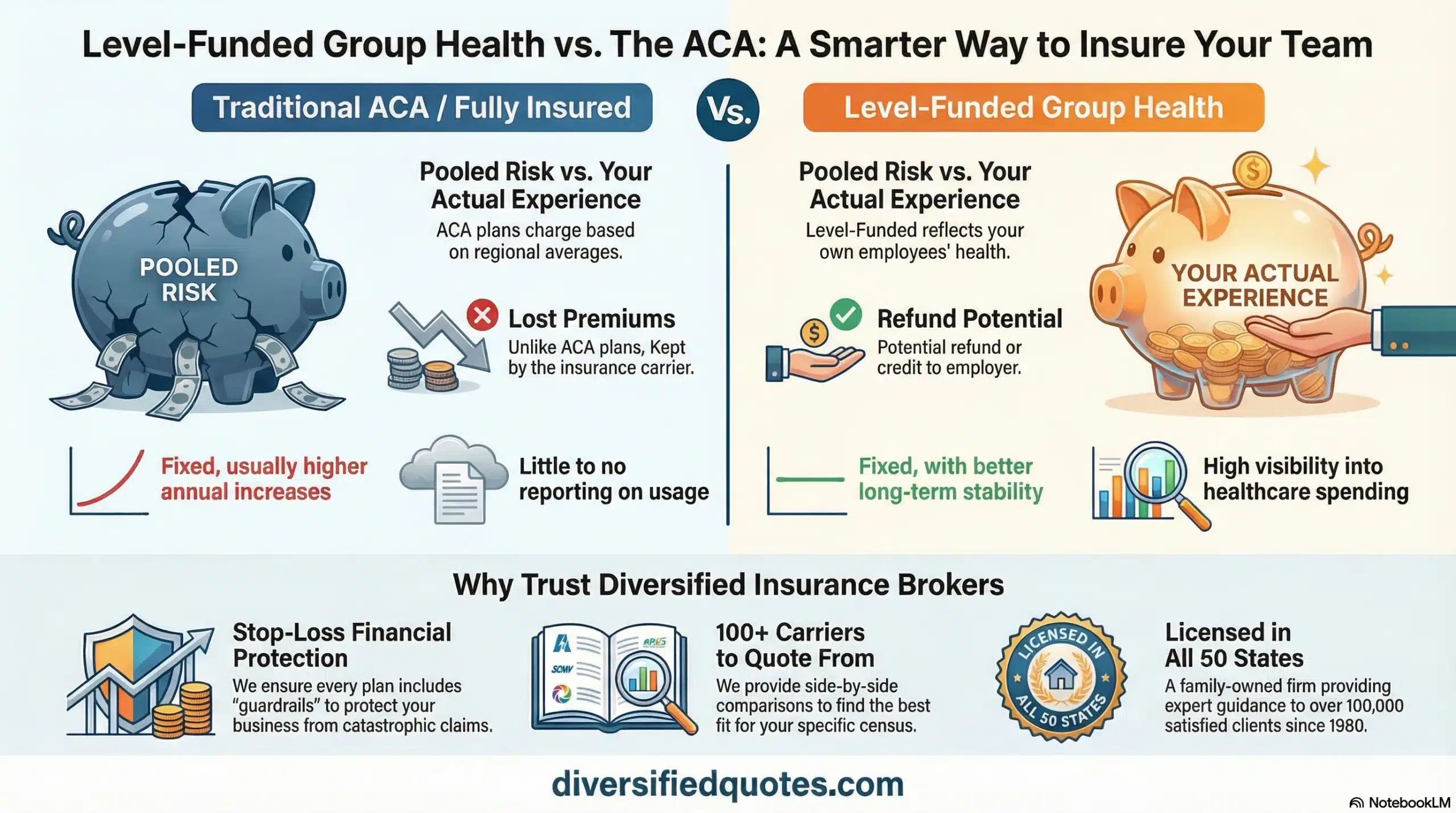
Talk With an Advisor Today
Choose how you’d like to connect—call or message us, then book a time that works for you.
Schedule here:
calendly.com/jason-dibcompanies/diversified-quotes
Licensed in all 50 states • Fiduciary, family-owned since 1980
FAQs: Stop-Loss Insurance in Level-Funded Plans
What is stop-loss insurance in a level-funded plan, and why is it necessary?
Stop-loss insurance is the financial guardrail that makes level-funded health plans viable for employers who need predictable monthly costs but do not want unlimited exposure to claims volatility. Level-funded plans are designed to feel like fully insured group health — with stable billing and predictable budgeting — while using self-funded mechanics behind the scenes. The monthly payment typically covers three components: expected claims funding, administrative costs, and stop-loss premium. Stop-loss caps the employer’s exposure when actual claims exceed those expectations — whether from a single catastrophic claim, an unexpectedly high-utilization year, or both. Without stop-loss, a level-funded plan would function like pure self-funding, which most small and mid-market employers cannot absorb without significant financial disruption.
What is the difference between specific and aggregate stop-loss?
Specific stop-loss protects against one person generating a very large claim. Once the plan pays eligible claims up to the specific attachment point for that individual, the stop-loss policy reimburses additional eligible amounts per the contract rules. This is the protection layer that matters most when a single medical event — major surgery, cancer treatment, a specialty drug, a premature birth — creates a six-figure claim for one member. Aggregate stop-loss protects against the group’s total annual claims running higher than projected. When cumulative eligible claims exceed the aggregate attachment point, the policy reimburses the excess. Aggregate coverage is most valuable when you do not have one monster claim but do have a high-utilization year where multiple members use more care than expected. Most level-funded plans include both types of stop-loss, working in combination to protect against both concentrated and distributed claims risk.
What is an attachment point and how does it affect the employer’s cost?
An attachment point is the dollar threshold where stop-loss begins reimbursing the plan. There is typically a specific attachment point per covered person and an aggregate attachment point for the group’s total annual claims. Lower attachment points mean stop-loss engages earlier — reducing the employer’s retained risk and claims volatility, but increasing the stop-loss premium. Higher attachment points mean the employer absorbs more claims before stop-loss kicks in — reducing premium cost but increasing exposure when claims run high. The right attachment point is not the lowest or the highest available; it is the one that balances the employer’s actual cash-flow capacity against the premium budget. Modeling multiple attachment scenarios against a “shock claim early in the year” situation is the best way to choose a structure that will not destabilize the business if claims go badly.
What is a “laser” in stop-loss underwriting and when should an employer accept one?
A laser is a higher specific deductible applied by the stop-loss carrier to a specific individual identified as elevated risk — typically because they are currently in treatment for a high-cost condition, on a specialty medication, or known to have an upcoming high-cost event. Instead of the standard specific attachment point applying, the lasered individual’s threshold is set higher — sometimes two to three times the standard amount. This reduces the stop-loss premium because the carrier is transferring more of that person’s risk back to the employer. Lasers are not automatically harmful. In some cases, accepting a laser is what makes a quote feasible at all for a group that would otherwise be declined or priced out. However, the employer must clearly understand the maximum out-of-pocket exposure for the lasered individual and confirm that exposure is manageable. Accepting a laser without modeling the worst-case scenario is how employers end up with unexpected financial stress when that individual has a high-cost year.
What does contract basis (12/12, 12/15, 12/18) mean and why does it matter?
Contract basis describes how the stop-loss policy counts claims based on when they are incurred and when they are paid. A 12/12 basis generally requires claims to be both incurred and paid within the same 12-month policy period to count under that period’s stop-loss protection. A 12/15 or 12/18 basis adds a run-out window after the plan year ends — allowing claims incurred during the plan year but paid in the weeks or months afterward to still count under the prior period’s attachment. This matters most for claims that occur late in the plan year but are billed and processed after the year closes, which is common for inpatient procedures, complex treatments, and specialty providers with delayed billing cycles. The run-out structure reduces late-claim surprises at renewal and keeps year-end reconciliation cleaner. For smaller groups where timing distortions have a larger proportional impact, extended contract basis is often worth a modest premium premium.
How does the employer protect cash flow if a large claim happens early in the plan year?
The primary protection comes from the specific attachment point selection — a lower threshold means stop-loss engages earlier, reducing the amount the employer must absorb before reimbursement begins. However, even with stop-loss, the plan typically pays claims first and receives reimbursement afterward, which means a large claim early in the year creates a timing gap. Employers can manage this through several approaches: selecting a lower specific attachment point that reduces the maximum retained amount; choosing a contract basis with a run-out provision that smooths year-end accounting; confirming the stop-loss carrier’s reimbursement timeline and documentation requirements upfront; and ensuring the business has adequate operating reserves or a credit facility to absorb short-term claims funding needs before reimbursement arrives. Modeling “early shock claim” scenarios at multiple attachment points before the plan year begins is the most reliable way to calibrate the right structure.
How do eligibility and participation affect stop-loss underwriting?
Stop-loss underwriting evaluates both the health risk of the enrolled population and the operational stability of the group structure. Clean W-2 eligibility rules, steady participation, and consistent employer contribution policies signal a group that is unlikely to experience dramatic changes in the enrolled population — which makes risk more predictable and pricing more competitive. Low participation raises concerns about adverse selection (only employees with high healthcare needs enrolling), which concentrates risk and typically results in higher premium or reduced plan availability. Messy census documentation, unclear waiting periods, or inconsistent eligibility definitions can cause delays, repricing, or declined submissions. Employers who invest time before the quoting process in confirming eligibility definitions, updating the census, and clarifying contribution strategy consistently receive better underwriting outcomes than those who submit a rough census and hope for the best.
Can 1099 contractors be included in a level-funded plan’s stop-loss coverage?
In most cases, level-funded plans and their accompanying stop-loss coverage are designed for bona fide W-2 employees and are not structured to include independent contractors. Attempting to include contractors in the group plan — whether disclosed or not — can create underwriting problems, eligibility violations, or retroactive claim exclusions if the contractor classification is identified during claims processing or audit. The clean approach is to maintain the level-funded plan strictly for eligible W-2 employees and build a separate coverage solution for contractors who need coverage. This keeps the group plan underwriting-clean and protects the stop-loss structure’s integrity. For contractors who need individual coverage, short-term health insurance, marketplace plans, or association health plans are common alternatives that do not jeopardize the group plan’s eligibility profile.
How does stop-loss change as the employer grows to larger headcounts?
Stop-loss mechanics are consistent across employer sizes, but optimal design evolves with headcount. At smaller group sizes (20–50 employees), the specific stop-loss layer is critical because a single catastrophic claim represents a large share of the claims fund, and lower specific attachment points are generally more prudent. At mid-market sizes (80–150 employees), both specific and aggregate stop-loss become important as utilization patterns emerge across a larger population, and attachment point selection becomes more of an actuarial decision. At larger employer sizes (250+ employees), claims pools are stable enough to support more aggressive attachment points, stop-loss markets are more competitive, and multi-year rate commitments become feasible. Employers planning for workforce growth should review their stop-loss structure periodically, because the optimal design at 50 employees is often materially different from what makes sense at 150 or 300.
Does industry type affect stop-loss pricing and underwriting?
Yes. Stop-loss underwriters evaluate industry profile as part of risk assessment because different industries carry different baseline health risk characteristics. Professional service firms with desk-based workforces (law firms, consulting firms, accounting firms) typically have lower occupational injury risk and often receive more favorable stop-loss pricing when census demographics are clean. Construction, manufacturing, and other physically demanding industries carry higher occupational risk, which can influence both specific and aggregate attachment point pricing. Healthcare employers, industries with aging workforces, and businesses in regions with high healthcare cost environments also face specific underwriting considerations. Working with an independent group health broker who understands industry-specific underwriting dynamics allows the group’s profile to be matched to carriers that view that industry most favorably, rather than submitting to carriers with stricter guidelines for a particular sector.
What makes a stop-loss quote competitive versus one that looks affordable but carries hidden risk?
A competitive stop-loss quote is one that appropriately prices the employer’s actual risk profile — not one that achieves a low premium by transferring excess risk back to the employer in ways that are not immediately visible. Common ways stop-loss quotes look cheaper than they are: attachment points that are higher than the employer’s cash-flow can actually support; lasers on high-risk individuals that shift material exposure to the employer without adequate premium savings to justify it; contract basis (12/12) that creates late-claim timing risk without discount transparent enough to evaluate; and aggregate attachment points that are set so high they would only engage in an extreme scenario, providing less practical protection than the quote implies. True cost comparison requires modeling multiple attachment scenarios, understanding the laser impact on worst-case exposure, and comparing contract basis options — not simply comparing the monthly premium number across quotes.
About the Author:
Jason Stolz, CLTC, CRPC, DIA, CAA and Chief Underwriter at Diversified Insurance Brokers (NPN 20471358), is a senior insurance and retirement professional with more than 25 years of real-world experience helping individuals, families, and business owners protect their income, assets, and long-term financial stability. As a long-time partner of the nationally licensed independent agency Diversified Insurance Brokers, Jason provides trusted guidance across multiple specialties—including fixed and indexed annuities, long-term care planning, personal and business disability insurance, life insurance solutions, Group Health, Travel Medical and Evacuation Insurance, and short-term health coverage. Diversified Insurance Brokers maintains active contracts with over 100 highly rated insurance carriers, ensuring clients have access to a broad and competitive marketplace.
His practical, education-first approach has earned recognition in publications such as VoyageATL, and contributions from his agency featured in Kiplinger and GoBankingRates— highlighting his commitment to financial clarity and client-focused planning. Drawing on deep product knowledge and years of hands-on field experience, Jason helps clients evaluate carriers, compare strategies, and build retirement and protection plans that are both secure and cost-efficient. Visitors who want to explore current annuity rates and compare options across multiple insurers can also use this annuity quote and comparison tool.
Explore More Group Health Insurance Options: Browse our complete guide to Level Funding, Self-Funded & ACA Alternatives — covering stop-loss coverage, tax benefits, 1099 options & ACA alternatives from 100+ carriers.
Explore More: Browse our complete Group Health Insurance guide — covering level funded plans, stop-loss coverage & group health solutions for businesses from 100+ carriers.
Last Reviewed: June 1, 2026 |
Reviewed by: Jason Stolz, CLTC, CRPC, DIA, CAA
Chief Underwriter, Diversified Insurance Brokers, Inc. | NPN: 20471358 | Diversified Insurance Brokers, Inc. — Licensed in all 50 states
Fact Checked by: Tonia Pettitt, CMIP©
Medicare Specialist, Diversified Insurance Brokers, Inc. | NPN: 14374308 | Diversified Insurance Brokers, Inc. — Licensed in all 50 states
Did you find this content helpful? Leave us a Google review — it helps others find trustworthy guidance too.
Editorial Standards: Diversified Insurance Brokers maintains rigorous editorial standards to ensure accuracy, clarity, and independence in all content. Learn more about our editorial standards and commitment to transparency.
