
Can 1099s Get Group Level Funding?
As an Independent Group Health Insurance Broker, we compare fully insured, level-funded, and self-funded options across carriers to find the lowest cost coverage for your business.
Can 1099s Get Group Level Funding?

Jason Stolz CLTC, CRPC, DIA, CAA
Can 1099 contractors get group level funding? Yes — in many cases, 1099 contractors can participate in group level-funded health plans, but the answer depends entirely on how the carrier defines eligibility, how your workforce is structured, and how your business documents compensation and working relationships. The biggest mistake employers make is assuming the answer is always “no” and never exploring carriers and plan designs built specifically for contractor-heavy businesses. The second biggest mistake is assuming the answer is always “yes,” then submitting an application that does not match the carrier’s eligibility rules and participation requirements. The best outcome comes from matching your roster to the right carrier appetite and building a plan structure that is clean, defensible, and easy to administer year over year. At Diversified Insurance Brokers, this page explains the practical reality: some level-funded carriers will allow 1099 participation under defined conditions, while others will not. We also cover what documentation carriers typically require, how owner and partner rules differ from contractor rules, what industries most commonly face this question, and how to support contractors who cannot be included in the main group plan through alternative coverage pathways. For the broader context of how level-funded plans work and where they fit in the group health landscape, start with our group health insurance overview and our guide on why group level funding can make sense, then return here for the contractor eligibility detail.
Confirm Whether Your 1099s Can Be Included
We’ll review your roster and match you to carriers that allow 1099 participation for group level funding.
Roster Review
We’ll map your W-2s and 1099s into eligibility classes and identify carriers that accept your workforce structure.
Level Funding Overview
Understand how level-funded plans work and what the monthly payment covers before evaluating 1099 eligibility.
Get a 2nd Opinion
Already have a group health quote? We’ll evaluate whether the 1099 eligibility structure is carrier-compliant.
What Group Level Funding Means in Plain Language
Group level funding is a group health plan structure that blends the predictability of a fixed monthly payment with many of the mechanics of self-funding. Each month the employer pays a set amount that typically includes administrative services, access to a provider network, stop-loss coverage, and a claims-funding component. Claims are paid from the plan’s claims-funding pool, and stop-loss is designed to protect the employer from unusually large claims from any single member or from the group’s total claims running higher than projected. Some level-funded designs also include the possibility of a year-end surplus credit or refund if claims run below expected levels, depending on plan terms. For a plain-language explanation of how self-funded mechanics work inside a level-funded plan, see our resource on what self-funded group health insurance is. For the stop-loss layer specifically — which is critical for understanding how contractor volatility can affect plan design — see our guide on understanding stop-loss insurance in level-funded plans.
W-2 Employees vs. 1099 Contractors: How Level-Funded Carriers Treat Each
| Eligibility Factor | W-2 Employees | 1099 Contractors (Carrier-Dependent) | Why It Matters |
|---|---|---|---|
| Eligibility Status | Accepted by virtually all carriers when they meet hours and waiting period requirements | Accepted by some carriers under defined class rules; rejected by others entirely | Carrier appetite — not a universal rule — determines whether 1099s can be included |
| Census Documentation | Standard census with hours, hire date, and compensation data | More detailed — may require engagement duration, expected hours, and contract structure evidence | Incomplete documentation is the most common reason 1099 inclusion fails at underwriting |
| Participation Counting | Counted toward participation; waivers reduce the eligible-enrolled ratio | May be counted separately or combined; depends on how carrier defines the eligible class | Low contractor participation can weaken the group’s overall participation ratio |
| Contribution Requirement | Standard employer contribution minimum (often 50% or more of employee premium) | Employer must still meet minimum contribution toward eligible contractor class | Sporadic or no employer contribution toward contractors raises eligibility questions |
| Stop-Loss Underwriting | Standard risk evaluation; W-2 populations assumed stable | May receive additional scrutiny; volatile contractor populations increase perceived risk | Stop-loss pricing may be less favorable when contractor turnover is high |
| Renewal Stability | Stable employment records make renewal straightforward | Changes in contractor roster between plan years can trigger eligibility disputes at renewal | Consistent class definitions and stable contractor relationships protect renewal experience |
So — Can 1099s Get Group Level Funding?
Yes — 1099 contractors can get group level funding, but the key phrase is “under the right carrier and plan rules.” Some carriers and third-party administrators are willing to treat certain contractor populations as an eligible class when the business can document that the contractors are stable, active, and meet the plan’s definition of eligibility — often tied to hours worked, duration of engagement, and ongoing relationship with the employer. In those cases, the plan is built to include contractors in a way that underwriting can price and administer consistently. Other carriers limit eligibility to W-2 employees only. That is why the right answer is not a universal rule — it is a process: confirm how your people are paid, how long they have been engaged, whether they meet full-time hours thresholds, how many will participate, what the employer will contribute, and then match those realities to carriers that allow 1099 participation. The goal is to pursue a plan that is not just issuable on day one, but genuinely renewable. For context on size thresholds that affect eligibility, see our resource on minimum employees for group health insurance — even when 1099s are allowed, the combined eligible population still must meet participation standards. And for the full employer perspective on setting up a group plan for the first time, see our guide on how to set up group health insurance for employees.
When 1099 Participation Is Most Likely to Work
Contractor participation tends to be most realistic when the contractors behave like a stable workforce from an underwriting standpoint — not because they need to be reclassified as employees, but because the carrier needs to see predictability and documentation. Common traits of contractor groups that are easier to place into level-funded designs: long-term contractor relationships rather than short project assignments; consistent work schedules that meet or approximate full-time hours thresholds; a clearly defined and consistently applied class definition that identifies which contractors are eligible; and stable participation from the contractor class, not just one or two individuals enrolling. The industries where this question comes up most often are industries that routinely engage long-term contractors as a structural part of their workforce model. Consulting firms frequently work with independent consultants on multi-year engagements. Law firms often engage contract attorneys or contract legal researchers. Construction firms and construction crews routinely use subcontractors in long-term trade relationships. Accounting firms may engage seasonal contractors through peak periods. In all of these contexts, carrier matching and documentation quality are what determine whether 1099 inclusion works — not a blanket yes or no from underwriting.
What Carriers Typically Require When 1099s Are Included
When a level-funded carrier allows contractors, the eligibility story must be clean and provable. Carriers generally require a clear census that separates W-2 employees from 1099 contractors and defines the eligibility class for each group. The goal is to prevent confusion about who is eligible and why — and to ensure the carrier can price the risk consistently across both classes. Evidence that contractors meet eligibility requirements is common: proof of engagement duration, expected work hours, or a contractor agreement structure that supports the plan’s class definition. Participation still matters — a carrier may allow contractors, but it will still require the eligible class (or combined classes) to meet participation standards after valid waivers. If the contractor population is optional and only one or two people enroll out of twelve eligible, that can weaken the group’s participation profile. Employer contribution rules apply: the employer must still contribute a meaningful minimum toward eligible participants, including the contractor class. Stop-loss design also becomes more important when the population includes contractors, because utilization volatility can be harder to predict when roster composition fluctuates. Understanding how stop-loss insurance works inside level-funded plans is essential context before submitting a contractor-heavy group for underwriting.
Owner/Partner Rules vs. Contractor Rules — They Are Not the Same
A common source of confusion is conflating owners, partners, and contractors because all three may receive 1099 forms. From a group health underwriting standpoint, these are distinct categories. Owners and partners are often treated differently depending on entity structure — a sole proprietor, an S-corporation shareholder-employee, an LLC member, or a general partner each has specific rules governing their eligibility as plan participants and the tax treatment of their coverage. In many entity structures, an owner can participate in the company’s group plan as an employee. In others, the owner must access coverage differently. The 1099 form itself is not the determining factor — the relationship structure and the entity type are what drive the eligibility analysis. When we evaluate a contractor-heavy business, we map every person into the correct underwriting category, confirm how the carrier treats each, and then design the plan around that structure. This prevents the two most common problems: enrolling the wrong people in a plan that is not designed for their category, or using a carrier whose eligibility rules do not match your workforce composition.
Worker Classification Risk: Why Getting This Wrong Has Consequences
One scenario that creates serious underwriting and compliance problems is misclassification — treating workers as 1099 contractors for tax and payroll purposes when the IRS and Department of Labor would characterize them as employees under applicable classification tests. If a carrier later determines that workers included in the group plan as “contractors” actually meet the legal standard for employees under the employer’s control and direction, it can create complications ranging from plan eligibility disputes to broader tax and labor compliance exposure. For group health purposes, the relevant question is how your carrier defines the eligible class — not just how you have classified workers for payroll tax purposes. If there is any ambiguity about worker classification in your business, addressing that with appropriate legal and accounting guidance before submitting for group health underwriting is strongly recommended. The intersection of worker classification and group health eligibility is one area where the cost of getting professional guidance upfront is substantially lower than the cost of correcting problems after the plan is already in place.
ACA Marketplace as an Alternative for Contractors Who Cannot Join the Group Plan
When contractors cannot be included in the group level-funded plan — whether because the carrier does not allow it, because participation is too low, or because the employer chooses a narrower eligibility class — those contractors still need access to health coverage. The ACA marketplace is the primary alternative for independent contractors: they can purchase individual plans through healthcare.gov or state-based exchanges, and their income as self-employed contractors may make them eligible for premium tax credits depending on their household income. Marketplace plans are guaranteed-issue and cannot exclude pre-existing conditions, making them a viable coverage solution for contractors with health histories that might not qualify for other options. Some employers actively help contractors understand their marketplace options as part of a broader contractor benefits education approach — directing them to resources like ACA alternatives for company healthcare and ensuring they understand the timing rules for open enrollment versus special enrollment periods. For contractors between engagements or between plans, short-term health insurance can bridge coverage gaps in states where it is available, though it is not a substitute for comprehensive coverage and should be understood in terms of its limitations. Our full guide to short-term health insurance options covers what these plans do and do not cover.
QSEHRA and ICHRA: Employer-Funded Alternatives for Supporting Contractor Health Coverage
Two federal mechanisms allow employers to support individual health coverage for workers without enrolling them in a traditional group plan — and both can be relevant for businesses with significant contractor workforces. A Qualified Small Employer Health Reimbursement Arrangement (QSEHRA) allows eligible small employers (generally those with fewer than 50 full-time equivalent employees who do not offer a group plan) to reimburse employees for individual marketplace coverage and other qualified medical expenses on a tax-advantaged basis. An Individual Coverage Health Reimbursement Arrangement (ICHRA) is available to employers of any size and allows employers to reimburse employees for individual coverage — with different benefit amounts available for different employee classes. Both mechanisms require that participants have qualifying individual health coverage. Neither is a substitute for a group plan, but for employers who cannot or do not want to offer a traditional group plan to their contractor workforce, these arrangements can provide meaningful employer-funded support for contractor health coverage without the eligibility complexity of a group plan. The contribution limits, class definitions, and compliance requirements for QSEHRA and ICHRA differ and require coordination with a benefits advisor and tax professional. For the group health cost context that informs whether QSEHRA or ICHRA might be more cost-effective than a group plan for your contractor class, see our resource on group health insurance costs for small businesses.
How to Compare Level-Funded Options When 1099s Are in the Mix
When contractors can be included, the comparison should focus on three areas: stability, total cost, and renewal risk. Stability is about whether the contractor class is predictable enough to meet participation and remain intact through the plan year without major roster disruption. Total cost covers the premium-equivalent monthly funding, employer contribution for the contractor class, and employee/contractor premium contributions. Renewal risk is about how the plan is likely to behave if claims spike, if contractor enrollment changes significantly, or if the stop-loss carrier reassesses the group’s risk profile at renewal. The tax treatment question also arises — how employer contributions toward contractors are treated for tax purposes depends on entity type and classification, and it is worth a conversation with the business’s CPA before committing to a contribution strategy. Our resource on level-funded health insurance tax benefits explained provides a starting-point overview. For the refund or surplus question — whether the plan can return unused claims dollars — see can small groups get health insurance refunds for how that language typically works in level-funded designs. For larger contractor-heavy employers, the size context matters significantly — how stop-loss and participation work differs across 20, 30, and 50 employees. Understanding creditable coverage rules by employer size is also relevant as the combined workforce approaches ACA mandate thresholds.
Practical Ways to Support 1099 Workers When Not Everyone Should Enroll
Even when a carrier allows contractors, it may not always be best to enroll every contractor. Some employers prefer to define eligibility narrowly — for example, including only contractors who have been engaged for 12 or more consecutive months — to keep the plan stable and participation metrics clean. Others may have contractors who are truly short-term project workers, and including them could increase administrative complexity and volatility without meaningful benefit. In those situations, employers can still support contractors through education and separate coverage pathways. Pointing contractors to marketplace options, explaining QSEHRA or ICHRA structures, or directing them to short-term medical options for bridge coverage are all practical strategies that support contractor welfare without compromising the group plan’s underwriting integrity. The key is separating “supporting contractors” from “forcing contractors into a plan design that is not a match.” If a carrier will allow your contractor class and the group will be stable, including contractors is a legitimate strategy. If your contractor population is temporary and volatile, supporting them through separate pathways is cleaner and protects the W-2 employee plan from the adverse selection and participation risks that a volatile contractor class can introduce. For a fuller picture of what employers typically ask and need to know before launching any group health plan, see top questions employers ask about group health insurance as a practical checklist alongside the contractor eligibility planning this page covers.
Three Scenarios That Show How This Works in Practice
Scenario 1 — stable contractor class included: a business has six W-2 employees and eight long-term contractors who work consistent schedules. The carrier allows the defined contractor class, participation is strong, and the employer meets contribution minimums for both classes. Quotes are built around the combined eligible class, and stop-loss is structured conservatively to protect against volatility. The plan is issued with clean documentation and renews without eligibility disputes because the class definition is consistent year over year and the contractor roster is stable. Scenario 2 — contractors allowed, but employer chooses a narrower eligibility class: a firm has a mix of long-term and short-term contractors. The carrier may allow contractors, but the employer chooses to include only the long-term contractor class — those engaged for 12 or more consecutive months meeting hours thresholds — to maintain underwriting stability. Short-term contractors are supported through marketplace education and bridge coverage. The underwriting file remains clean because eligibility is tied to defined class rules rather than ad hoc enrollment decisions. Scenario 3 — contractor-heavy business needs carrier matching: a startup has two W-2 employees and twelve contractors. The business wants level funding but does not want to convert contractors to W-2 employees. The solution is identifying carriers that allow a contractor class under a defined eligibility framework, then building quotes that meet participation and contribution requirements. The success depends on matching the specific roster characteristics to carrier appetite — not assuming any one carrier’s answer represents a universal rule. Working with an independent group health broker who knows which carriers accommodate contractor classes is the most efficient path to a correct first submission.
Build a Level-Funded Plan That Fits a Contractor Workforce
We’ll confirm eligibility, build compliant classes, and compare carrier options that allow 1099 participation for your specific workforce structure.
Side-by-Side Comparison
We’ll identify carriers that accept your contractor class and build quotes that meet their rules.
ACA Alternatives
Explore ACA-compliant coverage pathways for contractors who cannot access the group plan.
Bridge Coverage Options
Short-term health options for contractors between engagements or outside the group plan enrollment window.
Level-Funded and Group Health Plan Resources
Guides covering eligibility, funding models, stop-loss design, and employer health plan options by size.
Industry-Specific Group Health Resources
Industries that commonly use contractor workforces — with group health options tailored to each.
Use the options below to jump to the group health page that matches your workforce size.
750 Employees
Scaled cost-control with deeper data visibility and targeted interventions.
View Options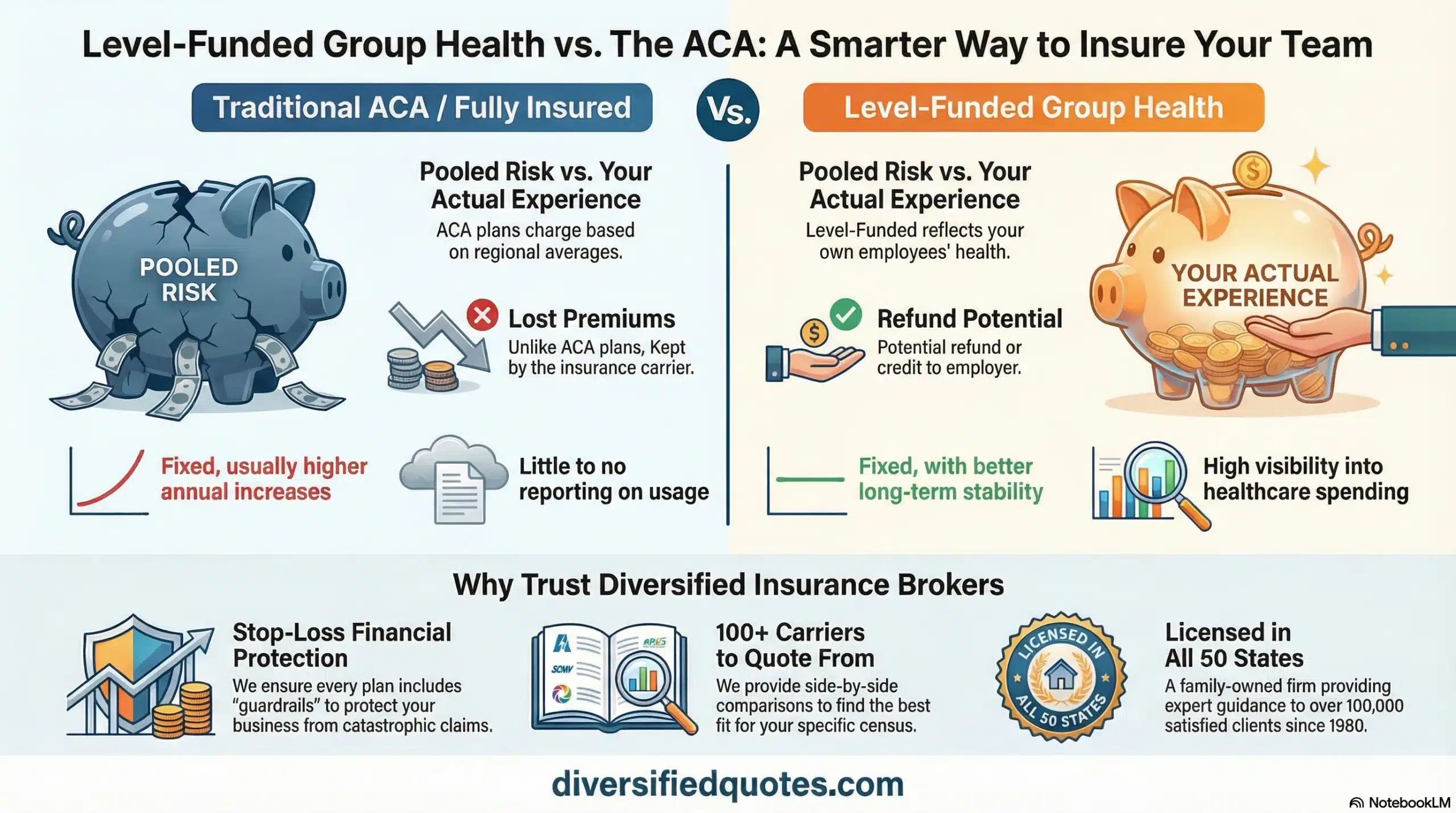
Talk With an Advisor Today
Choose how you’d like to connect—call or message us, then book a time that works for you.
Schedule here:
calendly.com/jason-dibcompanies/diversified-quotes
Licensed in all 50 states • Fiduciary, family-owned since 1980
FAQs: Can 1099 Contractors Get Group Level Funding?
Can 1099 contractors be included in a group level-funded health plan?
Yes — in many cases — but it depends on carrier appetite rather than a universal rule. Some level-funded carriers and third-party administrators will treat a defined contractor class as eligible when the business can document stable engagement, consistent hours, and a predictable participation profile. Other carriers limit eligibility strictly to W-2 employees. The most important step is matching your specific workforce structure to the carriers that accommodate it, rather than assuming either a blanket “yes” or “no.” Submitting a contractor-heavy census to a carrier that does not allow 1099 participation creates delays and declined applications that could have been avoided with proper carrier pre-screening.
Why do some carriers allow 1099s while others do not?
It comes down to underwriting philosophy and administrative design. Some carriers are built to handle defined contractor classes with clear documentation requirements, and their underwriting guidelines explicitly include a path for 1099 participation when conditions are met. Other carriers have designed their group health products for W-2 employees only and do not have the administrative framework to evaluate or manage contractor eligibility consistently. The carrier’s decision reflects their risk appetite, their stop-loss reinsurance arrangements, and their administrative capacity — not a general legal prohibition. That is why working with an independent group health broker who knows which carriers accommodate contractor classes produces better outcomes than generic applications to random carriers.
What makes 1099 participation more likely to be approved by a carrier?
Approval is most likely when contractors exhibit stability characteristics that underwriters can price predictably: long-term engagement relationships rather than short project assignments; consistent work schedules that meet or approximate full-time hours thresholds; a clearly defined and consistently applied class definition that the employer can document; and strong participation from the eligible contractor class. Clean census documentation that clearly separates W-2 and 1099 categories, with evidence of engagement duration and expected hours, is typically the difference between a smooth submission and a delayed or declined application. Employers who can demonstrate “this is a stable class with predictable participation and consistent documentation” consistently outperform employers who submit ad hoc contractor lists without supporting documentation.
What is the difference between owner/partner eligibility and 1099 contractor eligibility?
Owners, partners, and 1099 contractors all may receive 1099 forms, but they are treated as distinct categories in group health underwriting. Owners and partners are evaluated based on their entity structure — a sole proprietor, an S-corporation shareholder-employee, an LLC member, or a general partner each has specific rules governing group plan eligibility and the tax treatment of their coverage. In many entity structures, an owner participates as an employee; in others, they must access coverage separately. The 1099 form itself is not the determining factor for either group — it is the legal relationship and entity structure that govern eligibility. When we evaluate a business, we map every person into their correct underwriting category and confirm how the carrier treats each before designing the plan.
Does including 1099 contractors affect stop-loss pricing in the plan?
It can. Stop-loss underwriters evaluate the stability of the enrolled population when setting attachment points and premium. A contractor class that is stable, consistent, and well-documented tends to be priced similarly to a W-2 workforce of comparable size. A contractor class with high turnover, volatile enrollment, or uncertain commitment creates more perceived risk because the claims profile is harder to model predictably. When contractor turnover is high or participation is unpredictable, stop-loss carriers may require more conservative attachment points, charge higher premiums, or decline to include the contractor class in the stop-loss coverage at standard terms. This is why plan design for contractor-heavy groups should include explicit modeling of stop-loss options alongside the eligibility analysis — not as an afterthought.
What happens if we include contractors who later get reclassified as employees?
Worker misclassification is a separate legal and tax issue that can create downstream complications for group health plans. If workers classified as independent contractors are later determined by the IRS or Department of Labor to meet the legal standard for employees based on the employer’s control and direction, it can create tax liability, back-pay obligations, and potential plan eligibility disputes. From the group health perspective specifically, if the plan’s eligibility class was defined around contractor status and workers are reclassified as employees, the plan document may need updating and the carrier must be notified. This is why addressing worker classification questions with legal and accounting guidance before submitting a group health application is strongly recommended for businesses that use a significant contractor workforce and are uncertain about classification.
What coverage options exist for 1099 contractors who cannot join the group plan?
Several options exist for contractors who are excluded from the group plan or choose not to enroll. The ACA marketplace provides individual coverage for self-employed and independent workers, with premium tax credits available based on income — contractors should check marketplace eligibility during open enrollment or a qualifying life event. Short-term health insurance is available in most states as a bridge coverage option for contractors between engagements or during gaps in coverage, though it has limitations and does not qualify as ACA minimum essential coverage in all states. QSEHRA or ICHRA arrangements allow some employers to reimburse contractors for individual marketplace coverage costs on a tax-advantaged basis, effectively providing employer-funded coverage support without enrolling them in the group plan. Dental and vision coverage may also be available separately even when the contractor does not enroll in the group medical plan.
What are QSEHRA and ICHRA and how do they help employers support contractor coverage?
A Qualified Small Employer Health Reimbursement Arrangement (QSEHRA) allows eligible small employers — generally those with fewer than 50 full-time equivalent employees who do not offer a group plan — to reimburse employees and their dependents for individual marketplace coverage and qualified medical expenses on a tax-advantaged basis. An Individual Coverage Health Reimbursement Arrangement (ICHRA) allows employers of any size to reimburse employees for individual health coverage, with the flexibility to offer different contribution amounts to different employee classes. Both mechanisms require participants to have qualifying individual health coverage to receive reimbursements. Neither replaces a traditional group plan, but for businesses that cannot or choose not to offer a group plan to their contractor workforce, these arrangements can provide meaningful employer-funded support for contractor health coverage without the eligibility complexity of group underwriting. QSEHRA and ICHRA rules are specific and require proper implementation — a benefits advisor and CPA should be involved before establishing either arrangement.
Do we have to include all contractors if we include any?
Not necessarily. Many employers define eligibility to include only certain contractor classes — for example, contractors who have been engaged for 12 or more consecutive months and who work at least 30 hours per week. The key is that the class definition must be consistent, objective, and defensible — not chosen to favor specific individuals or exclude people selectively in ways that could be characterized as discrimination. Ad hoc enrollment decisions (choosing which contractors to include based on individual relationships rather than defined class criteria) create underwriting problems and potential compliance issues. When the eligibility class is clearly written, consistently applied, and well-documented, employers have significant flexibility in defining who qualifies for the group plan within the carrier’s allowable guidelines.
Is level funding a better fit than fully insured coverage for contractor-heavy businesses?
It depends on the employer’s specific workforce structure and priorities. Level funding offers more transparency, potential claims-performance-based surplus returns (depending on plan terms), and greater employer control over plan design — which can be attractive for employers who want insight into how their contractor population is using healthcare. However, level funding requires stable eligibility, consistent participation, and clean underwriting documentation — all of which can be more challenging for businesses with highly variable contractor rosters. Fully insured coverage is simpler administratively and may be more appropriate when the contractor population is unstable or when the employer does not want to manage the additional underwriting and documentation requirements that contractor inclusion in a level-funded plan requires. A side-by-side comparison that models both structures against your specific workforce typically makes the best answer clear.
What is the fastest way to find out if our 1099s can be included in a level-funded plan?
Start with a roster review. Once we understand who is W-2, who is 1099, how stable the contractor population is, what the expected participation looks like, and what the employer is willing to contribute toward each class, we can match you to carriers that allow 1099 participation and confirm the documentation needed before quoting. This pre-screening step prevents wasted time on carriers that will not accept your workforce structure and identifies the documentation gaps that would need to be addressed before submission. The review typically takes one conversation and a census — and it either confirms that a path forward exists with specific carriers and documentation requirements, or it clarifies that alternative coverage approaches for contractors are the more practical solution for your situation.
About the Author:
Jason Stolz, CLTC, CRPC, DIA, CAA and Chief Underwriter at Diversified Insurance Brokers (NPN 20471358), is a senior insurance and retirement professional with more than 25 years of real-world experience helping individuals, families, and business owners protect their income, assets, and long-term financial stability. As a long-time partner of the nationally licensed independent agency Diversified Insurance Brokers, Jason provides trusted guidance across multiple specialties—including fixed and indexed annuities, long-term care planning, personal and business disability insurance, life insurance solutions, Group Health, Travel Medical and Evacuation Insurance, and short-term health coverage. Diversified Insurance Brokers maintains active contracts with over 100 highly rated insurance carriers, ensuring clients have access to a broad and competitive marketplace.
His practical, education-first approach has earned recognition in publications such as VoyageATL, and contributions from his agency featured in Kiplinger and GoBankingRates— highlighting his commitment to financial clarity and client-focused planning. Drawing on deep product knowledge and years of hands-on field experience, Jason helps clients evaluate carriers, compare strategies, and build retirement and protection plans that are both secure and cost-efficient. Visitors who want to explore current annuity rates and compare options across multiple insurers can also use this annuity quote and comparison tool.
Explore More Group Health Insurance Options: Browse our complete guide to Level Funding, Self-Funded & ACA Alternatives — covering stop-loss coverage, tax benefits, 1099 options & ACA alternatives from 100+ carriers.
Explore More: Browse our complete Group Health Insurance guide — covering level funded plans, stop-loss coverage & group health solutions for businesses from 100+ carriers.
Last Reviewed: July 14, 2026 |
Reviewed by: Jason Stolz, CLTC, CRPC, DIA, CAA
Chief Underwriter, Diversified Insurance Brokers, Inc. | NPN: 20471358 | Diversified Insurance Brokers, Inc. — Licensed in all 50 states
Fact Checked by: Tonia Pettitt, CMIP©
Medicare Specialist, Diversified Insurance Brokers, Inc. | NPN: 14374308 | Diversified Insurance Brokers, Inc. — Licensed in all 50 states
Did you find this content helpful? Leave us a Google review — it helps others find trustworthy guidance too.
Editorial Standards: Diversified Insurance Brokers maintains rigorous editorial standards to ensure accuracy, clarity, and independence in all content. Learn more about our editorial standards and commitment to transparency.
