
Group Health Insurance for Construction Crews
Group Health Insurance for Construction Crews

Jason Stolz CLTC, CRPC, DIA, CAA
Group health insurance for construction crews is one of the most consequential decisions a construction employer makes — and one of the most frequently gotten wrong. The plan needs to work for people who start before dawn, move between job sites, operate heavy equipment, and may not have the time or energy to navigate complicated paperwork when they are hurt or sick. Group health insurance for construction crews done right means coverage that is accessible, networks that reach where workers actually live, and a cost structure the employer can sustain from one renewal to the next without annual budget shock. At Diversified Insurance Brokers, we work with construction companies, subcontractors, and trades-based employers of all sizes to build benefits programs that fit how the work actually gets done — not how a generic plan template assumes it does.
This page covers everything a construction employer needs to understand about group health insurance: why workers’ comp is not a substitute, what plan features matter most in the field, how networks must be evaluated for mobile crews, what drives cost in construction group health, and how to build a plan that stays sustainable through growth and workforce change. If you are ready to compare options now, the request form below starts the process.
Compare Group Health Options for Your Crew
We’ll review your crew size, budget, and risk profile to identify the most effective group medical structure.
Questions? Call 800-533-5969
Why Group Health Insurance Matters Differently in Construction
Construction employers often lean on workers’ compensation as the primary employee safety net, which makes intuitive sense — construction is a high-injury industry and comp coverage is mandatory. But workers’ compensation has a single, narrow purpose: it covers injuries that happen on the job, within a specific claims framework built around workplace incidents. It does not cover illness. It does not cover injuries that happen off-site. It does not cover routine care, prescriptions, blood pressure management, or any of the dozens of medical situations your crew faces in the course of living their lives. When a laborer has a respiratory infection, when a foreman’s spouse needs an ER visit, when an equipment operator’s back pain starts before a shift rather than during one — workers’ comp is irrelevant. Group health insurance fills the gap that workers’ comp leaves entirely open, which is most of the medical reality your workforce experiences.
There is also a retention and recruitment dimension that matters more in construction than in many other industries. Skilled trades workers are in genuine shortage across most of the country, and competition for experienced crew members is real. When a competitor offers health coverage and you don’t, or when your plan is inferior and employees know it, the cost shows up in turnover, in recruiting difficulty, and in the lower productivity that comes from constantly onboarding new people. A construction employer who understands how group medical insurance works and invests in a well-designed plan is not just complying with a good-practice norm — they are building a competitive advantage in the labor market that compounds year over year as the reputation for good benefits spreads in the trades community.
Beyond retention, health coverage directly affects productivity and safety. Workers who cannot afford to see a doctor delay treatment for conditions that worsen over time. A construction worker managing uncontrolled hypertension, untreated diabetes, or an undertreated musculoskeletal condition is a safety risk as well as a performance concern. Group health insurance that provides realistic, affordable access to primary care and prescription coverage is an investment in a safer, more reliable workforce — not simply a compliance or benefits line item on the budget.
The Construction Workforce Is Different — and the Plan Needs to Reflect That
Understanding what makes construction group health different from general commercial group health is essential to choosing the right plan structure. Construction workforces tend to skew younger on the field side and older on the supervision and management side, creating age diversity that affects both utilization patterns and pricing. Physical work accelerates certain types of musculoskeletal wear — back problems, shoulder injuries, knee degeneration, hand and wrist conditions — that develop over years of labor and lead to higher primary care and specialist utilization as workers age into their 40s and 50s. The plan needs to make it easy and affordable to address these conditions early, before they become the expensive acute events that drive renewal increases.
Construction workforces also frequently include variable worker classifications: full-time W-2 employees, part-time workers, seasonal hires, and 1099 subcontractors. Only eligible employees — typically full-time W-2 workers meeting a defined hours threshold — qualify for group health coverage, so the plan structure must clearly define eligibility in a way that matches the actual employment classifications the business uses. Confusion about who is and is not eligible creates administrative problems, compliance exposure, and employee frustration when workers assume they are covered and discover they are not.
The geographic mobility of construction work adds another layer of complexity that most standard group health designs do not automatically accommodate. When a crew is working a project 90 minutes from the company’s headquarters, in a county or region where the plan’s preferred network is thin, workers who need care face either inconvenient out-of-network situations or delayed treatment. Neither outcome is acceptable from a workforce stability standpoint. Network strategy for mobile construction crews has to be evaluated specifically — not assumed from the carrier’s marketing materials. Understanding the difference between group and individual benefit structures also helps employees understand why their employer-sponsored coverage works the way it does, particularly when they are accustomed to carrying individual plans.
Plan Features That Matter Most for Construction Crews
When designing group health coverage for construction employees, the plan features that deliver the most real-world value are not the same as what matters most for an office workforce. Construction crews need practical access, not premium features. The following plan elements consistently produce the most impact in construction settings.
Network breadth and geographic reach. This is the single most important feature for mobile crews. A plan with a narrow or geographically concentrated network creates real problems when job sites move. The ideal network for a construction employer covers the residential areas where employees live as well as the broader regional footprint where projects are located. Broad PPO networks are generally the most workable structure because they allow out-of-network access with predictable (if higher) cost sharing rather than creating a hard barrier. For employers with significant multi-state project exposure, verifying that the plan’s network is strong in all relevant operating geographies before selecting the carrier is essential.
Urgent care and telehealth access. Construction workers experience more acute care needs per capita than office workers — strains, cuts, eye injuries, respiratory infections from outdoor exposure, sudden illness on remote job sites. A plan that makes urgent care easy to access and affordable to use keeps workers out of the emergency room for non-emergency conditions, which reduces both employee out-of-pocket costs and employer claim spend. Telehealth access is increasingly important because workers on remote sites may be far from any care facility — a telehealth platform that can triage a symptom, provide a prescription, or assess whether an injury needs immediate in-person evaluation saves time, money, and disruption for both the worker and the employer.
Prescription drug coverage designed for physical workers. The prescription needs of construction crews are shaped by the physical nature of the work: pain management for musculoskeletal conditions, inflammation control, blood pressure and diabetes management, respiratory medications, and the medications associated with the chronic conditions that develop over years of physical labor. A plan with confusing formularies, frequent prior authorization requirements for common medications, or restricted pharmacy access creates gaps in treatment that show up as attendance problems, productivity loss, and — over time — higher claim costs as undertreated conditions escalate. Clear, accessible pharmacy coverage is not a luxury for construction group health — it is a functional requirement.
Straightforward cost-sharing that employees can understand and use. Construction employees, particularly field workers, tend to prefer simplicity. A plan with predictable copays for primary care and urgent care visits, a clear prescription tier structure, and straightforward deductible language performs better — in terms of employee satisfaction, utilization patterns, and plan retention — than a complex plan with multiple tiers, coinsurance percentages, and opaque rules about what triggers what cost. When employees understand how to use the plan, they use it appropriately. When they don’t, they either avoid care or end up in the most expensive care settings by default.
Network Strategy for Mobile and Multi-Site Construction Operations
Network strategy deserves separate attention because it is one of the areas where construction group health most commonly goes wrong. Many employers select a plan based on premium and plan design without rigorously evaluating whether the network actually works for where their employees live and where their projects run. The result is employees who face out-of-network situations they didn’t expect, bills they didn’t anticipate, and frustration with a plan they perceive as not working — even though the plan design may be perfectly appropriate in other respects.
The right evaluation starts with employee residential geography. Where do your employees live? What hospitals and primary care providers do they already use? Is the plan’s network strong in those specific zip codes? These questions should be answered with actual network lookup tools, not carrier assurances that the network is “broad.” Network directories are public and searchable, and verifying that key hospitals and common providers in your employees’ home communities are in-network is a 30-minute exercise that prevents years of employee frustration and plan dissatisfaction.
Then layer in job site geography. If your crews regularly work in regions where the plan’s network is thin — rural counties, border areas, regions dominated by hospital systems not contracted with the carrier — you need either a plan with explicit out-of-network coverage provisions that employees can actually afford to use, or a carrier whose network adequately covers those areas. A plan that is excellent near headquarters but fails 60 miles away where projects are located is not an adequate construction group health solution.
For construction companies with crews that work across multiple states, a national PPO or a plan that specifically supports multi-state coverage is worth the additional evaluation effort. The cost of resolving out-of-network billing disputes, the employee relations damage from unexpected bills, and the productivity loss from workers who delay care because they are unsure what is covered in a distant location all add up to costs that dwarf any premium savings from a plan with a geographically limited network.
What Drives Group Health Insurance Costs in Construction
Construction employers often assume that group health is simply going to be expensive because of the nature of the work, and they accept that framing without examining the specific cost drivers that are actually controllable. In reality, construction group health costs are shaped by the same factors that shape group health costs everywhere — but with some construction-specific dynamics that are worth understanding explicitly so they can be managed rather than simply absorbed.
Employee age and health profile. Older physical workers tend to have more expensive utilization profiles than younger ones. This is not unique to construction, but in an industry where workers often stay in the field into their 50s and 60s, the age distribution of the crew has a meaningful effect on premiums. This does not mean older workers should be disadvantaged — it means the plan design should support chronic condition management and preventive care that helps manage utilization for the older segment of the workforce.
Participation rate. Carriers price group health plans based in part on the assumption that the enrolled group represents a reasonably broad cross-section of eligible employees. When participation is low — only a fraction of eligible employees enroll — the enrolled pool tends to be those who most need coverage, which skews utilization and pricing upward. Contribution strategy directly affects participation: if the employer contribution is insufficient and the employee share is too high, healthy employees opt out and the plan is dominated by higher-utilizing members. A contribution strategy designed to encourage broad participation across the eligible group is one of the most effective cost-control levers available, and it requires no change to plan design.
Dependent enrollment and contribution strategy. Dependent coverage — spouses and children on the plan — significantly increases total plan spending, and construction employers must decide how much of that cost to subsidize versus pass through to employees. Many construction employers contribute strongly toward employee-only coverage and offer dependent coverage at higher employee cost, keeping the plan accessible for families without creating unlimited employer cost exposure. The right balance depends on the workforce’s demographic makeup and the employer’s retention priorities, but the decision should be made intentionally rather than by default.
Pharmacy and specialty drug trends. Pharmacy spend is increasingly a primary cost driver even in construction workforces that might seem unlikely to have high specialty drug exposure. GLP-1 medications for diabetes and weight management, specialty drugs for inflammatory conditions, and increasingly accessible biologics for musculoskeletal conditions are driving pharmacy cost growth across all employer segments. A plan with no pharmacy management strategy — no formulary controls, no specialty drug management, no generic substitution incentives — will experience faster pharmacy cost growth than one that addresses these drivers intentionally.
Site-of-care behavior. Where employees go when they need care matters enormously for total plan cost. ER use for non-emergency conditions is one of the most expensive utilization patterns in any group health plan, and construction workers — who may live in areas where urgent care access is limited, who work unconventional hours when primary care offices are closed, and who may not have good information about alternatives — tend to default to the ER at higher rates than office workers. Reducing ER utilization through urgent care promotion, telehealth availability, and clear employee education is one of the fastest-impact cost management levers in construction group health.
Plan Design Approaches That Work for Construction Employers
The most effective group health plan designs for construction crews balance three competing interests: adequate coverage that employees will actually value and use, cost-sharing structures that encourage appropriate utilization without creating hardship, and total cost that the employer can sustain from year to year without budget disruption. Getting all three right requires intentionality — not just accepting a carrier’s standard offering.
A two-option plan design — offering a value tier and a buy-up tier — works well in construction because it gives employees meaningful choice without forcing the employer to offer only the richest possible design to everyone. The value option is designed with lower premiums and stronger in-network incentives, making it the most accessible option for employees who are cost-conscious about their paycheck deductions. The buy-up option is designed with lower out-of-pocket costs for high healthcare utilizers — employees managing chronic conditions, families with regular specialist needs, or workers who simply prefer paying more monthly for less uncertainty when they need care. Positioning the value plan as the default while making the buy-up available gives the employer cost control without appearing to take options away from employees.
Elimination periods and waiting periods should be calibrated to the actual pace of construction hiring and the practical realities of crew employment. A 30-day waiting period is common and workable for most construction employers. Longer waiting periods may save costs in high-turnover segments of the workforce but can also create coverage gaps that damage retention for the workers the employer most wants to keep. The waiting period decision should be made in the context of the specific workforce dynamics of the business, not defaulted to an arbitrary number.
Reviewing group health insurance fundamentals provides a useful framework for these design decisions, and understanding minimum employee requirements ensures the plan structure being evaluated is actually available at the employer’s specific workforce size.
Small Crews vs. Growing Construction Operations: The Plan Structure Changes
The right plan structure for a small subcontracting crew of 8 is not the same as the right plan structure for a regional construction company with 80 employees across multiple job sites. Group health insurance for construction crews evolves as the business grows, and understanding when and how to transition between plan types prevents the employer from either overpaying for complexity they don’t need or underinvesting in structure that would reduce costs at a larger scale.
Small construction crews — typically under 50 eligible employees — typically access fully insured small-group plans, which provide simplicity, predictable monthly costs, and minimal administrative burden. These plans are appropriate when the employer is primarily focused on having a compliant, workable plan in place rather than optimizing every cost lever. The tradeoff is limited visibility into claims performance and a pricing model that may not reward favorable claims experience. For small crews, the priority is getting a stable plan in place, ensuring eligibility and participation are set up correctly, and building the administrative habits that will serve the company as it grows.
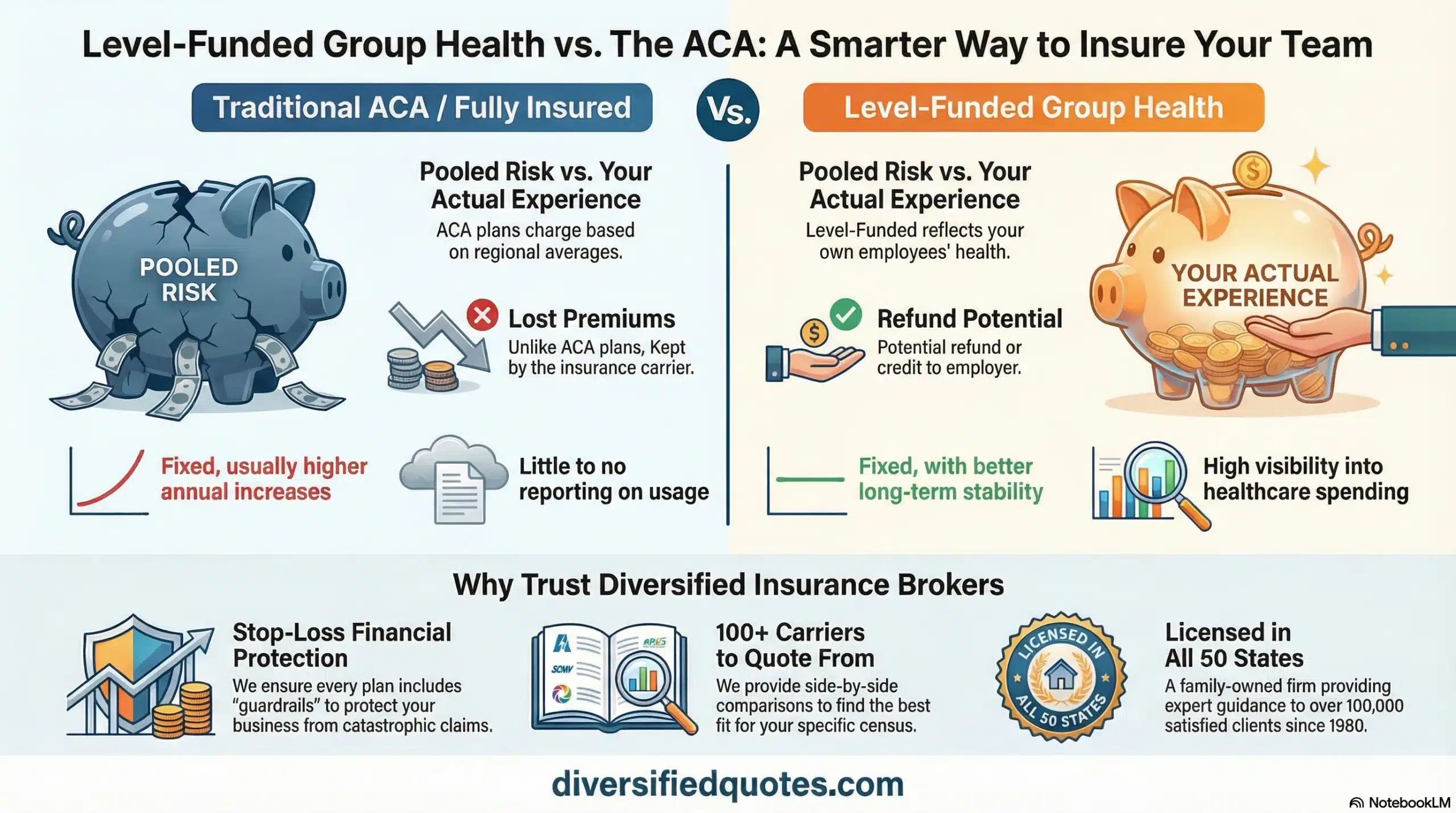
As crew size approaches and exceeds 50 employees, the calculus shifts. At this size, the employer typically has enough claims credibility to benefit from experience-based pricing, and the dollar magnitude of renewal increases is large enough to make plan management — not just plan selection — worthwhile. Level-funded plans, which provide potential claims refunds when performance is favorable, become available and often attractive at this size. Partially self-funded structures with stop-loss insurance become viable for employers willing to invest in the transparency and governance that makes them work. The employer’s role evolves from “pick a plan” to “manage a benefits program,” and that evolution requires either internal capacity or a broker partner who provides genuine plan management support rather than simply processing renewals.
Managing Renewal Volatility in Construction Group Health
Renewal increases are the most common frustration for construction employers with group health plans, and they are often accepted as inevitable when they are not. Understanding what actually drives renewal volatility — and which drivers are controllable — changes the conversation from “how do we accept this increase” to “what specific things can we do before next renewal to change the outcome.”
Renewal volatility in construction is driven by a combination of factors: aggregate medical trend (the industry-wide cost increase applied to all plans), the employer’s specific claims experience, changes in plan participation or dependent enrollment, and any large individual claims that occurred during the plan year. Of these, aggregate trend and large individual claims are the least controllable. But claims experience, participation levels, and plan design are all manageable — and when managed well, they can offset trend and produce renewals that are flat or manageable rather than double-digit increases.
The single most effective thing a construction employer can do to improve renewal outcomes is start the renewal process earlier. When review begins 90 to 120 days before renewal, there is time to compare carrier options, negotiate alternatives, evaluate plan design changes, and implement any adjustments before the deadline. When the process starts at 30 days, the only real option is accepting the renewal as presented or scrambling for an alternative on a timeline that rarely produces good results. An early, structured renewal process is the single highest-leverage administrative investment a construction employer can make in group health.
Compliance Obligations for Construction Group Health Plans
Group health insurance comes with compliance obligations that construction employers must manage alongside the plan’s operational requirements. These obligations include the Affordable Care Act’s employer shared responsibility provisions for applicable large employers (those with 50 or more full-time equivalent employees), ERISA plan document and summary plan description requirements, COBRA administration for employees who lose coverage eligibility, and HIPAA privacy requirements that govern how employee health information is handled.
For construction employers who are ALE (applicable large employer) status under the ACA, the requirement to offer minimum essential coverage to full-time employees and their dependents carries potential penalties for non-compliance that can be significant. ALE status is determined by counting full-time employees and full-time equivalent employees — including part-time and seasonal workers whose combined hours may push the employer across the 50-FTE threshold even if no single part-time worker is individually full-time. Construction employers with variable workforce compositions should confirm their ALE status with a knowledgeable advisor to ensure they understand their compliance obligations.
Even employers who are not ALEs are subject to ERISA requirements if they offer a group health plan, which means maintaining a compliant plan document, providing a Summary Plan Description (SPD) to employees, and following required notice and disclosure requirements. These obligations are not burdensome for employers who work with a broker who handles plan document maintenance and compliance notifications, but they can create exposure for employers who assume that simply purchasing a group health plan satisfies all legal requirements.
Employee Education: The Most Underused Cost Control Tool in Construction
Employee education is consistently underinvested in construction group health, and it is consistently one of the highest-return interventions available. When employees understand how to use their plan correctly — when to go to urgent care versus the ER, how to confirm a provider is in-network, how to use telehealth for minor issues, how prescriptions are tiered and why generic substitution matters — the utilization patterns of the plan improve. Better utilization means lower claims, and lower claims produce better renewals. No plan design change, no carrier switch, and no contribution adjustment produces the same sustained benefit as a workforce that uses the plan intelligently.
The investment required is modest. A single well-designed one-page guide distributed at open enrollment — explaining when to use urgent care vs. the ER, listing the telehealth number, explaining how to look up in-network providers, and walking through what happens when a prescription is filled — covers the decisions that account for most of the utilization impact. Following that with brief annual reminders at open enrollment reinforces the habits. Construction employees respond well to direct, practical information. Long plan booklets get ignored; one-page field guides get used.
Education also supports the recruitment and retention function of benefits. When a hiring manager can clearly and confidently explain what the plan covers and how to use it, benefits become a genuine selling point in job offers rather than a vague reference to “we have health insurance.” Candidates who have experienced poor employer coverage in previous jobs recognize and value a plan that is clearly explained and practically useful.
How Diversified Insurance Brokers Supports Construction Employers
At Diversified Insurance Brokers, we have worked with construction employers ranging from small subcontracting crews to multi-site regional operators, and we understand that group health for construction is not a generic problem with a generic solution. Our process starts with your specific workforce: crew size, geographic footprint, employment classifications, current coverage if any, and renewal history. From that starting point, we identify the plan structures that are realistically available and appropriate, compare them on total cost — not just premium — and present the tradeoffs clearly so you can make a decision based on information rather than urgency.
We assist with the full implementation process: plan documentation, employee communication materials, enrollment support, and payroll integration guidance. We also build a renewal governance calendar so that the renewal process starts on a timeline that produces real options rather than last-minute decisions. Our goal is to make group health insurance for construction crews a stable, predictable part of your business operations — not an annual crisis.
Get Group Health Options for Your Construction Crew
Tell us your crew size and goals, and we’ll present practical plan options with clear tradeoffs.
Questions? Call 800-533-5969
Financial Protection Essentials
Medicare updates, retirement rollover strategies, group coverage planning, and dental insurance comparison resources.
Related Pages
More resources that help construction employers qualify, compare structures, and plan for renewals.
Talk With an Advisor Today
Choose how you’d like to connect—call or message us, then book a time that works for you.
Schedule here:
calendly.com/jason-dibcompanies/diversified-quotes
Licensed in all 50 states • Fiduciary, family-owned since 1980
Group Health Insurance for Construction Crews — FAQs
Group health insurance for construction crews is an employer-sponsored medical benefits plan that covers routine care, illness, prescriptions, specialist visits, hospitalizations, and the full range of medical needs your workforce faces in the course of their lives — including everything that happens off the job site and off the clock. It is a fundamentally different product from workers’ compensation, which is a state-regulated liability program that specifically covers injuries occurring on the job within a defined workplace incident framework. Workers’ comp covers a narrow band of medical situations; group health insurance covers virtually everything else.
The distinction matters practically because construction employers sometimes operate under the assumption that workers’ comp provides adequate protection for their workforce. It does not. A construction worker who has a heart attack on a Sunday morning, whose child needs surgery, who develops diabetes, or who is in a car accident on the way to a job site is not covered by workers’ comp. Group health insurance is what provides that coverage. For construction employers who want to attract and retain skilled tradespeople in a competitive labor market, group health is not optional — it is a core compensation component that employees have come to expect and that competitors are offering.
Yes — many insurance carriers offer group health plans specifically for small groups, generally defined as employers with fewer than 50 eligible employees, with plan structures and pricing designed for smaller payrolls and simpler administration. Small construction companies can access fully insured small-group coverage that provides clear monthly premium obligations, standard network access, and minimal administrative setup requirements. The plan needs to define eligibility correctly — typically full-time W-2 employees meeting a minimum hours threshold — and the employer contribution needs to be set at a level that encourages adequate employee participation to satisfy carrier participation requirements.
For very small construction crews — under 10 employees — group plan availability varies by state and carrier, but options typically exist either through the traditional small-group market or through association-based group programs that some contractor associations and trade organizations offer. Reviewing minimum employee requirements for group health insurance before engaging with carriers helps set realistic expectations about which plan structures are available at a specific headcount. For small construction employers who are offering benefits for the first time, working with an independent broker who specializes in the construction segment is the most efficient path to a compliant, workable plan without over-engineering the solution for a size that doesn’t require it.
Network access for mobile construction crews is one of the most practically important plan design decisions, and it is also one of the most commonly underestimated. Group health plans use provider networks to establish which doctors, hospitals, and urgent care centers employees can visit at in-network cost sharing rates. When employees are working at a job site far from the carrier’s network concentration, they may face out-of-network situations when they need care — which means higher out-of-pocket costs and billing complexity that creates employee dissatisfaction and plan complaints.
The right approach is to evaluate network coverage in two ways: where your employees live and where your projects run. Routine care — primary care, prescription fills, specialist follow-up — happens near home, so the plan’s network needs to be strong in the residential areas of your workforce. Urgent and acute care may need to happen near job sites, so if projects regularly take crews to specific counties or regions, those areas need to be verified as well. Broad PPO plans with national or regional networks that include the geographies where your crews live and work are generally the most appropriate structure for construction. Narrow network HMO-style designs that restrict access to a defined provider panel are typically poorly suited to mobile construction workforces.
Group health premiums for construction companies are driven by the same factors that drive group health premiums in any industry — employee age distribution, plan design, geographic cost of care, participation rate, and dependent enrollment — with a few construction-specific dynamics layered in. The physical demands of construction work tend to accelerate musculoskeletal wear and increase acute care utilization relative to sedentary workforce profiles, which can put upward pressure on utilization and therefore renewal pricing as the workforce ages. However, this is a manageable dynamic rather than an inevitability: plan designs that encourage early treatment, support preventive care, and promote primary care utilization tend to produce better long-term cost trajectories than plans that make care inconvenient or expensive and lead workers to delay treatment until conditions become acute and expensive.
Participation rate is one of the most controllable premium drivers. When only high-utilizing employees enroll and healthier employees opt out because the plan is too expensive relative to their perceived need for coverage, the enrolled pool skews toward higher claimants and premiums rise. An employer contribution strategy designed to keep the employee premium share low enough to attract broad participation typically produces better pricing outcomes than a strategy that minimizes employer cost at the expense of participation. Pharmacy spend is increasingly a significant driver even in construction workforces — GLP-1 medications, specialty biologics for inflammatory conditions, and specialty medications for chronic disease management are raising pharmacy costs across all employer groups, and construction employers are not immune to these trends.
Eligibility for group health insurance is limited to eligible employees, which in the group insurance context typically means W-2 employees who meet a defined minimum hours threshold — usually 30 or more hours per week for ACA purposes, though employers may set different thresholds within legal parameters. Independent contractors classified as 1099 workers are generally not eligible for the employer’s group health plan because they are not employees. Seasonal employees may or may not be eligible depending on their hours, employment duration, and whether they trigger ALE counting under the ACA’s seasonal worker rules.
For construction employers with complex workforce compositions — and most construction businesses have some complexity here — the eligibility definition in the plan documents must accurately reflect the actual employment classifications being used. Including workers who are not employees in the group health plan creates legal and tax exposure. Excluding workers who should be classified as employees (rather than independent contractors) creates both coverage gaps and potential misclassification liability. The plan setup is not the place to discover classification problems that have existed for years in the business structure. Before finalizing group health eligibility rules, a construction employer with a mixed workforce should confirm that the employment classification approach is legally defensible, because the group health plan will make it visible and documented in a way that may not have been true previously.
Yes — construction employers offering group health plans are subject to a range of compliance obligations that depend on employer size, plan structure, and applicable state and federal law. The most significant federal compliance framework is the Affordable Care Act’s employer shared responsibility provisions, which require applicable large employers — those with 50 or more full-time equivalent employees — to offer minimum essential coverage to full-time employees and their dependents or face potential penalties. ALE determination includes full-time equivalents from part-time and seasonal workers, which means some construction employers who do not have 50 full-time employees may still be ALEs based on aggregate hours. Confirming ALE status annually is important for any construction employer with variable workforce sizes.
All employers who sponsor group health plans are subject to ERISA requirements regardless of size, including maintaining a written plan document, providing employees with a Summary Plan Description that clearly explains the plan terms, and following required notification and disclosure processes including COBRA notices, HIPAA notices, and annual enrollment disclosures. COBRA administration — ensuring former employees receive timely notification of their right to continue group coverage after leaving employment — is a specific compliance obligation that construction employers must manage carefully given the turnover patterns common in the industry. Missing COBRA notification deadlines creates legal exposure that the employer cannot retroactively cure. Working with a broker and a plan administrator who handle these compliance notifications as part of the service reduces the risk of inadvertent non-compliance in a high-turnover employment environment.
About the Author:
Jason Stolz, CLTC, CRPC, DIA, CAA and Chief Underwriter at Diversified Insurance Brokers (NPN 20471358), is a senior insurance and retirement professional with more than 25 years of real-world experience helping individuals, families, and business owners protect their income, assets, and long-term financial stability. As a long-time partner of the nationally licensed independent agency Diversified Insurance Brokers, Jason provides trusted guidance across multiple specialties—including fixed and indexed annuities, long-term care planning, personal and business disability insurance, life insurance solutions, Group Health, Travel Medical and Evacuation Insurance, and short-term health coverage. Diversified Insurance Brokers maintains active contracts with over 100 highly rated insurance carriers, ensuring clients have access to a broad and competitive marketplace.
His practical, education-first approach has earned recognition in publications such as VoyageATL, and contributions from his agency featured in Kiplinger and GoBankingRates— highlighting his commitment to financial clarity and client-focused planning. Drawing on deep product knowledge and years of hands-on field experience, Jason helps clients evaluate carriers, compare strategies, and build retirement and protection plans that are both secure and cost-efficient. Visitors who want to explore current annuity rates and compare options across multiple insurers can also use this annuity quote and comparison tool.
Explore More Group Health Insurance Options: Browse our complete guide to Group Health Insurance by Industry — covering law firms, consulting, construction, medical practices, schools & more from 100+ carriers.
Last Reviewed: June 9, 2026 |
Reviewed by: Jason Stolz, CLTC, CRPC, DIA, CAA
Chief Underwriter, Diversified Insurance Brokers, Inc. | NPN: 20471358 | Diversified Insurance Brokers, Inc. — Licensed in all 50 states
Fact Checked by: Tonia Pettitt, CMIP©
Medicare Specialist, Diversified Insurance Brokers, Inc. | NPN: 14374308 | Diversified Insurance Brokers, Inc. — Licensed in all 50 states
Did you find this content helpful? Leave us a Google review — it helps others find trustworthy guidance too.
Editorial Standards: Diversified Insurance Brokers maintains rigorous editorial standards to ensure accuracy, clarity, and independence in all content. Learn more about our editorial standards and commitment to transparency.
