
Small Business Group Health Insurance
As an Independent Group Health Insurance Broker, we compare fully insured, level-funded, and self-funded options across carriers to find the lowest cost coverage for your business.
Small Business Group Health Insurance

Jason Stolz CLTC, CRPC, DIA, CAA
Small business group health insurance helps employers with 2–50 employees offer professional-grade medical coverage while keeping costs predictable and benefits competitive. For many owners, the decision is not about checking a box — it is about recruiting and retaining great employees, improving stability, and protecting your team’s financial well-being when medical needs arise. A structured group plan can also create meaningful tax advantages and often provides stronger network access and plan value than many individual options, especially for teams that want consistent, long-term coverage.
The challenge is that small group health plans do not come in a single format. You can choose a traditional fully insured plan, explore hybrid approaches like level-funded arrangements, or evaluate a self-funded path for groups that want maximum transparency and cost control. The best choice depends on your headcount, budget, participation strength, how stable your employee roster is, and how much renewal volatility your business can tolerate year to year. If you are in the earliest research stage, start with 2-person group health insurance if you are right at the edge of eligibility, and review minimum employees for group health insurance to understand the most common qualification standards and documentation expectations before requesting quotes.
Compare Small Business Health Plans
See how small group plans can improve retention, strengthen coverage, and create a predictable monthly budget for your business.
How Small Business Group Health Insurance Works
When your business offers group health insurance, you are setting up a single employer-sponsored plan that covers eligible employees and — if you choose — eligible dependents. The employer typically pays a portion of the premium, and employees contribute the rest through payroll deductions. That shared structure spreads risk across the group and can make coverage more affordable and consistent than individual policies, especially when employees value stable networks and predictable benefits.
Most carriers define small groups as businesses with 2–50 employees, but the practical question is not just headcount — it is eligibility. Carriers typically want bona fide W-2 employees, and they often require minimum employer contributions and a minimum participation rate. If you are a micro-group, eligibility nuances matter more than anything else. An owner-and-one scenario can work when documentation and payroll structure are clean, but it can become difficult when the group is unstable or if the plan does not meet underwriting rules. For a direct walkthrough of what actually works at the smallest end of the market, see group health insurance for a 2-person business.
From an employer’s perspective, the plan is an ongoing business decision with predictable monthly billing, renewal pricing that must be evaluated each year, and compliance responsibilities such as eligibility definitions, waiting periods, and required notices. A strong plan does not just exist — it is designed to be understood, used, and renewed without shock. That outcome requires making decisions in the right order: confirm eligibility and participation strategy first, then choose the funding lane, then compare plan design and networks inside that lane.
Funding Models to Consider for Small Business Plans
Small business group health insurance is not one product — it is a category that includes multiple funding models. Choosing the right model is one of the most consequential decisions you will make because it affects not only your initial rate, but how renewals behave, how much transparency you get into claims, and whether you have pathways to long-term cost control. In practice, small employers typically evaluate three core approaches.
Fully insured plans are the traditional approach. You pay a fixed monthly premium, the carrier assumes the claims risk, and your cost is mostly determined by the carrier’s underwriting and renewal formula. Fully insured can be an excellent fit when simplicity is the top priority and you do not want any exposure to claims volatility. The tradeoff is that the structure typically includes carrier margin, premium taxes, and less transparency into what is driving long-term pricing.
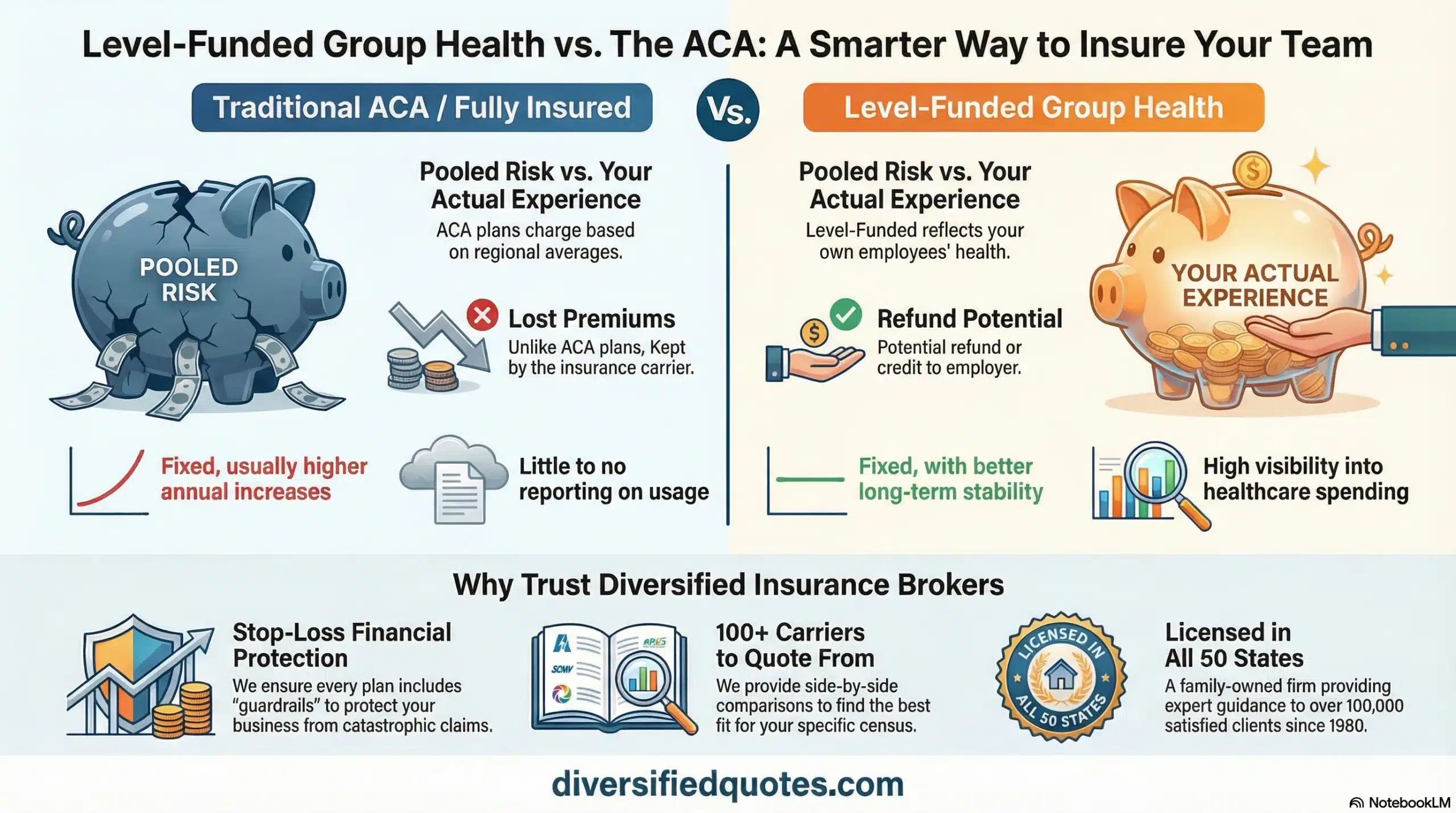
Level-funded plans are a hybrid designed specifically to make alternative funding realistic for smaller groups. In a level-funded arrangement, you pay a predictable monthly amount that generally includes estimated claims funding, fixed administrative costs, and stop-loss protection. If claims run lower than expected, many level-funded plans can return a portion of unused claims funding based on contract terms. For employers who want budget stability but still want a pathway to improved economics, level-funded is often a compelling middle lane. Our overview of why group level funding can make sense explains the mechanics in plain terms.
Self-funded plans place the employer in a more direct funding role. The employer pays claims as they occur and uses stop-loss insurance to cap major risk exposure. Self-funding can deliver strong transparency and customization, but it requires consistent cash flow and a willingness to manage the plan as an ongoing financial system rather than a passive premium purchase. The clearest foundation for this lane is what is self-funded group health insurance.
Why Stop-Loss Matters for Level-Funded and Self-Funded Plans
Stop-loss insurance is the protection layer that makes alternative funding practical for small employers. Without stop-loss, a single high-cost claim could create unacceptable volatility for a small group. With stop-loss in place, the plan can limit exposure above defined thresholds and create a more stable financial outcome across the plan year. This is why many level-funded proposals look simple on the surface — fixed monthly payments — but are powered by stop-loss mechanics underneath.
For employers evaluating level-funded designs, understanding stop-loss terms helps you compare proposals correctly. Specific deductible thresholds, aggregate protections, and contract basis can change the true risk profile and the total cost. Our plain-English breakdown of stop-loss insurance in level-funded plans covers the most common terms and how they impact underwriting. In practical terms, the goal is not to buy the lowest stop-loss premium — it is to align stop-loss structure with your risk tolerance, headcount, cash flow, and expected volatility.
Eligibility and Participation Rules That Drive Pricing
Most small group health plans are underwritten based on eligibility and participation rules, and these rules influence both whether you can be quoted and what the final pricing looks like. Carriers typically want eligible W-2 employees, consistent payroll, and a stable definition of who is benefits eligible. Participation matters because carriers do not want a plan where only employees who expect high claims enroll — which is why many carriers require a minimum participation percentage among eligible employees and why employer contributions affect that participation rate.
Workforce mix can also complicate eligibility. Contractors are a common point of confusion. In most cases, true 1099 contractors do not belong inside the group medical plan because carriers underwrite based on employee eligibility. If your workforce includes contractors and you want to stay compliant while still supporting them thoughtfully, review can 1099s get group level funding for an employer-friendly explanation of what is realistic without jeopardizing underwriting. And if you are right at the smallest end of the market, use minimum employees for group health insurance to validate baseline eligibility before requesting any quotes.
Plan Design: What to Compare Beyond the Monthly Premium
Many small businesses start by looking at the monthly premium. That is understandable, but it is not enough. Two plans can have similar premiums and deliver completely different employee experiences depending on network access, deductible structure, copays, coinsurance, and prescription coverage. A plan that employees can afford to use often has a bigger impact on retention and morale than a plan that simply has a lower sticker price.
Network strength is one of the biggest practical differentiators. Employees care about whether their doctors and preferred hospitals are in-network, and for employers with teams spread across multiple ZIP codes, network decisions become even more important. Deductible strategy is another major driver. High-deductible health plans paired with HSAs can be a strong fit for employers who want a lower premium and employees who are comfortable with more upfront cost in exchange for tax-advantaged savings — but an HDHP can be a poor fit if your team expects frequent care and will struggle with out-of-pocket exposure. Many employers solve this by offering two plan tiers: one leaner option and one richer plan for employees who prefer lower point-of-care cost.
Prescription coverage and pharmacy design can quietly drive the real-world value of a plan. Formularies, tiering, specialty drug handling, and mail-order expectations all affect employee out-of-pocket costs and satisfaction. Even in smaller groups, pharmacy utilization can influence renewals, especially if specialty medications are in play. A good plan design conversation includes pharmacy realities — not just medical deductibles. Finally, a plan must be understandable. Employee confusion creates HR burden, and clear plan explanations with a structured onboarding process reduce questions and improve satisfaction during the first 60 to 90 days after implementation.
Tax Benefits and the True Cost of Coverage
Small business group health insurance often provides meaningful tax efficiency. In many cases, employer-paid premiums are deductible as a business expense, and employee contributions can often be structured pre-tax depending on the plan setup and employer approach. These factors can reduce the net cost of coverage compared to an individual plan strategy, especially when the employer is trying to balance competitiveness with budget control.
Level-funded structures introduce additional planning considerations because the monthly amount typically combines multiple components: expected claims funding, fixed administration, and stop-loss. Understanding how these pieces work together helps employers compare proposals correctly. A practical reference for the employer side of this comparison is level-funded health insurance tax benefits explained, which is helpful when you want to evaluate the all-in cost rather than just the headline number. One of the biggest mistakes small employers make is comparing two plans that are not truly comparable — different networks, different plan designs, or different stop-loss structure — so defining your plan requirements first produces far cleaner comparisons.
Managing Costs and Renewals Without Destroying Benefits
Health insurance costs tend to rise over time, and renewals can feel unpredictable — especially for smaller groups where even a modest claims change can influence pricing. The goal is not to chase the cheapest option every year. The goal is to build a strategy that remains sustainable and competitive while still protecting your budget. Employers who approach renewals with a plan tend to get better results than employers who treat renewals as a last-minute emergency.
One high-impact method is offering plan choice — when employees have two options, you can control employer contributions while giving employees flexibility. Another lever is funding model selection at renewal. Employers who are tired of renewal spikes in fully insured plans often explore level-funded options because those models provide more transparency and, in favorable years, surplus return potential. If your team is very small, some level-funded models include provisions that can create refunds when claims are favorable — for a clearer explanation of what employers should realistically expect, see can small groups get health insurance refunds. And if you want a direct side-by-side of stop-loss structure and renewal behavior, return to understanding stop-loss insurance in level-funded plans before your next renewal conversation.
Model Fully Insured vs Level-Funded Side by Side
We’ll align networks and plan designs first, then compare funding models so you can see true cost and renewal behavior.
Comparison of Group Health Funding Models
| Funding Model | Predictability | Employer Risk | Refund Potential |
|---|---|---|---|
| Fully Insured | High — fixed monthly premiums | Low | None |
| Level-Funded | High — fixed payments with guardrails | Medium (capped with stop-loss) | Possible if claims are favorable |
| Self-Funded | Variable — claims-driven | Higher (offset by stop-loss) | Yes (claims savings stay with employer) |
Implementation, Enrollment, and Ongoing Administration
Small business group health insurance is easier when implementation is structured. Most employers benefit from a clean timeline: confirm eligibility rules, finalize plan selection, schedule enrollment, and ensure employees understand what is changing and how to use their benefits. A smooth implementation reduces confusion and prevents late enrollment issues that can create administrative problems or carrier disputes. Ongoing administration matters too — new hires, terminations, qualifying events, and renewal preparation all require consistent attention, and the right approach reduces the constant questions problem significantly.
If you want a straightforward employer question resource that mirrors what owners actually ask during quoting and implementation, review top questions employers ask about group health insurance. It complements this guide well and helps employers avoid the most common misunderstandings that delay underwriting or create confusion during onboarding. This is also where clarity around eligibility definitions becomes important, especially if your business has variable hours, seasonal staffing, or a mix of employee classes.
Request Small Business Group Health Quotes
Share basic details and we’ll return curated options with clear explanations and clean comparisons.
Financial Protection Essentials
Group health is one layer of a complete business protection plan. Explore these related areas to round out your coverage strategy.
Related Group Health Resources
Explore eligibility rules, funding models, stop-loss mechanics, and small-employer strategies to help you choose the right plan lane.
Talk With an Advisor Today
Choose how you’d like to connect—call or message us, then book a time that works for you.
Schedule here:
calendly.com/jason-dibcompanies/diversified-quotes
Licensed in all 50 states • Fiduciary, family-owned since 1980
FAQs: Small Business Group Health Insurance
No — businesses with fewer than 50 full-time equivalent employees are not required by federal law to offer health insurance. The ACA employer mandate applies only to employers with 50 or more FTEs. That said, many small businesses choose to offer coverage anyway because it provides a meaningful recruiting and retention advantage, and because employer-paid premiums are generally deductible as a business expense. For small employers with 25 or fewer FTEs and average wages below a certain threshold, the Small Business Health Care Tax Credit may also reduce the net cost of offering coverage further.
The decision to offer group health is ultimately about whether the value — better employee retention, tax efficiency, and competitive compensation — justifies the ongoing investment. Many small employers who run the comparison find that a well-structured group plan is more cost-effective than they expected, particularly when level-funded alternatives are included in the analysis. For a practical breakdown of the tax side, see level-funded health insurance tax benefits explained.
Fully insured plans charge a fixed monthly premium to the employer, and the carrier bears the claims risk. The employer knows exactly what they will pay each month, but they also pay the carrier’s margin, premium taxes, and overhead built into that rate. Renewals are driven primarily by the carrier’s statewide or regional claims data and the employer’s own experience, with limited transparency into what is actually driving costs. For employers who prioritize simplicity and dislike variable exposure, fully insured is a clean starting point.
Level-funded plans are a hybrid: the employer pays a fixed monthly amount that covers estimated claims funding, fixed administrative costs, and stop-loss protection. If claims are favorable during the year, many level-funded contracts return a portion of unused claims reserves. If claims are severe, stop-loss coverage absorbs the excess above the defined threshold. Self-funded plans take that a step further — the employer pays claims directly as they occur and relies on stop-loss for catastrophic exposure, gaining maximum transparency and potential savings in favorable years. Our page on why group level funding can make sense explains the middle lane in detail, and what is self-funded group health insurance covers the fully employer-directed model.
The most effective strategies combine plan design decisions with funding model choices. On the plan design side, offering an HDHP paired with an HSA can reduce the premium significantly while giving employees a tax-advantaged way to save for out-of-pocket costs. Offering two-tier plan options — one leaner and one richer — allows the employer to control contribution levels while still giving employees flexibility. Tiered networks and telehealth-first benefit designs can also reduce utilization costs over time without reducing the quality of care employees receive.
On the funding model side, employers who are frustrated with fully insured renewal volatility often find that transitioning to a level-funded design creates both more transparency and, in years with favorable claims, a return of unused reserves. That pathway is not guaranteed, but it changes the economics of renewal in a meaningful way. For small groups that have consistent claims patterns and enough administrative bandwidth, this shift can create sustained cost improvement over multiple renewal cycles. Reviewing can small groups get health insurance refunds explains what employers realistically should expect from that structure.
Many carriers require a minimum of two eligible employees to form a qualifying group — and in most cases, eligible means W-2 employees who are not spouses of the owner. The exact threshold varies by state and carrier, and some markets allow a solo owner with one W-2 employee to qualify while others require a slightly larger group. Documentation matters considerably at the micro-group level: payroll records, business filings, and confirmation that the employees are genuine W-2 workers — not 1099 contractors — are typically required before a carrier will issue a quote.
For employers right at the minimum eligibility boundary, the most useful first step is reviewing minimum employees for group health insurance to understand the most common standards, state-level variations, and documentation expectations. If you are an owner-and-one situation specifically, our companion page on 2-person group health insurance covers the real-world underwriting considerations in detail.
In most cases, no. Group health insurance carriers underwrite based on W-2 employee eligibility, and true independent contractors — workers who receive 1099 income and control their own work — generally do not qualify as eligible employees under standard group health underwriting rules. Including 1099 workers in a plan without proper eligibility documentation can create compliance problems and may jeopardize the group’s underwriting. This is a particularly important issue for businesses with a mix of employees and contractors.
That said, some employers explore whether contractors could access group-adjacent benefits through alternative funding structures. Our page on can 1099s get group level funding explains what is realistically possible and where the boundaries lie. If your workforce situation is complicated by a mix of worker classifications, it is best to address this before requesting quotes so that the group is correctly structured from day one.
Yes. The Small Business Health Care Tax Credit is available to eligible small employers who meet specific criteria: generally, the business must have fewer than 25 full-time equivalent employees, the average annual wage must fall below a threshold that adjusts annually, and the employer must pay at least 50% of the cost of employee-only coverage under a qualifying plan. The credit can cover up to 50% of the employer’s premium contribution (35% for tax-exempt organizations) and is specifically designed to incentivize small businesses to offer coverage to their employees.
Beyond the tax credit, employer-paid premiums are generally deductible as a business expense, and employee contributions made through a Section 125 cafeteria plan can be structured pre-tax, reducing payroll tax obligations for both the employer and employee. Level-funded arrangements can introduce additional planning considerations depending on how the plan components are structured. The most practical reference for understanding the full tax picture on the employer side is level-funded health insurance tax benefits explained.
Browse Small Business Group Health Insurance Guides
About the Author:
Jason Stolz, CLTC, CRPC, DIA, CAA and Chief Underwriter at Diversified Insurance Brokers (NPN 20471358), is a senior insurance and retirement professional with more than 25 years of real-world experience helping individuals, families, and business owners protect their income, assets, and long-term financial stability. As a long-time partner of the nationally licensed independent agency Diversified Insurance Brokers, Jason provides trusted guidance across multiple specialties—including fixed and indexed annuities, long-term care planning, personal and business disability insurance, life insurance solutions, Group Health, Travel Medical and Evacuation Insurance, and short-term health coverage. Diversified Insurance Brokers maintains active contracts with over 100 highly rated insurance carriers, ensuring clients have access to a broad and competitive marketplace.
His practical, education-first approach has earned recognition in publications such as VoyageATL, and contributions from his agency featured in Kiplinger and GoBankingRates— highlighting his commitment to financial clarity and client-focused planning. Drawing on deep product knowledge and years of hands-on field experience, Jason helps clients evaluate carriers, compare strategies, and build retirement and protection plans that are both secure and cost-efficient. Visitors who want to explore current annuity rates and compare options across multiple insurers can also use this annuity quote and comparison tool.
Explore All Group Health Insurance Options: Browse our complete Group Health Insurance guide — covering small business, company size options, industry-specific plans, level funding & ACA alternatives.
Last Reviewed: June 16, 2026 |
Reviewed by: Jason Stolz, CLTC, CRPC, DIA, CAA
Chief Underwriter, Diversified Insurance Brokers, Inc. | NPN: 20471358 | Diversified Insurance Brokers, Inc. — Licensed in all 50 states
Fact Checked by: Tonia Pettitt, CMIP©
Medicare Specialist, Diversified Insurance Brokers, Inc. | NPN: 14374308 | Diversified Insurance Brokers, Inc. — Licensed in all 50 states
Did you find this content helpful? Leave us a Google review — it helps others find trustworthy guidance too.
Editorial Standards: Diversified Insurance Brokers maintains rigorous editorial standards to ensure accuracy, clarity, and independence in all content. Learn more about our editorial standards and commitment to transparency.
