
Top Questions Employers Ask About Group Health Insurance
As an Independent Group Health Insurance Broker, we compare fully insured, level-funded, and self-funded options across carriers to find the lowest cost coverage for your business.
Top Questions Employers Ask About Group Health Insurance

Jason Stolz CLTC, CRPC, DIA, CAA
The top questions employers ask about group health insurance cluster around a predictable set of challenges that arise at the same decision points in nearly every business — when coverage is being offered for the first time, when a renewal is approaching and the current plan is no longer working, when the team is growing and existing eligibility rules no longer fit, or when a complex workforce structure creates genuine uncertainty about what is actually compliant. The top questions employers ask about group health insurance are not complicated in isolation, but they interact in ways that make the “right answer” for any specific employer depend entirely on how the questions are answered together: eligibility rules and participation requirements interact with contribution decisions, which interact with plan design choices, which interact with funding structure selection. Getting one element wrong cascades into problems elsewhere. This page works through the top questions employers ask about group health insurance in the sequence that most employers actually face them — from eligibility and structure through costs, compliance, and ongoing plan management — so that each question’s answer connects logically to the next.
At Diversified Insurance Brokers, Jason Stolz, CLTC, CRPC, DIA, CAA helps employers compare group health structures across fully insured, level-funded, and alternative funding models, working through the top questions employers ask about group health insurance in a way that produces a clean, compliant plan that matches the employer’s actual workforce and budget. Our resource on group health insurance overview covers the foundational framework before the detailed questions, and our resource on why group level funding covers the hybrid structure that answers several of the top questions employers ask about group health insurance simultaneously.
Get Answers and a Group Health Comparison
We’ll work through the top questions employers ask about group health insurance for your specific workforce, explain which funding structures are most appropriate, and produce side-by-side comparisons across carriers and plan designs.
Request a Group Health ReviewQuick Reference — The 15 Most Common Questions Employers Ask About Group Health Insurance
| # | Question | Short Answer |
|---|---|---|
| 1 | How do we qualify as a group? | Legal business entity + at least one W-2 employee + meet carrier eligibility requirements including participation and contribution minimums |
| 2 | How many employees do we need? | Most carriers require at least 2 eligible enrolling employees; some states allow single-employee groups; varies by carrier and state |
| 3 | What are our main funding options? | Fully insured (carrier assumes risk), level-funded (hybrid with refund potential), self-funded (employer assumes claims risk with stop-loss protection) |
| 4 | Can small groups access level-funded plans? | Yes — typically available from 5+ employees; requires clean documentation, stable census, and meeting participation thresholds |
| 5 | What is stop-loss insurance? | Protection layer in level-funded/self-funded plans: specific stop-loss caps individual claim exposure; aggregate stop-loss caps total annual claims; attachment points determine where protection starts |
| 6 | What are participation requirements? | Typically 50–75% of eligible employees must enroll; employees with other group coverage (e.g., spouse’s plan) can waive without counting against participation rate |
| 7 | What waiting period can we impose on new hires? | Maximum 90 days under ACA; can offer shorter periods; coverage must begin no later than the 91st day after hire |
| 8 | Are employer premium contributions tax-deductible? | Generally yes — employer contributions for group health benefits are typically treated as ordinary business expenses and are deductible |
| 9 | Does the ACA employer mandate apply to us? | Only if you have 50+ full-time equivalent employees (applicable large employer — ALE); employers under 50 FTEs are not required to offer coverage but must comply with ACA rules if they do |
| 10 | Can we include 1099 contractors in our group plan? | Generally no — most carriers underwrite group coverage around W-2 employees only; including 1099 contractors creates underwriting and compliance problems |
| 11 | What plan designs are available? | PPO, HMO, HDHP with HSA, EPO, POS — each with different cost-sharing structures, network access, and premium implications; multiple designs can be offered simultaneously |
| 12 | How does COBRA work for our plan? | Applies to employers with 20+ employees; allows former employees and dependents to continue coverage for up to 18-36 months at full premium cost (up to 102%); employer must send timely notices |
| 13 | What do carriers need to provide an accurate quote? | Census with DOBs and ZIP codes; clear eligible employee definitions; class structure if multiple employee classes; contribution and participation structure; prior carrier information |
| 14 | How do we manage renewals and avoid cost surprises? | Start renewal review 90+ days early; maintain stable eligibility and participation; compare multi-year cost projections not just first-year premium; model plan design changes alongside funding options |
| 15 | What alternatives exist if traditional group coverage isn’t feasible? | ICHRA (reimbursement for individual coverage, any size employer), QSEHRA (reimbursement for employers under 50 FTEs), marketplace SHOP plans, short-term medical for gap situations |
Q1 — How Does a Business Qualify for Group Health Insurance?
Among the top questions employers ask about group health insurance, “how do we qualify” is typically the first and most foundational. Group health insurance eligibility is based on three core requirements that apply regardless of carrier or plan type: a legitimate business entity, common-law employees on W-2 payroll, and the ability to meet minimum participation and contribution standards. Each of these requirements has practical implications that determine not just whether a group qualifies, but which plans are realistically available and how the application process works.
The business entity requirement is straightforward: the employer must be a legally recognized business — corporation, LLC, partnership, sole proprietorship, nonprofit — that can document its structure, ownership, and operations to the carrier’s satisfaction. This documentation typically includes state business registration, an EIN (Employer Identification Number), and tax filings that demonstrate the business is operational rather than newly formed for the purpose of obtaining group insurance.
The employee requirement connects directly to the carrier’s underwriting framework: group health plans are priced based on the assumption that a real employee group is being insured, with risk spread across multiple individuals and dependents. Most carriers require at least two eligible employees who actually enroll — not two employees who theoretically could enroll. The distinction matters because participation requirements measure actual enrollment as a percentage of eligible employees, and meeting that threshold is as important as the employee count itself. Our resource on minimum employees for group health insurance covers the specific minimums that apply at the carrier level and how state rules interact with carrier minimums in specific markets.
Q2 — What Are Participation Requirements and How Do They Work?
Participation requirements are among the most practically consequential of the top questions employers ask about group health insurance — and the most commonly misunderstood. A participation requirement specifies what percentage of eligible employees must enroll in the group plan for the carrier to accept the group. This requirement exists because carriers price group health based on risk spreading: if only unhealthy employees enroll while healthy ones opt out, the claims pool becomes adversely selected and the pricing model breaks down.
Most carriers require between 50% and 75% of eligible employees to participate. The specific threshold varies by carrier, state market, and plan type. The key planning detail is how “participation” is calculated: employees who waive coverage because they have other group coverage — most commonly through a spouse’s employer plan — typically count as valid waivers and do not negatively affect the participation rate calculation. An employee who simply prefers not to enroll without having other group coverage, by contrast, counts against participation. This distinction means that a group of eight employees where two waive because their spouses have employer coverage may easily meet a 75% participation requirement with only six enrolling, while the same eight-employee group where two simply decline without other coverage would fall below many carriers’ minimums with six enrolling.
One important tactical window for small employers who struggle with participation requirements: during the annual November 15 to December 15 period in the small group market, carriers are often required to accept small employer applications without imposing minimum participation or minimum contribution requirements for the following plan year. This annual window allows employers who have previously been unable to meet participation thresholds to obtain coverage during this specific enrollment period. Our resource on small business group health insurance covers how this annual window works in the small group market context and how employers can plan around it.
Q3 — What Are the Main Funding Options and How Do They Differ?
The top questions employers ask about group health insurance almost always include the funding structure question — and it is often where the conversation gets most confusing because different funding options create very different financial mechanics, risk exposures, and administrative requirements even when the plan designs and network coverage look similar on paper. The three primary funding structures available to most employers are fully insured, level-funded, and self-funded, and each represents a different answer to the fundamental question: who bears the financial risk when employees use healthcare?
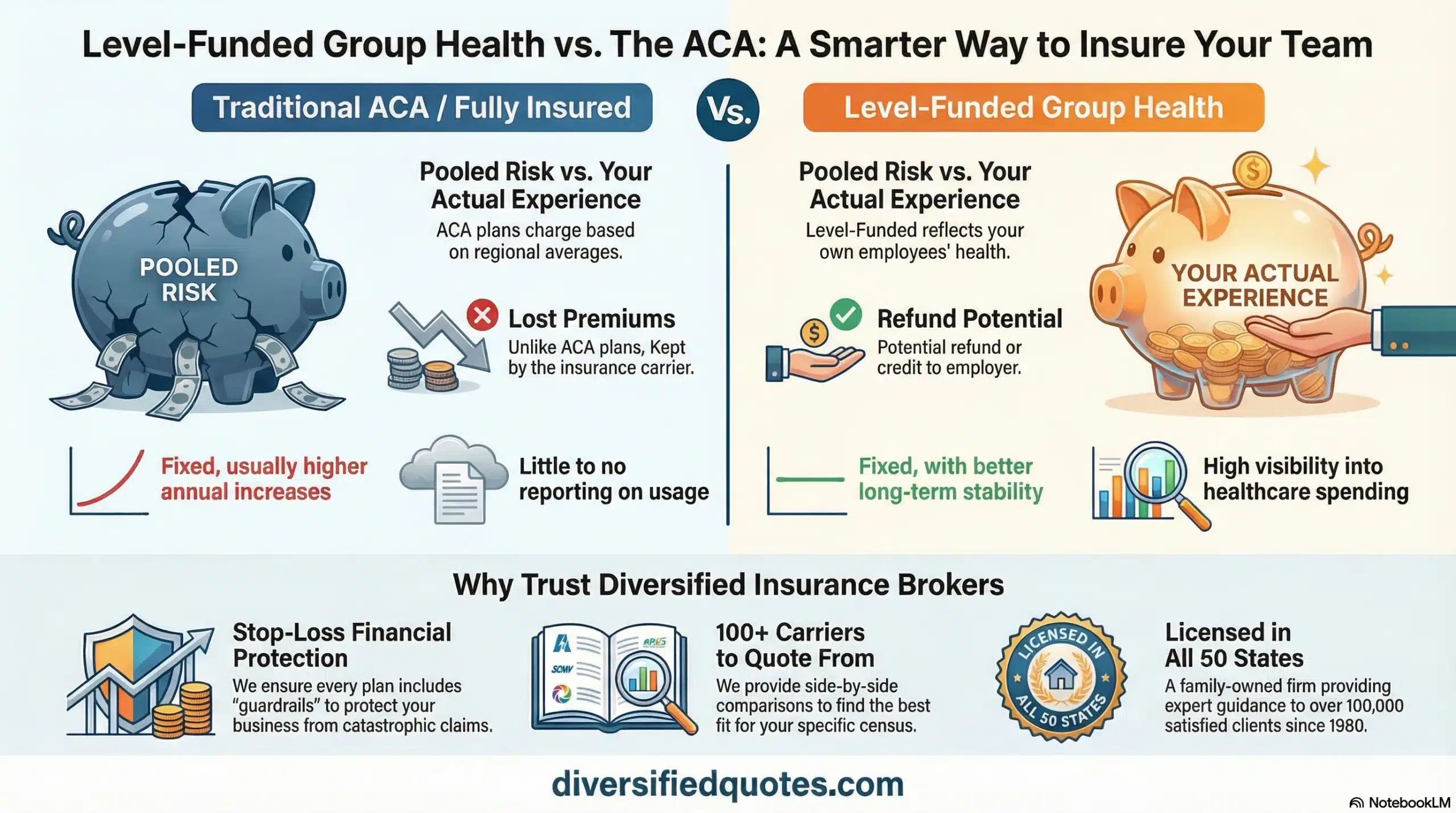
In a fully insured plan, the employer pays a fixed premium to the carrier and the carrier bears the financial risk of the group’s claims. If the group has a bad claims year, the carrier absorbs the loss and the employer’s cost for that year is limited to the premium already paid. If the group has an excellent claims year, the carrier retains the savings — the employer receives no refund or credit. Fully insured plans provide maximum cost predictability and minimum administrative burden. They are typically the most appropriate choice for employers who want simplicity, who have small or volatile employee populations, or whose workforce demographics make claims modeling difficult. The trade-off is that fully insured premiums are priced conservatively to cover the carrier’s claims risk, which means healthy groups often pay more than their actual utilization warrants.
In a level-funded plan, the employer pays a fixed monthly amount that appears similar to a traditional premium but is actually divided among three components: a claims funding pool, stop-loss insurance coverage, and administrative fees. The employer is technically self-funding the claims component, but the fixed monthly payment and stop-loss protection create a predictable maximum cost that feels like a traditional premium. The difference appears at year-end: if the group’s actual claims come in below the funded level, the unused claims fund balance is returned to the employer as a refund or applied to future periods, depending on the contract terms. If claims exceed the funded level, the stop-loss insurance covers the excess above defined attachment points. Level-funded plans are increasingly available to smaller employers and represent an attractive middle ground between the simplicity of fully insured and the long-term economics of full self-funding. Our resource on can small groups get health insurance refunds covers how the refund mechanism works in practice and what determines whether a specific group is likely to realize meaningful refunds. Our resource on level-funded health insurance tax benefits explained covers the distinct tax treatment implications of the level-funded structure.
Full self-funding places the employer directly in the claims-paying role: the employer funds claims as they occur from a dedicated claims account, protected by stop-loss insurance that caps the maximum exposure for individual large claims and for total annual claims. Self-funding is most common among larger employers — among covered workers at companies with 200 or more employees, approximately 80% are in self-insured plans as of 2025 — because the risk pooling and administrative infrastructure work better at scale. Our resource on what is self-funded group health insurance covers the full self-funding framework including stop-loss structure, claims administration, and when the economics typically favor this approach over the alternatives.
Q4 — How Does Stop-Loss Insurance Work in Level-Funded Plans?
Stop-loss insurance is the protection layer that makes level-funded and self-funded group health plans viable for employers who cannot absorb unlimited claims exposure. Among the top questions employers ask about group health insurance when evaluating level-funded structures, stop-loss mechanics are the element that most often requires clear explanation because the terminology — attachment points, specific vs. aggregate, contract basis, lasers — is unfamiliar to most business owners and HR leaders who have only managed fully insured plans.
Specific stop-loss insurance protects against any single individual’s claims exceeding a defined threshold in a plan year. If the specific stop-loss attachment point is $75,000, the employer’s self-funded claims pool bears the first $75,000 of any individual’s annual claims, and the stop-loss carrier reimburses claims above that threshold. This protection ensures that one catastrophic claim — a premature birth, a cancer diagnosis, a major surgery — cannot single-handedly overwhelm the employer’s claims fund.
Aggregate stop-loss insurance protects against the group’s total annual claims exceeding a defined level — typically set at a percentage above the expected annual claims for the group. If total claims for all covered members come in above the aggregate attachment, the stop-loss carrier reimburses the excess. Aggregate stop-loss prevents a broadly bad health year from producing an unmanageable total claims cost even when no single individual’s claims trigger the specific stop-loss threshold.
Contract basis is the technical term for how the stop-loss policy determines which claims count toward the attachment point calculation in a given contract year — a distinction that matters when claims span calendar year boundaries or when an individual is diagnosed late in one plan year but treated primarily in the next. The common contract basis structures are 12/12 (claims incurred and paid in the same plan year), 12/15 (claims incurred in the plan year but paid within 15 months), and 12/18 (15-month payment window). Our resource on understanding stop-loss insurance in level-funded plans covers these mechanics in detail and explains why contract basis terms can materially affect the effective protection a stop-loss policy provides.
Q5 — What Is the ACA Employer Mandate and How Does It Apply?
Among the top questions employers ask about group health insurance with the highest stakes for non-compliance, the ACA employer mandate is near the top of the list. Under the ACA, employers with 50 or more full-time equivalent employees — classified as Applicable Large Employers (ALEs) — are required to offer affordable, minimum-value group health coverage to at least 95% of their full-time employees and those employees’ children up to age 26, or face potential IRS penalties. The mandate does not require employers to offer coverage to spouses or part-time employees, but the FTE calculation that determines ALE status includes a formula that converts part-time hours into full-time equivalents, meaning an employer with many part-time workers can cross the 50-FTE threshold even if few or no individual employees work full-time hours.
Coverage is considered “affordable” for ACA employer mandate purposes if the employee’s required contribution for employee-only (self-only) coverage does not exceed a defined percentage of the employee’s household income. The IRS adjusts this affordability threshold annually: for 2025, the affordability threshold is 9.02% of household income. Because household income is not directly known by employers at the time of plan design, the ACA provides safe harbor methods — including using the employee’s W-2 wages or the federal poverty level — that allow employers to design contribution structures that satisfy the affordability standard without knowing individual household income figures.
For employers under the 50-FTE threshold — the majority of small businesses — the employer mandate does not apply, and offering group health insurance is entirely voluntary. However, if coverage is offered, it must comply with all applicable ACA requirements including the 90-day maximum waiting period, prohibition on pre-existing condition exclusions, required coverage of essential health benefits (for fully insured small-group plans), dependent coverage to age 26, and elimination of lifetime and annual benefit limits on essential health benefits. Our resource on creditable coverage by employer size covers how employer size affects which ACA requirements apply and how coverage structures should be designed with those requirements in mind.
Q6 — How Long a Waiting Period Can We Impose on New Employees?
The new hire waiting period question is one of the top questions employers ask about group health insurance because it sits at the intersection of plan design, competitive recruiting, and ACA compliance requirements. Under the ACA, group health plans may not impose a waiting period for new employees that exceeds 90 calendar days. Coverage must begin no later than the 91st day after the new hire date (counting all calendar days including weekends and holidays). Shorter waiting periods are permitted — some employers choose immediate eligibility on date of hire, while others implement 30-day or 60-day windows. The 90-day maximum is a ceiling, not a floor or a recommendation.
The employer’s choice of waiting period affects both administrative timing and employee experience at the point of hire. A 30-day waiting period means new employees can expect coverage to start in roughly a month; a 90-day waiting period means new employees may need to bridge nearly three months without employer-sponsored coverage. For employees who are leaving prior employer coverage, the gap between coverage end at the prior employer and coverage start at the new employer can be addressed through COBRA continuation from the prior plan, marketplace Special Enrollment Period coverage triggered by the job change, or short-term medical coverage during the gap period. Our resource on how short-term health insurance can bridge the coverage gap covers this interim coverage option for employees in transition.
Q7 — What Plan Designs Are Available and How Do We Choose?
Plan design is where many of the top questions employers ask about group health insurance become most intensely practical — because the plan design directly determines employee out-of-pocket costs, network access, and day-to-day experience using the benefit. The major plan design categories available in the group health market are PPO (Preferred Provider Organization), HMO (Health Maintenance Organization), HDHP with HSA (High Deductible Health Plan with Health Savings Account), EPO (Exclusive Provider Organization), and POS (Point of Service) plans. Each design makes a different trade-off between employee choice, cost-sharing structure, and premium.
PPO plans provide maximum network flexibility — employees can use in-network providers for lower cost-sharing or out-of-network providers at higher cost-sharing without a referral requirement. PPOs typically carry higher premiums than more restrictive network designs, but they minimize employee friction around access and specialist care. They are a strong fit for workforces that are geographically distributed, have existing patient-provider relationships, or prioritize flexibility and minimal administrative burden for employees.
HMO plans restrict covered care to an in-network provider network, require the selection of a primary care physician, and often require referrals for specialist care. In exchange for this restriction, HMOs typically offer lower premiums and more predictable cost-sharing. They work well for geographically concentrated workforces in markets where strong HMO networks exist and where employees are not deterred by the referral requirement.
High-deductible health plans paired with HSA eligibility reduce the employer’s premium cost — often significantly — by shifting the initial cost-sharing to employees through a higher deductible. Employees who enroll in qualifying HDHP coverage can contribute to a Health Savings Account pre-tax, which they can use to pay deductible and cost-sharing amounts. HDHPs work well for workforces with relatively healthy demographics who benefit from lower premiums and can fund HSA contributions, but they can create financial hardship for employees with ongoing healthcare needs who face substantial out-of-pocket costs before the deductible is met. Employers often offer both HDHP and lower-deductible options simultaneously to serve different employee needs. Our resource on group health insurance cost for small business covers how plan design choices affect the premium and total cost picture that employers budget against.
Q8 — How Does COBRA Work and What Are Our Obligations?
COBRA (Consolidated Omnibus Budget Reconciliation Act) continuation coverage is one of the top questions employers ask about group health insurance because the obligations it creates — notice requirements, election periods, premium rules, and coverage duration — represent a significant compliance responsibility that arises every time an employee leaves the organization, has hours reduced below eligibility thresholds, or experiences another qualifying event. COBRA applies to employers with 20 or more employees; smaller employers may be subject to state mini-COBRA laws that vary by state.
Under COBRA, when a qualifying event occurs — termination of employment (other than for gross misconduct), reduction in hours below the eligibility threshold, death of the covered employee, divorce or legal separation, loss of dependent child status, or Medicare entitlement of the employee — the employer is required to provide eligible individuals an election notice explaining their COBRA continuation rights. The election notice must be provided within a specific timeframe, the qualifying individual has 60 days from the notice date to elect continuation, and if COBRA is elected, coverage is retroactive to the qualifying event date. COBRA coverage can continue for up to 18 months for employees who lose coverage due to reduced hours or termination, and up to 36 months for dependents in certain qualifying events. The cost of COBRA coverage can be charged to the individual at up to 102% of the total plan premium (employee share plus employer share plus a 2% administrative fee).
For employers, the most common COBRA compliance failures are notice timing errors — sending the qualifying event notice late or failing to send it entirely — and administrative errors in tracking which individuals have elected COBRA and whether their premium payments are current. Our resource on how to set up group health insurance for employees covers the administrative infrastructure that supports COBRA compliance alongside enrollment, eligibility tracking, and payroll deduction management.
Q9 — What Do Carriers Need to Quote Group Health Accurately?
Among the top questions employers ask about group health insurance at the point of actually beginning the quoting process, “what information do carriers need” is one of the most operationally important. Carriers price group health based on the demographics and risk characteristics of the eligible employee population, the plan design being requested, and the employer’s contribution and participation structure. The quality and completeness of the information submitted determines not just the accuracy of the quote but in many cases the availability of the quote at all — incomplete submissions often result in delayed quotes, conservative pricing assumptions, or requests for additional information that extend the timeline.
A complete group health quote submission typically includes: an employee census with each eligible employee’s date of birth, ZIP code, coverage tier (employee only, employee plus spouse, employee plus children, family), and employment status (full-time or part-time); the employer’s proposed contribution structure (how much the employer will pay toward employee-only coverage and toward dependent coverage); the desired effective date; the prior carrier and prior carrier rates if applicable; and any specific plan design preferences (deductible levels, network type, HSA-eligible HDHP requirements). For level-funded quotes, carriers may also request claims history from the prior plan if available — which can significantly improve the accuracy and favorability of the initial pricing if the group’s claims history is favorable.
The single most common improvement that produces better quote outcomes for employers is census accuracy — ensuring dates of birth and ZIP codes are correct, that dependent counts reflect actual anticipated enrollment, and that any employees with other group coverage who plan to waive are noted. Carriers priced on incorrect census data produce premiums that may be materially different from the actual renewal cost once corrections are made. Our resource on group health insurance for volunteer organizations covers the employee classification decisions that affect census completeness for organizations with complex staffing structures.
Q10 — How Do We Manage Renewals and Avoid Cost Surprises?
Among the top questions employers ask about group health insurance, the renewal management question is where small and midsize employers lose the most money — not because renewal increases are inevitable, but because late-starting renewal reviews force rushed decisions that default to acceptance of whatever renewal rate the current carrier proposes. A 90-day minimum lead time before the renewal date is the baseline recommendation: it provides enough time to obtain competitive quotes from alternative carriers, model plan design changes that could reduce costs while preserving coverage quality, and evaluate whether a different funding structure (most commonly, transitioning from fully insured to level-funded) produces a better economic outcome.
Long-term renewal stability is also shaped by decisions made at plan inception. Choosing a plan design that matches the workforce’s actual utilization patterns — rather than the design with the lowest first-year premium — typically produces smoother renewals because the claims experience is more predictable. Employers who choose plans with very low employee cost-sharing (low deductibles, rich coverage) for a workforce that uses healthcare heavily will face higher and more volatile renewal increases than employers who choose plan designs that more accurately reflect their actual risk profile. Our resource on get a 2nd opinion on your group health insurance quote covers the renewal comparison process for employers who want an independent review of whether their current renewal is competitive.
Get a Side-by-Side Group Health Comparison
We model fully insured vs. level-funded projections, compare plan designs within each funding structure, and help you identify which combination of employer contribution, plan design, and funding approach produces the best outcome for your workforce and budget.
Request a Group Health ReviewRelated Group Health Planning Resources
Explore the group health guides most directly relevant to the top questions employers ask about eligibility, funding structures, stop-loss mechanics, and plan management.
Financial Protection Essentials for Employers
Connect group health planning with cost benchmarks, industry-specific guides, and complementary coverage resources.
Use the options below to jump to the group health page that matches your workforce size.
Talk With an Advisor Today
Choose how you’d like to connect—call or message us, then book a time that works for you.
Schedule here:
calendly.com/jason-dibcompanies/diversified-quotes
Licensed in all 50 states • Fiduciary, family-owned since 1980
Frequently Asked Questions: Top Questions Employers Ask About Group Health Insurance
How do small businesses qualify for group health insurance?
The top questions employers ask about group health insurance typically begin with qualification — and the framework is consistent across most states and carriers. To qualify, a business must be a legally recognized entity, must have at least one common-law W-2 employee (most carriers require at least two who actually enroll), must meet minimum participation requirements (typically 50–75% of eligible employees must enroll), and must offer a minimum employer contribution toward employee premiums. The eligible employee group must be defined consistently using clear class rules — and employees who waive because they have other group coverage (such as a spouse’s employer plan) typically do not count against participation. Businesses that struggle with participation during the year may find the November 15 to December 15 annual enrollment window in the small group market available without minimum participation requirements in many states.
What is the difference between fully insured, level-funded, and self-funded group health?
This is one of the top questions employers ask about group health insurance because the funding structure determines the financial mechanics, risk exposure, and long-term economics of the plan even when the plan design and network coverage appear similar. In a fully insured plan, the employer pays fixed premiums and the carrier assumes all claims risk — maximum simplicity, no year-end refund potential. In a level-funded plan, the employer pays a fixed monthly amount divided among a claims fund, stop-loss insurance, and administrative fees — similar monthly cost to fully insured, but with potential year-end refund if claims are favorable and more claims transparency throughout the year. In a self-funded plan, the employer bears claims risk directly, protected by stop-loss insurance — most common for larger groups, provides maximum control and potential savings but requires more administrative infrastructure and comfort with claims exposure.
What is the maximum waiting period for new employees under the ACA?
Under the ACA, group health plans cannot impose a waiting period for new employees that exceeds 90 calendar days. Coverage must begin no later than the 91st day after the hire date, counting all calendar days including weekends and holidays. Shorter waiting periods are permitted — employers may choose 30-day, 60-day, or immediate-eligibility waiting periods. The 90-day maximum is a compliance ceiling, not a recommendation. During the waiting period, employees who are leaving prior employer coverage may need bridge coverage through COBRA continuation, marketplace Special Enrollment Period coverage, or short-term medical insurance.
Does the ACA employer mandate apply to our business?
The ACA employer mandate applies to Applicable Large Employers (ALEs) — businesses with 50 or more full-time equivalent employees. ALEs must offer affordable, minimum-value coverage to at least 95% of their full-time employees and those employees’ children to age 26, or face potential IRS penalties. The FTE calculation includes a conversion of part-time hours that can push businesses above the 50-employee threshold even without 50 full-time workers. Employers under 50 FTEs are not required to offer coverage, but if coverage is offered, all applicable ACA requirements still apply — including the 90-day maximum waiting period, prohibition on pre-existing condition exclusions, dependent coverage to age 26, and elimination of lifetime and annual benefit limits on essential health benefits.
Can we include 1099 contractors in our group health plan?
Generally no — most carriers underwrite group health coverage around bona fide W-2 employees and will not include 1099 independent contractors in the eligible employee group. Attempting to include 1099 contractors creates underwriting complications (the carrier’s risk model is based on a true employment relationship), potential compliance issues with benefit plan rules, and may constitute misrepresentation in the application that could affect coverage at the worst possible time — when a claim is filed. If your workforce includes a mix of W-2 employees and 1099 contractors, the cleanest approach is to build the group plan around the W-2 employee population and address the 1099 workers’ health coverage needs through separate channels.
How do we manage group health insurance renewals effectively?
Among the top questions employers ask about group health insurance, renewal management is where the most preventable cost occurs. The key practice is starting the renewal review at least 90 days before the renewal date — providing enough time to obtain competitive quotes from alternative carriers, model plan design changes that might reduce premiums while preserving coverage quality, and evaluate whether a different funding structure would produce better long-term economics. Employers who wait until 30 days before renewal typically face a binary choice: accept the current carrier’s renewal rate or scramble into a rushed carrier transition. Long-term renewal stability also improves when plan designs are selected to match the workforce’s actual utilization patterns from the outset, rather than selecting the plan with the lowest first-year premium regardless of fit.
About the Author:
Jason Stolz, CLTC, CRPC, DIA, CAA and Chief Underwriter at Diversified Insurance Brokers (NPN 20471358), is a senior insurance and retirement professional with more than 25 years of real-world experience helping individuals, families, and business owners protect their income, assets, and long-term financial stability. As a long-time partner of the nationally licensed independent agency Diversified Insurance Brokers, Jason provides trusted guidance across multiple specialties—including fixed and indexed annuities, long-term care planning, personal and business disability insurance, life insurance solutions, Group Health, Travel Medical and Evacuation Insurance, and short-term health coverage. Diversified Insurance Brokers maintains active contracts with over 100 highly rated insurance carriers, ensuring clients have access to a broad and competitive marketplace.
His practical, education-first approach has earned recognition in publications such as VoyageATL, and contributions from his agency featured in Kiplinger and GoBankingRates— highlighting his commitment to financial clarity and client-focused planning. Drawing on deep product knowledge and years of hands-on field experience, Jason helps clients evaluate carriers, compare strategies, and build retirement and protection plans that are both secure and cost-efficient. Visitors who want to explore current annuity rates and compare options across multiple insurers can also use this annuity quote and comparison tool.
Explore More Group Health Insurance Options: Browse our complete guide to Small Business Group Health Insurance — covering getting started, costs, how to set up, best rates & working with a broker from 100+ carriers.
Browse More Resources: Return to our complete Health Insurance, Dental, Vision & Disability guide — covering short term health, dental, vision, group health & disability.
Last Reviewed: June 11, 2026 |
Reviewed by: Jason Stolz, CLTC, CRPC, DIA, CAA
Chief Underwriter, Diversified Insurance Brokers, Inc. | NPN: 20471358 | Diversified Insurance Brokers, Inc. — Licensed in all 50 states
Fact Checked by: Tonia Pettitt, CMIP©
Medicare Specialist, Diversified Insurance Brokers, Inc. | NPN: 14374308 | Diversified Insurance Brokers, Inc. — Licensed in all 50 states
Did you find this content helpful? Leave us a Google review — it helps others find trustworthy guidance too.
Editorial Standards: Diversified Insurance Brokers maintains rigorous editorial standards to ensure accuracy, clarity, and independence in all content. Learn more about our editorial standards and commitment to transparency.
