
Group Health Insurance for 80 Employees
As an Independent Group Health Insurance Broker, we compare fully insured, level-funded, and self-funded options across carriers to find the lowest cost coverage for your business.
Group Health Insurance for 80 Employees

Jason Stolz CLTC, CRPC, DIA, CAA
Group health insurance for 80 employees sits squarely in the mid-market range where healthcare strategy has a direct and measurable impact on profitability, retention, and long-term growth. At this size, healthcare is no longer a background benefit—it is a financial system that must be actively managed. Employers that continue using plans designed for much smaller groups often experience rising costs, volatile renewals, and limited insight into what is actually driving spend. The advantage of 80 employees is scale. Claims volume is typically sufficient to support more advanced funding strategies, improved pricing accuracy, and greater leverage with carriers and vendor partners. That scale creates real opportunities to reduce healthcare costs, stabilize renewals, and align benefits more closely with how employees actually use care—without cutting benefits or disrupting the workforce. At Diversified Insurance Brokers, we work with 80-employee organizations to restructure group health insurance around transparency, cost control, and long-term sustainability—building a year-round strategy where costs are understandable, risk is controlled, and plan decisions are based on data rather than guesswork.
Compare Group Health Options for 80 Employees
We’ll review your current plan, renewal trends, and claims efficiency to uncover opportunities to lower costs and improve predictability.
Level-Funded Plans
Predictable monthly costs, refund potential, and experience-based renewal pricing for mid-market groups.
Self-Funded Options
Full claims transparency with stop-loss protection — build a plan you can improve year over year.
Request a Group Health Review
We’ll compare funding models and identify your biggest cost-reduction opportunities.
Why Group Health Insurance at 80 Employees Requires a Different Strategy
Group health insurance for 80 employees is driven primarily by the employer’s own claims experience rather than broad small-group pooling. At this level, underwriters can more clearly identify utilization trends, high-cost claim patterns, and longer-term risk factors. That doesn’t mean the plan is “high risk.” It means the plan is measurable—and what’s measurable can be managed. Many employers still rely on fully insured plans because they are familiar and administratively simple. But fully insured pricing often includes conservative assumptions, carrier margin, and limited transparency. Over time, that combination can cause premiums to rise faster than actual healthcare usage, especially in years where claims are stable but market factors still drive renewal increases. Understanding how group medical insurance is structured helps explain why costs can escalate quickly when plans are not actively managed at this employee count. At 80 employees, a plan can look “fine” on paper while quietly becoming inefficient due to pharmacy leakage, network mismatch, and a lack of reporting that connects dollars to root causes.
Key Cost Drivers at 80 Employees: Where to Focus First
| Cost Category | Typical Share of Plan Spend | Primary Management Lever | Why It’s Controllable at 80 Employees |
|---|---|---|---|
| Pharmacy (including specialty) | 25–40% of total plan spend | Formulary design, specialty management, PBM alignment | Claims volume large enough to identify trends and act on them before renewal |
| Inpatient / Surgical | 20–30% of total plan spend | Network contract terms, pre-authorization, case management | Stop-loss caps exposure; network selection drives unit cost |
| Outpatient / Imaging | 15–25% of total plan spend | Site-of-care steerage, copay alignment, virtual care adoption | Plan design can redirect to lower-cost settings without reducing access |
| Emergency Room (avoidable) | 5–15% of total plan spend | ER copay structure, telemedicine integration, urgent care promotion | Employee education and plan design can reduce frequency measurably |
| Chronic Condition Management | Varies widely; can dominate | Preventive care incentives, disease management, medication adherence | Early intervention significantly reduces downstream cost |
What Changes at 80 Employees From an Underwriting Perspective
At smaller sizes, insurers rely heavily on pooled assumptions because credibility is limited. At 80 employees, credibility improves substantially. There is more enrollment stability, more recurring utilization, and more usable data. That usually creates two outcomes: better pricing accuracy and greater attention to plan design. Pricing accuracy can be an advantage when the plan is structured well. Employers that manage utilization and choose a network and pharmacy strategy aligned to their workforce often experience better long-term stability than employers who keep the same legacy structure year after year. Greater attention to plan design also means that networks, deductibles, coinsurance, out-of-pocket limits, and pharmacy structure can materially influence total cost at this size. The carrier brand matters, but the structure is what determines whether the plan is efficient or wasteful. For employers evaluating which structures are realistically available, reviewing minimum employee requirements for group health insurance is often a helpful starting point for understanding how participation and contribution expectations affect implementation.
Level-Funded Group Health Insurance for 80 Employees
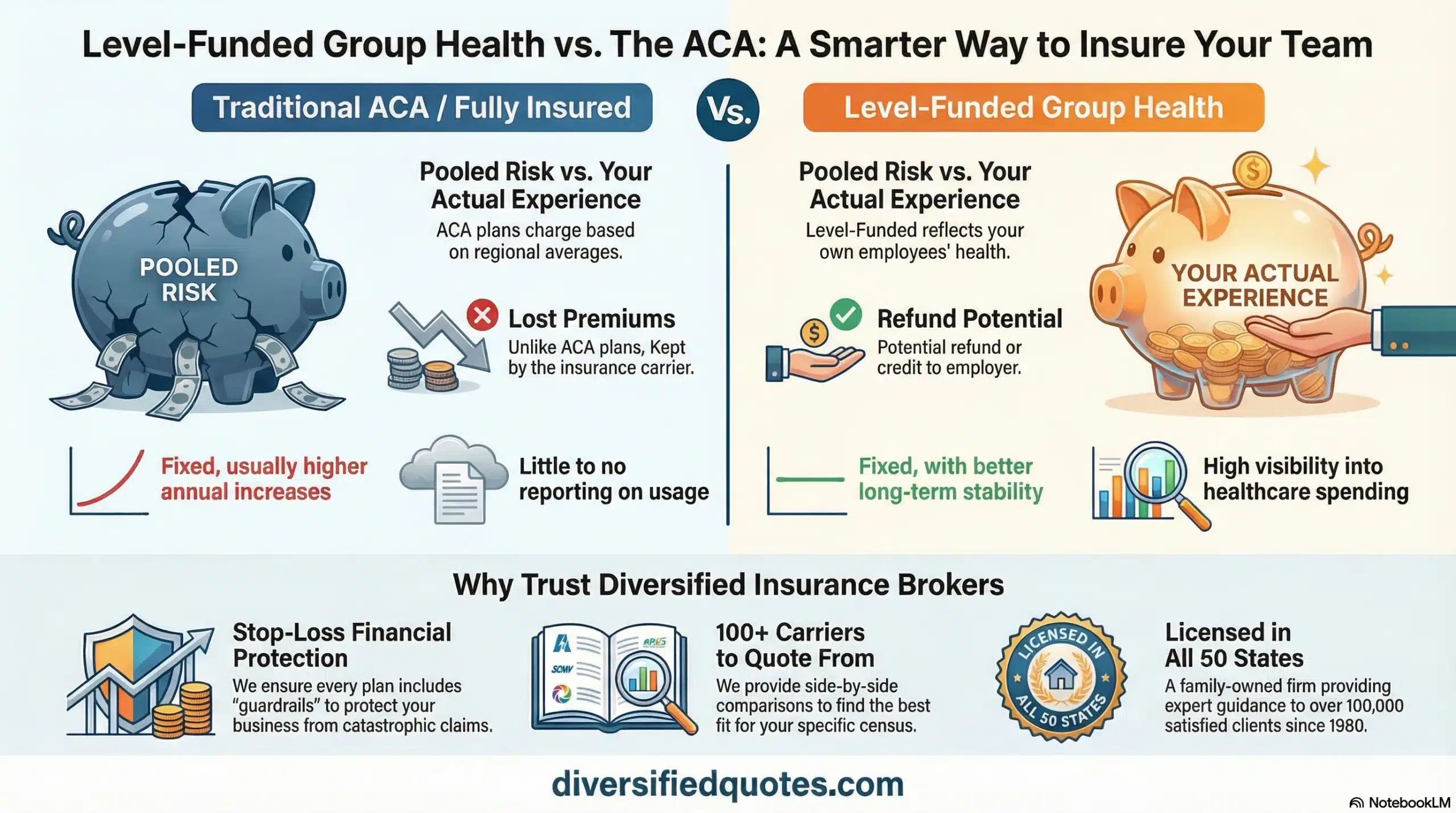
Level-funded group health insurance is often a strong fit for 80-employee organizations that want predictable monthly costs without overpaying for pooled risk. Under a level-funded model, the employer pays a consistent monthly amount that includes three components: estimated claims funding, administrative expenses, and stop-loss protection. From a practical standpoint, it feels like a premium. Strategically, it behaves differently because the claims portion can be reconciled against actual performance. The difference appears at the end of the plan year. If claims run lower than expected, unused claim dollars may be returned to the employer depending on plan terms. This refund potential allows companies to benefit from efficient claims experience rather than subsidizing broader market risk. Level funding also tends to stabilize renewals because pricing reflects the group’s actual performance more closely than market-wide pooled assumptions. Explore our guide on why group level funding works for a complete picture of how these programs are built and why they are particularly well-suited to groups at this size.
Partially Self-Funded Plans and Transparency
Many employers with 80 employees also qualify for partially self-funded group health plans. In a partially self-funded arrangement, the employer pays claims as they occur instead of prepaying premiums. Stop-loss insurance caps exposure for individual large claims and total annual costs. The primary advantage is transparency: employers gain visibility into where healthcare dollars are being spent, which makes it easier to identify cost drivers and implement targeted improvements over time. Instead of guessing what caused a renewal increase, the employer can see patterns—pharmacy trend, specialty exposure, high-cost claim clustering, site-of-care behavior, and network utilization. At 80 employees, that data is both meaningful and actionable. For organizations new to this approach, understanding what self-funded group health insurance is and carefully evaluating the pros and cons helps determine whether the added transparency aligns with your organization’s goals and operational capacity. At 80 employees, partial self-funding is less about taking a gamble and more about putting financial guardrails in place while creating a plan that can be improved year over year.
Stop-Loss Strategy at 80 Employees
Stop-loss insurance is what makes alternative funding practical for mid-market employers. It caps the employer’s exposure so one high-cost claimant—or an unusual cluster of claims—does not derail the budget. There are two primary risk categories employers care about: the shock of a large individual claim and the accumulation of higher-than-expected total annual claims. Stop-loss is designed to protect against both. Most programs include specific stop-loss (limits exposure for a single high-cost individual) and aggregate stop-loss (limits exposure for total annual claims). At 80 employees, the best stop-loss strategy is one that creates a clear worst-case boundary for the year while aligning attachment points to the group’s actual volatility profile. Stop-loss that is too aggressive creates unnecessary cost volatility; stop-loss set too conservatively creates pricing that behaves like fully insured without the transparency benefits. The goal is protection that matches your business reality—and that remains stable enough to allow the plan to improve over multiple years without constant structural disruption.
Mental Health Parity: A Federal Requirement at This Size
One compliance requirement that 80-employee organizations must address—and that is frequently overlooked in benefit design conversations—is the Mental Health Parity and Addiction Equity Act (MHPAEA). This federal law requires that health plans covering mental health and substance use disorder benefits do not apply more restrictive treatment limitations than those applied to comparable medical or surgical benefits. In practical terms, this means that if the plan covers physical health conditions with a $40 copay, it generally cannot require a $75 copay for the same level of mental health care. If medical out-of-pocket limits apply in one way, they must apply comparably for mental health and substance use disorder benefits.
MHPAEA compliance is not optional, and it requires more than just checking a box. Employers and their plan administrators must be able to document compliance through a Non-Quantitative Treatment Limitation (NQTL) comparative analysis—a formal review demonstrating that the plan does not apply more restrictive limitations to mental health benefits than to medical benefits. The Department of Labor has increased enforcement activity around this requirement in recent years. For employers moving into or maintaining self-funded or level-funded structures, confirming that plan design meets MHPAEA standards and that the TPA or carrier can support the documentation requirement is an important due diligence step. An independent broker with mid-market experience can help confirm that the plan structure satisfies both cost management goals and MHPAEA obligations.
The Vendor Ecosystem at 80 Employees: TPA, PBM, and Network Arrangements
At 80 employees, the vendor ecosystem becomes a meaningful factor in how the plan performs. In a fully insured plan, the carrier typically handles claims administration, network access, and pharmacy benefit management as a bundled package. In alternative funding arrangements—particularly partial self-funding—employers gain access to an independent vendor ecosystem that can be assembled for better fit and performance. A third-party administrator (TPA) manages claims processing and plan administration. A pharmacy benefit manager (PBM) manages prescription drug benefits, formulary design, and pharmacy network access. The employer’s network arrangement determines which providers and facilities are in-network and at what contracted rates.
This unbundling creates opportunity. An employer can choose a TPA with strong reporting capabilities for their plan type, a PBM with better formulary management for their specific drug utilization, and a network with better provider coverage in the geography where employees actually live and work. That alignment often produces better cost outcomes than staying with a carrier’s bundled package that was designed for the broadest possible market rather than for this specific group’s needs. It also requires more engagement from HR and leadership—but at 80 employees, that engagement is typically what separates employers who consistently manage their healthcare costs from those who consistently react to them.
Network Strategy: The Quiet Driver of Total Spend
Network strategy is one of the most overlooked drivers of total cost at 80 employees. Two plans can look similar to employees and perform very differently financially. Unit costs—what the plan actually pays for services—can vary significantly depending on network contracts, provider pricing, and how claims flow through the system. Network decisions should be intentional. That does not mean narrowing access unnecessarily. It means matching the network to where employees actually live, where they seek care, and what provider systems dominate local utilization. When network fit is good, employees experience stable access while the plan avoids paying premium prices for no additional value. Network strategy also intersects with site-of-care behavior. When employees routinely use high-cost hospital outpatient settings for services that can be performed in lower-cost freestanding centers—imaging, lab work, infusions, outpatient surgery—the plan’s total spend rises rapidly without employees noticing any change in their experience. A well-designed network strategy encourages appropriate sites of care without creating friction for necessary access.
Pharmacy Strategy: Where Mid-Market Volatility Often Lives
Pharmacy is a core driver of cost volatility for mid-market employers, and at 80 employees the exposure is real and measurable. Specialty medications—used for complex, chronic, or high-acuity conditions—can account for a disproportionate share of total annual spend even when only a small number of employees use them. That concentration is why pharmacy strategy is not a detail at 80 employees; it is a financial priority. Effective pharmacy strategy focuses on net cost and predictability: formulary design that encourages appropriate generic and biosimilar use where clinically sound, specialty management programs for high-cost medications, and pharmacy network access that minimizes unnecessary spread between what the plan pays and what medications actually cost. In level-funded and partially self-funded models, pharmacy reporting is typically stronger than in fully insured plans, which makes it possible to identify and address trend early rather than discovering the problem only at renewal. When pharmacy is managed well, it often provides some of the largest and most consistent cost savings available at this size.
Plan Design: Lowering Waste Without Lowering Value
Plan design is most effective when it reduces waste, improves utilization patterns, and protects the employee experience. At 80 employees, employers can design plans that encourage preventive care and appropriate primary care usage while discouraging avoidable high-cost behavior. When primary care and urgent care are accessible and predictable, employees are less likely to default to the emergency room for non-emergent issues. When preventive care is encouraged—and cost barriers to it are removed—conditions are identified earlier and often treated at significantly lower cost. When care navigation is simple and intuitive, employees choose better sites of care without feeling like they are fighting the system. The best plan is rarely the plan with the highest deductible or the most aggressive cost-shifting. The best plan is the one that aligns incentives with healthy behavior and appropriate care while maintaining benefits employees value and understand.
Claims Reporting: Turning Data Into Decisions
At 80 employees, reporting is a genuine competitive advantage. The point of reporting is not to overwhelm leadership with complex spreadsheets. The point is to create clear visibility into what is actually driving cost: what categories are increasing, where spend is concentrated, and what changes are most likely to improve the trend. Effective reporting answers practical questions: Are costs rising because of pharmacy or medical? Are a few claimants driving most of the spend? Are employees using the emergency room more frequently than expected? Are certain providers consistently higher cost? Are chronic conditions being managed proactively or escalating into high-cost episodes? When reporting is consistent and acted upon, employers can make smaller, smarter changes throughout the year rather than waiting for renewal season to force disruptive changes. That governance approach—continuous visibility and incremental adjustment—is how mid-market employers build sustainable benefits systems that improve over time rather than cycling through renewal crises.
Reducing Costs Without Reducing Benefits
Sustainable cost reduction at 80 employees rarely comes from cutting benefits or shifting excessive costs to employees. That approach can backfire by harming morale, increasing turnover, and encouraging employees to delay care—often resulting in higher-cost claims later. Instead, savings at this size are driven by smarter plan architecture and vendor alignment. Network selection can materially affect claim costs without changing how employees access care. Pharmacy strategy often represents one of the largest opportunities for savings. Plan design levers—deductibles, copays, coinsurance, and out-of-pocket limits—work best when they are aligned to utilization patterns rather than applied as blunt instruments. Employers who treat healthcare as a system typically focus on the predictable drivers: unit cost, utilization behavior, and pharmacy trend. A plan that addresses those drivers consistently outperforms a plan that tries to save money primarily by increasing employee cost-share.
Participation and Contribution Considerations
Participation requirements are generally less restrictive at 80 employees than at smaller sizes, but they still influence underwriting and pricing. Employee waivers matter. Contribution strategy matters. If too many employees waive coverage, the enrolled population can skew toward higher utilizers, which affects performance and pricing in ways that compound over time. Employer contribution levels affect participation, employee satisfaction, and perceived plan stability. Strong participation often leads to better pricing and broader plan options because it supports healthier risk distribution and better long-term results. At 80 employees, contribution strategy should be designed intentionally—aligned with compensation strategy, retention goals, and the plan design itself. The goal is not simply to reduce employer spend by shifting costs. The goal is to create a structure employees will enroll in and use effectively.
Planning Beyond 80 Employees
The group health insurance strategy chosen at 80 employees often sets the trajectory for future growth. As organizations expand toward 100, 150, or beyond, healthcare decisions become even more consequential and claims data becomes even more meaningful. Employers that introduce transparency, cost accountability, and proper vendor management at this stage tend to scale more efficiently. The 100-employee mark in particular brings expanded plan design options and greater claims credibility, making the improvements built at 80 even more valuable. See how strategy evolves at 100 employees to understand what additional leverage becomes available as headcount grows. Organizations that delay building a sustainable structure at 80 often find costs compounding faster than growth allows, making future transitions more disruptive and expensive. Proactive planning now reduces that disruption and positions the organization for long-term health plan stability.
Ready to Compare Group Health Plans for 80 Employees?
We’ll identify your biggest cost drivers, compare funding structures side by side, and build a plan designed to improve year over year.
Get a 2nd Opinion
Already have a plan or renewal proposal? We’ll tell you if you’re overpaying and where the real opportunities are.
Group Travel Coverage
Supplemental protection for employees traveling domestically or internationally on company business.
Request a Side-by-Side Comparison
We’ll model fully insured, level-funded, and self-funded options against your current plan and goals.
Not the Right Headcount?
Use the options below to jump to the group health page that matches your workforce size.
Mid-Market Group Health Insurance Resources
Explore funding strategies, industry-specific plans, and cost management resources for growing employers.
Employee Benefits and Compliance Essentials
Round out your group health plan and stay on top of employer compliance and ancillary coverage needs.
Talk With an Advisor Today
Choose how you’d like to connect—call or message us, then book a time that works for you.
Schedule here:
calendly.com/jason-dibcompanies/diversified-quotes
Licensed in all 50 states • Fiduciary, family-owned since 1980
FAQs: Group Health Insurance for 80 Employees
Can a company with 80 employees get group health insurance?
Yes. At 80 employees, companies are well-established in the large-group insurance market and typically qualify for fully insured, level-funded, and partially self-funded group health plans. The range of available options and carrier competitiveness at this size is broader than at smaller groups because the claims base is large enough to underwrite with more accuracy. Employer mandate compliance under the ACA applies—the organization must offer minimum essential coverage that meets affordability and minimum value standards to eligible full-time employees—but the focus at this size is primarily on cost management and plan design, not initial compliance setup.
What is the Mental Health Parity Act and does it apply at 80 employees?
Yes, the Mental Health Parity and Addiction Equity Act (MHPAEA) applies. This federal law requires that health plans covering mental health and substance use disorder benefits do not apply more restrictive limitations than those applied to comparable medical or surgical benefits. In practical terms, copays, deductibles, prior authorization requirements, and treatment limits for mental health care must be comparable to those for equivalent medical care. Employers must also be able to document compliance through a formal Non-Quantitative Treatment Limitation (NQTL) comparative analysis. The Department of Labor has increased MHPAEA enforcement activity in recent years. Confirming that your plan design meets these requirements—and that your TPA or carrier can support the documentation—is an important compliance responsibility at this size.
Are refunds possible with group health plans at 80 employees?
Refunds are possible under level-funded and partially self-funded plans when claims run lower than expected during the plan year. In level-funded arrangements, unused claim dollars above the program’s retention threshold may be returned at year-end based on reconciliation terms. In partially self-funded plans, the employer pays actual claims rather than padded premiums, so efficient utilization directly reduces net cost. At 80 employees, refund potential is meaningful because the claims base is large enough for the plan’s performance to show up clearly in annual reconciliation. Refunds are not guaranteed—they depend on claims performance—but they create a direct financial incentive to invest in plan design, employee navigation, and pharmacy management.
What is the difference between a TPA and a carrier at this size?
A carrier is an insurance company that underwrites risk and administers plans—in fully insured arrangements, the carrier handles everything. A third-party administrator (TPA) is an independent company that manages plan administration (claims processing, enrollment, ID cards, member services) without underwriting the risk. In alternative funding arrangements—particularly partial self-funding—employers often use a TPA for administration while separately securing stop-loss insurance and a network arrangement. This unbundled approach allows employers to select the TPA with the best reporting capabilities for their size, the network with the best provider coverage for their geography, and stop-loss terms best suited to their risk profile. At 80 employees, this flexibility often produces better cost outcomes than a carrier’s bundled package designed for the broadest possible market.
What is self-funding and is it appropriate for 80 employees?
In a partially self-funded plan, the employer pays claims as they occur rather than prepaying fixed premiums. Stop-loss insurance caps individual large claims (specific stop-loss) and total annual plan costs (aggregate stop-loss). At 80 employees, partial self-funding is well-suited for groups with stable enrollment, consistent demographics, and leadership willing to engage with claims reporting. The claims base is large enough that utilization patterns are measurable and actionable. Stop-loss provides the financial guardrails that make the approach predictable. The primary advantage is transparency: instead of receiving a renewal increase with limited explanation, the employer can see exactly what drove cost and make targeted adjustments. This governance capability is what produces sustainable long-term results.
How much does pharmacy typically affect group health costs at 80 employees?
Pharmacy often accounts for 25-40% of total plan spend, and that share can be significantly higher in groups where specialty medications are concentrated. At 80 employees, the claims base is large enough that a small number of specialty prescriptions can be the single largest driver of year-over-year cost increase. Effective pharmacy management involves formulary design, specialty drug management programs, pharmacy network alignment, and employee education that reduces unnecessary brand use when generics are available. In level-funded and partially self-funded plans, pharmacy reporting is typically more detailed than in fully insured plans, which makes it possible to identify and address trend proactively rather than discovering the issue only at renewal.
Why does network strategy matter so much at 80 employees?
Network strategy determines what the plan actually pays for services—regardless of what the benefit design says on paper. Two plans can have identical deductibles and copays but produce very different total costs depending on what their network contracts allow for unit pricing. At 80 employees, the claims volume is large enough that unit cost differences between networks are measurable and material. Network strategy also affects site-of-care behavior: when employees use high-cost hospital outpatient settings for imaging, lab work, or outpatient procedures that could be performed at lower-cost freestanding facilities, plan spend rises substantially. A network that matches where employees actually live and seek care—and that encourages appropriate sites of care—can reduce total plan spend without reducing employee access or satisfaction.
How often should an 80-employee group review its health plan?
At minimum, a structured review should happen annually—ideally 90-120 days before the renewal date so alternatives can be evaluated without time pressure. In addition to annual renewal reviews, many mid-market employers with alternative funding benefit from quarterly claims reporting reviews that track performance against expectations throughout the year. Catching a pharmacy trend or ER utilization spike in month five is far less disruptive than discovering it only at renewal. This governance rhythm—annual plan review plus periodic in-year reporting—is what allows incremental improvements to compound and prevents the “renewal crisis” cycle that many employers experience when they only look at the plan once per year.
Is stop-loss insurance expensive at 80 employees?
Stop-loss premiums are a component of the total plan cost in alternative funding arrangements, not a separate expense layered on top. The cost of stop-loss depends on attachment points (how high the threshold is before stop-loss pays), the group’s industry and demographics, and the stop-loss carrier’s assessment of the group’s risk. At 80 employees, stop-loss markets are competitive—more so than at smaller sizes—because the group is large enough to underwrite with meaningful credibility. In most cases, the total cost of a well-structured level-funded or partially self-funded plan (including stop-loss) is comparable to or lower than a fully insured plan, while providing significantly better transparency and renewal stability.
What should an 80-employee company look for in claims reporting?
Effective reporting at 80 employees answers five core questions: (1) Where are claims concentrated by category—pharmacy, inpatient, outpatient, ER? (2) Are a small number of claimants driving a disproportionate share of spend, and is stop-loss engaged for those claimants? (3) Are chronic conditions being managed proactively or escalating into high-cost episodes? (4) How is ER utilization trending, and is it avoidable? (5) What is the pharmacy trend, and are specialty medications a growing share? Reports that answer these questions in plain language—without requiring actuarial expertise to interpret—give leadership the information needed to make decisions between renewals, not just at renewal time. Ask prospective TPAs and carriers how frequently reports are delivered and what format they use before committing to a plan structure.
Will a plan designed for 80 employees scale well as the company grows?
Yes, when designed with scalability in mind. Plans built around alternative funding, strong reporting, and intentional plan design scale smoothly as headcount grows because the fundamentals—claims-aligned pricing, stop-loss protection, vendor accountability—become more advantageous, not less, as the group gets larger. The data becomes richer, the claims pool becomes more stable, and the employer’s leverage with stop-loss carriers, networks, and TPAs increases. At 100 employees, plan design options expand further and claims credibility creates even more leverage. Employers who build a sustainable structure at 80 are typically better positioned at 100 and beyond than those who delay the transition and face more disruptive restructuring at a later stage.
About the Author:
Jason Stolz, CLTC, CRPC, DIA, CAA and Chief Underwriter at Diversified Insurance Brokers (NPN 20471358), is a senior insurance and retirement professional with more than 25 years of real-world experience helping individuals, families, and business owners protect their income, assets, and long-term financial stability. As a long-time partner of the nationally licensed independent agency Diversified Insurance Brokers, Jason provides trusted guidance across multiple specialties—including fixed and indexed annuities, long-term care planning, personal and business disability insurance, life insurance solutions, Group Health, Travel Medical and Evacuation Insurance, and short-term health coverage. Diversified Insurance Brokers maintains active contracts with over 100 highly rated insurance carriers, ensuring clients have access to a broad and competitive marketplace.
His practical, education-first approach has earned recognition in publications such as VoyageATL, and contributions from his agency featured in Kiplinger and GoBankingRates— highlighting his commitment to financial clarity and client-focused planning. Drawing on deep product knowledge and years of hands-on field experience, Jason helps clients evaluate carriers, compare strategies, and build retirement and protection plans that are both secure and cost-efficient. Visitors who want to explore current annuity rates and compare options across multiple insurers can also use this annuity quote and comparison tool.
Explore More Group Health Insurance Options: Browse our complete guide to Group Health Insurance by Company Size — covering plans for 2, 10, 20, 50, 100, 250, 500, 750 & 1,000+ employees from 100+ carriers.
Last Reviewed: June 1, 2026 |
Reviewed by: Jason Stolz, CLTC, CRPC, DIA, CAA
Chief Underwriter, Diversified Insurance Brokers, Inc. | NPN: 20471358 | Diversified Insurance Brokers, Inc. — Licensed in all 50 states
Fact Checked by: Tonia Pettitt, CMIP©
Medicare Specialist, Diversified Insurance Brokers, Inc. | NPN: 14374308 | Diversified Insurance Brokers, Inc. — Licensed in all 50 states
Did you find this content helpful? Leave us a Google review — it helps others find trustworthy guidance too.
Editorial Standards: Diversified Insurance Brokers maintains rigorous editorial standards to ensure accuracy, clarity, and independence in all content. Learn more about our editorial standards and commitment to transparency.
