
Group Health Insurance for 40 Employees
As an Independent Group Health Insurance Broker, we compare fully insured, level-funded, and self-funded options across carriers to find the lowest cost coverage for your business.
Group Health Insurance for 40 Employees

Jason Stolz CLTC, CRPC, DIA, CAA
Group health insurance for 40 employees represents a genuine inflection point for growing businesses. At this headcount, healthcare costs are no longer a background administrative expense — they become a material budget line item that can meaningfully affect profitability, hiring decisions, compensation planning, and long-term organizational strategy. Employers with 40 employees often discover that the approaches that worked at 10 or 20 employees begin to break down as utilization patterns become more established, claims volume grows, and renewal volatility accelerates in ways that feel increasingly difficult to predict or control.
For companies at this size, the opportunity is no longer simply about finding a plan that covers employees — it is about building a healthcare structure that controls costs with intention, improves financial predictability across plan years, and rewards efficient claims experience rather than penalizing employers who happen to have a healthy workforce. This is the stage where many employers begin moving beyond default fully insured arrangements and start evaluating smarter funding approaches that align plan costs more closely with actual performance. At Diversified Insurance Brokers, we help 40-employee organizations redesign group health insurance around transparency, risk management, and long-term sustainability — without sacrificing the benefit quality or employee satisfaction that drives retention and recruiting outcomes.
Group Health Review for 40 Employees
We will analyze your current plan, renewal risk, and claims efficiency to uncover ways to lower costs and improve long-term stability for your workforce.
Request a Group Health ReviewWhy Group Health Insurance Costs Change at 40 Employees
Group health insurance for 40 employees behaves differently than it does for smaller teams because the plan now has enough participation and claims volume for utilization patterns to develop and be measured. That does not mean the group suddenly becomes fully predictable — it means the plan’s financial performance is increasingly influenced by what your employees actually do. How they use primary care, urgent care, emergency rooms, specialist services, imaging, behavioral health, and prescription medications all begins to shape the plan’s cost trajectory in ways that were difficult to observe at smaller headcounts.
At lower employee counts, many employers feel like renewals are largely random because one or two high-cost claims can swing results dramatically in either direction. At 40 employees, the group has more “actuarial credibility,” and carriers begin paying closer attention to group-specific experience when pricing renewals. Unfortunately, if the plan structure is still built around small-group defaults, that increased credibility does not automatically translate into cost control. Employers can still experience double-digit renewal increases even in years where workforce utilization was relatively modest — because fully insured premiums typically embed conservative pricing assumptions, carrier margin, administrative load, and broad market trend factors that may not reflect what actually happened in your group during the plan year. Understanding how group medical insurance is priced and structured helps explain why cost management becomes more difficult as employee count rises unless the plan architecture evolves alongside the organization’s growth. Our broader resource on why group level funding is worth evaluating explains the alternative pricing framework that changes this dynamic for groups that qualify.
What Typically Breaks Down Between 25 and 40 Employees
Many companies reach 40 employees while still operating with the same mindset they had at 10 or 15 employees: select a carrier, choose a plan, and hope the renewal is manageable. That approach is understandable given how group health insurance is typically presented to small employers, but it often becomes expensive as the organization grows because the underlying cost drivers have changed even when the plan selection process has not. At 40 employees, the plan is large enough that average employee utilization patterns matter. The company now has sufficient claims volume that plan design choices, network strategy, and pharmacy management can create meaningful differences in outcomes year over year.
Three patterns appear consistently among employers in this size range. First, employers discover they are effectively overpaying for pooled risk they are not generating — subsidizing other groups’ claims through fully insured premium structures that do not reward their own performance. Second, they have little or no visibility into what is actually driving their healthcare spending, making it impossible to address cost drivers proactively. Third, they feel increasingly trapped by annual renewals because switching carriers frequently is operationally disruptive and does not address the underlying cost structure. The solution is not to chase a new carrier every twelve months. The solution is to choose a plan structure and funding model that makes costs genuinely manageable so the plan can remain stable and continuously improving over multiple years.
Expanded Group Health Insurance Options Available at 40 Employees
At 40 employees, employers gain meaningful access to a broader range of funding strategies than were available or practical at smaller headcounts. Fully insured plans remain available and may be appropriate for some employers, but they are no longer the only — or typically the most financially efficient — option. Many carriers and third-party administrators actively target the 35 to 50 employee range for level-funded and partially self-funded arrangements specifically because groups this size are large enough to develop predictable claims experience while still being appropriately protected by stop-loss coverage.
These alternative funding structures align costs more closely with actual claims experience rather than conservative actuarial assumptions, while using stop-loss insurance to protect against large or unexpected expense events. That shift changes the employer’s fundamental relationship with the plan — instead of paying a premium that prices for a worst-case scenario the employer may never experience, the employer pays closer to an expected-case amount with defined financial guardrails. Eligibility for specific programs depends on industry, employee demographics, participation rates, and sometimes prior claims history. Our resource on minimum employee requirements for group health insurance provides a useful baseline for understanding eligibility thresholds, though at 40 employees most employers qualify for a wide range of structural options across the market. For employers also evaluating options for smaller satellite locations or related entities, our resource on group health insurance for 2-person businesses covers the very small employer end of the spectrum.
Level-Funded Group Health Insurance for 40 Employees
Level-funded group health insurance is one of the most commonly recommended solutions for companies at the 40-employee range because it keeps monthly budgeting straightforward and familiar while fundamentally improving how the plan is priced and financially reconciled over time. Under a level-funded model, the employer pays a predictable monthly amount that bundles three components into a single payment: an estimated claims fund that pays actual employee claims during the plan year, an administrative services fee, and a stop-loss insurance premium that protects against claims exceeding the funded amount.
From a cash-flow management standpoint, this structure feels similar to what employers are accustomed to with fully insured coverage — a steady monthly amount that can be budgeted with confidence. The difference materializes in how the plan performs over time. If actual claims during the plan year run lower than the funded estimate, unused claim dollars may be returned to the employer at year-end based on the program’s specific terms. That refund potential directly rewards employers for healthy workforce utilization and effective plan design in a way that fully insured arrangements — which retain all premium regardless of claims performance — do not offer. Level funding also tends to smooth renewal volatility because pricing is more closely tied to the group’s own experience rather than broad pooled market assumptions, making renewal conversations more transparent and incremental improvements more clearly connected to plan changes.
For 40-employee companies, level funding frequently represents the most practical “next step” beyond fully insured coverage — providing predictable monthly costs, meaningfully better claims visibility, and a financial incentive structure that rewards good plan performance without requiring the employer to take on the full administrative complexity of comprehensive self-funding. Our resource on small employer group health insurance options and strategy covers level funding in the broader context of what growing employers need to evaluate as their workforce expands. For employers who have already explored level funding and want to understand the next tier of options, our resource on small business group health insurance approaches provides additional context.
Partially Self-Funded Plans and Claims Transparency
Some employers with 40 employees qualify for partially self-funded group health plan arrangements, particularly when the workforce is demographically stable, the employer wants maximum financial transparency, and leadership is comfortable with a somewhat more active role in plan management. In these arrangements, the employer funds claims as they occur rather than prepaying a fully insured premium. Stop-loss insurance caps exposure for individual high-cost claims at a defined specific attachment point, and aggregate stop-loss caps total annual plan spending, keeping the employer’s financial risk clearly bounded even in adverse claims years.
The primary and most significant advantage of partial self-funding is transparency. Employers gain direct visibility into where healthcare dollars are being spent — which allows leadership to identify specific cost drivers and implement targeted improvements rather than accepting renewal increases with limited explanation. Instead of simply being told costs increased by a percentage tied to market trend, the employer can analyze whether pharmacy spending is rising, whether imaging utilization is higher than benchmarks, whether out-of-network claims represent a correctable access issue, or whether specific care categories are driving outsized claims that behavioral or educational interventions could reduce.
For organizations new to alternative funding approaches, understanding what self-funded group health insurance is and how it manages risk provides the conceptual foundation for evaluating whether this model fits the organization’s goals and tolerance for financial variability. For employers who want a practical framework for the tradeoffs involved, our resource on the pros and cons of self-funded group health covers the key decision variables in straightforward terms. Our companion page on group health insurance for 30 employees is useful context for employers who are just crossing this threshold, and our resource on group health insurance for 50 employees shows where the strategy evolves as the organization continues to grow.
Stop-Loss Strategy — How 40-Employee Employers Control Downside Risk
Stop-loss insurance is what makes alternative funding practical and sustainable for employers who want better cost alignment without unpredictable financial exposure. The concept is straightforward: the employer funds predictable, expected claims directly, and stop-loss insurance absorbs the large surprises that would otherwise create budget-disrupting volatility. Most alternative funding arrangements include two stop-loss components — specific stop-loss, which protects against a single individual’s claims exceeding a defined threshold, and aggregate stop-loss, which protects against the group’s total annual claims exceeding a defined overall budget threshold. Designing stop-loss attachment points that genuinely match the employer’s risk tolerance is among the most important decisions in the alternative funding design process. Attachment points that are set too conservatively can make the plan feel and price like fully insured coverage without delivering the cost benefits. Points that are set too aggressively can expose the employer to more volatility than leadership is comfortable absorbing.
At 40 employees, the most sustainable stop-loss strategy is typically one that leadership can commit to confidently over multiple plan years rather than revisiting constantly. Consistency in the plan structure matters because it allows incremental improvements — in network strategy, pharmacy management, employee education, and preventive care engagement — to accumulate into measurable results. Employers who change funding models or carriers annually experience operational disruption and reset the plan’s performance baseline repeatedly, preventing the continuous improvement cycle that produces long-term cost control. For employers evaluating group health options for specific industry sectors, our resources on group health insurance for physician practices and group health insurance for law firms cover how stop-loss strategy and funding model selection interact with specific workforce and industry characteristics.
Reducing Group Health Costs Without Cutting Benefits
At 40 employees, meaningful and sustainable cost reduction almost never comes from cutting benefits or shifting excessive financial burden onto employees through dramatically higher deductibles and out-of-pocket requirements. That approach frequently backfires in predictable ways. When employees face significantly higher out-of-pocket costs without better care navigation support, many delay accessing primary care and preventive services. Delayed care becomes higher-acuity and higher-cost care when conditions that could have been addressed early progress to the point of requiring emergency intervention or hospitalization. The plan’s long-term cost trend worsens, employees feel increasingly frustrated with their benefits, and the employer ends up paying more while offering a benefits package that damages rather than supports recruiting and retention.
Sustainable savings typically come from better plan architecture rather than benefit reduction. Network optimization — identifying high-quality, cost-efficient provider networks — can meaningfully reduce claim costs without changing the employee experience in the ways that matter most. Pharmacy benefit design represents one of the largest and most consistently underaddressed opportunities for savings in employer health plans, particularly when specialty medications are involved. Aligning deductible structures, copay tiers, and out-of-pocket maximum design with how employees actually use healthcare — rather than with generic industry templates — can reduce avoidable waste while preserving access to the services employees value and need. Employee education and navigation support — helping employees understand when to use primary care versus urgent care versus emergency care, how to verify network status, and how to manage prescriptions efficiently — can reduce claims waste without making employees feel their benefits have been restricted. For employers who want to understand how contributing strategy affects participation and plan viability, our resource on group health insurance for the self-employed provides useful context on how contribution decisions interact with enrollment outcomes.
Pharmacy Strategy — Often the Largest Hidden Cost Driver
For many 40-employee employers, pharmacy spending is the quiet but significant driver of renewal increases that leadership does not see clearly until the annual carrier renewal conversation. A small number of prescriptions — particularly specialty medications for chronic conditions — can represent a disproportionately large share of total healthcare spending. Employers who focus their cost management attention primarily on deductible structures and network changes while pharmacy trend is driving the actual cost problem often make plan design changes that do not address the real source of spending growth.
A strong pharmacy strategy does not mean restricting access to necessary medications. It means managing the pharmacy benefit intelligently through formulary design that guides employees toward clinically equivalent alternatives, specialty pharmacy partnerships that apply clinical management and cost controls to the highest-cost medications, prior authorization processes that ensure expensive medications are being used appropriately, and education that helps employees navigate prescription options efficiently. In level-funded and partially self-funded plans, pharmacy visibility and reporting are typically meaningfully better than in fully insured arrangements — which makes it possible to address pharmacy cost drivers proactively rather than discovering their impact only when a large renewal increase arrives. When pharmacy is managed with intention, employers frequently observe improvements in both total cost performance and employee satisfaction, because fewer employees encounter confusing coverage situations or unexpected cost-sharing surprises at the pharmacy counter. Our resource on group health insurance for 20 employees covers the earlier-stage context for pharmacy strategy as it develops.
Refund Potential and Renewal Stability in Alternative Funding
One of the most consequential limitations of fully insured group health plans is the structural absence of any reward for favorable claims experience. An employer can have a genuinely low-claims year — where the workforce is healthy, utilization is efficient, and spending is well below what the carrier priced for — and still receive a substantial renewal increase because the carrier’s broader risk pool performed poorly or the carrier’s pricing assumptions were conservative. Alternative funding structures change this dynamic fundamentally by connecting plan costs more directly to the employer’s own experience.
In level-funded plans, favorable claims performance can result in unused claim fund refunds or renewal credits, depending on the specific program design and the carrier’s terms. In partially self-funded plans, employers avoid paying premiums inflated for risk they did not generate because the plan funds actual claims rather than pooled actuarial assumptions. This structural alignment between cost and performance produces two important planning benefits: it can reduce net annual healthcare spending in favorable years, and it consistently improves renewal predictability by making each year’s pricing more directly traceable to the group’s own utilization. Refund potential should not be the primary motivation for choosing an alternative funding structure — the more important reason is the alignment between cost and performance that gives the employer genuine financial leverage to control healthcare spending over time.
Participation and Contribution Strategy at 40 Employees
Participation and employer contribution strategy continue to matter meaningfully at 40 employees, both for underwriting purposes and for plan effectiveness. Strong participation — where a high proportion of eligible employees actually enroll in the plan — signals a stable risk pool with lower adverse selection exposure, typically producing better underwriting terms, broader plan options, and more favorable stop-loss pricing. Weak participation can create underwriting friction that narrows available options and increases plan pricing, even when the employer’s intentions around benefit quality are strong.
At 40 employees, contribution strategy should be built with enrollment outcomes in mind. A contribution approach that makes the employee-only premium accessible and the family tier reasonably priced will typically produce stronger overall participation than one optimized entirely around minimizing employer contribution as a percentage of payroll. Many employees who waive coverage do so because the employee contribution — not just the employer contribution — is too high relative to their household budget and alternative coverage options. Understanding how contribution mechanics affect both enrollment and plan economics is among the planning elements that separate employers who build effective long-term benefits strategies from those who repeatedly cycle through carriers looking for a solution that never quite stabilizes.
Planning for Growth Beyond 40 Employees
The group health insurance structure chosen at 40 employees typically establishes the foundation and the cultural expectations for how the organization will approach benefits as it grows. Employers who introduce transparency, cost accountability, and intentional plan design at this stage tend to scale more efficiently as they move to 50, 75, or 100 employees — because the framework for managing healthcare spending is already in place and the organization is already accustomed to treating benefits as a strategic management function rather than a passive administrative line item. Our resources on group health insurance for 50 employees, group health insurance for 100 employees, and group health insurance for 150 employees show how the strategy and available options evolve at each headcount milestone.
Employers who delay building a strategic benefits approach often find their options narrowing and their costs escalating as the organization grows, because the cost basis established during the small-to-mid employer transition becomes increasingly difficult to reset at higher headcounts. Proactive planning at 40 employees avoids that compounding problem. When the plan structure is stable and the framework for continuous improvement is in place, the employer can make incremental refinements — network optimization, pharmacy management, education programs, preventive care engagement — without the operational disruption of rebuilding the benefits program from scratch every few years under cost pressure.
What a Strong 40-Employee Group Health Strategy Looks Like
A strong group health strategy at 40 employees consistently includes several elements working together rather than any single plan feature or carrier selection. A funding structure matched to the employer’s comfort with financial variability and desire for claims transparency provides the financial architecture. Stop-loss protection designed to give leadership genuine confidence in the budget establishes the risk guardrails. Plan design that encourages efficient utilization rather than simply shifting costs to employees creates the behavioral foundation. An intentional pharmacy strategy that addresses the highest-cost spending category directly builds the clinical management layer. And a contribution and communication approach that drives strong participation ensures the risk pool remains stable and the investment in plan design reaches the employees it was built for.
When these elements work together, the plan becomes measurably easier to manage year over year. Renewals stop being annual surprises and become planning events where leadership can understand what happened, why it happened, and what specific adjustments will improve the following year’s performance. That shift — from reactive to proactive benefits management — is the goal of a well-designed group health strategy at 40 employees, and it is the foundation for sustainable cost management at every headcount milestone that follows.
Related Group Health Resources
Financial Protection Essentials
Pick Your Company Size
Not the right headcount? Use the buttons below to jump to the group health page that matches your workforce.
Group Health Insurance for 10 Employees
Small-team pricing, participation strategy, and easy rollout.
View 10-Employee OptionsGroup Health Insurance for 20 Employees
Plan design choices that improve cost control and retention.
View 20-Employee OptionsGroup Health Insurance for 30 Employees
Reduce renewal spikes and address pharmacy cost drivers.
View 30-Employee OptionsGroup Health Insurance for 40 Employees
Better plan efficiency as your claims credibility improves.
View 40-Employee OptionsGroup Health Insurance for 50 Employees
Cost containment strategies and scalable benefit design.
View 50-Employee OptionsGroup Health Insurance for 60 Employees
Improve predictability and reduce waste without cutting benefits.
View 60-Employee OptionsGroup Health Insurance for 70 Employees
Funding choices that reduce renewal volatility as you grow.
View 70-Employee OptionsGroup Health Insurance for 80 Employees
Plan design and vendor strategy to control cost trends.
View 80-Employee OptionsGroup Health Insurance for 90 Employees
Prepare for 100+ pricing leverage and stabilize renewals.
View 90-Employee OptionsGroup Health Insurance for 100 Employees
A major transition point: funding options expand and plan design matters more.
View 100-Employee OptionsGroup Health Insurance for 150 Employees
More claims credibility means more leverage — optimize funding and reduce overpaying.
View 150-Employee OptionsGroup Health Insurance for 250 Employees
Advanced funding and transparency strategies for stronger cost control.
View 250-Employee OptionsGroup Health Insurance for 500 Employees
Enterprise approach: analytics, vendor oversight, and smarter funding strategy.
View 500-Employee OptionsGroup Health Insurance for 750 Employees
Scaled cost-control with deeper data visibility and targeted interventions.
View 750-Employee OptionsGroup Health Insurance for Over 1,000 Employees
Enterprise governance, advanced funding, and high-impact cost management.
View 1,000+ Employees Options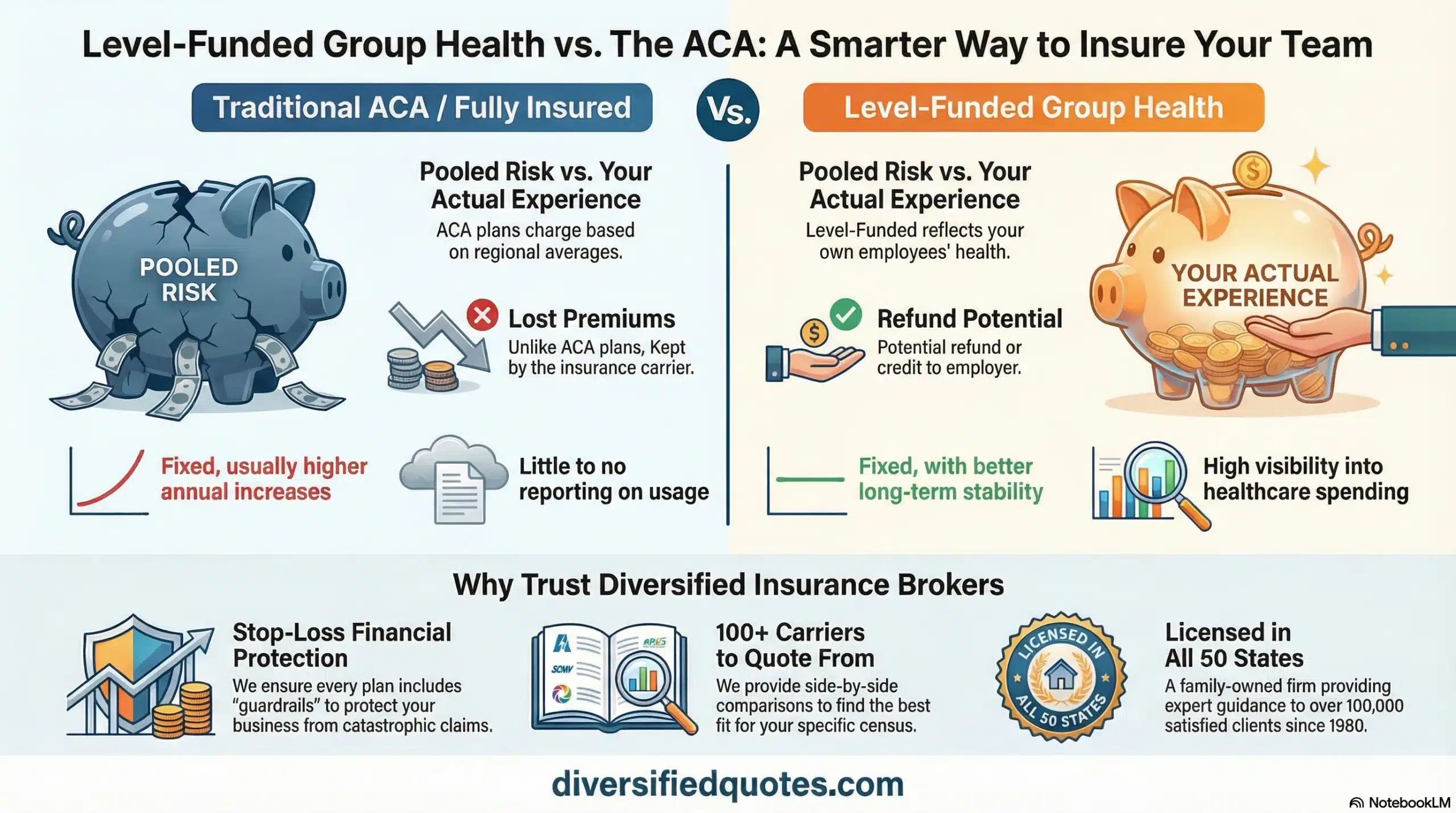
Talk With an Advisor Today
Choose how you’d like to connect—call or message us, then book a time that works for you.
Schedule here:
calendly.com/jason-dibcompanies/diversified-quotes
Licensed in all 50 states • Fiduciary, family-owned since 1980
Group Health Insurance for 40 Employees FAQs
Yes — employers with 40 employees typically qualify for a broad range of group health insurance options including fully insured plans, level-funded arrangements, and partially self-funded structures with stop-loss protection. At this headcount, the group is large enough to access most of the funding models that larger employers use while still being treated as a small-to-mid employer in most carrier and regulatory frameworks. Eligibility for specific programs depends on factors including the employer’s industry, employee demographics, current participation rates, and in some alternative funding arrangements, prior claims history. In most cases, employers at this size have more plan design and funding model flexibility than they had at 15 or 20 employees — which is precisely why this headcount is a good time to conduct a structured review of whether the current plan structure is still the most efficient available option. Working with an independent broker who has access to multiple carriers and funding platforms produces a more complete picture of available options than applying directly to a single carrier or working with a captive agent who represents only one product line.
Level-funded group health insurance is a plan structure that combines the monthly payment predictability of a fully insured plan with the cost alignment and transparency of alternative funding. The employer pays a fixed monthly amount that bundles estimated claims funding, administrative expenses, and stop-loss insurance premium into a single payment. If the group’s actual claims during the plan year run below the funded estimate, the unused claim dollars may be returned to the employer at year-end under the program’s specific terms. Level funding is often an excellent fit for 40-employee groups because the employer gains meaningful claims transparency and refund potential without taking on the full administrative complexity of comprehensive self-funding. Renewals tend to be more closely tied to the group’s own experience rather than broad pooled carrier assumptions, making them more predictable and easier to address through targeted plan design improvements. The combination of predictable monthly costs, improved claims visibility, and financial upside for favorable performance makes level funding one of the most commonly recommended plan structures for growing employers in this headcount range.
Refunds of unused claim dollars are a feature of level-funded plan designs and are possible when a group’s actual claims during the plan year run lower than the funded amount built into the monthly payments. The specific refund mechanics — including how unused claim dollars are calculated, when they are distributed, and what portion is returned versus retained — vary by program and carrier, so reviewing the specific terms of any level-funded arrangement is important before selecting it based primarily on refund potential. In partially self-funded arrangements, refunds are not structured as an explicit program feature in the same way, but the employer effectively pays only for actual claims incurred rather than a premium that assumes higher utilization — which produces a similar financial outcome when the group performs well. Neither level funding nor partial self-funding eliminates renewal increases entirely, but they create a structural connection between the employer’s plan performance and the cost the employer pays — which is the more important planning benefit than any specific refund amount in any given year.
Partially self-funded arrangements for 40-employee groups are specifically designed with stop-loss insurance that makes the financial risk manageable and clearly bounded. Specific stop-loss insurance caps the employer’s exposure for any single individual’s claims above a defined threshold — meaning that even a catastrophic individual claim produces a predictable employer cost rather than an open-ended financial liability. Aggregate stop-loss caps the employer’s total annual claims spending above a defined overall threshold, providing a ceiling on total plan year cost even if multiple employees experience significant health events simultaneously. The appropriate stop-loss attachment points — both specific and aggregate — depend on the employer’s financial capacity and tolerance for variability, and designing these attachment points correctly is one of the most important roles an experienced broker plays in the alternative funding evaluation process. When stop-loss is structured appropriately, partial self-funding at 40 employees is not inherently riskier than fully insured coverage — it simply distributes the financial relationship between expected claims and exceptional claims more transparently, with clearly defined limits on each category.
A standard group health plan implementation for 40 employees typically requires four to eight weeks from the point of carrier selection through the date coverage becomes effective, depending on the funding model complexity, the completeness of the employer’s census and underwriting documentation, the enrollment process timeline, and whether the employer is implementing a new plan or transitioning from an existing carrier. Fully insured implementations generally move through the timeline more quickly because underwriting requirements are simpler and administrative setup is more standardized. Level-funded and partially self-funded implementations may require additional documentation — including prior plan claims data for underwriting in some programs — and the administrative setup for claims funding accounts and stop-loss coordination can add a few weeks to the process. Employers who begin the review and carrier comparison process three to four months before the desired effective date have the most flexibility to evaluate options thoroughly, complete underwriting requirements without timeline pressure, and implement the selected plan with adequate time for employee enrollment and benefits communication before coverage begins.
Renewal increases for 40-employee groups are driven by a combination of factors — some related to the group’s own experience and some related to broader market dynamics. The group’s actual claims experience during the prior plan year is typically the most significant driver, particularly in level-funded and partially self-funded arrangements where experience-based pricing is more directly applied. Overall healthcare cost inflation — driven by rising provider rates, pharmaceutical costs, and utilization trends — creates baseline upward pressure that affects virtually all groups regardless of their specific performance. Changes in plan participation, shifts in the age and demographic composition of the enrolled population, and individual high-cost claims that affect credibility-weighted renewal calculations can all influence the renewal. In fully insured plans, carrier margin assumptions, risk buffer pricing, and pooled trend factors may also inflate renewals beyond what the group’s own experience would justify. The most effective long-term strategy for managing renewals is building a plan structure where the employer can clearly understand what drove the cost change — claims by category, pharmacy trends, utilization patterns — and make targeted adjustments that address the actual drivers rather than applying broad benefit reductions that may not address the underlying issue.
Pharmacy spending is frequently one of the largest and most rapidly growing components of total group health cost, and it is consistently underaddressed in small employer benefits strategy because the detail required to manage it effectively is not visible in fully insured plan reporting. For 40-employee groups, a small number of specialty medication prescriptions — used to manage conditions like autoimmune disease, cancer, multiple sclerosis, or rare chronic conditions — can account for a disproportionately large share of total plan spending. A strong pharmacy strategy for this size group includes formulary design that creates appropriate financial incentives for using cost-effective medication options without restricting clinically necessary care, specialty pharmacy partnerships that apply utilization management to the highest-cost drugs, and employee education that helps participants navigate prescription options efficiently. In level-funded and partially self-funded plans, pharmacy claims data is typically visible and reportable — making it possible to identify pharmacy cost trends early and make adjustments before they drive a large renewal increase. Employers who address pharmacy strategy as a distinct planning element alongside medical benefit design consistently achieve better total cost outcomes than those who focus exclusively on deductible and network changes while pharmacy trend accumulates unaddressed.
Yes — and in fact, the plan structure selected at 40 employees significantly influences how smoothly the benefits program scales as the organization grows beyond this headcount. Plans built around transparency, claims visibility, intentional plan design, and alternative funding structures tend to scale efficiently because the framework for managing healthcare costs as a strategic function is already in place. As the employer adds employees, the additional claims credibility actually improves the ability to use experience-based pricing, which can make alternative funding increasingly advantageous over time. Employers who build on a fully insured default at 40 employees and do not transition the structure often find themselves facing escalating costs and limited options at 75 or 100 employees because the cost basis established during the growth period became progressively more difficult to reset. Transitioning to a more transparent and strategically managed plan structure at 40 employees — when the group is large enough to benefit from alternative funding but not yet so large that the stakes of getting it wrong are maximally consequential — is typically the most efficient timing for building the benefits foundation that supports long-term growth.
Participation requirements — the minimum percentage of eligible employees who must enroll in the plan for it to be offered by the carrier — vary by program and funding model, and they have a real impact on which options are available and at what pricing. Most group health programs require that a minimum percentage of eligible employees enroll, after accounting for valid waivers from employees who have other coverage through a spouse or another employer. Strong participation generally produces better underwriting terms, broader plan options, and more favorable stop-loss attachment points in alternative funding arrangements because it signals a stable, non-adversely-selected risk pool. Participation that falls below threshold minimums can disqualify the group from certain programs or trigger less favorable pricing on the options that remain available. Employer contribution strategy — how much the employer contributes toward employee-only and dependent premiums — is the most direct lever for influencing participation rates. Contribution levels that make employee-only coverage genuinely affordable for the lowest-paid members of the workforce typically drive the strongest participation outcomes, which in turn produce the best plan economics for the group as a whole.
An independent broker accesses the full competitive marketplace — comparing fully insured carriers, level-funded programs across multiple platforms, partially self-funded third-party administrators, and stop-loss carriers — rather than presenting a single company’s product offerings. For 40-employee groups that are crossing the threshold into alternative funding options, this breadth of market access produces meaningfully different outcomes than working with a captive agent or purchasing directly from one carrier. Different carriers and program platforms approach the 40-employee segment with different underwriting appetites, pricing methodologies, stop-loss terms, and reporting capabilities — and those differences compound into significantly different financial outcomes over a three-to-five-year planning horizon. An independent broker also brings the experience of having implemented similar transitions for other employers at comparable headcounts, which helps anticipate implementation challenges, design the plan correctly the first time, and build an ongoing renewal management process that improves year over year. At Diversified Insurance Brokers, we have helped employers across a wide range of industries build group health strategies that control costs, improve predictability, and scale effectively — beginning with the honest assessment of what the current plan is actually delivering relative to what the market can provide.
About the Author:
Jason Stolz, CLTC, CRPC, DIA, CAA and Chief Underwriter at Diversified Insurance Brokers (NPN 20471358), is a senior insurance and retirement professional with more than 25 years of real-world experience helping individuals, families, and business owners protect their income, assets, and long-term financial stability. As a long-time partner of the nationally licensed independent agency Diversified Insurance Brokers, Jason provides trusted guidance across multiple specialties—including fixed and indexed annuities, long-term care planning, personal and business disability insurance, life insurance solutions, Group Health, Travel Medical and Evacuation Insurance, and short-term health coverage. Diversified Insurance Brokers maintains active contracts with over 100 highly rated insurance carriers, ensuring clients have access to a broad and competitive marketplace.
His practical, education-first approach has earned recognition in publications such as VoyageATL, and contributions from his agency featured in Kiplinger and GoBankingRates— highlighting his commitment to financial clarity and client-focused planning. Drawing on deep product knowledge and years of hands-on field experience, Jason helps clients evaluate carriers, compare strategies, and build retirement and protection plans that are both secure and cost-efficient. Visitors who want to explore current annuity rates and compare options across multiple insurers can also use this annuity quote and comparison tool.
Explore More Group Health Insurance Options: Browse our complete guide to Group Health Insurance by Company Size — covering plans for 2, 10, 20, 50, 100, 250, 500, 750 & 1,000+ employees from 100+ carriers.
Last Reviewed: June 9, 2026 |
Reviewed by: Jason Stolz, CLTC, CRPC, DIA, CAA
Chief Underwriter, Diversified Insurance Brokers, Inc. | NPN: 20471358 | Diversified Insurance Brokers, Inc. — Licensed in all 50 states
Fact Checked by: Tonia Pettitt, CMIP©
Medicare Specialist, Diversified Insurance Brokers, Inc. | NPN: 14374308 | Diversified Insurance Brokers, Inc. — Licensed in all 50 states
Did you find this content helpful? Leave us a Google review — it helps others find trustworthy guidance too.
Editorial Standards: Diversified Insurance Brokers maintains rigorous editorial standards to ensure accuracy, clarity, and independence in all content. Learn more about our editorial standards and commitment to transparency.
