
Group Health Insurance for 70 Employees
As an Independent Group Health Insurance Broker, we compare fully insured, level-funded, and self-funded options across carriers to find the lowest cost coverage for your business.
Group Health Insurance for 70 Employees

Jason Stolz CLTC, CRPC, DIA, CAA
Group health insurance for 70 employees sits at a consequential inflection point in the mid-market employer journey. At this size, the organization is large enough that healthcare decisions carry real strategic weight — they affect the annual budget in ways that are now meaningful, they influence retention in a segment of the labor market where competition for talent is real, and they have enough claims history to make plan management genuinely productive. But 70 employees is also small enough that administrative complexity must still be manageable, that the employer does not yet have the internal infrastructure of a large benefits department, and that every design decision gets made by people who are also running a business with many other demands on their attention. Group health insurance for 70 employees done right produces a plan that works in that context — cost-efficient, sustainable, visible enough to manage, and straightforward enough to administer without becoming a full-time distraction.
At Diversified Insurance Brokers, we work with mid-market employers at the 70-employee level to move from the reactive renewal cycle that most organizations at this size are stuck in toward an intentional plan management approach that produces better cost outcomes year over year. This page explains why group health at 70 employees is different from smaller-group coverage, what funding options become available and attractive at this size, how the key cost drivers can be managed, and what a sustainable multi-year benefits strategy looks like for an organization at this stage of growth.
Group Health Review for 70 Employees
We’ll review your current plan, renewal exposure, and cost drivers to identify the most effective plan structure for your organization.
Questions? Call 800-533-5969
Why Group Health at 70 Employees Requires a Different Approach
The transition from small-group to mid-market group health is one of the most underappreciated shifts in the benefits lifecycle for growing organizations. Many employers with 70 employees are still operating with the same plan philosophy they had at 30 — shop around at renewal, pick a carrier, hope costs don’t spike again next year. That approach was barely adequate at 30 employees. At 70, it is actively counterproductive. Here’s why: at 70 employees, the plan’s premium base is large enough that a 12% renewal increase represents a significant budget disruption. The dollar amount that would have been an annoyance at 20 employees is now a serious line-item problem. And yet the small-group passivity — accepting renewals without engagement, without data, without a deliberate management strategy — persists at this size more than it should.
The key structural difference at 70 employees is claims credibility. Carriers and plan administrators can now model this group’s actual utilization with reasonable statistical confidence. That is a double-edged development: a group with inefficient utilization patterns will see those patterns reflected in renewal pricing with increasing accuracy, while a group with well-managed utilization can legitimately argue for better renewal terms and access alternative funding structures that reward their performance. Understanding how group medical insurance is priced and structured helps explain why this transition matters — at smaller sizes, pricing is largely community-rated and disconnected from the group’s specific experience. At 70 employees, the connection between plan management and plan cost becomes real and meaningful.
The other major shift is funding option availability. Fully insured plans remain available at 70 employees, but they are no longer the only viable option or necessarily the most cost-efficient one. Level-funded programs, partially self-funded structures, and reference-based pricing approaches are all typically available at this size, and for many 70-employee organizations, one of these alternatives would produce meaningfully better cost outcomes than a fully insured renewal year over year. The question is not “should we leave fully insured?” — the question is “have we actually evaluated whether fully insured is still the right choice, or are we just renewing by default?”
Understanding Funding Options at 70 Employees
The funding model is the most consequential structural decision in group health for a 70-employee organization. It determines how premiums are priced, who bears claim risk, what transparency the employer has into the plan’s performance, and whether favorable experience produces financial benefit for the employer. Here is a clear overview of the options typically available at this size.
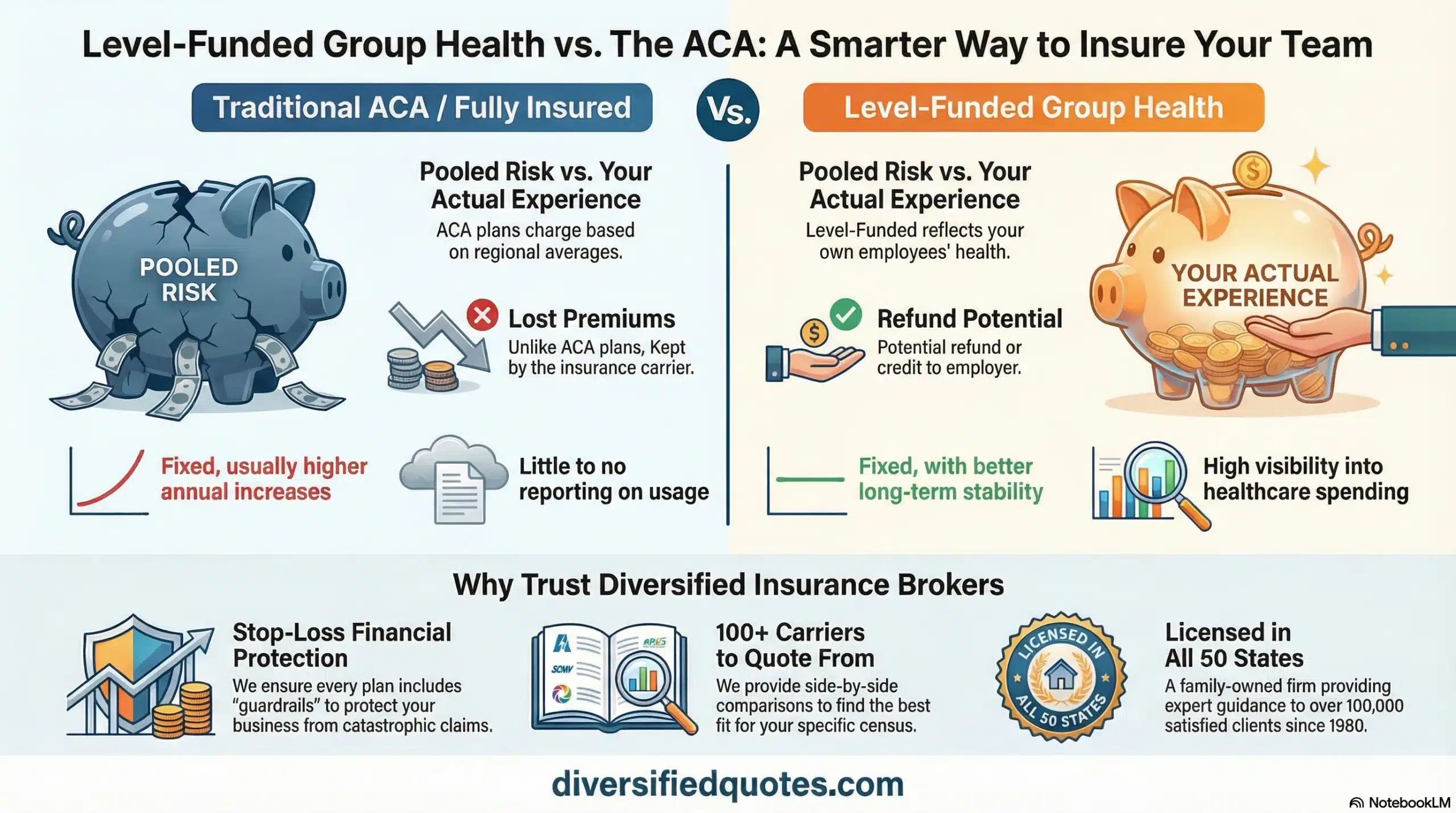
Fully insured plans. In a fully insured arrangement, the employer pays a fixed monthly premium to the insurance carrier. The carrier bears all the claim risk and manages the plan administration. Premiums are typically based on a combination of community rating (broad market pricing factors) and group-specific underwriting, and they include a margin for carrier profit and risk reserves. The primary advantage of fully insured is simplicity: predictable monthly cost, no claims-year-end reconciliation, minimal administrative complexity. The primary disadvantage is that favorable claims performance does not benefit the employer — the carrier keeps the surplus, and renewal pricing may not reflect the employer’s good experience as accurately or as generously as it should. For 70-employee organizations that are actively managing their plan and have favorable utilization, fully insured often means paying more than necessary for risk that is being well-managed.
Level-funded plans. Level-funded plans have grown significantly in the mid-market because they provide most of the simplicity of fully insured while creating a mechanism for favorable claims performance to benefit the employer. In a level-funded arrangement, the employer pays a consistent fixed monthly amount — similar to a fully insured premium — but that payment is structured as three components: a claims fund estimate, administrative costs, and stop-loss protection. If actual claims during the plan year are lower than the estimated fund, the unused portion may be returned to the employer at year end (subject to contract terms). Stop-loss insurance caps exposure to large individual claims and aggregate annual spend. The result is a plan that feels administratively similar to fully insured but has both downside protection and upside potential. For 70-employee organizations with stable workforces and reasonable claims histories, level funding typically produces better financial outcomes than fully insured over a multi-year horizon. For employers evaluating whether their claims history supports a level-funded approach, understanding how self-funded and level-funded group health works provides the conceptual foundation.
Partially self-funded (Administrative Services Only) plans. In a partially self-funded or ASO arrangement, the employer pays claims as they occur from a claims fund rather than paying fixed premiums. Stop-loss insurance — specific stop-loss for individual high claims and aggregate stop-loss for total annual plan spend — provides the financial guardrails that prevent unlimited exposure. The employer gains full transparency into claims activity, cost drivers, and utilization patterns in a way that is simply not available in fully insured plans. This transparency is the most powerful advantage of self-funding at 70 employees: instead of receiving a renewal number with opaque justification, the employer can see exactly which cost drivers are producing the renewal — high pharmacy spend, specific utilization patterns, site-of-care inefficiencies — and take targeted action before the next renewal rather than accepting increases passively. The pros and cons of self-funded group health merit careful review for any 70-employee organization considering this transition, because the operational requirements are meaningfully different from fully insured administration.
What Drives Renewal Volatility at 70 Employees — and What Controls It
Renewal increases at 70 employees are driven by two distinct categories of factors: uncontrollable market dynamics and organization-specific utilization patterns. Understanding which is which is essential to knowing where to invest management attention and where to accept trend as the cost of doing business in healthcare.
The uncontrollable category includes broad medical and pharmaceutical trend — the industry-wide cost increases that reflect inflation in provider contracts, hospital costs, and drug pricing that affect all group health plans regardless of what any individual employer does. Trend has run in the 5-10% range annually for most of the past decade, with pharmacy trend often higher. No amount of plan management eliminates these macroeconomic headwinds, and employers who expect a well-managed plan to produce flat or declining premiums year over year will be disappointed. The realistic goal is not zero trend — it is renewals that track trend rather than exceeding it by 5-15 points because of controllable utilization problems that were not addressed.
The controllable category is where management attention produces ROI. Site-of-care behavior — whether employees go to urgent care or the emergency room for non-emergency conditions — is one of the highest-leverage controllable variables. ER visits for conditions that could have been handled at urgent care cost three to five times as much as the urgent care alternative, and reducing ER non-emergency utilization by 20-30% through employee education and telehealth access can produce renewal impact that meaningfully offsets trend. Pharmacy management — formulary design, generic substitution incentives, specialty drug clinical management — is increasingly critical as GLP-1 medications and specialty biologics become larger shares of group health pharmacy spend. A plan with no pharmacy management strategy will experience pharmacy cost growth that far exceeds general medical trend. Network unit cost management — ensuring the plan is using the most cost-efficient contracting available in the market areas where most utilization occurs — is a background lever that affects every single claim processed through the plan.
Chronic condition management is a longer-lead lever but a high-impact one. Employees with poorly managed diabetes, hypertension, or musculoskeletal conditions are higher utilizers of acute and specialist care than those whose chronic conditions are well-managed through consistent primary care and medication adherence. A plan design that makes primary care visits easy and affordable encourages the ongoing management that prevents expensive acute events. The investment is in the plan design and cost-sharing structure; the return comes in the claims performance that produces better renewals over a 2-3 year horizon.
Network Strategy and Plan Design That Produces Value at 70 Employees
Network selection at 70 employees is not primarily a cost question — it is a value question. The cheapest network is not automatically the right network if it forces employees out-of-network frequently, creates billing complexity, or limits access to the providers employees already have established relationships with. The right network is the one that provides strong in-network access to the providers and facilities your employees actually use, at the most competitive contracted rates available in those specific geographies.
For most 70-employee organizations, a broad PPO or tiered PPO design provides the best balance of access and cost management. Broad PPOs give employees the flexibility to use a wide range of in-network providers without gatekeeper requirements, while tiered designs can steer utilization toward higher-value providers within the network by creating cost-sharing incentives without restricting access. High-performance networks that direct members to centers of excellence for high-cost procedures — joint replacements, cardiac care, cancer treatment — can produce significant savings on high-dollar claims without meaningfully affecting the day-to-day plan experience for the majority of employees.
Plan design at 70 employees should be calibrated to the actual utilization patterns of the workforce, not defaulted to industry standard templates. The most common design failure is setting cost-sharing structures (deductibles, copays, out-of-pocket limits) based on what looks reasonable on paper rather than on what will produce the right utilization behavior from the actual workforce. If the primary care copay is set too high, employees avoid primary care and defer conditions that then become expensive. If the urgent care copay is set too high relative to ER, employees default to ER when urgent care would be perfectly appropriate and sufficient. Aligning cost-sharing to the actual behaviors the employer wants to encourage — and reviewing utilization data to confirm that the cost-sharing structure is producing those behaviors — is the type of active plan management that distinguishes organizations that control their group health costs from those that don’t.
Pharmacy Strategy: The Most Underestimated Cost Driver at 70 Employees
For employers who have been on fully insured plans, pharmacy often feels like a black box — a number that shows up in the renewal justification without much visibility into what is driving it. One of the most compelling reasons to consider level-funded or self-funded arrangements at 70 employees is that they typically provide pharmacy transparency that fully insured plans do not. When an employer can see actual pharmacy spending — which drug classes are driving cost, which specialty medications are on the formulary, how much is being spent on brand medications when generics are available — they can make informed decisions about pharmacy benefit design rather than simply accepting the carrier’s standard formulary.
GLP-1 medications (Ozempic, Wegovy, and similar) have become a major pharmacy cost factor for group health plans across all sizes. A single employee on a GLP-1 medication may cost $15,000 to $25,000 annually in pharmacy spend. At 70 employees, even a few employees on these medications can meaningfully affect the plan’s pharmacy cost trajectory and renewal pricing. Employers have choices about how to address this: formulary management that requires prior authorization or step therapy for high-cost medications, plan designs that include or exclude specific drug classes based on FDA-approved indications, or pharmacy carve-outs to third-party pharmacy benefit managers who specialize in managing high-cost drug spend. None of these decisions can be made intelligently without the pharmacy transparency that alternative funding arrangements typically provide.
Participation, Contribution Strategy, and Why They Matter More Than You Think
Participation rate — the percentage of eligible employees who enroll in the group health plan — is one of the most controllable premium drivers and one of the most neglected. Carriers set minimum participation thresholds (often 70-75% of eligible employees after waivers are excluded) because low participation creates adverse selection: only employees who expect to use coverage heavily tend to enroll when premiums are high, which skews the enrolled pool toward higher claimants and drives costs up, which makes premiums less affordable for the next enrollment cycle, which further reduces participation. This spiral is a real phenomenon in group health, and it begins with contribution strategies that make the employee’s premium share high enough that healthier employees opt out.
The employer contribution decision — how much of the total premium the employer pays versus what gets passed to employees through payroll deductions — directly determines whether broad participation is achievable. A rule of thumb that holds up consistently in mid-market group health is that employee-only premium share needs to be kept reasonable to encourage healthy employees to enroll, because the enrolled pool’s health profile directly affects claim costs and therefore future premium levels. Employers who scrimp on contributions to reduce short-term cost often end up with higher long-term costs because the enrolled group becomes less healthy as participation declines.
Dependent enrollment strategy is a separate decision. Family coverage is significantly more expensive than employee-only coverage, and most 70-employee employers cannot fully subsidize family premiums without material budget exposure. The most common and workable approach is to contribute generously toward employee-only premium (encouraging broad employee participation) while offering dependent coverage at a higher employee-share, making it accessible but not fully employer-funded. This structure supports the enrolled pool health dynamics for employee-only coverage while making family coverage available for those who need it without creating unlimited employer cost exposure for dependent utilization.
Building a Renewal Governance Process That Produces Consistent Results
The single most consistent differentiator between 70-employee organizations that control their group health costs year over year and those that experience chronic renewal shock is whether they have a deliberate renewal governance process or whether they treat renewal as an annual event rather than an ongoing management responsibility. A governance process does not require a full HR department or expensive external consultants — it requires a calendar, a few specific data points reviewed on a regular schedule, and a relationship with a broker who treats plan management as a service rather than an annual transaction.
The renewal governance calendar for a 70-employee organization should include: a mid-year claims review (typically around the 6-month mark of the plan year) to identify emerging cost drivers before they fully develop in the renewal; a quarterly pharmacy review if transparency permits it; a 90-day pre-renewal analysis comparing current plan performance against renewal terms being offered by the current carrier and alternatives; an annual plan design review to confirm that cost-sharing structures are still aligned with actual utilization patterns; and an annual employee communication and education effort that reinforces smart plan utilization. None of these activities requires more than a few hours per quarter, and the cumulative effect over two to three years consistently produces meaningfully better renewal outcomes than organizations that simply accept what the carrier proposes each year.
Employers who build this governance process at 70 employees create the infrastructure that makes scaling to 100, 150, and 200 employees progressively easier rather than progressively more chaotic. Each renewal becomes a refinement of an established process rather than a from-scratch reaction to an unexpected number.
Planning the Transition: From Reactive Renewals to Proactive Plan Management
For employers who recognize that their current group health approach is reactive — accepting renewals, switching carriers when increases are intolerable, repeating the cycle — the transition to proactive plan management is not technically complex. The barriers are mostly organizational: the renewal calendar has to change, the broker relationship has to evolve, and the employer’s own engagement with the plan has to deepen from “sign the renewal paperwork” to “review the data and make deliberate decisions.” These are behavioral changes, not technical ones.
The practical starting point is a comprehensive plan assessment: current plan structure, renewal history, claims experience if available, participation rate, contribution strategy, and how the current plan compares to alternatives available at this group’s size and profile. That assessment produces a clear picture of where the organization is versus where it could be, and what specific changes — in funding model, plan design, contribution strategy, pharmacy management, or utilization education — would produce the most meaningful improvement in cost and stability. From that analysis, a transition plan can be built that moves the organization toward a better structure on a timeline that is realistic given the group’s renewal calendar and administrative capacity.
Compare Group Health Funding Options for 70 Employees
We’ll evaluate your current plan and compare fully insured, level-funded, and self-funded alternatives to find the structure that reduces cost and improves stability.
Questions? Call 800-533-5969
Financial Protection Essentials
Medicare updates, retirement rollover strategies, group coverage planning, and dental insurance comparison resources.
Related Group Health Pages
Explore additional group health resources for small and growing employers.
Pick Your Company Size
Not the right headcount? Use the buttons below to jump to the group health page that matches your workforce.
Talk With an Advisor Today
Choose how you’d like to connect—call or message us, then book a time that works for you.
Schedule here:
calendly.com/jason-dibcompanies/diversified-quotes
Licensed in all 50 states • Fiduciary, family-owned since 1980
FAQ: Group Health Insurance for 70 Employees
Yes — employers with 70 employees typically qualify for fully insured, level-funded, and partially self-funded group health plans. At this size, the organization is firmly in the mid-market category and usually has access to a wider range of plan structures than smaller employers. Fully insured plans are the most familiar and easiest to administer. Level-funded programs offer potential refunds for favorable claims experience with predictable monthly budgeting. Partially self-funded plans provide greater transparency and claims control for organizations that want to understand what is actually driving costs.
Eligibility for each structure depends on factors including workforce demographics, industry classification, and historical claims experience. The quality of options available also depends significantly on how the group is presented during the underwriting or program review process — which is one of the practical reasons working with an independent broker who can position the group favorably across multiple carriers produces better outcomes than applying to a single carrier without that comparison context. Starting the plan selection process early enough to evaluate options deliberately, rather than accepting a default renewal, is the most consistent way to ensure the organization is accessing the full range of plan structures available at this size.
Refunds may be available under level-funded plans when actual claims are lower than the program’s estimated claims component for the plan year. In a level-funded arrangement, the employer’s monthly payment is built from three components: an estimated claims fund, administrative costs, and stop-loss protection. If claims during the plan year are less than the estimated fund, unused claim dollars may be returned to the employer at year end, subject to the specific contract terms and program rules of the carrier or program administrator. This refund potential is one of the primary reasons level funding becomes attractive at 70 employees — it allows companies to benefit directly from efficient claims experience rather than simply subsidizing a fully insured carrier’s conservative pricing assumptions.
In partially self-funded arrangements, the employer pays claims as they occur rather than prepaying fixed premiums, which means the financial benefit of favorable claims experience shows up as lower total annual costs rather than a year-end refund per se. The result is similar — the organization pays closer to what care actually costs rather than paying for worst-case assumptions that may not materialize. Even in years when refunds are modest or costs are average, the transparency and pricing efficiency of alternative funding models tend to improve renewal outcomes over time compared to fully insured plans, where favorable claims experience has no mechanism for benefiting the employer.
Self-funding for a 70-employee company is not the same as self-funding without protection. In a partially self-funded arrangement, stop-loss insurance is used to cap financial exposure for large individual claims and total annual plan costs, creating defined guardrails that limit the organization’s downside risk. Specific stop-loss coverage limits how much the plan pays for any single claimant’s claims in a year — for example, the stop-loss carrier reimburses the plan for claims above a set threshold. Aggregate stop-loss coverage limits total plan spending across all claimants in a plan year. Together, these mechanisms ensure the employer never faces unlimited financial exposure.
The practical risk at 70 employees in a partially self-funded structure is not catastrophic financial exposure — it is the operational and governance requirements of managing a more transparent plan. The organization needs a plan administrator, reporting capabilities, and a process for responding to cost driver information when it is available. For employers who want the financial benefits of self-funding but prefer the operational simplicity of a fixed monthly payment, level funding provides a middle path: claims-aligned pricing with the predictable monthly budgeting structure of a fully insured plan. Most advisors position the self-funding risk question not as “is it risky?” but as “which structure is right for this organization’s risk tolerance, operational capacity, and financial goals?”
Most group health plans for 70 employees can be implemented within a few weeks once underwriting review, plan selection, and enrollment are completed. The typical timeline runs from initial proposal and comparison through enrollment and first effective date, with the critical path usually driven by underwriting turnaround from carriers or program administrators and the time required to collect employee enrollment information. For level-funded or partially self-funded plans that require additional financial review or stop-loss underwriting, the timeline may be slightly longer — typically four to six weeks from application submission to coverage effective date.
The implementation timeline can be compressed or extended depending on how organized the employer is with eligibility data, enrollment windows, and employee communication. A clean, well-communicated enrollment process where employees receive clear materials, understand their options, and submit elections within the enrollment window typically produces a faster implementation with fewer corrections and re-submissions. Employers who begin the review and comparison process at least 90 days before their desired effective date give themselves enough time to evaluate options deliberately, complete enrollment without rushing, and ensure the first billing cycle is set up correctly — which prevents the administrative disruptions that tend to happen when implementations are compressed into the final weeks before the effective date.
Yes — plans designed around transparency and cost control at 70 employees typically scale more smoothly as employee count increases. The fundamental infrastructure of a well-designed mid-market plan — clear eligibility rules, clean administrative processes, utilization management, pharmacy oversight, and a renewal governance process — becomes more valuable as the organization grows, not less. Employers that invest in building this infrastructure at 70 employees tend to face less disruption as they move into larger group categories because the plan management disciplines are already established and the team understands how to use data to make informed decisions.
The alternative — staying on a passive fully insured plan and accepting default renewals — tends to compound problems as employee count grows. Costs drift upward, renewal options narrow, and the organization finds itself trying to implement significant changes under time pressure rather than evolving the plan incrementally. Each of our headcount-specific group health pages — from 80 employees through 1,000+ — reflects the progression of available options and strategies as organizations grow, recognizing that the right plan at each stage builds toward a more sophisticated and cost-efficient structure over time rather than starting from scratch at each transition point.
About the Author:
Jason Stolz, CLTC, CRPC, DIA, CAA and Chief Underwriter at Diversified Insurance Brokers (NPN 20471358), is a senior insurance and retirement professional with more than 25 years of real-world experience helping individuals, families, and business owners protect their income, assets, and long-term financial stability. As a long-time partner of the nationally licensed independent agency Diversified Insurance Brokers, Jason provides trusted guidance across multiple specialties—including fixed and indexed annuities, long-term care planning, personal and business disability insurance, life insurance solutions, Group Health, Travel Medical and Evacuation Insurance, and short-term health coverage. Diversified Insurance Brokers maintains active contracts with over 100 highly rated insurance carriers, ensuring clients have access to a broad and competitive marketplace.
His practical, education-first approach has earned recognition in publications such as VoyageATL, and contributions from his agency featured in Kiplinger and GoBankingRates— highlighting his commitment to financial clarity and client-focused planning. Drawing on deep product knowledge and years of hands-on field experience, Jason helps clients evaluate carriers, compare strategies, and build retirement and protection plans that are both secure and cost-efficient. Visitors who want to explore current annuity rates and compare options across multiple insurers can also use this annuity quote and comparison tool.
Explore More Group Health Insurance Options: Browse our complete guide to Group Health Insurance by Company Size — covering plans for 2, 10, 20, 50, 100, 250, 500, 750 & 1,000+ employees from 100+ carriers.
Last Reviewed: June 1, 2026 |
Reviewed by: Jason Stolz, CLTC, CRPC, DIA, CAA
Chief Underwriter, Diversified Insurance Brokers, Inc. | NPN: 20471358 | Diversified Insurance Brokers, Inc. — Licensed in all 50 states
Fact Checked by: Tonia Pettitt, CMIP©
Medicare Specialist, Diversified Insurance Brokers, Inc. | NPN: 14374308 | Diversified Insurance Brokers, Inc. — Licensed in all 50 states
Did you find this content helpful? Leave us a Google review — it helps others find trustworthy guidance too.
Editorial Standards: Diversified Insurance Brokers maintains rigorous editorial standards to ensure accuracy, clarity, and independence in all content. Learn more about our editorial standards and commitment to transparency.
