
2 Person Group Health Insurance
As an Independent Group Health Insurance Broker, we compare fully insured, level-funded, and self-funded options across carriers to find the lowest cost coverage for your business.
2 Person Group Health Insurance

Jason Stolz CLTC, CRPC, DIA, CAA
2 person group health insurance is the smallest employer-sponsored group health plan that exists in the standard market — and it is one of the most underutilized structures in small business benefits planning. Most states define the small group market as beginning at two qualifying employees, meaning a business does not need a large workforce or a formal HR department to access coverage through the employer group channel. For business owners who have spent years paying individual market premiums or navigating ACA marketplace volatility, the discovery that a two-person company can qualify for group health coverage — with employer-deductible premiums, pre-tax employee contributions, and a plan design that does not reset annually with marketplace carrier changes — is often the most significant benefits planning shift they make.
The four most common structures that arrive at 2 person group health insurance are: a business partnership where both partners draw W-2 payroll income; a business owner and one non-owner full-time employee; a family business where two working family members receive legitimate W-2 wages; and a sole proprietor who has hired the business’s first full-time employee and wants to establish benefits infrastructure immediately. In each case, the mechanics of qualification are the same — documented business operations, verified payroll, employer contribution meeting the carrier’s minimum threshold, and both eligible employees enrolled — but the planning considerations differ depending on business structure, state of domicile, and whether the two employees have other credible coverage options available. At Diversified Insurance Brokers, Jason Stolz, CLTC, CRPC, DIA, CAA helps small business owners navigate these qualification requirements, compare fully insured and level funded plan structures, and establish a 2 person group health insurance strategy that positions the business correctly from the first enrollment cycle. Our resource on group health insurance covers the broad employer health insurance framework, and our resource on small business group health insurance covers the full small employer planning context.
Get a 2 Person Group Health Insurance Quote
We verify your business’s eligibility for 2 person group health insurance, compare fully insured and level funded plan options across our carrier network, confirm participation and contribution requirements specific to your state, and structure the plan for the strongest combination of coverage quality, premium efficiency, and tax positioning.
Request a 2 Person Group Health QuoteHow 2 Person Group Health Insurance Works
2 person group health insurance operates under the same regulatory framework and carrier rating structures as all small employer group health plans — the only distinguishing feature is group size. The plan is established as an employer-sponsored group health plan, premiums are rated on a small group basis rather than individual market rules, and all plan participants are enrolled through the employer’s group policy rather than through a marketplace or direct individual application. The employer acts as the policyholder and plan sponsor, carries the administrative responsibilities of a group plan, and is entitled to the business expense deductions that come with employer-sponsored health insurance.
With two eligible participants, the risk pool is at its smallest possible size, which creates specific underwriting considerations that don’t apply to larger groups. Most carriers that offer two-person group plans rate them on a community rating or modified community rating basis for the small group market rather than individual health underwriting — meaning pre-existing conditions cannot be used to deny coverage or increase individual premiums within a small group plan. This is one of the most significant advantages of 2 person group health insurance compared to historical individual market underwriting: both participants are covered regardless of health history, and neither faces individual underwriting exclusions. Our resource on what is the primary reason to buy group health insurance covers the core coverage advantages of employer-sponsored plans over individual market alternatives.
Plan design for a 2 person group follows the same menu available to larger small groups: HMO, PPO, HDHP with HSA compatibility, EPO structures, and in some states POS plans. Coverage tiers — employee only, employee plus spouse, employee plus children, family — are all available, allowing each of the two participants to select the tier that fits their household without affecting the other participant’s enrollment. Our resource on how to set up group health insurance for employees covers the full plan design and implementation process.
Who Qualifies — The Four Common 2-Person Group Scenarios
Understanding who qualifies for 2 person group health insurance requires distinguishing between the business structure, the employment relationship, and the state-specific rules that govern small group eligibility. Our carrier market analysis across states identifies four scenarios that consistently produce successful 2-person group enrollments.
The first is the business partnership where both partners are structured as W-2 employees of the business entity. When a partnership, LLC, or corporation pays both partners through payroll with documented W-2 income, both partners typically qualify as eligible employees for group health purposes. This is particularly common in professional services firms — consulting partnerships, financial advisory practices, legal offices, and medical practices — where two principals operate a legitimate business with documented payroll. The key documentation requirement is confirmed W-2 wages for both participants, not simply ownership interest or profit distributions.
The second scenario is a business owner plus one non-owner full-time employee. This is the most straightforward 2-person group structure: a small business owner hires one full-time employee and wants to offer group health benefits to both. As long as the employee meets the carrier’s minimum hours requirement (typically 30 hours per week for full-time status, though some carriers allow 20-29 hours), the business qualifies as a 2-person group. The owner must also be drawing W-2 payroll rather than relying solely on pass-through distributions or owner’s draws, which do not typically satisfy the W-2 verification requirement.
The third scenario is a working spousal business where both spouses draw legitimate W-2 wages from the same business entity. Some states allow spouse-only groups; others require at least one non-owner or non-spouse W-2 employee for group eligibility. State rules vary meaningfully here, and carrier-specific guidelines add additional variation. Our advisors verify state and carrier eligibility before any application to prevent enrollment delays or retroactive eligibility denials in spousal group situations.
The fourth scenario is a sole proprietor transitioning to their first full-time hire. When a sole proprietor brings on the business’s first W-2 employee, the business immediately becomes eligible for small group coverage in most states. This is a critical planning moment: establishing the 2 person group plan at the first hire creates the benefits infrastructure that scales naturally as the business grows, positions the company competitively for future hiring, and gives both the owner and the first employee access to coverage that was not available when the business was a single-person operation. Our resource on group health insurance for consulting firms covers how professional solo practitioners navigate this transition when adding their first employee.
The Participation Challenge Unique to 2-Person Groups
The participation requirement is the most practically significant obstacle unique to 2 person group health insurance, and it deserves direct attention before any other aspect of plan selection. Most carriers apply a minimum participation threshold — typically around 70% of eligible employees — as a condition of group plan issuance and renewal. With a 2-person group, the arithmetic of 70% participation creates a specific planning constraint: both eligible employees generally must enroll in the group plan, because one enrollee out of two represents only 50% participation, which falls below the carrier threshold.
| Participation Scenario | Employees Enrolled | Participation Rate | Typically Qualifies? | Planning Notes |
|---|---|---|---|---|
| Both employees enroll | 2 of 2 | 100% | Yes — exceeds all standard thresholds | Cleanest scenario; no participation concern |
| One enrolls, one has credible other coverage (waiver) | 1 of 1 eligible | 100% of non-waived | Yes — waived employees excluded from denominator when waiver is for credible coverage | Employee waiving must have a qualifying credible coverage source (spouse’s plan, Medicare, etc.) |
| One enrolls, one declines without credible waiver | 1 of 2 | 50% | No — below typical 70% threshold | Special enrollment window (Nov 15–Dec 15) may bypass this requirement — see below |
| Neither enrolls | 0 of 2 | 0% | No — group plan cannot issue with zero enrolled | Consider QSEHRA or ICHRA as participation-free alternatives |
The waiver provision in the second scenario is an important planning tool. When an eligible employee has credible alternative coverage — a spouse’s employer plan, Medicare, Medicaid, or coverage through another employer — they can waive enrollment in the group plan without being counted against the participation percentage. For a 2-person group where one participant is covered under a spouse’s employer plan and wishes to waive the group plan, the business may still qualify with only one active enrollee, because the waiving employee is removed from the participation denominator. Carrier documentation requirements for valid waivers vary, and confirming the waiver terms before application prevents mid-enrollment eligibility complications. Our resource on minimum employees for group health insurance covers how participation calculations work across different group sizes.
The November Special Enrollment Window — The Participation Safety Valve
One of the most important and least-known planning tools for 2 person group health insurance is the annual special enrollment window that runs from November 15 through December 15 each year. During this window, many carriers relax or suspend the standard participation thresholds — meaning a 2-person business can enroll in group coverage even if only one of the two eligible employees intends to participate, without triggering the normal 70% participation denial that would apply during standard enrollment periods.
For business owners where one partner, spouse-employee, or hired employee declines group coverage for personal preference reasons (not credible coverage), the November-December window represents the only standard enrollment opportunity that does not require both employees to participate. Businesses that have been unable to qualify during other months because one employee declined coverage should specifically target this annual window for their group health enrollment. The coverage effective date from a November 15-December 15 enrollment typically begins January 1, aligning with the calendar-year plan cycle that most small employers prefer for budgeting purposes. Our resource on top questions employers ask about group health insurance covers enrollment timing and other common small employer planning questions in full.
Documentation Requirements for 2-Person Group Health
2 person group health insurance qualification requires documentation that establishes three things: the business is a legitimate, active operating entity; both participants are genuine W-2 employees receiving earned wages; and the employer meets the carrier’s contribution requirements. Our carrier market analysis confirms the following documentation as standard across most small group carriers.
Business legitimacy documentation typically includes an active Employer Identification Number (EIN), business entity registration documentation from the state of domicile, recent business bank statements showing active financial operations, and — depending on the carrier and business structure — a most recent business tax return. The documentation standard is higher than individual market enrollment precisely because carriers are verifying the legitimacy of the employer-employee relationship before extending group plan pricing and non-medical underwriting treatment. Carriers that offer 2-person group plans have encountered situations where the “employer-employee” relationship is a paper structure created solely to access group coverage, and documentation requirements are designed to screen for genuine operating businesses.
Payroll documentation is the most critical qualification item. Most carriers require recent payroll reports — typically covering the most recent one to three pay periods — showing both employees receiving regular wage payments. W-2 documentation from the most recent tax year may also be required for business owners who want to demonstrate an established payroll history. For businesses that are newly formed or in their first payroll cycle, some carriers will accept a payroll service enrollment confirmation and an initial payroll register; others require a minimum period of documented payroll history before group enrollment. Our resource on how to set up group health insurance for employees covers the full documentation and setup process for small employers establishing their first group plan.
Employer Contribution Requirements
Employer contribution requirements for 2 person group health insurance establish a minimum floor for how much the business must contribute toward employee premiums. Most carriers in the small group market require the employer to pay at least 50% of the employee-only (single) premium for each eligible employee. This minimum contribution applies to the base plan — the least expensive option if the employer offers multiple plan choices — though the employer may choose to contribute more if the benefits strategy calls for higher employer participation.
The 50% employer contribution minimum has two planning implications for 2-person groups. First, it establishes a real cash commitment from the business — both employees’ single premiums must be at least 50% employer-funded, creating a predictable minimum annual expense that the business must budget for before enrolling. Second, it triggers the tax deductibility that makes group health insurance financially attractive for small businesses: employer contributions to group health premiums are generally deductible as business expenses under standard tax treatment, shifting what would otherwise be personal after-tax health spending into the business expense category. Our resource on group health insurance cost for small business covers contribution amounts and budget planning for small employer groups.
For 2025, the ACA affordability standard requires that the employee’s share of self-only coverage not exceed 9.02% of the employee’s W-2 wages. While the ACA employer mandate applies only to businesses with 50 or more full-time equivalents — meaning most 2-person groups are not legally required to offer health insurance — designing the contribution structure to meet the affordability threshold is still good planning practice, particularly if the business intends to grow beyond two employees in future years. Our resource on level funded health insurance tax benefits explained covers the tax positioning framework that applies across small employer group structures.
Tax Efficiency — Why Group Coverage Changes the Cost Calculus
The tax advantages of 2 person group health insurance represent the most significant financial benefit beyond the coverage itself, and they are the primary reason that a 2-person group plan often produces better total financial outcomes than individual market coverage even when the gross premium is comparable. Three tax mechanisms work together to produce this efficiency.
The employer deduction is the first and largest mechanism. When a business pays employee health insurance premiums as the employer, those premium payments are generally deductible as ordinary business expenses — reducing the business’s taxable income by the full employer contribution amount. For a business owner in a 30-35% combined federal and state marginal tax bracket, every $1,000 of employer health premium generates approximately $300-350 of tax reduction, effectively reducing the after-tax cost of the coverage by that percentage. Individual health insurance premiums paid by a self-employed person are partially deductible under the self-employment health insurance deduction, but the deduction mechanics and limitations differ from the full business expense treatment available for legitimate employer-sponsored group plan contributions.
The Section 125 cafeteria plan is the second mechanism. When a 2-person group establishes a Section 125 plan (also called a Premium Only Plan or POP), employees can pay their share of group health premiums through pre-tax payroll deductions rather than after-tax dollars. This reduces the employee’s taxable income, reduces the employer’s payroll tax base (generating FICA savings for both employer and employee), and effectively makes the employee’s health premium contribution more efficient than any individual market structure. For a 2-person group, the administrative cost of establishing a Section 125 plan is typically modest relative to the ongoing FICA savings generated each year.
The Health Savings Account (HSA) compatibility is the third mechanism, available when the group plan is structured as a qualified High Deductible Health Plan (HDHP). HSA-eligible plans allow both employees to contribute pre-tax dollars to individual HSAs, creating a triple-tax-advantaged account structure: pre-tax contributions, tax-free investment growth, and tax-free withdrawals for qualified medical expenses. For 2-person groups where both participants are relatively healthy and prefer lower premium options, pairing an HDHP group plan with HSA contributions can significantly reduce total annual healthcare costs compared to richer plan designs at higher premiums. Our resource on why group level funding covers additional funding structures that enhance cost efficiency for small employer groups.
Fully Insured vs. Level Funded for 2-Person Groups
Small employer group plans are available through two primary funding structures, and the right choice for a 2-person group depends on the health profile of the two participants, the business’s tolerance for annual premium variability, and whether the carrier market in the state offers level funded options to groups this small.
Fully insured plans transfer all claim risk to the carrier in exchange for a fixed monthly premium. The employer pays the same amount each month regardless of whether the group uses zero or a large amount of medical services. Renewals in subsequent years are driven by the carrier’s overall rate adjustments, not just the group’s specific claim experience, which means a fully insured 2-person group that has low utilization may not see the claim savings reflected in their renewal rate. The trade-off is predictability: the employer never faces a mid-year premium adjustment for claims events, and the administrative simplicity is highest with fully insured plans. For new 2-person groups establishing their first employer benefits structure, fully insured is typically the logical starting point. Our resource on what is self-funded group health insurance covers the contrast between insured and self-funded risk structures in detail.
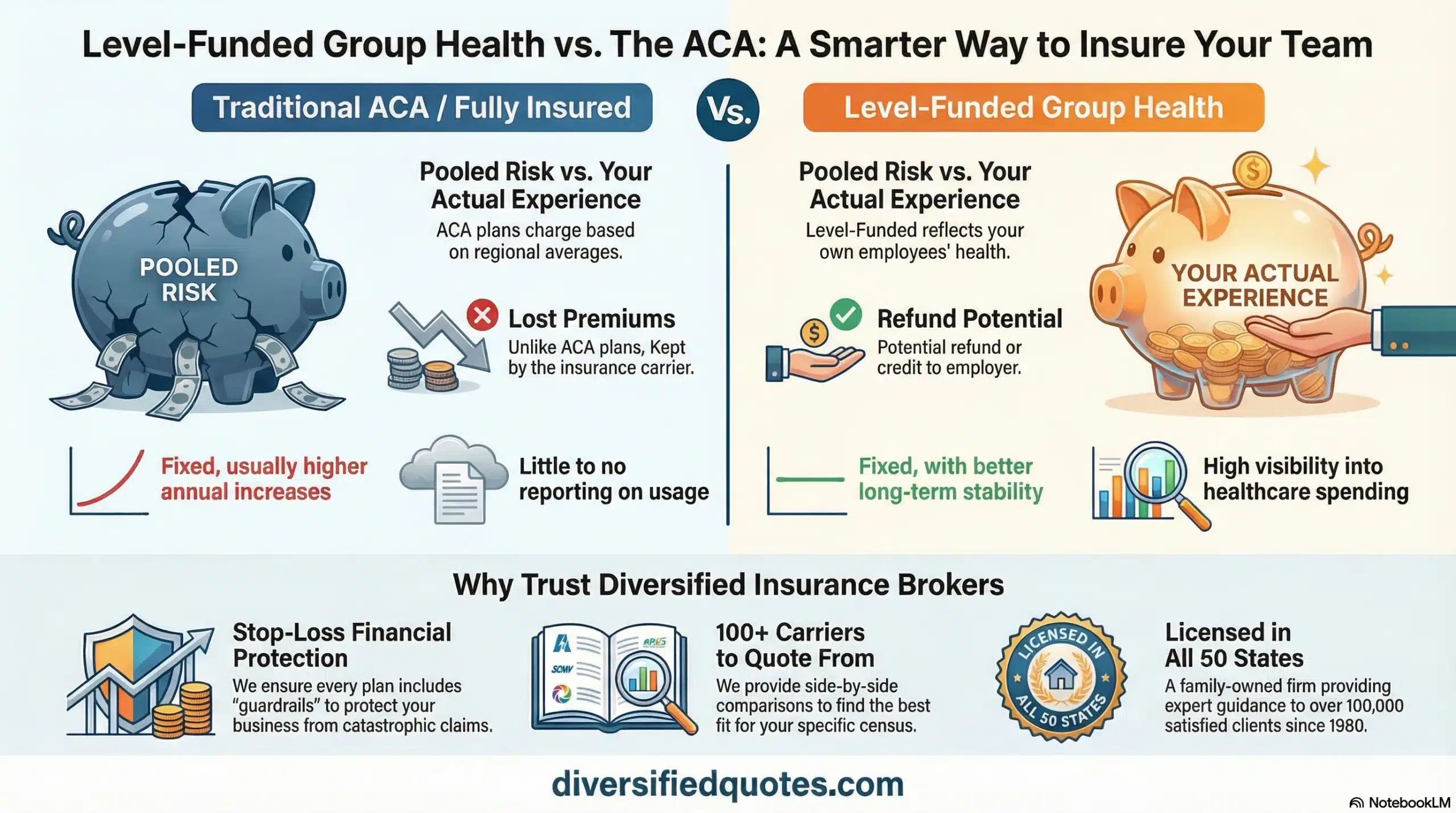
Level funded plans are becoming more available to small groups, including some 2-person groups, as carriers develop micro-group level funding products. Level funded structures maintain a fixed monthly payment — preserving the cash flow predictability of fully insured — but separate the employer’s monthly payment into three components: the administrative fee, the claims fund contribution, and the stop-loss premium. If the group’s claims run lower than the projected claims fund amount, the unused portion may generate a surplus credit at renewal, effectively reducing the following year’s cost. For 2-person groups with healthy participants who have low expected utilization, level funded structures can produce long-term cost advantages over fully insured plans. Our resource on understanding stop-loss insurance in level funded plans covers how the catastrophic claim protection within level funded structures works to cap employer risk exposure. Our resource on can 1099s get group level funding covers related eligibility questions for businesses with mixed workforce structures.
2 Person Group vs. Individual Market — Side-by-Side Comparison
Understanding when 2 person group health insurance produces a better outcome than individual market coverage requires examining the factors that drive cost and quality in both markets. Individual marketplace plans — including ACA marketplace plans and direct-to-carrier individual plans — are rated differently, structured differently, and subject to different renewal dynamics than small group employer plans.
Individual plans are subject to community rating within rating areas, which means premiums reflect the overall health and utilization profile of the individual market pool in the geographic area. ACA marketplace plans can change carrier, network, and plan structure annually, which means a policyholder may find that their preferred providers are not covered in the following year’s plan without a carrier change. Business owners who want predictable benefits that they can describe consistently to employees and dependents find the individual market’s annual variability frustrating for planning purposes.
2 person group plans are structured with employer involvement, which creates both a cost-sharing mechanism (employer contribution) and a tax positioning mechanism (business expense deduction) that individual plans cannot match. Group plans also typically offer richer network access in certain geographic markets where major carrier networks are more accessible through employer channels than individual plans. Our resource on ACA alternatives for company healthcare covers the full landscape of employer-side alternatives, and our resource on how to reduce company healthcare costs covers cost control strategies across different employer funding approaches.
When 2-Person Group Doesn’t Fit — QSEHRA and ICHRA Alternatives
Not every 2-person business qualifies for a traditional group health plan. Participation requirements may not be met. State rules may not support the specific ownership structure. Or the employer contribution minimum may strain the business’s early-stage budget. When traditional 2 person group health insurance isn’t accessible or isn’t the most efficient structure, two federal reimbursement arrangements provide meaningful alternatives.
A Qualified Small Employer Health Reimbursement Arrangement (QSEHRA) allows businesses with fewer than 50 full-time equivalent employees to reimburse employees tax-free for individual health insurance premiums and qualified medical expenses, up to IRS annual maximums. QSEHRAs have no participation requirement — employees can choose to participate or not without jeopardizing the arrangement — and there is no minimum employer contribution floor. This makes QSEHRA a practical alternative when the 2-person group cannot meet standard participation thresholds.
An Individual Coverage Health Reimbursement Arrangement (ICHRA) is more flexible than QSEHRA, has no contribution limit cap, and can be offered to different employee classes with different reimbursement amounts. ICHRAs also have no participation requirement, making them suitable for 2-person groups where one participant declines to participate in any employer health arrangement. Our resource on best group health insurance options for 2-person businesses covers the full comparison between traditional group plans and reimbursement arrangement alternatives for micro-groups. Our resource on dental and vision insurance covers the supplemental benefits that pair with any of these health coverage structures.
Strategic Value of Establishing Group Coverage at Two Employees
Beyond the immediate coverage and tax benefits, establishing 2 person group health insurance at the earliest eligible group size produces several long-range strategic advantages for businesses planning to grow. The administrative infrastructure — payroll integration, carrier relationships, Section 125 plan documentation, renewal cycle management — is established when the business is small and the complexity is manageable. When the business grows to five, ten, or twenty employees, the health benefits program scales from an existing foundation rather than being built from scratch at a more complicated stage.
Benefits infrastructure also affects hiring competitiveness. When a 2-person business establishes group health coverage, it can truthfully advertise employer-sponsored health benefits in job listings for the next hire — a meaningful differentiator in many labor markets where benefits access is a significant factor in candidate decision-making. Building the benefits program at two employees means it exists and is functional before the third hire is made. Our resource on disability income insurance for key person employees covers the complementary income-protection layer that sophisticated small employers pair with group health for a complete protection package.
Get Your 2 Person Group Health Insurance Quote
We verify your business’s eligibility, compare fully insured and level funded plan structures, confirm state-specific participation rules, and design a benefits strategy that positions both coverage quality and tax efficiency from day one.
Request a 2 Person Group Health QuoteRelated Group Health Strategy Pages
Talk With an Advisor Today
Choose how you’d like to connect—call or message us, then book a time that works for you.
Schedule here:
calendly.com/jason-dibcompanies/diversified-quotes
Licensed in all 50 states • Fiduciary, family-owned since 1980
Frequently Asked Questions: 2 Person Group Health Insurance
Can a business with only 2 employees qualify for group health insurance?
Yes. Most states define the small group market as beginning at two qualifying employees, making 2-person group health insurance the smallest employer-sponsored group plan available in the standard market. Both employees must be W-2 wage earners working a minimum number of hours (typically 30 hours per week for full-time classification, though some carriers allow 20-29 hours depending on plan design). The business must be an active, documented operating entity with verified EIN and payroll records, and the employer must meet the carrier’s minimum contribution requirement — typically paying at least 50% of the employee-only premium for each eligible participant.
What is the participation requirement for a 2-person group plan?
Most carriers apply a participation threshold of approximately 70% of eligible employees for small group health plans. With a 2-person group, this means both employees must typically enroll — because one enrollee out of two represents only 50% participation, which falls below the standard threshold. The important exception is the waiver provision: an employee who declines coverage because they have credible alternative coverage (a spouse’s employer plan, Medicare, or another qualifying source) is typically excluded from the participation denominator, meaning the remaining enrolled employee can satisfy the threshold alone. Additionally, during the annual special enrollment window from November 15 through December 15, many carriers suspend standard participation thresholds, allowing 2-person groups to enroll even if only one employee intends to participate.
Can spouses qualify as a 2-person group?
It depends on the state and carrier. Some states allow spouse-only groups where both spouses draw legitimate W-2 wages from the same business entity. Other states require at least one non-owner or non-spouse W-2 employee for small group eligibility. Carrier-specific guidelines add additional variation beyond state rules — some carriers that operate in permissive states still decline spousal-only group applications based on their own underwriting standards. Our advisors verify state and carrier eligibility before any application to prevent enrollment delays or retroactive eligibility denials in spousal group situations.
What are the tax advantages of a 2-person group health plan vs. individual coverage?
Employer-paid group health premiums are generally deductible as ordinary business expenses, reducing the business’s taxable income by the full employer contribution amount. A Section 125 cafeteria plan allows employees to pay their share of premiums through pre-tax payroll deductions, reducing taxable income and generating FICA savings for both employer and employee. When the group plan is a qualified High Deductible Health Plan, participants can make pre-tax HSA contributions for additional triple-tax-advantaged healthcare savings. Individual market health insurance does not provide these three layered tax mechanisms — the deductibility of individual premiums is limited and does not include the FICA savings generated by Section 125 structures.
What is the November 15-December 15 enrollment window and why does it matter?
Many carriers in the small group market relax or suspend standard participation thresholds during an annual special enrollment window running from November 15 through December 15. This means a 2-person business can enroll in group health coverage during this window even if only one of the two eligible employees intends to participate — bypassing the standard requirement that would otherwise deny the group due to insufficient enrollment. Coverage from this window typically begins January 1, aligning with the calendar-year plan cycle. For businesses where one partner, spouse-employee, or hired employee declines coverage, targeting this annual window is the primary strategy for establishing group health without meeting the full-year participation threshold.
What if one person leaves and the group drops to one employee?
If one of the two employees leaves the business and no replacement W-2 employee is added, the business no longer meets the two-employee minimum for most small group health plans. The remaining individual typically has COBRA continuation rights that allow coverage to continue for up to 18 months at group rates plus a small administrative fee — providing time to hire a replacement employee, transition to individual market coverage, or evaluate alternative structures like QSEHRA or ICHRA that function without minimum employee count requirements. Planning for this scenario in advance — particularly for partnership-based groups — protects the remaining participant from an abrupt coverage gap.
About the Author:
Jason Stolz, CLTC, CRPC, DIA, CAA and Chief Underwriter at Diversified Insurance Brokers (NPN 20471358), is a senior insurance and retirement professional with more than 25 years of real-world experience helping individuals, families, and business owners protect their income, assets, and long-term financial stability. As a long-time partner of the nationally licensed independent agency Diversified Insurance Brokers, Jason provides trusted guidance across multiple specialties—including fixed and indexed annuities, long-term care planning, personal and business disability insurance, life insurance solutions, Group Health, Travel Medical and Evacuation Insurance, and short-term health coverage. Diversified Insurance Brokers maintains active contracts with over 100 highly rated insurance carriers, ensuring clients have access to a broad and competitive marketplace.
His practical, education-first approach has earned recognition in publications such as VoyageATL, and contributions from his agency featured in Kiplinger and GoBankingRates— highlighting his commitment to financial clarity and client-focused planning. Drawing on deep product knowledge and years of hands-on field experience, Jason helps clients evaluate carriers, compare strategies, and build retirement and protection plans that are both secure and cost-efficient. Visitors who want to explore current annuity rates and compare options across multiple insurers can also use this annuity quote and comparison tool.
Explore More Group Health Insurance Options: Browse our complete guide to Small Business Group Health Insurance — covering getting started, costs, how to set up, best rates & working with a broker from 100+ carriers.
Last Reviewed: May 25, 2026 |
Reviewed by: Jason Stolz, CLTC, CRPC, DIA, CAA
Chief Underwriter, Diversified Insurance Brokers, Inc. | NPN: 20471358 | Diversified Insurance Brokers, Inc. — Licensed in all 50 states
Fact Checked by: Tonia Pettitt, CMIP©
Medicare Specialist, Diversified Insurance Brokers, Inc. | NPN: 14374308 | Diversified Insurance Brokers, Inc. — Licensed in all 50 states
Did you find this content helpful? Leave us a Google review — it helps others find trustworthy guidance too.
Editorial Standards: Diversified Insurance Brokers maintains rigorous editorial standards to ensure accuracy, clarity, and independence in all content. Learn more about our editorial standards and commitment to transparency.
