
ACA Alternatives for my Company Healthcare
ACA Alternatives for my Company Healthcare

Jason Stolz CLTC, CRPC, DIA, CAA
ACA alternatives for my company healthcare is the search that begins when a business owner stops accepting annual renewal increases as an inevitable cost of doing business and starts asking whether a different structure could deliver the same or better coverage at a more predictable and controllable cost. The Affordable Care Act established minimum standards for employer-sponsored group health coverage and created the small group marketplace that most employers under 50 full-time equivalents interact with most directly — but the ACA did not mandate that employers use fully insured plans to meet their coverage obligations. The landscape of ACA alternatives for company healthcare includes employer-sponsored structures that satisfy coverage requirements through different funding mechanisms, reimbursement models that replace the traditional group plan entirely, and hybrid approaches that layer different tools to create more cost-efficient and transparent healthcare strategies than the standard fully insured model can provide.
The most important framing for any employer evaluating ACA alternatives for company healthcare is that the goal in almost every case is not to reduce the benefit but to change who bears the risk, who retains surplus, and who controls the information about where healthcare dollars are actually going. Fully insured plans bundle claims risk, administrative costs, and carrier profit into a single fixed premium — and the employer pays that bundle whether or not claims experience justifies the price. The ACA alternatives explored on this page change that equation in specific, practical ways. At Diversified Insurance Brokers, Jason Stolz, CLTC, CRPC, DIA, CAA helps employers evaluate the full landscape of ACA alternatives for company healthcare across our 100+ carrier network, compare the actual cost and risk implications of each structure, and design a benefits strategy that positions the company for long-term sustainability rather than another year of reactive renewal decisions. Our resource on group health insurance overview covers the full employer health insurance framework, and our resource on top questions employers ask about group health insurance covers the most common planning questions in small and mid-size employer benefits decisions.
Explore ACA Alternatives for Your Company Healthcare
We compare fully insured ACA group plans against level-funded, self-funded, ICHRA, and QSEHRA alternatives across our carrier network — identifying which structure best fits your company size, workforce composition, and long-term cost control goals.
Request a Group Health ReviewWhy Employers Search for ACA Alternatives for Company Healthcare
The typical employer journey toward ACA alternatives for company healthcare begins with a renewal notice that feels disconnected from reality. A business with a relatively young, healthy workforce, low claims utilization, and stable headcount receives a 15-25% premium increase with minimal explanation. The employer cannot understand why costs are rising when nothing in the company’s actual health experience suggests the increase is justified. The answer, in most cases, is that fully insured small group plans do not price to the individual employer’s experience — they price to the carrier’s entire risk pool, which includes utilization patterns, regional medical inflation, and carrier margin requirements that have nothing to do with the specific employer’s workforce.
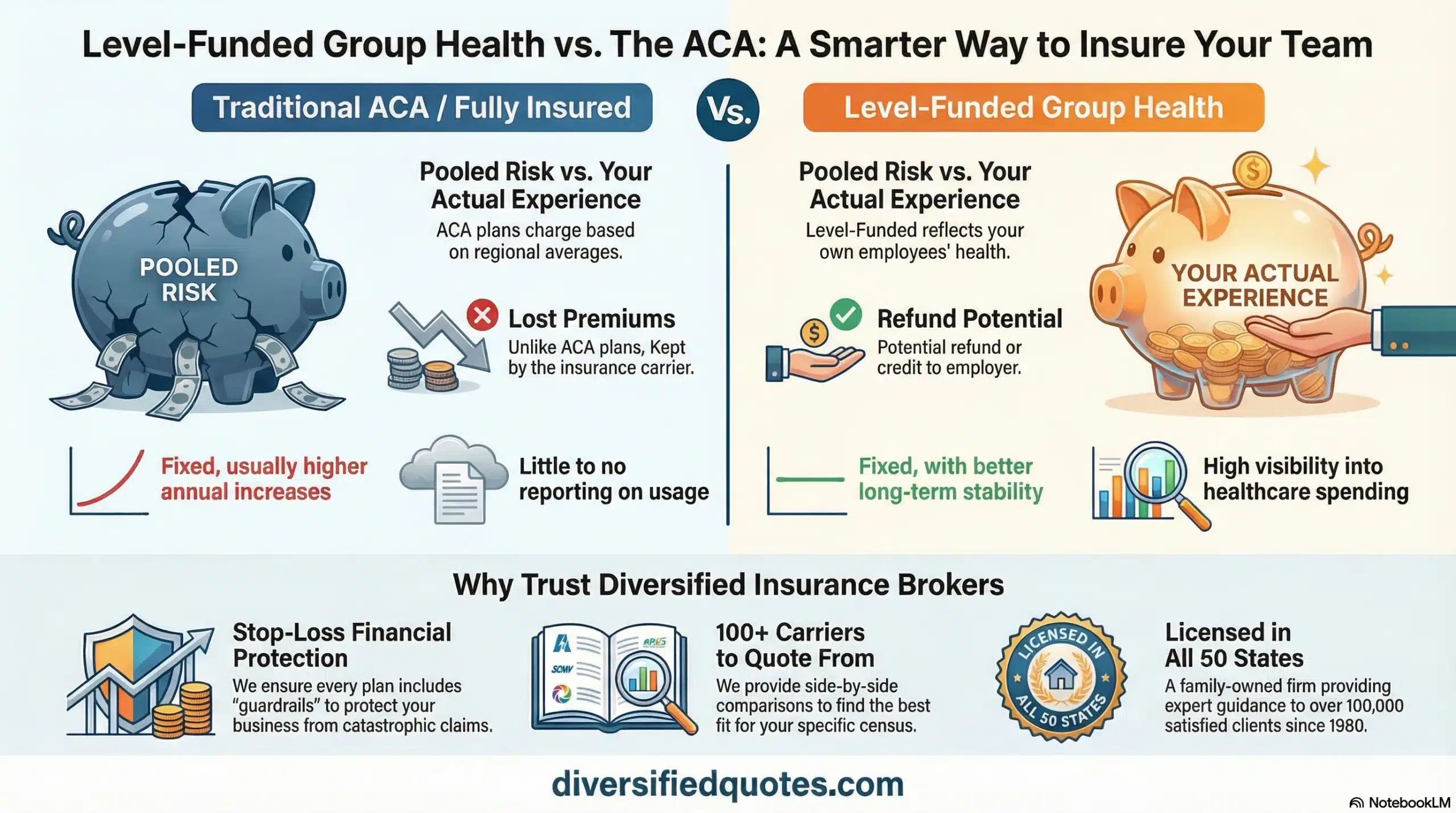
This disconnect between what an employer pays and what an employer’s workforce actually costs in healthcare is the fundamental problem that ACA alternatives for company healthcare are designed to solve. When the employer has low claims utilization, fully insured plans extract that surplus — the premium paid above actual claims — and retain it as carrier profit. The employer never sees the benefit of their workforce’s favorable health experience. ACA alternatives that shift risk to the employer allow the employer to capture that surplus directly, either as reduced cost or as a refund or credit at plan year end. Our resource on how to get the best group health insurance rates covers the carrier evaluation and rate strategy that sets the context for understanding fully insured pricing dynamics, and our resource on group health insurance cost for small business provides cost benchmarks across employer sizes and plan types.
The Full Landscape of ACA Alternatives for Company Healthcare
| Alternative Structure | Best Employer Size | Participation Required? |
Premium Predictability |
Claims Transparency |
Surplus Potential? |
Compliance Complexity |
|---|---|---|---|---|---|---|
| Fully Insured ACA Group Plan (status quo) | 2–50 employees (small group) | Yes — typically 70% of eligible | High — fixed monthly premium | Low — limited claims data access | No — surplus retained by carrier | Low — carrier handles compliance |
| Level-Funded Group Plan | 5–200 employees | Yes — varies by carrier | High — fixed monthly with claims fund | Moderate — quarterly claims reporting | Possible — surplus credits if claims low | Moderate — TPA handles most admin |
| Self-Funded Group Plan | 50+ employees (varies) | Yes — plan document required | Variable — claims-driven with stop-loss | High — full claims data access | Yes — favorable claims = direct savings | Higher — ERISA compliance required |
| ICHRA (Individual Coverage HRA) | Any size — all employee classes | No — employees choose own plans | High — employer sets reimbursement cap | N/A — individual plans, not group claims | N/A — unused allowance stays with employer | Moderate — IRS rules, class definitions |
| QSEHRA | Under 50 FTE only | No — employees choose own plans | High — IRS annual contribution caps apply | N/A — individual plans, not group claims | N/A — unused allowance stays with employer | Lower — simpler than ICHRA |
The comparison table reveals the core planning question for any employer evaluating ACA alternatives for company healthcare: how much risk are you willing to carry in exchange for transparency, flexibility, and the potential to benefit from your workforce’s favorable health experience? Fully insured plans remove risk from the employer but also remove the upside. Self-funded plans return both the risk and the upside to the employer, with stop-loss limiting catastrophic exposure. Level-funded plans sit in the middle. ICHRA and QSEHRA remove the group plan dynamic entirely, replacing it with reimbursement structures that give employees individual plan choice. Each of these is a legitimate ACA alternative for company healthcare serving different employer sizes, risk tolerances, and long-term cost strategies.
Why Fully Insured Plans Become the Problem — The Bundle Explanation
Understanding fully insured plans as a bundled product is the key to understanding why employers search for ACA alternatives for company healthcare. When an employer pays a fully insured group health premium, they are paying for three distinct components that are bundled invisibly into a single monthly number: the actual claims cost of the workforce, the administrative cost of the carrier’s plan operations, and the carrier’s risk margin and profit. The employer cannot see how much of their premium goes to each component, cannot influence any individual component, and cannot benefit if claims run below the risk margin built into the premium.
For employers with younger, healthier workforces, this bundle is particularly costly because the risk margin in the premium is priced for a broader, more diverse risk pool — not for the specific demographic profile of the employer’s actual employees. Paying full risk-pool pricing when the employer’s workforce carries below-average claim risk is the most common financial argument for moving to ACA alternatives that separate these components. Our resource on what is self-funded group health insurance explains how self-funded plans unbundle these components and gives the employer direct visibility into each. Our resource on why group level funding covers the level-funded approach that provides this unbundling while maintaining fixed monthly payment predictability.
Level-Funded Plans — The Most Accessible ACA Alternative for Company Healthcare
For most small and mid-size employers evaluating ACA alternatives for company healthcare, the level-funded group plan is the most practical starting point. Level funding preserves the fixed monthly payment structure of a fully insured plan — the employer knows exactly what they will pay each month — while fundamentally changing what that payment represents. Instead of a bundled premium where all risk and administration are combined, the level-funded monthly payment is divided into three transparent components: the administrative fee, the stop-loss insurance premium, and the monthly contribution to a claims fund from which employee claims are paid.
When claims run below the claims fund balance at year end, the employer may receive a surplus refund, renewal credit, or retained balance depending on the specific plan design. This surplus potential is the financial mechanism that makes level funding an attractive ACA alternative for company healthcare — employers with favorable claims experience are rewarded rather than subsidizing a broader risk pool that doesn’t reflect their workforce. Our resource on level funded health insurance tax benefits explained covers the tax efficiency advantages that add another financial layer to the level-funded structure, and our resource on can small groups get health insurance refunds covers how surplus credits are calculated and returned under different plan designs.
Level funding is generally available to groups starting at 5 employees in most markets, extending to groups of 200 or more before pure self-funding typically becomes the more appropriate structure. The sweet spot is often 10-50 employees — small enough that fully insured pricing feels arbitrary and disconnected from actual experience, but large enough that the claims fund creates meaningful statistical credibility for surplus calculations. Our resource on small employer group health insurance covers the specific eligibility and structural considerations for smaller groups navigating the choice between fully insured and alternative funding models.
Self-Funded Group Health — Maximum Transparency and Control
Self-funded group health plans represent the most comprehensive ACA alternative for company healthcare, giving the employer direct control over claims funding, plan design, vendor selection, and cost management strategy. In a self-funded structure, the employer pays employee claims from a dedicated fund rather than paying a fixed premium to a carrier. The employer retains the surplus when claims run favorably, pays actual claims when utilization is high (up to stop-loss limits), and gains access to detailed claims reporting that enables data-driven management of healthcare costs over time.
This transparency is the defining advantage of self-funding as an ACA alternative for company healthcare. Employers can identify whether pharmacy costs, specialty care, emergency room utilization, or preventive care gaps are driving trends — and respond with targeted plan design changes, vendor additions, or employee education programs. A fully insured employer responds to renewal increases reactively; a self-funded employer manages utilization proactively. Our resource on pros and cons of self-funded group health covers the complete trade-off analysis for employers evaluating this structure, and our resource on how to choose the right group health plan covers the decision framework that determines when self-funding is the appropriate fit.
Self-funding is not without complexity. ERISA plan documentation requirements, third-party administrator selection, stop-loss negotiation, network contracting, and ongoing compliance management require more organizational attention than a fully insured plan. But the reward for that investment — a healthcare strategy that the employer controls, understands, and can actively improve — is why self-funding is the dominant funding model among large employers and is increasingly accessible to mid-market companies. Our resource on how to reduce company healthcare costs covers the cost management strategies that self-funded employers use to maximize the financial return from claims transparency.
ICHRA — The Individual Coverage HRA as a Group Plan Alternative
The Individual Coverage Health Reimbursement Arrangement (ICHRA) represents a structurally different category of ACA alternative for company healthcare — one that replaces the traditional group plan entirely rather than changing how the group plan is funded. Under an ICHRA, the employer sets a defined monthly reimbursement allowance for each employee class, employees use that allowance to purchase their own individual health insurance policies from the marketplace or directly from carriers, and the employer reimburses qualified premiums and medical expenses tax-free up to the defined cap.
ICHRA’s most significant structural advantages over traditional group health as an ACA alternative for company healthcare are participation flexibility and class-based design. Unlike fully insured or even self-funded group plans, ICHRA has no minimum participation requirement — employees can participate or not based on their own preferences and other coverage options without jeopardizing the employer’s plan. Additionally, ICHRA allows employers to offer different reimbursement amounts to different employee classes (full-time, part-time, salaried, hourly, geographic location-based classes), providing a level of benefit customization that traditional group plans cannot match.
For employers with diverse workforces — where some employees have access to spousal coverage and prefer to waive group benefits, while others rely entirely on employer-sponsored insurance — ICHRA eliminates the participation tension that complicates traditional group health enrollment. The employer’s financial exposure is capped at the defined monthly allowance regardless of employee selection. Any unused portion of the allowance is not paid out. Our resource on 2-person group health insurance covers the alternative structures available at the smallest end of the employer market where ICHRA is particularly relevant.
QSEHRA — The Small Business HRA for Under 50 FTE
The Qualified Small Employer Health Reimbursement Arrangement (QSEHRA) is the predecessor and simpler cousin of the ICHRA, available exclusively to employers with fewer than 50 full-time equivalent employees who do not offer a traditional group health plan. Like the ICHRA, QSEHRA allows the employer to reimburse employees tax-free for individual health insurance premiums and qualified medical expenses — but QSEHRA has IRS-defined maximum annual contribution limits (updated annually) and must be offered uniformly to all full-time employees with proportional rules for part-time workers.
For very small employers — sole proprietors who have added their first employee, 2-to-5-person professional practices, and startup-phase businesses — QSEHRA provides a way to offer meaningful healthcare support without the administrative complexity of establishing a group plan, meeting participation requirements, or navigating employer contribution minimums. The employer defines their monthly budget per employee, employees purchase individual coverage that fits their personal needs, and the employer reimburses documented expenses up to the defined cap. Our resource on can 1099s get group level funding covers related eligibility questions for businesses with mixed W-2 and contractor workforces where traditional group plan eligibility is complicated.
Stop-Loss Insurance — The Protection Layer That Makes Alternatives Viable
Any discussion of ACA alternatives for company healthcare that involves self-funded or level-funded structures must address stop-loss insurance, because stop-loss is the protection layer that makes these alternatives financially viable for most employers. Without stop-loss, a single catastrophic claim — an organ transplant, a cancer diagnosis, a premature birth — could expose the self-funded employer to an unbounded financial liability. With individual stop-loss, the employer’s exposure from any single claim is capped at the specific stop-loss deductible. With aggregate stop-loss, total plan-year claims are capped, protecting the employer from the financial impact of multiple high-cost claims occurring simultaneously.
Stop-loss is not a commodity purchase — the details of the contract determine the actual financial protection. Deductible levels, coverage definitions, policy terms, corridor provisions, and contract basis (12/12, 12/15, 12/18) all influence both the cost and the protection quality. Selecting stop-loss based on the lowest quoted premium without understanding these provisions is one of the most common mistakes employers make when establishing self-funded or level-funded plans as ACA alternatives for company healthcare. Our resource on understanding stop-loss insurance in level funded plans covers these provisions in detail and explains how to evaluate stop-loss quality alongside stop-loss cost. Our resource on group long-term care covers the complementary benefit layer that some employers add alongside self-funded health coverage as part of a comprehensive employee benefits package.
Claims Transparency — The Intelligence Layer ACA Alternatives Unlock
Claims transparency is the planning advantage that most employers underestimate when they first explore ACA alternatives for company healthcare. In a fully insured plan, the employer pays a monthly premium and receives periodic summary statements that show broad utilization categories without meaningful actionable detail. The employer cannot see which cost categories are driving trends, cannot identify whether the workforce has preventive care gaps that are leading to avoidable high-cost claims, and cannot evaluate whether network or pharmacy vendor performance is contributing to cost escalation.
Self-funded and level-funded ACA alternatives change this fundamentally. With direct claims reporting — protected appropriately under privacy standards that aggregate data rather than exposing individual employee information — the employer gains visibility into the actual cost drivers within their healthcare spend. This intelligence enables proactive management: adjusting plan design to steer utilization toward cost-effective care settings, adding point-of-care support for high-frequency chronic conditions like diabetes or hypertension, or implementing targeted wellness initiatives where the data shows preventable cost accumulation.
Our resource on minimum employees for group health insurance covers the eligibility thresholds that govern access to different plan structures, and our resource on how to set up group health insurance for employees covers the implementation process for employers transitioning from fully insured to alternative funding models. The supplemental benefits that often pair with self-funded strategies — dental, vision, and disability coverage — are covered in our resource on dental and vision insurance.
Compliance Considerations for ACA Alternatives
ACA alternatives for company healthcare carry compliance obligations that differ from the simpler fully insured model — but the complexity is manageable when employers work with experienced advisors and qualified third-party administrators. Self-funded and level-funded plans are governed by ERISA and require formal plan documents, required notices, Summary Plan Descriptions, Form 5500 filing for plans above 100 participants, and ongoing nondiscrimination testing. ICHRA and QSEHRA have IRS-specific compliance requirements around class definitions, contribution uniformity rules, and required employee notices within defined timelines before plan year start.
The compliance work is largely handled by experienced TPA firms and compliance specialists embedded in well-structured alternative plan designs — the employer’s role is to approve, communicate, and maintain documentation rather than to manage the compliance process directly. Our resource on group medical insurance covers the full employer group coverage framework within which these compliance requirements operate, and our resource on disability income insurance for key person employees covers the complementary income protection layer that key employees often require alongside group health coverage.
From Annual Scramble to Long-Term Strategy
The most significant shift that ACA alternatives for company healthcare enable is the transition from an annual reactive renewal cycle to a multi-year proactive cost management strategy. Fully insured renewal cycles force the employer to make a major benefit decision every 12 months, often under time pressure with limited information. ACA alternatives — particularly self-funded and level-funded structures — give the employer ongoing claims visibility and plan design control that makes each renewal a data-informed adjustment rather than a blind reaction to carrier-provided numbers.
Employers who establish the alternative funding infrastructure — stop-loss protection, TPA claims administration, claims reporting — find that year two and year three of the alternative structure are where the real financial return is generated. Year one is often about matching fully insured costs while building transparency. By year two, the employer understands their specific cost drivers. By year three, targeted plan design changes and vendor optimizations produce meaningful trend improvement. This is the multi-year value of ACA alternatives for company healthcare that a fully insured renewal cycle can never deliver.
Review Your Renewal Before You Accept It
Before locking into another fully insured renewal, compare ACA group coverage against level-funded, self-funded, ICHRA, and QSEHRA strategies built for long-term stability. We evaluate your specific workforce composition, claims history where available, and cost objectives to identify which ACA alternative produces the best outcome for your company.
Request a Renewal ReviewRelated Group Health Pages
Keep exploring employer health strategies, funding models, and eligibility questions.
Financial Protection Essentials
Chronic condition underwriting guidance, dental and vision options, financial firm reviews, and state-level consumer protections.
Talk With an Advisor Today
Choose how you’d like to connect—call or message us, then book a time that works for you.
Schedule here:
calendly.com/jason-dibcompanies/diversified-quotes
Licensed in all 50 states • Fiduciary, family-owned since 1980
Frequently Asked Questions: ACA Alternatives for Company Healthcare
What are the main ACA alternatives for group health insurance?
The primary ACA alternatives for company healthcare that maintain an employer-sponsored benefit structure are level-funded group plans, self-funded group health plans, Individual Coverage HRAs (ICHRA), and Qualified Small Employer HRAs (QSEHRA). Level-funded and self-funded plans change how claims are funded while preserving the traditional group plan framework. ICHRA and QSEHRA replace the group plan with reimbursement structures that give employees individual plan choice. Each alternative serves different employer sizes, risk tolerances, and workforce compositions — the right choice depends on the company’s specific situation. Our resource on what is self-funded group health insurance covers the primary funding alternative in full detail.
Are self-funded group health plans ACA compliant?
Yes. Self-funded group health plans must still comply with applicable ACA requirements including coverage mandates, employee protections, and required plan provisions. Self-funded plans are governed by ERISA (federal law) rather than state insurance regulations, which can actually provide more flexibility in plan design in some respects — but the core ACA employee protections remain in place. Employers comparing self-funded and fully insured structures often begin by reviewing how small employer group health insurance differs at the carrier and regulatory level across these funding approaches. Our resource on small employer group health insurance covers regulatory considerations for employers in the small group market.
What is the difference between fully insured and partially self-funded plans?
Fully insured plans charge a fixed monthly premium that bundles claims risk, administrative costs, and carrier profit into one number. The carrier retains surplus if claims run below the premium level. Partially self-funded (level-funded) plans separate these components: the employer pays a fixed monthly amount divided into administrative fees, stop-loss premiums, and claims fund contributions — and may receive a surplus credit if claims run below the fund. The employer gains transparency into cost components and the potential to benefit from favorable claims experience. Businesses evaluating these options sometimes also review 2-person group health insurance options when evaluating eligibility at the smallest group sizes.
How does stop-loss insurance protect my company in a self-funded plan?
Stop-loss insurance caps the employer’s financial exposure by limiting the cost impact of individual high claims (specific stop-loss) and total annual plan claims (aggregate stop-loss). Individual stop-loss means the employer’s exposure from any single claim is capped at the specific deductible; the stop-loss carrier pays claims exceeding that threshold. Aggregate stop-loss caps total plan-year claims, protecting against multiple high-cost claims occurring simultaneously. Stop-loss contract terms, deductible levels, and coverage definitions significantly affect actual protection quality — evaluating these details is essential before selecting stop-loss as part of an ACA alternative strategy. Our resource on understanding stop-loss insurance in level funded plans covers these mechanics in full.
What size company benefits most from self-funded or level-funded alternatives?
Level-funded plans are generally accessible to groups starting at 5 employees and become increasingly valuable as group size reaches 10-50 employees — where fully insured pricing feels most disconnected from actual workforce experience. Self-funded plans are most common among groups of 50 or more, though some carriers extend self-funding access to smaller groups with stable participation and favorable demographics. Suitability depends more on workforce stability, participation levels, and leadership commitment to data-driven management than on headcount alone. Employers transitioning from ACA-rated coverage sometimes first review structural pricing differences through resources like is short-term health insurance expensive to understand how different coverage structures affect cost benchmarks.
Can self-funded group health plans actually lower costs?
They can — particularly for employers whose workforce generates below-average claims relative to the risk margin built into fully insured premiums. Self-funding allows employers to retain the surplus that fully insured plans extract as carrier profit when claims run favorably. Over multiple years, employers who use claims transparency to proactively manage utilization and vendor performance can produce meaningful trend improvement. The savings are not guaranteed in year one, but the framework for achieving them is built into the structure from day one. Our resource on how to choose the right group health plan covers the decision framework for evaluating whether the cost management potential justifies the transition from fully insured alternatives.
Is self-funded group health riskier than fully insured?
Self-funded plans involve more employer financial responsibility, but stop-loss coverage and proper plan design significantly limit risk exposure compared to paying unpredictable fully insured renewals year after year. The risk profile difference is primarily about timing — fully insured plans smooth costs into fixed monthly premiums but may produce large renewal increases; self-funded plans expose the employer to actual claims variability but protect against catastrophic exposure through stop-loss and allow the employer to benefit from favorable experience. Employers evaluating risk tolerance often review the complete trade-off through our resource on pros and cons of self-funded group health before committing to a structure.
Do self-funded plans still offer employee choice and coverage flexibility?
Yes — and often more flexibility than fully insured plans. Self-funded and level-funded plan designs can be customized for deductibles, copays, coinsurance structures, network configurations, prescription formularies, and wellness incentives in ways that fully insured carrier plans often cannot match. This design flexibility allows employers to maintain competitive benefits while targeting specific cost drivers rather than accepting a carrier-defined plan menu that may not align with the workforce’s actual needs or the employer’s cost management priorities. Many employers also integrate supplemental dental and vision coverage alongside self-funded medical — our resource on dental and vision insurance covers how these benefits layer into the overall compensation package.
About the Author:
Jason Stolz, CLTC, CRPC, DIA, CAA and Chief Underwriter at Diversified Insurance Brokers (NPN 20471358), is a senior insurance and retirement professional with more than 25 years of real-world experience helping individuals, families, and business owners protect their income, assets, and long-term financial stability. As a long-time partner of the nationally licensed independent agency Diversified Insurance Brokers, Jason provides trusted guidance across multiple specialties—including fixed and indexed annuities, long-term care planning, personal and business disability insurance, life insurance solutions, Group Health, Travel Medical and Evacuation Insurance, and short-term health coverage. Diversified Insurance Brokers maintains active contracts with over 100 highly rated insurance carriers, ensuring clients have access to a broad and competitive marketplace.
His practical, education-first approach has earned recognition in publications such as VoyageATL, and contributions from his agency featured in Kiplinger and GoBankingRates— highlighting his commitment to financial clarity and client-focused planning. Drawing on deep product knowledge and years of hands-on field experience, Jason helps clients evaluate carriers, compare strategies, and build retirement and protection plans that are both secure and cost-efficient. Visitors who want to explore current annuity rates and compare options across multiple insurers can also use this annuity quote and comparison tool.
Explore More Group Health Insurance Options: Browse our complete guide to Level Funding, Self-Funded & ACA Alternatives — covering stop-loss coverage, tax benefits, 1099 options & ACA alternatives from 100+ carriers.
Last Reviewed: May 25, 2026 |
Reviewed by: Jason Stolz, CLTC, CRPC, DIA, CAA
Chief Underwriter, Diversified Insurance Brokers, Inc. | NPN: 20471358 | Diversified Insurance Brokers, Inc. — Licensed in all 50 states
Fact Checked by: Tonia Pettitt, CMIP©
Medicare Specialist, Diversified Insurance Brokers, Inc. | NPN: 14374308 | Diversified Insurance Brokers, Inc. — Licensed in all 50 states
Did you find this content helpful? Leave us a Google review — it helps others find trustworthy guidance too.
Editorial Standards: Diversified Insurance Brokers maintains rigorous editorial standards to ensure accuracy, clarity, and independence in all content. Learn more about our editorial standards and commitment to transparency.
