
Life Insurance for COPD
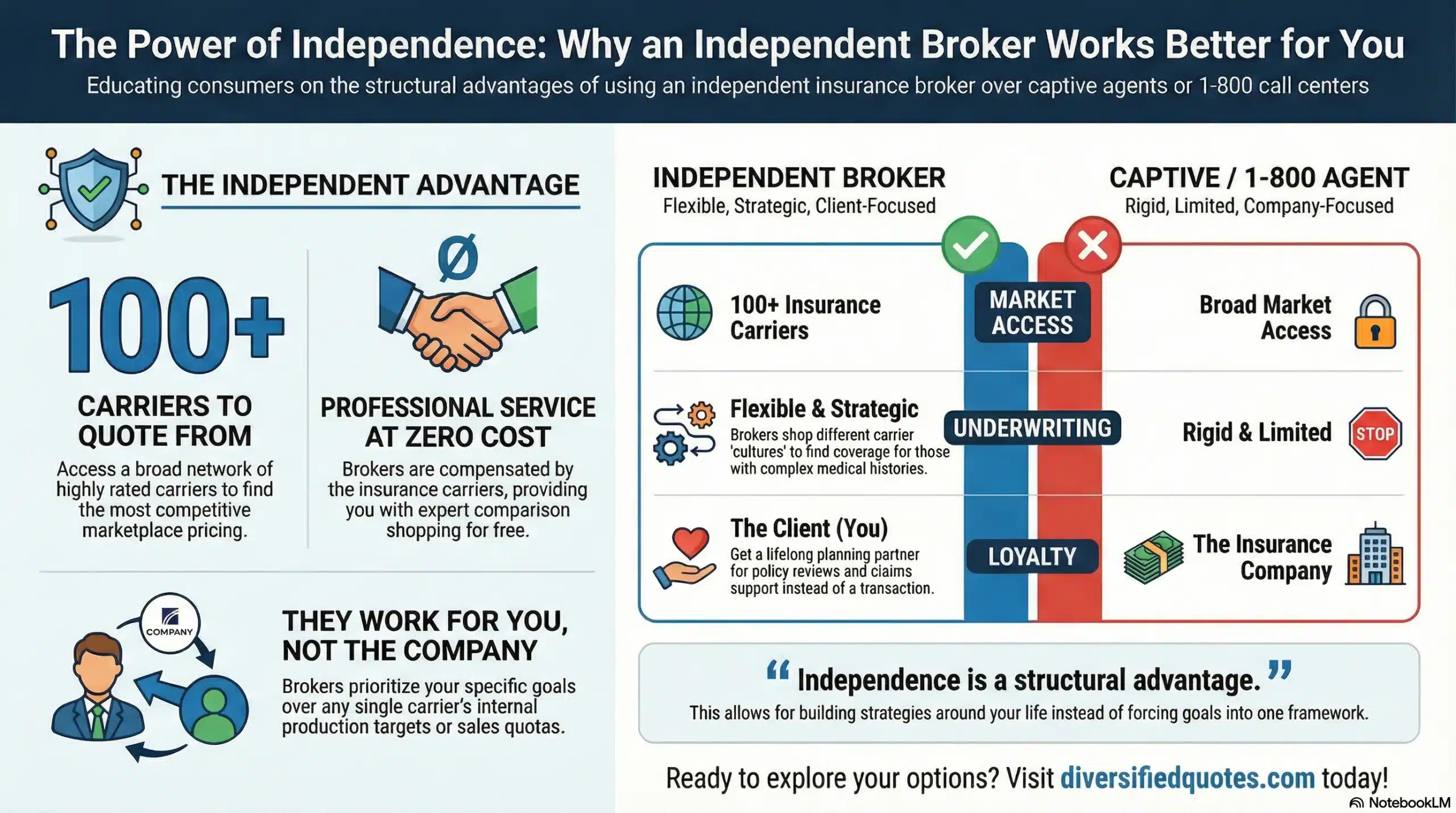
As an Independent Life Insurance Broker, we compare rates across 100+ carriers and prescreen every application before submission.
Life Insurance for COPD

Jason Stolz CLTC, CRPC, DIA, CAA
If you have been diagnosed with COPD (Chronic Obstructive Pulmonary Disease), it is easy to assume life insurance will either be too expensive or unavailable entirely. In reality, life insurance with COPD is frequently possible, and many applicants are approved every year. The outcome usually depends on the specific factors that underwriters evaluate most closely — the severity of your condition based on objective pulmonary testing, how stable your symptoms have been over time, your smoking history and whether you have quit, your medication regimen, and whether exacerbations and hospitalizations have been frequent or rare. At Diversified Insurance Brokers, we regularly help clients with respiratory conditions navigate the life insurance underwriting process. COPD is a condition where carrier selection matters tremendously — some insurance companies automatically treat any COPD diagnosis as severe risk, while others evaluate the full clinical picture and price accordingly. COPD-related declines most commonly occur not because coverage is impossible, but because the application was submitted to the wrong carrier or the medical record did not clearly demonstrate stability. When a case is structured properly and submitted to companies that price pulmonary conditions more reasonably, the outcome can be very different. For a broader view of how carriers handle complex respiratory and medical histories, our resource on best high-risk life insurance companies explains how insurers evaluate applicants with respiratory and other complex medical profiles.
Life Insurance With COPD / Pulmonary Conditions
Coverage may still be available. Our team specializes in underwriting-driven cases and can compare multiple carriers that work with respiratory risk profiles.
Get a COPD Life Insurance Quote Call 800-533-5969Estimate Your Coverage Needs
Use the quoter below to explore coverage amounts and term lengths as a starting baseline. For COPD cases specifically, the real work is identifying which carriers evaluate respiratory histories most favorably for your specific disease stage, tobacco history, and stability profile before any formal application is submitted.
Life Insurance Quoter
COPD Severity and Life Insurance Underwriting — Expected Outcomes by Disease Stage
The Global Initiative for Chronic Obstructive Lung Disease (GOLD) framework classifies COPD severity by spirometry findings — specifically the FEV1 (Forced Expiratory Volume in one second) as a percentage of the predicted normal value. Life insurance underwriters use these objective measurements, alongside clinical history, to categorize risk. The table below maps COPD severity to the underwriting approaches that typically apply.
General reference only. Actual outcomes depend on full clinical history, tobacco status, exacerbation history, comorbidities, specific carrier guidelines, and documentation quality. FEV1 values alone do not determine underwriting outcomes.
| COPD Profile | GOLD Stage | FEV1 % Predicted | Typical Underwriting Approach | Coverage Most Likely Available | Key Documentation Priority |
|---|---|---|---|---|---|
| Mild COPD — Stable, non-smoker or long-term former smoker, minimal symptoms | GOLD 1 | ≥ 80% | Most favorable tier — many carriers consider standard or mildly rated outcomes; tobacco-free history significantly improves pricing | Fully underwritten term and permanent coverage accessible; competitive pricing possible at MS-experienced carriers | Spirometry results with FEV1; pulmonologist or PCP notes confirming stability; quit date if former smoker; no exacerbations |
| Moderate COPD — Managed with inhalers, stable function, few exacerbations | GOLD 2 | 50–79% | Achievable but carrier-dependent — table ratings typical; documentation of stability, medication compliance, and no frequent exacerbations critical | Term and permanent coverage possible at respiratory-experienced carriers; moderate table ratings likely; face amounts may be limited at some carriers | FEV1 trend over time; exacerbation frequency; medication list and stability; pulmonary specialist notes; tobacco status with quit date |
| Severe COPD — Significant breathlessness, frequent exacerbations, exercise limitation | GOLD 3 | 30–49% | More restrictive — most standard carriers decline; specialty underwriting required; outcomes highly dependent on exacerbation history and comorbidities | Traditional underwriting possible at specialty carriers only; simplified issue may be more realistic; guaranteed issue available as fallback | Complete hospitalization history; exacerbation dates and treatments; current pulmonary function; oxygen use status; all comorbidities documented |
| Very Severe COPD — Severe breathlessness, frequent acute events, limited function | GOLD 4 | < 30% | Highly restrictive — nearly all traditional carriers decline; simplified or guaranteed issue is the primary realistic pathway | Simplified issue or guaranteed issue most realistic; smaller face amounts; final expense burial coverage most accessible | Current treatment plan; oxygen type and use details; all recent hospitalizations; specialist assessment of current functional status |
| COPD with supplemental oxygen dependency — Any GOLD stage | Any stage | Varies | Significantly limits traditional options — oxygen dependency signals advanced disease; carries much heavier rating or declination at most carriers regardless of GOLD stage | Simplified issue possible at some carriers depending on oxygen type, hours used, and functional status; guaranteed issue always available | Prescription oxygen type (continuous vs. nocturnal vs. exertional only); daily hours of use; most recent pulmonary evaluation; functional status documentation |
| Recent exacerbation or hospitalization — Within 6-12 months, any GOLD stage | Any stage | Varies | Postponement likely — recent instability raises mortality assumptions regardless of underlying GOLD stage; most carriers want stable window before reviewing | Simplified or guaranteed issue most realistic in immediate term; reapplication after extended stable window; traditional carrier review possible after 12+ months stability | Hospitalization records and discharge summary; current pulmonary status; post-hospitalization treatment plan; specialist follow-up documentation |
How Underwriters Evaluate COPD — The Six-Factor Framework
Underwriters are not simply reacting to the COPD diagnosis. They are trying to estimate long-term mortality risk by examining a specific set of factors that together define how the disease actually presents in your life. The following table maps those evaluation factors against what carriers examine and what strengthens or weakens any COPD file.
| Evaluation Factor | What Carriers Examine | What Strengthens the File | What Creates Underwriting Friction |
|---|---|---|---|
| Pulmonary Function Testing (Spirometry) | FEV1 % predicted, FEV1/FVC ratio, trend over multiple tests, DLCO if available, consistency of results | FEV1 in GOLD 1-2 range; stable or improved results across multiple tests over time; documented objective measurement rather than clinical impression alone | FEV1 below 50%; significant year-over-year decline in spirometry values; no recent objective testing available; values worsening trend |
| Tobacco History and Current Status | Pack-year history, quit date, years since cessation, use of cessation medications, any relapse after quitting | Tobacco-free for 2+ years (many carriers require 12-24 months minimum for non-smoker rates); longer cessation period further improves outcome; low pack-year history | Current smoker — universally the most negative modifier; recent quit (under 12 months); high pack-year history; documented smoking relapse after cessation |
| Exacerbation History and Hospitalizations | Frequency of acute exacerbations, severity of each episode, ER visits, hospitalizations, ICU admissions, and recency of most significant event | No hospitalizations in 2+ years; infrequent exacerbations managed outpatient with bronchodilators or short antibiotic courses; pattern of stability or improving frequency | Recent hospitalization (within 12 months); ICU admission history; recurrent hospitalizations in any 12-month period; increasing exacerbation frequency trend |
| Oxygen Use | Whether supplemental oxygen is prescribed, type of use (continuous, nocturnal, exertional only), oxygen saturation at rest and with activity | Exertional oxygen only, prescribed for a specific activity limitation rather than resting hypoxia, with documentation of adequate resting saturation; recently prescribed with improving function | Continuous 24-hour oxygen dependency; oxygen prescribed for resting hypoxia; oxygen requirement increasing over time; low resting oxygen saturation documented |
| Medication Regimen and Compliance | Type and number of medications, stability of regimen, adherence evidence, frequent antibiotic or steroid prescriptions suggesting exacerbation pattern | Stable, long-term inhaler regimen (LAMA, LABA, or combination) without frequent changes; regular follow-up visits suggesting consistent management; no frequent steroid burst prescriptions | Frequent antibiotic and steroid prescriptions in pharmacy records suggesting recurring acute episodes; triple-inhaler therapy plus frequent rescue medication use; escalating medication complexity |
| Comorbidities and Overall Health Picture | Cardiovascular disease, heart failure, sleep apnea, diabetes, anxiety/depression, BMI, other conditions that compound pulmonary risk | Well-controlled comorbidities with stable management; no significant cardiovascular events; normal or near-normal BMI; no recent significant events in any comorbid system | Cor pulmonale or right heart failure as COPD complication; pulmonary hypertension; uncontrolled diabetes or cardiovascular disease; significant obesity compounding respiratory function |
Can You Get Approved for Life Insurance With COPD?
Yes — many individuals with COPD successfully qualify for life insurance coverage. Approval is typically more straightforward when the condition has been stable, symptoms are manageable, and medical records demonstrate consistent treatment and follow-up care. Underwriters want to see that the condition is controlled and that there is no evidence of rapid progression or frequent hospitalizations. Two applicants with the same COPD diagnosis may receive completely different underwriting decisions. Someone with mild symptoms, stable spirometry results across multiple evaluations, and several years without exacerbations may qualify for a standard or mildly rated policy. Another applicant with recent hospitalizations or oxygen dependency may face heavier ratings or smaller policy options. This variability is why carrier selection matters so much — different insurers interpret pulmonary risk differently, and choosing the wrong company can result in a decline that could have been avoided. Many COPD applicants are declined by direct-to-consumer carriers that apply blanket conservative guidelines to any respiratory diagnosis, only to receive approval at a specialty carrier that evaluates the actual clinical picture.
COPD also frequently exists alongside other medical conditions that influence underwriting outcomes. Sleep disorders, cardiovascular conditions, and metabolic health may all play a role in the final underwriting classification when they are present alongside COPD. If your case includes overlapping health factors, understanding how insurers approach life insurance with pre-existing conditions provides useful context for how layered risk is evaluated across the full file. Understanding what a standard policy does not cover — including exclusions relevant to complex chronic conditions — is also useful context for any COPD applicant evaluating coverage comprehensively. Our resource on what deaths are not covered by life insurance covers the standard exclusion framework that applies regardless of underwriting classification.
Smoking History — The Single Most Important Modifier in COPD Underwriting
No single factor influences COPD life insurance underwriting more than tobacco history. Smoking is both the leading cause of COPD and the most heavily weighted risk modifier in how carriers evaluate respiratory cases. Applicants who are currently smoking while managing COPD face the most challenging underwriting environment: the combination of active tobacco use and existing pulmonary disease is typically viewed as among the highest risk profiles in respiratory underwriting. Most carriers who will consider COPD applicants at all will require tobacco cessation before they evaluate the case favorably. For current smokers with COPD, our resource on life insurance for smokers covers the rate class implications and the cessation timelines that typically produce meaningful pricing improvements.
Former smokers who have successfully quit can see their underwriting picture improve substantially over time. Most carriers require a minimum of 12 months of tobacco abstinence before they will consider non-smoker rate classes, with 24 months of cessation producing more consistent access to favorable pricing across a broader range of carriers. The pack-year history — total lifetime smoking exposure — also matters: a former smoker with 5 pack-years who quit 10 years ago presents a very different risk profile than a former smoker with 40 pack-years who quit 18 months ago, even if both currently have similar spirometry results. For COPD applicants who use cannabis therapeutically for pain management or sleep — a combination that raises specific carrier questions — our resource on whether marijuana use affects life insurance rate classes covers how carriers evaluate cannabis use in the context of a respiratory condition, where the smoking route of administration creates additional underwriting consideration beyond the standard cannabis underwriting question. For applicants who specifically use cigars or pipe tobacco — which may have produced COPD from non-cigarette tobacco exposure — our resource on life insurance for cigar smokers covers how non-cigarette tobacco use is evaluated differently by underwriters.
Spirometry and Objective Testing — Why the Numbers Matter
COPD is one of the conditions where objective medical testing carries the most weight during underwriting because it provides measurable, standardized data rather than relying solely on clinical impressions or symptom descriptions. Pulmonary function testing provides insurers with specific measurements of lung capacity and airflow limitation that can be compared to predicted normal values for the applicant’s age, sex, and height. FEV1 (Forced Expiratory Volume in one second) — the volume of air exhaled in the first second of a forced exhalation — is the primary measurement used for GOLD staging and underwriting classification. FEV1/FVC ratio (the ratio of FEV1 to Forced Vital Capacity) is used to confirm airflow obstruction: a ratio below 0.70 post-bronchodilator confirms COPD by GOLD criteria. Carriers review these values not just for their absolute level but for their trend over multiple tests — consistency over time is often more important than a single measurement, because stable spirometry across multiple evaluations provides more meaningful evidence of disease stability than one favorable test result surrounded by missing data. When testing demonstrates stable lung function across multiple evaluations at different points in time, underwriters may view the condition as lower risk compared with cases where significant decline is documented between measurements or where no recent testing exists at all.
COPD Comorbidities — How They Compound the Underwriting Picture
COPD frequently exists alongside other significant conditions that compound the underwriting picture. Cardiovascular disease is one of the most common and most underwriting-significant COPD comorbidities — the shared risk factor of tobacco use, combined with the cardiovascular strain that advanced COPD creates, means many COPD patients also have coronary artery disease, hypertension, or heart failure. When cardiovascular history accompanies COPD, underwriters evaluate both systems simultaneously: the COPD underwriting framework and the cardiovascular underwriting framework combine to produce a total risk assessment more conservative than either condition alone. Our resource on life insurance after cardiac events covers how cardiovascular history is evaluated — directly relevant for COPD patients with concurrent cardiac history. For COPD patients who have developed cor pulmonale (right heart failure as a consequence of chronic hypoxia from advanced COPD), the cardiovascular complication changes the underwriting picture substantially and shifts the realistic pathway toward simplified issue or guaranteed issue coverage in most cases.
Sleep apnea is an extremely common COPD comorbidity — the “overlap syndrome” of COPD plus obstructive sleep apnea is well-documented clinically and creates additional underwriting complexity when both are present. Uncontrolled sleep apnea alongside COPD compounds the hypoxia risk and the cardiovascular strain. Our resource on life insurance for sleep apnea covers how sleep apnea is evaluated independently — a framework that applies to COPD cases where sleep apnea is also documented. For COPD patients who develop significant respiratory limitation that ultimately leads to a lung transplant evaluation or transplant, our resource on life insurance for organ transplant recipients covers the post-transplant underwriting framework — the stability window, medication considerations, and graft function requirements that apply when pulmonary disease has advanced to transplant level. COPD patients who are also managing type 2 diabetes — another common comorbidity in the typical COPD demographic — face a combined assessment that our resource on life insurance for type 2 diabetes covers from the metabolic underwriting perspective. Most COPD applicants are over 50 — the demographic where COPD most commonly develops and presents for life insurance evaluation. Our resource on life insurance over 50 covers how the age-related underwriting context shifts alongside chronic condition evaluation for this population.
COPD Medications and What They Signal to Underwriters
The medication profile for any COPD applicant tells underwriters a detailed story about severity, control, and the frequency of acute events. Long-acting bronchodilators — particularly long-acting muscarinic antagonists (LAMAs such as tiotropium) and long-acting beta-agonists (LABAs) — are the mainstay of moderate COPD maintenance therapy and signal managed but meaningful airflow limitation. A stable, single-inhaler or dual-inhaler regimen over an extended period signals managed disease without frequent dose escalation or crisis management. Triple-inhaler therapy (LAMA plus LABA plus inhaled corticosteroid) indicates more advanced disease where dual therapy was insufficient — still manageable from an underwriting perspective but associated with more significant disease burden. Frequent prescriptions for systemic antibiotics and oral corticosteroids — especially repeated courses within a 12-month period — are among the most informative data points in a pharmacy records review, because each course suggests an acute exacerbation that required systemic treatment. Underwriters count antibiotic and steroid courses as a proxy for exacerbation frequency when formal exacerbation history is not clearly documented in the clinical record.
Why COPD Is Underwritten Carefully — And Why Carrier Selection Determines the Outcome
Insurance companies evaluate COPD carefully because the condition can vary widely in severity and trajectory. Mild COPD may have minimal impact on long-term life expectancy when properly managed — particularly in former smokers who quit early in the disease course and maintain stable lung function. Advanced COPD may lead to complications such as chronic respiratory infections, chronic hypoxia, cor pulmonale, or significantly reduced exercise tolerance. Underwriters are primarily trying to answer whether the condition is stable, whether lung function has declined significantly in recent years, whether exacerbations are becoming more frequent, and whether the medical documentation supports a predictable pattern of care and symptom management. Because carriers use different internal actuarial models and claim databases for respiratory conditions, their pricing and approval thresholds for the same COPD profile can vary substantially — making independent broker access to multiple carriers the most effective strategy for finding the most favorable outcome for any individual COPD case. Two applicants with FEV1 in the 55% range can receive meaningfully different offers at different carriers based entirely on underwriting guidelines and internal risk appetite for respiratory cases.
Policy Options for Applicants with COPD
Applicants with COPD typically consider several different life insurance structures depending on their underwriting profile and financial goals. Term life insurance is often the first option evaluated when someone needs larger coverage amounts for family protection, mortgage protection, or income replacement. Term policies provide coverage for a specific period matching major financial obligations — if your COPD is stable and you qualify medically, term insurance often provides the largest death benefit for the lowest premium. For individuals seeking lifelong protection, permanent coverage such as whole life or universal life may also be appropriate — particularly when the goal is to guarantee coverage regardless of future health changes, or when the purpose is estate planning rather than temporary income replacement. For annuity income that can help maintain life insurance premiums without creating budget strain during a period when COPD management expenses may also be significant, our resource on how annuity payments can fund life insurance premiums covers the financial integration approach. In more severe COPD scenarios, simplified issue or guaranteed issue policies may be the realistic pathway. These plans typically avoid medical exams and focus on a limited set of health questions, though premiums are higher per dollar of coverage. Our resource on guaranteed issue burial insurance covers the graded benefit structure, face amount limitations, and when this option makes the most sense for COPD applicants whose disease complexity makes traditional underwriting unavailable.
If your primary goal is covering end-of-life expenses, a smaller burial policy may be sufficient — and our guide on how much burial insurance you need covers how to size final expense coverage appropriately relative to actual anticipated costs. For context on whether traditional or no-exam underwriting makes sense for a COPD case, our resource on what a life insurance exam includes covers the full underwriting process that applies to most traditional life insurance applications. In some COPD cases, the no-exam simplified pathway covered in our resource on life insurance with no medical questions asked provides a faster alternative when traditional underwriting is not the most practical route.
How We Shop COPD Cases Differently
Most agents simply submit applications and wait for underwriting results. COPD cases require a more strategic approach. Because each carrier evaluates pulmonary risk differently — using different FEV1 thresholds, different exacerbation frequency standards, and different tolerance for oxygen use alongside specific tobacco history requirements — selecting the right company before submitting an application can make a significant difference between a decline and a meaningful offer. In more complex cases, we begin with a confidential underwriting prescreen: a summary of the key medical facts that allows carriers to review the case informally before a formal application is submitted. That strategy prevents unnecessary declines, helps identify the companies most likely to offer favorable terms, and preserves the applicant’s MIB history from the pattern of declines that can make subsequent placements progressively harder. If you would like to understand that strategy in more detail, our guide on how to prescreen a life insurance application covers the mechanics. For a broader perspective on the carriers most commonly associated with favorable respiratory underwriting outcomes, our resource on best high-risk life insurance companies covers the market landscape. When COPD is accompanied by significant other health history that further complicates the file, our resource on life insurance for sarcoidosis covers another complex pulmonary and multisystem condition whose underwriting framework has meaningful parallels to complex COPD cases with comorbid involvement.
Compare COPD-Friendly Life Insurance Options
Submit a quick request and we will compare multiple carriers that specialize in underwriting respiratory conditions — matching your specific COPD profile to the most favorable available market.
Get a Quote Today Call 800-533-5969Related Pages
No-exam options, prescreening strategy, high-risk carrier resources, and related respiratory and metabolic condition guides.
Financial Protection Essentials
Life insurance resources for lung transplant recipients, complex autoimmune conditions, and other conditions that share underwriting parallels with COPD.
Compare Term Life Insurance Lengths
Explore different term periods to find coverage that best matches your timeline and budget.
Talk With an Advisor Today
Choose how you’d like to connect—call or message us, then book a time that works for you.
Schedule here:
calendly.com/jason-dibcompanies/diversified-quotes
Licensed in all 50 states • Fiduciary, family-owned since 1980
FAQs: Life Insurance for COPD
Can I get life insurance if I have COPD?
Yes — many people with COPD can still qualify for coverage. Approval and pricing depend on severity (as measured by spirometry results including FEV1 percent predicted), stability history, smoking status and cessation timeline, frequency of exacerbations and hospitalizations, oxygen use, medication compliance, and whether comorbid conditions are also present. Mild to moderate COPD with long-term stability and tobacco cessation often qualifies for fully underwritten term or permanent coverage at competitive pricing. Severe COPD may be better matched to simplified issue or guaranteed issue options depending on the clinical picture. The most important variable is carrier selection — different insurers evaluate pulmonary risk very differently, and the same COPD profile can receive meaningfully different offers at different carriers.
What COPD details do life insurance companies care about most?
Insurers focus primarily on six dimensions: spirometry results including FEV1 percent predicted and the trend over multiple tests; tobacco status including quit date and pack-year history; exacerbation frequency including ER visits and hospitalizations in the past 12-24 months; oxygen use including whether supplemental oxygen is prescribed and at what level of dependence; medication regimen stability and frequency of antibiotic or systemic steroid courses suggesting acute episodes; and comorbid conditions especially cardiovascular disease, sleep apnea, and diabetes. Of these, tobacco status is typically the single most heavily weighted modifier — current smokers with COPD face the most challenging underwriting environment, while former smokers with 2+ years of cessation and stable spirometry are evaluated much more favorably.
Will I be declined if I use supplemental oxygen?
Not automatically — but oxygen use significantly limits traditional coverage options and often leads to higher ratings or smaller available face amounts. The key distinction is between exertional-only oxygen use (prescribed specifically for activity-related oxygen desaturation, with adequate resting saturation) and continuous 24-hour oxygen dependency (indicating resting hypoxia). Exertional-only oxygen with documented adequate resting saturation produces better underwriting outcomes than continuous dependence. Continuous 24-hour oxygen dependency is typically a major barrier to traditional underwriting at most carriers and shifts the realistic pathway to simplified issue or guaranteed issue options. Some applicants with oxygen use can still qualify depending on how and why oxygen is used, overall functional status, and the specific carrier’s appetite for respiratory risk.
How does smoking history affect my COPD life insurance application?
Tobacco history is the single most important modifier in COPD underwriting. Current smokers face the most challenging environment — the combination of active tobacco use with existing pulmonary disease is among the highest risk profiles in respiratory underwriting, and most carriers who will consider COPD cases at all require tobacco cessation before favorable evaluation. Former smokers typically need 12-24 months of documented tobacco abstinence before carriers will consider non-smoker rate classes. Longer cessation periods produce progressively better outcomes: 5 years of cessation produces meaningfully better pricing than 18 months. Pack-year history also matters as lifetime exposure context — a 10 pack-year history at 2 years of cessation presents differently than a 40 pack-year history at the same cessation duration. The combination of cessation and stable spirometry is more powerful together than either factor alone.
Do I need a medical exam to get life insurance with COPD?
Not necessarily — the requirement depends on the carrier, the policy type, the coverage amount, and the severity of the COPD. Traditional fully underwritten policies often require a paramed exam along with medical records and spirometry results. For mild COPD cases, some accelerated underwriting programs can evaluate the application through electronic health record access, prescription database review, and administrative data rather than requiring an in-person exam. For more severe COPD where traditional underwriting is challenging, simplified issue policies evaluate the application through health questions only with no paramed exam — though premiums are higher per dollar of coverage. Guaranteed issue policies require no health questions or exam at all. Our resource on what a life insurance exam includes covers the full paramed exam process for applicants who will go through traditional underwriting.
What is the GOLD staging system and how does it affect underwriting?
GOLD (Global Initiative for Chronic Obstructive Lung Disease) staging classifies COPD severity based primarily on FEV1 — the volume of air exhaled in one second during a forced exhalation, expressed as a percentage of the predicted normal value for the applicant’s age, sex, and height. GOLD 1 (mild, FEV1 ≥ 80%) typically underwrites most favorably among COPD applicants. GOLD 2 (moderate, FEV1 50-79%) is achievable with the right carrier but typically produces table ratings. GOLD 3 (severe, FEV1 30-49%) restricts most standard carrier options and requires specialty underwriting. GOLD 4 (very severe, FEV1 < 30%) makes traditional underwriting very unlikely and shifts the realistic pathway to simplified or guaranteed issue. Underwriters use GOLD staging as an objective anchor point, but they also weight the trend over time, exacerbation history, and comorbidities alongside the staging classification — so GOLD stage alone does not fully determine the underwriting outcome.
What type of policy is most realistic for different COPD severities?
The appropriate policy type depends on both the COPD severity and the overall health picture. Mild COPD (GOLD 1) in a former smoker with good overall health can often qualify for standard to mildly rated term or permanent coverage with meaningful face amounts. Moderate COPD (GOLD 2) with stable history typically qualifies for table-rated term or permanent coverage at respiratory-experienced carriers — the rating level varies significantly by carrier, tobacco history, and exacerbation history. Severe COPD (GOLD 3) or oxygen-dependent applicants are more realistically matched to simplified issue whole life with face amounts typically capped at $25,000-$50,000, or to guaranteed issue coverage at lower face amounts. Very severe COPD (GOLD 4) typically limits realistic options to guaranteed issue burial coverage. In all cases, carrier selection — not just product type — determines the best available outcome, and the same severity tier can produce significantly different offers at different carriers.
Why do some carriers treat COPD so much more conservatively than others?
Each insurer uses its own actuarial models, internal claims experience database, and underwriting philosophy for respiratory conditions. Carriers with limited COPD claims history tend to apply conservative blanket guidelines to any respiratory diagnosis rather than granular evaluation of severity and stability. Carriers with more COPD-specific experience may have actuarial models that clearly differentiate mild stable COPD from severe progressive disease — and price each category much more accurately. The practical implication for COPD applicants is significant: applying to a conservative carrier first can produce a decline that a more experienced carrier would have approved. This is why prescreening across multiple carriers before any formal application is submitted — and why working with an independent broker who shops the full market — consistently produces better outcomes for COPD cases than a single-carrier approach.
How does a recent COPD exacerbation or hospitalization affect my application?
Recent exacerbations and hospitalizations are among the most significant negative modifiers in COPD underwriting — not because they permanently close all options, but because they signal current instability that most carriers address by requiring a stable window before reviewing the case favorably. A hospitalization in the past 12 months will trigger postponement at most traditional carriers regardless of the underlying GOLD stage, because recent instability makes mortality risk harder to predict. The practical strategy is to secure simplified issue or guaranteed issue coverage in the immediate term if needed for family protection, and to plan for a reapplication to traditional underwriting after an extended stable period has been documented with updated clinical notes and spirometry. The longer the stable interval since the most recent exacerbation, the more favorably the file typically underwrites at subsequent applications.
What comorbidities most affect COPD life insurance underwriting?
The comorbidities with the greatest underwriting impact alongside COPD are cardiovascular disease (especially heart failure or coronary artery disease, which compound the cardiovascular strain of chronic hypoxia), sleep apnea (which creates additional nocturnal hypoxia and cardiovascular risk), and cor pulmonale (right heart failure as a direct consequence of advanced COPD — one of the most serious COPD complications from an underwriting perspective). Type 2 diabetes compounds the overall risk picture significantly. Significant obesity adds additional respiratory compromise to existing airflow limitation. When multiple comorbidities accompany COPD, the underwriting evaluation becomes increasingly complex and typically requires specialty carrier access rather than standard market placement. Each comorbid system is evaluated on its own terms alongside the COPD assessment, and the compounded picture is more conservative than any individual condition would produce alone.
Can I improve my COPD underwriting outcome over time?
Yes — the COPD underwriting picture is not fixed, and several actions can meaningfully improve future application outcomes. Tobacco cessation is the most impactful single action: achieving and documenting 24+ months of tobacco freedom significantly changes the underwriting baseline for most COPD applicants. Accumulating a longer stability window — more time without acute exacerbations, ER visits, or hospitalizations — directly improves how the exacerbation history section of the underwriting evaluation appears. Consistent pulmonary specialist follow-up with documented stable or improving FEV1 measurements provides the objective data that underwriters need to price risk more favorably. Achieving better control of comorbid conditions like blood pressure, diabetes, and sleep apnea removes compounding risk factors from the overall picture. COPD applicants who are appropriately pessimistic about their first application result often find that a well-prepared reapplication 12-24 months later — with an updated stability record — produces a meaningfully different and more favorable outcome.
What should I gather before requesting a COPD life insurance quote?
The most useful information to have ready before a COPD quote request includes: your COPD diagnosis type (chronic bronchitis, emphysema, or COPD NOS), approximate diagnosis date, most recent FEV1 value and the date of testing, GOLD stage if your pulmonologist has documented it, tobacco status and quit date if applicable, exacerbation history including the most recent ER visit or hospitalization date, current medication list including all inhalers and whether you have a course of antibiotics or steroids in the past 12 months, whether supplemental oxygen has been prescribed and at what level, and the name and specialty of the provider managing your COPD care. The more complete and current this information is, the more accurately we can identify which carriers are most likely to evaluate your profile favorably and structure the inquiry or application most effectively before submission.
About the Author:
Jason Stolz, CLTC, CRPC, DIA, CAA and Chief Underwriter at Diversified Insurance Brokers (NPN 20471358), is a senior insurance and retirement professional with more than 25 years of real-world experience helping individuals, families, and business owners protect their income, assets, and long-term financial stability. As a long-time partner of the nationally licensed independent agency Diversified Insurance Brokers, Jason provides trusted guidance across multiple specialties—including fixed and indexed annuities, long-term care planning, personal and business disability insurance, life insurance solutions, Group Health, Travel Medical and Evacuation Insurance, and short-term health coverage. Diversified Insurance Brokers maintains active contracts with over 100 highly rated insurance carriers, ensuring clients have access to a broad and competitive marketplace.
His practical, education-first approach has earned recognition in publications such as VoyageATL, and contributions from his agency featured in Kiplinger and GoBankingRates— highlighting his commitment to financial clarity and client-focused planning. Drawing on deep product knowledge and years of hands-on field experience, Jason helps clients evaluate carriers, compare strategies, and build retirement and protection plans that are both secure and cost-efficient. Visitors who want to explore current annuity rates and compare options across multiple insurers can also use this annuity quote and comparison tool.
Explore More Life Insurance Options: Browse our complete guide to Life Insurance for Cardiovascular & Respiratory Conditions — covering heart attack, heart disease, stroke, blood clots, COPD, and sleep apnea from 100+ carriers.
Last Reviewed: June 14, 2026 |
Reviewed by: Jason Stolz, CLTC, CRPC, DIA, CAA
Chief Underwriter, Diversified Insurance Brokers, Inc. | NPN: 20471358 | Diversified Insurance Brokers, Inc. — Licensed in all 50 states
Fact Checked by: Tonia Pettitt, CMIP©
Medicare Specialist, Diversified Insurance Brokers, Inc. | NPN: 14374308 | Diversified Insurance Brokers, Inc. — Licensed in all 50 states
Did you find this content helpful? Leave us a Google review — it helps others find trustworthy guidance too.
Editorial Standards: Diversified Insurance Brokers maintains rigorous editorial standards to ensure accuracy, clarity, and independence in all content. Learn more about our editorial standards and commitment to transparency.
