
Life Insurance with No Medical Questions Asked
As an Independent Life Insurance Broker, we compare rates across 100+ carriers and prescreen every application before submission.
Life Insurance with No Medical Questions Asked

Jason Stolz CLTC, CRPC, DIA, CAA
Life insurance with no medical questions asked is the clearest, most direct path to guaranteed coverage for people whose health history has made traditional underwriting impractical, unpredictable, or already resulted in declines. The phrase means exactly what it says: the insurance company does not ask about your diagnoses, medications, surgeries, hospitalizations, or medical history in any form. Approval is based on your age, your state of residence, and whether you fall within the carrier’s eligibility window — not on your health record. In the life insurance market, this category is represented almost exclusively by guaranteed issue whole life insurance, a permanent policy structure specifically designed to extend coverage access to people who cannot qualify through standard or simplified underwriting channels. Understanding what life insurance with no medical questions asked actually provides, what it costs relative to other options, what the graded benefit period means for your family, and when it is genuinely the right choice versus when a different path might still be open to you — that complete picture is what this page covers.
At Diversified Insurance Brokers, Jason Stolz, CLTC, CRPC, DIA, CAA helps clients compare life insurance with no medical questions asked alongside simplified issue and fully underwritten options to identify which path produces the most coverage for the most realistic premium — because the goal is never simply “get any policy” but “get the best policy the market will offer for your actual situation.” Our resource on burial and final expense insurance services covers the complete final expense landscape, and our resource on high-risk life insurance services covers the full spectrum of options available when standard underwriting is not accessible.
See Real-Term Rates Side by Side
Life Insurance Quoter
Instant Final Expense and Burial Insurance Quotes
Use the quote tool below to compare guaranteed issue and simplified issue final expense rates across carriers. You can test different benefit amounts to find what matches your actual goal and budget before speaking with an advisor.
What “Life Insurance with No Medical Questions Asked” Actually Means
Life insurance with no medical questions asked is a specific underwriting category, not a vague marketing claim, and understanding what it actually includes — and excludes — prevents the most common and most expensive misunderstanding people encounter when shopping for coverage with a complex health history. True life insurance with no medical questions asked asks nothing about your diagnoses, your prescription medications, your surgical history, your hospitalizations, your pending treatments, or your family medical history. The application typically asks for basic identification information — name, date of birth, address, Social Security number, beneficiary designation — and that is substantially it. If you fall within the carrier’s eligible age range and live in a state where the product is available, the application is approved.
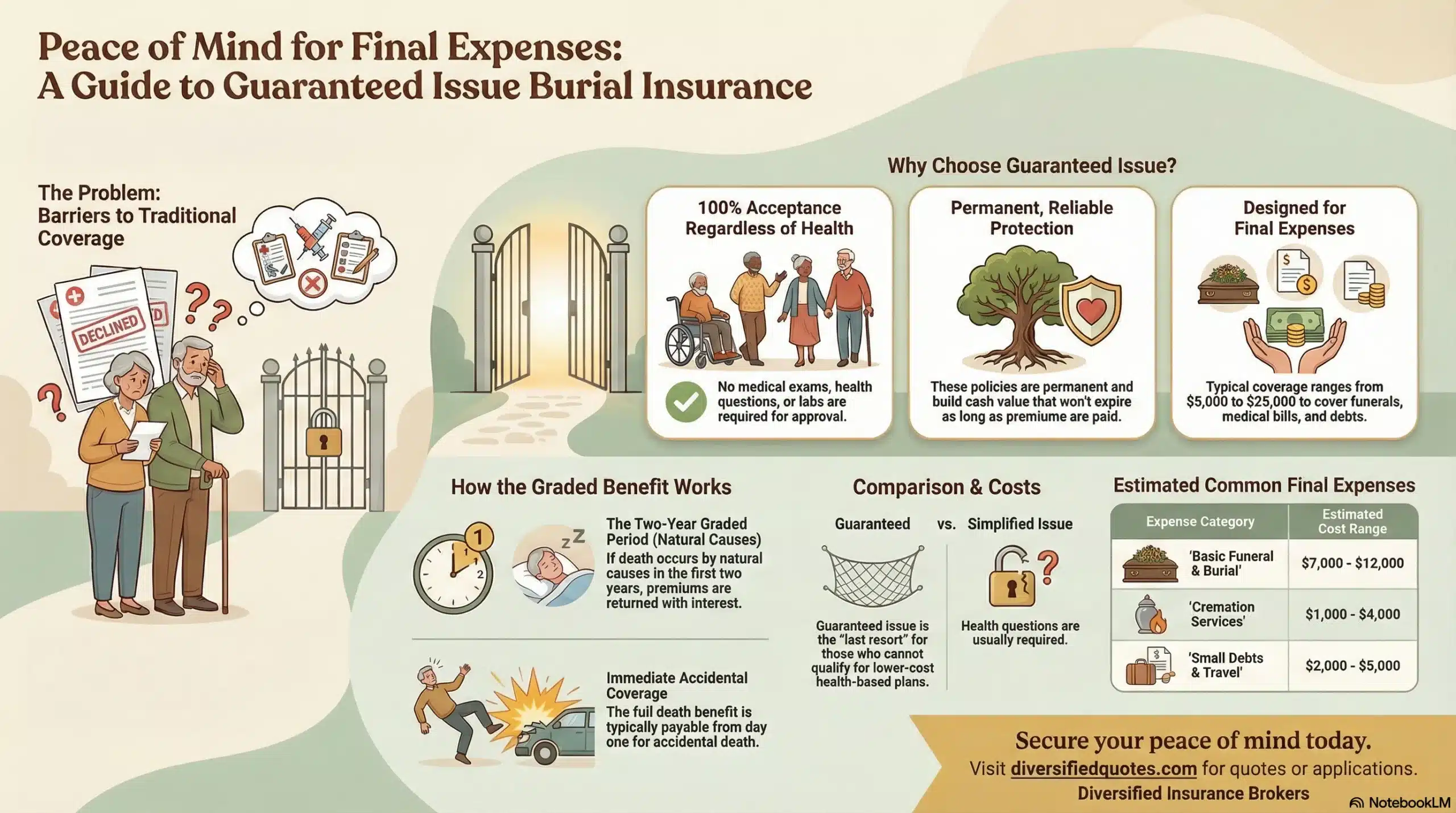
What this underwriting structure does not ask about, the insurer compensates for through pricing and policy structure. Because the insurer is accepting all comers within the age window without health screening, the cost per $1,000 of coverage is higher than any other life insurance product type, and virtually all life insurance with no medical questions asked policies include a graded benefit period — a waiting window during which the full death benefit is not paid for deaths from natural or illness causes. This graded benefit structure is the single most important element to understand before purchasing any guaranteed issue policy, because it directly affects what your beneficiary receives if death occurs in the early years of the policy. Understanding the graded benefit is not a reason to avoid life insurance with no medical questions asked — it is a reason to understand exactly what you are buying before you buy it.
The most accurate description of life insurance with no medical questions asked is this: it is a permanent whole life insurance policy with level premiums for life, a modest death benefit typically sized for final expenses rather than income replacement, guaranteed approval based on age and state eligibility, and a graded benefit period of typically two years during which the full death benefit is not payable for non-accidental causes of death. After the graded period, the full benefit is payable for any covered cause of death as long as premiums remain current. Our resource on guaranteed issue burial insurance covers the product mechanics in full, and our resource on how does life insurance work covers the foundational underwriting framework that explains why these three different underwriting paths exist and what each one is designed to accomplish.
The Three Underwriting Paths — A Direct Comparison
| Feature | Guaranteed Issue (No Medical Questions) | Simplified Issue (Few Questions, No Exam) | Fully Underwritten (Exam + Medical Records) |
|---|---|---|---|
| Health Questions Required | None — no health questions of any kind | Short questionnaire (typically 10-20 questions); no exam | Full questionnaire; medical exam may be required; medical records reviewed |
| Approval Certainty | Guaranteed if you meet age and state eligibility | High — most applicants approved; some declines for specific conditions | Variable — depends on health history; declines possible |
| Typical Age Range | 45–80 (varies by carrier; some to 85) | 45–85 (varies by carrier and product) | 18–70+ (varies widely by carrier and face amount) |
| Typical Face Amounts | $2,000–$25,000 (some carriers to $50,000) | $5,000–$50,000+ (varies significantly by carrier) | $100,000 to $1M+ — largest available amounts |
| Cost per $1,000 of Coverage | Highest — reflects unscreened risk pool | Moderate — better than guaranteed issue when qualified | Lowest (when health qualifies for standard or better) |
| Waiting Period / Graded Benefit | Always present — typically 2 years for natural causes | Often none — immediate full benefit for level benefit policies | None for approved applicants |
| Policy Type Available | Permanent whole life only — no term | Mostly whole life; some simplified term available | Full range: term, whole life, universal life |
| Best For | Serious health conditions, terminal illness, prior declines — when no other path is available | Moderate health issues; wants speed and simplicity; can answer “no” to key questions | Good to average health; seeking maximum coverage or lowest premium |
The table clarifies the most important strategic principle in shopping for life insurance with no medical questions asked: always check whether simplified issue is available before defaulting to guaranteed issue. The two product types share many surface similarities — no medical exam, permanent coverage, final expense sizing — but differ materially on cost, graded benefit mechanics, and the presence or absence of health questions. Many people who assume they need life insurance with no medical questions asked can in fact answer “no” to the short list of questions on a simplified issue application and qualify for a policy with immediate full coverage at a lower per-dollar premium. The check is worth the three minutes it takes because the cost difference compounds over years of premiums.
Who Life Insurance with No Medical Questions Asked Is Actually Built For
Life insurance with no medical questions asked is correctly understood as a product of last resort — not in a negative sense, but in the precise sense that it is specifically designed for people who genuinely cannot access coverage through any other channel. The carriers who offer guaranteed issue whole life have priced the product to include the highest-risk applicants in the market because they accept everyone regardless of health. Understanding who genuinely belongs in this category helps people make the right choice between guaranteed issue and alternatives that may still be available to them.
The clearest candidates for life insurance with no medical questions asked are people with active terminal illness, recent cancer diagnosis or active cancer treatment, end-stage organ disease including dialysis-dependent renal failure, current use of supplemental oxygen for COPD or emphysema, recent major cardiac events within the past 12 months (especially when combined with other conditions), recent stroke or neurological event, or people who have been formally declined by multiple insurers through traditional or simplified underwriting channels. These are the situations where the health history is simply incompatible with any underwriting that includes health questions — and where life insurance with no medical questions asked is the only realistic path to any coverage at all.
Life insurance with no medical questions asked is also genuinely appropriate for people who have been declined through simplified issue because specific conditions appear on the “knockout question” list — the conditions that simplified issue applications specifically exclude — even when those conditions are otherwise stable. Common knockout conditions vary by carrier but often include: current hospitalization, institutionalization, or nursing home residence; active chemotherapy or radiation in the past 12 to 24 months; terminal illness diagnosis; diagnosis of AIDS; and certain recently treated cancers. If any of these apply, simplified issue is unavailable regardless of how stable the overall health picture is, and life insurance with no medical questions asked becomes the appropriate first-line choice rather than a fallback.
Our resource on burial insurance for cancer survivors covers the specific underwriting windows and product options for cancer histories, and our resource on burial insurance with no waiting period covers the simplified issue products that provide immediate full coverage for applicants whose health history doesn’t trigger knockout questions — a direct comparison point for anyone evaluating whether guaranteed issue is truly the only path or whether a no-waiting-period alternative is available.
The Graded Benefit Period — The Most Important Fine Print in Life Insurance with No Medical Questions Asked
The graded benefit period is the contractual feature that makes life insurance with no medical questions asked economically viable for insurers — and the feature that most buyers misunderstand at the point of purchase. Every genuine life insurance with no medical questions asked policy includes a graded benefit structure during the first two to three years of coverage. Understanding exactly what this means — and what it does not mean — for your beneficiary is not optional reading before buying. It is the single most important fact about the policy.
During the graded benefit period, typically lasting two years from policy issue (some carriers use three years), the following rules apply for death from natural or illness causes: the policy pays a return of premiums paid, plus interest — commonly 10% of cumulative premiums paid — rather than the full face amount. This means a person who paid $150 per month for 18 months and then died of natural causes would leave their beneficiary approximately $2,700 in premiums paid plus approximately $270 in interest, not the $15,000 face amount they believed was in place. For deaths caused by accident, most life insurance with no medical questions asked policies pay the full face amount from day one regardless of the graded period. Accident definitions vary by policy and state and should always be confirmed in the actual contract before purchase.
After the graded benefit period ends — typically after two full years of premium payments — the full face amount becomes payable for any covered cause of death as long as premiums remain current. From that point forward, the policy behaves identically to any whole life policy: full benefit payable, premiums guaranteed level for life, cash value accumulating modestly over time. The graded period is not a permanent limitation; it is an early-years restriction that transitions to full coverage automatically without any action required from the policyholder.
The practical planning implication is that life insurance with no medical questions asked is most protective for beneficiaries when the policy has been in force for at least two years. For people who purchase life insurance with no medical questions asked because they have serious health concerns and want immediate protection, the graded benefit reality is a meaningful limitation that should be weighed honestly. For people who have stable health but simply want the simplicity of no health questions, the two-year wait may be a reasonable tradeoff for the certainty of approval. Our resource on best burial insurance with immediate coverage covers the simplified issue products that provide full-day-one coverage — the primary alternative for anyone whose health allows them to answer the simplified underwriting questions.
Age Ranges, Face Amounts, and Coverage Limits in Life Insurance with No Medical Questions Asked
Life insurance with no medical questions asked is available within a specific age window that varies by carrier. Most guaranteed issue whole life products are designed for applicants between approximately 45 and 80 years of age, though some carriers extend eligibility to 85. Outside these age windows, guaranteed issue products generally are not available — younger applicants are expected to pursue traditional or simplified underwriting, and older applicants may encounter carrier-specific eligibility restrictions. The eligibility check is straightforward: if you fall within the age window for the product in your state, you are eligible. If you fall outside it, life insurance with no medical questions asked from that carrier is not available regardless of health history.
Face amounts in life insurance with no medical questions asked policies are deliberately sized for final expenses rather than income replacement. The most common range is $2,000 to $25,000, though some carriers offer face amounts up to $40,000 or $50,000 depending on age and state. This sizing reflects the purpose of the product: covering funeral and cremation costs, outstanding medical bills, small debts, and immediate household needs — not replacing decades of earned income or paying off a mortgage. For buyers whose life insurance need extends beyond $25,000 to $50,000, life insurance with no medical questions asked is not the appropriate primary solution. Additional coverage through term life insurance (if health allows any underwriting access) or group employer coverage should be explored before treating guaranteed issue as the only answer to a larger coverage need.
When choosing a face amount within the guaranteed issue category, the most practical approach is to start with the realistic cost of what the policy is meant to cover. A basic funeral and burial in the United States in 2025 typically costs $8,000 to $12,000 depending on location and service choices; cremation with a memorial service is often $3,000 to $7,000. Adding a modest cushion for unpaid medical bills, estate administrative costs, and immediate household expenses typically brings the realistic coverage target to $15,000 to $25,000 for most families. Choosing a face amount at the high end of what guaranteed issue allows — especially when the premium stretches the monthly budget — creates more financial stress than protection if the policy lapses due to non-payment before the graded period ends. Our resources on burial insurance for seniors over 50, burial insurance for seniors over 60, burial insurance for seniors over 70, and burial insurance for seniors over 80 cover how pricing and product availability change at each age bracket.
Why Life Insurance with No Medical Questions Asked Costs More — And When the Tradeoff Makes Sense
Life insurance with no medical questions asked is the most expensive life insurance category per dollar of death benefit because the carrier accepts the full spectrum of health risk without screening. When an insurer agrees to cover everyone who falls within the age window regardless of health status, they are knowingly including applicants with terminal illness, recent hospitalizations, active serious conditions, and other circumstances that make near-term claims highly probable. The higher premium per $1,000 of coverage is the mathematical consequence of this unscreened acceptance — it is not a carrier charging more than warranted for an arbitrary reason; it is a pricing model that makes guaranteed acceptance financially sustainable.
One research source estimated that a male policyholder with a $10,000 guaranteed issue policy who lives to age 90 could potentially have saved thousands of dollars by answering a few health questions and qualifying for a simplified issue level benefit policy instead. For a $25,000 policy, the cost difference over a long lifetime is even more substantial. This is why the strategic question before purchasing life insurance with no medical questions asked is always: is guaranteed issue genuinely necessary, or does the applicant still have access to simplified issue coverage that would deliver the same face amount with immediate full benefits at meaningfully lower cost?
The tradeoff for guaranteed issue makes clear financial sense in two specific scenarios. First, when the applicant genuinely cannot qualify for any simplified issue product due to knockout health conditions — in which case guaranteed issue is not expensive relative to alternatives because there are no alternatives. Second, when the applicant has modest health concerns that might technically qualify for simplified issue but where the certainty of guaranteed acceptance is worth the premium premium — because the alternative involves a real risk of simplified issue decline that creates MIB records and adds friction to future applications. Our resource on burial insurance with no medical exam covers the product landscape for applicants who want to avoid a medical exam but may still be able to answer health questions, clarifying where simplified no-exam coverage fits between guaranteed issue and traditional underwriting.
Simplified Issue — The Middle Path Worth Checking Before Guaranteed Issue
The single most important recommendation for anyone researching life insurance with no medical questions asked is to check simplified issue availability before purchasing guaranteed issue. Simplified issue policies require a short health questionnaire — typically 10 to 20 questions covering the most serious health disqualifiers — but do not require a medical exam, do not require medical records to be pulled, and can often be approved in hours. When the health history allows a “no” answer to the key knockout questions, simplified issue provides immediate full coverage at a substantially lower cost per $1,000 than guaranteed issue.
The questions on simplified issue applications vary by carrier but typically focus on: current terminal illness diagnosis, active cancer or cancer treatment within the past one to two years, current use of supplemental oxygen, current organ failure or dialysis, current or recent hospice care, current nursing home residency, and AIDS/HIV diagnosis. Applicants who can answer “no” to all or most of these typically qualify for simplified issue even with a substantial history of heart disease, diabetes, COPD, stroke history within certain timeframes, prior cancers in remission, and many other conditions that would make traditional fully underwritten coverage unavailable or heavily table-rated. The simplified issue “no exam” path frequently provides $10,000 to $25,000 of immediate full coverage for applicants with these histories — without the graded period that guaranteed issue requires.
Our resource on burial insurance with no waiting period covers the specific simplified issue products that provide day-one full coverage, and our resource on burial insurance with no medical exam covers the no-exam landscape across both guaranteed and simplified issue structures. Our resource on burial insurance for people with high blood pressure covers how hypertension history is handled in simplified issue underwriting — an important companion for applicants who have blood pressure as part of their health profile alongside other conditions. Our resource on burial insurance for overweight people covers how build is evaluated in the simplified issue context.
What Happens After a Decline — When Life Insurance with No Medical Questions Asked Becomes the Clear Answer
For applicants who have already been formally declined for traditional or simplified issue life insurance, life insurance with no medical questions asked transitions from “one option to consider” to “the primary viable path.” A formal decline means that the applicant’s health history exceeded what a screened underwriting process would accept, and the MIB record created by that decline makes future screened applications more complicated. Life insurance with no medical questions asked side-steps this entirely — because the insurer never looks at the health record or the MIB file, a prior decline has no relevance to guaranteed issue approval.
The practical strategy after a decline is to secure guaranteed issue coverage immediately for immediate family protection needs, then assess whether any simplified issue products remain available (since some simplified issue carriers do not query MIB and have different knockout question lists), and finally evaluate whether a future re-application to traditional underwriting makes sense after a meaningful stability period has passed. Our resource on life insurance with a prior decline covers the complete reassessment process in detail, and our resource on what to do if you’re denied life insurance covers the strategic options available after a formal denial — both of which are essential reading for any applicant who has been told “no” by a screened carrier and is now evaluating the guaranteed issue path.
Policy Mechanics — Cash Value, Beneficiaries, and Tax Treatment
Life insurance with no medical questions asked, as a whole life insurance structure, accumulates a modest amount of cash value over time — typically accessible through policy loans at guaranteed interest rates specified in the contract. Cash value in guaranteed issue whole life policies grows slowly compared to other permanent structures, but it does provide a liquid reserve that the policyholder can access during their lifetime without surrendering the policy. Cash value loans that remain outstanding at death reduce the face amount paid to the beneficiary by the outstanding loan balance, so borrowing against the cash value should be done with that consequence clearly understood.
Premiums in life insurance with no medical questions asked are guaranteed level for the life of the policy — they cannot be increased by the carrier due to age or any change in health status. The premium is set at issue and remains fixed as long as the policy remains in force. This level-premium structure is one of the most meaningful practical advantages of guaranteed issue whole life relative to term alternatives: there is no policy expiration and no renewal premium increase, which means the coverage remains in force indefinitely at the original payment amount.
The death benefit paid to beneficiaries of life insurance with no medical questions asked is generally income tax-free to the beneficiary under current federal tax law — treated the same as any other life insurance death benefit. This tax-free treatment applies to both the full benefit after the graded period and to the return-of-premium benefit paid during the graded period. Our resource on is life insurance death benefit taxable covers the tax treatment framework in full, including the estate tax implications that may apply in certain high-value estate situations (not typically relevant for guaranteed issue face amounts, but worth understanding). Keeping beneficiary designations current — and ensuring the named beneficiary knows the policy exists and knows where to find the policy documents — are the two most important administrative steps after purchase.
Compare Your Options — Guaranteed Issue vs. Simplified Issue
We compare guaranteed issue and simplified issue side-by-side for your specific health history, age, and coverage goal — so you get the most coverage for the most realistic premium rather than defaulting to the most expensive option when a better one is still available.
Explore Final Expense OptionsRelated Burial and Final Expense Resources
Explore the complete guaranteed issue and simplified issue landscape — by age, health condition, and coverage goal.
Financial Protection Essentials
Connect life insurance with no medical questions asked to the broader life insurance and high-risk planning landscape.
Talk With an Advisor Today
Choose how you’d like to connect—call or message us, then book a time that works for you.
Schedule here:
calendly.com/jason-dibcompanies/diversified-quotes
Licensed in all 50 states • Fiduciary, family-owned since 1980
Frequently Asked Questions: Life Insurance with No Medical Questions Asked
What exactly is life insurance with no medical questions asked?
Life insurance with no medical questions asked refers to guaranteed issue whole life insurance — a permanent policy that accepts applicants without any health questionnaire, medical exam, or medical records review. Approval is based solely on age (typically 45-80, varying by carrier) and state of residence. If you fall within the carrier’s eligible age range in your state, you are approved regardless of your health history, diagnoses, medications, or prior declines. The tradeoff for this unconditional acceptance is a higher cost per $1,000 of coverage compared to screened alternatives, a graded benefit waiting period during the first two years for natural causes of death, and face amounts sized for final expenses ($2,000 to $25,000 typically) rather than income replacement.
Is there a waiting period with life insurance with no medical questions asked?
Yes — virtually all life insurance with no medical questions asked policies include a graded benefit period, commonly two years, during which deaths from natural or illness causes do not pay the full face amount. Instead, the policy typically pays a return of all premiums paid plus interest — often 10% of cumulative premiums — during this period. Deaths caused by accident are generally covered at the full face amount from day one, though definitions of “accidental death” vary by policy and state. After the two-year graded period ends, the full face amount is payable for any covered cause of death as long as premiums remain current. Always read the specific contract and graded benefit terms before purchasing, as these provisions vary by carrier.
Is simplified issue better than guaranteed issue?
When available, simplified issue is almost always the better financial choice. Simplified issue requires answering a short health questionnaire (no medical exam) but provides immediate full coverage from day one, lower cost per $1,000 of coverage, and the same face amount range as guaranteed issue. Many people who assume they need life insurance with no medical questions asked can actually qualify for simplified issue by answering “no” to the key knockout questions — even with substantial histories of heart disease, diabetes, controlled COPD, prior stroke, or past cancer in remission. The recommendation is always to check simplified issue eligibility first before purchasing guaranteed issue, because the cost difference over years of premiums can be substantial.
Who genuinely needs life insurance with no medical questions asked?
The clearest candidates are people with active terminal illness, current cancer treatment, current use of supplemental oxygen for COPD, dialysis-dependent kidney disease, current or recent hospice care, and prior formal declines from multiple insurers through both traditional and simplified underwriting. These situations involve health conditions that are explicitly excluded from simplified issue applications regardless of overall stability, making guaranteed issue the only realistic path to any coverage. For applicants in any other situation — including most chronic conditions, most prior cardiac events beyond the acute phase, and most histories of cancer in remission — simplified issue should be checked first to determine if the graded period and higher premium of guaranteed issue is actually necessary.
Can I be declined for life insurance with no medical questions asked?
In the true sense of the term, no — guaranteed issue policies cannot decline based on health history. However, an application can be rejected for non-health administrative reasons: falling outside the carrier’s age eligibility window (most policies are available approximately ages 45-80), residing in a state where the carrier is not licensed, providing incomplete or inaccurate identification information, or in some cases already holding a maximum amount of guaranteed issue coverage with that carrier. If you meet the age and state eligibility criteria, health history — including prior declines, current serious illness, or any other medical factor — cannot be used to decline a true guaranteed issue application.
How much does life insurance with no medical questions asked cost?
Cost varies by carrier, age, sex, and face amount. Generally, guaranteed issue whole life insurance is the most expensive life insurance category per $1,000 of death benefit because the carrier accepts all applicants regardless of health risk. As a general framework, women pay lower premiums than men, and premiums increase with age at the time of purchase. For a $10,000 policy, monthly premiums for a 70-year-old male might range from $70 to $100+ depending on carrier; for a 60-year-old female, the range is lower. Using the quote tool on this page provides actual carrier rates for your specific age and desired face amount — the most reliable way to budget before making a purchase decision.
Does life insurance with no medical questions asked build cash value?
Yes. Guaranteed issue whole life insurance, like all whole life insurance, accumulates modest cash value over time. The cash value is accessible through policy loans during the policyholder’s lifetime without surrendering the policy — though loans that remain outstanding at death reduce the death benefit paid to beneficiaries by the unpaid loan balance. Cash value growth in guaranteed issue policies is slower than in other permanent life insurance structures, but it does represent a real financial asset that the policyholder owns and can access. Premiums are level for life — they cannot be increased by the carrier regardless of age or health changes — which makes the cash value accumulation predictable and the policy’s long-term cost certain.
About the Author:
Jason Stolz, CLTC, CRPC, DIA, CAA and Chief Underwriter at Diversified Insurance Brokers (NPN 20471358), is a senior insurance and retirement professional with more than 25 years of real-world experience helping individuals, families, and business owners protect their income, assets, and long-term financial stability. As a long-time partner of the nationally licensed independent agency Diversified Insurance Brokers, Jason provides trusted guidance across multiple specialties—including fixed and indexed annuities, long-term care planning, personal and business disability insurance, life insurance solutions, Group Health, Travel Medical and Evacuation Insurance, and short-term health coverage. Diversified Insurance Brokers maintains active contracts with over 100 highly rated insurance carriers, ensuring clients have access to a broad and competitive marketplace.
His practical, education-first approach has earned recognition in publications such as VoyageATL, and contributions from his agency featured in Kiplinger and GoBankingRates— highlighting his commitment to financial clarity and client-focused planning. Drawing on deep product knowledge and years of hands-on field experience, Jason helps clients evaluate carriers, compare strategies, and build retirement and protection plans that are both secure and cost-efficient. Visitors who want to explore current annuity rates and compare options across multiple insurers can also use this annuity quote and comparison tool.
Explore More Life Insurance Options: Browse our complete guide to Guaranteed Issue, No Exam & High-Risk Education — covering guaranteed issue policies, no-exam coverage, and table ratings from 100+ carriers.
Last Reviewed: June 15, 2026 |
Reviewed by: Jason Stolz, CLTC, CRPC, DIA, CAA
Chief Underwriter, Diversified Insurance Brokers, Inc. | NPN: 20471358 | Diversified Insurance Brokers, Inc. — Licensed in all 50 states
Fact Checked by: Tonia Pettitt, CMIP©
Medicare Specialist, Diversified Insurance Brokers, Inc. | NPN: 14374308 | Diversified Insurance Brokers, Inc. — Licensed in all 50 states
Did you find this content helpful? Leave us a Google review — it helps others find trustworthy guidance too.
Editorial Standards: Diversified Insurance Brokers maintains rigorous editorial standards to ensure accuracy, clarity, and independence in all content. Learn more about our editorial standards and commitment to transparency.
