
Guaranteed Issue Burial Insurance
Guaranteed Issue Burial Insurance

Jason Stolz CLTC, CRPC, DIA, CAA
We help families secure protection even when traditional life insurance is not an option. Guaranteed issue burial insurance is designed for people who need final expense coverage with no medical exams, no health questions, and no underwriting — where acceptance within the eligible age range is guaranteed as a matter of product design rather than as a function of health screening. If you have been declined elsewhere, carry multiple medications or serious diagnoses, or simply want the certainty of acceptance without medical back-and-forth, guaranteed issue coverage creates a dependable final expense benefit so your loved ones are not left scrambling to pay funeral costs, outstanding medical bills, or other end-of-life expenses.
At Diversified Insurance Brokers, we work with families nationwide to compare final expense options and explain the real differences between guaranteed issue and other “no exam” policies — because those differences matter more than most people realize before they purchase. Some applicants assume guaranteed issue is their only option because they have been declined before, and in many cases that assumption is correct. In other cases, a simplified issue plan may still be available at lower cost, even with common conditions, and we help clients identify which path is genuinely appropriate for their health history before committing to guaranteed issue’s higher premium structure.
Get Coverage Regardless of Health
Guaranteed acceptance within the eligible age range. No exams. No health questions.
Get a Quote or Apply Now with Gerber LifeQuestions? Call 800-533-5969
What Guaranteed Issue Burial Insurance Actually Is — and What It Is Not
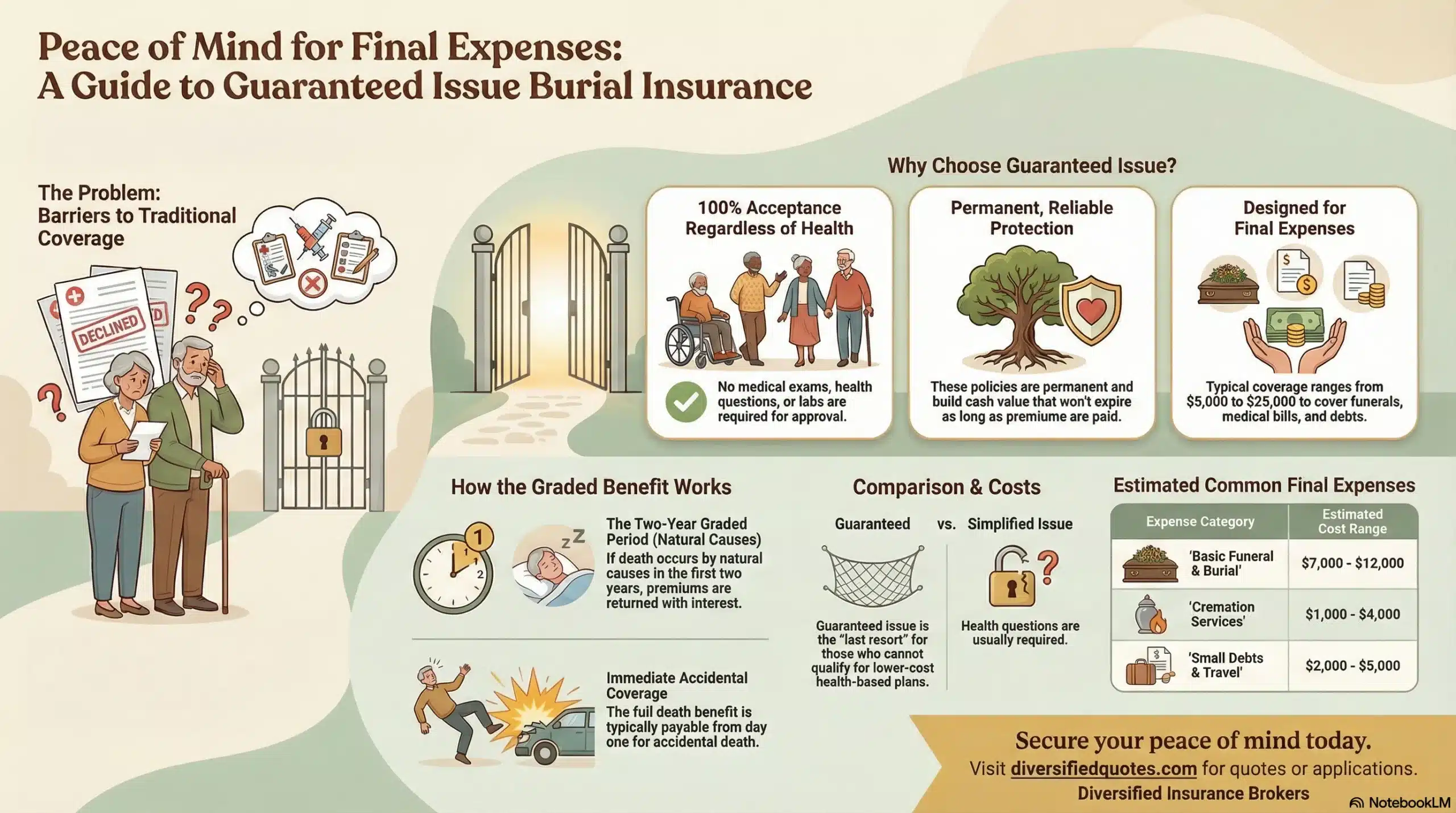
Guaranteed issue burial insurance is a small permanent life insurance policy — typically whole life — designed specifically for final expense coverage with a structurally different approval process than any other type of life insurance. The defining feature is not the product category, the face amount range, or the premium structure. It is the absence of health underwriting. Every other type of life insurance — fully underwritten, simplified issue, accelerated underwriting — evaluates the applicant’s health in some way before making a coverage decision. Guaranteed issue removes that evaluation entirely. Age eligibility and administrative requirements (state of residence, valid identification, payment method) determine acceptance; health history does not.
This structural distinction creates both the value and the limitations of guaranteed issue burial insurance. The value is access — the policy is available to applicants who could not obtain any other form of life insurance coverage because of their health history. The limitations are the direct consequence of accepting all applicants regardless of health: premiums are higher per dollar of coverage than simplified issue alternatives, face amounts are typically capped lower than other final expense options, and a graded benefit waiting period limits the death benefit for natural causes during an initial period after policy issue.
Understanding guaranteed issue clearly also requires separating it from the broader category of “no exam” life insurance. Many no-exam policies still involve health screening — they simply replace the physical examination with a health questionnaire, a prescription database check, an MIB (Medical Information Bureau) report, and automated underwriting algorithms. Simplified issue final expense insurance is “no exam” in the literal sense, but it still makes underwriting decisions based on health information. Guaranteed issue is genuinely different: no questionnaire, no prescription check, no medical records, no underwriting algorithm. If you meet the age requirements and the policy is available in your state, you are accepted. Our resource on life insurance with no medical questions asked explains this distinction in detail and helps applicants understand where the lines between product categories actually fall.
How Guaranteed Issue Pricing Works Without Health Screening
The absence of health underwriting in guaranteed issue insurance creates a pricing challenge that carriers solve through actuarial pooling at the population level. In a simplified issue policy, the carrier uses health information to price each applicant’s risk individually — a healthy 68-year-old receives a lower premium than an unhealthy 68-year-old because their mortality risk is measurably different. In guaranteed issue, the carrier cannot price individual risk because they have no health information about any individual applicant. Instead, they price as if every applicant in the eligible age range has an adverse health profile — because they know their applicant pool will include a disproportionate number of people with serious health conditions who could not qualify for other coverage.
This adverse selection dynamic — where people in poor health are more likely to seek guaranteed issue coverage than people in good health — is the primary reason guaranteed issue premiums are higher than simplified issue premiums for the same age and coverage amount. The carrier is not charging you more because they know you are unhealthy (they do not know that). They are charging more because they know their book of guaranteed issue business, in aggregate, will have a higher claims frequency than their simplified issue book. The pricing reflects the expected claims experience of the entire guaranteed issue applicant pool, not the expected claims experience of any individual applicant.
This is also why the premium difference between guaranteed issue and simplified issue is the most important financial comparison for any applicant who might qualify for simplified issue. If you can honestly answer simplified issue health questions without triggering an adverse underwriting outcome, the premium you pay for the same coverage amount is meaningfully lower — sometimes by 30% to 50% or more — than guaranteed issue pricing. Working with an independent broker who can evaluate whether simplified issue is genuinely available for your health profile before defaulting to guaranteed issue saves premium dollars without sacrificing coverage access when simplified issue is viable.
The Graded Benefit Period: A Complete Explanation
The graded benefit period is the most important structural feature of guaranteed issue burial insurance that applicants need to understand before purchasing — and the feature that is most frequently misunderstood or glossed over in the sales process. Understanding the graded benefit period completely, including what it means in practice for a beneficiary, is not optional due diligence. It is the core information needed to evaluate whether a guaranteed issue policy serves the applicant’s actual planning goals.
Most guaranteed issue policies include a graded benefit period of two years from the policy’s effective date, though some carriers use a three-year period and some states have regulatory requirements that affect the structure. During the graded benefit period, the benefit payable for death from natural causes (illness, disease, organ failure — any cause other than accident) is limited rather than the full face amount. The specific limited benefit structure varies by carrier, but the most common designs are: a return of 100% of premiums paid plus a defined interest rate (often 10% or 20% of total premiums paid); or a tiered percentage of the face amount that increases each year (for example, 30% in year one, 70% in year two, 100% from year three onward). For accidental death — death resulting from an accident rather than illness — most guaranteed issue policies pay the full face amount from day one, even during the graded period.
A concrete example illustrates what this means for a beneficiary. An applicant purchases a $15,000 guaranteed issue policy with premiums of $85 per month. In a design that returns premiums plus 10% interest, if the insured dies from natural causes in month eight of coverage, the beneficiary receives the total premiums paid ($680) plus 10% ($68) — a total of $748, not the $15,000 face amount. If the insured dies from an accident in month eight, the beneficiary receives the full $15,000. If the insured lives past the two-year graded period and then passes from natural causes, the beneficiary receives the full $15,000. The graded period is not designed to prevent coverage — it is designed to delay full coverage for natural causes during the period when adverse selection risk is highest, and then provide complete coverage for the remainder of the policy’s life.
Viewing the graded period in this realistic context helps applicants make rational decisions about guaranteed issue. For most people purchasing guaranteed issue, the expectation is that the policy will be in force for many years — providing permanent coverage that builds to full benefit value after the graded period ends. The graded period is a short initial phase relative to the expected lifetime of the policy. The practical concern is for applicants with serious, immediately life-threatening conditions who are purchasing guaranteed issue with a specific short-term urgency. For those applicants, the graded period represents a real limitation that the policy cannot overcome — which is why guaranteed issue is genuinely useful primarily as a long-term planning tool rather than as emergency coverage for an immediately terminal condition.
Guaranteed Issue vs. Simplified Issue: Who Should Actually Choose Each
The decision between guaranteed issue and simplified issue final expense insurance is one of the most consequential in the final expense market, and it is made incorrectly in both directions — some people purchase guaranteed issue when simplified issue was available and less expensive, and some people assume simplified issue is available when it is not and face disappointing underwriting outcomes. Getting this decision right requires an honest evaluation of the health profile against what simplified issue carriers actually underwrite.
Simplified issue final expense insurance is appropriate when the applicant can honestly answer the carrier’s health questions in a way that produces an acceptable underwriting outcome — meaning no “yes” answers to the specific adverse conditions the carrier is screening for. Common simplified issue health questions cover: whether the applicant has been diagnosed with or treated for specific terminal conditions (active cancer treatment, ALS, kidney failure requiring dialysis), whether the applicant currently uses oxygen for a medical condition, whether the applicant has been hospitalized in the past one to two years for cardiac or other serious events, whether the applicant has a history of stroke or TIA within the carrier’s lookback period, and whether the applicant has cognitive impairment or requires assistance with activities of daily living. Applicants who can answer these questions honestly without triggering the adverse conditions typically qualify for simplified issue at meaningfully lower premiums than guaranteed issue — and may qualify for level benefit (immediate full coverage) rather than a graded benefit structure.
Guaranteed issue is the appropriate choice when the applicant’s health history genuinely prevents simplified issue qualification — active cancer treatment, oxygen-dependent COPD, dialysis, recent major cardiac events within simplified issue lookback windows, documented cognitive impairment, or combinations of serious conditions that together exceed simplified issue guidelines at available carriers. It is also appropriate when the applicant has experienced prior insurance declines that suggest simplified issue application would produce a decline or an unacceptable offer. And it is appropriate when the applicant simply wants the certainty of acceptance without any possibility of underwriting uncertainty, even if simplified issue might technically be available — the peace of mind value of guaranteed acceptance has genuine worth for some applicants that justifies the premium differential.
Our resource on life insurance with pre-existing conditions explains how carrier underwriting standards vary across simplified issue carriers and why the same health history that triggers a decline at one carrier may qualify for level benefit coverage at another — context that helps applicants evaluate whether simplified issue has been genuinely exhausted before defaulting to guaranteed issue.
Specific Health Situations That Make Guaranteed Issue the Right Answer
Understanding in concrete terms which health situations reliably require guaranteed issue — rather than remaining potentially addressable through careful simplified issue carrier selection — helps applicants make informed decisions rather than pre-emptively accepting guaranteed issue’s higher cost when it is not necessary.
Active cancer treatment is one of the clearest situations where guaranteed issue is typically required. Virtually all simplified issue final expense carriers screen for current cancer treatment in their health questions, and an affirmative answer produces a decline rather than an adverse offer. Cancer that is in remission, resolved, or treated more than a defined number of years ago is often a different story — many simplified issue carriers accept certain cancers after a specific remission period. But applicants currently receiving chemotherapy, radiation, or other active cancer treatment will find their simplified issue options effectively nil, making guaranteed issue the practical coverage path.
Oxygen dependency from any cause — COPD, pulmonary fibrosis, cardiac conditions, or other respiratory disease requiring supplemental oxygen — is similarly a universal simplified issue disqualifier. The consistent use of supplemental oxygen is interpreted by simplified issue underwriters as a strong indicator of serious underlying disease and elevated near-term mortality risk. Guaranteed issue is typically the only available coverage path for applicants with current oxygen use.
Dialysis or kidney failure requiring regular dialysis treatment is another condition that virtually all simplified issue carriers screen for explicitly and decline upon disclosure. The mortality risk associated with end-stage renal disease is too elevated for simplified issue pricing models to accommodate, making guaranteed issue the standard coverage path for applicants on dialysis.
Recent major cardiac events — heart attacks, significant decompensated heart failure episodes, or major cardiac procedures — within most simplified issue carriers’ lookback windows (typically two to three years) trigger declines at most simplified issue carriers. Applicants whose cardiac events are beyond the lookback window with stable recovery since may still qualify for simplified issue, making timing a significant factor. Recent events make guaranteed issue the most realistic path.
Cognitive impairment or dementia diagnosis typically disqualifies applicants from simplified issue underwriting because cognitive conditions create both elevated mortality risk and potential policy contestability concerns. Guaranteed issue provides coverage access for applicants with diagnosed cognitive impairment who are otherwise within the eligible age range.
Multiple prior insurance declines, even when the specific reason for each decline is not completely clear to the applicant, suggest that simplified issue underwriting is unlikely to produce a favorable result and that guaranteed issue is the appropriate starting point rather than a last resort after additional declined applications create an adverse MIB record.
What “Guaranteed Acceptance” Actually Means in Practice
The phrase “guaranteed acceptance” in the context of guaranteed issue burial insurance is accurate but carries nuances that applicants should understand before applying. Acceptance is guaranteed within the constraints of the carrier’s eligibility framework — which means the guarantee has boundaries, even if those boundaries are much broader than health-based underwriting.
Age eligibility is the primary constraint on guaranteed issue acceptance. Most guaranteed issue final expense policies have both a minimum and maximum eligible age — commonly a range like 45 to 85, though the specific range varies by carrier and by state. Applicants who are outside the eligible age range — either too young (uncommon for the demographic seeking guaranteed issue) or too old (more commonly encountered at the upper age boundary) — cannot obtain the policy regardless of their willingness to pay the premium. For applicants approaching the upper age limit, applying before crossing that boundary is a genuine planning consideration.
State availability is another eligibility constraint that is often overlooked. Not all guaranteed issue products are available in all states — state insurance regulations, regulatory approval processes, and carrier strategic decisions about where to offer specific products affect availability. Some carriers offer guaranteed issue products in most states but have filed exceptions for specific states where regulatory requirements make the product economics difficult to manage. Confirming state availability before beginning an application process prevents wasted effort.
Administrative requirements — providing valid identifying information, confirming state of residence, establishing a payment method — must be satisfied for the application to be processed and the policy to be issued. These are genuinely minimal requirements compared to health underwriting, but they are requirements nonetheless. Incomplete or inaccurate administrative information can delay or prevent policy issuance even when health acceptance is guaranteed.
Incontestability period is a related concept worth understanding. Most life insurance policies — including guaranteed issue — include a contestability period (typically two years) during which the carrier may investigate a death claim and potentially rescind the policy if they discover material misrepresentation in the application. For guaranteed issue policies, where no health information was submitted, the practical scope of contestability is narrow — there is essentially no health information on the application to misrepresent. But fraud in the administrative information (false identity, false date of birth, false state of residence) could still theoretically be the basis for contestation. Applying accurately and honestly with correct identifying information is always the right approach regardless of policy type.
Coverage Amounts, Premium Ranges, and How to Right-Size a Guaranteed Issue Policy
Guaranteed issue face amounts are typically capped at lower levels than simplified issue final expense products. The most common maximum face amount for guaranteed issue burial insurance is $25,000, though some carriers cap at $15,000 or $20,000 and others allow higher amounts. These caps reflect the adverse selection reality — the carrier is managing risk by limiting the total liability per policy when they have no health information to price individual risk against.
For most families purchasing guaranteed issue burial insurance, the planning question is not “how do I maximize the face amount” — it is “what benefit amount creates adequate coverage for the specific expenses I am trying to address at a premium that remains comfortably manageable on a fixed income.” The most valuable guaranteed issue policy is not the largest one — it is the one that gets issued, stays in force, and pays the benefit when it is needed. A policy that becomes unaffordable and lapses before the graded period ends provides exactly zero benefit.
Common guaranteed issue face amounts range from $5,000 to $25,000. For applicants whose primary goal is ensuring that funeral costs do not burden surviving family members, $10,000 to $15,000 often provides meaningful coverage that keeps premiums within reach on Social Security income or a modest pension. For applicants who want to cover a broader range of final expenses — funeral plus medical bills plus small debts plus family travel — $20,000 to $25,000 provides more comprehensive protection. The premium impact of increasing from $10,000 to $25,000 is significant at older ages — understanding the monthly premium difference across face amounts and evaluating what is genuinely manageable long-term is the most important financial decision in the guaranteed issue purchase process.
Our resources on burial insurance for seniors over 50 and burial insurance for seniors over 80 provide age-specific context on how the final expense market behaves at different age ranges, and our resource on low cost burial insurance helps applicants identify whether guaranteed issue is genuinely the lowest-cost available path for their specific situation or whether simplified issue alternatives warrant evaluation first.
Policy Administration, Beneficiary Planning, and Long-Term Maintenance
A guaranteed issue burial insurance policy is only as useful as its ability to actually pay the benefit to the right person at the right time. Several administrative details — simple individually but collectively critical — determine whether the policy functions as intended when the beneficiary needs it.
Keeping the beneficiary designation current is the most important ongoing maintenance task. A guaranteed issue policy purchased 15 years ago with a spouse named as beneficiary may need updating after that spouse predeceases the insured — without updating, a deceased beneficiary designation can require estate settlement procedures that delay payment and create exactly the administrative burden the policy was purchased to prevent. Reviewing beneficiary designations annually, or any time there is a family change, takes a few minutes and prevents significant complications. Some families name a primary beneficiary and a contingent beneficiary to provide a backup designation if the primary is not alive at the time of the claim.
Ensuring the named beneficiary knows the policy exists — and knows the carrier name, policy number, and how to initiate a claim — is equally important. A guaranteed issue policy that no one can find or no one knows to claim is effectively worthless. Keeping a written record of policy information in a secure but accessible location, and communicating that location to the beneficiary while the insured is alive, is simple to do and prevents a genuinely unfortunate outcome where a policy goes unclaimed.
Premium payment consistency is the maintenance task that most directly affects whether the policy remains in force. Most final expense whole life policies have a grace period (typically 30 days) for late premium payments before the policy lapses, but a lapsed policy requires reinstatement procedures and may impose new waiting periods depending on the carrier’s reinstatement rules. Setting up automatic payment — electronic funds transfer or credit card billing — eliminates the risk of accidental lapse from a missed manual payment. For policies that a family member is helping manage on behalf of an elderly parent, automatic payment from the parent’s bank account or the family member’s account is the most reliable maintenance approach.
Most guaranteed issue burial insurance policies are permanent whole life insurance and build modest cash value over time. Cash value is not the reason most people purchase guaranteed issue — the death benefit is the point — but the cash value provides a small asset that can be accessed through policy loans if needed. Policy loans reduce the death benefit by the loan amount plus accrued interest, so borrowing against cash value has real consequences for the beneficiary. Using cash value as a policy maintenance tool — borrowing to pay premiums if income is temporarily disrupted — is possible but reduces the benefit that was purchased. The most straightforward guidance is to keep the policy funded through premium payments and treat the cash value as an emergency option rather than a planned feature. The tax treatment of life insurance death benefits — generally paid income-tax-free to named beneficiaries — is explained in our resource on whether life insurance benefits are taxable.
Secure Guaranteed Coverage Today
Apply online in minutes with guaranteed acceptance within the eligible age range. No health questions, no exams.
Apply Now with Gerber LifeQuestions? Call 800-533-5969
Related Pages
Explore additional guides on final expense options, “no questions asked” coverage, and common underwriting barriers.
Financial Protection Essentials
Employer health planning, high-risk life insurance guidance, retirement transitions, and long-term care comparison tools.
Talk With an Advisor Today
Choose how you’d like to connect—call or message us, then book a time that works for you.
Schedule here:
calendly.com/jason-dibcompanies/diversified-quotes
Licensed in all 50 states • Fiduciary, family-owned since 1980
FAQs: Guaranteed Issue Burial Insurance
What is guaranteed issue burial insurance?
Guaranteed issue burial insurance is a small permanent life insurance policy — typically whole life — designed to help cover final expenses, where acceptance is guaranteed within the carrier’s eligible age range regardless of health history. No medical exam, no health questionnaire, and no prescription database check are involved in the underwriting process. If you meet the age eligibility requirements and the policy is available in your state, you are accepted. This makes guaranteed issue the coverage of last resort for applicants who cannot qualify for any form of health-screened life insurance — whether due to serious diagnoses, recent hospitalizations, current oxygen use, dialysis, or a combination of conditions that place them outside what simplified issue carriers will accept.
The face amounts available are typically in the final expense range — commonly $5,000 to $25,000 — rather than large income replacement amounts. The premiums are higher than simplified issue alternatives for the same age and coverage amount, reflecting the adverse selection reality that the guaranteed issue applicant pool contains a disproportionate number of people with serious health conditions who could not obtain coverage elsewhere. Most guaranteed issue policies include a graded benefit waiting period of two years for natural causes of death, during which the benefit is limited rather than the full face amount, followed by full benefit coverage for the remainder of the policy’s life.
Who is eligible for guaranteed issue burial insurance?
Eligibility for guaranteed issue burial insurance is based on age and state availability rather than health. Most carriers offer guaranteed issue products to applicants between approximately 45 and 85 years old, though the specific eligible age range varies by carrier and state. Applicants must also meet basic administrative requirements — valid identification, confirmed state of residence, established payment method — and the product must be available in the applicant’s state of residence. Some guaranteed issue products have slightly different age boundaries, so confirming the specific carrier’s eligibility range before applying is worthwhile, particularly for applicants near the upper age boundary.
Health conditions, medications, prior insurance declines, and medical history do not affect eligibility for guaranteed issue products within the eligible age and state framework. This universal acceptance within the eligibility framework is the defining feature of guaranteed issue — it exists specifically to provide coverage access to applicants who cannot obtain it through any health-screened product. The absence of health-based eligibility criteria is what distinguishes guaranteed issue from all other life insurance product types.
How much coverage can I buy with guaranteed issue?
Guaranteed issue face amounts are typically capped at lower levels than simplified issue final expense products, reflecting the adverse selection reality of insuring a pool of applicants without health screening. The most common maximum face amount for guaranteed issue burial insurance is $25,000, though some carriers cap at $15,000 or $20,000. Minimum face amounts are typically in the $5,000 to $10,000 range. Some carriers offer a fixed face amount rather than a range, particularly for simplified guaranteed issue products designed for quick enrollment.
For most families purchasing guaranteed issue, the planning question is less about maximizing the face amount and more about identifying the benefit amount that provides meaningful final expense coverage at a premium that is genuinely manageable long-term. A $15,000 policy that stays in force for decades is more valuable than a $25,000 policy that becomes unaffordable and lapses. The graded benefit waiting period adds another consideration for face amount selection — during the first two years, the benefit for natural causes is limited, so the full face amount’s value only materializes after the graded period ends.
Are premiums level for life?
Yes — most guaranteed issue burial insurance policies are designed as whole life insurance with premiums that are intended to stay the same for the life of the policy. The premium you are quoted and pay at the time of enrollment is the premium you continue paying indefinitely, regardless of aging, health changes, or any other factors that would typically cause premiums to increase in health-reviewed products. This level premium structure is one of the most practically valuable features of whole life burial insurance for seniors on fixed incomes — the coverage cost is predictable and does not create the escalating expense problem that renewable term insurance or age-banded products would generate over time.
The policy also does not expire as long as premiums are paid. Unlike term insurance that ends after a defined period, permanent whole life burial insurance remains in force indefinitely, providing coverage that is there whenever the insured passes — whether that is three years or thirty years after the policy is issued. This combination of fixed premium and permanent coverage is the reason whole life is the standard product chassis for final expense insurance regardless of whether the specific policy is simplified issue or guaranteed issue.
Is there a waiting period with guaranteed issue?
Yes — most guaranteed issue policies include a graded benefit period, typically two years from the policy’s effective date, during which the benefit payable for death from natural causes is limited rather than the full face amount. The specific limited benefit structure varies by carrier: most common designs either return 100% of premiums paid plus a defined interest rate (often 10% to 20% of total premiums paid), or pay a tiered percentage of the face amount that increases each year until full coverage begins. Accidental death is typically covered at the full face amount from day one even during the graded period.
After the graded period ends, the full face amount is payable for all covered causes of death — natural or accidental — as long as premiums are paid and the policy remains in force. The graded period is not designed to prevent coverage payment; it is designed to delay full coverage for natural causes during the period when adverse selection risk is highest, immediately after acceptance. For applicants purchasing guaranteed issue as a long-term planning tool, the graded period is a short initial phase relative to the expected duration of coverage. The practical concern is for applicants with immediately terminal conditions for whom the graded period represents a real limitation the policy cannot overcome.
Does guaranteed issue burial insurance build cash value?
Most guaranteed issue burial insurance policies are whole life insurance, and whole life policies do accumulate cash value over time. The cash value grows modestly and is backed by the insurance company — it does not fluctuate with market conditions the way investment products do. Over time, the accumulated cash value can be accessed through policy loans or policy surrender. Policy loans reduce the death benefit by the loan amount plus accrued interest. Surrendering the policy terminates coverage and returns the surrender value, which may be less than total premiums paid in early years but grows toward the face amount over time depending on the policy’s design.
Cash value is not the primary reason most people purchase guaranteed issue burial insurance — the death benefit is the purpose, and the cash value is a secondary feature of the permanent insurance chassis. For most policyholders, keeping the policy in force through regular premium payments and leaving the cash value untouched maximizes the death benefit available to beneficiaries. Using cash value through loans or surrender reduces the benefit that was purchased, which works against the policy’s primary planning purpose.
What can the death benefit be used for?
Your beneficiary can generally use the death benefit for any purpose — there is no requirement to spend the funds on funeral costs, burial, or any specific category of final expenses. The benefit is paid as a lump-sum cash payment directly to the named beneficiary, who then has complete discretion over how it is used. Families most commonly use guaranteed issue death benefits for funeral home services, cremation or burial costs, a memorial or celebration of life, final medical bills, credit card balances, outstanding utilities, travel and lodging costs for family members attending the service, and a cushion for unexpected expenses that arise in the weeks following a loss.
This flexibility is one of the most practically valuable features of life insurance death benefits compared to pre-paid funeral arrangements, which contractually restrict the funds to specific services from a specific provider. A life insurance death benefit gives the beneficiary the flexibility to adjust spending based on actual circumstances — using a simpler service if circumstances call for it, covering unexpected expenses that pre-paid arrangements do not account for, or simply providing financial breathing room during a stressful transition period.
Are there alternatives if I can answer a few health questions?
Yes — and evaluating simplified issue alternatives before defaulting to guaranteed issue is one of the most financially significant decisions in the final expense shopping process. Simplified issue final expense insurance skips the medical exam but asks a short list of health questions and may check prescription history. Applicants who can honestly answer those questions without triggering the adverse conditions the carrier is screening for may qualify for level benefit coverage (immediate full coverage from day one) at premiums that are meaningfully lower than guaranteed issue pricing for the same age and face amount — sometimes 30% to 50% lower.
The conditions that reliably prevent simplified issue qualification include active cancer treatment, current oxygen use, dialysis, and recent major cardiac events within the carrier’s lookback window. Many conditions that people assume would prevent simplified issue qualification — controlled high blood pressure, stable diabetes, managed COPD, prior resolved cancer beyond the lookback period, common senior medications — actually qualify for simplified issue at most carriers. Working with an independent broker who can evaluate whether simplified issue is genuinely available for your specific health profile before recommending guaranteed issue provides the information needed to make this decision correctly. Our resource on life insurance with pre-existing conditions explains how carrier underwriting varies and why carrier selection matters for simplified issue qualification.
Can I be declined for guaranteed issue?
Declines are uncommon for guaranteed issue when applicants meet the age eligibility requirements, live in a state where the product is available, and complete the application accurately with correct identifying information. The health-based declines that occur in simplified issue and fully underwritten insurance do not apply to guaranteed issue — there is no health information submitted and therefore no health-based basis for decline. However, the administrative requirements for policy issuance are still real constraints: applicants outside the eligible age range cannot obtain the policy regardless of premium willingness, applicants in states where the specific product is not filed and approved cannot enroll, and applications with inaccurate or incomplete administrative information may require correction before processing.
The incontestability period — typically two years — allows the carrier to investigate claims and potentially rescind policies if material misrepresentation is discovered. For guaranteed issue, where no health information is submitted, the practical scope of incontestability is narrow. But misrepresentation of administrative information — false date of birth to circumvent age eligibility, false state of residence to access a product not available in the actual state — could theoretically be the basis for contestation. Applying accurately with correct information is always the correct approach regardless of policy type.
How fast can coverage start?
Many guaranteed issue applications are processed quickly — often within a few days of submitting complete enrollment information and establishing the premium payment. The effective date of the policy and the date from which the graded benefit period begins are typically tied to the first premium payment date or the policy issue date, depending on the carrier’s specific terms. Because there is no medical underwriting to complete, no exam to schedule, and no prescription or records review to conduct, the administrative processing time is the primary determinant of how quickly coverage begins.
For applicants with urgent timing concerns — a family member recently diagnosed with a serious illness who wants coverage in place quickly — it is important to understand that the graded benefit period begins from the policy’s effective date and cannot be shortened by expediting the application process. The two-year graded period for natural causes runs from whenever the policy is issued, meaning coverage purchased today will provide full benefit for natural causes two years from the issue date. Accidental death coverage at the full face amount is typically available from day one. The urgency of the application process affects when the graded period starts, not how long the graded period is.
Browse No Medical Exam & Guaranteed Issue Options
About the Author:
Jason Stolz, CLTC, CRPC, DIA, CAA and Chief Underwriter at Diversified Insurance Brokers (NPN 20471358), is a senior insurance and retirement professional with more than 25 years of real-world experience helping individuals, families, and business owners protect their income, assets, and long-term financial stability. As a long-time partner of the nationally licensed independent agency Diversified Insurance Brokers, Jason provides trusted guidance across multiple specialties—including fixed and indexed annuities, long-term care planning, personal and business disability insurance, life insurance solutions, Group Health, Travel Medical and Evacuation Insurance, and short-term health coverage. Diversified Insurance Brokers maintains active contracts with over 100 highly rated insurance carriers, ensuring clients have access to a broad and competitive marketplace.
His practical, education-first approach has earned recognition in publications such as VoyageATL, and contributions from his agency featured in Kiplinger and GoBankingRates— highlighting his commitment to financial clarity and client-focused planning. Drawing on deep product knowledge and years of hands-on field experience, Jason helps clients evaluate carriers, compare strategies, and build retirement and protection plans that are both secure and cost-efficient. Visitors who want to explore current annuity rates and compare options across multiple insurers can also use this annuity quote and comparison tool.
Explore All Burial Insurance Options: Browse our complete Burial Insurance guide — covering seniors, high risk conditions, no medical exam options & final expense planning.
Last Reviewed: June 9, 2026 |
Reviewed by: Jason Stolz, CLTC, CRPC, DIA, CAA
Chief Underwriter, Diversified Insurance Brokers, Inc. | NPN: 20471358 | Diversified Insurance Brokers, Inc. — Licensed in all 50 states
Fact Checked by: Tonia Pettitt, CMIP©
Medicare Specialist, Diversified Insurance Brokers, Inc. | NPN: 14374308 | Diversified Insurance Brokers, Inc. — Licensed in all 50 states
Did you find this content helpful? Leave us a Google review — it helps others find trustworthy guidance too.
Editorial Standards: Diversified Insurance Brokers maintains rigorous editorial standards to ensure accuracy, clarity, and independence in all content. Learn more about our editorial standards and commitment to transparency.
