
Gerber Life Guaranteed Issue Whole Life
Gerber Life Guaranteed Issue Whole Life

Jason Stolz CLTC, CRPC, DIA, CAA
Gerber Life Guaranteed Issue Whole Life — What It Is, Who It’s For, and What to Know Before Buying
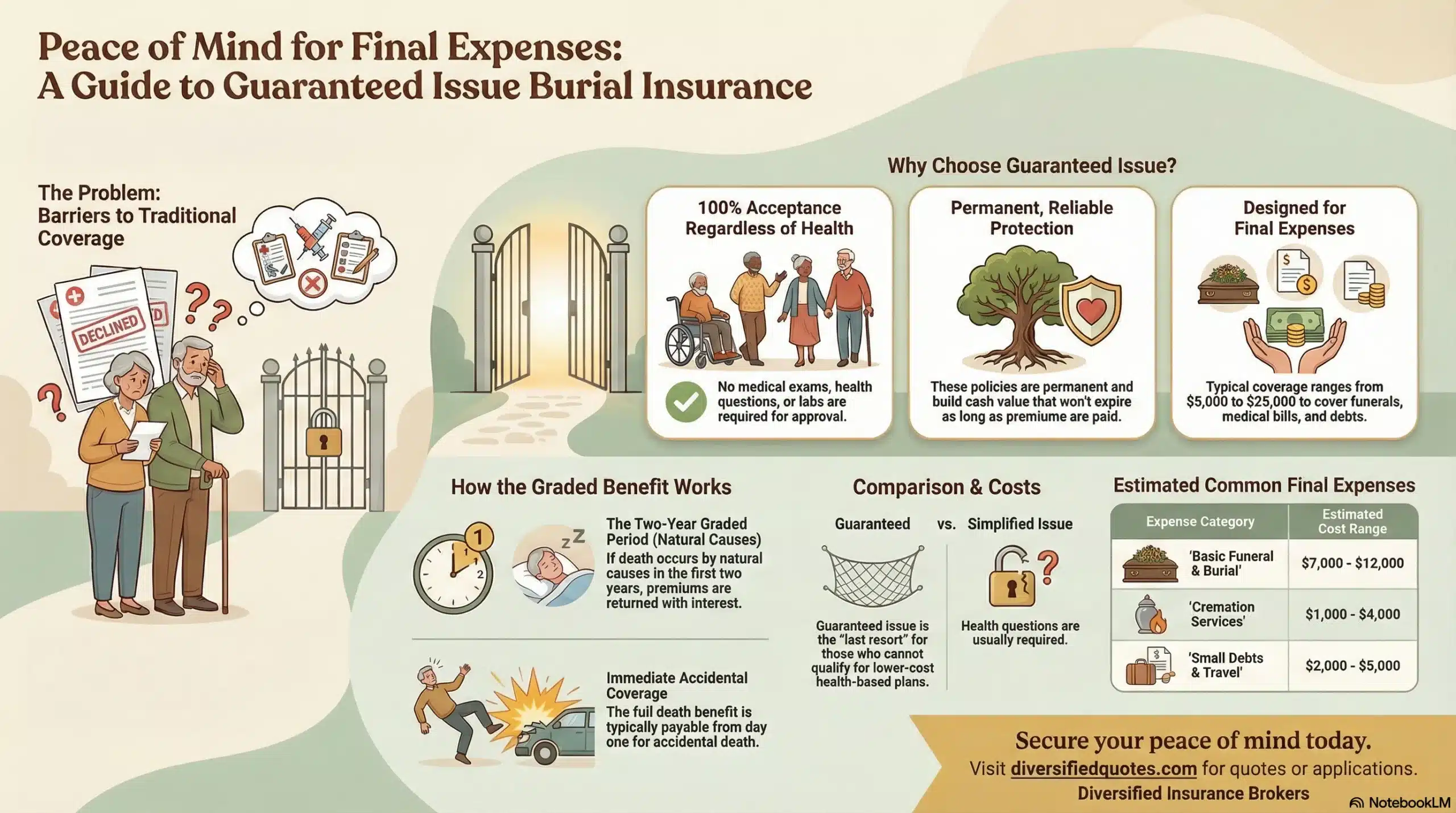
Gerber Life’s Guaranteed Issue Whole Life Insurance is a burial and final expense policy available to adults between ages 50 and 80 that accepts every applicant regardless of health history — no medical exam, no health questions, and no possibility of being declined based on any medical condition. For seniors who have been turned down by other life insurance carriers, who are living with serious health conditions that make traditional underwriting impossible, or who simply want a straightforward policy that covers funeral and final expense costs without the uncertainty of a health review, the Gerber Life guaranteed issue product offers a defined and accessible option. The trade-off for that unconditional acceptance is a two-year graded benefit period during which non-accidental deaths receive only a return of premiums paid plus 10 percent interest rather than the full face amount — the insurance company’s mechanism for managing the elevated mortality risk it accepts by issuing coverage with no health information at all. After the two-year period, the full death benefit is paid for any cause of death with no further conditions. At Diversified Insurance Brokers, Jason Stolz, CLTC, CRPC, DIA, CAA reviews guaranteed issue coverage alongside the full burial insurance and final expense market — because Gerber Life is one option in a broader competitive landscape, and many seniors who assume guaranteed issue is their only path forward actually qualify for simplified issue policies that offer immediate full coverage, lower premiums, or higher face amounts than the guaranteed issue structure provides. The right policy depends on the applicant’s specific health profile, and the only way to identify the best available option is to compare the full market rather than purchasing the first guaranteed acceptance product encountered.
Who Gerber Life’s Guaranteed Issue Product Actually Serves
Gerber Life’s guaranteed issue whole life is specifically appropriate for seniors between 50 and 80 who cannot qualify for any other life insurance product — either because of serious health conditions that would result in decline under any underwriting standard, or because the applicant has been explicitly declined by other carriers and has no alternative path to coverage. The policy is also available in New York for applicants up to age 75, is not available in Montana, and caps at $15,000 in South Dakota rather than the standard $25,000 maximum. Gerber Life is owned by Western and Southern Financial Group and holds an AM Best A+ financial strength rating — the highest possible rating from AM Best — which provides meaningful assurance of the company’s long-term claims-paying capacity. Coverage amounts range from $5,000 to $25,000, making this a final expense and burial insurance product rather than an income replacement product — the face amounts are designed to cover funeral costs, outstanding medical bills, small debts, and similar end-of-life expenses rather than to replace years of lost income for surviving dependents. Premiums are fixed for life once the policy is issued — they will never increase regardless of age, health changes, or any other factor. The policy builds cash value over time that the owner can borrow against if needed, though borrowing against the cash value reduces the death benefit by the outstanding loan amount. Burial insurance options for seniors over 80 address the coverage need for applicants who have aged out of the Gerber guaranteed issue eligibility window — because the product’s maximum issue age of 80 means applicants who reach that age without having secured coverage need to evaluate the narrower set of options available in the oldest age brackets. No-exam life insurance covers the full spectrum of policies that do not require a physical examination — including both guaranteed issue products like the Gerber policy and simplified issue products that ask health questions but do not require a paramedical exam, a distinction that is important for applicants who may qualify for simplified issue coverage at better rates than guaranteed issue requires.
Apply Now for Gerber Life Guaranteed Issue Coverage
No health questions. No medical exam. Guaranteed acceptance for ages 50–80. Lock in lifelong coverage today.
Get a Quote and Apply NowGerber Life Guaranteed Issue — Key Features, Limitations, and How It Compares
| Feature | Gerber Life Guaranteed Issue | Simplified Issue Burial Insurance (Comparison) |
|---|---|---|
| Eligibility requirement | No medical exam, no health questions — guaranteed acceptance for all applicants ages 50–80 regardless of health history; cannot be declined for any health reason | No medical exam required, but health questions are asked; applicants with certain serious conditions may be declined or rated; healthier applicants typically qualify at lower premiums |
| Waiting period | Two-year graded benefit period — non-accidental deaths in the first two years receive only return of premiums paid plus 10% interest; accidental death pays full benefit from day one; full benefit for all causes after two years | Many simplified issue carriers offer immediate first-day coverage for all causes of death — no waiting period for applicants who qualify through the health question underwriting; some carriers offer graded benefit options for applicants with more complex health histories |
| Coverage amounts available | $5,000 to $25,000 (maximum $15,000 in South Dakota; not available in Montana; maximum issue age 75 in New York) | Many simplified issue carriers offer $5,000 to $50,000 or higher, providing access to larger face amounts for applicants whose final expense needs exceed $25,000 |
| Premium structure | Fixed for life — premiums never increase regardless of age or health changes; higher per thousand dollars of coverage than medically underwritten alternatives because the carrier accepts all health risks without selection | Fixed for life on most simplified issue products; lower premiums per thousand than guaranteed issue because the health question screening allows the carrier to select lower-risk applicants at more favorable rates |
| Cash value | Builds cash value over time; owner can borrow against the cash value if needed; outstanding loans reduce the death benefit by the loan amount; cash value grows at a defined rate specified in the policy | Most simplified issue whole life products also build cash value; the cash value growth rate and loan terms vary by carrier and product |
| Financial strength | AM Best A+ rating (highest possible) as of the most recent rating — Gerber Life is a subsidiary of Western and Southern Financial Group, one of the largest mutual insurance holding companies in the United States | Varies by carrier — financial strength ratings should be confirmed for any carrier being considered; the burial insurance market includes both highly-rated and less-established carriers |
The comparison table documents the most consequential differences between the Gerber Life guaranteed issue product and simplified issue alternatives available in the burial insurance market. The central planning question for any senior evaluating the Gerber policy is whether guaranteed issue is actually necessary — because the guaranteed acceptance that makes Gerber accessible comes with a two-year waiting period and premium rates that are higher than simplified issue alternatives. For applicants who genuinely cannot qualify for simplified issue coverage due to serious health conditions, the Gerber guaranteed issue product is a legitimate and financially strong option. For applicants who have not been explicitly declined by other carriers and who have not gone through a full simplified issue application process, defaulting to guaranteed issue without first testing simplified issue eligibility means paying higher premiums and accepting a waiting period that may not be necessary. The best-rated burial insurance companies in the market include both guaranteed issue and simplified issue carriers whose products serve different segments of the senior market — identifying which carrier and product type is most appropriate for a specific applicant’s health profile requires the full market comparison that an independent broker provides. Burial insurance for seniors as a product category encompasses the full range of final expense whole life options — from standard whole life with full underwriting for healthier seniors, to simplified issue with health questions and typically immediate coverage, to guaranteed issue for seniors who cannot qualify for any underwritten product. Understanding where on that spectrum a specific applicant’s health profile places them is the starting point for any burial insurance recommendation.
The Two-Year Waiting Period — What It Means and When It Matters Most
The two-year graded benefit period is the most important limitation of the Gerber Life guaranteed issue product — and of all guaranteed issue life insurance products generally, because no insurance company can accept applicants with no health screening at all without limiting the death benefit for deaths that occur shortly after the policy is issued. The graded structure works as follows: if the insured dies from any cause other than an accident within the first two years of the policy, the beneficiary receives only the total premiums paid into the policy plus 10 percent interest — not the full face amount. If the insured dies from an accident within the first two years, the full death benefit is paid immediately with no reduction. After two full years from the policy issue date, all deaths from any cause — illness, disease, natural causes, accident — receive the full face amount with no further conditions or limitations.
The planning implication of the two-year waiting period is straightforward but critical: a senior who purchases a $15,000 Gerber guaranteed issue policy and dies from a health-related cause eight months later will leave their beneficiary with only the premiums paid plus 10 percent — perhaps $500 to $800 depending on the monthly premium and the age at issue — rather than the $15,000 that was the purpose of the policy. The policy was purchased to cover funeral expenses, but if death occurs before the waiting period expires, it will not serve that purpose. This is not a flaw unique to Gerber — it is the universal structure of all guaranteed issue life insurance because of the adverse selection risk that guaranteed acceptance creates — but it is a limitation that must be understood and factored into the purchasing decision. For seniors in declining health who are purchasing guaranteed issue coverage specifically because they anticipate a shorter life expectancy, the two-year waiting period is the most consequential limitation of the product. For seniors who are in reasonable health for their age and are purchasing primarily to ensure coverage is in place for eventually-needed funeral expenses, the two-year window is a manageable planning consideration rather than a disqualifying factor. Life insurance options for cancer survivors illustrate the simplified issue alternative — some cancer survivors, depending on the type, stage, and time since treatment, can qualify for simplified issue burial insurance with immediate coverage rather than defaulting to guaranteed issue with a two-year wait. The full underwriting landscape for specific health conditions requires carrier-by-carrier analysis rather than the assumption that a specific diagnosis automatically requires guaranteed issue coverage. Life insurance with chronic illness riders and other flexible underwriting products represent additional options in the broader market for seniors with health conditions that don’t necessarily require the most restrictive guaranteed issue structure.
Gerber Life Guaranteed Issue vs. the Full Burial Insurance Market — When to Choose and When to Keep Looking
The Gerber Life guaranteed issue product occupies a specific niche within the burial insurance market — it serves applicants who genuinely cannot obtain coverage anywhere else and who need the certainty of guaranteed acceptance above all other considerations. For that specific group of seniors, the Gerber product’s AM Best A+ rating, fixed premiums, and straightforward structure make it a legitimate solution to a genuine coverage need. The question that every senior evaluating the Gerber policy should ask — and that Diversified Insurance Brokers asks on behalf of every client — is whether guaranteed issue is actually necessary, or whether a simplified issue product would serve the same coverage purpose at lower premiums and with immediate full coverage.
The simplified issue market for burial insurance includes carriers with products that ask health questions but do not require a medical exam, and that use the health question answers to underwrite applicants rather than accepting all risks. Healthier applicants who answer those questions favorably can obtain immediate full coverage at premiums meaningfully lower than what guaranteed issue requires — because the carrier has selected for lower risk through the underwriting process and can price accordingly. Many seniors who assume they cannot qualify for simplified issue because of health conditions have never actually gone through a simplified issue application with a carrier whose underwriting guidelines are favorable to their specific conditions. The only way to know whether simplified issue is available is to apply — and the only way to compare the full simplified issue market is through an independent broker with access to multiple carriers. Defaulting to guaranteed issue without testing simplified issue availability is a planning gap that can cost more in premiums and deliver a weaker benefit structure than necessary. Life insurance rates for burial and final expense coverage vary significantly across carriers, coverage amounts, and product types — the rate comparison across the full market is the most direct way to identify whether the Gerber guaranteed issue premium is the best available option or whether alternatives exist at comparable or lower cost. How much life insurance is needed for final expense purposes specifically — accounting for funeral costs, outstanding debts, final medical expenses, and any modest legacy objectives — establishes the coverage amount target that determines whether the Gerber maximum of $25,000 is sufficient or whether a product with higher coverage limits would better serve the applicant’s needs. Whether life insurance is still needed in retirement is the foundational question that precedes any burial insurance evaluation — the answer depends on whether final expense obligations would otherwise fall on family members, whether existing assets can cover those costs, and whether a modest death benefit serves any legacy purpose the applicant values. A second opinion on any life insurance quote — including a Gerber Life guaranteed issue quote — is the most straightforward way to confirm whether the proposed product is the best available option or whether alternatives in the market serve the same purpose at better terms.
Coordinating Burial Insurance With the Broader Retirement Financial Plan
Burial insurance and final expense planning exist within a broader retirement financial picture that includes income security, healthcare cost management, and long-term care planning — and the decision about which life insurance product to purchase should be evaluated in the context of that complete picture rather than in isolation. A senior who secures burial insurance coverage but has not addressed the long-term care funding gap, has not optimized Social Security income, and has not considered how retirement account distributions will affect Medicare premium costs may be solving a smaller planning problem while leaving larger ones unaddressed. Whether Medicare covers long-term care — it does not cover custodial care, which is the most expensive category of senior care — establishes the coverage gap that burial insurance alone does not address and that long-term care planning specifically serves. Annuities with long-term care benefits address both the income security need and the long-term care coverage gap simultaneously within a single contract — a planning approach that seniors evaluating burial insurance should understand as part of the comprehensive coverage landscape. Non-qualified long-term care annuities provide both tax-deferred accumulation and long-term care benefit access in a structure that serves the dual planning objective of income security and care cost protection. Long-term care insurance with shared spousal benefits addresses the care cost risk for couples where either spouse may need care — a planning dimension that affects the household’s financial security regardless of which spouse the burial insurance is intended to protect. Annuities for conservative investors represent the principal-protected savings and income vehicle that many seniors use alongside burial insurance as part of a comprehensive retirement financial structure — the annuity providing guaranteed income and the burial insurance ensuring final expenses do not burden the family. The best annuity for guaranteed income in retirement is the income planning complement to the final expense coverage that burial insurance provides — together, they address two distinct dimensions of retirement financial security. How Social Security and annuities work together in a retirement income plan establishes the foundational income architecture within which burial insurance and other final expense planning sits. Social Security planning guidance for seniors evaluating burial insurance is relevant because the Social Security claiming decision affects the household income level, and the income level affects both the affordability of burial insurance premiums and the extent to which other assets can cover final expenses without insurance. Medicare enrollment planning and Medicare cost projection are retirement planning dimensions that interact with burial insurance decisions — because the out-of-pocket healthcare costs that Medicare does not cover represent an additional financial burden on the household that affects how much of the budget is available for insurance premiums. IRMAA management strategies that reduce Medicare premium costs free up retirement income that can fund burial insurance premiums and other final expense planning. Medicare supplement plans for seniors address the healthcare cost gap that original Medicare leaves — a planning need that is distinct from but complementary to burial insurance as part of the complete senior financial protection picture. How annuity death benefits work is relevant for seniors who already hold annuity assets — the annuity’s death benefit passes to beneficiaries alongside any life insurance death benefit, and coordinating these two sources of survivor benefit produces a more complete picture of what heirs will receive. Annuity beneficiary designations for seniors holding both annuity contracts and life insurance policies should be reviewed in coordination — ensuring that both sets of beneficiary designations reflect current intent and that the total death benefit passes efficiently to the intended recipients. What annuity guarantees mean in the context of retirement income security — the contractual principal protection, guaranteed crediting, and income guarantee provisions — establishes the income safety net within which burial insurance serves its more limited but specific purpose of ensuring final expenses are covered. The annuity rescue plan process reviews existing annuity positions alongside insurance coverage to identify whether the overall financial protection structure is optimized or whether repositioning any element would improve the retirement financial plan. The best fixed indexed annuity for a senior’s specific financial profile provides the growth and income planning complement to the death benefit and final expense planning that burial insurance addresses — the two products serving different but complementary functions within a complete retirement financial structure.
Compare Burial Insurance Options Across the Full Market
We compare Gerber Life alongside every simplified issue and guaranteed issue carrier available for your age, state, and health profile — identifying the policy that provides the best coverage at the best price for your specific situation.
Talk With an Advisor Today
Choose how you’d like to connect—call or message us, then book a time that works for you.
Schedule here:
calendly.com/jason-dibcompanies/diversified-quotes
Licensed in all 50 states • Fiduciary, family-owned since 1980
FAQs: Gerber Life Guaranteed Issue Whole Life Insurance
Can I really be turned down for the Gerber Life guaranteed issue policy?
No — the Gerber Life Guaranteed Issue Whole Life policy accepts every applicant between ages 50 and 80 regardless of health history, medical conditions, or any other health-related factor. There are no health questions, no medical exam requirements, and no possibility of being declined based on a health condition. The only eligibility requirements are age — between 50 and 80 at application — and state of residence, since the policy is not available in Montana and has modified terms in South Dakota and New York. If you meet the age and state requirements, you are guaranteed to be issued the policy at the coverage amount you select.
This guaranteed acceptance is the product’s defining feature and its primary value proposition for seniors who have been declined by other carriers or who have serious health conditions that make any underwritten policy unavailable. The trade-off for this unconditional acceptance is the two-year graded benefit period — the insurance company’s mechanism for managing the elevated mortality risk it accepts when issuing coverage with no health information at all. Understanding that trade-off is essential before purchasing, because the two-year waiting period means the policy will not pay the full face amount for health-related deaths in the first two years. The unconditional acceptance solves one problem — getting coverage issued at all — while the graded benefit creates a planning consideration about the timing and nature of coverage that the full face amount requires surviving.
How does the two-year waiting period work and what does my beneficiary receive if I die during it?
The two-year graded benefit period means that if the insured dies from any cause other than an accident within the first two years of the policy, the beneficiary receives only the total premiums paid into the policy plus 10 percent interest — not the full face amount of the policy. For example, if a policyholder pays $50 per month for 14 months and then dies from a health-related cause, the beneficiary receives approximately $700 plus 10 percent ($70) — a total of $770 — rather than the $10,000 or $15,000 face amount the policy was purchased to provide. The accidental death exception applies from day one: if the insured dies in an accident within the first two years, the full face amount is paid immediately with no reduction.
After the policy has been in force for two full years from the issue date, the full death benefit is paid for any cause of death — illness, disease, natural causes, accident — with no further conditions or limitations. The policy then provides the permanent whole life coverage it was designed to deliver for the remainder of the insured’s life. The two-year waiting period is not unique to Gerber Life — it is the standard structure of all guaranteed issue life insurance products across all carriers, because insurers cannot accept applicants with no health screening at all without limiting early claims. This is important context for evaluating any guaranteed issue product, not a specific weakness of the Gerber policy. The practical planning question is whether a two-year waiting period is acceptable given the applicant’s health situation and the urgency of their coverage need.
Is $25,000 enough coverage for final expenses?
Whether $25,000 is sufficient depends on the specific final expenses being planned for. National Funeral Directors Association data documents that the median cost of a funeral with burial has consistently been in the range of $8,000 to $10,000, and a cremation with services runs meaningfully less — though costs vary significantly by region, funeral home, and the specific services selected. A $25,000 face amount would cover a full traditional funeral and burial in most parts of the country with funds remaining for outstanding medical bills, small debts, or other end-of-life costs. For many seniors, the Gerber maximum of $25,000 is sufficient for the specific burial and final expense purpose.
Where $25,000 may fall short is for applicants who have larger outstanding obligations — significant medical debt, a mortgage balance, credit card obligations, or a desire to leave more than basic final expense coverage for surviving family members. For applicants whose final expense needs exceed $25,000, the Gerber guaranteed issue product is insufficient by design, and alternatives in the simplified issue market that offer higher face amounts — some up to $50,000 or more — should be evaluated first. An applicant who assumes they cannot qualify for simplified issue because of health conditions should test that assumption through an actual application before concluding that the Gerber $25,000 maximum is their coverage ceiling. The independent broker comparison process is the most efficient way to establish the actual maximum coverage available to a specific applicant given their health profile.
Are Gerber Life’s premiums competitive compared to other guaranteed issue carriers?
Within the guaranteed issue category specifically, Gerber Life’s premiums are generally considered competitive — the product offers meaningful coverage amounts at rates that compare favorably to some other guaranteed issue carriers, and the company’s AM Best A+ financial strength rating provides confidence that the claims-paying capacity behind the policy is among the strongest in the market. Some industry analyses have noted that Gerber’s guaranteed issue rates are superior to specific competitors in the same guaranteed issue category, making it a strong choice when guaranteed issue is genuinely necessary.
The more important comparison is not Gerber’s premiums against other guaranteed issue carriers but Gerber’s premiums against simplified issue alternatives — because simplified issue products typically offer lower premiums per thousand dollars of coverage than any guaranteed issue product from any carrier. The higher cost of guaranteed issue is not a Gerber-specific issue but an industry-wide reality: when a carrier accepts all health risks without screening, the premium must reflect the elevated expected claims from the unselected risk pool. For applicants who qualify for simplified issue coverage, the premium difference is meaningful over the life of the policy. The practical question is whether the applicant actually needs guaranteed issue or whether they have assumed it without testing their simplified issue eligibility.
What if I have a serious health condition — does that automatically mean I need guaranteed issue?
Not necessarily — and this is one of the most important planning points in the burial insurance market. Many seniors assume that any serious health condition automatically disqualifies them from simplified issue coverage and routes them to guaranteed issue. In reality, different carriers have very different underwriting guidelines for different conditions, and an applicant who is declined by one simplified issue carrier may be accepted by another whose guidelines are more favorable for their specific diagnosis, treatment status, or condition severity. The burial insurance market includes carriers that specifically specialize in impaired risk underwriting — offering simplified issue products with more favorable guidelines for common senior health conditions than standard carriers provide.
Common conditions that some simplified issue carriers accommodate with immediate or near-immediate coverage include well-controlled diabetes, treated high blood pressure, stable heart conditions, past cancer diagnoses with defined remission periods, COPD at certain severity levels, and many others. The specific underwriting guidelines vary by carrier and are not publicly disclosed in detail — identifying which carriers are most favorable for a specific combination of health conditions requires working with an independent broker who has experience placing impaired risk life insurance and who can match the applicant’s health profile to the carrier most likely to offer the best combination of coverage and premium. Defaulting to guaranteed issue without attempting simplified issue means potentially paying more for a policy with a two-year waiting period when a better option may have been available through a carrier with favorable underwriting for the specific condition involved.
How does the cash value in the Gerber policy work?
The Gerber Life Guaranteed Issue Whole Life policy builds cash value over time as premiums are paid — a feature of all whole life insurance products that distinguishes them from term life policies, which have no cash value accumulation. The cash value grows at a defined rate specified in the policy and can be accessed through a policy loan if the owner needs funds. A policy loan does not require repayment on any schedule — outstanding loan balances simply accumulate interest, and any outstanding loan at the time of death is deducted from the death benefit paid to the beneficiary.
For most purchasers of a burial insurance policy, the cash value dimension is a secondary consideration — the primary purpose is the death benefit, and the cash value that accumulates in a $10,000 to $25,000 burial policy over a 10 or 15-year period is typically modest. The cash value does provide a liquidity option in financial emergencies, but borrowing against a burial insurance policy reduces the death benefit available to cover the final expenses the policy was purchased to address. The more practically significant cash value feature is the surrender value: if the policyholder decides to cancel the policy after it has been in force for a number of years, the accumulated cash value is returned to the owner rather than being forfeited — a protection that pure term life insurance does not offer. For seniors who purchase a burial policy and later find their financial circumstances change, the ability to surrender the policy for its accumulated cash value provides an exit option that recovers some portion of the premiums paid.
About the Author:
Jason Stolz, CLTC, CRPC, DIA, CAA and Chief Underwriter at Diversified Insurance Brokers (NPN 20471358), is a senior insurance and retirement professional with more than 25 years of real-world experience helping individuals, families, and business owners protect their income, assets, and long-term financial stability. As a long-time partner of the nationally licensed independent agency Diversified Insurance Brokers, Jason provides trusted guidance across multiple specialties—including fixed and indexed annuities, long-term care planning, personal and business disability insurance, life insurance solutions, Group Health, Travel Medical and Evacuation Insurance, and short-term health coverage. Diversified Insurance Brokers maintains active contracts with over 100 highly rated insurance carriers, ensuring clients have access to a broad and competitive marketplace.
His practical, education-first approach has earned recognition in publications such as VoyageATL, and contributions from his agency featured in Kiplinger and GoBankingRates— highlighting his commitment to financial clarity and client-focused planning. Drawing on deep product knowledge and years of hands-on field experience, Jason helps clients evaluate carriers, compare strategies, and build retirement and protection plans that are both secure and cost-efficient. Visitors who want to explore current annuity rates and compare options across multiple insurers can also use this annuity quote and comparison tool.
Explore More Burial Insurance Options: Browse our complete guide to Guaranteed Issue Burial Insurance — covering no medical exam, no waiting period & immediate coverage burial insurance options from top carriers.
Last Reviewed: June 9, 2026 |
Reviewed by: Jason Stolz, CLTC, CRPC, DIA, CAA
Chief Underwriter, Diversified Insurance Brokers, Inc. | NPN: 20471358 | Diversified Insurance Brokers, Inc. — Licensed in all 50 states
Fact Checked by: Tonia Pettitt, CMIP©
Medicare Specialist, Diversified Insurance Brokers, Inc. | NPN: 14374308 | Diversified Insurance Brokers, Inc. — Licensed in all 50 states
Did you find this content helpful? Leave us a Google review — it helps others find trustworthy guidance too.
Editorial Standards: Diversified Insurance Brokers maintains rigorous editorial standards to ensure accuracy, clarity, and independence in all content. Learn more about our editorial standards and commitment to transparency.
