
Life Insurance Rates
As an Independent Life Insurance Broker, we compare rates across 100+ carriers and prescreen every application before submission.
Life Insurance Rates

Jason Stolz CLTC, CRPC, DIA, CAA
Life insurance rates are not standardized across the market — they are individually calculated for each applicant based on a combination of factors that collectively define the insurer’s assessment of mortality risk. Two people of identical age applying for identical coverage amounts can receive dramatically different premium quotes from the same carrier — and the difference may have nothing to do with a serious health condition. Build, blood pressure control, tobacco use history, prescription profile, driving record, and even the timing of a recent diagnosis relative to the application date all influence the underwriting class assignment that determines your premium. Understanding the factors that drive rate variation — and how carrier selection, timing, and case presentation can influence the outcome — produces better results than simply collecting the lowest online estimate and hoping it holds through underwriting.
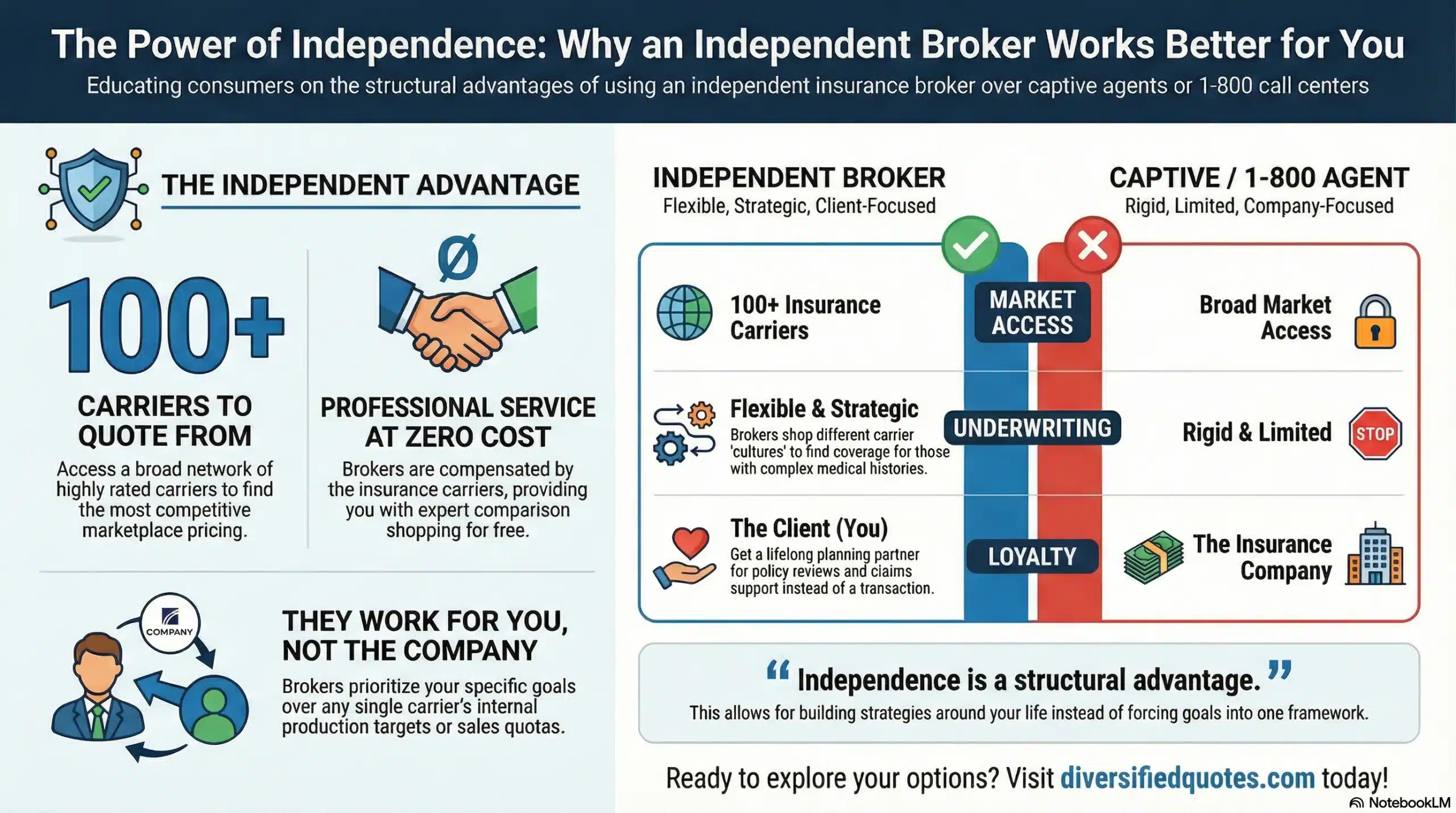
At Diversified Insurance Brokers, we are an independent life insurance brokers, fiduciary insurance agency licensed in all 50 states with access to more than 100 carriers. Our independence is the functional requirement for genuine rate comparison — we are not limited to a single company’s rate sheet, and we can pre-screen your profile across multiple carriers’ underwriting guidelines before any formal application creates a record in medical databases. Our resource on best life insurance rates and our guide on how to get the best life insurance rates provide the strategic context for approaching the rate-optimization process, and our life insurance calculator and term life insurance calculator give you real-time premium context across different coverage amounts and term lengths before you speak with anyone.
Life Insurance Rate Comparison Tool
Compare real-time rates from 100+ top-rated carriers. No pressure. No obligation.
Need help interpreting your results? Call 800-533-5969 or explore all life insurance options →
What Life Insurance Rates Are Actually Based On
Life insurance pricing is a mortality risk calculation. The insurer is estimating the probability that the policy will result in a death benefit claim during the coverage period, and it sets the premium high enough to cover expected claims across all policyholders in a similar risk pool while maintaining financial solvency. This actuarial foundation means that every factor influencing the probability of early mortality affects the premium — not arbitrarily, but proportionally to the statistical impact of that factor on expected mortality outcomes.
Age is the single most powerful pricing variable. Mortality probability increases with age, and the premium reflects this directly. A 35-year-old purchasing $500,000 of 20-year term coverage pays a small fraction of what a 55-year-old would pay for the same coverage at the same health classification — because the statistical probability of a claim during the 20-year term is dramatically higher at 55. This is why purchasing life insurance earlier in life is so financially efficient: locking in younger-age underwriting rates produces decades of below-market cost for the same coverage that would cost significantly more later. Our resource on whether life insurance is expensive provides current premium context across different ages, and our guide on how much life insurance costs covers the full pricing landscape across age ranges, health classes, and coverage amounts.
Health classification is the second most impactful variable. Most life insurance carriers use a tiered classification system — typically Preferred Plus (or Elite), Preferred, Standard Plus, Standard, and Substandard (table-rated) — with meaningful premium differences between each tier. The difference between Preferred Plus and Standard for a 40-year-old purchasing $1,000,000 of 20-year term life insurance can be $40 to $80 per month — a spread that compounds to $9,600 to $19,200 over the policy term. The underwriting class assigned depends on the full health profile presented — not just the presence or absence of diagnoses, but the degree of control, stability, treatment compliance, specialist involvement, and trend over time across every relevant health factor.
Tobacco and nicotine use creates a separate pricing tier at most carriers — tobacco rates versus non-tobacco rates — with tobacco rates typically running 2 to 3 times the non-tobacco premium for identical age and health classification. Many carriers include vaping and e-cigarettes in the tobacco classification even if the applicant has never smoked traditional cigarettes. Some carriers distinguish between occasional cigar use and regular tobacco use, which can matter for certain applicants. Timing also matters: most carriers require a defined nicotine-free period — typically 12 to 36 months depending on the carrier and classification target — before an applicant qualifies for non-tobacco rates. Our resource on life insurance for smokers covers the carrier landscape and the timing strategy for applicants planning to quit.
Coverage amount and term length both directly influence premium. Larger face amounts produce higher premiums proportionally. Longer terms produce higher premiums because the insurer is guaranteeing the rate for a longer period of potential mortality risk — a 30-year guarantee costs more than a 20-year guarantee for the same coverage amount at the same health class. Our term-specific resources — from 10-year term through 20-year term, 30-year term, and beyond — show current market pricing across different term lengths so the cost-versus-protection trade-off at each length is visible before selecting a term.
The Underwriting Class System — Where Rates Are Actually Set
The online quote you receive before applying is a projection based on an assumed health class — typically Preferred or Standard. That projection becomes the actual rate only if underwriting confirms you belong to that class. If your health profile places you in a higher (better) class, you pay less than quoted. If underwriting places you in a lower class or applies table ratings for specific health factors, you pay more. Understanding the underwriting class structure helps set realistic expectations and informs the timing and carrier selection strategy for your application.
Most major carriers’ term life underwriting class structures work as follows. Preferred Plus (sometimes called Elite or Super Preferred) is reserved for applicants with exceptional health metrics across all categories — ideal build range, optimal blood pressure and cholesterol without medication, no significant health history, no tobacco use, excellent family history, clean driving record. This class produces the lowest possible premiums and is genuinely achievable only by a minority of applicants. Preferred allows for modestly elevated but controlled health metrics — blood pressure that is well-controlled on one or two medications, mild elevated cholesterol on a statin, body weight slightly outside optimal range, family history with certain conditions. This is the most common “best practical class” for moderately healthy adults. Standard Plus and Standard accommodate applicants with more significant health history, including well-managed chronic conditions, slightly impaired metabolic markers, or health history that would prevent Preferred classification at most carriers. Substandard / Table ratings apply when specific health factors present enough mortality risk to warrant a premium surcharge above Standard — typically expressed as a Table 2 through Table 16 rating that adds a percentage of the Standard premium for each table step.
The critical insight is that health classification is not a simple binary healthy/unhealthy determination — it is a multi-factor assessment where the same health factor can produce different classifications at different carriers based on each carrier’s specific underwriting guidelines. Carrier A may classify treated hypertension with good control as Standard Plus. Carrier B may classify the same profile as Preferred. This carrier-to-carrier variation is the primary reason why independent brokerage access to multiple carriers produces better rate outcomes than single-carrier applications. Our resource on the best independent life insurance broker explains the structural advantage of independent brokerage in life insurance rate optimization. Understanding Table Ratings and Flat Extras is an essential aspect of how life insurance pricing is determined.
How the Same Health History Gets Rated Differently Across Carriers
| Health Factor | Conservative Carrier Outcome | Favorable Carrier Outcome | Impact of Carrier Selection |
|---|---|---|---|
| Controlled hypertension (1 medication) | Standard | Preferred | Often 20–35% premium difference |
| Elevated BMI (slightly outside preferred range) | Standard or Table 2 | Standard Plus or Standard | Carrier build charts vary; different cutoffs for each class |
| Well-managed Type 2 diabetes (diagnosed after 40) | Table 4–6 or decline | Table 2–4 with good A1C and control | Right carrier can mean approval vs. decline |
| Treated anxiety/depression/Bi Polar (stable, no hospitalization) | Standard or Table 2 | Standard Plus or Standard | Some carriers are significantly more favorable for mental health history |
| Sleep apnea (CPAP compliant, normal studies) | Standard | Standard Plus or Preferred | CPAP compliance documentation matters significantly |
| Elevated cholesterol (statin-controlled, good ratios) | Standard Plus or Standard | Preferred | Total cholesterol, HDL/LDL ratios, and response to treatment all matter |
The Medical Exam vs. No-Exam Decision
Many applicants want to avoid a life insurance medical exam — for convenience, privacy, or concern about what the exam might reveal. The no-exam life insurance market has grown significantly, offering meaningful coverage amounts through accelerated underwriting programs that use data sources (prescription databases, MIB records, driving records, electronic health records in some cases) to make underwriting decisions without a physical paramedical exam. Our resource on no-exam life insurance and our guide on no-exam life insurance for young adults cover the current market for exam-free coverage and the coverage amounts available without a physical exam.
The practical trade-off: no-exam policies at accelerated underwriting carriers can be issued quickly — sometimes within 24 to 48 hours — with competitive rates for healthy younger applicants. However, accelerated underwriting programs typically have coverage amount limits, may produce less favorable rate class outcomes than fully underwritten applications for applicants who would qualify for high health classes, and are not universally available for all health profiles. A 35-year-old in excellent health who wants $500,000 of 20-year term coverage may find that a fully underwritten application produces a Preferred Plus rate that is meaningfully lower than the no-exam rate for the same coverage. A 45-year-old with some health history who wants $250,000 may find no-exam coverage is more accessible and more appropriately priced relative to fully underwritten alternatives. Our resource on what a life insurance exam is explains what the paramedical exam involves, why some applicants benefit from taking it, and how the exam results affect underwriting outcomes.
Why Pre-Existing Conditions Don’t Automatically Mean Bad Rates
One of the most persistent misconceptions about life insurance is that any medical history results in dramatically higher rates or automatic declines. The reality is more nuanced and more favorable for most applicants with managed conditions. What underwriters evaluate is not the presence of a diagnosis but the degree of control, the stability of the condition, the compliance with recommended treatment, the specialist involvement where appropriate, and the absence of complications or secondary conditions that would compound the risk profile.
A 48-year-old with Type 2 diabetes diagnosed at age 43, A1C consistently around 6.5%, controlled with oral medication, no neuropathy or nephropathy, and regular endocrinology follow-up is in a meaningfully different underwriting position than a 48-year-old with Type 2 diabetes, A1C of 9.2%, insulin-dependent, with documented peripheral neuropathy. Same diagnosis, dramatically different risk profiles, dramatically different outcomes across the carrier market. Our resource on life insurance with pre-existing conditions and our guide on how to get life insurance with health issues cover the carrier-specific underwriting landscape for the most common medical history scenarios. Our resource on the best life insurance for pre-existing conditions provides current carrier comparisons for applicants with the most commonly evaluated health histories.
For applicants whose health profiles make traditional fully underwritten life insurance difficult or unavailable at acceptable rates, our resources on guaranteed issue life insurance under age 50 and affordable life insurance for seniors with health issues cover the simplified and guaranteed issue pathways that remain available regardless of health history.
Term Length Selection: Matching the Coverage Period to the Need
Term length selection is often underweighted in the rate conversation despite being one of the most consequential decisions in life insurance planning. The coverage period should align with the specific financial obligation or dependency that the insurance is designed to protect — not simply selected as “the longest affordable option” or “the most popular choice.” Overpaying for a 30-year term when a 20-year term would outlast the relevant financial exposure by a decade produces unnecessary premium cost. Underprotecting with a 10-year term when a mortgage will run for 25 years creates a coverage gap during the most financially consequential years.
Common term length logic: the coverage period should extend at least to the point when the financial dependency it protects is expected to be self-sufficient or no longer applicable. If the primary obligation is a 30-year mortgage, a 30-year term or a 25-year term starting now provides appropriate alignment. If the primary concern is income replacement during a dependent spouse’s income-earning years, the term should extend to the approximate retirement date or the last dependent child’s financial independence. If the coverage is for a specific business obligation — a buy-sell agreement, a key person policy, or a loan guarantee — the term should match the obligation’s expected duration.
Our full suite of term-specific resources — 10-year, 15-year, 20-year, 25-year, 30-year, 35-year, and 40-year term — show current market pricing at each term length so the cost trade-off between protection duration and premium level is visible before committing. For applicants who anticipate their protection needs changing over time, our resource on converting term to permanent life insurance explains how conversion provisions preserve the ability to extend protection without new medical underwriting.
How Much Life Insurance Do You Actually Need?
The amount of life insurance to purchase is the question that most directly determines how much you pay — because more coverage costs more, and the right amount is the one that genuinely replaces the financial impact of the insured’s premature death without overpaying for coverage that creates no marginal protection value. Our resource on how much life insurance you need provides the analytical framework for the needs calculation across different household structures and financial situations.
The common starting point — 7 to 10 times annual income — is a useful quick estimate but not a substitute for a structured needs analysis. A household with substantial liquid assets and minimal debt needs less insurance per dollar of income than a household with a large mortgage, student loans, two young children, and no significant savings. A household where one spouse earns significantly more than the other and the lower-earning spouse provides childcare and household management needs insurance on both spouses — not just the primary earner — because replacing the economic value of the non-earning spouse’s contributions has real cost. Our resources on group vs. individual life insurance and life insurance strategies the wealthy use provide the broader strategic context within which individual policy sizing sits.
Common Mistakes That Increase Premiums
Several avoidable mistakes consistently produce unnecessary premium increases or coverage complications in life insurance applications. Understanding them before applying prevents the most common adverse outcomes.
Applying immediately after a new diagnosis is one of the most consequential timing mistakes. Many carriers have waiting periods — sometimes one to two years — before they will underwrite an application at favorable terms following a new medical diagnosis. Applying within weeks of a new hypertension diagnosis, for example, may result in Standard or table-rated classification when the same application submitted 18 months later with documented stable control would produce Preferred classification. When timing is flexible, the optimal application point is when the health profile is most favorable and most documented — which is often not immediately after a diagnostic event.
Inconsistent nicotine disclosure creates underwriting problems that are difficult to resolve. The prescription database screening that all major carriers run as part of underwriting frequently reveals nicotine replacement products, smoking cessation prescriptions, and other nicotine-related items. Discrepancies between application disclosure and database findings are treated very seriously in underwriting. Complete and accurate nicotine disclosure — including the type, frequency, and timing of any nicotine product use — is essential for clean underwriting outcomes and for avoiding rescission risk after policy issuance.
Selecting the wrong carrier without pre-screening is the most common preventable rate error. Applying to a carrier without understanding its specific underwriting posture for your health profile produces a rate outcome that may be significantly less favorable than the best available market result. Pre-screening — the process of informally presenting a health profile to multiple carriers’ underwriting departments before submitting a formal application — identifies which carriers are most likely to produce the best class outcome for a specific combination of health factors. This is the most valuable service an experienced independent broker provides, and it cannot be replicated through any direct-to-consumer online quoting platform. Our resource on how to get life insurance covers the application and underwriting process from start to finish, and our second opinion life insurance quote review evaluates whether an existing offer represents the best available market result for your specific profile.
Related Life Insurance Pages
Rate comparison tools, underwriting guides, and coverage strategy resources from Diversified Insurance Brokers.
Compare Term Life Insurance Lengths
Explore different term periods to find coverage that best matches your timeline and budget.
Financial Protection Essentials
Life insurance strategy, underwriting resources, and coverage planning guides from Diversified Insurance Brokers.
Talk With an Advisor Today
Choose how you’d like to connect—call or message us, then book a time that works for you.
Schedule here:
calendly.com/jason-dibcompanies/diversified-quotes
Licensed in all 50 states • Fiduciary, family-owned since 1980
FAQs: Best Life Insurance Rates
What is the best way to get the lowest life insurance rate?
The most reliable path to the lowest rate combines four elements: applying while younger and healthy (age and health class are the two most powerful pricing variables), selecting the right term length that matches your actual protection need without overpaying for unnecessary coverage duration, working with an independent broker who can pre-screen your profile across multiple carriers before submitting a formal application, and timing the application strategically relative to any health history (not immediately after a new diagnosis, but after documented stability is established).
Online comparison tools provide useful starting estimates, but the rate you ultimately receive depends on the underwriting class assigned after full review of medical records, prescription databases, lab results, and other data sources. The difference between a Preferred Plus and Standard underwriting class can represent thousands of dollars in premium over the policy term — and which class you land in at which carrier depends significantly on how the case is presented and which carrier’s underwriting guidelines are most favorable for your specific combination of health factors. Our resource on how to get the best life insurance rates covers the strategic framework for the full rate optimization process.
Are online quotes for life insurance accurate?
Online quotes are accurate projections of what you would pay if your health profile matches the assumed underwriting class — typically Preferred or Standard. They are not final prices until underwriting reviews your complete health record. The online quote becomes the actual rate only if underwriting confirms you belong to the assumed class. If your health profile places you in a better class (Preferred Plus instead of Preferred), you pay less than quoted. If underwriting places you in a lower class or applies table ratings for specific health factors, you pay more.
For healthy applicants without significant health history, online quotes are reliable enough to frame realistic expectations before applying. For applicants with any meaningful health history — managed conditions, medications, family history concerns — the difference between the online estimate and the actual underwriting outcome can be significant. In those cases, working with an experienced broker who can pre-screen the health profile and identify which carriers are most likely to produce the best class outcome is more valuable than any online estimate. Our resource on how much life insurance costs provides current market pricing context across different health classes.
Is term life always cheaper than whole life?
Yes in most cases, because term and whole life serve fundamentally different purposes and are priced for different durations of risk. Term life insurance is priced for a defined period — the carrier is guaranteeing the rate for 10, 20, or 30 years and the coverage expires at the end of the term. Whole life insurance is priced to provide permanent lifetime coverage and includes a cash value accumulation component — the carrier is guaranteeing coverage indefinitely and must price for the certainty of eventually paying a death claim. That guarantee and permanence is reflected in meaningfully higher premiums.
For the vast majority of income replacement, mortgage protection, and family protection planning objectives, term life insurance is the most cost-efficient tool — it provides the highest death benefit for the lowest premium during the years when the protection is most needed. Whole life and universal life make sense for specific planning objectives: lifetime estate protection needs, permanent wealth transfer strategies, or business planning applications where the permanence of coverage is the functional requirement. Our resource on converting term to permanent life insurance explains how to preserve the option to convert to permanent coverage later without new medical underwriting, which can be a useful planning strategy for people who start with term and later need permanent coverage.
Does vaping affect life insurance rates?
Often yes — sometimes significantly. Most major life insurance carriers treat vaping and e-cigarettes as nicotine use, which can result in tobacco-class pricing regardless of whether the applicant has ever smoked traditional cigarettes. Tobacco-class premiums typically run 2 to 3 times the non-tobacco premium for identical age and health classification — a difference that can represent thousands of dollars over the life of a 20- or 30-year term policy.
The specific treatment of vaping varies by carrier. Some carriers classify any nicotine product use — including nicotine pouches, nicotine gum used occasionally, and vaping — as tobacco use regardless of frequency. Others distinguish between occasional non-cigarette nicotine use and regular tobacco smoking. Some carriers have specific policies on cotinine (a nicotine metabolite) testing thresholds that determine classification. Accurate and complete disclosure of any nicotine product use — type, frequency, and recency — is essential for clean underwriting outcomes. Discrepancies between application disclosure and laboratory or prescription database findings are treated very seriously in underwriting and can result in rescission after a policy is issued. Our resource on life insurance for smokers covers the carrier landscape and timing strategy for applicants planning to quit.
Can I still get good rates with a pre-existing condition?
Often yes — particularly when the condition is stable, well-managed, and documented with appropriate medical care. What underwriters evaluate is not simply the presence of a diagnosis but the degree of control, treatment compliance, specialist involvement, and absence of complications. A stable, well-controlled condition with good documentation frequently produces Standard or Standard Plus classification — sometimes even Preferred at carriers with favorable underwriting postures for that specific condition. An unstable, poorly controlled, or recently diagnosed condition of the same type may produce table ratings or in some cases declines.
Carrier selection is especially important for applicants with pre-existing conditions because the variation in underwriting guidelines across carriers is widest in this category. Carrier A may classify treated hypertension with good control as Standard. Carrier B may classify the same profile as Preferred. For a $1,000,000 policy, this classification difference can mean $30 to $60 per month — thousands of dollars over the policy term — for the same condition at the same stage of control. Our resources on life insurance with pre-existing conditions and the best life insurance for pre-existing conditions cover the carrier-specific underwriting landscape for the most commonly evaluated medical history scenarios.
How much life insurance do most families need?
The common starting point of 7 to 10 times annual income is a useful rough estimate but not a substitute for a structured needs analysis. The right amount depends on household debt obligations (mortgage balance, student loans, other significant debt), number and age of dependents, the expected cost of replacing the economic contributions of the insured (both earned income and non-monetary contributions like childcare and household management), existing liquid assets and savings, and any specific planning goals such as college funding or legacy objectives.
A household with two young children, a $400,000 mortgage, $100,000 in student loans, and $30,000 in liquid savings needs significantly more coverage per dollar of income than a household with no children, no debt, and $500,000 in liquid savings. Additionally, many households underestimate the need for coverage on a non-earning spouse whose contributions to the household — childcare, household management, family support — have real replacement costs even though they don’t generate W-2 income. Our resource on how much life insurance you need provides a structured needs calculation framework for different household structures and financial situations.
Will my rate go up after I buy a level term policy?
No — during the guaranteed level term period, your premium is fixed for the entire term you selected. This is the fundamental feature that makes level term life insurance so useful for planning: you lock in today’s rate and today’s health class for 10, 20, 30, or more years, regardless of any health changes that occur after the policy is issued. A 40-year-old who purchases a 30-year term at Preferred rates pays that Preferred rate at age 65 — even if they develop a chronic condition at age 50 that would result in a decline if they tried to apply new. The non-cancelable level term guarantee is one of life insurance’s most financially valuable features.
After the level term period ends, the dynamics change. Most term policies include a renewal provision that allows continuation of coverage past the initial term period — but at annually increasing rates based on attained age rather than the original level rate. These post-term renewal rates are typically very expensive and are designed for short-term continuation while permanent alternatives are arranged, not as long-term coverage solutions. Planning the term length to align with the actual duration of protection need — rather than relying on post-term renewal — is the correct design approach. Our resource on converting term to permanent life insurance covers the conversion option as an alternative to post-term renewal for applicants who need ongoing coverage after the initial term expires.
What health items raise premiums the most?
The factors that most significantly increase life insurance premiums fall into several categories. Nicotine use — any form of tobacco, vaping, or regular nicotine product use — is typically the single largest individual pricing factor, moving applicants into a tobacco rate tier that runs 2 to 3 times the non-tobacco premium. Uncontrolled chronic conditions — blood pressure, blood sugar, or cholesterol that are documented as poorly controlled or noncompliant with recommended treatment — produce table ratings that add meaningful premium surcharges. Cardiovascular history, including prior heart attacks, stent procedures, bypass surgery, and certain arrhythmias, significantly affects underwriting depending on the condition, the recency, and the degree of recovery and treatment. Cancer history, depending on the type, stage, treatment, and time since treatment, can produce table ratings or declines at many carriers. Elevated build — BMI significantly above the carrier’s preferred build charts — adds premium that scales with the degree of elevation. Adverse driving history — DUI convictions, multiple at-fault accidents, or reckless driving within recent years — also affects rate class at many carriers. Our resource on high-risk life insurance covers the carrier market for applicants whose health or lifestyle profiles fall outside standard underwriting ranges.
How fast can I get approved for life insurance?
Approval timelines vary from same-day to several weeks depending on the coverage amount, the carrier’s underwriting approach, and the applicant’s health history. Accelerated underwriting programs — available at many major carriers for qualifying applications up to defined coverage amount limits — can produce approved decisions within 24 to 72 hours using data sources (prescription databases, MIB, driving records, electronic health records) without requiring a paramedical exam. Our resource on no-exam life insurance covers the accelerated underwriting pathway for applicants who qualify.
For applications that trigger full underwriting — typically larger coverage amounts, applicants with health history, or any application where the carrier requires additional information — the timeline depends on how quickly medical records can be ordered and reviewed. Most carriers complete full underwriting within 3 to 6 weeks when records are ordered promptly and the applicant’s physicians respond efficiently. The application can sometimes be expedited by having recent physician visit notes, lab work, and specialist reports available before the application is submitted — which reduces the records ordering and review period. Our resource on what a life insurance exam is covers the paramedical exam process, typical timing, and what it involves when a physical exam is required.
Browse More Life Insurance Guides
About the Author:
Jason Stolz, CLTC, CRPC, DIA, CAA and Chief Underwriter at Diversified Insurance Brokers (NPN 20471358), is a senior insurance and retirement professional with more than 25 years of real-world experience helping individuals, families, and business owners protect their income, assets, and long-term financial stability. As a long-time partner of the nationally licensed independent agency Diversified Insurance Brokers, Jason provides trusted guidance across multiple specialties—including fixed and indexed annuities, long-term care planning, personal and business disability insurance, life insurance solutions, Group Health, Travel Medical and Evacuation Insurance, and short-term health coverage. Diversified Insurance Brokers maintains active contracts with over 100 highly rated insurance carriers, ensuring clients have access to a broad and competitive marketplace.
His practical, education-first approach has earned recognition in publications such as VoyageATL, and contributions from his agency featured in Kiplinger and GoBankingRates— highlighting his commitment to financial clarity and client-focused planning. Drawing on deep product knowledge and years of hands-on field experience, Jason helps clients evaluate carriers, compare strategies, and build retirement and protection plans that are both secure and cost-efficient. Visitors who want to explore current annuity rates and compare options across multiple insurers can also use this annuity quote and comparison tool.
Browse All Insurance & Annuity Resources: Return to our complete Insurance & Annuity FAQs hub — annuity products, supplemental insurance, life insurance, health, dental, vision & wealth strategies.
Browse More Resources: Return to our complete Life Insurance Special Topics guide — covering permanent life, estate planning, key person, IUL, infinite banking & special needs.
Last Reviewed: July 8, 2026 |
Reviewed by: Jason Stolz, CLTC, CRPC, DIA, CAA
Chief Underwriter, Diversified Insurance Brokers, Inc. | NPN: 20471358 | Diversified Insurance Brokers, Inc. — Licensed in all 50 states
Fact Checked by: Tonia Pettitt, CMIP©
Medicare Specialist, Diversified Insurance Brokers, Inc. | NPN: 14374308 | Diversified Insurance Brokers, Inc. — Licensed in all 50 states
Did you find this content helpful? Leave us a Google review — it helps others find trustworthy guidance too.
Editorial Standards: Diversified Insurance Brokers maintains rigorous editorial standards to ensure accuracy, clarity, and independence in all content. Learn more about our editorial standards and commitment to transparency.
