
Affordable Life Insurance for Seniors with Health Issues
As an Independent Life Insurance Broker, we compare rates across 100+ carriers and prescreen every application before submission.
Affordable Life Insurance for Seniors with Health Issues

Jason Stolz CLTC, CRPC, DIA, CAA
Affordable life insurance for seniors with health issues is available in forms that are broader and more accessible than most seniors expect — but only when the application process starts with the right question. That question is not “which carrier is cheapest?” It is “which underwriting lane am I actually eligible for, and which carrier within that lane values my specific health profile most favorably?” The answer determines not just the price but whether coverage is available at all, how quickly it can begin, what the death benefit structure looks like in the early years, and whether the policy provides the kind of protection the senior and their family actually need. Seniors with health conditions who approach life insurance with the wrong strategy — applying blindly to carriers whose underwriting guidelines are unfavorable for their specific condition — experience declines, higher premiums from table ratings, and frustration that leads many to believe coverage simply isn’t available. In most cases, it is. The obstacle is application strategy, not medical reality.
The coverage options for seniors with health issues span a wider range than the final expense market alone. Depending on age, health severity, and coverage goals, some seniors with managed health conditions can still qualify for term life insurance or permanent life insurance through standard or impaired risk underwriting — with larger face amounts that address income replacement, mortgage protection, or legacy planning objectives beyond final expenses. Others will find that simplified issue final expense insurance or guaranteed issue burial insurance is the most realistic and cost-effective path. Understanding where each senior sits on this spectrum before applying — and working with an independent broker who knows the carrier landscape for impaired risk underwriting — is what produces the best outcome. At Diversified Insurance Brokers, Jason Stolz, CLTC, CRPC, DIA, CAA helps seniors with health histories evaluate the full range of options, identify which underwriting lane is realistic for their specific condition profile, and match their application to the carriers most likely to produce the best approval at the most competitive premium. Our resource on high risk life insurance covers the full impaired risk underwriting landscape, and our resource on life insurance with pre-existing conditions covers the specific underwriting considerations for common health conditions affecting senior applicants.
Compare Life Insurance Options for Seniors With Health Issues
Life Insurance Quoter
Get Your Personalized Senior Life Insurance Quote
We identify which underwriting lane fits your health profile, match your application to the most favorable carriers, and help you secure the most coverage at the most competitive premium available for your situation.
Request a QuoteThe Three Underwriting Lanes for Seniors With Health Issues
Affordable life insurance for seniors with health issues is organized around three distinct underwriting approaches, each suited to a different range of health complexity. The first lane is fully underwritten life insurance — term life, whole life, universal life, or guaranteed universal life — with traditional underwriting that evaluates complete health history, may require a paramedical exam, reviews medical records, and assigns the applicant to a health classification (preferred plus, preferred, standard, or a table-rated class). This lane offers the largest face amounts and the widest product range, but health conditions can result in rated premiums that are meaningfully higher than standard pricing. Seniors with managed, stable conditions who have not experienced recent hospitalizations or acute events may still qualify for this lane — often at rated premiums — and the larger face amounts available here can address coverage needs that the final expense market cannot.
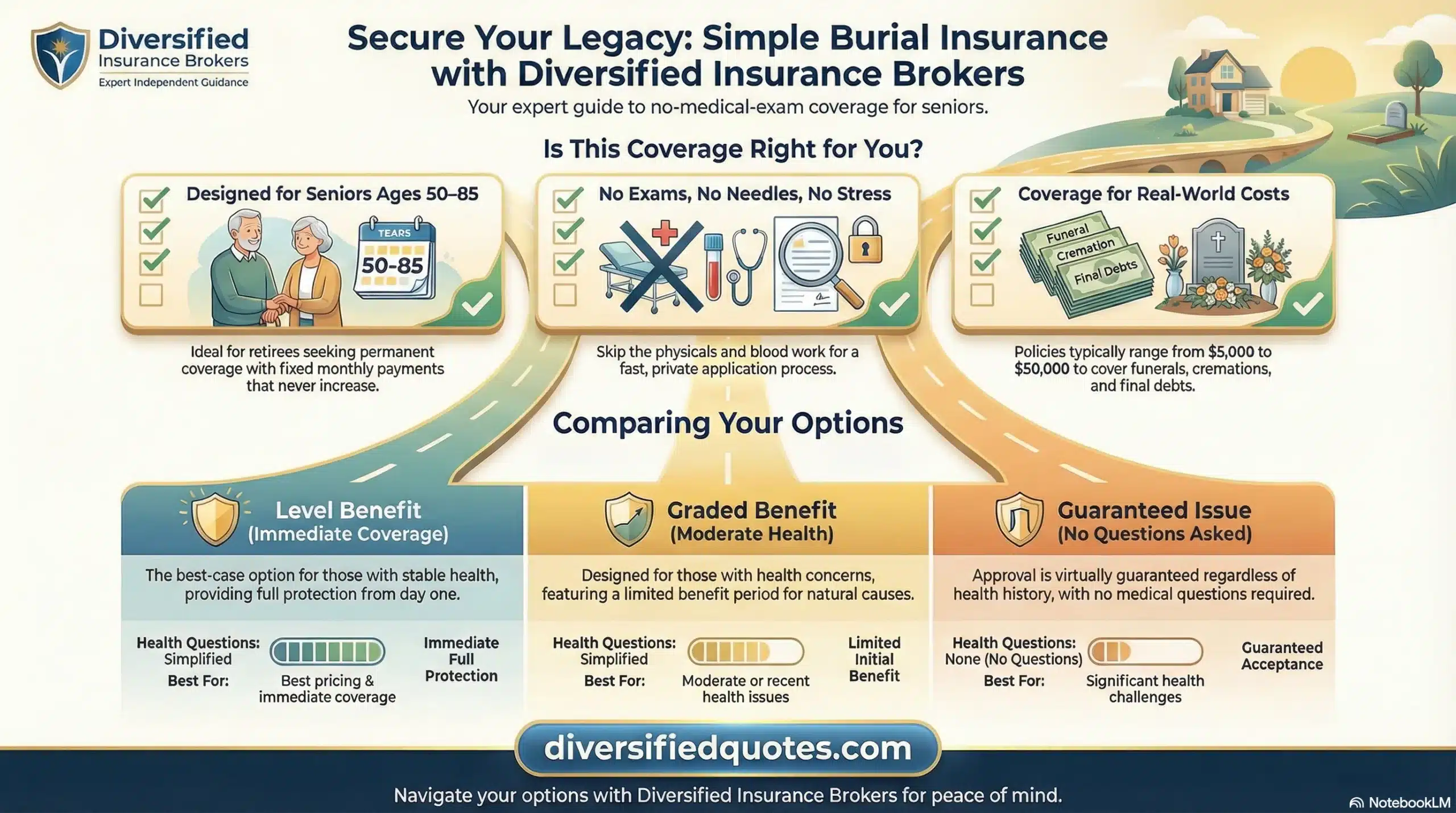
The second lane is simplified issue life insurance — including final expense and burial insurance products — that eliminates the paramedical exam but asks a defined set of health questions and conducts electronic verification against prescription and MIB databases. This lane offers smaller face amounts (typically $5,000-$50,000), faster approvals, and pricing that reflects a moderate health screening rather than the full underwriting review of the first lane. For seniors with common managed conditions who want coverage for final expenses, income bridge, or a modest death benefit without the complexity of traditional underwriting, this lane provides the most cost-effective outcome for qualifying applicants.
The third lane is guaranteed issue life insurance — which eliminates both the paramedical exam and the health questionnaire, providing automatic approval for all applicants within the eligible age range. This lane carries the highest premium per dollar of coverage and typically includes a graded benefit period for natural causes of death in the first two years. It is the appropriate choice when the second lane is not accessible due to health conditions that fail simplified issue screening — but it should be used only when the second lane has been genuinely evaluated and found inaccessible, not assumed as the default. Our resource on final expense life insurance vs. term life insurance covers the product-level comparison between the most common options in the second lane and traditional term life available in the first lane.
How Common Senior Health Conditions Affect Life Insurance Options
| Health Condition | Fully Underwritten (Term/Perm) Eligibility |
Simplified Issue Final Expense Eligibility |
Key Factors That Affect Outcome |
|---|---|---|---|
| Controlled High Blood Pressure | Often available — standard or slightly rated | Typically qualifies for level benefit | Current readings, medication compliance, no kidney or cardiac complications |
| Type 2 Diabetes (Oral Medication) | Possible — rated; depends on A1C and complications | Often qualifies for level benefit at many carriers | A1C control, no neuropathy/retinopathy/kidney disease, oral vs. insulin management |
| Insulin-Dependent Diabetes | Difficult — significant table rating or decline at many carriers | Some simplified issue carriers accept; others decline — carrier matching critical | Presence of complications, hospitalization history, A1C level, years since diagnosis |
| Past Heart Attack (Beyond 2 Years) | Possible at rated premiums with some carriers — depends on EF and treatment | Many simplified issue carriers accept beyond the lookback period | Ejection fraction, stent vs. bypass, time since event, current cardiac status |
| COPD / Emphysema | Difficult at many carriers — table rated or decline depending on severity | Some carriers accept without supplemental oxygen; oxygen use typically leads to guaranteed issue | Supplemental oxygen use, recent hospitalization, FEV1 results if available |
| Cancer (In Remission 2+ Years) | Possible depending on cancer type, stage, and remission period | Many simplified issue carriers accept remission beyond defined lookback — cancer type matters | Cancer type (localized vs. metastatic), lookback period from remission, current treatment status |
| Stroke (Beyond 2 Years) | Limited availability — most fully underwritten carriers significantly rate or decline | Some simplified issue carriers accept beyond the lookback with no functional impairment | Residual neurological deficits, time since event, TIA vs. full stroke, current medication |
| Active or Recent Cancer (Within 2 Years) | Generally not available — most carriers decline active treatment | Most simplified issue carriers decline — guaranteed issue appropriate | Guaranteed issue burial insurance is typically the only available path during active treatment |
Underwriting eligibility varies significantly by carrier. The above reflects general market patterns — specific carrier guidelines differ and a condition that declines at one carrier may qualify at another. Working with an independent broker who knows carrier-specific underwriting guidelines before applying is the most reliable way to identify the best available option for a specific health profile.
The table illustrates the central reality of affordable life insurance for seniors with health issues: the specific condition matters less than the specific factors within that condition — recency, severity, management quality, presence of complications, and current treatment status. Two seniors with a “history of heart attack” can be in entirely different underwriting positions depending on when the event occurred, what the current cardiac function assessment shows, and which carriers have guidelines that view that history favorably. Our resource on life insurance after a heart attack covers the cardiac underwriting landscape in detail, and our resource on life insurance for cancer survivors covers the remission timing and cancer type factors that most affect eligibility across carrier guidelines.
What Carriers Actually Evaluate — Beyond the Diagnosis Name
One of the most important insights for seniors seeking affordable life insurance with health issues is that carriers evaluate conditions by their management status and stability — not simply by their names. A diagnosis that sounds serious in a general conversation may be entirely manageable in an underwriting context when the specific details reveal well-controlled parameters, no complications, and stable medication management. The opposite is also true: a condition that sounds minor may create significant underwriting concerns when the specific details reveal poor control, recent hospitalizations, or progressive complications.
For diabetes, the relevant underwriting factors are not simply “diabetes” but the type (type 2 oral medication vs. type 1 or insulin-dependent type 2), the A1C level reflecting long-term glucose control, the presence or absence of diabetic complications (neuropathy, retinopathy, nephropathy, peripheral vascular disease), and recent hospitalization history. A senior with well-controlled type 2 diabetes on oral medication with a normal A1C and no complications is in a dramatically better underwriting position than a senior with the same diagnosis who uses insulin, has peripheral neuropathy, and was hospitalized for a diabetic event within the past 12 months — even though both might describe their situation as simply “I have diabetes.” Our resource on life insurance for diabetics with complications covers the specific underwriting variables that determine outcome for diabetic applicants across different carrier guidelines.
For cardiovascular conditions, the relevant factors include the nature of the cardiac event (heart attack, stents, bypass, arrhythmia, heart failure), the time elapsed since the event, the current ejection fraction if measured, the current medication regimen, and recent cardiac testing results. Carriers who are favorable for post-cardiac life insurance applications evaluate these factors against their actuarial models and may offer coverage at rated premiums for applicants with stable cardiac history beyond a defined lookback window. Our resource on life insurance for heart disease covers the specific underwriting variables for cardiac conditions, and our resource on life insurance with living benefits for chronic or critical illness covers how policies that also provide living benefits interact with the health conditions that most commonly affect senior applicants.
Table Ratings and Flat Extras — Impaired Risk Underwriting for Seniors
When a senior with health issues qualifies for fully underwritten life insurance but does not qualify at the best health classifications, the carrier typically assigns a table rating or flat extra — specific mechanisms for adjusting the premium upward to reflect the additional mortality risk associated with the health condition, while still providing coverage. Understanding how these rating mechanisms work helps seniors evaluate whether the rated premium is reasonable for the coverage being provided.
Table ratings are expressed as multiples of the standard premium or as letter/number grades. A “table 2” or “table B” rating typically adds 50% to the standard rate. A “table 4” or “table D” rating adds 100% (doubling the standard rate). Table ratings can go higher for more significant impairment — though applicants rated above “table 8” are often better served by simplified issue or guaranteed issue products from a cost perspective. Flat extras are fixed dollar amounts added per $1,000 of death benefit per year — common for hazardous conditions or time-limited health concerns that are expected to resolve or normalize over time. Both rating mechanisms allow carriers to approve applicants who would otherwise be declined, at a premium that reflects their assessed risk level.
For seniors where the primary goal is final expense coverage at affordable premiums rather than large-face income replacement coverage, the table-rated fully underwritten path is often not the most cost-effective choice. A simplified issue final expense policy frequently provides better value — lower premium per dollar of coverage, faster approval, and no paramedical exam — even for applicants who might technically qualify for rated fully underwritten policies. The question is always: what is the goal the coverage is meant to accomplish, and which underwriting lane achieves that goal most efficiently? Our resource on life insurance for anemia illustrates how a specific condition that might concern applicants is evaluated in the underwriting context, and our resource on life insurance with no medical questions asked covers the fully no-exam options available when traditional or simplified issue underwriting creates barriers.
Burial and Final Expense Insurance for Seniors With Health Issues
For many seniors with health issues whose primary coverage goal is protecting their family from final expense costs rather than large-scale income replacement, final expense and burial insurance provide the most practical combination of accessibility, affordability, and meaningful protection. The smaller face amounts — typically $5,000 to $25,000 — keep premiums manageable even at the senior age bands where life insurance pricing is highest, and the simplified or guaranteed issue underwriting eliminates the paramedical exam and most of the health documentation requirements that make traditional underwriting challenging.
The burial insurance pricing tool below allows seniors to compare premiums across multiple final expense plan structures based on age and state — providing a real-cost starting point for evaluating how a modest death benefit fits within a monthly budget:
The burial insurance comparison through our service covers level benefit policies — which provide immediate full coverage for qualifying applicants without a graded waiting period — as well as graded benefit options for applicants with more complex health histories. Our resource on burial insurance services covers the full final expense product landscape, and our resource on burial insurance for seniors covers age-specific final expense planning for the senior demographic. Our resource on burial insurance for seniors over 50 covers the earliest age band where final expense planning is most common.
Why a Prior Decline Doesn’t Eliminate Coverage Options
A prior life insurance decline is one of the most discouraging experiences a senior can have — but it does not mean that affordable life insurance for seniors with health issues is no longer available. What it means is that the specific carrier that declined the application did not find the applicant’s risk profile within their underwriting guidelines at the applied amount. A different carrier with different guidelines, a different product type, or a different face amount may produce an approval for the same applicant.
The important procedural consideration after a decline is the MIB (Medical Information Bureau) record created by the application. Subsequent simplified issue applications at other carriers will see this record — which creates the imperative to work with a broker who understands the carrier landscape before submitting additional applications, rather than continuing to submit applications blindly and accumulating a record of declines that compounds the underwriting challenge with each subsequent carrier. Our resource on what to do if nobody will insure you for life insurance covers the recovery path after a decline in detail — including how to evaluate which options remain, how guaranteed issue burial insurance provides an unconditional backstop, and how to approach future applications most strategically. Our resource on life insurance for construction workers provides an illustration of how occupation-related risk (separate from health risk) interacts with underwriting, showing how specific risk factors are evaluated in the broader impaired risk context.
Comparing Senior Life Insurance Options — Healthy vs. Health-Impaired
| Factor | Healthy Senior Applicant | Senior With Managed Health Issues |
|---|---|---|
| Available Policy Types | Term, whole life, UL, GUL, burial, final expense | Burial/final expense primary; some term or permanent at rated premiums |
| Available Face Amounts | Unlimited — multiples of income for income replacement | $5,000–$50,000 for final expense; larger amounts possible if fully underwritten path is accessible |
| Underwriting Approach | Full underwriting for best pricing; simplified issue also available | Simplified issue most common; guaranteed issue as backstop; full underwriting at rated premiums in some cases |
| Premium Level | Lowest available for age and gender | Higher than healthy rates — right carrier and lane selection determines how much higher |
| Approval Speed | Same day to a few weeks depending on product | Days for simplified/guaranteed issue; longer for fully underwritten with medical records |
| Immediate Full Coverage? | Yes — level benefit from day one in most approved policies | Level benefit if simplified issue qualifies; graded benefit if guaranteed issue required |
Application Strategy That Protects Approval Odds
The most effective application strategy for affordable life insurance for seniors with health issues begins with health profile assessment before any application is submitted. This means working through the relevant health history — diagnoses, medications, recent hospitalizations, testing results, and treatment timelines — against the underwriting guidelines of potential carriers before the first application is filed. The goal is to identify the carrier most likely to produce the best approval at the best premium for the specific health profile being presented, and to submit a complete, accurate, and well-organized application to that carrier first.
Complete and accurate health disclosure is the most important single factor in application quality. The instinct to minimize health disclosures to improve approval odds creates the worst possible outcome: a material misrepresentation that could result in claim denial when the family files a death benefit claim — the exact moment the coverage exists to protect. Carriers can and do investigate death claims, review medical records, and contest claims where misrepresentation is found in the first two years of a policy. Accurate disclosure, even when it results in a higher premium or a graded benefit structure, produces the reliable outcome the family is counting on. Our resource on how to buy instant decision life insurance covers the application pathways that produce the fastest approval decisions for seniors who qualify, and our resource on life insurance rates covers the rate environment and health class pricing context for senior applicants across the product spectrum. Our resource on is life insurance death benefit taxable covers the tax treatment of the death benefit that surviving family members receive.
Compare Senior Coverage Options
We identify which underwriting lane fits your health profile, match your application to the carriers most favorable for your specific conditions, and help you secure the most coverage at the most competitive premium available — no matter how complex your health history is.
Request a QuoteRelated Pages
Compare senior-friendly life insurance options, understand underwriting with health conditions, and estimate burial coverage costs.
Financial Protection Essentials
High-risk life insurance planning, disability income protection with COLA, and financial institution reviews.
Talk With an Advisor Today
Choose how you’d like to connect—call or message us, then book a time that works for you.
Schedule here:
calendly.com/jason-dibcompanies/diversified-quotes
Licensed in all 50 states • Fiduciary, family-owned since 1980
Frequently Asked Questions: Affordable Life Insurance for Seniors With Health Issues
Can seniors with health issues still qualify for life insurance?
Yes — in most cases, affordable life insurance for seniors with health issues is available through one of the three underwriting lanes: fully underwritten coverage at rated premiums for seniors with managed conditions that clear the underwriting bar, simplified issue final expense or burial insurance for seniors with common managed health conditions, or guaranteed issue life insurance for seniors with more serious health histories that prevent qualification through the other paths. The right lane depends on the specific condition, its management status, and the coverage goal. Working with an independent broker who evaluates which lane is appropriate before applying produces the best outcome — both in terms of approval probability and premium competitiveness. Our resource on guaranteed issue burial insurance covers the unconditional approval path for seniors who cannot qualify for other underwriting lanes.
What is the difference between simplified issue and guaranteed issue life insurance?
Simplified issue policies ask a short set of yes/no health questions and conduct electronic verification against prescription history and prior application databases — no paramedical exam required. Applicants who answer the health questions favorably receive approval and typically qualify for level benefit coverage with full death benefit from day one. Guaranteed issue policies have no health questions and no verification — all applicants within the eligible age range are automatically approved. The trade-off is that guaranteed issue costs more per dollar of coverage and typically includes a graded benefit period for natural causes during the first two years. Simplified issue is the better outcome when health allows it; guaranteed issue is the appropriate backstop when simplified issue is not accessible. Our resource on burial insurance with no waiting period covers the level benefit simplified issue options that provide immediate full coverage.
Will my policy pay the full death benefit immediately?
It depends on the policy type and underwriting path. Simplified issue policies with level benefit structures provide full death benefit coverage from the policy effective date — there is no graded waiting period. Guaranteed issue policies typically include a graded benefit period of two years during which natural-cause deaths receive a return of premiums plus interest rather than the full face amount; after the graded period expires, full benefits apply to all causes of death. Fully underwritten policies at table-rated premiums typically provide full coverage from day one. Understanding the benefit structure before applying — particularly whether the policy is level or graded — is one of the most important parts of the coverage selection decision.
How much life insurance do seniors typically buy for final expenses?
Most seniors focused on final expense coverage select between $10,000 and $25,000 — enough to cover realistic funeral and end-of-life costs without creating premium obligations that strain a monthly budget. The right amount depends on the specific final expense the coverage is meant to address: direct cremation with a simple memorial, traditional burial service, or a service with travel and gathering costs. Right-sizing the face amount to the actual expected cost keeps premiums manageable and sustainable for the life of the policy. Our resource on how much burial insurance do I need at 65 covers the coverage needs analysis process with specific age context.
If I was declined before, can I still get coverage?
Yes. A prior decline from one carrier does not eliminate coverage options — it reflects that specific carrier’s assessment under their specific guidelines. Different carriers have different underwriting approaches to the same conditions, and the carrier that declined an application may not represent the market’s consensus. Additionally, guaranteed issue burial insurance provides an unconditional approval path for all eligible applicants regardless of health history or prior declines. The important strategic consideration after a decline is not to continue submitting applications blindly to additional carriers — each application creates an MIB record that subsequent carriers can see. Working with a broker who can identify the most appropriate carrier for the specific condition profile before any new application is submitted is the most productive next step. Our resource on what to do if nobody will insure you for life insurance covers the specific recovery path after a decline.
Does taking multiple medications automatically increase my life insurance price?
Not automatically. Underwriting evaluates medications as evidence of what conditions are being treated — the conditions themselves, their control status, and their implications for mortality risk are what affect the premium, not the number of medications per se. A senior on five well-managed medications for controlled conditions may underwrite more favorably than a senior on two medications for poorly controlled or high-risk conditions. What matters is the stability, control quality, and complication status of the underlying conditions the medications address. For simplified issue applications specifically, the health questionnaire focuses on defined conditions and recent events rather than medication counts. Our resource on life insurance rates covers the rate environment and health class pricing context that determines the premium impact of specific health profiles.
How fast can senior life insurance coverage start?
Simplified issue and guaranteed issue life insurance applications for seniors can be completed and approved very quickly — often the same day or within a few days of submission. Many carriers design their final expense and simplified issue products for fast electronic decisions, recognizing that senior applicants are often at ages where coverage urgency is real. Coverage begins according to the carrier’s effective date rules — typically when the first premium payment is successfully processed. For fully underwritten life insurance at larger face amounts, the timeline is longer because medical records and paramedical exam results must be gathered and reviewed. Our resource on how to buy instant decision life insurance covers the carriers and products that specialize in the fastest possible approval timelines for qualifying applicants.
About the Author:
Jason Stolz, CLTC, CRPC, DIA, CAA and Chief Underwriter at Diversified Insurance Brokers (NPN 20471358), is a senior insurance and retirement professional with more than 25 years of real-world experience helping individuals, families, and business owners protect their income, assets, and long-term financial stability. As a long-time partner of the nationally licensed independent agency Diversified Insurance Brokers, Jason provides trusted guidance across multiple specialties—including fixed and indexed annuities, long-term care planning, personal and business disability insurance, life insurance solutions, Group Health, Travel Medical and Evacuation Insurance, and short-term health coverage. Diversified Insurance Brokers maintains active contracts with over 100 highly rated insurance carriers, ensuring clients have access to a broad and competitive marketplace.
His practical, education-first approach has earned recognition in publications such as VoyageATL, and contributions from his agency featured in Kiplinger and GoBankingRates— highlighting his commitment to financial clarity and client-focused planning. Drawing on deep product knowledge and years of hands-on field experience, Jason helps clients evaluate carriers, compare strategies, and build retirement and protection plans that are both secure and cost-efficient. Visitors who want to explore current annuity rates and compare options across multiple insurers can also use this annuity quote and comparison tool.
Explore More Life Insurance Options: Browse our complete guide to Guaranteed Issue, No Exam & High-Risk Education — covering guaranteed issue policies, no-exam coverage, and table ratings from 100+ carriers.
Last Reviewed: October 7, 2026 |
Reviewed by: Jason Stolz, CLTC, CRPC, DIA, CAA
Chief Underwriter, Diversified Insurance Brokers, Inc. | NPN: 20471358 | Diversified Insurance Brokers, Inc. — Licensed in all 50 states
Fact Checked by: Tonia Pettitt, CMIP©
Medicare Specialist, Diversified Insurance Brokers, Inc. | NPN: 14374308 | Diversified Insurance Brokers, Inc. — Licensed in all 50 states
Did you find this content helpful? Leave us a Google review — it helps others find trustworthy guidance too.
Editorial Standards: Diversified Insurance Brokers maintains rigorous editorial standards to ensure accuracy, clarity, and independence in all content. Learn more about our editorial standards and commitment to transparency.
