
Disability Income Insurance with COLA
As an Independent Disability Insurance Broker, we have access to exclusive discounts and negotiated pricing most captive agents can’t offer — see the full breakdown near the end of this page.
Disability Income Insurance with COLA

Jason Stolz CLTC, CRPC, DIA, CAA
Disability income insurance with a Cost of Living Adjustment (COLA) rider is designed to protect your paycheck not only at the start of a disability, but throughout a long-term claim. A standard disability policy replaces a portion of your income when you cannot work. The COLA rider is the feature that helps that benefit stay meaningful years later by increasing payments while you remain disabled — so inflation does not quietly shrink your purchasing power at exactly the time when you need stable income most. At Diversified Insurance Brokers, we help professionals, business owners, and high-income earners structure disability coverage with the right combination of benefit period, elimination period, residual benefits, and optional riders like COLA. The practical goal is straightforward: if you are disabled for a long time, you should not be living on a benefit that was priced for “today” while your actual expenses rise year after year. The full income protection insurance framework covers how individual DI policies are built, and disability insurance riders explained covers how the COLA rider fits alongside the other optional features that determine real-world policy performance.
Compare Disability Insurance with COLA
See how COLA riders work, what they typically cost, and which carriers offer strong long-claim inflation protection.
Request a Disability Insurance QuoteWhat Is COLA in Disability Income Insurance?
A Cost of Living Adjustment rider is a policy feature that can increase your monthly disability benefit while you are on claim. The critical timing distinction: COLA generally activates after the first full 12 months of continuous disability and applies annually from that point forward as long as the claim continues. It is not a raise while you are working. It does not increase the base benefit before a claim begins. It is protection against inflation after disability starts, when you can no longer control income growth through promotions, new clients, overtime, or business expansion.
That distinction matters because long-term disability is often a financial “life pause.” Even if expenses stay stable in nominal terms, the cost of essentials typically rises over time. Without COLA, your benefit can become less effective every year you remain on claim. With COLA, the benefit has a built-in mechanism to keep up — partially or materially — depending on how the rider is structured. For professionals with to-age-65 benefit periods who experience a disability in their 30s or 40s, a claim could potentially span 20-30 years. COLA is the feature that determines whether a benefit sized appropriately today remains meaningful two decades from now. The value of a COLA rider is directly proportional to the expected duration of the claim — short claims of one to three years receive minimal benefit from compounding; claims lasting five or more years are where COLA produces meaningful protection.
COLA Structure Options — How They Compare
| COLA Structure | How Increases Are Calculated | Premium Impact | Best Fit |
|---|---|---|---|
| 3% Compound (most common) | Benefit increases by exactly 3% of the prior year’s benefit each year on claim; compounding means each year’s increase is applied to the already-increased benefit — not the original | Typically adds 10-20% to the base premium; the most common and cost-efficient long-term inflation protection option | Most buyers with a to-age-65 benefit period; younger professionals (30s-40s) with long potential claim horizons; those who want predictable, consistent benefit growth |
| 6% Maximum Compound | Baseline of 3% per year; can increase up to 6% annually if the CPI-U inflation index exceeds 3%; provides a higher inflation ceiling than the fixed 3% option | Higher premium than 3% compound; the most protective against high-inflation periods but adds meaningful cost | Higher earners with large monthly benefits where inflation erosion is especially costly; those who believe long-term inflation may run above 3%; those willing to pay for maximum purchasing power protection |
| CPI-Linked | Annual increase tied to the Consumer Price Index for Urban Consumers (CPI-U); typically capped at 6-8% and floored at zero (no benefit decrease in deflationary periods); tracks actual inflation rather than a fixed assumption | Variable premium depending on carrier; less predictable than fixed-rate options; may produce smaller increases than 3% compound during low-inflation periods | Those who prefer benefit increases that reflect actual economic conditions rather than a fixed assumption; those comfortable with the variability of CPI-linked growth versus fixed rates |
| Simple Interest COLA | Annual increase calculated on the original benefit amount only — not the previously increased amount; grows linearly rather than exponentially; produces meaningfully lower long-term benefit than compound | Lower premium than compound options; the cheapest inflation protection but delivers less purchasing power protection over long claims | Budget-constrained buyers who want some inflation protection without the full cost of compound; shorter expected claim horizons; those closer to retirement where the compound/simple difference is less significant |
| 4-Year Delayed COLA | Same structure as 3% compound but increases do not begin until the 4th anniversary of the disability date; years 1-3 of a claim receive no COLA increase; years 4+ receive compound increases from the original benefit base | Meaningfully lower premium than standard 3% compound; the 4-year delay is the source of the savings since most shorter claims never reach the COLA period | Buyers for whom the 3% compound premium is difficult to justify; those who want protection against very long claims (5+ years) while reducing the rider cost; a practical compromise between budget and long-term inflation protection |
Why Inflation Is a Disability Risk You Do Not See Coming
Most people think of disability planning as a “monthly benefit” problem. They focus on whether the initial benefit is large enough. That matters — but it is only half the story. The real risk in long-term disability planning is the duration: a disability that lasts years, not months. When that happens, inflation becomes its own category of financial pressure because your benefit is replacing income across a long stretch of time. Housing costs, insurance premiums, utilities, transportation, and healthcare expenses rarely remain flat. Even in a household that manages spending carefully, the baseline cost of living tends to rise. In a long disability, new expenses may also appear that did not exist at the claim’s start — ongoing therapy, prescription costs, mobility support, home modifications, or additional household help. The combination of rising costs and a flat benefit is exactly why the COLA rider can make such a meaningful difference in long-term financial outcomes. The case for long-term disability insurance rests on protecting against claims that last years — and COLA is the feature that ensures the protection remains adequate across those years rather than just at the start. A detailed look at is disability insurance worth it covers this long-term value calculation more broadly.
How the Math Works — Benefit Growth Over a Long Claim
The power of compound COLA is most visible when the math is modeled over the realistic duration of a long-term claim. The table below shows how a $5,000 monthly benefit grows at 3% compound COLA over the course of a claim lasting up to 20 years — the kind of duration a disability beginning in the mid-30s could realistically produce under a to-age-65 benefit period. The difference between the compounded benefit in year 20 and the flat benefit that would exist without COLA represents more than $4,000 in additional monthly purchasing power — a meaningful gap between financial stability and gradual erosion.
| Year of Disability | Monthly Benefit Without COLA | Monthly Benefit With 3% Compound COLA | Annual Income With COLA |
|---|---|---|---|
| Start of Claim | $5,000 | $5,000 | $60,000 |
| Year 2 | $5,000 | $5,150 | $61,800 |
| Year 5 | $5,000 | $5,796 | $69,552 |
| Year 10 | $5,000 | $6,720 | $80,640 |
| Year 15 | $5,000 | $7,785 | $93,420 |
| Year 20 | $5,000 | $9,031 | $108,372 |
Example assumes a $5,000 monthly disability benefit with a 3% compounded COLA rider activating after the first year of claim. Actual policy designs, rider structures, and benefit calculations vary by carrier and contract terms.
Who Benefits Most from Disability Insurance with COLA
COLA riders provide the most value when the odds of a long claim are meaningful and the inflation time horizon is long. That is why younger professionals benefit most. Someone who becomes disabled at 30 or 35 with a to-age-65 benefit period faces a potential claim duration of 30-35 years — long enough for even a moderate inflation rate to significantly reduce the purchasing power of a flat benefit. COLA is essentially a hedge against losing income growth capacity at the same time that everyday costs keep rising. The case for COLA protection specifically in early-career planning is made plainly at why you need disability insurance even if you are young and healthy — the COLA argument is simply an extension of the same long-horizon thinking. Disability insurance for new professionals and disability insurance for medical residency cover how early-career buyers should structure their first disability policy — COLA is one of the features most worth prioritizing at that stage because locking it in while young maximizes the time it can compound.
High-income earners also commonly prioritize COLA. As income rises, people often take on higher fixed obligations — mortgage payments, education costs, insurance premiums, and long-term savings targets. Those costs also increase over time. A flat disability benefit may not keep pace with the lifestyle and financial obligations built over years of career development. The larger the monthly benefit, the more meaningful each percentage point of COLA becomes in absolute dollars. High income disability insurance covers the full benefit sizing and rider framework for earners where monthly benefits are large enough that inflation erosion becomes especially consequential. The broader planning context for high earners is at disability insurance for high earners and business owners. Physicians — whose specialty-specific disability insurance for physicians requires own-occupation coverage with to-age-65 benefit periods — are among the clearest COLA beneficiaries because a mid-career physician disability could span two or more decades. The same argument applies to executives whose benefit amounts are substantial and whose financial obligations grow alongside their careers.
Business owners should consider COLA in the context of both personal income protection and business overhead planning. COLA protects household purchasing power on the personal income replacement side. Business overhead disability insurance and the companion disability business overhead expense coverage address the business cost side separately. For self-employed professionals, the personal LTD policy with COLA is the entire household income protection plan — making the COLA decision especially important since there is no employer group plan underneath it.
COLA vs. Future Increase Riders — Two Different Problems
COLA is frequently confused with riders that increase coverage while you are working. They solve fundamentally different problems. The future increase option (FIO) — sometimes called a benefit increase option — is designed to let you add more monthly benefit as your income grows over time, typically without repeating full medical underwriting. The FIO solves the “my income has grown but my benefit hasn’t” problem before any disability occurs. COLA solves the “I am on a long claim and inflation is eroding my benefit” problem during a disability. Both matter, but they operate at different stages. Many well-designed disability policies include both: the FIO keeps coverage in alignment with career income growth before any claim, and COLA protects the benefit’s purchasing power if a claim is long. The full rider interaction is covered at disability insurance riders explained.
How COLA Fits with Residual and Recovery Benefits
One of the most practical disability planning conversations is how benefits behave when you improve but do not fully recover. Many disabilities are not an on-off switch. You may return part-time, take fewer clients, reduce procedure volume, or shift into a different role while income remains lower than before. That is where residual disability benefits address the “I am working but earning less” problem, while COLA addresses the long-claim inflation problem. When both are designed well, the policy performs better across the range of realistic claim scenarios — not just the extreme total disability endpoint. The elimination period also interacts with COLA: COLA typically activates after 12 months of claim, meaning the initial waiting period and the first year of benefit do not yet include COLA increases. Understanding when the COLA clock starts — from disability onset or from the first benefit payment — is part of reading the rider terms correctly before purchase.
Cost Considerations and When to Prioritize COLA
Adding COLA generally increases premium — typically 10-30% above the base policy cost — with the exact amount depending on age, occupational class, benefit amount, elimination period, benefit period, and the carrier’s rider structure. The key is understanding what you are buying: the right for your benefit to increase during disability for as long as the claim continues. That additional cost is most easily justified for younger buyers or for long benefit periods, because the risk window for inflation is larger and the potential compounding period is longer. COLA is also typically chosen at application — disability insurance is medically underwritten, and riders are part of the initial contract design. Adding it later is generally not possible. If inflation protection is a priority, it needs to be built in from the start. The overall benefit sizing framework — including how COLA affects the total long-term value calculation — is at how much disability insurance do I need. The tax treatment of disability benefits, which is relevant to understanding the net purchasing power COLA is protecting, is covered at are disability insurance payments taxable. For a complete policy evaluation that includes COLA rider comparison across carriers, working with an independent disability insurance broker provides the market access that matters — different carriers offer meaningfully different COLA structures at different prices for the same applicant. For existing policyholders who want to evaluate whether their current COLA rider is appropriate compared to what is available in the market today, get a 2nd opinion on your disability insurance quote covers that independent review process.
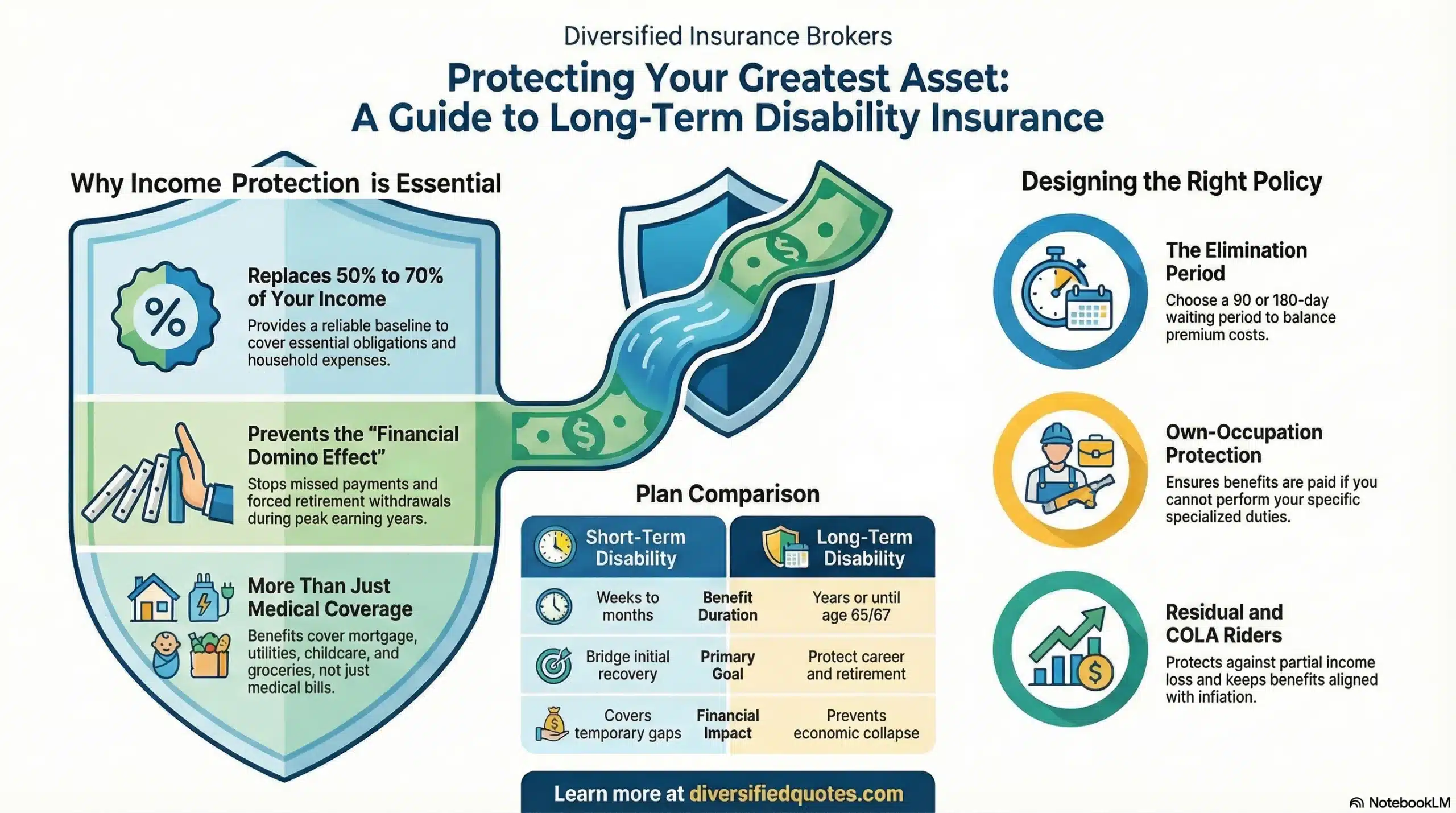
For those considering the short-term vs. long-term disability insurance decision, COLA is exclusively a long-term disability feature — short-term policies with 90-day or 6-month benefit periods do not benefit meaningfully from inflation protection because there is insufficient time for compounding to matter. COLA is part of the reason that a properly designed own-occupation long-term policy — the most protective definition for specialized professionals — produces the best real-world outcome for a long-duration disability when COLA is included alongside strong benefit period and residual coverage.
Talk With an Advisor Today
Choose how you’d like to connect—call or message us, then book a time that works for you.
Schedule here:
calendly.com/jason-dibcompanies/diversified-quotes
Licensed in all 50 states • Fiduciary, family-owned since 1980
FAQs: Disability Income Insurance with COLA
When does the COLA rider start increasing my benefit?
The COLA rider activates after you have been disabled and receiving benefits for at least 12 months — not from the first day of a claim. After that first anniversary, your benefit increases annually by the rider’s defined percentage (or CPI-linked formula) for as long as the disability continues and benefits remain payable. COLA does not increase your benefit while you are healthy and working. It is specifically a long-claim inflation protection feature. The 4-year delayed COLA variant waits until the 4th anniversary before the first increase — a budget option for buyers who want protection against very long claims while reducing the rider’s premium cost.
What happens to my COLA-increased benefit when I return to work?
In most disability policy designs, the benefit resets to the original base amount when a claim ends and you return to work. The COLA increases that compounded during the disability period do not permanently carry forward to the base policy in most standard structures. This “reset” approach is part of what keeps the rider cost manageable — you are paying for inflation protection during the disability period when you need it, not for a permanent raise regardless of claim status. A small number of policy designs do permanently carry forward some portion of the COLA increase. If this feature matters to you, it should be confirmed in the specific carrier’s rider language before purchase.
Is 3% compound COLA always the right choice, or are there cases where other structures make more sense?
3% compound COLA is the most commonly selected option because it balances meaningful long-term protection with manageable premium. However, the right structure depends on the buyer’s age, benefit amount, and inflation outlook. Younger buyers with very large benefit amounts and 30+ year potential claim horizons may find the 6% maximum compound worth the extra cost given the magnitude of compounding over that duration. Buyers with tighter premium budgets who still want protection against very long claims may find the 4-year delayed option a practical compromise. Buyers within 10 years of retirement often benefit less from COLA relative to its cost, since the potential compounding period is shorter. Simple interest COLA is generally the least protective over long claim horizons and is usually selected only when the compound options are not affordable.
How much does adding a COLA rider increase my disability insurance premium?
COLA riders typically add 10-30% to the base premium, with the exact amount depending on age, occupational class, monthly benefit amount, benefit period, elimination period, and the specific carrier’s rider pricing. In practical terms, a buyer in their 30s with a $5,000 monthly benefit might see the COLA rider add $50-$150 per month to their policy cost. Older buyers pay proportionally less for COLA because the potential claim duration is shorter. The premium addition is generally most cost-efficient for younger buyers with large benefit amounts and long benefit periods — the combination that creates the largest inflation exposure gap over a potential claim.
Can I add a COLA rider to my existing disability policy?
In most cases, no — disability insurance riders including COLA are selected at the time of application and become part of the initial contract. They are not typically available as add-ons to an existing policy after issue. This is one of the most important reasons to evaluate and include desired riders at the time of purchase rather than planning to add them later. If your current policy does not have a COLA rider and you want inflation protection, the options typically involve purchasing a new supplemental policy that includes COLA, or evaluating a 1035-style exchange into a new contract at current underwriting — which may be complex or unavailable if health has changed since the original policy was issued.
About the Author:
Jason Stolz, CLTC, CRPC, DIA, CAA and Chief Underwriter at Diversified Insurance Brokers (NPN 20471358), is a senior insurance and retirement professional with more than 25 years of real-world experience helping individuals, families, and business owners protect their income, assets, and long-term financial stability. As a long-time partner of the nationally licensed independent agency Diversified Insurance Brokers, Jason provides trusted guidance across multiple specialties—including fixed and indexed annuities, long-term care planning, personal and business disability insurance, life insurance solutions, Group Health, Travel Medical and Evacuation Insurance, and short-term health coverage. Diversified Insurance Brokers maintains active contracts with over 100 highly rated insurance carriers, ensuring clients have access to a broad and competitive marketplace.
His practical, education-first approach has earned recognition in publications such as VoyageATL, and contributions from his agency featured in Kiplinger and GoBankingRates— highlighting his commitment to financial clarity and client-focused planning. Drawing on deep product knowledge and years of hands-on field experience, Jason helps clients evaluate carriers, compare strategies, and build retirement and protection plans that are both secure and cost-efficient. Visitors who want to explore current annuity rates and compare options across multiple insurers can also use this annuity quote and comparison tool.
Explore More Disability Insurance Options: Browse our complete guide to Disability Insurance Planning & Education — covering how it works, riders, elimination periods, own occupation, costs & buying guides from 100+ carriers.
Last Reviewed: June 6, 2026 |
Reviewed by: Jason Stolz, CLTC, CRPC, DIA, CAA
Chief Underwriter, Diversified Insurance Brokers, Inc. | NPN: 20471358 | Diversified Insurance Brokers, Inc. — Licensed in all 50 states
Fact Checked by: Tonia Pettitt, CMIP©
Medicare Specialist, Diversified Insurance Brokers, Inc. | NPN: 14374308 | Diversified Insurance Brokers, Inc. — Licensed in all 50 states
Did you find this content helpful? Leave us a Google review — it helps others find trustworthy guidance too.
Editorial Standards: Diversified Insurance Brokers maintains rigorous editorial standards to ensure accuracy, clarity, and independence in all content. Learn more about our editorial standards and commitment to transparency.
