
Assurity Life Disability Insurance
As an Independent Disability Insurance Broker, we have access to exclusive discounts and negotiated pricing most captive agents can’t offer — see the full breakdown near the end of this page.
Assurity Life Disability Insurance

Jason Stolz CLTC, CRPC, DIA, CAA
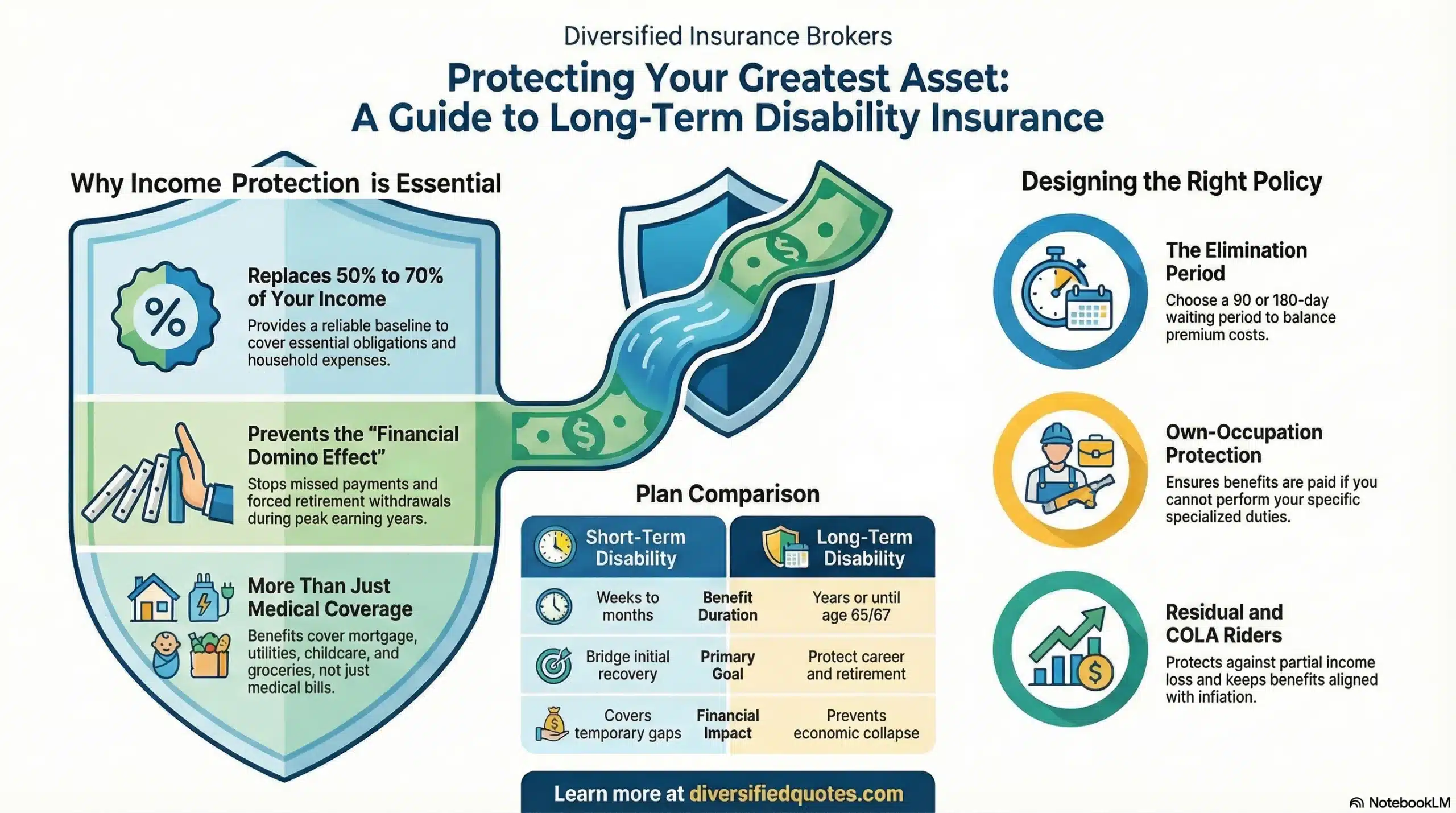
Assurity Life disability insurance provides long-term income replacement when a covered illness or injury prevents you from performing your occupational duties. The critical difference between long-term disability insurance and the emergency income bridge that short-term disability provides is duration and consequence: long-term disability is the coverage that protects what you’ve spent years building — your career earnings trajectory, your mortgage, your retirement contributions, and your family’s financial stability — when a disability disrupts income for months or years rather than weeks. A back condition that sidelines a surgeon for 18 months is a different financial problem than a back strain that keeps a freelancer out for 6 weeks. Long-term disability is designed specifically for the extended scenario, and the policy design decisions that govern it are more consequential and more nuanced than short-term coverage because the stakes are higher and the benefit period extends much longer. At Diversified Insurance Brokers, Jason Stolz, CLTC, CRPC, DIA, CAA helps clients evaluate Assurity long-term disability alongside the carrier’s positioning for specific occupations, income profiles, and benefit design objectives. Our resource on is Assurity a good insurance company covers the carrier’s financial strength and product philosophy, and our resource on Assurity Life short-term disability insurance covers the complementary shorter-duration coverage that bridges the initial months of a disability before long-term coverage activates.
Long-term disability planning is also closely connected to broader financial security planning. The income a disability policy protects is the same income that funds retirement contributions, mortgage payments, life insurance premiums, and long-term care planning. Protecting that income from an extended disability event is not a separate planning exercise from building wealth and preparing for retirement — it is the foundation that makes all of those strategies viable. Our resource on why you need disability insurance even if you’re young and healthy covers the income protection case with the statistical context that makes long-term disability planning one of the most important and most commonly deferred financial decisions for working-age adults.
Apply for Assurity Long-Term Disability Insurance Online
Start your quote, customize benefit amount, elimination period, benefit period, and optional riders — then apply online at your pace. Or request advisor guidance to structure the policy correctly for your occupation and income.
Quote & Apply Online With Assurity Request Advisor GuidanceAssurity Long-Term Disability — Key Policy Design Decisions
Long-term disability policy design is more consequential than short-term disability design because the decisions made at purchase govern a benefit that may need to perform for years — potentially until retirement age. Each design variable below represents a meaningful trade-off between cost, coverage breadth, and benefit behavior during an actual long-duration claim. The table maps these variables against their practical implications.
Sample rates for illustrative comparison. Actual premiums depend on carrier, occupation class, health class, state, and plan options selected.
| Design Variable | Common Options | How It Affects Benefit Behavior | Premium Impact | Best Choice For |
|---|---|---|---|---|
| Elimination Period (waiting period) | 90 days, 180 days, 365 days (most common for LTD) | Determines how long disability must persist before benefits begin — 90-day means benefits start after 3 months, 180-day after 6 months; benefit does not begin until the full elimination period is satisfied | Longer elimination = significantly lower premium; a 180-day elimination period typically costs less than 90-day for the same benefit | 90-day: limited cash reserves or thin short-term coverage; 180-day: strong savings or robust STD coverage that bridges the first 6 months; 365-day: paired with long STD benefit period |
| Benefit Period | 2-year, 5-year, 10-year, to age 65, to age 67 | How long benefits continue during a qualifying disability — “to age 65” means benefits pay until age 65 regardless of disability duration; shorter periods mean benefits stop at the stated limit even if disability continues | Longer benefit period = significantly higher premium; “to age 65” is the most expensive option and typically the most valuable for younger buyers with decades of earning years remaining | To age 65/67: working-age professionals who need full career income protection; 5-year or 10-year: buyers with strong savings/assets who want protection for the most likely recovery window without insuring the full career |
| Disability Definition | Own-occupation (for a defined period), modified own-occupation, any-occupation | Determines what it means to be “disabled” — own-occ means unable to perform your specific occupation’s duties; any-occ means unable to perform any occupation for which you’re qualified; the distinction is critical for specialists whose skill set commands premium compensation | Own-occupation definition is more expensive but provides materially stronger protection; any-occupation is cheaper but can deny claims if the disabled person can theoretically perform some lower-paying work | Own-occupation: surgeons, attorneys, dentists, executives — any professional whose specific skills command compensation that cannot be replaced by a “career change”; any-occ: buyers whose job duties are more broadly substitutable |
| Monthly Benefit Amount | Typically 50–70% of gross income; subject to carrier maximums and income documentation | Determines the monthly income replacement amount — higher percentage replaces more income but is capped by carrier guidelines to prevent over-insurance; self-employed income requires specific documentation to verify the benefit basis | Linear relationship — higher monthly benefit = higher premium; the tax treatment of benefits determines the net amount received, which may affect the appropriate gross benefit level to target | Build benefit from essential monthly expenses first (housing, utilities, food, debt, insurance premiums, childcare) rather than from a generic percentage — the floor that protects the household from financial crisis |
| Residual / Partial Disability Benefit | Available as base provision or optional rider; typically pays proportional benefit when income loss is partial but not total | Pays a portion of the full benefit when the insured returns to work with reduced capacity, hours, or earnings — reflects the reality that many disability recoveries are gradual and income-reduced rather than a clean on/off return to full earnings | Adds modest cost; often one of the highest practical-value enhancements in real claims because the partial return scenario is more common than total, permanent disability | Most buyers — partial disability and gradual recovery is the statistical majority of working-age disability claims; provides significant real-world protection that total disability-only policies miss entirely |
| Future Increase Option (FIO) / Future Insurability Rider | Optional rider; allows benefit increases at defined future dates without new medical underwriting, based on income growth | Preserves the ability to increase the monthly benefit at future option dates regardless of any health changes that occur after policy issue — the original health class carries forward to the increased coverage | Adds modest cost at issue; avoids the risk of needing new underwriting at a future date when health may have changed — the option pays for itself if income grows and a health change would otherwise limit the ability to add coverage | Younger buyers and early-career professionals whose income is expected to grow significantly; anyone who recognizes they will need more coverage as income rises but wants to lock in underwriting eligibility now |
| Cost of Living Adjustment (COLA) Rider | Optional rider; increases benefit payments during a disability claim by a defined annual percentage (typically 3% or CPI-linked) | Only activates during an active claim — benefit payments increase annually during disability to offset inflation; does not increase premiums during claim; benefit remains level during any non-claim period | Can add meaningful premium cost; most valuable for long-duration to-age-65 benefit periods where a multi-year disability claim would otherwise produce a progressively eroded real benefit | Buyers with to-age-65 benefit periods who want inflation protection on long-duration claims; less critical for shorter 5-year or 10-year benefit periods where inflation impact is smaller over the protected window |
The table’s most practically important row for most working-age buyers is the disability definition row. The distinction between own-occupation and any-occupation coverage is the most consequential design decision in long-term disability insurance because it determines what must be true for a claim to be paid — and it is the distinction that most commonly causes dissatisfaction with disability policies when a claim is denied because the insurer argues the claimant can perform “any occupation” even though they cannot perform the specific job they held. Our resource on own-occupation disability insurance covers this definition in full — including how it applies for specialists whose compensation is specifically tied to their occupation’s skill requirements. Our resource on disability insurance future insurability rider covers the FIO mechanics in detail — the rider that most commonly separates a policy that will adequately cover a buyer’s future income from one that becomes underfunded as income grows.
Why Group Employer Disability Coverage Often Falls Short
The most common source of long-term disability under-coverage is over-reliance on employer group coverage without understanding its limitations. Many employees assume their group long-term disability benefit will replace most of their income if they are disabled for an extended period — and many are surprised to discover the actual benefit calculation when they need it.
Group LTD policies typically cap benefits at 60% of base salary, excluding bonuses, commissions, and other variable compensation that may represent a significant portion of total compensation for sales professionals, executives, and commission-based workers. The group definition of disability is often less favorable than an individual own-occupation policy — most group plans shift from an own-occupation definition after 24 months to an any-occupation standard that is significantly harder to meet. Group coverage terminates when employment ends, leaving no protection during career transitions. And group LTD benefits paid to the employee are generally taxable as ordinary income when the employer pays the premiums — meaning the 60% headline benefit may deliver significantly less than 60% in actual after-tax purchasing power.
Individual disability insurance through Assurity addresses each of these gaps. The benefit amount is based on the individual’s documented income rather than a group plan’s standardized formula, the disability definition can be structured to maintain own-occupation language for the full benefit period, and the policy is portable — it stays with the individual regardless of employer changes. Our resource on are disability insurance payments taxable covers the tax treatment difference between employer-paid and individually-paid disability premiums — the calculation that often reveals that individual disability insurance provides meaningfully more after-tax income protection than group coverage at the same gross benefit level.
The Elimination Period Decision for Long-Term Disability
The elimination period for long-term disability coverage is measured in months rather than the days used for short-term disability — 90 days, 180 days, and 365 days are the most common options. The correct elimination period for long-term disability is the one that aligns with how long a household can sustain itself from a combination of short-term disability coverage and emergency savings without the long-term policy activating. A buyer who has a short-term disability policy with a 6-month benefit period and an emergency fund that provides additional coverage can comfortably elect a 180-day long-term disability elimination period — the short-term policy and savings together cover the first 6 months, and the long-term policy activates for any disability that persists beyond that window.
A buyer without short-term disability coverage and with limited savings should select a 90-day elimination period to ensure that benefits begin before savings are depleted. A buyer with a comprehensive short-term disability policy covering the first 12 months and strong savings can consider a 365-day elimination period, which significantly reduces long-term disability premium — the savings on annual premium can be substantial, and the protection gap is covered by the STD policy and the savings buffer. Our resource on Assurity Life short-term disability insurance covers the STD side of this coordination — the front-end coverage that most effectively reduces the long-term disability elimination period requirement for many buyers.
The coordination between short-term and long-term disability benefit periods and elimination periods is one of the most important planning details in comprehensive income protection design. When the two policies are misaligned — the STD benefit period ends before the LTD elimination period expires — there is a gap period without income replacement that represents exactly the window when financial damage is most likely to compound. Designing the two policies together, with explicit attention to the handoff point, produces a protection architecture where one coverage layer picks up precisely where the other leaves off.
Occupation Class and Its Impact on Disability Insurance Design
Occupation class is one of the most consequential variables in disability insurance pricing and coverage design — and it is one that most buyers do not think about until they see how much it affects their premium or their policy terms. Carriers assign occupations to classes (typically numbered or lettered, often from Class 1 to Class 6 or equivalent, with higher classes being more favorable) based on the physical demand of the job, the injury and illness risk profile of the occupation, and the extent to which disabilities are expected to be total versus partial.
A physician in a lower-risk specialty, an attorney in a white-collar office role, or a financial professional in an entirely sedentary position typically qualifies for the most favorable occupation class — producing lower premiums and access to stronger disability definitions including long-duration own-occupation language. A carpenter, plumber, or other skilled trades worker involves higher physical exposure and typically qualifies for a less favorable occupation class — producing higher premiums and potentially more restrictive definition terms. This is not arbitrary carrier preference — it reflects the actuarial reality of which occupations produce more frequent and more severe disability claims.
For buyers in specialized occupations — physicians, dentists, attorneys, engineers, architects, and similar credentialed professionals — understanding the specific occupation class they qualify for and which carriers evaluate their occupation most favorably is a meaningful component of the carrier selection strategy. Our resource on disability insurance for physicians covers the occupation-specific framework for medical professionals, and our resource on disability insurance for dentists covers the specific underwriting considerations for dental professionals whose hand-specific disability exposure makes the own-occupation definition particularly consequential. Our resource on disability insurance for high-risk occupations covers the broader occupation-specific underwriting landscape for jobs where physical exposure elevates the disability risk profile above the general population baseline.
The Own-Occupation Definition — Why It Matters Most for Specialists
The disability definition is the single most consequential policy term in long-term disability insurance — because it determines what the claimant must prove in order to receive benefits. For most working-age professionals, the meaningful distinction is between “own-occupation” and “any-occupation” disability definitions.
Under a true own-occupation definition, a surgeon who loses fine motor control in their dominant hand is disabled — because they cannot perform the material and substantial duties of their specific occupation as a surgeon — regardless of whether they could theoretically earn income as a medical consultant, a hospital administrator, or a medical school teacher. The benefit is paid based on inability to perform the specific occupation, not inability to earn any income. Under an any-occupation definition, that same surgeon might not qualify for benefits because a carrier could argue they can perform “any occupation for which they are reasonably qualified by education, training, or experience.” The income replacement consequences of these two definitions for a surgeon whose career compensation far exceeds what alternative roles would pay are enormous.
The most favorable disability policies maintain an own-occupation definition for the full benefit period — meaning the definition never shifts from own-occupation to any-occupation as long as the claimant qualifies under the own-occupation standard. Less favorable policies use a modified definition that starts as own-occupation for the first 24 months but shifts to any-occupation thereafter — meaning a claimant who is still unable to perform their original occupation but can perform some other work may have benefits discontinued after the 24-month own-occupation period ends. For professionals in specialized, high-compensation careers, the difference between these two definition structures represents a potentially catastrophic financial consequence in a long-term disability scenario. Our resource on own-occupation disability insurance covers the complete definition analysis and the carrier landscape for policies that maintain own-occupation protection through the full benefit period.
Self-Employed and Independent Professionals — Why Individual LTD Is Essential
Self-employed individuals, independent contractors, and business owners face the most acute income replacement risk of any working-age population when disability occurs — because their income stops completely when they cannot work, without the payroll continuation or group disability backstop that W-2 employees may have access to through their employers. A solo practitioner, consultant, or independent professional who is disabled for 18 months faces 18 months of zero professional income against ongoing personal expenses and — if they own a business — ongoing business fixed costs that do not pause because the owner is disabled.
Individual long-term disability insurance is the foundational income protection tool for self-employed applicants — and the benefit design decisions are especially important because the income being protected often varies year-to-year, may include multiple income streams, and may be difficult to document in ways that standard benefit calculation formulas accommodate easily. Our resource on disability insurance for the self-employed covers the specific planning and documentation considerations for self-employed applicants evaluating long-term disability coverage. Our resource on disability business overhead expense insurance covers the parallel coverage that protects the ongoing fixed costs of the business — rent, staff payroll, utilities, equipment leases, and other overhead — during a disability period when the business owner cannot generate revenue. This business overhead coverage is the complement to personal LTD for business owners: personal LTD replaces the owner’s income; business overhead coverage prevents the business from failing due to unpaid fixed costs during the disability period.
Long-Term Disability and the Complete Income Protection Architecture
Long-term disability insurance is most effective when it exists within a complete income protection architecture rather than as a standalone policy. The complete architecture typically includes short-term disability to cover the initial months of a disability period before the long-term policy activates; long-term disability to cover extended or permanent income replacement; business overhead expense coverage if the insured owns a business; and life insurance to address the mortality risk that exists alongside disability risk. Each of these products solves a different financial risk that the others do not address — and none of them substitutes for the others.
The connection to longer-term financial planning is also direct: the income that long-term disability protects is the same income that funds retirement contributions, mortgage paydown, life insurance premiums, and long-term care planning. A disability that goes uninsured for an extended period does not only replace income with a policy benefit — it permanently impairs the accumulation trajectory that every other financial planning goal depends on. Our resource on how to protect your funds in retirement covers the broader financial security framework within which disability insurance plays its foundational role, and our resource on long-term care insurance with shared benefits covers the adjacent planning category that addresses the disability risk specific to later life — care needs that emerge from cognitive decline, chronic conditions, or functional limitations that are distinct from the working-age disability scenario that long-term disability insurance addresses. Our resource on when to meet with a financial advisor covers the planning inflection points where a comprehensive review of income protection, disability, long-term care, and retirement strategies is most valuable for identifying gaps before they become crises.
Residual and Partial Disability — The Real-World Claims Reality
Total disability — the complete inability to perform any occupational duties — is the scenario most people imagine when they think about disability insurance. But statistical claims data consistently shows that a significant portion of long-term disability claims are partial rather than total: the claimant returns to some form of work with reduced capacity, fewer hours, modified duties, or a different role — and earns less than they did before the disability. Without a residual or partial disability benefit in the policy, those partial-return-to-work situations produce no benefit even though the disability is clearly causing ongoing income loss.
Residual disability provisions pay a proportional benefit when the insured is working with disability-related income reduction. A physician who can return to practice but only at 60% of prior productivity due to ongoing limitations receives a residual benefit proportional to their income loss rather than either a full benefit (which would require total inability to work) or no benefit (which would be the result without a residual provision). This provision acknowledges how recovery actually happens — gradually, with ups and downs, often in a modified capacity before full return — and provides income replacement that matches the real-world experience rather than an all-or-nothing model that fails to accommodate the partial recovery reality. For most buyers, the residual disability provision represents one of the highest practical-value enhancements available and should be included in any comprehensive long-term disability policy evaluation. Our resource on disability insurance for medical residency covers the specific coverage considerations for medical residents — an early-career professional group for whom establishing strong disability coverage with good definition language and the residual provision during training years, before income grows and before any health changes occur, is one of the most valuable planning steps available.
How to Structure the Right Assurity Disability Policy
The most effective approach to structuring an Assurity long-term disability policy starts with identifying the specific financial floor the policy needs to protect — the monthly income level at which the household can meet all essential obligations and continue building toward its financial goals — and then designing the policy around that specific objective rather than around a generic percentage of income or a plan template that was not built for the individual’s actual income structure and expense profile. Building from essential expenses produces a benefit amount that is both meaningful and realistic relative to what the carrier can provide for the specific income level and occupation class.
The elimination period should be chosen in explicit coordination with existing short-term disability coverage and savings liquidity: the elimination period should begin precisely where the household’s ability to sustain itself from other sources ends. The benefit period should reflect the realistic worst-case scenario the household needs protection against — for most working-age buyers with families and mortgages, a benefit period extending to retirement age is the appropriate long-term security net. Optional riders should be evaluated against specific planning needs: the FIO rider is most valuable for buyers early in their income trajectory; COLA is most valuable for buyers electing long benefit periods; the residual provision should be standard for virtually all buyers. Our resource on hospital indemnity insurance covers a complementary supplemental product that addresses hospital-specific costs that disability income does not cover — relevant for buyers who want layered protection for the immediate costs of hospitalization alongside the income replacement function of long-term disability. And our resource on what is a life insurance exam covers what to expect from the underwriting process in a related product category — helpful context for disability insurance buyers who are simultaneously evaluating life insurance and want to understand how the medical underwriting process compares across different protection products.
Design Your Long-Term Disability Policy Correctly
Apply directly online with Assurity, or request advisor guidance to structure the elimination period, benefit period, definition, and optional riders around your specific occupation and income profile before you commit.
Quote & Apply Online With Assurity Request Advisor GuidanceRelated Pages
Assurity carrier review, disability planning adjacent resources, and complementary protection guides.
Financial Protection Essentials
Specialized coverage resources, group health planning, disability occupation guides, and life insurance essentials.
Talk With an Advisor Today
Choose how you’d like to connect—call or message us, then book a time that works for you.
Schedule here:
calendly.com/jason-dibcompanies/diversified-quotes
Licensed in all 50 states • Fiduciary, family-owned since 1980
FAQs: Assurity Life Disability Insurance
How does Assurity long-term disability insurance work?
Assurity long-term disability insurance pays a monthly benefit when you are unable to perform your occupational duties due to a covered illness or injury, after the selected elimination period (waiting period) has been satisfied. You select a monthly benefit amount based on your income, an elimination period that reflects how long you can cover expenses from savings or other sources before benefits are needed, a benefit period that defines how long benefits can continue during disability, and optional riders that customize how the policy behaves in specific scenarios. Once a disability claim is approved and the elimination period expires, benefits are paid monthly for the duration of the disability up to the selected benefit period — which may be 2 years, 5 years, 10 years, or to retirement age depending on the plan design. The monthly benefit is designed to replace a portion of lost income so you can maintain essential household obligations during the disability period. Our resource on are disability insurance payments taxable covers how the tax treatment of your premium payments determines whether the benefits you receive are taxable — a practical planning dimension that affects what gross benefit level you should target.
What is the difference between own-occupation and any-occupation disability definitions?
This is the most consequential question in long-term disability insurance design — and the answer is particularly important for professionals in specialized, high-compensation careers. Under an own-occupation definition, you are considered disabled if you are unable to perform the material and substantial duties of your specific occupation — regardless of whether you could perform some other type of work. A surgeon who loses fine motor control is disabled under an own-occupation definition even if they could theoretically work as a medical consultant or professor. Under an any-occupation definition, you are considered disabled only if you cannot perform any occupation for which you are reasonably qualified by education, training, or experience. The same surgeon might not qualify under this standard because they can perform other medically-related work, even if that work pays significantly less than surgery. For specialists whose skills command premium compensation that cannot be replaced by alternative employment, the own-occupation definition is not simply a better policy — it is the only policy that provides meaningful protection against the actual financial consequence of disability. Our resource on own-occupation disability insurance covers this distinction in full.
How much disability coverage should I buy?
The most reliable way to determine the right benefit amount is to build from monthly essential expenses rather than from a generic percentage of income. List all monthly obligations that must continue during a disability: housing (mortgage or rent), utilities, food, transportation, childcare, insurance premiums (health, life, disability), and minimum debt payments. The total of those expenses is the income floor your disability benefit needs to cover — the amount at which your household can remain financially stable during recovery without depleting savings or accumulating debt at a rate that creates long-term damage. Once you have that floor, compare it against what carriers will allow based on your documented income and occupation class. Carrier maximums typically cap individual disability benefits at 50–70% of gross income, and the benefit calculation varies between carriers based on income documentation requirements, especially for self-employed applicants with variable earnings. Starting from your expense floor and working backward to the needed gross benefit (accounting for any tax treatment impact on the net benefit received) produces a target that is both meaningful and achievable rather than a generic percentage that may over-insure or under-insure your specific situation.
Is Assurity disability insurance good for self-employed individuals?
Yes — individual disability insurance through Assurity and similar carriers is particularly essential for self-employed individuals, precisely because they have no employer-provided disability backstop. A solo practitioner, freelancer, or independent contractor who cannot work receives no income from their primary occupation during a disability — there is no group disability plan continuing 60% of salary, no sick leave bank, and no HR process managing the situation. The financial consequence of an uninsured disability for a self-employed individual with household obligations is immediate and acute. Individual long-term disability provides the income replacement layer that converts that catastrophic risk into a manageable planned cost. For self-employed applicants, income documentation requirements for the benefit calculation are particularly important — disability carriers require documentation of actual earned income (typically through tax returns and financial statements) to establish the benefit basis, and income that varies significantly year-to-year requires specific attention to how the carrier calculates the average income for benefit purposes. Our resource on disability insurance for the self-employed covers the specific planning and documentation framework for self-employed disability applicants.
Are Assurity disability insurance benefits taxable?
When individual disability insurance premiums are paid with after-tax dollars — which is the standard structure for individually purchased policies where the individual pays premiums directly — the monthly benefit payments received during a disability claim are generally not subject to federal income tax. This means the gross benefit amount stated in the policy is approximately equal to the net amount you receive, which has important implications for how much coverage to purchase. When employer-paid group disability premiums are used — with the employer paying premiums and taking the business deduction — the benefit payments are generally taxable as ordinary income when received. This tax treatment difference means that an individual disability policy providing $6,000 per month in non-taxable benefits delivers meaningfully more purchasing power than a group policy providing $6,000 per month in taxable benefits. For buyers evaluating whether their employer-provided group coverage is adequate, accounting for the after-tax net benefit — not just the gross percentage — is a necessary step in the comparison. Our resource on are disability insurance payments taxable covers the complete tax framework for both individual and group disability income situations.
What is the Future Increase Option rider and why does it matter?
The Future Increase Option (FIO) — also called the Future Insurability rider — allows the policyholder to increase the monthly disability benefit at defined future option dates (typically every one to three years) up to specified limits, based on income growth, without providing new medical evidence of insurability. This means that any health changes that occur after the policy is issued do not affect the right to increase coverage — the policyholder’s original health class carries forward to the additional coverage purchased under the FIO option. The rider is most valuable for younger buyers and early-career professionals whose income is expected to grow significantly over time. Without an FIO rider, adding disability coverage in the future requires new full underwriting at whatever health class the applicant qualifies for at that time — which may be less favorable if health conditions have developed in the interim. The FIO rider effectively locks in underwriting eligibility for future coverage increases while the buyer is young and healthy, eliminating the risk of being unable to increase coverage affordably when income growth makes higher coverage necessary. The modest additional premium for the FIO rider is typically one of the highest-value enhancements available for buyers whose income trajectory makes it likely they will need more coverage in the next 5–15 years. Our resource on disability insurance future insurability rider covers the FIO mechanics in full.
Does Assurity offer partial disability benefits?
Yes — Assurity disability policies can include residual or partial disability provisions that pay a proportional benefit when the insured returns to work with reduced capacity, fewer hours, or modified duties and earns less than they did before the disability. This provision reflects the statistical reality of how disability claims actually resolve: most working-age disability claims do not end with a clean, complete return to full prior capacity. Many end with a gradual return to work that begins at reduced hours or modified duties, producing income that is still below pre-disability levels for months or years. Without a residual disability provision, a policy that only pays on total disability would produce no benefit during this partial-return-to-work period — even though the disability is clearly causing ongoing income loss. The residual provision bridges that gap by paying a benefit proportional to the income loss, typically calculated as the percentage of income reduction applied to the full monthly benefit. For most buyers, including the residual disability provision is a standard component of a comprehensive long-term disability policy rather than an optional enhancement — the practical value it provides in real-world claims justifies its modest additional cost in nearly all buyer scenarios.
About the Author:
Jason Stolz, CLTC, CRPC, DIA, CAA and Chief Underwriter at Diversified Insurance Brokers (NPN 20471358), is a senior insurance and retirement professional with more than 25 years of real-world experience helping individuals, families, and business owners protect their income, assets, and long-term financial stability. As a long-time partner of the nationally licensed independent agency Diversified Insurance Brokers, Jason provides trusted guidance across multiple specialties—including fixed and indexed annuities, long-term care planning, personal and business disability insurance, life insurance solutions, Group Health, Travel Medical and Evacuation Insurance, and short-term health coverage. Diversified Insurance Brokers maintains active contracts with over 100 highly rated insurance carriers, ensuring clients have access to a broad and competitive marketplace.
His practical, education-first approach has earned recognition in publications such as VoyageATL, and contributions from his agency featured in Kiplinger and GoBankingRates— highlighting his commitment to financial clarity and client-focused planning. Drawing on deep product knowledge and years of hands-on field experience, Jason helps clients evaluate carriers, compare strategies, and build retirement and protection plans that are both secure and cost-efficient. Visitors who want to explore current annuity rates and compare options across multiple insurers can also use this annuity quote and comparison tool.
Explore More Disability Insurance Options: Browse our complete guide to Disability Insurance Planning & Education — covering how it works, riders, elimination periods, own occupation, costs & buying guides from 100+ carriers.
Last Reviewed: May 28, 2026 |
Reviewed by: Jason Stolz, CLTC, CRPC, DIA, CAA
Chief Underwriter, Diversified Insurance Brokers, Inc. | NPN: 20471358 | Diversified Insurance Brokers, Inc. — Licensed in all 50 states
Fact Checked by: Tonia Pettitt, CMIP©
Medicare Specialist, Diversified Insurance Brokers, Inc. | NPN: 14374308 | Diversified Insurance Brokers, Inc. — Licensed in all 50 states
Did you find this content helpful? Leave us a Google review — it helps others find trustworthy guidance too.
Editorial Standards: Diversified Insurance Brokers maintains rigorous editorial standards to ensure accuracy, clarity, and independence in all content. Learn more about our editorial standards and commitment to transparency.
