
Disability Insurance for Physicians
As an Independent Disability Insurance Broker, we have access to exclusive discounts and negotiated pricing most captive agents can’t offer — see the full breakdown near the end of this page.
Disability Insurance for Physicians

Jason Stolz CLTC, CRPC, DIA, CAA
As a physician, your most valuable asset is not your home, your investments, or your retirement accounts — it is your ability to earn income from the specialized training and skills you spent a decade or more acquiring. A sudden illness or injury can interrupt years of career momentum and dramatically reduce lifetime earnings, even when you can still work in some limited or modified capacity. At Diversified Insurance Brokers, we help physicians structure disability coverage designed specifically for medical specialties — with options that protect current income, accommodate future income growth, address student loan obligations, and maintain long-term retirement momentum. For a broader foundation on how disability insurance works before diving into physician-specific strategy, our core overview of disability insurance provides the full product framework.
Physicians face a unique risk profile that separates them from most other disability insurance applicants. The specialization of the skill set — where years of training and specific technical capabilities define the professional value — means that even a modest impairment can produce large income losses if that impairment touches the specific duties that generate earnings. A surgeon with hand tremors, an anesthesiologist with peripheral neuropathy, an interventional cardiologist with vision changes, or an emergency physician with post-concussion cognitive effects may be fundamentally unable to perform their core professional duties — yet could theoretically work in some other capacity. How the disability policy handles that scenario is the entire game, and it is determined entirely by the contract language selected at the time of purchase.
Physician Disability Insurance Quotes
Compare true own-occupation options, residual riders, and physician-focused benefit structures — built around your specialty.
In training? Ask us about resident/fellow discounts and future increase options. Call 800-533-5969
Why Physicians Need True Own-Occupation Coverage — and Why “Own-Occ” Is Not All the Same
Own-occupation disability insurance is the policy definition standard that most physicians require — but the phrase “own-occupation” encompasses a spectrum of actual contract language that produces very different outcomes at claim time. Understanding that spectrum is the foundation of every physician disability insurance decision.
At the strongest end of the spectrum is pure own-occupation language: benefits are payable when you cannot perform the material and substantial duties of your specific occupation or specialty, regardless of whether you are working elsewhere and earning income. A surgeon who can no longer operate but continues working as a medical educator or consultant receives full disability benefits under a pure own-occ policy. The policy recognizes that the specialized practice of surgery — not medicine generally, not employment broadly — is what is insured. Pure own-occupation language is typically available from the Big 5 individual disability carriers and represents the strongest protection available for procedural and specialty-specific income.
Weaker versions of “own-occupation” exist in the market and are worth understanding explicitly. Modified own-occupation language pays benefits if you cannot perform your specific duties — but reduces or eliminates benefits if you become gainfully employed in another occupation earning income. Under this definition, the surgeon who transitions to medical consulting or teaching may see benefits reduced or stopped despite the genuine inability to continue surgical practice. For physicians whose income is tied specifically to clinical or procedural performance, this definitional weakness creates exactly the coverage gap that the policy was purchased to prevent. Any-occupation definitions — which only pay when the insured cannot perform any reasonable occupation — provide essentially no meaningful protection for most physicians facing specialty-specific disability.
The key practical implication is that two policies with the same monthly benefit amount and similar premiums can produce completely opposite outcomes when a cardiologist develops essential tremor or a surgeon develops a musculoskeletal condition affecting fine motor performance. Policy selection based on premium alone, without evaluating the specific definitional language, consistently produces the worst outcomes for physician disability claims. Our resource on own-occupation disability insurance covers this spectrum of definitions in full detail.
Specialty-Specific Risk: Why the Type of Medicine Matters
Disability risk in medicine is not uniform across specialties. Procedural and high-acuity specialties carry disability risk profiles that are meaningfully different from cognitive or office-based medical practice, and the policy features that matter most reflect those differences.
Surgeons — general, orthopedic, neurosurgical, cardiothoracic, and others — face disability risk most concentrated in fine motor function, hand-eye coordination, endurance, and cognitive acuity under pressure. The same hand tremor that is irrelevant to a psychiatrist’s practice is career-ending for an orthopedic surgeon. The same chronic pain condition that limits a primary care physician to partial duties may be incompatible with any surgical activity. Surgeons benefit most from pure own-occupation language that specifically references the surgical specialty, residual disability coverage that addresses income loss during partial recovery or practice modification, and benefit periods extending to retirement age that protect against the permanent career consequences of a serious surgical disability.
Interventional specialists — interventional cardiologists, electrophysiologists, interventional radiologists, neurosurgeons — combine the fine motor risk of surgery with radiation exposure risk and the cognitive demands of real-time procedural decision-making. Disability risk for these specialties includes conditions that affect cognitive processing speed and precision, not only physical dexterity. The policy definition must protect against both categories of impairment.
Anesthesiologists face disability risk from conditions affecting cognitive precision, chemical sensitivity, and stress tolerance in addition to the physical demands of airway management. A condition that produces cognitive slowing, medication sensitivity, or stress-related physical symptoms may be incompatible with anesthesia practice while leaving the physician capable of other medical work — making the own-occupation definition the critical protection.
Primary care and cognitive specialty physicians — internists, psychiatrists, neurologists, family medicine — carry disability risk more concentrated in cognitive function and sustained practice capacity. Mental health conditions, neurological impairments, and musculoskeletal conditions that affect sustained desk and clinical work represent the most common disability scenarios for these specialties. The residual disability rider is often the most practically important coverage dimension, since partial reduction in practice capacity is a more common scenario than complete cessation.
Why Partial Disability Is Often the Real Physician Risk
A significant percentage of physician disability claims are not “cannot work at all” scenarios. More commonly, a physician can continue to work — but not at full capacity. Call may be reduced. Procedural hours may be cut. Patient load may be limited. The most demanding and highest-compensating duties may be the first to become impossible. The income loss from this partial disability scenario is real, often substantial, and not protected by a policy that only pays for total disability.
The residual (partial) disability rider is designed specifically for this scenario. When a covered condition produces a measurable loss of income or time relative to pre-disability levels, the residual rider pays a proportionate benefit even while the physician continues to work. The benefit calculation is typically based on the percentage of income lost — a physician who loses 40% of income due to a covered condition receives approximately 40% of the monthly disability benefit, adjusted according to the specific rider’s calculation method.
For procedural and high-acuity physicians, the residual rider is often the most utilized provision in actual claims experience. A physician who reduces surgical volume by half due to a musculoskeletal condition, or who transitions to lower-acuity cases due to a sensory impairment, or who limits hours due to a chronic fatigue condition is experiencing exactly the scenario that residual coverage is designed to address. Omitting the residual rider from a physician disability policy — to save premium or simplify the structure — is one of the most consequential policy design errors for this population. Our resource on residual disability insurance benefits explained covers how this rider works and why its trigger threshold and benefit calculation matter.
The Resident and Fellow Planning Window
Medical training represents the best available opportunity to establish disability insurance coverage — and the window that most physicians discover only after it has partially closed. Disability insurance pricing is determined at the time of application by age, health, and occupational classification. A physician who establishes coverage at age 28 as a resident locks in pricing based on that age and health profile for the life of the policy. A physician who waits until age 38 as an established attending pays meaningfully higher premiums for identical coverage, and has accumulated ten additional years of health history that may affect underwriting outcomes.
Many carriers offer specific training discounts and streamlined underwriting options for residents and fellows. These programs allow coverage to be established at favorable premium levels with preset benefit amounts appropriate for training-level income, with future increase options (FIO) — also called guaranteed insurability riders — that allow the physician to increase coverage as income grows without submitting to additional medical underwriting. The only financial verification required for future increases is documentation of income growth; health history is not re-evaluated. This is the mechanism that allows a physician who develops a health condition after coverage is established to still increase their protection as their income grows, rather than being locked into the benefit amount established during training.
For residents and fellows specifically: the most common mistake is not acting during training because the benefit amount seems modest relative to eventual attending income. The value during training is not the current benefit amount — it is the future increase option that locks in the right to purchase substantially more coverage later without health scrutiny, and the premium rate that is established based on young-age and training-stage health. A resident who establishes a $5,000 monthly benefit with a $10,000 future increase option has effectively secured up to $15,000 in eventual coverage at training-era health underwriting, regardless of any health changes that occur between the training program and attending practice.
Physician Income Structures and Underwriting Documentation
Physician compensation structures create specific underwriting documentation requirements that practitioners need to understand before applying. The monthly benefit amount a carrier will approve is tied to documented earned income, and how income is structured — and how it is presented — affects the maximum benefit available.
Employed physicians with base salary typically have the most straightforward income documentation: W-2 wages or salary verification provide the income base from which the benefit amount is calculated. Many employed physicians also receive production bonuses, call pay, or quality incentive payments that supplement base salary. Whether these variable components are included in the insurable income base depends on the carrier’s underwriting guidelines — some carriers include average bonus payments when documented over two to three years; others base the benefit on base salary only. Knowing which carriers include variable compensation in their income calculation can produce meaningfully different maximum benefit amounts for the same physician.
Physicians in private practice or partnerships receive income through a combination of W-2 salary, K-1 distributions, and in some cases personal draws from practice revenue. The underwriting approach for practice-owner income typically requires two years of personal and business tax returns, and some carriers require practice financial statements. The key challenge is that aggressive tax planning — common among practice owners — often produces taxable income figures that understate actual economic income. Carriers calculate insurable income from tax returns, not from actual cash flow, which means a physician who reports $200,000 in taxable income but generates $400,000 in economic income due to depreciation, Section 179 deductions, and other tax strategies may find their maximum benefit limited by the reported taxable figure. Experienced independent brokers who work with physician-owner income documentation understand how to present financials to maximize the insurable income calculation within carrier guidelines.
Academic physicians typically have a base university salary plus potential for research grants, consulting income, and in some cases clinical practice income through a faculty practice plan. Academic physicians should confirm whether their total compensation — including sources outside the university base salary — can be included in the income base for benefit calculation purposes, and which carriers’ underwriting guidelines accommodate academic income structures most favorably.
Key Policy Features Physicians Should Prioritize
True own-occupation definition — The most critical provision, evaluated at the specialty level. The policy should specifically reference the physician’s medical specialty rather than “medicine” broadly. Our resource on own-occupation disability insurance explains how definition strength varies across carrier products.
Residual/partial disability rider — The most commonly utilized rider in physician disability claims. The trigger threshold (often a 15% to 20% income or time loss) and the benefit calculation method vary by carrier and should be evaluated against realistic partial disability scenarios for the specific specialty.
Future increase option — Essential for residents, fellows, and early attendings. Allows coverage to expand with income growth without additional medical underwriting. Our resource on the disability insurance future insurability rider explains how this protection functions across carriers.
Cost-of-living adjustment (COLA) rider — Increases monthly benefits annually during an active disability claim to preserve real purchasing power. For a physician facing a career-ending disability at 40, a benefit that is adequate today represents significantly less purchasing power twenty years later without COLA protection. Our resource on disability income insurance with COLA protection explains the mechanics and financial impact of this rider.
Non-cancelable and guaranteed renewable — Locks in both premium rates and policy definitions for the life of the policy. The carrier cannot increase premiums, change definitions, or alter riders as the physician ages or accumulates health history. This provision is the contractual guarantee that the policy purchased today will perform according to its current terms for the next 30 years.
Mental/nervous and substance use coverage — Many policies include these coverage categories but impose a 24-month lifetime benefit limitation. Physician burnout, depression, anxiety disorders, and substance use conditions are documented disability causes in the medical profession. Understanding how each carrier handles these claims — including the benefit limit, the definition of mental/nervous conditions, and the availability of extensions or additional coverage — is an important evaluation criterion specific to the medical profession.
Catastrophic disability rider (CAT) — Provides an additional monthly benefit if disability is severe enough to prevent performing two or more activities of daily living or requires substantial supervision. Relevant primarily for worst-case severity claims, this rider provides an additional financial layer for the most serious disability scenarios.
Business overhead expense coordination — For physicians who own practices, the personal disability policy addresses income replacement while a separate Business Overhead Expense (BOE) policy addresses fixed practice costs — rent, staff wages, equipment leases, utilities, malpractice premiums — that continue regardless of whether the physician can practice. The two policies address different financial obligations and are not substitutes for each other.
How Employer Group LTD Interacts with Individual Coverage
Many physicians employed by hospital systems or large medical groups receive group long-term disability coverage through their employer. Group LTD can be a useful foundation, but it has structural limitations that most physicians discover only when they evaluate the details rather than the headline.
Group LTD plans typically cap monthly benefits at a defined maximum — often $10,000 to $15,000 per month — that may represent a fraction of an attending physician’s monthly income. A physician earning $500,000 annually ($41,667 per month) whose group LTD plan provides a $12,000 monthly benefit cap is protected for less than 30% of income, not the 60% or 70% typically cited as income replacement benchmarks. Individual supplemental disability insurance covers the gap between the group plan cap and the physician’s actual income replacement needs.
If the employer pays the group LTD premiums, the benefits received during a claim are taxable as ordinary income — meaning the net benefit after taxes is meaningfully less than the gross monthly benefit amount. A physician receiving $12,000 per month in taxable group LTD benefits may net $8,000 to $9,000 after taxes, creating an even larger gap between benefit received and income replaced. Individual disability insurance premiums paid personally produce tax-free benefits, making the after-tax comparison between group and individual coverage even more favorable for personally-paid individual policies.
Group LTD plans also frequently contain definition limitations — own-occupation language that converts to any-occupation after two years, or “regular occupation” language that is interpreted more broadly than specialty-specific own-occupation. And group coverage is not portable — it ends when employment ends, which means a physician changing hospital systems, entering private practice, or reducing employed hours loses the group coverage at exactly the transition moment when new individual coverage applications require full underwriting review.
Compare Physician Disability Policies
We’ll compare contract definitions and rider details so the policy matches the real-world risks your specialty faces.
Questions? Call 800-533-5969
Related Pages
More disability resources that help physicians compare definitions, underwriting paths, and business-owner planning.
Financial Protection Essentials
Burial insurance comparisons, travel protection planning, carrier reviews, and post-heart attack life insurance guidance.
Talk With an Advisor Today
Choose how you’d like to connect—call or message us, then book a time that works for you.
Schedule here:
calendly.com/jason-dibcompanies/diversified-quotes
Licensed in all 50 states • Fiduciary, family-owned since 1980
FAQs: Disability Insurance for Physicians
What is “own-occupation” disability insurance for physicians?
“True own-occupation” coverage pays benefits when you cannot perform the material and substantial duties of your specific medical specialty — even if you can work in another role or earn income elsewhere. This is the strongest available definition and the standard that most physicians require. Under pure own-occupation language, a surgeon who develops a hand condition preventing surgical work receives full disability benefits even if they continue working as a medical consultant, educator, or in a non-procedural role. The policy insures the specific specialty practice, not employment generally.
The own-occupation definition is not uniform across all disability policies that claim to offer it. “Modified own-occupation” language pays benefits if you cannot perform specialty duties but reduces or eliminates benefits if you become gainfully employed elsewhere. “Any-occupation” language only pays if you cannot perform virtually any employment — a standard that is rarely met by physicians who retain some work capacity. For physicians whose income is tied to specialty-specific technical skills, pure own-occupation language is not a premium upgrade — it is the foundational protection that makes the policy meaningful for the real-world disability scenarios that affect medical careers. Our resource on own-occupation disability insurance explains the full spectrum of definitions and their practical consequences.
How is true own-occ different from modified or any-occupation?
True own-occupation pays benefits based on inability to perform your specific occupational duties regardless of whether you work elsewhere and earn other income. A radiologist who can no longer read imaging studies but takes an administrative medical director position still receives full disability benefits under a true own-occ policy. Modified own-occupation pays if you cannot perform your specialty duties but reduces or stops benefits if you become gainfully employed in another occupation — so the same radiologist in a medical director role might receive reduced or no benefits, even though they can no longer do the specialized work their disability insurance was purchased to protect.
Any-occupation definitions require the insured to be unable to perform virtually any gainful employment for which they are reasonably suited by education, training, or experience. This standard is extraordinarily difficult for physicians to meet — a physician who cannot practice medicine but could teach, consult, or work in health administration would typically not qualify for benefits under an any-occupation definition. For physicians, any-occupation language provides essentially no real income protection against the specialty-specific disability scenarios that represent their actual professional risk. The practical consequence of selecting a weaker definition to reduce premium can be a complete denial of benefits at exactly the moment the policy was purchased to pay.
Which riders matter most for physicians?
The residual (partial) disability rider is typically the most practically important rider for physicians because most physician disability claims involve partial rather than total incapacity. A physician who reduces surgical volume, limits call, or transitions to lower-acuity cases due to a covered condition is experiencing exactly the scenario the residual rider addresses. Without a residual rider, the policy pays nothing during partial disability periods — regardless of how significant the income loss is. The future increase option is essential for residents, fellows, and early attendings, allowing coverage to grow with income without new medical underwriting. The cost-of-living adjustment rider preserves real benefit purchasing power during long-term claims. Non-cancelable and guaranteed renewable provisions lock in premium rates and definitions for the policy’s lifetime.
Specialty-specific riders worth evaluating include the catastrophic disability rider (which adds an additional benefit layer for the most severe disability scenarios), student loan protection riders for physicians still servicing training debt, and retirement protection riders designed to maintain retirement savings momentum during a disability claim. Mental/nervous and substance use coverage terms should be evaluated carefully, as these are documented disability causes in the medical profession and carrier treatment of these claims varies significantly — including whether a 24-month limitation applies and whether extensions are available.
How much monthly benefit can I qualify for?
Maximum monthly benefits are based on verified earned income and existing coverage in force. Carriers apply benefit-to-income ratios — typically allowing coverage for 60% to 70% of earned income — to determine the maximum approvable benefit. Residents and fellows typically qualify for preset amounts (often $5,000 to $7,500 per month) with expanded future increase options to add coverage as income grows. Attendings and practice owners qualify based on verified income documentation: W-2 wages, K-1 distributions, practice financial statements, and two years of tax returns.
Income structure matters significantly for the maximum available benefit. Employed physicians with base salaries plus production bonuses need to confirm whether the variable compensation is included in the carrier’s insurable income calculation. Practice owners whose tax strategies reduce reportable taxable income need to be aware that carriers calculate insurable income from tax documentation, not actual cash flow, which can limit available benefit amounts if tax-optimized income figures are significantly lower than economic income. Supplemental coverage from multiple carriers can address situations where a single carrier’s benefit cap is lower than the physician’s total coverage need.
Is my hospital or group practice LTD enough by itself?
Group LTD is rarely adequate as standalone disability protection for physicians, for three structural reasons. First, benefit caps — most group plans impose a monthly maximum (often $10,000 to $15,000) that represents a small fraction of a high-earning physician’s monthly income need. A physician earning $400,000 annually whose group LTD caps at $12,000 per month has 36% of income protected, not 60% to 70%. Second, taxability — employer-paid group LTD premiums make benefits taxable as ordinary income at claim time, so the net benefit is materially less than the gross benefit amount. Third, portability — group coverage ends when employment ends, which means a physician who changes hospital systems, enters private practice, or shifts to a different practice structure loses the protection at the exact moment when obtaining new individual coverage requires fresh underwriting.
The standard approach for most employed physicians is to use group LTD as a foundation and supplement it with individual disability insurance to reach an adequate total monthly benefit at the most protective definition available. Individual coverage fills both the benefit gap and the definition gap, provides portable protection independent of employment, and produces tax-free benefits when premiums are paid personally.
What elimination and benefit periods should I consider?
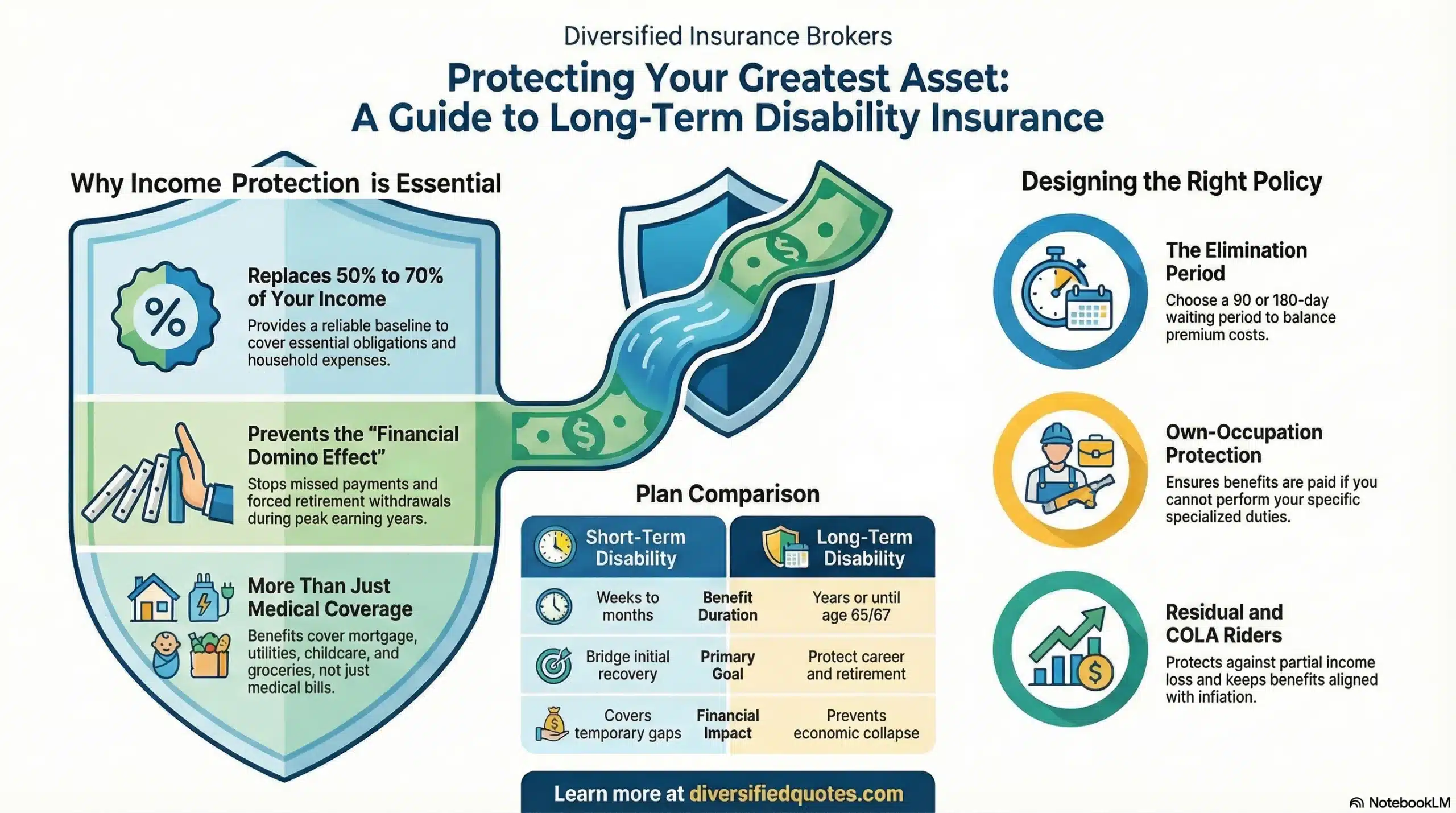
A 90-day elimination period is the most common choice for physicians, balancing premium cost against the need to bridge the income gap between disability onset and benefit activation. Physicians with strong emergency savings, employer sick leave policies, or short-term disability coverage can comfortably use a 90-day wait. A 180-day elimination period reduces premiums further but requires roughly six months of accessible savings to cover expenses between disability onset and first benefit payment — a consideration that requires honest assessment of liquidity rather than total assets. Elimination periods shorter than 90 days are available but carry premium premiums that make them cost-inefficient for most physicians compared to combining a 90-day individual policy with short-term disability coverage.
For benefit periods, the most common physician choice is coverage to age 65 or age 67, providing protection through the full working career. Some carriers offer benefit periods to age 70 for certain occupational classifications. The choice between to-65 and to-67 involves a premium differential that should be evaluated against the realistic risk of a long-duration disability. A 5-year benefit period is meaningfully less protective for a physician who becomes disabled at 45 — a 20-year income gap vs. a 5-year benefit creates exactly the long-term financial risk that physician disability insurance is designed to prevent.
Are mental/nervous conditions covered?
Most individual disability policies include mental/nervous and substance use conditions as covered causes of disability. However, many policies impose a lifetime benefit limitation for these claim categories — most commonly 24 months of combined benefits for mental/nervous and substance use claims over the life of the policy. After the 24-month limit is reached, benefits for these conditions cease even if total disability continues. Some carriers and product lines offer longer or unlimited mental/nervous benefits, typically in premium product tiers or for specific occupational classifications.
For physicians specifically, mental health conditions, burnout-related diagnoses, and substance use disorders are documented occupational disability risks in the medical profession. Understanding exactly how each carrier defines the mental/nervous benefit limit — including whether it applies to all mental health diagnoses or only specific categories, and whether extensions are available — is an important carrier-level evaluation criterion. Carriers vary meaningfully in their mental/nervous coverage terms, making this a dimension where independent carrier comparison produces real differences in actual coverage quality rather than just nominal policy features.
Can residents and fellows get discounts?
Yes — many carriers offer specific training discounts for medical residents and fellows. These discounts can reduce initial premiums by 15% to 25% or more, with the discounted rate maintained for the life of the policy. Training discount eligibility typically requires documentation of resident or fellow status (match letter, appointment letter, or program enrollment documentation) and is available during the training period and sometimes for a defined period after training completion. The combination of training discounts and young-age pricing makes the training years the most cost-efficient time to establish physician disability coverage.
Beyond the premium discount, the more strategically important consideration is the future increase option. Residents and fellows who establish a base policy during training lock in the right to increase coverage substantially as income grows — without new medical underwriting — after completing training and entering practice. A resident who develops a health condition during training that would otherwise complicate future disability underwriting retains full access to coverage increases under the future increase option, regardless of the health change, because no medical re-underwriting is required for future increases. This combination — training discount pricing, future increase option, and locked-in policy definitions — makes the training period the most valuable disability insurance purchasing opportunity most physicians will ever have.
Should practice owners also consider BOE coverage?
Yes — physicians who own practices or have fixed business obligations face a two-layer disability risk that requires two separate coverage solutions. Personal disability insurance replaces the physician’s household income during a disability. Business Overhead Expense (BOE) disability insurance reimburses eligible fixed practice costs — rent, staff wages, equipment leases, utilities, malpractice premiums, business loan payments — that continue regardless of whether the physician can practice. Without BOE coverage, a physician whose practice has $20,000 in monthly fixed overhead faces the choice between depleting personal savings to keep the practice open, allowing the practice to close, or attempting to operate in a compromised capacity.
BOE coverage is typically structured with shorter benefit periods than personal disability insurance — often 12 to 24 months — reflecting the goal of keeping the practice intact through a recovery period rather than providing decades of perpetual overhead reimbursement. BOE benefits are typically taxable but may be deductible as business expenses, depending on how the premium is treated. The combination of personal IDI (for household income) and BOE (for practice overhead) is the standard planning approach for physician-owners who want to protect both their personal financial life and the business they have built. Our resource on business overhead expense disability insurance explains BOE structure and planning in detail.
What common mistakes do physicians make with disability coverage?
The most common and consequential mistake is accepting a policy with a weaker occupational definition — modified own-occupation or any-occupation language — because it carries a lower premium than true own-occupation coverage. The premium differential between policy types is modest relative to the potential claim difference at a specialty-specific disability event. Physicians who discover they have modified or any-occupation language only when filing a claim face the possibility of benefit denial for exactly the specialty-specific disability that makes physician income protection necessary.
Other common mistakes include: skipping the residual rider to reduce premium (leaving the most common physician claim scenario unprotected); waiting until after health changes to apply (losing access to favorable underwriting available during training or early career); relying solely on group LTD without evaluating benefit caps, taxability, and portability; and selecting a 5-year benefit period that leaves a gap between benefit exhaustion and the realistic end of a career-ending disability. The best time to establish comprehensive physician disability coverage is when health is optimal and income is just beginning to grow — not when a health event forces the issue.
Browse all of our Disability Pages for the Medical Field
About the Author:
Jason Stolz, CLTC, CRPC, DIA, CAA and Chief Underwriter at Diversified Insurance Brokers (NPN 20471358), is a senior insurance and retirement professional with more than 25 years of real-world experience helping individuals, families, and business owners protect their income, assets, and long-term financial stability. As a long-time partner of the nationally licensed independent agency Diversified Insurance Brokers, Jason provides trusted guidance across multiple specialties—including fixed and indexed annuities, long-term care planning, personal and business disability insurance, life insurance solutions, Group Health, Travel Medical and Evacuation Insurance, and short-term health coverage. Diversified Insurance Brokers maintains active contracts with over 100 highly rated insurance carriers, ensuring clients have access to a broad and competitive marketplace.
His practical, education-first approach has earned recognition in publications such as VoyageATL, and contributions from his agency featured in Kiplinger and GoBankingRates— highlighting his commitment to financial clarity and client-focused planning. Drawing on deep product knowledge and years of hands-on field experience, Jason helps clients evaluate carriers, compare strategies, and build retirement and protection plans that are both secure and cost-efficient. Visitors who want to explore current annuity rates and compare options across multiple insurers can also use this annuity quote and comparison tool.
Explore All Disability Insurance Options: Browse our complete Disability Insurance guide — covering occupations, high risk jobs, medical professionals, self-employed, and planning strategies from 100+ carriers.
Last Reviewed: June 22, 2026 |
Reviewed by: Jason Stolz, CLTC, CRPC, DIA, CAA
Chief Underwriter, Diversified Insurance Brokers, Inc. | NPN: 20471358 | Diversified Insurance Brokers, Inc. — Licensed in all 50 states
Fact Checked by: Tonia Pettitt, CMIP©
Medicare Specialist, Diversified Insurance Brokers, Inc. | NPN: 14374308 | Diversified Insurance Brokers, Inc. — Licensed in all 50 states
Did you find this content helpful? Leave us a Google review — it helps others find trustworthy guidance too.
Editorial Standards: Diversified Insurance Brokers maintains rigorous editorial standards to ensure accuracy, clarity, and independence in all content. Learn more about our editorial standards and commitment to transparency.
