
Disability Insurance for Physician Assistants
As an Independent Disability Insurance Broker, we have access to exclusive discounts and negotiated pricing most captive agents can’t offer — see the full breakdown near the end of this page.
Disability Insurance for Physician Assistants

Jason Stolz CLTC, CRPC, DIA, CAA
Disability insurance for physician assistants is one of the most important and most frequently overlooked financial protections available to a healthcare profession that is simultaneously one of the fastest-growing, most versatile, and most income-producing allied health careers in American medicine. Physician assistants — now formally designated as physician associates by the American Academy of Physician Associates — practice medicine across more than 60 specialties and settings, from primary care and internal medicine through surgical subspecialties, emergency medicine, critical care, oncology, and cardiothoracic surgery. The AAPA’s 2025 Salary Report confirmed total median compensation for PAs at $134,000, a 5.5% increase from the prior year, with surgical subspecialists and those in high-acuity hospital settings earning $150,000 to $198,000 or more. The Bureau of Labor Statistics projects 20% job growth for physician assistants between 2024 and 2034 — far faster than the average for all occupations — reflecting the profession’s increasingly central role in delivering care across the physician shortage landscape. This professional momentum makes disability insurance planning not a luxury but a financial imperative: the faster income grows and the more central the PA’s clinical role becomes, the more severe the financial consequences of an uninsured disability event. The National Commission on Certification of Physician Assistants found that 34.1% of certified PAs experience professional burnout — and that among those planning to leave their clinical position, 44.9% cite burnout as the driving reason. Beyond burnout, PAs face occupation-specific disability risks that vary meaningfully by specialty: surgical PAs carry the sharps exposure and musculoskeletal demands of the operating room; emergency medicine PAs face patient violence and the physical and emotional demands of the highest-burnout PA specialty; primary care PAs face the administrative burden and high-volume patient interaction that drives healthcare worker burnout broadly. At Diversified Insurance Brokers, we help physician assistants in every specialty and practice setting design disability coverage that reflects the real demands of their work, the income their career has generated, and the planning considerations that make the PA’s financial protection strategy distinctive. For a foundational overview of disability insurance before examining PA-specific planning, our disability insurance services overview provides the essential framework, and our resource on why people buy disability insurance explains the core protection logic that applies across every specialty and income level in healthcare.
Protect Your Income as a Physician Assistant
Compare disability insurance options designed for PAs across all specialties, settings, and income levels.
Request Disability Insurance OptionsQuestions? Call 800-533-5969
The Physician Assistant Profession: Versatility, Growth, and the Disability Risk It Creates
Physician assistants are clinicians who practice medicine under the supervision of, or in collaboration with, physicians — diagnosing illness, developing treatment plans, prescribing medications, performing procedures, and providing the full range of clinical services that their supervising specialty encompasses. The scope of what a PA does in practice is determined not by a fixed national standard but by the specialty they practice in, the state they are licensed in, and the collaborative agreement that governs their clinical relationship with the supervising physician. A surgical PA in a neurosurgery practice assists in complex spinal operations, performs first assist duties in the operating room, manages post-operative patients in the ICU, and independently sees patients in clinic for follow-up care. An emergency medicine PA evaluates and treats the full spectrum of acute presentations with independent clinical judgment, performs emergency procedures including laceration repair, fracture reduction, lumbar puncture, and airway management, and functions in an environment where the pace, acuity, and physical demands are among the most intense in clinical medicine. A primary care PA manages chronic disease panels, performs wellness examinations, addresses acute illness, coordinates complex patient care, and navigates the administrative burden of a high-volume primary care practice. Each of these practice contexts carries a distinct disability risk profile — and a disability insurance strategy that works for a primary care PA does not automatically serve a surgical PA adequately.
The profession’s growth trajectory amplifies the financial stakes of disability planning. The BLS projects 20% growth in PA employment between 2024 and 2034 — a rate approximately seven times faster than the average for all occupations. This growth is driven by the expanding physician shortage, the increasing acceptance of team-based care models across specialties and settings, the legislative evolution of PA scope of practice in multiple states, and the recognition that experienced PAs in specialty practices deliver clinical services that were previously provided exclusively by physicians. As PA salaries rise in response to this demand — the AAPA’s 2025 report documents a 5.5% increase in median total compensation, continuing a multi-year upward trajectory — the income that disability insurance must protect becomes more significant each year. A PA earning $142,000 today who experiences a career-disrupting disability without income protection faces not only the immediate income loss but the foreclosure of a career trajectory that could reach $170,000, $180,000, or higher through specialty advancement, experience accumulation, and continued market-driven salary increases.
Burnout: The Most Prevalent Disability Risk Across the PA Profession
The National Commission on Certification of Physician Assistants reports that 34.1% of certified physician assistants experience professional burnout — a prevalence that, while lower than the burnout rates reported in some physician specialties, is substantially higher than in most non-healthcare professions and represents a clinically significant workforce health challenge with direct financial consequences for the practitioners affected. Among the PAs who indicate they plan to leave their current clinical position within the next year, 44.9% cite professional burnout as the primary driving reason — making burnout not just a wellness concern but an active career and income disruption risk that disability insurance planning must address.
Burnout rates within the PA profession are not uniform across specialties. Emergency medicine PAs report the highest burnout rates within the profession — approximately 39.9% — consistent with the pattern in physician burnout data where emergency medicine consistently ranks among the highest-burnout specialties. The demands that drive emergency medicine burnout in physicians operate identically for PAs working in the same clinical environment: unpredictable patient flow, high-acuity presentations requiring immediate decision-making, exposure to trauma and critical illness, frequent patient death and difficult family communications, shift work including overnight and weekend coverage, and the emotional toll of sustained exposure to human suffering in its most acute forms. Internal medicine subspecialty PAs report the second-highest burnout rates, followed by primary care PAs — both reflecting the administrative burden, large patient panels, and documentation demands that characterize these practice settings.
Surgical subspecialty PAs, who represent the largest single specialty category in the PA workforce at approximately 18.6% of the profession, carry a burnout risk that reflects the specific demands of surgical practice: long operative days, call responsibilities that may include overnight surgical emergencies, the physical demands of the operating room, and the professional pressure of assisting in high-consequence procedures where technical precision and sustained concentration are simultaneously required. When burnout in any of these specialty contexts progresses to clinical major depression, anxiety disorder, or other conditions that impair the cognitive function, emotional regulation, and clinical performance that PA practice requires, it constitutes a genuine disability — and one that disability insurance with appropriate mental health coverage must address. Our resource on disability insurance riders explained covers how mental health provisions are structured across different policy types, including the 24-month mental health benefit period limitation that is the most important adverse provision for PAs evaluating coverage options.
Surgical PAs: The Highest Physical and Sharps Exposure Risk in the Profession
The approximately 18.6% of physician assistants who practice in surgical subspecialties occupy the most physically demanding and sharps-intensive practice environment in the PA profession. Surgical PAs — whether in orthopedics, neurosurgery, cardiothoracic surgery, general surgery, plastic surgery, or other surgical disciplines — spend extended hours in the operating room performing first assist duties, managing retractors, driving sutures and staples, managing tissue with surgical instruments, and providing the sustained technical support that complex surgical procedures require. This OR environment exposes surgical PAs to every sharps and bloodborne pathogen risk that surgeons themselves face — needlestick injuries from suture needles, scalpel lacerations, instrument-related sharps exposure — at comparable frequency because the PA is physically present in the operative field throughout the case.
The physical demands of long operative days are significant. A cardiothoracic surgical PA who assists in open heart procedures may stand in sustained positions at the operating table for 4 to 8 hours or more per case, maintaining upper extremity positioning, retractor pressure, and technical precision throughout the procedure. The cumulative musculoskeletal loading from sustained OR postures, repeated instrument handling, and the physical demands of assisting in patient positioning and surgical retraction generates lumbar, cervical, shoulder, and upper extremity loading that produces the same occupational injury risk documented in surgical nurses, scrub technicians, and surgeons who spend their working lives in the OR environment. A surgical PA whose shoulder condition or back injury prevents the sustained OR standing and instrument handling that their practice requires has experienced a genuine occupational disability even if they retain the cognitive ability to evaluate patients in clinic or perform lower-demand clinical tasks.
Radiation exposure from intraoperative fluoroscopy is an additional occupational health concern for surgical PAs who regularly participate in fluoroscopically guided procedures — orthopedic fracture fixation, spine surgery with pedicle screws, minimally invasive vascular procedures, and other fluoroscopy-dependent surgical techniques. Surgical PAs who wear lead protective equipment for extended hours across high-volume fluoroscopic surgical practices accumulate the same musculoskeletal loading from lead apron wear that has been documented in interventional radiologists and interventional cardiologists. For surgical PAs considering disability coverage, our resource on own-occupation disability insurance explains how the policy definition must protect the specific clinical functions of surgical PA practice — including the OR work and procedure-based duties that distinguish this specialty context from other PA practice settings.
Emergency Medicine PAs: Highest Burnout, Patient Violence Exposure, and Acute Physical Demand
Emergency medicine PAs practice in the clinical environment with the highest documented burnout rate in the PA profession — and the physical and psychological demands of emergency medicine create a disability risk profile that is meaningfully more acute than that of outpatient or elective practice settings. The emergency department environment generates occupational health risks across multiple dimensions simultaneously: physical exhaustion from sustained high-pace clinical activity, patient violence exposure from the patient population that emergency medicine serves, infectious disease exposure from patients presenting with undiagnosed and often communicable conditions, shift work including overnight and weekend coverage that disrupts circadian rhythm and generates chronic fatigue, and the emotional toll of managing trauma, sudden death, and acute crisis without the longitudinal patient relationships that soften the emotional impact in other specialties.
Patient violence in emergency settings is a documented and significant occupational hazard. Emergency departments have among the highest rates of healthcare worker assault in any clinical environment, with patients under the influence of substances, in psychiatric crisis, in severe pain, or in fear and disorientation generating physical aggression at rates that significantly exceed other clinical settings. An emergency medicine PA who sustains a back injury from a patient altercation, or a wrist fracture from a defensive response to an assault, has experienced a genuine disability event from a documented occupational hazard — one that disability insurance covers exactly as it would any other injury-related income disruption. The cumulative physical and psychological burden of high-acuity emergency medicine practice also creates the burnout and secondary traumatic stress exposure that makes mental health coverage without a 24-month limitation particularly important for PAs in this specialty.
Primary Care and Internal Medicine PAs: Administrative Burden and High-Volume Demands
Primary care and internal medicine physician assistants represent a large and growing segment of the PA workforce — and the burnout drivers in these settings are well-documented even if they differ from the acute physical demands of emergency and surgical practice. Primary care PAs manage large patient panels, navigate complex documentation requirements in electronic health records, address the prior authorization burdens that have expanded to encompass increasingly basic treatments and medications, and provide care to patient populations with multiple chronic conditions whose management is simultaneously clinically complex and emotionally demanding.
The administrative burden dimension of primary care PA burnout has been specifically identified as a primary driver: documentation and charting emerged as burnout’s top contributor across a 2025 survey of healthcare providers, cited by 16% of providers as their primary driver. For a PA managing a panel of 100 or more patients — the NCCPA reports that 34.7% of clinically active PAs have their own patient panel with a median of 100 patients — the combination of clinical demands and documentation burden creates a sustained daily workload that, across years of practice, generates the cumulative stress and compassion fatigue that produces clinical burnout. When burnout reaches the level of major depression impairing concentration, motivation, and clinical performance, it represents a genuine disability from which disability insurance must provide income protection. Our resource on whether disability insurance is worth it applies the statistical framework that makes coverage protection most clearly valuable for high-burnout clinical environments, and our resource on how much disability insurance you need helps translate a specific PA income into the right coverage amount.
Income Structure and the Financial Stakes of Disability for PAs
Physician assistant income has grown substantially over the past decade and continues to grow at a pace that outperforms most other healthcare professions. The AAPA’s 2025 Salary Report — the profession’s own authoritative compensation survey — reports total median compensation of $134,000, a 5.5% increase from the prior year. Medscape’s 2024 Physician Assistant Compensation Report found average total compensation of $142,000. The BLS reports a median annual wage of $130,020. These medians mask a wide range: entry-level PAs in primary care may start at $90,000 to $95,000, while experienced PAs in cardiothoracic surgery, neurosurgery, or critical care medicine earn $152,500 to $198,000 or more annually. Geographic factors drive additional variation — California PAs average $159,000 to $162,000 annually compared to the East Central region’s $132,000 average.
The financial exposure of disability across this income range is substantial and growing. A PA earning $142,000 annually who develops a disabling condition at age 35 and cannot return to practice faces nearly $3.5 million in foregone income over a 25-year remaining career — before accounting for the salary growth that experience and specialty advancement would have generated in the absence of disability. Even a shorter partial disability — 12 months of inability to work at the median PA salary — represents over $142,000 in direct income loss. Against the backdrop of student loan obligations typical for master’s-level clinical education programs, mortgage payments, and family financial responsibilities, this income disruption without insurance protection creates rapid and compounding financial damage that savings alone cannot absorb for most practicing PAs.
Approximately 37.1% of PAs work in private practice office settings, and a smaller but significant segment are employed by group practices or operate under independent contractor arrangements that provide no employer sick leave, limited or no group disability coverage, and immediate income cessation when clinical work stops. For these PAs, the financial exposure of disability is particularly acute. Our resource on disability insurance for independent contractors addresses the coverage design considerations for PAs operating outside traditional employment arrangements, and our resource on getting disability insurance when self-employed covers the income documentation requirements for PAs in independent practice.
The Own-Occupation Definition: Critical for Specialty-Specific PA Practice
For physician assistants, the disability definition in any policy they consider determines whether benefits pay in the specific scenarios their occupational risk profile makes most likely — and this matters in PA-specific ways that differ from the physician disability planning context.
Under a true own-occupation disability definition, a PA is considered disabled when they cannot perform the material and substantial duties of their specific occupation as a physician assistant in their specialty practice setting, even if they could theoretically perform some other type of work. A surgical PA whose shoulder condition prevents the sustained OR positioning and instrument handling that neurosurgery first assist requires would receive benefits under own-occupation coverage even if they could perform primary care outpatient work. An emergency medicine PA whose PTSD prevents the acute trauma management and high-acuity emergency environment of their practice would receive benefits even if they could perform scheduled clinic work in a lower-acuity setting.
Under an any-occupation standard — which most employer group policies apply after 24 months — the same PA might be denied benefits because the carrier determines they retain capacity for some other form of clinical work, even if that work pays significantly less and does not match the specialty-specific skills their training developed. For PAs in high-earning surgical subspecialties specifically, this definition failure is particularly costly: an any-occupation standard might identify primary care PA work as theoretically accessible for a surgical PA who cannot perform OR duties — even when the income differential between the specialties is $40,000 to $60,000 annually. The own-occupation definition must apply for the full benefit period to provide genuine protection for specialty-specific PA clinical function. Our resource on best disability insurance rates helps compare carrier-specific definition language alongside premium for PA applicants across all specialty contexts.
Employer Coverage Gaps for Employed PAs
The majority of physician assistants — approximately 41.7% working in hospitals and 37.1% in office-based private practice — are employed, and most employer settings provide access to group long-term disability coverage as part of the benefits package. Understanding the systematic limitations of that coverage is essential for any PA who has not independently evaluated whether their group plan is adequate.
Standard group LTD policies replace 60% of base salary subject to a monthly maximum benefit cap that is typically far below what a high-earning PA requires. For a surgical PA earning $175,000 annually ($14,583 per month), a $10,000 monthly group benefit cap provides only 69% of monthly income — leaving 31% completely unprotected. For PAs earning above median in high-acuity specialty settings, this gap is proportionally larger. Productivity bonuses and compensation components above base salary are typically excluded from group policy benefit calculations, further widening the gap between actual and insured income.
The disability definition transition at 24 months — from own-occupation to any-occupation — is the second and often more consequential limitation. Group policies also fail the portability test: a PA who changes employers, transitions to a different specialty, moves to an independent contractor arrangement, or leaves clinical practice temporarily loses group coverage immediately. Given that 8.7% of PAs plan to leave their clinical position within the next year — and that career mobility is a characteristic of the PA profession, which is specifically valued for its flexibility across specialties and settings — this non-portable group coverage is a particularly fragile foundation for long-term income protection. Individual disability insurance that supplements group coverage, fills the income gap above the benefit cap, maintains own-occupation coverage for the full benefit period, and travels with the PA through any employment or specialty transition is the standard of adequate protection. Our resource on guaranteed issue group disability insurance explains how group coverage works and where individual coverage fills its consistent gaps, and our resource on why working with an independent disability insurance broker matters covers how carrier comparison produces better outcomes for PAs with specialty-specific risk profiles.
Occupation Classification and What It Means for PA Applicants
Disability insurance carriers classify occupations into risk tiers that affect both the premium and the policy provisions available. Physician assistants are typically classified in the 4A or 4B occupation class range — a favorable classification that reflects the professional, clinical nature of the work and provides access to own-occupation definitions, to-age-65 benefit periods, and a full range of riders. This favorable classification means that PAs can generally access the same quality of disability coverage available to many physician specialties, at premium levels that reflect their professional occupation class rather than a high-risk manual labor classification.
The occupation class for a specific PA may vary somewhat by specialty and work setting across carriers — a surgical PA or emergency medicine PA may receive a slightly different classification than a primary care PA in an office setting, reflecting the additional physical and procedural demands of those practice environments. An independent advisor who has placed PA applications across multiple carriers knows which insurers classify specific PA specialties most favorably and can identify the optimal carrier before any application is submitted. Our resource on disability insurance by occupation provides broader context on how occupation classification shapes coverage across healthcare professions, and our disability insurance second opinion service provides an independent evaluation for PAs who have already received coverage proposals and want an unbiased comparison.
Designing a Disability Policy for Physician Assistants
Disability insurance design for PAs should reflect the individual’s specific specialty context, income level, employment structure, and financial obligations — because the differences across PA practice settings are significant enough that a generic “PA disability policy” approach misses important customization opportunities.
The benefit amount should reflect total documented compensation as fully as the carrier’s rules allow. For a surgical PA earning $175,000 annually, the monthly protection need is approximately $14,583 — a level that may exceed some individual carrier maximums and require supplemental coverage to fully address. For a primary care PA earning $115,000, the monthly protection need of approximately $9,583 is within the range of most individual carrier maximums. Maximizing the available benefit amount rather than defaulting to minimum coverage ensures the policy actually addresses the income loss of a realistic disability scenario.
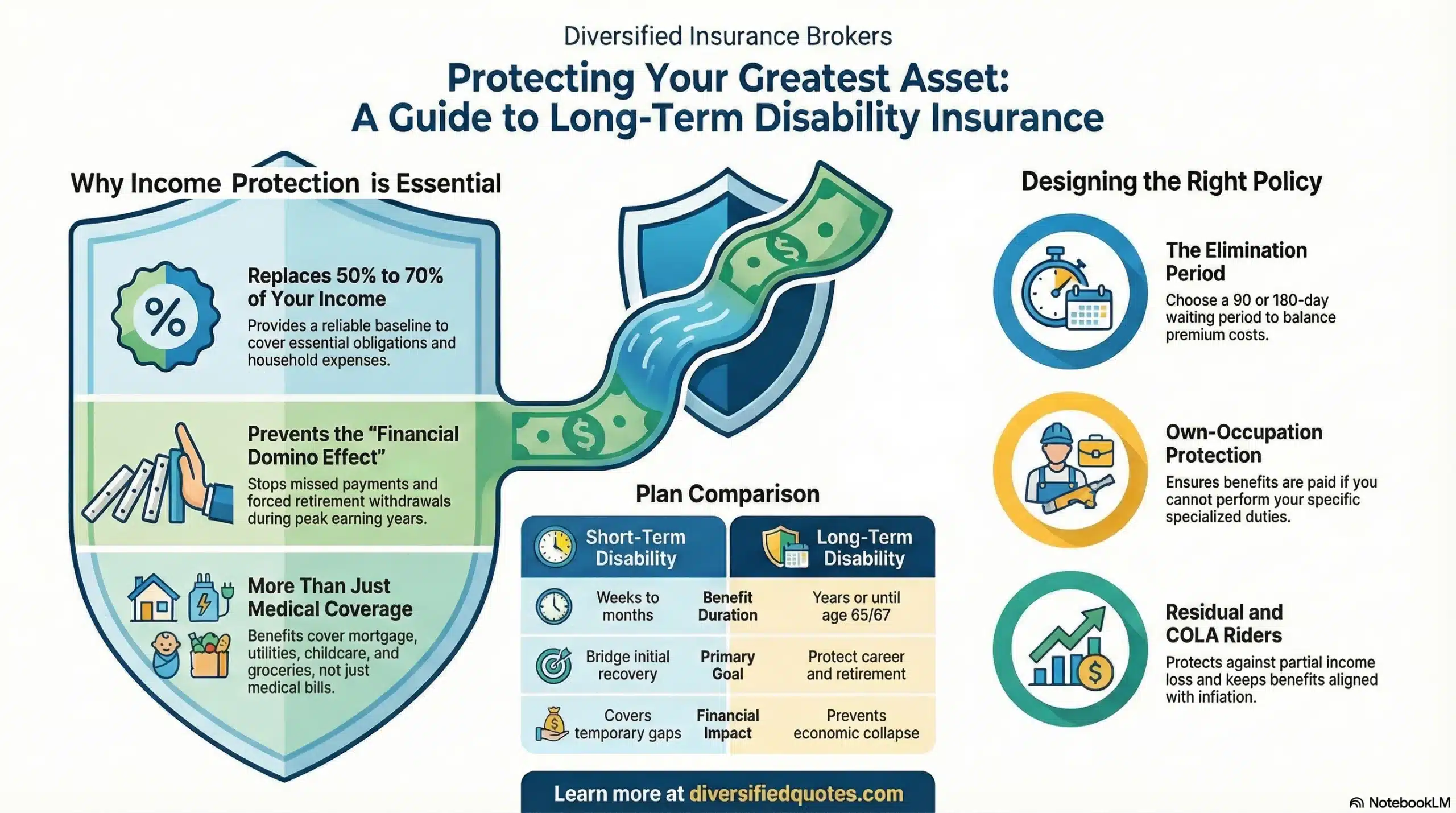
The elimination period should reflect actual financial reserves. PAs with limited liquid savings — particularly those in early career stages with active student loan obligations — should consider a 30 or 60-day elimination period that initiates benefits before financial pressure becomes acute. The standard 90-day elimination period is appropriate for PAs with adequate emergency reserves. Our resource on disability insurance elimination periods explained provides the framework for calibrating this choice to individual financial circumstances.
The benefit period should extend to age 65. A PA who develops a disabling condition at age 33 and cannot return to practice has 32 years of career income potentially unprotected under a 5-year benefit period. A to-age-65 benefit period ensures the most financially catastrophic scenario — a career-ending disability in early or midlife — is fully addressed rather than briefly covered and then abandoned.
The residual disability rider is important for PAs because many disability scenarios produce partial rather than total incapacity. A surgical PA managing a shoulder condition that allows some clinical work but not OR participation is experiencing real income loss — from the specialty premium they can no longer earn — without meeting the total disability threshold. Our resource on residual disability insurance benefits explained covers how partial disability benefits work and why they matter for PAs in specialty practices where procedural and non-procedural income components can diverge during recovery.
The future increase option is particularly valuable for PAs early in their careers whose income will grow substantially through experience accumulation, specialty advancement, and continued market-driven salary increases. This rider allows the benefit amount to expand as income grows — without new medical underwriting — preserving the ability to maintain adequate coverage regardless of health changes that occur as clinical career demands accumulate. Our resource on disability insurance future insurability riders covers how this protection works and when it matters most for clinicians with growing income trajectories.
The COLA rider protects the purchasing power of benefits during long-duration claims. A PA receiving benefits for 20 years following a career-ending disability at age 45 needs benefits that maintain economic value across that entire period — without COLA adjustment, inflation erodes the real purchasing power of the benefit substantially. Our resource on disability income insurance with COLA explains how this rider is structured and valued across different policy designs. For PAs who want to understand the full range of short-term protection options alongside long-term coverage, our resource on how to buy short-term disability insurance covers the options that bridge the period between disability onset and long-term benefit initiation.
When to Apply: The Timing Advantage That Compounds Over a Career
For physician assistants, the timing of a disability insurance application is one of the most consequential career financial decisions they make — because every dimension of coverage quality (premium level, definition strength, exclusion riders, rider availability) is affected by the age and health status at the time of application, and these advantages compound across every year of premium payment over a working career.
A PA who applies at age 26, fresh from their PA program completion, and one who applies at age 40 after 14 years of clinical practice may pay premiums that differ by 60% to 80% annually for the same monthly benefit — with the difference locked in for the full policy life of both. Across 35 years of premium payments, this premium differential accumulates to a very large total cost difference. More importantly, a PA who applies before occupational health conditions have appeared in their medical records — before the shoulder symptoms from surgical OR work, the lumbar discomfort from procedure-heavy primary care, or the documented anxiety from emergency medicine burnout — obtains a comprehensive policy without the exclusion riders that limit coverage for the most realistic disability scenarios their career presents.
PA programs typically offer students access to favorable simplified or guaranteed-issue disability coverage options from carriers who recognize the new-graduate PA as an especially favorable underwriting risk — young, healthy, entering a growing profession with strong income trajectory. Taking advantage of these program-sponsored coverage opportunities, or applying individually immediately following program completion, produces the strongest possible foundation for lifetime income protection. Our resource on disability insurance for new professionals addresses the specific planning considerations for PAs entering the workforce, and our resource on why young healthcare professionals need disability coverage explains the timing argument in full. For PAs with existing coverage who want an independent evaluation, our resource on how to get the best disability insurance rates explains the factors that determine coverage quality and cost across the market.
Get Disability Insurance Quotes for Physician Assistants
We compare options across carriers for PAs in all specialties and settings to find the right combination of definition strength, benefit design, and value.
Request Disability Insurance OptionsQuestions? Call 800-533-5969
Financial Protection Essentials
Income protection resources and disability insurance planning tools for physician assistants across all specialties and settings.
Related Pages
Talk With an Advisor Today
Choose how you’d like to connect—call or message us, then book a time that works for you.
Schedule here:
calendly.com/jason-dibcompanies/diversified-quotes
Licensed in all 50 states • Fiduciary, family-owned since 1980
Frequently Asked Questions: Disability Insurance for Physician Assistants
Physician assistant disability risks vary significantly by specialty context but fall into several consistent categories across the profession. Burnout is the most prevalent risk: the NCCPA reports 34.1% of certified PAs experience professional burnout, with emergency medicine PAs at the highest specialty rate of approximately 39.9%. Among PAs planning to leave their clinical position, 44.9% cite burnout as the primary reason — making burnout an active career and income disruption risk, not merely a wellness concern. When burnout progresses to clinical major depression, anxiety disorder, or other mental health conditions that impair the cognitive function and clinical performance PA practice requires, it constitutes a genuine disability that coverage must address.
Beyond burnout, specialty-specific risks dominate the disability profile. Surgical PAs in the operating room face the same sharps and needlestick exposure, lead apron radiation exposure, and musculoskeletal demands from long operative cases that surgeons themselves face. Emergency medicine PAs face patient violence exposure, physical exhaustion from high-pace acute care, and infectious disease exposure. Primary care PAs face the administrative burden and high-volume patient interaction that drives healthcare worker burnout in outpatient settings. Our resource on disability insurance for high-risk occupations provides context on how specialty-specific risk factors are evaluated in underwriting for clinical healthcare worker applicants.
Yes — specialty context affects both how the own-occupation definition applies in a claim scenario and how carriers classify the occupation for underwriting purposes. A surgical PA practicing in a neurosurgery or cardiothoracic surgery environment carries a meaningfully different risk profile than a primary care PA in an outpatient clinic — and the disability definition in a well-designed policy should reflect this distinction. Under a true own-occupation definition, a surgical PA who cannot perform OR duties due to a shoulder or back condition receives benefits even if they could perform outpatient clinical work — protecting the specialty income premium that surgical PA practice generates.
Carrier classification may also vary slightly by specialty for PAs — some insurers evaluate surgical PA practice as a somewhat different occupation class than primary care PA practice, with corresponding differences in premium and provision availability. An independent broker with experience placing PA applications across carriers can identify which carriers classify specific PA specialty contexts most favorably before any application is submitted. Our resource on own-occupation disability insurance explains in detail how specialty-specific definition language works in real claim scenarios, and our resource on why working with an independent disability insurance broker matters explains the value of carrier-specific specialty knowledge.
For most physician assistants, employer group disability coverage leaves significant gaps that create real financial exposure — particularly as PA incomes rise and the profession’s income trajectory continues upward. Standard group LTD policies replace 60% of base salary subject to a monthly maximum cap that may be $8,000 to $15,000 per month. For a surgical PA earning $175,000 annually ($14,583 per month), a $10,000 monthly group cap provides only 69% of actual monthly income — with the remaining 31% completely unprotected. Productivity bonuses and specialty compensation components above base salary are typically excluded from group policy calculations, further widening the gap.
The disability definition transitions from own-occupation to any-occupation at 24 months — the most consequential limitation. Group policies also end when employment ends, which is especially problematic for a profession where career mobility is a defining characteristic. The NCCPA reports that 8.7% of PAs plan to leave their position within the next year. Individual disability insurance that supplements group coverage, fills income gaps, maintains own-occupation coverage for the full benefit period, and travels through any employment change is the standard of adequate income protection. Our resource on guaranteed issue group disability insurance explains how group coverage is structured at the employer level.
Yes — surgical PAs have a distinctly different disability risk profile from PAs in non-surgical settings, and their coverage design should reflect these differences. Surgical PAs face the same operating room hazards that surgeons do: needlestick and sharps exposure from suture needles and surgical instrumentation in the operative field, musculoskeletal demands from long operative cases requiring sustained standing and instrument management, fluoroscopic radiation exposure in procedures with intraoperative C-arm imaging, and the physical and cognitive demands of first assist responsibilities in complex surgical cases. A shoulder injury, back condition, or hand condition that prevents the sustained OR positioning and technical demands of surgical first assist directly impairs a surgical PA’s professional function in a specialty-specific way.
For coverage design, surgical PAs should ensure their own-occupation definition specifically protects the OR and procedural duties of their practice — not just the outpatient clinic functions they share with non-surgical PAs. The benefit amount should reflect actual total compensation including the specialty premium that surgical PA practice commands. The residual disability rider is especially important because a PA who becomes unable to perform OR work but can still do outpatient work has experienced a partial disability that reduces income by the difference between surgical and non-surgical PA compensation. Our resource on residual disability insurance benefits explained covers how partial disability benefits address this income reduction scenario.
The PA profession’s career flexibility — the ability to transition between specialties, employers, and practice settings — makes portable individual disability insurance especially important. Every employment change potentially involves loss of employer group coverage and a gap in protection. A PA who builds disability protection on employer group coverage alone loses that protection with each career transition and may face underwriting complications when applying for replacement coverage at an older age with accumulated health history. Individual own-occupation coverage established early in the career travels through every specialty change, employer transition, and geographic move without interruption or new underwriting.
The future increase option purchased with an initial policy allows coverage to expand as income grows through each specialty and experience level without new medical underwriting — ensuring that coverage remains adequate even as the PA’s clinical expertise and compensation evolve significantly over a 30 to 35-year career. Our resource on disability insurance for new professionals addresses the specific planning considerations for PAs entering the workforce, where establishing portable individual coverage early is the foundational recommendation.
Given that burnout is the most prevalent disability risk in the PA profession — with 34.1% of certified PAs experiencing professional burnout and 44.9% of those planning to leave their position citing burnout as the reason — mental health coverage provisions are among the most important policy comparison points for PA applicants. Two specific provisions matter most. First, confirmation that mental health conditions are covered under the disability definition when they produce functional impairment that prevents the performance of professional duties. Second, and more critically, confirmation that the policy does not apply a 24-month benefit period limitation specifically to mental and nervous condition claims.
Many standard group LTD policies and some individual policies cap mental health benefits at 24 months even when physical disability benefits would continue to age 65. For a PA whose disabling burnout-driven depression requires 3 to 4 years of treatment and recovery before return to full clinical function, a 24-month mental health limitation leaves the remaining recovery period completely unprotected. Explicitly confirming the absence of this limitation in any policy being considered is the most important mental health provision evaluation step for PA applicants. Our resource on disability insurance with preexisting conditions explains how documented mental health history affects underwriting — reinforcing why applying before any burnout treatment documentation exists is the optimal approach.
The optimal time for a PA to apply for disability insurance is as early in their career as possible — ideally during their PA program or immediately following graduation, before clinical work has begun accumulating the occupational health history that creates underwriting complications. PA programs often offer new graduates access to guaranteed-issue or simplified-underwriting disability coverage options from carriers who recognize the new-graduate PA as a favorable risk. Taking advantage of these program-linked opportunities produces the most comprehensive coverage at the lowest cost.
For PAs who are already in practice and have not yet established individual disability coverage, the urgency is real and increases with each passing year. Every year of delay increases the premium cost at eventual application and increases the probability that occupational health conditions will produce exclusion riders that limit coverage for the most likely disability scenarios. A PA applying at age 28 and one applying at age 42 may face premium differences of 50% to 75% annually for the same coverage, locked in for the remainder of their careers. Our resource on how to buy disability insurance walks through the application process from start to finish, and our resource on how to get the best disability insurance rates explains all the factors that determine coverage quality and cost across the market.
About the Author:
Jason Stolz, CLTC, CRPC, DIA, CAA and Chief Underwriter at Diversified Insurance Brokers (NPN 20471358), is a senior insurance and retirement professional with more than 25 years of real-world experience helping individuals, families, and business owners protect their income, assets, and long-term financial stability. As a long-time partner of the nationally licensed independent agency Diversified Insurance Brokers, Jason provides trusted guidance across multiple specialties—including fixed and indexed annuities, long-term care planning, personal and business disability insurance, life insurance solutions, Group Health, Travel Medical and Evacuation Insurance, and short-term health coverage. Diversified Insurance Brokers maintains active contracts with over 100 highly rated insurance carriers, ensuring clients have access to a broad and competitive marketplace.
His practical, education-first approach has earned recognition in publications such as VoyageATL, and contributions from his agency featured in Kiplinger and GoBankingRates— highlighting his commitment to financial clarity and client-focused planning. Drawing on deep product knowledge and years of hands-on field experience, Jason helps clients evaluate carriers, compare strategies, and build retirement and protection plans that are both secure and cost-efficient. Visitors who want to explore current annuity rates and compare options across multiple insurers can also use this annuity quote and comparison tool.
Explore More Disability Insurance Options: Browse our complete guide to Disability Insurance for Physicians & Medical Specialists — covering physicians, surgeons, anesthesiologists, radiologists, podiatrists & medical specialists from 100+ carriers.
Last Reviewed: June 8, 2026 |
Reviewed by: Jason Stolz, CLTC, CRPC, DIA, CAA
Chief Underwriter, Diversified Insurance Brokers, Inc. | NPN: 20471358 | Diversified Insurance Brokers, Inc. — Licensed in all 50 states
Fact Checked by: Tonia Pettitt, CMIP©
Medicare Specialist, Diversified Insurance Brokers, Inc. | NPN: 14374308 | Diversified Insurance Brokers, Inc. — Licensed in all 50 states
Did you find this content helpful? Leave us a Google review — it helps others find trustworthy guidance too.
Editorial Standards: Diversified Insurance Brokers maintains rigorous editorial standards to ensure accuracy, clarity, and independence in all content. Learn more about our editorial standards and commitment to transparency.
