
Residual Disability Insurance Benefits Explained
As an Independent Disability Insurance Broker, we have access to exclusive discounts and negotiated pricing most captive agents can’t offer — see the full breakdown near the end of this page.
Residual Disability Insurance Benefits Explained

Jason Stolz CLTC, CRPC, DIA, CAA
Residual disability insurance benefits are the feature inside a disability income policy that most earners will actually use — yet most people shopping for disability coverage spend the least time evaluating it. Total disability coverage protects you when you cannot work at all. Residual disability coverage protects you when you can still work, but your income has dropped because of a medically documented illness or injury. For the majority of long-term disability claimants, particularly professionals, business owners, and commission-based earners, partial impairment is a far more common outcome than complete incapacity. A surgeon whose hand tremor limits surgical volume but does not eliminate the ability to practice entirely. An attorney managing a neurological condition that reduces billable hours. A contractor whose shoulder injury limits certain labor-intensive tasks while allowing others. A financial advisor whose cancer treatment forces reduced client capacity for months. In each of these scenarios — and hundreds like them — total disability benefits never trigger. Without a residual rider, the policyholder receives nothing despite experiencing a real, documented, financially damaging reduction in earning capacity.
The residual disability benefit closes this gap by paying a proportional monthly benefit whenever a qualifying income loss occurs that is directly attributable to a medical condition. The calculation is straightforward in principle: the percentage of income lost during the disability period is applied to the policy’s monthly benefit amount to determine the residual payment. If a policyholder with a $10,000 monthly benefit loses 40% of their pre-disability income due to a qualifying condition, the residual benefit typically produces $4,000 per month — paid in addition to whatever reduced income they are still earning from work. The benefit is not a flat payment for working less; it is a specifically calculated income replacement proportional to the verified loss. This proportionality makes residual benefits both more flexible and more precisely targeted than total disability coverage, because they respond to the actual financial impact of the disability rather than requiring a binary determination about whether work is possible at all.
This resource covers residual disability insurance in full practical depth: how qualifying criteria are structured, how the proportional benefit calculation works, the difference between basic and enhanced residual rider designs, how the recovery benefit extends protection beyond medical recovery, how pre-disability income baselines are established, the special challenges residual coverage presents for business owners and variable-income earners, and what to evaluate when comparing policies. For the broader disability insurance evaluation framework, our resource on disability insurance services covers the full coverage landscape we serve, and our guide on how to choose the right disability insurance policy covers the complete evaluation process. For consumers in specialized occupations where partial disability risk is especially pronounced, our resources on disability insurance for physicians, disability insurance for pilots, and disability insurance for high-risk occupations cover the occupation-specific underwriting considerations that affect residual benefit availability and structure.
Get Your Disability Income Quote
Our specialists compare residual disability coverage across top carriers to identify the policy that best protects your specific income and occupation.
Request Your DI QuoteOr call us directly: 800-533-5969
What Residual Disability Insurance Is — and Why It Matters More Than Most People Realize
The most fundamental fact about disability risk is also the one most underappreciated in the design of disability insurance coverage: the majority of disabling conditions that affect working professionals do not produce complete, immediate inability to work. They produce gradual, partial impairment. A chronic back condition that limits physical capacity without eliminating it. A heart attack that reduces stamina and forces shorter working days. A progressive neurological condition that limits fine motor skills while preserving cognitive function. Cancer treatment side effects that reduce productive hours for months before and after procedures. In these scenarios — which statistically represent the most common path through a disability claim — the policyholder’s challenge is not “I cannot work at all” but “I cannot work at the same capacity as before, and my income has dropped accordingly.”
Residual disability coverage was designed to respond to this reality. A policy without a residual rider forces a binary determination at the time of claim: either the policyholder meets the total disability definition (typically, unable to perform the material and substantial duties of their occupation) and receives the full monthly benefit, or they do not qualify and receive nothing. A policy with a well-designed residual rider introduces a third outcome that reflects the actual lived experience of most disability claimants: they can work in a reduced capacity, they are earning less than before, they have a documented medical reason for the reduction, and the policy pays a proportional benefit that replaces the measured income shortfall. This third outcome is not a secondary benefit or an edge case — for many professionals, it is the primary scenario for which disability coverage is needed, which makes the residual rider one of the most consequential decisions in the entire disability policy purchase.
The Three Ways a Residual Disability Claim Is Triggered
Most modern residual disability riders define eligibility through one or more of three qualifying tests. Understanding which test a specific policy uses — and whether it requires one, two, or all three to be satisfied simultaneously — is critical because different policy designs produce very different claim eligibility outcomes for the same medical scenario. The first test is loss of income: the policyholder’s current earnings have fallen below pre-disability earnings by at least the policy’s specified minimum threshold, typically either 15% or 20% depending on whether the policy carries a basic or enhanced residual rider design. The loss of income must be directly attributable to the qualifying medical condition, not to voluntary reduction in hours, business market conditions, or other non-medical factors.
The second test is loss of time: the policyholder cannot perform their occupation duties for the full number of hours their normal working schedule requires, again due to the qualifying medical condition. A physician who previously worked 50 hours per week and can now only manage 30 due to a documented chronic condition would typically satisfy this test. The third test is loss of duties: the policyholder can no longer perform one or more material and substantial duties of their specific occupation. A surgeon who can no longer perform certain procedures due to a hand or vision condition, or a dentist who can no longer perform fine motor work, would satisfy this test even if total hours remain relatively unchanged. Some policy designs allow any single qualifying test to trigger residual benefits. Others require both an income loss and either a time or duty loss. The specific combination required by the policy materially affects how claims unfold in practice, and the distinction between policy designs is something an experienced disability insurance broker evaluates as part of any serious policy comparison.
Residual Rider Design Comparison
| Feature | No Residual Coverage | Basic Residual Rider | Enhanced Residual Rider |
|---|---|---|---|
| Income loss threshold to qualify | Total disability required — must meet full duty loss definition | Typically 20% income loss minimum | Typically 15% income loss minimum — lower threshold, easier to qualify |
| Benefit calculation method | All-or-nothing: full benefit if totally disabled, zero if not | Proportional to income loss percentage applied to monthly benefit | Proportional — often with minimum benefit floor (e.g., 50% of monthly benefit) if income loss exceeds a defined level |
| Recovery benefit | Not applicable | Usually not included; benefits stop when medical condition resolves | Included — benefits may continue after medical recovery if income has not yet returned to pre-disability baseline |
| Best suited for | Situations where only total disability is a concern — rarely appropriate for professionals or business owners | W-2 employees in stable-income roles where income variability is low and medical recovery typically precedes income recovery | Business owners, commission earners, fee-for-service professionals, physicians, attorneys, and anyone whose income recovery lags physical recovery |
| Qualifying tests typically used | Full duty loss under total disability definition only | Income loss; may require time or duty loss in addition | Any qualifying loss — income, time, or duties; most flexible trigger structure |
Rider designs, income loss thresholds, benefit calculation methods, and recovery benefit availability vary by carrier and policy. The table above reflects general market patterns rather than any specific carrier’s current product terms. Always review the actual policy contract language before purchase. Individual claim outcomes depend on policy definitions, medical documentation, and the specific facts of each disability scenario.
How the Proportional Benefit Is Calculated
The proportional calculation at the core of residual disability benefits works by comparing the policyholder’s current monthly earnings during the disability period to their established pre-disability income baseline, then applying the resulting loss percentage to the policy’s monthly benefit amount. If a physician earning a pre-disability income of $25,000 per month sees income drop to $15,000 per month due to a qualifying condition, the income loss is $10,000 — representing a 40% reduction. Applied to a $15,000 monthly benefit policy, that 40% produces a $6,000 monthly residual benefit. Combined with the $15,000 in continuing work income, the physician’s total monthly income becomes $21,000 — not the full pre-disability $25,000, but meaningfully better protected than the $15,000 they would have received with no disability coverage activating at all.
Some policy designs impose a minimum benefit floor — for example, paying the full monthly benefit (or at least 50% of it) when the income loss exceeds a defined high-loss threshold, regardless of the precise proportional calculation. This floor prevents the situation where a very high income loss produces a residual benefit that falls below a practical level of financial support. Other policies impose a maximum benefit ceiling — most commonly, some form of offset that prevents the total of residual benefit plus current income from exceeding the pre-disability income level. Understanding these floors and ceilings requires reading the specific policy language, not relying on benefit illustrations that may only show the standard proportional calculation without reflecting caps or minimums. A broker who specializes in disability insurance will identify these features during the policy comparison process and help structure coverage that performs correctly across the range of income scenarios that might actually occur during a claim.
Pre-Disability Income Baseline — How Carriers Measure What You Were Earning
The pre-disability income baseline is the foundation of every residual disability benefit calculation, and its accuracy determines whether the proportional benefit is meaningful or inadequate. Most carriers establish the baseline using a specific lookback period prior to the disability onset — typically the prior 12 or 24 months of documented income, averaged to produce a monthly pre-disability earnings figure. This averaging approach works well for earners with stable, predictable income but creates meaningful complexity for those with variable, seasonal, or growth-trajectory earnings. A business owner whose income grew significantly in the year before the disability, for example, would have their baseline averaged with prior lower-income periods, potentially understating the actual income they were on track to earn at the time the disability occurred.
Documentation is the operational challenge. During a residual disability claim, the carrier will typically request monthly income verification — tax returns, business financial statements, pay stubs, production records, or whatever evidence of current earnings applies to the policyholder’s income structure. For W-2 employees, this documentation is straightforward. For self-employed professionals, business owners, and variable-income earners, it requires ongoing bookkeeping discipline and often accountant involvement. The pre-disability baseline must be established correctly at the start of the claim, and any errors in that figure — whether from incomplete documentation, income definition disputes, or misclassification of deductible business expenses — can materially reduce the benefit paid. This is one of the primary reasons that claim advocacy experience matters when selecting the broker or advisor who helps structure the coverage, because the policy language determining how income is defined and measured directly affects claim outcomes.
Basic vs. Enhanced Residual Riders — A Critical Distinction
Not all residual riders are built alike, and the difference between a basic and an enhanced residual rider can be the difference between meaningful income protection during recovery and a benefit that terminates precisely when continued support is most needed. A basic residual rider typically requires a 20% income loss threshold, calculates benefits proportionally with no floor or recovery continuation, and stops paying once the medical condition is certified resolved — regardless of whether income has actually returned to pre-disability levels. This design is adequate for some scenarios but fails in two common situations: first, when the initial income loss is between 15% and 20% (below the basic threshold, so no benefit is paid despite a real documented loss), and second, when income recovery trails medical recovery by months or years, leaving the claimant financially impaired after the insurance company has closed the file.
An enhanced residual rider addresses both of these failure points. It reduces the qualifying threshold to 15%, making it more accessible for claimants whose income loss is real but modest. More importantly, it includes a recovery benefit — a provision that continues paying residual benefits for a specified period after the medical condition resolves, as long as income has not yet returned to the pre-disability baseline. This recovery benefit is particularly valuable for commission-based earners, business owners, and fee-for-service professionals whose income is driven by client relationships, referral networks, and revenue cycles that take time to rebuild after any disruption, even after the underlying health condition improves. The premium difference between basic and enhanced residual coverage is typically modest relative to the additional protection it provides, and for most high-income professionals the enhanced design is the appropriate standard. Our broader resource on long-term disability insurance covers how these rider structures fit within the complete policy design, and our guide on short-term vs. long-term disability insurance covers how the two coverage timeframes interact.
The Recovery Benefit — Income Protection That Outlasts Medical Recovery
One of the most practically important and least understood features in disability insurance is the recovery benefit provision found in enhanced residual rider designs. The standard disability insurance framework assumes that when a medical condition resolves, the financial impact of the disability resolves simultaneously. For many earners, that assumption is incorrect — and the gap between when their doctor clears them to return to work and when their income actually returns to pre-disability levels can span months or longer. A dentist who spent eight months recovering from a neurological condition has likely lost patients to other practices. An attorney who was limited in client capacity for a year has lost referral relationships that take time to rebuild. A financial advisor whose treatment limited advisor-client interaction has experienced attrition in ongoing relationships that produces reduced revenue for quarters after returning to full health.
The recovery benefit addresses this lag directly. Under a policy with this provision, the carrier continues paying residual benefits for a defined period — often up to six months or longer depending on the carrier — after the medical condition is no longer clinically active, as long as the policyholder’s current income remains below the pre-disability baseline. The continuing benefit is calculated proportionally on the same basis as during the active medical period: the percentage of income still missing relative to baseline produces the same percentage of the monthly benefit. This provision effectively converts the disability policy from a medical-state-dependent benefit into an income-recovery-dependent benefit during the transition period — a distinction that has significant financial value for anyone whose income is generated through relationships, client volume, referral networks, or business revenue cycles rather than a simple hourly or salaried wage structure. For business owners and self-employed professionals in particular, the recovery benefit should be considered a core policy feature rather than a discretionary enhancement. Our resource on disability insurance for physicians and our guide on disability insurance for new professionals cover how the recovery benefit interacts with the specific income patterns common in those professional contexts.
Own-Occupation Policies and the Residual Benefit Connection
Residual disability benefits are most powerful — and most clearly defined — within own-occupation disability policies, where the definition of disability is anchored to the policyholder’s specific professional duties rather than to a generic standard of any gainful employment. In a true own-occupation policy, the disability trigger asks whether the insured can perform the material and substantial duties of their own specific occupation — not whether they could perform any job for which they might be qualified by education, training, and experience. This specificity is essential for residual benefit claims because it establishes the clear reference point against which partial impairment is measured: the specific duties, the specific specialty, and the specific income level associated with the actual occupation being insured.
Some long-term disability policies reduce the own-occupation definition to an any-occupation standard after an initial period — commonly 24 months. When this transition occurs, residual benefit claims become more complex, because the carrier can argue that even if the policyholder cannot perform their prior occupation at full capacity, they may be capable of performing a different occupation and therefore do not qualify for further disability benefits. Own-occupation policies with lifelong own-occupation definitions — available primarily through individual, professionally underwritten disability insurance carriers for qualifying occupations — avoid this transition problem entirely. The own-occupation definition also matters for how material and substantial duties are defined at the time of a partial disability claim: the more specifically the policy language ties the disability determination to the policyholder’s actual specialty and specific job duties, the more clearly it protects against partial impairment that reduces income without eliminating the ability to work in some modified capacity.
Business Owners and Residual Disability — Special Challenges
Business owners face a unique set of challenges in residual disability coverage that stem directly from the nature of business income. Unlike a W-2 employee whose income is documented on a predictable payroll basis, a business owner’s income flows through profit distributions, owner draws, or a combination of salary and pass-through earnings that may not reflect the business’s actual financial performance in any given month. When a disability claim occurs, the carrier must establish both the pre-disability income baseline and the current income during the disability period — and for business owners, both of those determinations can be complicated by the same structural features that make business income flexible and tax-advantaged under normal circumstances.
The pre-disability income calculation for business owners typically relies on prior tax returns, usually averaging the two or three years prior to the disability onset. This approach can understate actual income for businesses that are growing rapidly, overstate it for businesses that experienced a strong year before a subsequent downturn, and create definitional disputes about which business expenses are appropriate deductions when calculating the net income that disability benefits are meant to replace. Business owners whose income growth trajectory was steep in the years preceding a disability may find that the averaged pre-disability baseline understates the income they were on track to earn — a gap that proper policy structuring can partially address through appropriate benefit amounts and inflation-adjustment provisions. Business owners evaluating disability coverage should work with an advisor who understands business income documentation, disability policy definitions of earned income, and how to structure the claim documentation process to accurately reflect the financial impact of a partial disability on the business. Our broader guide on disability insurance for high-risk occupations covers how occupational and business-structure factors interact with coverage design.
Commission-Based and Fee-for-Service Earners — The Highest Partial Disability Risk
Among all the professional categories that benefit most from robust residual disability coverage, commission-based earners and fee-for-service professionals are at the top of the list. Their income is not an automatic function of showing up to work a set number of hours — it is a direct product of production volume, client relationships, and the specific services they perform. When a disability reduces their capacity to produce, even partially, the income impact is immediate and measurable without requiring a total cessation of work. A financial advisor who reduces client meeting capacity by 30% sees revenue decline at a rate that is not fully compensated by reduced expenses. A real estate professional whose health limits their ability to conduct property showings or client presentations sees transaction volume and commission income decline in proportion to the limitation.
The recovery period is equally challenging for these earners. Once health improves, rebuilding a client book, reestablishing referral relationships, and returning production volume to pre-disability levels can take considerably longer than the medical recovery itself. A commission-based producer who spent nine months working at reduced capacity has lost pipeline momentum, client relationships that migrated to competitors, and referral source goodwill that requires active rebuilding. The enhanced residual rider with recovery benefit was designed precisely for this scenario: continuing proportional income support during the medical phase, then continuing that support through the income recovery phase even after health has normalized. Without this feature, a commission-based earner may experience their most financially difficult period — the months immediately following medical clearance, when income has not yet recovered but benefits have been terminated — without any insurance support.
Tax Treatment of Residual Disability Benefits
The tax treatment of disability insurance benefits — including residual benefits — depends on who paid the premiums that produced the coverage. When a policyholder pays individual disability insurance premiums with after-tax personal dollars, the benefits received during a claim are generally received income-tax-free, regardless of the benefit amount. This tax-free status applies to both total disability benefits and residual disability benefits under the same policy. For high-income professionals whose disability benefit is sized to replace a substantial portion of pre-disability income, the tax-free status of benefits is a significant factor — it means that the effective after-tax replacement ratio of a well-designed policy is higher than the nominal monthly benefit amount alone would suggest.
When employer-paid disability coverage funds the premium — whether fully or partially — the benefits become taxable income to the recipient during a claim, because the premium dollars that funded the coverage were not previously taxed through the employee’s compensation. In this scenario, the effective after-tax replacement income from a given benefit level is meaningfully lower than from an individually-funded policy with the same nominal benefit. For high-income earners with employer-provided disability coverage, this taxability issue is one of the most common reasons individual supplemental coverage is appropriate — not just to increase the total monthly benefit but to create a tax-advantaged benefit layer that preserves after-tax income replacement ratios even when employer coverage is partially offset by taxation. Understanding this distinction is important when sizing coverage correctly. Long-term financial goals — retirement savings, investment contributions, mortgage obligations — are all funded from after-tax income, and the true adequacy of disability coverage is measured against after-tax income needs, not gross pre-disability income.
Additional Riders That Work Alongside Residual Coverage
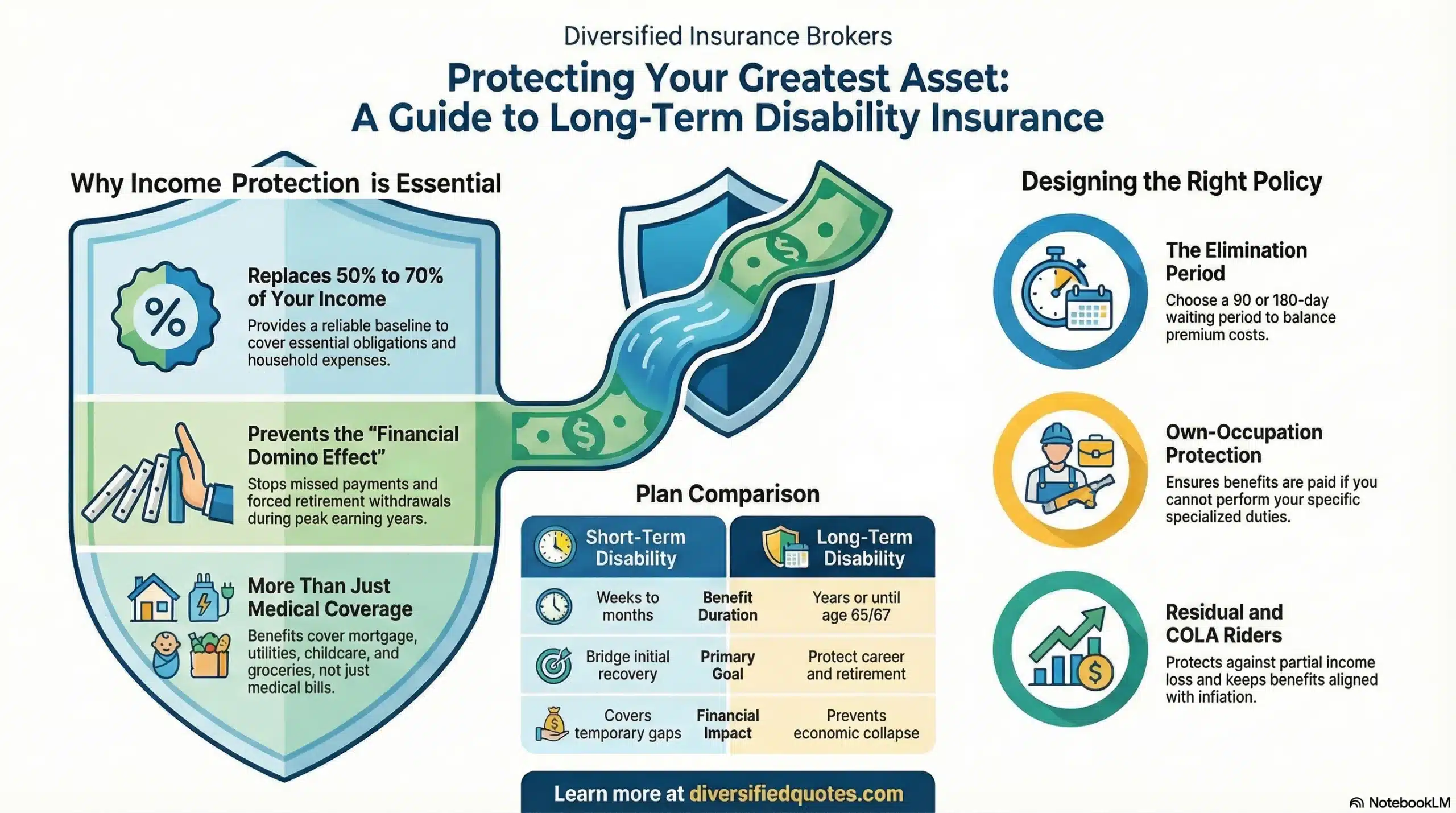
A residual disability rider does not operate in isolation — it is most effective when combined with other policy provisions and riders that address the full spectrum of income protection needs over a working career. The cost-of-living adjustment (COLA) rider is particularly relevant during extended disability claims, including residual claims: it increases the benefit amount annually during a long-term claim to partially offset the purchasing power erosion that occurs when fixed benefits are paid over many years. For a professional who experiences a residual disability early in their career and requires benefits for an extended period, the COLA rider can prevent the real-dollar value of the benefit from declining significantly relative to its purchasing power at the time the policy was purchased.
The future purchase option (FPO) rider — also called a benefit increase option or future insurability option by different carriers — allows the policyholder to increase the policy’s monthly benefit amount at specified future dates without new medical underwriting. For professionals early in their career whose income will grow significantly over time, this rider ensures that disability coverage grows alongside income without requiring the policyholder to requalify medically as their health status evolves. Without this provision, income growth creates a gap between the coverage level purchased at policy issue and the income protection that would be needed if a disability occurred at a later, higher-income point in the career. For professionals in residual-disability-risk occupations — physicians, attorneys, commissioned sales professionals, business owners — the FPO rider is a planning essential rather than a nice-to-have addition. Our resources on disability insurance for new professionals, disability insurance for pilots, and the broader second-opinion disability quote review all cover how these rider combinations interact in the complete policy design.
Common Claim Scenarios Where Residual Benefits Apply
Understanding residual benefits in theory is one thing; seeing how they apply in real scenarios clarifies why the coverage matters. A surgeon who develops essential tremor that limits the number of surgical procedures performed per week but does not prevent all surgical work would typically qualify for residual benefits based on both loss of duties (specific procedures are no longer safely performable) and loss of income (surgical volume is reduced). The benefit is proportional to the income reduction, continues as long as the condition persists and income remains below the pre-disability baseline, and — with a recovery benefit provision — may continue for a defined period after the condition stabilizes if income has not fully recovered. A dentist who experiences a repetitive strain injury affecting fine motor control presents a similar scenario: partial limitation of the specific skills that generate dental income, proportional income loss, and a recovery trajectory that may lag the physical recovery by months as the practice rebuilds from any patient attrition during the limited-capacity period.
Commission-based professionals — financial advisors, real estate agents, insurance producers, sales representatives — present the clearest cases for recovery benefit importance. When a medical condition reduces their client-facing capacity for six to twelve months, the income impact begins immediately and does not end the day the doctor clears them to return to work. The client relationships lost to competitors, the pipeline momentum interrupted, and the referral network that requires active rebuilding all produce an income recovery arc that extends well past medical recovery. An enhanced residual rider with recovery benefit continues paying a proportional benefit during this transition. Without it, the claimant faces their most financially precarious period — health recovered, benefits terminated, income not yet restored — precisely when continued support would have the greatest impact. The long-term financial planning implications of disability — its interaction with retirement savings timelines, investment contributions, and debt service — are important context for understanding why disability coverage is foundational rather than supplementary. Our resources on annuity vs. 401(k) for retirement and the life insurance for high-risk occupations resource cover how disability planning intersects with the broader financial protection architecture. For occupational situations involving legal or financial disputes related to income capacity, our resources on legal cash advances and advance on a pending lawsuit cover reactive funding options that underscore why proactive disability coverage is a far superior planning approach.
Talk With an Advisor Today
Choose how you’d like to connect—call or message us, then book a time that works for you.
Schedule here:
calendly.com/jason-dibcompanies/diversified-quotes
Licensed in all 50 states • Fiduciary, family-owned since 1980
FAQs: Residual Disability Insurance Benefits
What is residual disability insurance and how does it differ from total disability coverage?
Residual disability insurance (also called partial disability coverage) pays a proportional monthly benefit when a policyholder can still work but experiences a documented reduction in income due to a qualifying illness or injury. Total disability coverage pays the full monthly benefit only when the policyholder cannot perform the material and substantial duties of their occupation at all. The critical distinction is that residual coverage responds to partial impairment — the far more common disability scenario — while total coverage requires a binary determination that the policyholder cannot work. For most professionals and business owners, residual coverage is the feature they are most likely to actually use during a claim.
What income loss threshold triggers residual disability benefits?
The income loss threshold varies by policy design. Basic residual riders typically require at least a 20% reduction in income compared to the pre-disability baseline for benefits to begin. Enhanced residual riders typically lower this threshold to 15%, making it easier to qualify for benefits when the income loss is real but less severe. The income loss must be directly attributable to a qualifying medical condition — not to business market conditions, voluntary schedule reductions, or other non-medical factors. Some policies also require a loss of time or loss of duties in addition to income loss; others allow income loss alone to qualify.
How is the residual disability benefit amount calculated?
Residual benefits are typically calculated proportionally. The percentage of income lost during the disability period — measured against the established pre-disability income baseline — is applied to the policy’s monthly benefit amount. If a policyholder with a $10,000 monthly benefit loses 40% of pre-disability income due to a qualifying condition, the residual benefit is typically $4,000 per month. Some policies include a minimum benefit floor (often 50% of the monthly benefit) that applies when the income loss exceeds a high-loss threshold, preventing very high loss scenarios from producing disproportionately small benefits relative to the severity of the disability. Specific calculation methods vary by carrier and policy — always review the contract language.
What is a recovery benefit in a disability insurance policy?
A recovery benefit is a provision found in enhanced residual rider designs that continues paying disability benefits for a specified period after the underlying medical condition has resolved, as long as income has not yet returned to the pre-disability baseline. This feature is particularly valuable for commission-based earners, business owners, and fee-for-service professionals whose income recovery typically lags their physical recovery by months. Without a recovery benefit, disability benefits terminate when the doctor certifies medical recovery — leaving the claimant without support during what is often the most financially difficult phase of their return to full productivity. Not all disability policies include a recovery benefit; it is a specific rider feature to confirm when comparing policy options.
Are residual disability benefits taxable?
The tax treatment of residual disability benefits mirrors the tax treatment of total disability benefits under the same policy and is determined by who paid the premiums. When the policyholder pays individual disability insurance premiums with after-tax personal dollars, benefits received during a claim — including residual benefits — are generally received income-tax-free. When employer-paid premiums fund the disability coverage, benefits received are typically taxable income to the recipient. For high-income earners, this distinction materially affects the effective after-tax income replacement the policy provides, and is one reason individually funded disability coverage is often recommended alongside or instead of solely relying on employer-provided coverage. Consult a tax advisor for guidance specific to your situation.
Is residual disability coverage included automatically in disability policies?
It depends on the policy. Some modern long-term individual disability policies include residual coverage as a built-in contract feature, while others offer it as an optional rider that must be specifically added at application. In some occupation classes — particularly for physicians and other medical professionals — carriers may require the residual rider as part of the base policy. The presence, quality, and specific definition of residual coverage should never be assumed — it must be confirmed by reviewing the actual policy contract. When comparing disability policies from multiple carriers, explicitly confirm whether residual coverage is included, whether it is a basic or enhanced design, and whether a recovery benefit provision is part of the rider structure.
Why is residual coverage especially important for business owners?
Business owners face heightened residual disability risk for several reasons. Their income is driven by their direct production and involvement in business operations — any reduction in capacity affects revenue more immediately and more proportionally than for salaried employees. Their income documentation for establishing pre-disability baselines relies on tax returns and financial statements, which may require careful interpretation to accurately reflect actual earned income versus business expenses and distributions. Their income recovery after a disability typically depends on rebuilding client relationships, operational momentum, and team dynamics that were disrupted during the disability period — making the recovery benefit provision especially valuable. Business owners should work with a disability insurance specialist who understands business income documentation and how to structure coverage that performs correctly through both the active disability and the income recovery phases.
How does the own-occupation policy definition interact with residual disability benefits?
Own-occupation disability policies provide the strongest foundation for residual disability claims because they tie the disability determination to the policyholder’s specific occupation and duties rather than to a generic any-occupation standard. When residual disability benefits are embedded within a true own-occupation policy, the qualifying tests for partial impairment — loss of income, loss of time, or loss of duties — are evaluated against the policyholder’s specific occupational requirements. This specificity protects against the common carrier argument that a partially disabled professional can perform some different occupation and therefore does not qualify for disability benefits. Policies that switch from own-occupation to any-occupation definitions after the first 24 months of a claim can create complications for residual claimants, which is why lifelong own-occupation definitions are preferred for high-income professionals evaluating comprehensive disability coverage.
About the Author:
Jason Stolz, CLTC, CRPC, DIA, CAA and Chief Underwriter at Diversified Insurance Brokers (NPN 20471358), is a senior insurance and retirement professional with more than 25 years of real-world experience helping individuals, families, and business owners protect their income, assets, and long-term financial stability. As a long-time partner of the nationally licensed independent agency Diversified Insurance Brokers, Jason provides trusted guidance across multiple specialties—including fixed and indexed annuities, long-term care planning, personal and business disability insurance, life insurance solutions, Group Health, Travel Medical and Evacuation Insurance, and short-term health coverage. Diversified Insurance Brokers maintains active contracts with over 100 highly rated insurance carriers, ensuring clients have access to a broad and competitive marketplace.
His practical, education-first approach has earned recognition in publications such as VoyageATL, and contributions from his agency featured in Kiplinger and GoBankingRates— highlighting his commitment to financial clarity and client-focused planning. Drawing on deep product knowledge and years of hands-on field experience, Jason helps clients evaluate carriers, compare strategies, and build retirement and protection plans that are both secure and cost-efficient. Visitors who want to explore current annuity rates and compare options across multiple insurers can also use this annuity quote and comparison tool.
Explore More Disability Insurance Options: Browse our complete guide to Disability Insurance Planning & Education — covering how it works, riders, elimination periods, own occupation, costs & buying guides from 100+ carriers.
Last Reviewed: June 2, 2026 |
Reviewed by: Jason Stolz, CLTC, CRPC, DIA, CAA
Chief Underwriter, Diversified Insurance Brokers, Inc. | NPN: 20471358 | Diversified Insurance Brokers, Inc. — Licensed in all 50 states
Fact Checked by: Tonia Pettitt, CMIP©
Medicare Specialist, Diversified Insurance Brokers, Inc. | NPN: 14374308 | Diversified Insurance Brokers, Inc. — Licensed in all 50 states
Did you find this content helpful? Leave us a Google review — it helps others find trustworthy guidance too.
Editorial Standards: Diversified Insurance Brokers maintains rigorous editorial standards to ensure accuracy, clarity, and independence in all content. Learn more about our editorial standards and commitment to transparency.
