
Disability Insurance for Pilots
As an Independent Disability Insurance Broker, we have access to exclusive discounts and negotiated pricing most captive agents can’t offer — see the full breakdown near the end of this page.
Disability Insurance for Pilots

Jason Stolz CLTC, CRPC, DIA, CAA
Disability insurance for pilots is one of the most misunderstood coverage decisions in professional insurance planning — not because the concept is complicated, but because most agents approach it the wrong way. Standard disability insurance is built around a medical definition of disability: can you perform the duties of your occupation because of a sickness or injury? For most professionals, that framework works. For pilots, it creates a critical gap. The FAA does not use the insurance industry’s definition of disability. The FAA uses medical certification standards, and a pilot can lose their certificate — and their income — from a condition that would allow virtually any other professional to keep working. Hypertension, certain cardiac arrhythmias, neurological events, vision changes, sleep apnea findings, specific medications — any of these can trigger a grounding that ends a pilot’s income immediately, without meeting a standard disability policy’s definition of disabling illness. Understanding this gap is the first step to protecting a pilot’s income correctly. And protecting that income correctly requires understanding two distinct insurance categories: traditional own-occupation disability insurance and Loss of License coverage — and how they work together to create a complete protection plan.
The stakes are unusually high for aviation professionals because the income replacement gap is unusually large. A commercial airline captain earning $250,000–$400,000 annually who loses their First Class medical certificate from a cardiovascular event cannot replace that income flying a desk. A corporate pilot who becomes grounded from a knee injury may be physically capable of other work but facing a 60–80% income reduction compared to what aviation was generating. For both, the answer is not a generic “disability policy” from a general agent — it is a purpose-built strategy that accounts for FAA medical realities, the structure of aviation income, and the specific underwriting approach each carrier takes toward aviation occupations. At Diversified Insurance Brokers, we specialize in disability insurance for high-risk and specialized professions through our dedicated independent disability insurance broker approach — which means comparing across carriers rather than presenting one company’s shelf. Our resource on disability insurance for high-risk occupations provides the broader framework for specialty occupation planning, and this page applies that framework specifically to pilots.
For pilots who are also evaluating life insurance for aviation professionals, the underwriting overlap is significant: the same medical history, certification status, and flight duty profile that affects disability underwriting also shapes life insurance availability and pricing. Pilots planning their comprehensive income and asset protection strategy should address both products with carriers that have genuine aviation appetite — not general market carriers who treat aviation as an exclusion by default. Our disability insurance services overview provides the foundational context for how individual disability income insurance works before the aviation-specific nuances apply, and our resource on own-occupation disability insurance covers the critical definition-of-disability question that is most consequential for pilots.
Request a Pilot Disability Insurance Quote
Compare coverage designed for FAA medical risk, specialty occupations, and variable income — built for how pilots actually earn and lose income. Independent comparison, no obligation.
Get a Pilot Disability QuoteThe Critical Distinction — Traditional Disability Insurance vs. Loss of License Coverage
The most important concept in pilot disability planning is the distinction between two fundamentally different coverage structures: traditional individual disability income (IDI) insurance and Loss of License (LOL) insurance. These products are not interchangeable, and most pilots who rely exclusively on one are incompletely protected. Understanding how each works — and where each falls short for aviation professionals — is the foundation of building a plan that actually pays when a grounding occurs.
Traditional individual disability income insurance pays benefits when a covered sickness or injury prevents the insured from performing the material and substantial duties of their occupation. The trigger is a medical condition that causes functional limitation. For pilots with strong own-occupation language, this means the policy pays if they cannot perform pilot duties due to illness or injury — regardless of whether they could work in another field. The limitation for pilots is that not every grounding event constitutes a “disability” in the insurance policy’s terms. A pilot grounded for elevated blood pressure that is medically manageable, or for a medication that disqualifies them from medical certification but doesn’t actually impair function, may not trigger a traditional disability policy’s benefit — because they aren’t “disabled” in the functional sense the policy contemplates. They simply no longer hold an active medical certificate.
Loss of License insurance was specifically designed to close this gap. LOL policies pay benefits when a pilot loses their FAA medical certificate due to illness, injury, or a medical condition — regardless of whether that condition constitutes traditional disability. The trigger is the certificate loss, not functional impairment. This covers the grounding scenarios that traditional disability policies may miss: cardiovascular conditions managed medically, vision or hearing changes that fail FAA standards, neurological findings that trigger administrative grounding, or medications that are disqualifying under FAA rules. The table below summarizes the key differences between these two coverage structures.
| Feature | Traditional DI (Own-Occupation) | Loss of License (LOL) Insurance |
|---|---|---|
| Trigger for Benefits | Sickness or injury preventing occupational duties | Loss of FAA medical certificate for any medical reason |
| Covers Regulatory Grounding? | Not always — depends on policy language | Yes — certificate loss is the trigger |
| Covers Functional Disability? | Yes — primary purpose | Only if tied to certificate loss |
| Benefit Period | To age 65 or 67 (long-term) | Often 2–5 years; some long-term options |
| Residual/Partial Benefit | Available via rider | Less common; product-dependent |
| Carrier Availability | Multiple carriers with aviation appetite | Specialty market; fewer carriers |
| Best Used For | Long-term income replacement if permanently disabled | FAA-specific grounding risk, including temporary loss |
| Tax Treatment of Benefits | Tax-free if personally paid premiums | Tax-free if personally paid premiums |
The optimal protection strategy for most professional pilots combines both structures: a traditional own-occupation individual disability policy for long-term income replacement if a permanent disability occurs, layered with Loss of License coverage to address the FAA-specific grounding risk that the traditional policy may not fully cover. These two products work together rather than substituting for each other, and the combined premium for an appropriately structured plan is typically justifiable against the income replacement risk a pilot faces. Understanding how these structures interact is core to what we do in pilot disability planning at Diversified Insurance Brokers.
What Grounds Pilots — Common Causes of FAA Medical Certificate Loss
The FAA medical certification system is designed to screen for conditions that could affect a pilot’s ability to safely perform aviation duties — a standard that is far more stringent than what disability policies typically require. The leading causes of pilot grounding — and therefore the scenarios that create income loss — span several medical categories that pilots should understand before evaluating coverage.
Cardiovascular conditions represent the most common category of pilot grounding. Hypertension requiring certain medications, cardiac arrhythmias, coronary artery disease, history of myocardial infarction, and other cardiac findings can trigger FAA action ranging from temporary grounding for evaluation to permanent disqualification. Neurological conditions — including TIA, seizure disorders, certain brain injuries, and conditions requiring neurologically active medications — are a second major category. Vision and hearing changes that fall below FAA standards for either First or Second Class certification create grounding regardless of the underlying condition’s severity. Sleep apnea, particularly when identified through formal testing and requiring treatment, has become an increasingly common grounding factor as FAA has tightened its protocols around sleep disorder evaluation. Orthopedic injuries — particularly those requiring certain pain medications during recovery — can cause temporary grounding even when recovery is expected to be complete. Mental health conditions and certain psychiatric medications are also subject to FAA review, and the disclosure and evaluation process can create income gaps during the certification process even when the pilot ultimately returns to the cockpit.
Each of these categories illustrates why pilots need coverage that responds to FAA medical realities rather than just functional disability. A pilot with successfully treated hypertension who nonetheless loses First Class certification has experienced a financial disability even if they are fully functional in every other respect. Structuring coverage around this reality — rather than around what standard disability policies assume — is the core of competent pilot disability planning. For context on how major health events like cardiovascular conditions affect insurance underwriting more broadly, our resource on life insurance after a heart attack provides parallel underwriting insight applicable to pilots navigating complex medical histories.
FAA Medical Certificate Classes — How Certification Tier Affects Coverage Design
The FAA issues three classes of medical certificates, each with different standards and different implications for disability planning. First Class medical certification is required for airline transport pilots (ATPs) flying for commercial airlines. Second Class is required for commercial pilots flying for compensation or hire outside the ATP framework. Third Class is required for private pilots flying non-commercially. Each class has progressively more lenient standards — but from a disability planning perspective, the most important distinction is between First Class (airline) and Second Class (commercial), because a pilot who loses First Class certification may retain Second Class and therefore retain limited flying capability, just not at the airline level. This creates a partial income loss scenario that a well-designed plan must address.
For airline pilots specifically, the loss of First Class certification — even temporarily — can mean immediate loss of position at a major carrier. Airlines are not required to hold positions for grounded pilots indefinitely, and the return-to-fly timeline for medical certification can extend months or years depending on the condition. Loss of License coverage that begins paying benefits relatively quickly after grounding — with elimination periods as short as 30 days for some products — is specifically designed for this scenario. Traditional DI policies with 90-day or 180-day elimination periods may leave meaningful income gaps in a temporary grounding scenario, which is why short-term LOL coverage layered under long-term DI is a common and effective pilot protection structure.
Aviation Pilot Types — Underwriting Differences That Affect Your Coverage Options
Not all pilots are underwritten identically. Disability carriers differentiate between aviation roles based on income stability, duty type, aircraft operated, flight hours, and risk exposure. Understanding how your specific role is evaluated helps set realistic expectations for what coverage is available, at what cost, and with what structure.
Airline transport pilots (ATP) at major, regional, or cargo carriers typically have structured, documented income and predictable duty cycles. Income verification is straightforward, and the underwriting risk is well-understood by carriers with aviation programs. The primary complexity is the First Class medical standard and the income replacement calculation, since pilot compensation often includes base pay, per diem, and bonuses that need to be correctly aggregated for benefit amount purposes. Corporate and charter pilots (Part 91 and Part 135) present more variable underwriting profiles — irregular schedules, diverse aircraft types, variable income documentation, and sometimes a combination of flight and non-flight compensation. Benefit amount calculations require careful income verification, and occupation-definition language must account for both the flight duties and any ground-based income component that would survive a grounding. Flight instructors (CFI, CFII, MEI) earn income through instruction that may or may not require an active medical certificate depending on ground vs. flight instruction roles, creating a nuanced coverage conversation about exactly what income is at risk and what the grounding trigger should be. Military pilots transitioning to civilian aviation frequently need individual coverage because military disability programs are structured around military pay tables and may not account for the income trajectory of a civilian aviation career. They may also have health documentation needs that require careful coordination with underwriters who understand military medical record structures.
Own-Occupation Definition — Why Policy Language Is the Pilot’s Most Critical Coverage Variable
The definition of disability in an individual policy determines when benefits are payable. For pilots, this language is the single most consequential factor in coverage design — not the carrier name, not the benefit amount, and not the premium. A policy that pays benefits only when you cannot perform any occupation provides almost no protection for a high-income pilot who can teach, consult, or work in aviation-adjacent roles. A policy with strong own-occupation language pays benefits if you cannot perform the material and substantial duties of your specific occupation — flying — even if you are capable of working elsewhere in some capacity. Our resource on own-occupation disability insurance explains how this definition works in policy language and why it matters so much for specialized professions.
The ideal disability policy for a pilot includes own-occupation language that identifies flying as the occupation and does not offset benefits based on income earned in non-aviation roles. This allows a grounded pilot to teach ground school, consult for aviation businesses, or work in an administrative aviation role without losing disability benefits — because the occupation defined in the policy is specifically flying, not “aviation-related work.” This language varies by carrier and product, and it must be reviewed explicitly before purchase. Some policies that appear to be “own-occupation” contain modified definitions that can significantly weaken protection for pilots who pivot to alternative work after grounding. Reviewing the actual policy contract language — not the marketing brochure summary — is non-negotiable for any pilot evaluating disability coverage.
Group and Employer Disability Plans — What They Provide and Where They Fall Short
Many commercial airline pilots have access to Long-Term Disability (LTD) through ALPA, airline benefit packages, or other union agreements. These plans provide a baseline layer of protection, but they carry limitations that individual coverage is specifically designed to address. Group LTD plans frequently cap benefits at a dollar amount significantly below the income replacement need of a senior captain or First Officer. They may define disability in ways less favorable than individual own-occupation policies. Benefits from employer-funded plans are taxable if the employer paid the premiums — reducing net monthly income during a claim. Group plans offer no portability: if you change carriers, leave a union, or transition between employers, the coverage disappears. They also cannot be customized with the riders — residual/partial disability, future purchase options, cost-of-living adjustments — that make individual coverage far more comprehensive.
The appropriate strategy for most pilots with access to group coverage is to use it as a base layer, not a complete solution, and supplement it with individually owned coverage that addresses the gaps. Individual disability coverage is medically underwritten at the time of purchase — which means the earlier a pilot applies while in good health, the better the terms they can lock in permanently. Waiting until health issues emerge significantly limits options and may result in exclusions or inability to qualify. For pilots evaluating how much individual coverage to add above a group base, our resource on how much disability insurance do I need provides the income-gap calculation framework that drives the benefit amount decision.
Residual and Partial Disability — Coverage When Grounding Is Partial
Not every aviation medical event results in total permanent grounding. Pilots frequently experience partial grounding: reduced to Second Class from First Class, restricted to certain aircraft types, limited in duty hours, or transitioned to ground duties during a medical evaluation period. In each scenario, income may be reduced without being eliminated — creating a partial disability that traditional total disability benefits may not address. A residual or partial disability rider addresses this gap by paying benefits proportional to income loss when a medical event reduces earning capacity without eliminating it entirely. For pilots whose pay is tied to duty positions, aircraft types, or hours flown, this rider can be one of the most valuable components of the disability plan — because the financial pain of partial grounding often begins well before flying stops completely. Ensuring the plan includes this rider, and that the rider is structured appropriately for aviation income patterns, is part of every disability strategy review we conduct at Diversified.
Key Riders for Pilot Disability Policies
Beyond the base policy and residual rider, several additional provisions are particularly valuable for pilots. A Future Purchase Option (FPO) or Guaranteed Insurability Option (GIO) allows the pilot to increase their benefit amount in the future — based on income growth — without additional medical underwriting. This is critical for younger pilots at the early stages of earnings growth: locking in insurability at current health standards before any medical history develops preserves the ability to increase coverage as income grows to the six-figure range and above. A Cost of Living Adjustment (COLA) rider increases monthly benefits during a claim period to keep pace with inflation. For pilots who experience a permanent grounding in their 40s or 50s, a COLA provision can meaningfully protect purchasing power over a multi-decade benefit period. Return to Work Incentive provisions can support gradual return to aviation duties without immediately eliminating benefits, which is valuable for pilots navigating FAA recertification timelines after a medical event.
Tax Treatment of Pilot Disability Benefits
When individual disability insurance premiums are paid with after-tax personal dollars, the monthly benefits received during a claim are generally income-tax-free. This makes individually owned disability coverage an extremely efficient income replacement tool for pilots in high federal tax brackets — because the benefit amount needed to maintain purchasing power is lower than the gross income replacement figure would suggest on a pre-tax basis. If employer or union LTD plan premiums are paid by the employer or funded pre-tax, benefits from those plans are taxable — creating a net income gap even if the stated benefit percentage appears sufficient. Understanding how each layer of your disability plan is funded — and what the after-tax benefit amounts actually are — is essential to correctly modeling the income replacement adequacy of your overall plan. For pilots with complex compensation structures (base + per diem + bonuses + 401(k) contributions), the net after-tax income replacement calculation requires more detailed modeling than a simple percentage of base salary.
Related Pages
Get a Policy Built Around FAA Reality
We’ll help you compare occupation wording, Loss of License vs. traditional DI structures, residual protection, and benefit design — so your coverage responds the way pilots actually need it to.
Request a Pilot Disability Review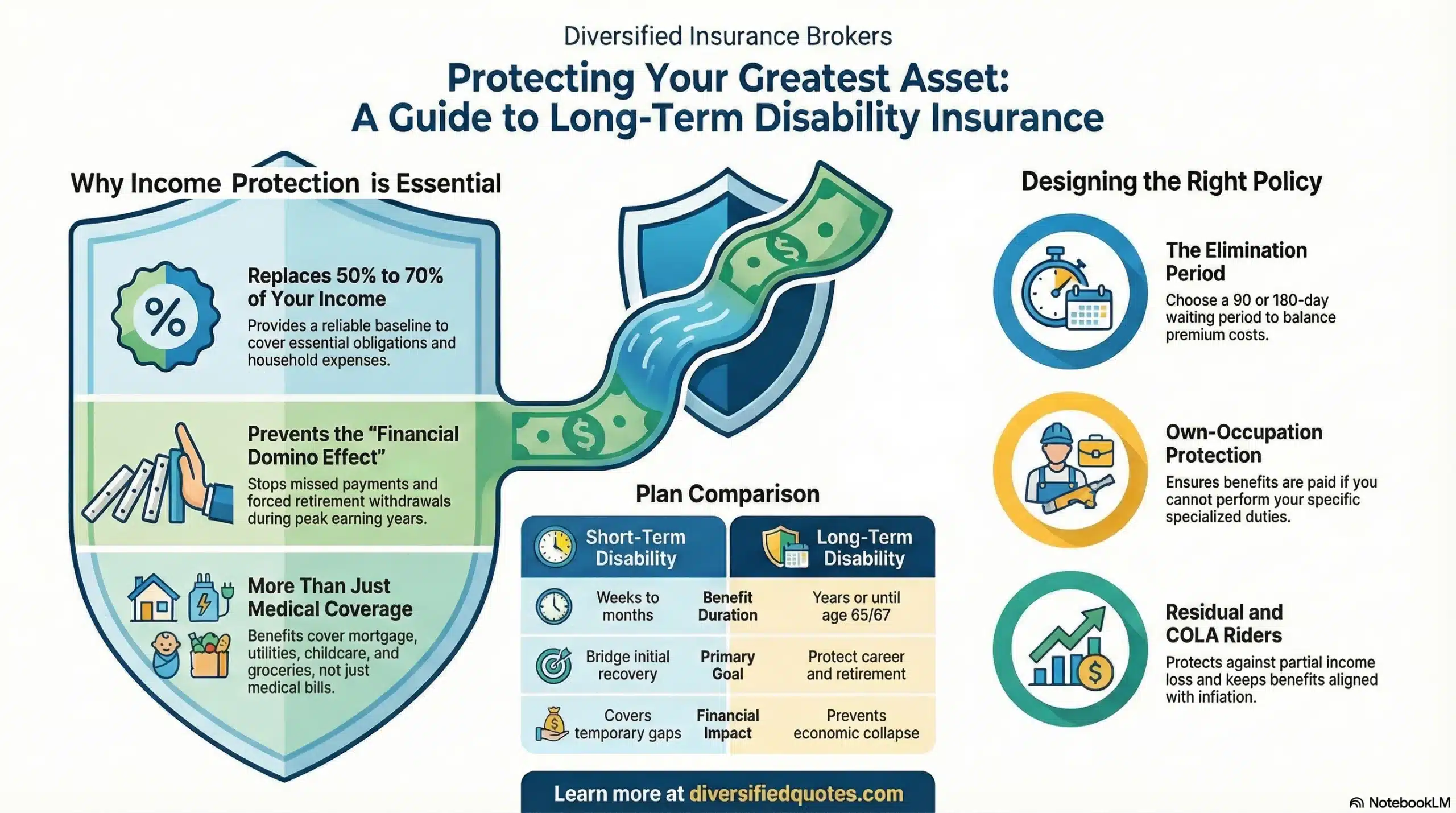
Talk With an Advisor Today
Choose how you’d like to connect—call or message us, then book a time that works for you.
Schedule here:
calendly.com/jason-dibcompanies/diversified-quotes
Licensed in all 50 states • Fiduciary, family-owned since 1980
FAQs: Disability Insurance for Pilots
What is the difference between traditional disability insurance and Loss of License insurance for pilots?
Traditional disability insurance pays benefits when a sickness or injury prevents you from performing your occupational duties. Loss of License (LOL) insurance pays benefits when you lose your FAA medical certificate due to a medical condition — even if that condition doesn’t meet the functional disability threshold a traditional policy requires. Many conditions that trigger FAA grounding (hypertension managed with certain medications, neurological findings, vision changes, sleep apnea) may not constitute traditional disability, but they eliminate aviation income just as effectively. Most pilots benefit from carrying both: traditional DI for long-term income replacement if permanently disabled, and LOL coverage for FAA-specific grounding risk.
Can pilots qualify for own-occupation disability insurance?
Yes, but carrier availability and policy language vary significantly by aviation role. Airline transport pilots at commercial carriers generally have access to the strongest own-occupation coverage options. Corporate pilots, charter pilots, flight instructors, and contract pilots can qualify but may face more limited carrier options depending on their specific duty profile, aircraft type, and income documentation. The most important variable is the policy’s definition of disability — the language must specifically protect aviation duties, not just generic occupational duties. An agent with genuine aviation underwriting experience is essential to placing the right coverage with the right carrier.
Does disability insurance cover loss of FAA medical certification?
Traditional disability insurance may or may not cover FAA medical certificate loss depending on the cause and the specific policy language. If the grounding is triggered by a condition that also meets the policy’s functional disability definition, traditional DI may pay. If the grounding is regulatory — the pilot lost certification due to a condition that doesn’t impair function but fails FAA standards — traditional DI may not trigger. Loss of License insurance specifically covers FAA certificate loss regardless of whether functional disability exists, making it the purpose-built solution for this gap. The combination of both structures provides the most complete protection.
Are aviation duties excluded from standard disability policies?
Some carriers may add aviation exclusions for certain pilot profiles, particularly those flying in higher-risk categories. However, many carriers with aviation underwriting experience offer pilot coverage without exclusions, especially when the application is positioned correctly and the occupational class fits underwriting guidelines. The presence or absence of an aviation exclusion — and exactly what activities are excluded — must be confirmed in the actual policy language before purchase. This is one reason working with an independent broker who specializes in aviation occupation underwriting matters: placing the application with the right carrier from the start prevents exclusions that a less aviation-aware agent might accept without challenge.
What does a residual disability rider do for pilots?
A residual or partial disability rider pays benefits proportional to income loss when a medical event reduces earning capacity without eliminating it entirely. For pilots, this covers scenarios where a grounding reduces hours, restricts aircraft type, requires a position change to lower-pay duties, or results in partial grounding during an FAA evaluation period. Since pilot compensation is often tied to duty position, flight hours, and aircraft type, a partial income loss from a medical event can be substantial without meeting the total disability threshold. The residual rider addresses this gap and is one of the most valuable components of a comprehensive pilot disability plan.
How is pilot income calculated for disability benefit amounts?
Disability benefit amounts are based on earned income, and for pilots this calculation can be more complex than a simple base salary figure. Commercial airline pilots earn base pay plus per diem, potential overtime, and bonuses. Corporate and charter pilots may have variable compensation that fluctuates significantly year to year. Most disability carriers use a trailing 12-to-24-month income average for benefit amount calculations, and per diem may or may not be included depending on the carrier’s financial underwriting guidelines. The benefit amount target is typically 50%–70% of earned income, with the goal of replacing net take-home after considering the tax-free nature of individually owned disability benefits. An experienced disability broker will help calculate the accurate income base and maximum insurable amount before applying.
What health conditions most commonly affect pilot disability underwriting?
Disability underwriters for pilot cases typically focus on cardiovascular history (hypertension, arrhythmias, coronary artery disease), neurological history (TIA, seizure history, certain medications), vision and hearing stability, sleep apnea screening or treatment status, orthopedic conditions particularly affecting hands, wrists, and spine, mental health treatment history, and prescription history. None of these automatically disqualify a pilot from coverage — but each requires clear documentation, consistent medical narrative, and the right carrier match. A prior medical issue that was resolved, well-documented, and stable often underwrites better than a vague or inconsistent medical history. Applying with aviation-experienced underwriters who understand FAA certification context is critical for accurate risk assessment.
Is employer or union disability coverage enough for airline pilots?
Employer and union LTD plans (including ALPA-affiliated programs) provide a helpful base layer, but most pilots find they fall short as a complete solution. Group plans typically have benefit caps that leave senior pilots significantly underinsured, may define disability less favorably than individual own-occupation policies, produce taxable benefits when employer-funded, and are not portable when you change airlines or leave the union. Individual disability coverage supplements group plans by adding portability, stronger contract language, custom riders, and benefit amounts that match actual income replacement needs. The earlier a pilot locks in individual coverage based on current health, the better — underwriting is more favorable with a clean medical history, and future health changes cannot affect a policy already in force.
About the Author:
Jason Stolz, CLTC, CRPC, DIA, CAA and Chief Underwriter at Diversified Insurance Brokers (NPN 20471358), is a senior insurance and retirement professional with more than 25 years of real-world experience helping individuals, families, and business owners protect their income, assets, and long-term financial stability. As a long-time partner of the nationally licensed independent agency Diversified Insurance Brokers, Jason provides trusted guidance across multiple specialties—including fixed and indexed annuities, long-term care planning, personal and business disability insurance, life insurance solutions, Group Health, Travel Medical and Evacuation Insurance, and short-term health coverage. Diversified Insurance Brokers maintains active contracts with over 100 highly rated insurance carriers, ensuring clients have access to a broad and competitive marketplace.
His practical, education-first approach has earned recognition in publications such as VoyageATL, and contributions from his agency featured in Kiplinger and GoBankingRates— highlighting his commitment to financial clarity and client-focused planning. Drawing on deep product knowledge and years of hands-on field experience, Jason helps clients evaluate carriers, compare strategies, and build retirement and protection plans that are both secure and cost-efficient. Visitors who want to explore current annuity rates and compare options across multiple insurers can also use this annuity quote and comparison tool.
Explore More Disability Insurance Options: Browse our complete guide to Disability Insurance for Public Safety, Military & Government — covering firefighters, law enforcement, military, pilots, TSA, SWAT & first responders from 100+ carriers.
Last Reviewed: June 1, 2026 |
Reviewed by: Jason Stolz, CLTC, CRPC, DIA, CAA
Chief Underwriter, Diversified Insurance Brokers, Inc. | NPN: 20471358 | Diversified Insurance Brokers, Inc. — Licensed in all 50 states
Fact Checked by: Tonia Pettitt, CMIP©
Medicare Specialist, Diversified Insurance Brokers, Inc. | NPN: 14374308 | Diversified Insurance Brokers, Inc. — Licensed in all 50 states
Did you find this content helpful? Leave us a Google review — it helps others find trustworthy guidance too.
Editorial Standards: Diversified Insurance Brokers maintains rigorous editorial standards to ensure accuracy, clarity, and independence in all content. Learn more about our editorial standards and commitment to transparency.
