
Disability Insurance for Armed Forces and Military
As an Independent Disability Insurance Broker, we have access to exclusive discounts and negotiated pricing most captive agents can’t offer — see the full breakdown near the end of this page.
Disability Insurance for Armed Forces and Military

Jason Stolz CLTC, CRPC, DIA, CAA
Disability insurance planning for the armed forces and military requires understanding a fundamental distinction that most coverage discussions miss: the difference between service members who need government military benefit information and military professionals — physicians, dentists, attorneys, veterinarians, nurses, and chaplains — for whom individual civilian disability insurance is both available and critically important during and after service. Standard individual DI carriers cannot generally cover active duty combat service members due to war exclusions and the nature of military service. But the uniformed professionals who serve in specialized roles within the military face a specific financial planning problem that individual civilian disability insurance is uniquely designed to solve: the gap between what military disability systems provide and what their future civilian income potential actually represents. At Diversified Insurance Brokers, we help military professionals navigate this specific planning need — structuring coverage that coordinates with military benefits, protects future civilian earning potential, and ensures that a disability during military service does not eliminate the income trajectory that years of professional training were designed to produce. The broader income protection insurance framework covers how individual policies are structured for professionals in specialized high-earning roles.
The core issue for military professionals is straightforward: military disability systems — the Department of Defense Disability Evaluation System, the Integrated Disability Evaluation System (IDES), and the VA disability compensation system — are designed to compensate for service-connected conditions based on percentage ratings. They are not designed to replace the full civilian income potential of a physician who could earn $350,000 in private practice, a dentist who could earn $250,000, or a JAG attorney who could earn $180,000-$300,000 in private law. A 100% VA disability rating for any military professional produces the same monthly VA benefit regardless of their professional income potential — a flat compensation amount that may represent a small fraction of what they could earn in civilian practice. This is the income gap that individual civilian disability insurance addresses. The disability insurance by occupation framework covers how occupational class and coverage design is determined for the specialized professional roles that most commonly appear in military service.
Disability Insurance for Military Physicians, Dentists, Attorneys & Veterinarians
We compare individual disability insurance options that coordinate with military benefits and protect future civilian income potential for specialized military professionals.
Request Disability Insurance OptionsMilitary Professionals and Disability Insurance — Government Benefits, Coverage Gaps, and Individual Policy Design
| Military Professional Role | Government Benefit Structure | The Civilian Income Gap | Individual Coverage Priority |
|---|---|---|---|
| Military Physicians (AMEDD, Navy/USAF Medical Corps) | Military basic pay by rank/time in service; DoD/VA disability rating-based compensation for service-connected conditions; TRICARE for medical coverage; potential military retirement pension | Military physician salary: $120,000-$180,000 depending on rank; comparable civilian physician income: $250,000-$450,000+ for specialists; VA disability compensation does not bridge this gap and is service-connected only | Future Purchase Option rider at current military income; individual own-occupation policy covering inability to practice medicine regardless of service-connection; coverage designed to expand to civilian income levels at transition |
| Military Dentists (Dental Corps) | Same military pay structure as physicians; DoD/VA rating system for service-connected conditions; no specialty-specific income protection beyond rank-based pay | Military dentist salary: $100,000-$160,000; comparable civilian private practice income: $180,000-$320,000; fine motor hand dexterity is the career-defining physical capability most at risk for dentists in all settings | Own-occupation coverage defining disability as inability to perform dental procedures specifically; fine motor dexterity loss from any cause (not just service-connected) triggers benefits; FIO preserves expansion to civilian income without new underwriting |
| JAG Attorneys (Army/Navy/USAF Judge Advocate General) | Military basic pay by rank; DoD/VA rating for service-connected conditions; no attorney-specific income protection; some JAG personnel transition to civilian federal positions where FERS disability provisions apply | JAG attorney military salary: $80,000-$140,000; private sector legal income potential: $150,000-$400,000+ depending on practice area; cognitive ability to practice law at professional standard is the key income-dependent capability | Own-occupation coverage tied to legal practice functions; covers cognitive disability that prevents professional-level legal analysis and advocacy regardless of service connection; FIO critical for attorneys anticipating private practice transition |
| Military Veterinarians (Veterinary Corps) | Military basic pay; DoD/VA rating system; veterinary practice requires fine motor precision similar to dentistry; public health and food safety roles may also be available in civilian federal employment | Military veterinarian salary: $90,000-$150,000; civilian private practice income: $120,000-$250,000; specialty practices (surgery, emergency) at higher end; fine motor and cognitive disability risk profile similar to military dentists | Own-occupation language covering veterinary practice duties specifically; fine motor and cognitive impairment coverage; FIO preserving the right to protect higher civilian income as career transitions |
| Military Nurses & Healthcare Professionals | Military basic pay; TRICARE; DoD/VA disability rating for service-connected conditions; may transition to civilian nursing or advanced practice roles (NP, CRNA) with significantly higher income | Military nurse salary: $65,000-$110,000; civilian nurse/NP income: $80,000-$140,000; CRNA transition income: $170,000-$230,000+; military disability provisions do not address lost civilian CRNA or advanced practice income potential | Coverage at current income with FIO to cover projected post-transition income; own-occupation definition that distinguishes nursing specialty from general healthcare work; particularly important for military nurses planning CRNA or NP paths |
Understanding the VA and DoD Disability Systems — What They Cover and What They Don’t
Military disability benefits operate through two interrelated systems. The Department of Defense Disability Evaluation System — implemented through the Integrated Disability Evaluation System (IDES) that combines DoD and VA evaluations — determines whether a service member can return to full duty, separates them or retires them for disability, and assigns a DoD disability rating. The VA disability compensation system provides tax-free monthly payments to veterans for service-connected conditions, using percentage ratings (10-100%) in 10% increments to determine the monthly benefit amount. VA disability rates received a 2.8% COLA increase effective December 2025, and current 2026 rates reflect that adjustment. The critical limitation of both systems for military professionals is the same: benefits are calibrated to service-connected conditions and expressed as percentage-based compensation, not as income replacement designed to reflect the professional’s specific earning potential. A 100% disabled military physician receives the same monthly VA benefit as a 100% disabled enlisted specialist — a flat amount that bears no relationship to the income either person would earn in their respective civilian careers. This is not a design flaw in the VA system; it is a feature of what the system was built to accomplish. But it does mean that professional military personnel face a specific financial gap that the VA system was never intended to address, and that individual civilian disability insurance fills. The parallel situation for other government workers is documented across other government-employment roles: TSA employees, FBI agents, and federal law enforcement officers all face the same fundamental gap between government disability provisions and actual full income replacement. The physical risk dimension that military service adds on top of the standard professional disability risk profile is covered at disability insurance for high-risk occupations.
What Individual Civilian Disability Insurance Covers That Military Systems Don’t
Individual civilian disability insurance addresses two specific gaps that neither the DoD disability system nor VA compensation resolves. First, individual DI covers disability from any cause — not just service-connected conditions. A military physician who develops a neurological condition unrelated to service, experiences a vehicle accident, or develops depression that prevents practice is protected by an individual civilian policy regardless of whether the condition has any service connection. Government disability benefits only address service-connected conditions; individual DI covers everything. Second, individual DI can be structured to reflect the actual income potential of the professional’s career trajectory — both current military salary and projected civilian practice income — through the Future Increase Option rider that preserves the right to expand coverage without new medical underwriting. This matters most for military physicians in residency, JAG attorneys in their first commissioning years, and military dentists whose future civilian income will substantially exceed their current military compensation. The own-occupation dimension is critical throughout: an anesthesiologist who cannot administer anesthesia due to a hand tremor is disabled from their specialty regardless of other cognitive functions remaining intact; dentists who lose hand dexterity are disabled from dental practice regardless of other abilities; attorneys who cannot perform complex legal analysis due to cognitive impairment are disabled from legal practice regardless of physical capability. The own-occupation disability insurance framework covers why specialty-specific definitions matter for all of these professional roles — and why any-occupation language in government benefit systems fails to protect the specific career value these professionals have built.
The Future Income Protection Problem — The Most Important Planning Window
For most military professionals, the most valuable moment to purchase individual disability insurance is during the early years of military service — when the individual is young, healthy, and the premium is at its career-long low point — before any service-related health events or conditions could create exclusions on a future application. The Future Increase Option (FIO) rider purchased at a military physician’s salary of $130,000 creates the contractual right to expand that coverage to $250,000-$350,000 of protected income at civilian transition — without any new medical underwriting, regardless of what health events have occurred during military service. This is the specific planning mechanism that addresses the future income gap most directly: lock in the right to protect future civilian income while young and healthy, then exercise that right at transition regardless of health history. The civilian income potential protection framework for military physicians is at disability income insurance for doctors and physicians and the residency training period context is at disability insurance for medical residency. Military dentists transitioning to civilian practice face the same planning structure covered at disability insurance for dentists, and military veterinarians face the same transition income coverage problem at disability insurance for veterinarians. The military nursing profession transition — particularly for those pursuing CRNA or advanced practice paths — is addressed at disability income insurance for nurses.
Policy Design for Military Professionals
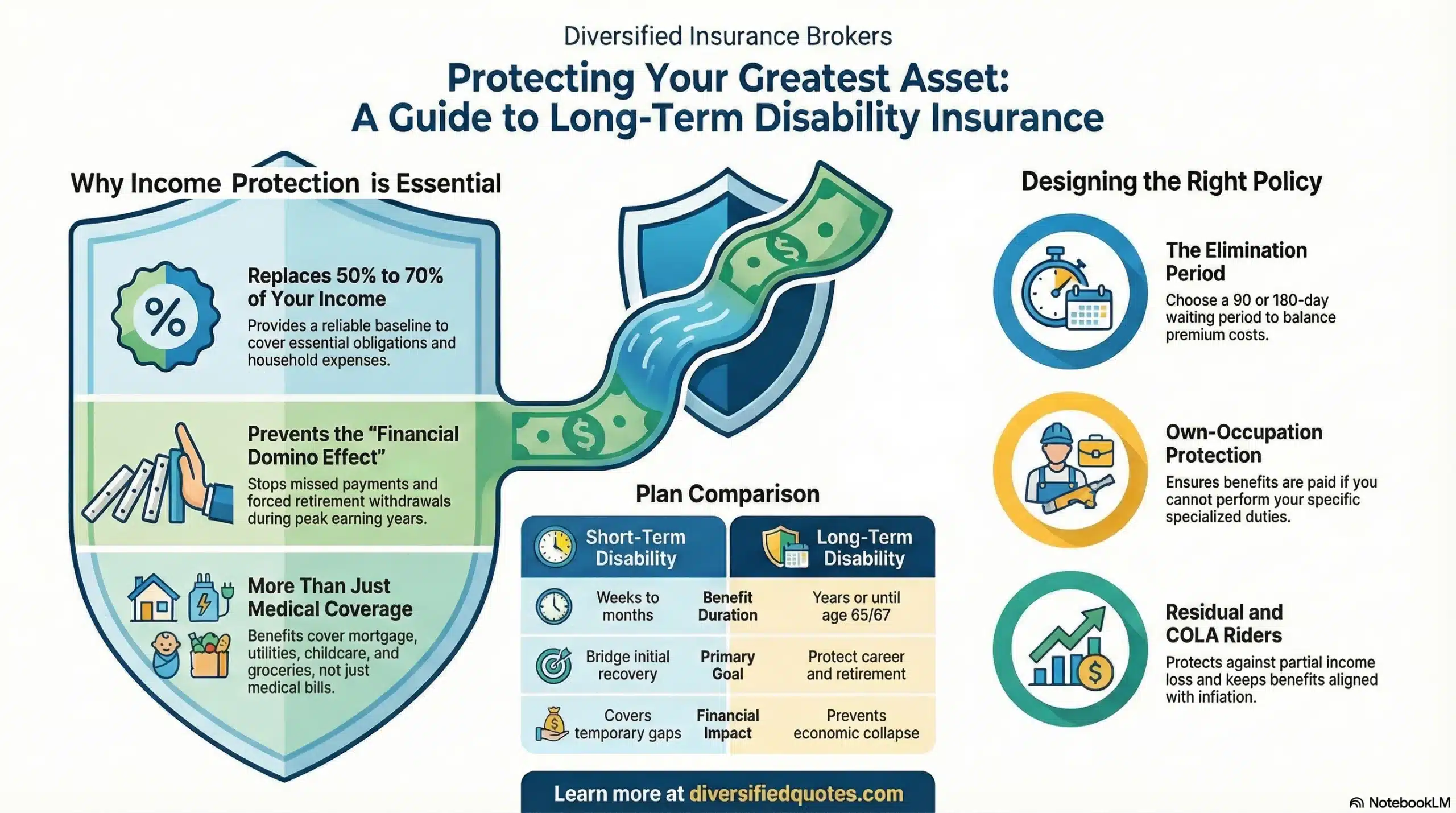
The benefit period for a military professional’s individual disability policy should extend to retirement age — long-term disability insurance to age 65 protects against career-ending conditions across the full professional career. The elimination period for military professionals should account for available military sick leave and any short-term income continuation; a 90-day elimination period is typically appropriate when military income continues during a short-term health event. The residual disability rider captures partial income loss during recovery when professional performance is reduced but not eliminated — particularly relevant for physicians returning to practice at reduced capacity, dentists with partial hand function, or attorneys with partially impaired cognitive performance. The COLA rider protects purchasing power for long-duration benefits — important for military professionals whose career transitions may extend the income gap protection window over many years. The full rider framework is at disability insurance riders explained. The tax treatment of individually owned policy benefits — generally received income-tax-free with after-tax premium payment — is at are disability insurance payments taxable. Benefit sizing for military professionals coordinating individual coverage with VA and DoD benefit structures is at how much disability insurance do I need. For an independent evaluation of any existing or proposed policy, get a 2nd opinion on your disability insurance quote covers the review process.
Talk With an Advisor Today
Choose how you’d like to connect—call or message us, then book a time that works for you.
Schedule here:
calendly.com/jason-dibcompanies/diversified-quotes
Licensed in all 50 states • Fiduciary, family-owned since 1980
FAQs: Disability Insurance for Armed Forces and Military
Can active duty military members get individual disability insurance?
Active duty enlisted service members and combat-role officers generally cannot obtain standard individual civilian disability insurance due to war exclusions in most carrier policies. However, military professionals in specialized roles — physicians, dentists, JAG attorneys, veterinarians, nurses, chaplains, and similar healthcare and professional specialties — can typically obtain individual civilian disability insurance because their specific professional functions are insurable by carriers with military professional programs. The planning need is specifically acute for these professionals because their future civilian income potential substantially exceeds what military disability systems are designed to replace.
Why isn’t VA disability compensation sufficient for military professionals?
VA disability compensation is designed to compensate veterans for service-connected health conditions through a percentage rating system — it is not designed as a full income replacement mechanism. A 100% VA-disabled military physician earns the same monthly VA benefit as a 100% disabled enlisted soldier, regardless of the dramatically different civilian income potential these two individuals represent. VA compensation rates in 2026 reflect a 2.8% COLA increase, but even at 100% disability, monthly VA compensation is a fraction of what a physician, dentist, or attorney could earn in civilian practice. Additionally, VA compensation only covers service-connected conditions — illness or injury with no service connection receives no VA benefit at all. Individual civilian disability insurance covers any cause of disability and can be sized to reflect actual professional income potential.
Why is the Future Increase Option so critical for military physicians and dentists?
A military physician’s salary during service — typically $120,000-$180,000 depending on rank — may represent a fraction of their potential civilian practice income of $250,000-$450,000+. The Future Increase Option rider allows a policy purchased at the lower military income level to be expanded to protect the higher civilian income without new medical underwriting — regardless of what health conditions develop during military service. For a military physician who serves for 10 years and then transitions to civilian practice, any health event during those service years would otherwise create coverage limitations or exclusions on a new application. The FIO preserves the right to protect future income even when service-period health events would otherwise complicate that future coverage. This is arguably the most important feature in disability coverage for military professionals.
Does individual disability insurance coordinate with VA disability benefits?
Individual disability insurance is a private contract that in most cases does not reduce or offset VA disability compensation, and VA compensation generally does not reduce or offset individual DI benefits. The two systems operate independently. VA compensation is tax-free and based on service-connected condition ratings; individual DI benefits are generally tax-free when premiums are paid with after-tax personal funds. Having both does not create a problem in most individual policy designs — the combined income from both sources may still fall well short of full civilian income replacement for high-earning professionals. The specific coordination provisions should be confirmed in the actual policy language before purchase, as some group employer plans (not individual policies) may have offset provisions.
What is the best time during military service to purchase individual disability insurance?
As early as possible — ideally upon commissioning or entry into a professional military role — before any service-period health events can create exclusions, higher premiums, or declined applications. Premiums lock in at the issue age and do not increase with age alone. The mental and physical health effects of military service — including PTSD, musculoskeletal conditions, neurological events, and TBI — can accumulate over service years and create significant underwriting complications if individual DI is delayed. A military physician who completes 10 years of service before applying for individual DI may have a substantially different health profile than one who applied at the start of service. The FIO rider purchased early preserves future expansion rights; the decision to delay application can permanently limit the coverage available at transition.
About the Author:
Jason Stolz, CLTC, CRPC, DIA, CAA and Chief Underwriter at Diversified Insurance Brokers (NPN 20471358), is a senior insurance and retirement professional with more than 25 years of real-world experience helping individuals, families, and business owners protect their income, assets, and long-term financial stability. As a long-time partner of the nationally licensed independent agency Diversified Insurance Brokers, Jason provides trusted guidance across multiple specialties—including fixed and indexed annuities, long-term care planning, personal and business disability insurance, life insurance solutions, Group Health, Travel Medical and Evacuation Insurance, and short-term health coverage. Diversified Insurance Brokers maintains active contracts with over 100 highly rated insurance carriers, ensuring clients have access to a broad and competitive marketplace.
His practical, education-first approach has earned recognition in publications such as VoyageATL, and contributions from his agency featured in Kiplinger and GoBankingRates— highlighting his commitment to financial clarity and client-focused planning. Drawing on deep product knowledge and years of hands-on field experience, Jason helps clients evaluate carriers, compare strategies, and build retirement and protection plans that are both secure and cost-efficient. Visitors who want to explore current annuity rates and compare options across multiple insurers can also use this annuity quote and comparison tool.
Explore More Disability Insurance Options: Browse our complete guide to Disability Insurance for Public Safety, Military & Government — covering firefighters, law enforcement, military, pilots, TSA, SWAT & first responders from 100+ carriers.
Last Reviewed: June 6, 2026 |
Reviewed by: Jason Stolz, CLTC, CRPC, DIA, CAA
Chief Underwriter, Diversified Insurance Brokers, Inc. | NPN: 20471358 | Diversified Insurance Brokers, Inc. — Licensed in all 50 states
Fact Checked by: Tonia Pettitt, CMIP©
Medicare Specialist, Diversified Insurance Brokers, Inc. | NPN: 14374308 | Diversified Insurance Brokers, Inc. — Licensed in all 50 states
Did you find this content helpful? Leave us a Google review — it helps others find trustworthy guidance too.
Editorial Standards: Diversified Insurance Brokers maintains rigorous editorial standards to ensure accuracy, clarity, and independence in all content. Learn more about our editorial standards and commitment to transparency.
