
Disability Insurance for Acupuncturists
As an Independent Disability Insurance Broker, we have access to exclusive discounts and negotiated pricing most captive agents can’t offer — see the full breakdown near the end of this page.
Disability Insurance for Acupuncturists

Jason Stolz CLTC, CRPC, DIA, CAA
Acupuncture practice depends on a level of manual precision that is uncommon even among healthcare professions. Needle placement — at specific anatomical locations, to specific depths, at specific angles, requiring controlled threading, manipulation, and monitoring throughout treatment — demands steady hands, fine motor coordination, and tactile sensitivity that cannot be approximated through modified techniques if those capabilities are meaningfully impaired. A carpal tunnel condition, a tremor, a wrist injury, or a neurological condition affecting hand steadiness does not merely reduce an acupuncturist’s efficiency — it makes safe, effective needle placement impossible. That directness of exposure, from physical capability to clinical function to income, is what makes disability insurance planning unusually urgent for licensed acupuncturists. The disability insurance services available to allied healthcare practitioners address this specific income protection need, and the income protection insurance framework covers how individual policies are structured for clinicians whose earnings depend entirely on hands-on patient care.
The employment structure of acupuncture practice amplifies this exposure. The majority of acupuncturists are self-employed, operate their own clinic, or practice as independent contractors within integrative health or wellness settings. There is typically no employer-provided short-term or long-term disability coverage. No paid leave. No salary continuation during recovery. When an injury or illness prevents needle-placement work, income stops immediately — while practice overhead (clinic rent, staff, professional liability insurance, supplies, continuing education requirements, and licensing fees) continues. The individual disability policy is not a supplement to an existing benefit structure for most acupuncturists — it is the entire income protection plan, and it needs to be designed accordingly. At Diversified Insurance Brokers, we help acupuncturists build disability coverage that matches the clinical, financial, and professional reality of how they practice.
Compare Disability Insurance for Acupuncturists
We compare options across 100+ carriers and structure coverage around the manual precision demands and self-employed practice structure of acupuncture professionals.
Request Disability Insurance OptionsDisability Insurance for Acupuncturists — Occupational Class, Risk Profile, and Policy Design
| Coverage Dimension | The Acupuncturist Reality | What the Right Policy Design Looks Like |
|---|---|---|
| Occupational class | Licensed acupuncturists with graduate-level credentials (MACM, MSOM, DAOM) typically qualify for occupational class 3-4, reflecting the specialized clinical education and professional nature of the work alongside the manual precision component; higher than massage therapy due to the professional and diagnostic dimensions, lower than purely cognitive roles due to the hands-on clinical function | Accurate occupation description on the application — specifying the clinical, diagnostic, and patient assessment functions alongside the needle placement and manual therapy components — helps carriers assign the highest available class; some carriers may be more favorable to acupuncturists than others, making independent market comparison valuable |
| Definition of disability | Acupuncture requires manual precision that cannot be approximated if fine motor capability is impaired; a condition preventing accurate needle placement ends clinical practice — but may leave the practitioner capable of consulting, teaching, or administrative work, giving any-occupation policies grounds to deny benefits | True own-occupation coverage pays benefits when you cannot perform the material duties of acupuncture practice — needle placement, patient assessment, treatment administration — even if you could theoretically work in another capacity; the policy should specify the acupuncture specialty, not just “healthcare work” |
| Primary injury risk | Repetitive needle manipulation and fine wrist/hand motions across multiple patient sessions daily create cumulative exposure to carpal tunnel syndrome, tendinitis, and other repetitive strain conditions; prolonged positioning during treatment creates back, neck, and shoulder strain; any condition affecting hand steadiness or tactile precision directly impairs clinical function | Coverage for disability from any cause; residual disability rider to capture the partial recovery phase (reduced patient volume or restricted treatment types) before conditions either fully resolve or permanently limit practice; elimination period matched to available cash reserves without practice overhead becoming a crisis |
| Self-employed practice structure | Most acupuncturists are self-employed clinic owners or independent contractors without employer disability coverage; when clinical work stops, income stops — while fixed practice overhead (rent, staff, supplies, professional liability insurance, continuing education, licensing) continues | Personal LTD policy sized to household income replacement needs; separate Business Overhead Expense policy covering documented fixed practice costs during disability; these two policies solve two different problems and should be structured together for clinic-owning acupuncturists |
| Income documentation | Self-employed acupuncturists document income through Schedule C on personal tax returns; income may vary across tax years depending on patient volume, clinic growth, and seasonal patterns; carriers require documentation to support benefit amount requests | Two to three years of tax returns establishing an average monthly income baseline; variable year-to-year income is typically averaged; benefit amount should reflect realistic average earnings rather than peak years; documenting the total compensation picture including any associate income from other practitioners sharing the space |
| Policy portability and renewal | An acupuncturist’s career may span 30-40 years across multiple clinic locations, practice structures, and patient population shifts; group or employer-linked coverage would follow employment changes and create re-underwriting risk as health evolves over the career | Non-cancellable and guaranteed renewable individual policy secured while healthy — locks premium and benefit terms for the life of the contract, travels through all career and practice structure changes, and prevents health changes later in the career from affecting coverage that was properly secured earlier |
The Fine Motor Risk — Why Acupuncture Is Not Replaceable by Light-Duty Work
The disability risk that is most specific to acupuncture is one that most people outside the profession do not fully appreciate until it is explained: the work requires manual precision at a level that has very little tolerance for impairment. Needle placement in acupuncture involves threading a fine gauge needle through skin, subcutaneous tissue, and sometimes muscle at angles and depths determined by point location and therapeutic intent — with the practitioner’s hands providing both guidance and feedback throughout the process. Moxibustion, cupping, and the manual manipulation of inserted needles require similar fine control. A hand tremor that would be barely perceptible in most activities is clinically disqualifying for safe needle placement. Carpal tunnel syndrome — one of the most common occupational conditions for acupuncturists, resulting from the repetitive precision hand and wrist motions performed across multiple patient sessions daily — can impair the tactile sensitivity and motor control that needle work requires before producing symptoms severe enough for the practitioner to recognize as a clinical problem.
This is the same fine motor dependency that makes own-occupation coverage so critical for dentists — a comparison made directly in the disability insurance literature. Disability insurance for dentists covers the definitional and occupational class issues that arise when fine motor impairment ends a specialty clinical career while leaving other work possibilities open. The situation is directly parallel for acupuncturists: a condition that prevents safe needle placement ends the acupuncture career regardless of what other work remains possible — and only a true own-occupation policy treats that outcome as a compensable claim. Disability insurance for chiropractors presents the same pattern in a manipulation-based modality where hand and wrist function is clinically essential, and disability insurance for massage therapists covers the hands-on manual care context where repetitive strain is the dominant occupational risk. The full own-occupation disability insurance framework covers how the definition works and why it matters so differently from any-occupation language in real-world claim scenarios for specialty practitioners. For context on how disability insurance carriers classify acupuncturists alongside other allied health and medical professionals, disability insurance by occupation covers the full occupational class framework.
Practice Overhead and the Two-Policy Planning Need
Running an acupuncture practice creates a fixed overhead structure that is completely separate from personal income — and that does not pause when clinical work does. A sole-practitioner clinic in a leased treatment space carries monthly rent, professional liability malpractice insurance, disposable needle and supply costs, continuing education requirements for license renewal, state licensing fees, front-desk software, and potentially staff wages if the practice employs a receptionist or billing coordinator. When the acupuncturist cannot see patients, that overhead does not disappear. A personal LTD policy replaces household income — it does not cover these business expenses. Business overhead disability insurance and disability business overhead expense coverage address this second financial layer, paying documented fixed practice costs during a disability period so the clinic does not deteriorate during recovery. For self-employed acupuncturists, structuring both a personal LTD policy and a BOE policy together creates a complete protection plan that keeps both the household and the practice financially stable during an extended absence.
Allied Health Profession Context — Where Acupuncturists Fit
The disability planning framework for acupuncturists draws directly from the allied health professional tradition — a field of licensed clinical practitioners whose income depends on patient contact, manual clinical skills, and professional judgment. Disability insurance for physical therapists covers the income protection design for a profession where manual therapeutic work is the clinical core and own-occupation coverage addresses the gap between physical impairment and general work capability. Disability insurance for occupational therapists and the broader physician context cover how the licensed practitioner’s clinical function — not just general work ability — should anchor the disability definition. For allied health professionals in private practice whose patient relationships and referral networks take years to build — similar to optometrists and podiatrists operating independent specialty clinics — the income value of the practice itself extends beyond the immediate year’s earnings, making a disability that interrupts patient relationships even more consequential than the immediate income loss.
Policy Features That Matter Most for Acupuncturists
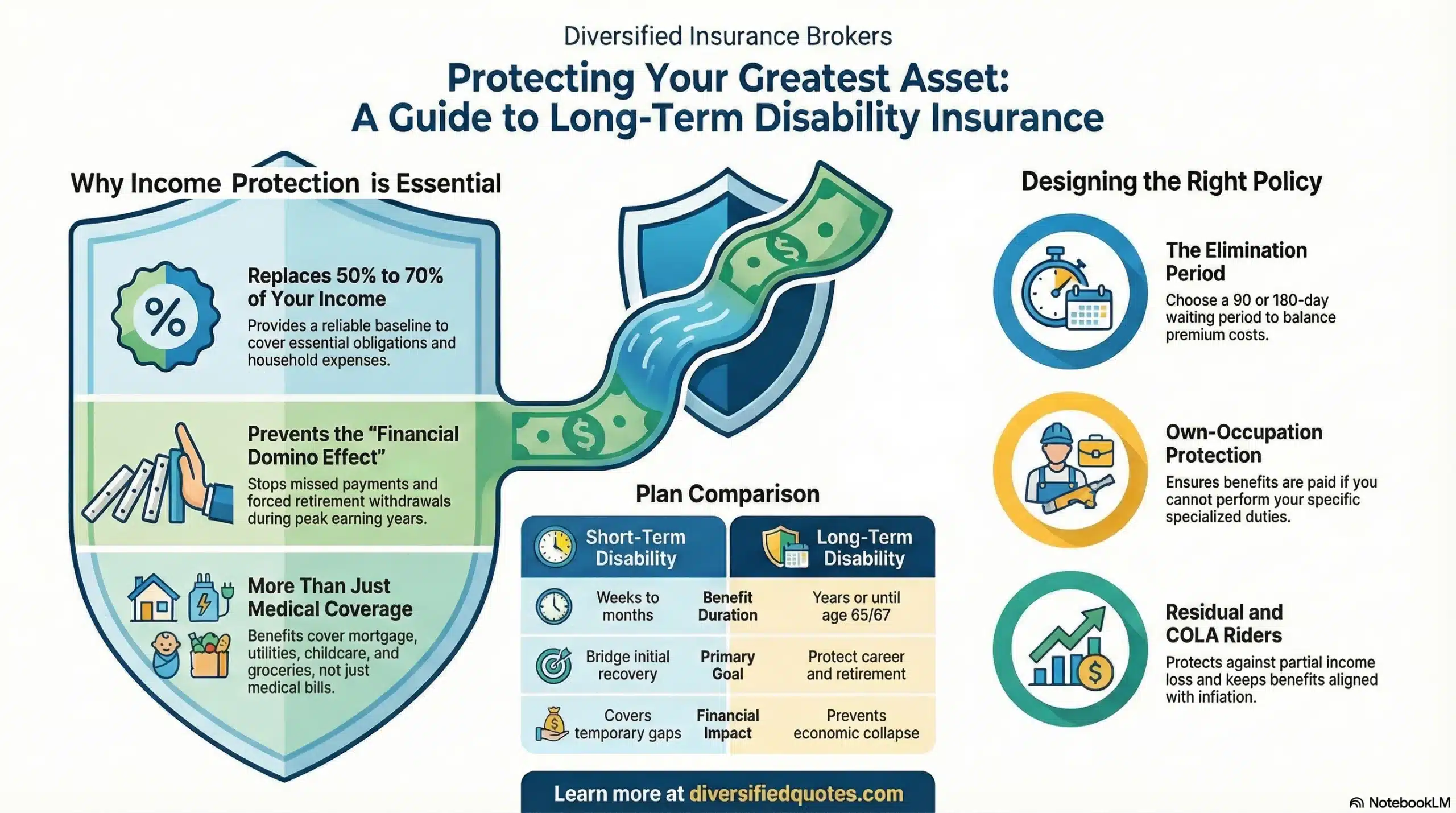
The residual disability rider is particularly important for acupuncturists because many real-world disability scenarios involve reduced patient capacity rather than complete inability to practice. A carpal tunnel condition that limits daily needle sessions from eight patients to four — cutting income by 50% while the practitioner manages symptoms through modified scheduling — is not total disability, but it produces a real and significant income loss. Without residual coverage, that period produces no benefit. With it, benefits are proportional to the income loss. The elimination period for a self-employed acupuncturist without employer benefit backup should be calibrated against available personal savings — there is no employer short-term disability to bridge the initial weeks, making the 90-day period appropriate only when cash reserves can sustain three months of household and practice expenses without income. The benefit period for primary coverage should extend to retirement age — long-term disability insurance with a to-age-65 or to-age-67 benefit period protects the full remaining career horizon against permanent or extended conditions. The cost-of-living adjustment rider protects long-duration benefit purchasing power, and the full rider framework is at disability insurance riders explained. The tax advantage of benefits from individually owned policies paid with after-tax dollars — generally received income-tax-free — is covered at are disability insurance payments taxable, and the benefit sizing process for self-employed acupuncturists with variable income is at how much disability insurance do I need. For acupuncturists wondering whether a medical exam is required as part of the application process, does disability insurance require a medical exam covers the underwriting process and when simplified issue options are available. Working with an independent disability insurance broker provides the carrier comparison access that matters in a specialized market, and get a 2nd opinion on your disability insurance quote covers the review process for acupuncturists evaluating existing coverage.
Talk With an Advisor Today
Choose how you’d like to connect—call or message us, then book a time that works for you.
Schedule here:
calendly.com/jason-dibcompanies/diversified-quotes
Licensed in all 50 states • Fiduciary, family-owned since 1980
FAQs: Disability Insurance for Acupuncturists
Why is own-occupation disability coverage especially important for acupuncturists?
Acupuncture requires manual precision at a level where even modest impairment in fine motor control, hand steadiness, or tactile sensitivity makes safe needle placement impossible. A carpal tunnel condition, hand tremor, wrist injury, or neurological issue that prevents accurate needle work ends clinical practice — but the practitioner may remain capable of teaching, consulting, or administrative work. Under an any-occupation disability policy, that remaining work capability provides grounds for benefit denial. True own-occupation coverage pays benefits when you cannot perform the material duties of acupuncture specifically — needle placement, patient assessment, and treatment administration — regardless of whether other types of work remain possible.
What are the most common disabilities that affect acupuncturists?
Carpal tunnel syndrome — from the repetitive precision wrist and hand motions performed across multiple patient sessions daily — is one of the most consistent occupational conditions for acupuncturists. Tendinitis affecting the wrists, hands, or forearms develops from the same repetitive motion profile. Ergonomic strain producing back, neck, and shoulder pain arises from the prolonged positioning and bending required during treatment. Any condition affecting fine motor control — including neurological conditions, nerve injuries, and chronic pain affecting hand sensitivity — can compromise the manual precision acupuncture requires. These conditions often develop gradually as cumulative overuse injuries rather than acute events.
Do acupuncturists need both personal disability insurance and business overhead expense coverage?
For acupuncturists who own or operate their own clinic — which describes most acupuncture practitioners — yes. A personal LTD policy replaces household income when clinical work stops. A Business Overhead Expense policy covers documented fixed practice costs — clinic rent, professional liability insurance, supplies, staff wages, licensing, software — that continue regardless of whether the owner is seeing patients. These two policies solve two completely different problems. Using personal disability income to cover practice overhead leaves both the household and the practice underfunded. Structuring both together creates complete protection during a disability period for self-employed practitioners.
How is income documented for disability insurance when you are self-employed?
Self-employed acupuncturists document income through Schedule C on personal tax returns. Carriers typically require two to three years of returns to establish an average monthly income baseline for benefit sizing. Variable income from year to year is averaged rather than sized to peak earnings. Business structure matters — a sole proprietor documents differently than an S-corporation or LLC. Having organized income documentation before submitting an application streamlines underwriting and ensures the benefit amount accurately reflects actual financial exposure rather than an arbitrary estimate.
Is a medical exam required to apply for disability insurance as an acupuncturist?
It depends on the benefit amount requested, the carrier, and the applicant’s health history. For lower benefit amounts or through programs that offer simplified underwriting, a medical exam may not be required. For larger benefit amounts or with carriers requiring full underwriting, a paramedical exam — blood draw, urinalysis, and basic health measurements — is typically required. Health history disclosures are required regardless of whether a physical exam is needed. The application process and when exams are required is covered in detail at the disability insurance underwriting process resource, and an independent broker can identify which carriers offer the most streamlined process for a given benefit amount and health profile.
About the Author:
Jason Stolz, CLTC, CRPC, DIA, CAA and Chief Underwriter at Diversified Insurance Brokers (NPN 20471358), is a senior insurance and retirement professional with more than 25 years of real-world experience helping individuals, families, and business owners protect their income, assets, and long-term financial stability. As a long-time partner of the nationally licensed independent agency Diversified Insurance Brokers, Jason provides trusted guidance across multiple specialties—including fixed and indexed annuities, long-term care planning, personal and business disability insurance, life insurance solutions, Group Health, Travel Medical and Evacuation Insurance, and short-term health coverage. Diversified Insurance Brokers maintains active contracts with over 100 highly rated insurance carriers, ensuring clients have access to a broad and competitive marketplace.
His practical, education-first approach has earned recognition in publications such as VoyageATL, and contributions from his agency featured in Kiplinger and GoBankingRates— highlighting his commitment to financial clarity and client-focused planning. Drawing on deep product knowledge and years of hands-on field experience, Jason helps clients evaluate carriers, compare strategies, and build retirement and protection plans that are both secure and cost-efficient. Visitors who want to explore current annuity rates and compare options across multiple insurers can also use this annuity quote and comparison tool.
Explore More Disability Insurance Options: Browse our complete guide to Disability Insurance for Nursing, Therapy & Allied Health — covering nurses, therapists, dental hygienists, pharmacists, lab techs & allied health professionals from 100+ carriers.
Last Reviewed: June 6, 2026 |
Reviewed by: Jason Stolz, CLTC, CRPC, DIA, CAA
Chief Underwriter, Diversified Insurance Brokers, Inc. | NPN: 20471358 | Diversified Insurance Brokers, Inc. — Licensed in all 50 states
Fact Checked by: Tonia Pettitt, CMIP©
Medicare Specialist, Diversified Insurance Brokers, Inc. | NPN: 14374308 | Diversified Insurance Brokers, Inc. — Licensed in all 50 states
Did you find this content helpful? Leave us a Google review — it helps others find trustworthy guidance too.
Editorial Standards: Diversified Insurance Brokers maintains rigorous editorial standards to ensure accuracy, clarity, and independence in all content. Learn more about our editorial standards and commitment to transparency.
