
Disability Insurance for Optometrists
As an Independent Disability Insurance Broker, we have access to exclusive discounts and negotiated pricing most captive agents can’t offer — see the full breakdown near the end of this page.
Disability Insurance for Optometrists

Jason Stolz CLTC, CRPC, DIA, CAA
Disability insurance for optometrists is income protection for a healthcare profession that sits at the front line of American vision care — one that the Bureau of Labor Statistics projects will grow 8 percent from 2024 to 2034, much faster than the average for all occupations, and that encompasses approximately 41,000 practicing doctors of optometry who examine eyes, diagnose and manage visual system conditions, prescribe corrective lenses and contact lenses, and in many states treat ocular disease with therapeutic pharmaceuticals. Optometrists earned a median annual wage of $134,830 in May 2024 according to BLS data, with private practice owners averaging $255,000 and above according to industry surveys, and partnership or group practice owners averaging $315,000. They complete four years of undergraduate education and four years of optometry school — many also completing one-year residencies — before practicing independently. Unlike physicians, most optometrists enter independent practice without the hospital-based employment that provides group disability benefits, and many assume immediate business ownership and the full financial obligations of practice operations. When a disability prevents an optometrist from practicing — a hand or upper extremity condition from the sustained precision of contact lens fitting and tonometry, a neck or back condition from sustained slit lamp and examination posture, a visual condition that the specialty would otherwise help treat, or any other medical event requiring extended recovery — income stops, often alongside a practice whose overhead continues generating obligations regardless of whether the OD can see patients.
At Diversified Insurance Brokers, we help optometrists across every practice setting and career stage — employed ODs at commercial and corporate practices, hospital and health system employed optometrists, private practice owners and partners, and optometry students approaching the transition to independent practice — structure disability insurance coverage that reflects the specific clinical and occupational demands of optometric practice and provides own-occupation income protection calibrated to the educational investment and income level their OD degree represents. Our resource on what is the primary reason people buy disability insurance provides the financial case for income protection that applies to optometrists with particular force given the combination of student debt, private practice ownership, and the absence of institutional safety nets for many ODs.
Get Disability Insurance Quotes for Optometrists
We compare carriers, explain how OD occupational classifications work, and structure policies built for the income levels and practice realities of optometric practice.
What Optometrists Do — and the Disability Risk Hidden in the Clinical Routine
The optometrist’s clinical day is built around examination procedures that create a physical demand profile more specific and consequential for disability planning than the comfortable, controlled appearance of an optometry practice might suggest. A comprehensive eye examination involves sustained slit lamp biomicroscopy — positioning the patient’s face in the chin rest, aligning the slit beam through precise manual control, and maintaining the binocular microscope viewing posture while performing detailed anterior segment evaluation. It involves non-contact tonometry, pachymetry, visual field testing supervision, dilated fundus examination with indirect ophthalmoscope and contact lens techniques, and refraction requiring the sustained hand-held lens manipulation and patient communication that produces the spectacle prescriptions driving most optometric income. Contact lens fitting adds the precision of lens parameter selection, the manual dexterity of lens insertion and removal instruction, and the slit lamp evaluation of contact lens fit across its full optical zone. In ODs with therapeutic pharmaceutical prescribing authority — now available in all 50 states — the clinical scope extends to managing glaucoma suspects, dry eye disease, red eye conditions, and ocular surface disorders that require both diagnostic precision and pharmacological knowledge.
The sustained forward flexion posture of slit lamp work — positioned over the instrument with the examining OD’s face slightly forward and the hands controlling the joystick and beam controls — creates the ergonomic exposure that produces neck and upper back conditions in optometrists who perform examinations across a full patient schedule every working day for years. The hand and wrist demands of sustained refraction, tonometry, and lens manipulation accumulate the repetitive fine motor loading that produces the upper extremity conditions documented in clinical professions requiring sustained precision. Published ergonomic research on dental and clinical healthcare professions documents the musculoskeletal consequences of sustained examination posture — and optometric practice shares the postural demands of other instrument-based clinical disciplines in ways that make the OD’s occupational health profile more demanding than the profession’s office-based appearance suggests. For context on how other instrument-based healthcare professions approach disability planning around ergonomic occupational risks, our resource on disability insurance for dental hygienists provides parallel perspective on clinical professions where sustained precision posture creates cumulative musculoskeletal risk.
The Ironic Visual Risk: The Optometrist Whose Vision Changes
The most distinctively optometry-specific disability risk is one that the specialty itself treats in its patients: visual conditions that affect the optometrist’s own clinical performance. An optometrist who develops a significant change in their own binocular vision, a scotoma affecting their visual field, or a condition altering the stereopsis that clinical examination and contact lens fitting rely on faces a professional disability specific to a specialty whose clinical work requires specific visual capabilities. The slit lamp examination that requires binocular control, the indirect ophthalmoscopy that requires spatial judgment, and the refraction that requires subjective visual reference all depend on the OD’s own visual system functioning at a clinical level.
This ironic risk — the eye care professional whose clinical work is affected by a change in their own visual system — is not the most common disability scenario for optometrists, but it is the most specialty-specific. The more common disability pathways for ODs are the general health events that affect all working-age professionals — cardiovascular events, cancer diagnoses, serious injury, and the musculoskeletal conditions that sustained clinical work produces — alongside the specific ergonomic conditions from optometric examination posture. Individual disability insurance covers qualifying disability from any cause regardless of origin, addressing the full range of health events that can prevent an optometrist from practicing. Our resource on own-occupation disability insurance explained covers how the OD’s specific clinical duties define disability under an own-occupation policy — ensuring that conditions preventing optometric practice specifically are recognized as disabling regardless of what other activities the OD could theoretically perform.
Private Practice ODs: The Self-Employment Disability Exposure
The optometry profession has a substantially higher rate of private practice ownership than most healthcare professions — industry surveys consistently show that the majority of survey respondents work in private practice settings, and that private practice ownership dramatically increases optometrist income, with practice owners averaging $255,000 and partners averaging $315,000 versus employed ODs averaging $154,963 according to Review of Optometry data. This private practice prevalence means that a large fraction of the optometry profession faces the self-employed disability exposure: when the practice-owning OD cannot see patients, not only does the OD’s personal income stop, but the practice’s revenue drops while its fixed costs continue.
An optometry practice carries overhead that runs every day regardless of whether the OD is in the exam lane: office lease payments, equipment financing for plenoptic cameras, OCT instruments, visual field analyzers, and phoropters; dispensary inventory and frame costs; staff salaries for opticians, technicians, and front desk personnel; frame and contact lens vendor accounts; electronic health record and practice management system costs; and professional liability insurance premiums. When the OD cannot practice, these costs accumulate against a business generating reduced revenue. Business overhead expense disability insurance covers these practice costs during the disability period — preserving the staff, the lease, and the practice infrastructure that years of patient relationships and professional investment have built. Our resource on disability business overhead expense coverage explains how these policies work for optometry practice owners. For ODs documenting self-employment income from Schedule C for disability underwriting, our resource on disability insurance for the self-employed covers the income documentation and benefit structuring considerations specific to practice-owning ODs.
Employed ODs: Group Coverage Gaps at the Corporate and Health System Level
ODs employed at corporate optometry locations — LensCrafters, Target Optical, Walmart Vision Centers, and similar retail-adjacent practices — or at health systems and hospital-employed vision clinics have access to employer group disability benefits through those employment relationships. These plans leave the standard structural gaps for ODs at every income level. The income gap: a corporate-employed OD earning $140,000 annually with a group plan replacing 60 percent of base salary generates approximately $84,000 in benefits while household obligations, student loan payments from optometry school, and living expenses continue at full pre-disability levels — leaving approximately $56,000 per year unprotected. The definition gap: many group plans convert from own-occupation to any-occupation definitions after 24 months, potentially denying benefits to an OD whose neck condition prevents sustained slit lamp examination while leaving some sedentary capacity intact. The portability gap: corporate employment group coverage ends when employment ends — an OD who leaves LensCrafters to open a private practice loses group coverage at exactly the career transition when business ownership creates the greatest financial vulnerability and when new individual underwriting may face conditions that have accumulated during employed practice years.
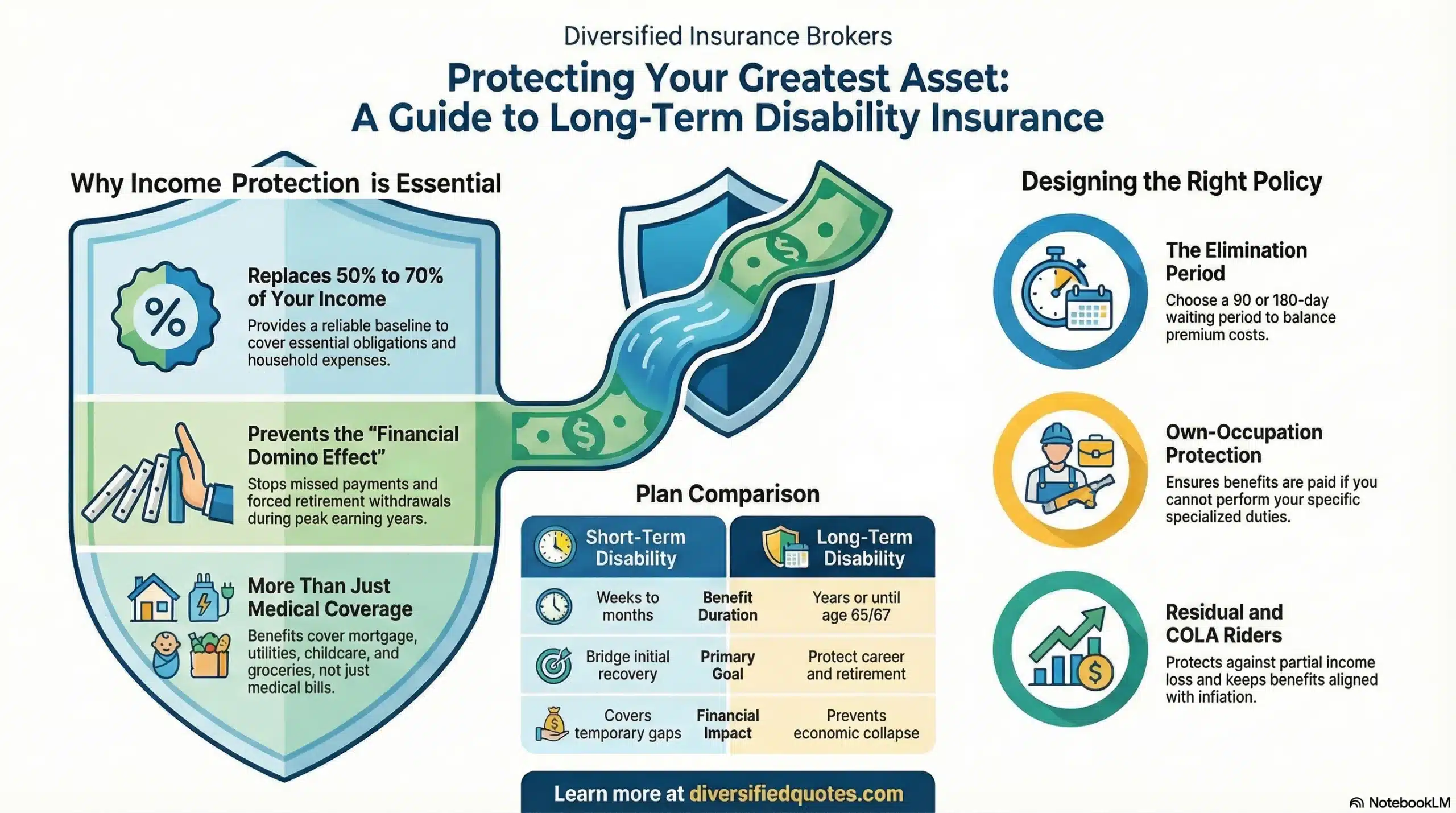
Individual own-occupation disability insurance purchased while young and healthy — before occupational ergonomic conditions from sustained slit lamp posture have accumulated in the medical record — travels through every career transition, maintains non-cancellable terms, and grows through future increase options as practice ownership increases income above the employed OD level. Our resource on short-term vs. long-term disability insurance covers how different coverage durations address different disability scenarios for ODs at every career stage.
Case Study — Private Practice OD, Neck Condition From Slit Lamp Posture
Consider a private practice optometrist eight years into practice, examining 25 patients per day four days per week, earning $245,000 annually with no employer group disability plan and a practice generating $380,000 in annual revenue against $135,000 in fixed overhead. After developing cervical disc herniation requiring surgical intervention — attributed by their spine surgeon to years of sustained forward head posture during slit lamp examination — this OD cannot return to examining patients for a six-month recovery period and faces restrictions on sustained neck flexion for the following three months. The table below illustrates the financial stakes.
| Scenario | No Individual Disability Coverage | Individual Policy + BOE in Place |
|---|---|---|
| Personal Income During Disability | $0 — no patients seen, no OD professional service income; practice produces no profit without the OD | Approximately $12,250–$14,292 per month from individual own-occupation policy; 60–70% of $245K documented income |
| Practice Overhead During Disability | $11,250/month in fixed overhead continues; staff wages, lease, equipment costs accumulate against zero professional service revenue | BOE policy covers fixed overhead during disability; staff retained, lease current, practice infrastructure preserved |
| Six-Month Financial Impact | $67,500 in unmet overhead + $122,500 in lost personal income = $190,000 financial shortfall absorbed from savings or credit | Individual policy covers personal income; BOE covers overhead; household and practice remain financially stable |
| Practice Viability at Return | Staff may have left for other positions; equipment financing possibly past due; patient base partially lost to competitor practices during absence | BOE-funded practice returns the OD to a stable, staffed practice that maintained patient relationships during absence |
Cervical disc conditions from sustained slit lamp examination posture are the most specifically optometry-related occupational musculoskeletal disability scenario — a condition arising from the core clinical activity that generates optometric income, occurring in an OD whose disability has both household and practice financial consequences. Individual own-occupation coverage combined with business overhead expense protection provides the comprehensive financial protection that each exposure requires separately. Our resource on how residual disability benefits work covers how proportional benefits function when an OD can return to limited patient activity before resuming a full examination schedule.
Key Policy Features for Optometrists
The own-occupation definition is the most consequential policy feature for optometrists, protecting the specific clinical duties of optometric examination — slit lamp biomicroscopy, refraction, contact lens fitting, tonometry, and ophthalmic pharmaceutical management — regardless of whether the OD could theoretically perform other types of work. A neck condition preventing sustained slit lamp posture qualifies as own-occupation disability even when the OD can sit at a desk or drive normally. Without this definition, a group plan converting to any-occupation at 24 months could eliminate benefits for an OD whose ergonomic condition prevents optometric examination while leaving sedentary capacity intact. Non-cancellable and guaranteed renewable provisions lock in policy terms for the full benefit period regardless of subsequent health changes — essential for optometrists who may practice for 30 years after securing coverage. The future increase option allows income growth through practice ownership, partnership, and associate practice expansion to be reflected in benefit amounts without new underwriting. Our resource on the disability insurance future insurability rider explains how this works for optometrists at every stage of practice development. A residual disability rider provides proportional benefits when an OD can see a reduced patient schedule while still unable to sustain a full examination day — important for the partial recovery scenarios that neck or upper extremity conditions commonly produce.
When to Apply — The Student and New Graduate Window
The optimal disability insurance application window for optometrists is during optometry school or immediately upon entering first OD employment — before any health conditions from clinical training or practice have been documented, at the youngest available application age, and with access to student discount or new graduate program terms that some carriers make available through optometry school associations. Many optometry schools and state optometric associations have negotiated program access that provides favorable coverage terms to students and new graduates. An OD who applies during the fourth year of optometry school or in the first year of practice secures comprehensive own-occupation coverage that travels through every subsequent career transition — from employed associate position to private practice ownership to partnership — at terms that cannot be revisited by the carrier. For ODs who already have some documented health history, our resource on disability insurance with preexisting conditions covers what options remain available. For ODs asking what the application process involves, our resource on does disability insurance require a medical exam explains what individual disability underwriting entails.
Why Independent Broker Access Matters for OD Coverage
Not every disability insurance carrier classifies optometry occupational profiles with equal sophistication, and the distinction between an employed OD at a corporate practice, a private practice owner with substantial business overhead, and a group practice partner with both personal and equity interests requires different policy structures that single-carrier applications frequently do not address comprehensively. At Diversified Insurance Brokers, we evaluate options across multiple carriers for every optometrist we serve — understanding how to present the specific clinical duties of optometric examination to underwriters, how to document private practice and corporate employment income accurately for benefit calculations, and how to structure own-occupation definitions, business overhead expense coverage, and future increase options that produce genuinely comprehensive income protection for the specific OD’s practice structure and career stage. Our resource on why independent disability insurance brokers matter explains the full value of this approach for healthcare professionals whose coverage needs require expertise to address properly.
Related Disability Insurance Pages
Talk With an Advisor Today
Choose how you’d like to connect—call or message us, then book a time that works for you.
Schedule here:
calendly.com/jason-dibcompanies/diversified-quotes
Licensed in all 50 states • Fiduciary, family-owned since 1980
Disability Insurance for Optometrists — FAQs
The most common disability pathways for optometrists span general health events alongside the specific ergonomic conditions that optometric examination posture produces. For general health events — cardiovascular conditions, cancer, serious injury, serious illness requiring extended recovery — individual disability insurance provides the same protection it does for any working professional, replacing income when any qualifying medical condition prevents practice. For optometry-specific occupational risks, the sustained examination posture of slit lamp biomicroscopy is the most documented source: forward head posture during extended periods of slit lamp examination, sustained neck flexion, and the upper extremity demands of refraction, tonometry, and contact lens work create the cumulative musculoskeletal loading that produces cervical and upper extremity conditions in clinical instrument-based professions. An OD whose neck condition prevents the sustained slit lamp posture that comprehensive eye examination requires has experienced a genuine own-occupation disability specifically tied to the clinical demands of their profession. The most distinctively optometry-specific risk — though not the most common — is a change in the OD’s own visual system that affects the clinical examination capabilities the profession requires. Individual own-occupation disability insurance covers qualifying disability from any of these causes regardless of origin.
Private practice ownership creates two distinct disability exposures that employed ODs do not face. First, there is no employer sick pay, no group disability plan, and no institutional income bridge of any kind — when a practice-owning OD cannot see patients, personal income stops immediately with nothing standing behind it. Second, the practice generates fixed overhead costs that continue during disability regardless of whether the OD is examining patients: staff wages, lease payments, equipment financing, technology costs, and professional liability insurance premiums all continue accumulating against a practice generating reduced or zero professional service revenue. A personal income replacement disability policy addresses the first problem — replacing personal income during the disability period. A business overhead expense disability policy addresses the second — covering the practice’s fixed costs during the OD’s absence and preserving the operational infrastructure that patient relationships and professional investment have built. Practice-owning ODs who have only personal income replacement coverage face the scenario where their household needs are covered but their practice’s lease, staff, and equipment obligations are draining savings simultaneously. Both coverage types together provide the comprehensive protection that practice ownership requires.
Disability insurance premiums for optometrists reflect the favorable occupational classification that most disability insurance carriers assign to the OD credential — a professional clinical classification that is more favorable than manual or high-physical-demand occupations. Generally, an optometrist can expect to pay approximately 2 to 4 percent of the monthly benefit amount as an annual premium for a comprehensive own-occupation policy with a 90-day elimination period, depending on the carrier, age at application, gender, benefit period selected, and any applicable riders. For a $5,000 monthly benefit on a policy purchased at age 30, premiums might range from approximately $1,200 to $2,400 annually. For a $10,000 monthly benefit, the range scales proportionally. Applying earlier in the career — during optometry school or first employment — captures lower premiums that remain fixed for a non-cancellable policy. Our resource on how much disability insurance costs provides realistic premium ranges that allow optometrists to budget for coverage before beginning the application process.
Yes — the structural gaps in corporate employment group coverage create meaningful income protection shortfalls at every OD income level. Group disability plans typically replace 60 percent of base salary with monthly benefit caps that for ODs earning $130,000 to $160,000 at corporate settings leave approximately $52,000 to $64,000 per year in unprotected income while student loan payments and household obligations continue at full levels. Many group plans convert to any-occupation or modified disability definitions after 24 months, potentially denying benefits to an OD whose neck or upper extremity condition prevents optometric examination while leaving some sedentary capacity intact. And corporate employment group coverage ends when employment ends — an OD who leaves a corporate setting to open a private practice loses coverage at the moment that practice ownership creates the greatest financial vulnerability, and must apply for new individual coverage at an older age with any conditions documented during prior corporate employment years. Individual own-occupation coverage purchased while young and healthy — even while corporate employment provides group coverage — is portable through every career transition and maintains the terms secured at the original application age regardless of subsequent health developments.
Optometry school debt — which commonly ranges from $150,000 to $300,000 or more for graduates of four-year optometry programs — continues generating monthly repayment obligations during a disability regardless of whether the OD is generating income from practice. Income-driven repayment plans adjust payments based on reported income, which provides some flexibility, but even reduced payments under IDR plans continue representing financial obligations. Standard repayment plans require scheduled monthly payments regardless of income disruption. For ODs carrying significant optometry school debt alongside practice financing or personal financial obligations, disability insurance benefit sizing must explicitly account for monthly loan service obligations — not just housing and living expenses — to provide genuine income replacement that covers all actual monthly financial commitments. An OD whose individual disability benefit covers housing and living expenses but not student loan payments still faces a meaningful financial gap during a disability period. Sizing benefits to cover total monthly obligations, not just a percentage of gross income, is the practical planning goal that produces genuinely adequate protection for optometrists with substantial educational debt.
Optometrists typically receive occupational classifications from disability insurance carriers that are favorable — reflecting the primarily clinical, office-based, and professional nature of optometric practice — though typically one tier below the physician-equivalent classification that MDs and DOs receive from most carriers. This difference reflects the insurance industry’s recognition of the OD credential as a doctoral-level healthcare profession while maintaining a distinction from the MD/DO physician category that most policy forms are specifically written for. The practical consequence is that optometrists generally have access to strong own-occupation policy terms — including own-occupation definitions, non-cancellable provisions, and comprehensive rider selections — at premium rates that are somewhat higher than comparable physician coverage. The occupational classification favorable enough to allow comprehensive own-occupation coverage, combined with the OD’s professional income level and student debt obligations, makes individual disability insurance a straightforward planning decision for most optometrists even if the specific premium rates differ from the physician disability market. Some carriers treat ODs at the same classification tier as physicians; others maintain a distinction. An independent broker who works across multiple physician and professional disability carriers can identify which carriers offer the most favorable classification and terms for optometrists specifically.
The best time is during optometry school — fourth year if possible — or immediately upon entering first OD employment after graduation. Applying during school or at career entry secures coverage at the youngest available age, capturing the lowest available premium on a non-cancellable policy whose rates are then fixed for the full benefit period regardless of subsequent age or health changes. It also secures coverage before the neck and upper extremity conditions that sustained slit lamp examination and clinical instrument work produce have appeared in the medical record — conditions that, once documented, can result in exclusion riders eliminating protection for exactly the most likely optometry-specific disability scenarios. Some optometry schools and state optometric associations have negotiated program access that provides favorable terms to students and new graduates, making the school or graduation window even more advantageous for ODs aware of these programs. The optometry student who applies during fourth year, uses the future increase option as practice income grows from employed associate to private practice owner, and maintains comprehensive own-occupation coverage through the career has achieved the most complete disability protection available — and at the lowest lifetime cost for the coverage secured.
About the Author:
Jason Stolz, CLTC, CRPC, DIA, CAA and Chief Underwriter at Diversified Insurance Brokers (NPN 20471358), is a senior insurance and retirement professional with more than 25 years of real-world experience helping individuals, families, and business owners protect their income, assets, and long-term financial stability. As a long-time partner of the nationally licensed independent agency Diversified Insurance Brokers, Jason provides trusted guidance across multiple specialties—including fixed and indexed annuities, long-term care planning, personal and business disability insurance, life insurance solutions, Group Health, Travel Medical and Evacuation Insurance, and short-term health coverage. Diversified Insurance Brokers maintains active contracts with over 100 highly rated insurance carriers, ensuring clients have access to a broad and competitive marketplace.
His practical, education-first approach has earned recognition in publications such as VoyageATL, and contributions from his agency featured in Kiplinger and GoBankingRates— highlighting his commitment to financial clarity and client-focused planning. Drawing on deep product knowledge and years of hands-on field experience, Jason helps clients evaluate carriers, compare strategies, and build retirement and protection plans that are both secure and cost-efficient. Visitors who want to explore current annuity rates and compare options across multiple insurers can also use this annuity quote and comparison tool.
Explore More Disability Insurance Options: Browse our complete guide to Disability Insurance for Physicians & Medical Specialists — covering physicians, surgeons, anesthesiologists, radiologists, podiatrists & medical specialists from 100+ carriers.
Last Reviewed: September 21, 2026 |
Reviewed by: Jason Stolz, CLTC, CRPC, DIA, CAA
Chief Underwriter, Diversified Insurance Brokers, Inc. | NPN: 20471358 | Diversified Insurance Brokers, Inc. — Licensed in all 50 states
Fact Checked by: Tonia Pettitt, CMIP©
Medicare Specialist, Diversified Insurance Brokers, Inc. | NPN: 14374308 | Diversified Insurance Brokers, Inc. — Licensed in all 50 states
Did you find this content helpful? Leave us a Google review — it helps others find trustworthy guidance too.
Editorial Standards: Diversified Insurance Brokers maintains rigorous editorial standards to ensure accuracy, clarity, and independence in all content. Learn more about our editorial standards and commitment to transparency.
